
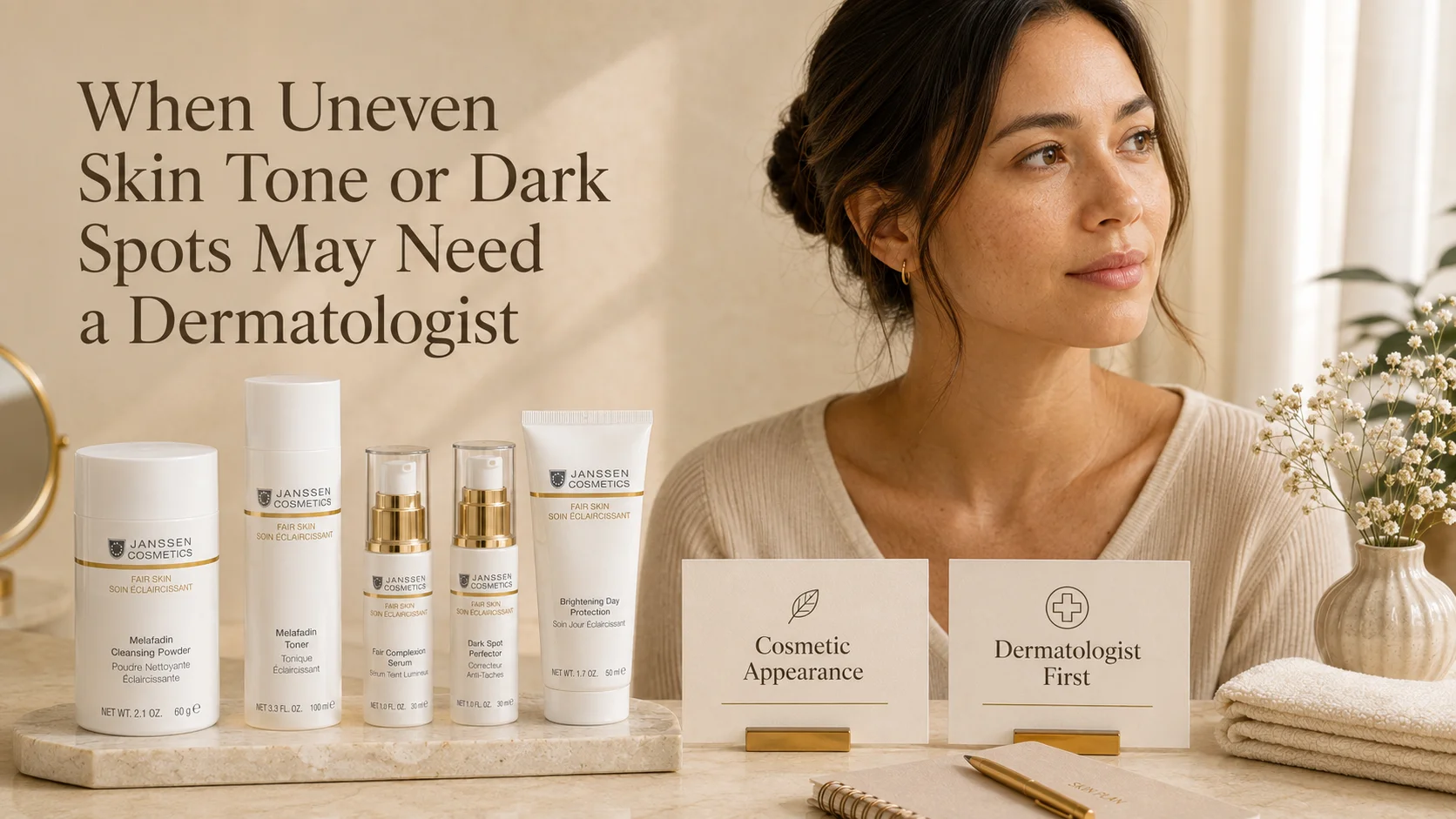
Uneven-looking skin tone is often a cosmetic concern.
It may appear as dullness, patchiness, post-blemish marks, dark spot appearance, sun-related unevenness, dryness, or rough texture. In many cases, a consistent skincare routine can help support the look of a more even-looking complexion.
But not every mark should be handled with skincare alone.
Some spots, patches, or skin changes need a dermatologist.
At Zendevie, we do not diagnose skin conditions or tell clients to treat medical-looking concerns with cosmetic products. In consultation, our licensed esthetician can help review your skincare routine, SPF habits, irritation, dryness, sensitivity, and cosmetic concerns. But if a mark looks unusual, changes, bleeds, crusts, hurts, itches severely, appears suddenly, or worsens quickly, a dermatologist should evaluate it.
Skincare can support appearance.
Medical-looking changes need medical evaluation.
Uneven-looking tone or dark spot appearance may need a dermatologist if a spot is new, changing, growing, bleeding, crusting, painful, severely itchy, irregular-looking, very different from other marks, or not healing. The American Academy of Dermatology advises seeing a dermatologist for new spots, spots that look different from others, or spots that are changing, itching, or bleeding.
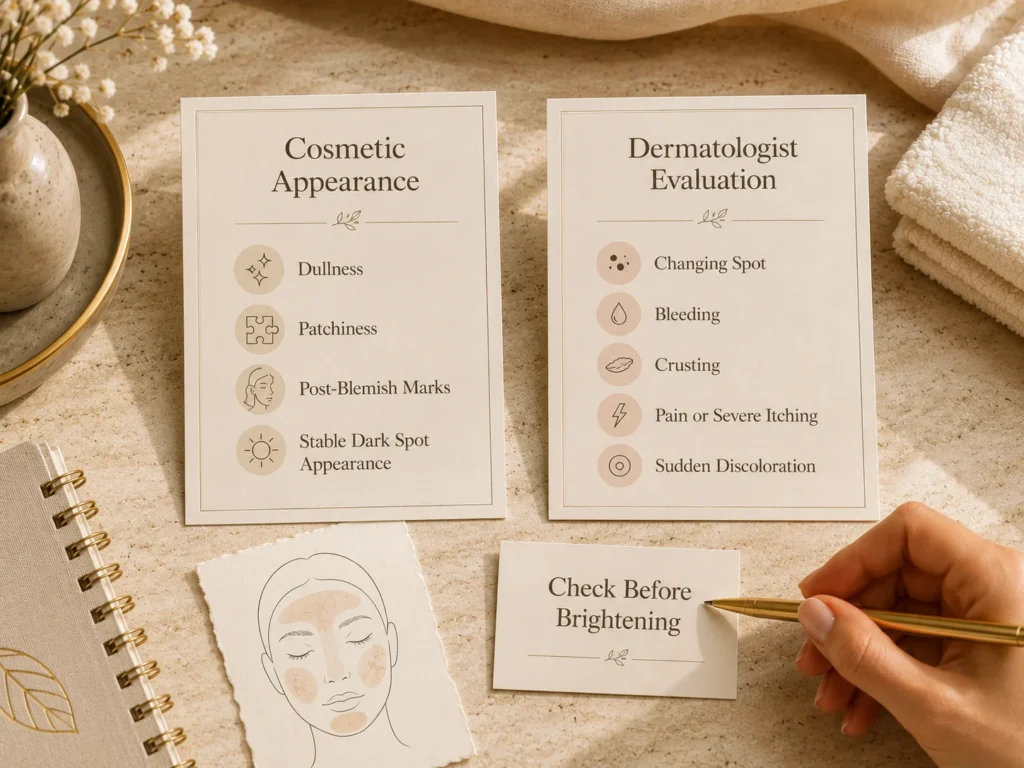
Cosmetic skincare may support appearance when the concern looks like:
A dermatologist should evaluate concerns such as:
When in doubt, do not guess.
Get the area checked.
Cosmetic uneven tone usually refers to the appearance of the complexion.For terminology, review the difference between uneven skin tone and hyperpigmentation before treating a clinical-looking concern as a cosmetic one.
It may look like:
Medical-looking skin changes may involve symptoms or changes that should not be treated with cosmetic products first.
These may include:
Cosmetic skincare is not a substitute for medical evaluation.
The difference matters because a brightening-support routine is designed to support appearance.
It is not designed to diagnose a mark, identify a skin disease, or decide whether a changing spot is harmless.
A cosmetic routine may include:
But if a spot is changing, bleeding, crusting, painful, or unusual, the first step should be a dermatologist.
Not a stronger serum.
Dark spot appearance may be cosmetic when it is stable, familiar, and related to visible lifestyle or skin history factors such as:
Even then, the routine should be gentle and SPF-focused.
Do not scrub dark spot appearance.
Do not use several active products at once.
Do not skip SPF.
A dark spot should be checked if it is changing, new, bleeding, crusting, painful, growing, irregular-looking, or different from other spots.
The American Cancer Society notes that unusual moles, sores, lumps, blemishes, markings, or changes in how an area of skin looks or feels may be a warning sign of skin cancer or another concern.
This does not mean every dark spot is dangerous.
It means changing or unusual marks deserve professional medical evaluation.
A new spot does not automatically mean something serious.
But new spots should be observed carefully, especially if they look unusual or different from the rest of the skin.
A dermatologist should evaluate a new spot if it:
Do not try to lighten or exfoliate a new, unusual spot before getting it checked.
A changing spot should not be handled with cosmetic skincare alone.
Changes may include:
The American Academy of Dermatology lists changing moles, spots that look like a new mole or age spot but look different from others, growing spots, firm dome-shaped growths, and sores that may bleed among melanoma warning signs.
If something is changing, it deserves attention.
A spot that looks different from the rest of your marks is sometimes called the “ugly duckling” idea.
It may stand out because it is:
If one mark looks different from all the others, do not treat it as a simple cosmetic spot.
Have it checked.
A spot that bleeds or crusts should be evaluated.
Do not exfoliate it.
Do not apply acids to it.
Do not use a brightening serum on it.
Do not pick it.
Do not cover it with strong products and wait.
Bleeding, crusting, or oozing skin needs medical attention, especially if it does not heal or keeps returning.
A sore that does not heal should be checked.
This includes areas that:
The American Cancer Society lists a sore that bleeds or does not heal after several weeks among signs that should be evaluated.
Do not keep applying cosmetic products to a non-healing sore.
A spot or patch that is severely itchy, painful, tender, or uncomfortable should be checked.
Cosmetic uneven-looking tone usually should not cause strong pain or persistent severe itching.
Seek dermatologist guidance if an area:
Do not keep using active products on painful or severely itchy skin.
Sudden discoloration should be evaluated, especially if it appears quickly or looks unusual.
Sudden changes may look like:
Cosmetic skincare should not be the first response to sudden unexplained discoloration.
Uneven tone can sometimes be confused with rash-like irritation.
A rash-like area may look:
If the area looks rash-like, do not treat it as a dark spot.
A dermatologist can help identify what is happening.
If an area looks infection-like, cosmetic skincare should stop.
Warning signs may include:
Do not apply brightening products, exfoliants, acids, or retinol-style products to infection-looking skin.
Seek medical care.
The eye area is delicate.
A dermatologist or medical provider should evaluate changes near the eyes if there is:
Do not apply strong brightening products, acids, retinol-style products, or exfoliants near the eye unless the product is made for that area and tolerated.
Post-blemish marks after picking are common, but picked skin can become irritated or damaged.
Seek dermatologist guidance if a picked area becomes:
Do not apply active products to broken or freshly picked skin.
Post-blemish mark appearance may be a cosmetic concern when the blemish has fully calmed and the skin is closed.
A gentle routine may include:
Morning: Gentle cleanser → serum if appropriate → moisturizer → SPF
Evening: Gentle cleanser → moisturizer
But if the blemish area is still open, painful, crusted, bleeding, or infected-looking, do not treat it as a tone concern.
Let it be evaluated if needed.
Sun exposure can make uneven-looking tone appear more noticeable.
If the skin simply looks more uneven after sun exposure, return to gentle basics:
Morning: Gentle cleanser → moisturizer → SPF
Evening: Gentle cleanser → moisturizer
But if the area is blistered, severely burned, swollen, painful, oozing, or not healing, seek medical care.
Do not exfoliate sun-irritated skin.
Some people notice patchy brown-looking or gray-brown-looking areas on the face.
This may look like melasma, but Shop Zendevie does not diagnose melasma.
The American Academy of Dermatology notes that melasma can appear as blotchy patches and freckle-like spots, and the color can vary by skin tone.
If you suspect melasma or have persistent patchy discoloration, a dermatologist can help identify what is happening and what options may be appropriate.
Some dark spot appearance may look like age spots or sun spots.
But not every brown spot is the same.
The American Academy of Dermatology notes that some brown spots that look like age spots can actually be actinic keratoses, which are precancerous growths.
This is why changing, unusual, rough, scaly, crusting, or new spots should be checked instead of being treated only with brightening skincare.
People with deeper skin tones may notice dark spot appearance or post-blemish marks more easily because of contrast.
This does not mean natural skin tone is the problem.
The goal is not to lighten natural skin color.
The goal is to support the appearance of a more even-looking complexion while respecting the skin’s natural tone.
A dermatologist may be especially helpful when discoloration is persistent, spreading, difficult to identify, or triggered by irritation.
People with lighter skin tones may notice dark spot appearance, red-looking marks, sun spots, freckles, or uneven tone more clearly after sun exposure.
Again, not every spot is the same.
A stable cosmetic concern can be supported with skincare and SPF.
A changing or unusual mark should be checked.
Uneven tone around the mouth may be related to dryness, friction, post-blemish marks, hair removal irritation, lip products, toothpaste residue, or SPF gaps.
But dermatologist guidance is important if the area is:
Do not use strong active products on irritated mouth-area skin.
Forehead unevenness may be related to sun exposure, SPF gaps, sweat, hair product residue, oily T-zone buildup, post-blemish marks, or over-exfoliation.
Dermatologist guidance is important if the forehead has:
Do not assume every forehead mark is cosmetic.
The neck and décolleté are often exposed to sun but forgotten during SPF.
Uneven-looking tone in these areas may be cosmetic, especially when related to sun exposure, dryness, fragrance irritation, or mature skin changes.
But a dermatologist should evaluate:
The neck and décolleté should not be treated aggressively with strong face actives.
Skincare may be appropriate when the concern looks cosmetic, stable, and not medically concerning.
A supportive routine may focus on:
The routine should not sting, burn, or make the skin more irritated.
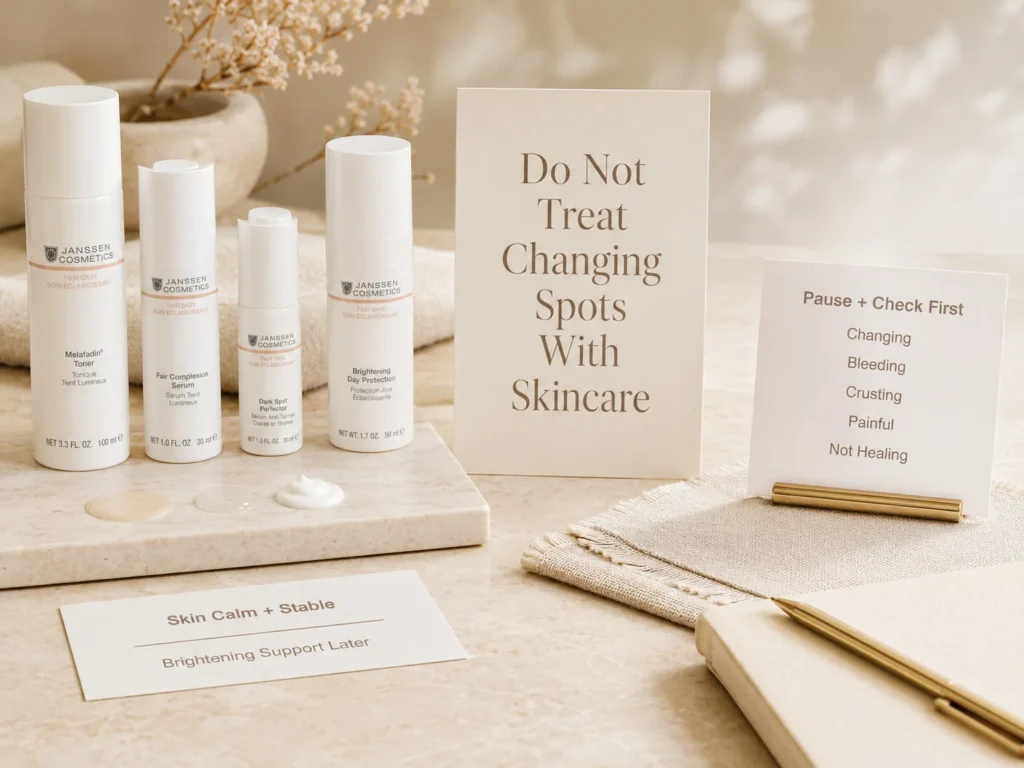
Skincare should wait if the area is:
Do not apply brightening-support products, acids, scrubs, retinol-style products, or exfoliating toner to these areas.
Brightening-support products may be appropriate when:
Brightening support should be introduced carefully.
One product at a time.
Brightening products are not the first step when the skin is:
In these cases, the first step is medical evaluation or calming the routine, depending on severity.
SPF is essential for cosmetic uneven-looking tone.
It matters for:
But SPF does not replace dermatology care for changing or concerning spots.
SPF is part of daily protection.
A dermatologist is needed for evaluation.
If there are no warning signs and the concern appears cosmetic, a simple routine may begin with:
Morning:
Gentle cleanser → moisturizer → SPF
Evening:
Gentle cleanser → moisturizer
Then, after the skin feels stable, a support step may be reviewed:
Do not add everything at once.
Morning:
Gentle cleanser → serum if appropriate → moisturizer → SPF
Evening:
Gentle cleanser → moisturizer
Avoid:
If the area is open, painful, oozing, crusted, or not healing, seek medical guidance.
Morning:
Gentle cleanser → brightening-support serum if appropriate → moisturizer → SPF
Evening:
Gentle cleanser → moisturizer or targeted support if appropriate
Avoid:
A changing spot should be checked first.
Morning:
Mild cleanser → moisturizer → SPF
Evening:
Mild cleanser → moisturizer
Optional later:
Calming or hydration support if tolerated
Sensitive skin should not be pushed into brightening support too early.
If sensitivity is persistent, rash-like, painful, swollen, or worsening, seek dermatologist guidance.
Morning:
Gentle cleanser → hydrating serum if needed → moisturizer → SPF
Evening:
Gentle cleanser → hydrating serum if needed → cream
Avoid:
Dryness can make uneven-looking tone appear stronger, but broken or painful skin should be evaluated.
Morning:
Gentle gel cleanser → lightweight moisturizer → SPF
Evening:
Gentle cleanser → lightweight moisturizer
Optional:
BHA only when clogged-looking pores, blackheads, whiteheads, or T-zone buildup are present and the skin is stable
If bumps are painful, cystic-looking, infected-looking, rapidly worsening, or leaving concerning changes, seek dermatologist guidance.
Morning:
Gentle cleanser → hydration or radiance-support serum if tolerated → moisturizer or cream → SPF
Evening:
Gentle cleanser → serum if appropriate → cream
Do not forget:
Mature skin may have sun-related dark spot appearance, but changing or unusual spots should be checked.
A skincare consultation can help with cosmetic routine planning.
It can help identify:
A consultation can support skincare decisions.
It cannot diagnose medical skin conditions.
A dermatologist can evaluate skin changes medically.
A dermatologist can assess:
A dermatologist can also decide whether medical testing or treatment is needed.
Book a dermatologist before buying brightening products if:
If you are worried, checking first is the safest choice.
Shop Zendevie does not promise to remove dark spots.
Cosmetic skincare can help support the appearance of a more even-looking complexion, but results vary.
Visible progress depends on:
Safe skincare should never promise guaranteed results.
We do not use language like:
Instead, we use appearance-focused language such as:
Safe wording protects the client and the brand.
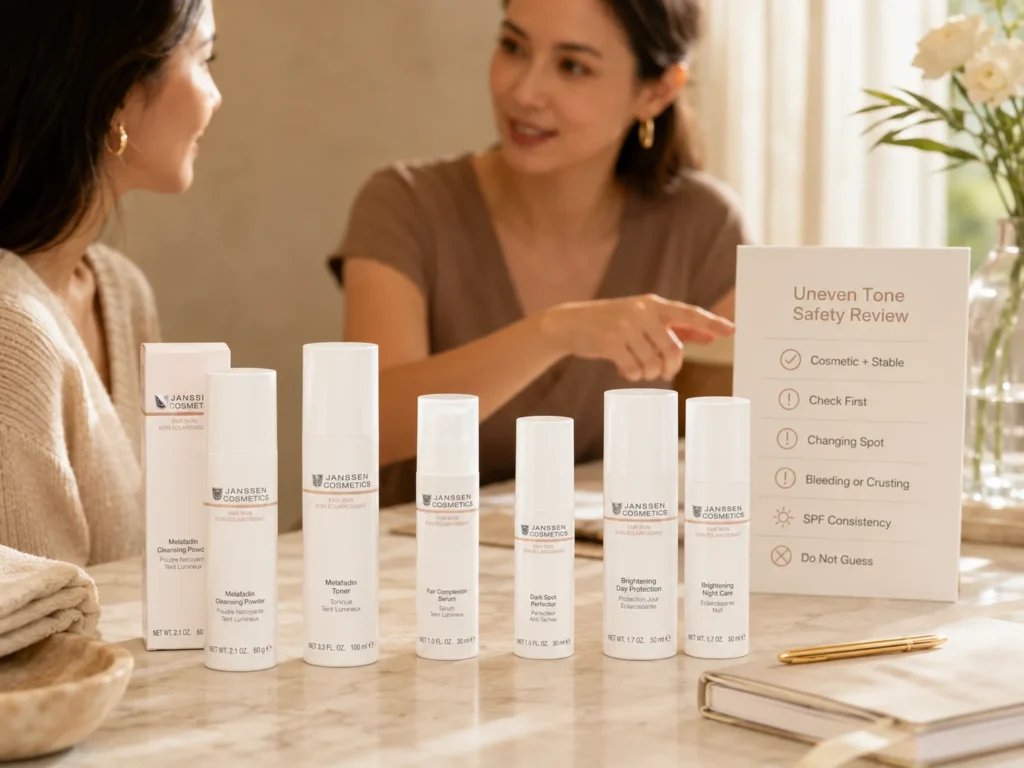
If there are no warning signs and the concern appears cosmetic, our licensed esthetician may consider Janssen Cosmetics options after consultation.
For uneven-looking tone and dark spot appearance support, possible options may include:
For dull, tired-looking, or radiance-focused uneven-looking skin, possible options may include:
For dry or dehydrated uneven-looking skin, possible options may include:
For sensitive or overworked uneven-looking skin, comfort-focused options may come first, such as:
For oily uneven-looking skin or clogged-looking areas, possible options may include:
For morning routines, Face Guard Advanced SPF 30 may be considered as the final daytime protection step when appropriate and tolerated.
These are not automatic recommendations. The Janssen pairing guidance also reinforces that brightening routines need patience and SPF, oily skin should be balanced without stripping, and too many new products at once can make it hard to know what is helping or irritating.
Do not try to lighten a changing spot with cosmetic products.
Do not scrub dark spot appearance.
Do not apply acids to bleeding, crusting, painful, or broken skin.
Do not pick post-blemish marks.
Do not use brightening products on rash-like irritation.
Do not ignore a sore that does not heal.
Do not ignore a spot that changes in size, shape, or color.
Do not ignore bleeding, oozing, swelling, or severe itching.
Do not use professional-only products at home.
Do not use whitening language or products that promise to change natural skin color.
Do not assume every darker-looking area is the same concern.
Do not delay medical evaluation if a mark worries you.
Uneven-looking tone should be evaluated by a dermatologist if there are changing spots, bleeding, crusting, pain, severe itching, sudden discoloration, non-healing sores, or marks that look very different from others.
No. Some dark spot appearance may be cosmetic, but new, changing, bleeding, crusting, painful, or unusual spots should be checked by a dermatologist.
Cosmetic skincare can support the appearance of a more even-looking complexion, but it should not be described as removing, curing, or treating dark spots medically.
Concerning signs include change in size, shape, or color; bleeding; crusting; pain; severe itching; rapid growth; irregular-looking borders; multiple colors; or a spot that looks different from others.
Not before it is checked if the spot is new, changing, unusual, bleeding, painful, crusting, or growing.
Post-blemish mark appearance may be supported with gentle skincare, moisturizer, SPF, and appropriate brightening support when the skin is closed and calm. Broken or infected-looking skin should be evaluated.
Persistent or severe itching should be evaluated, especially if the spot is changing, bleeding, crusting, painful, or different from others.
A bleeding spot should be checked by a dermatologist. Do not scrub it or apply active products to it.
Sometimes skin conditions can look like cosmetic uneven tone. A dermatologist can evaluate persistent, sudden, painful, spreading, rash-like, or unusual changes.
If there are warning signs, see a dermatologist first. If the concern appears cosmetic and stable, a Zendevie consultation can help build a safe skincare routine
If your uneven-looking tone appears cosmetic and stable, we can help you build a thoughtful routine.
But if a spot is new, changing, bleeding, crusting, painful, severely itchy, growing, or different from others, please see a dermatologist first.
At Zendevie, a free virtual consultation helps us review your cleanser, moisturizer, SPF habits, sensitivity, dryness, hydration, post-blemish marks, dark spot appearance, and current products before recommending anything.
Your skin deserves care.
And when something looks concerning, it deserves the right professional evaluation.

Zendevie is guided by Haby Diallo, a licensed esthetician with more than 20 years of professional skincare experience. Her approach is rooted in education, professional judgment, and personal care.
years of experience