


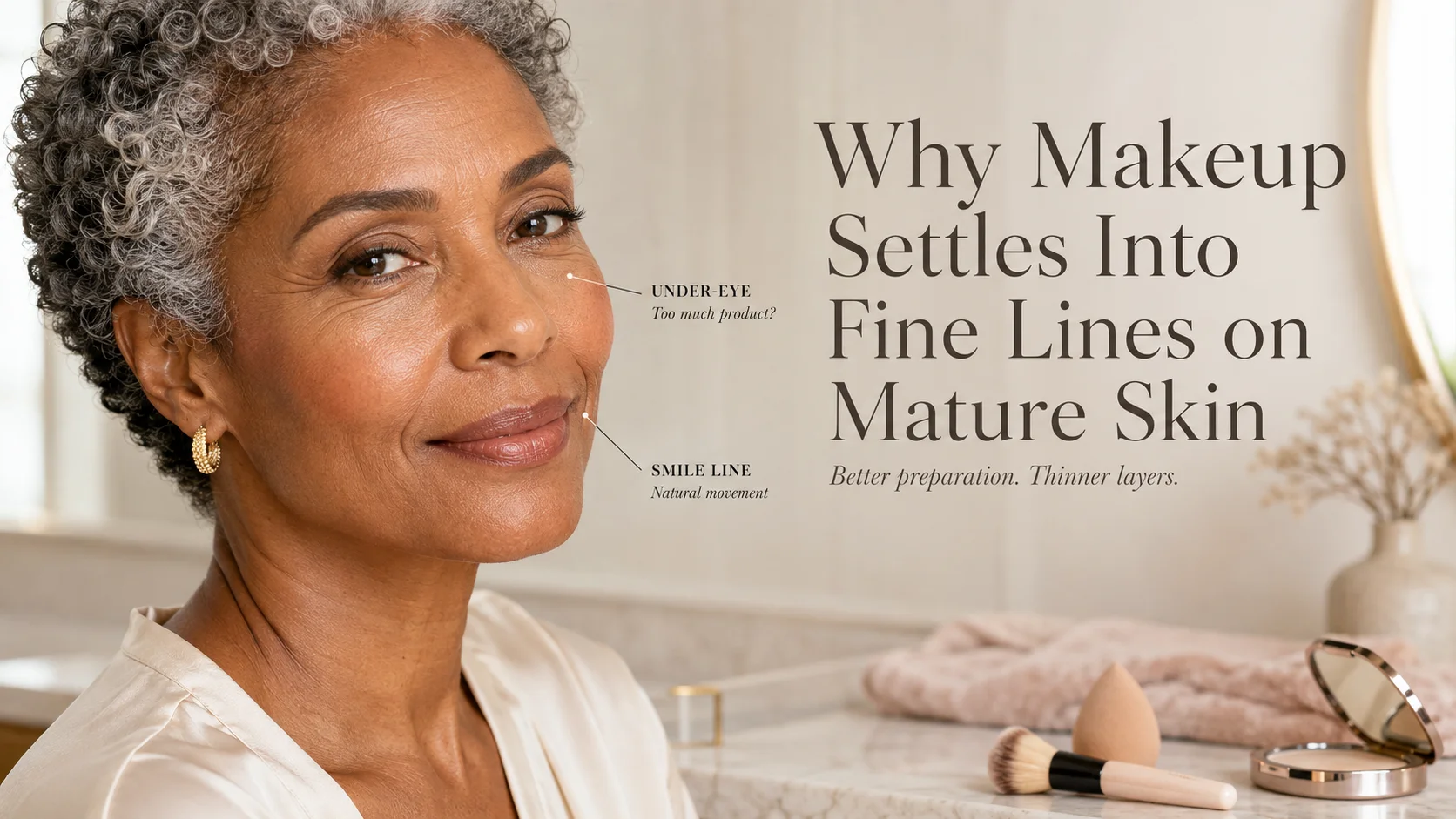
Makeup may begin to sit differently as skin matures.
Foundation that once looked smooth may begin collecting around:
Concealer may settle more noticeably under the eyes.
Powder may make the surface look dry.
Foundation may appear smooth in the morning but separate by afternoon.
Makeup may cling to flaky areas while sliding from oilier zones.
This does not mean mature skin should stop wearing makeup.
It also does not mean every visible line needs to be hidden.
Makeup often settles because of the relationship between:
At Zendevie, our licensed esthetician looks at the skincare underneath makeup before suggesting more coverage.
If the skin feels tight, flaky, over-exfoliated, or heavily layered, another primer may not solve the problem.
A comfortable, well-prepared surface usually begins with a simple and appropriate skincare routine.
Makeup may settle into fine lines on mature skin because of:
A simple makeup-prep routine may be:
Gentle cleanser or lukewarm-water rinse → one hydrating serum if needed → appropriate moisturizer → eye care if needed → daytime SPF → makeup
The routine does not need every possible step.
For some mature skin, a simpler structure may work better:
Rinse or gentle cleanse → moisturizer → SPF → makeup
Use thin makeup layers.
Allow skincare to settle.
Apply additional coverage only where needed.
Avoid heavy powder over dry or visibly textured areas.
Do not exfoliate aggressively to remove natural lines or temporary makeup creasing.
Persistent burning, painful cracking, swelling, severe itching, bleeding, blistering, crusting, eye symptoms, or reactions to basic products should be evaluated by a dermatologist.
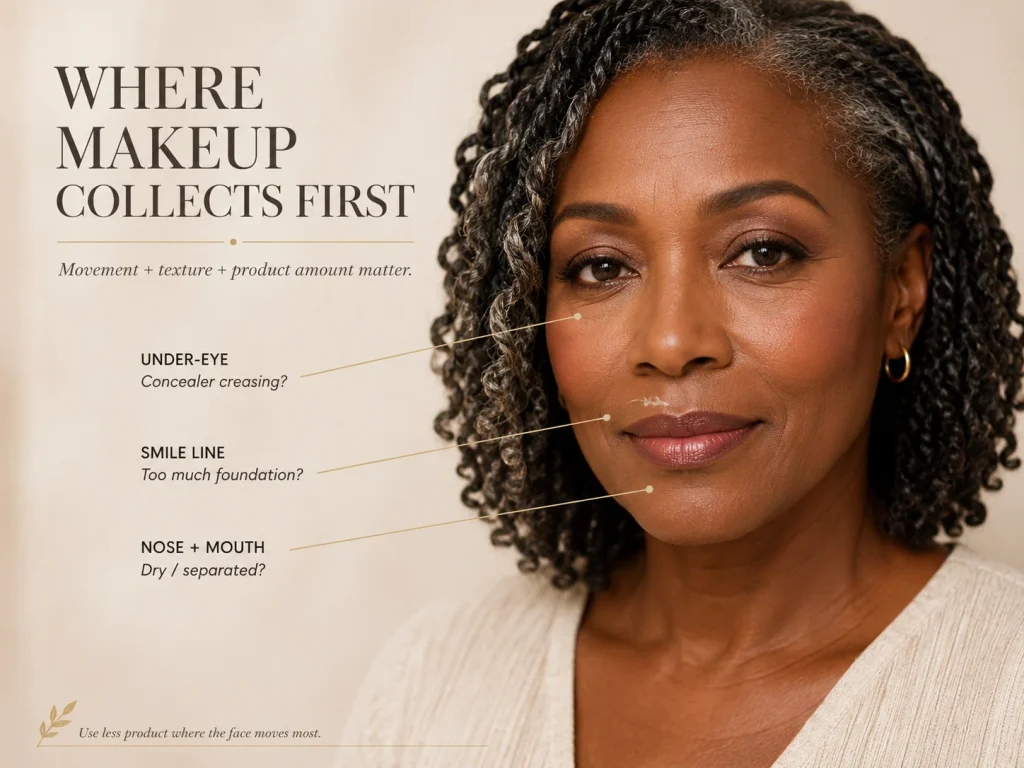
Fine lines are part of natural facial movement and skin maturation.
They may become more noticeable with:
Skincare may support a smoother-looking, more comfortable surface.
Makeup techniques may help reduce the appearance of product collecting in lines.
Neither skincare nor makeup should promise to remove every line permanently.
The goal is not to create a motionless face.
The goal is a comfortable, polished finish that still looks like skin.
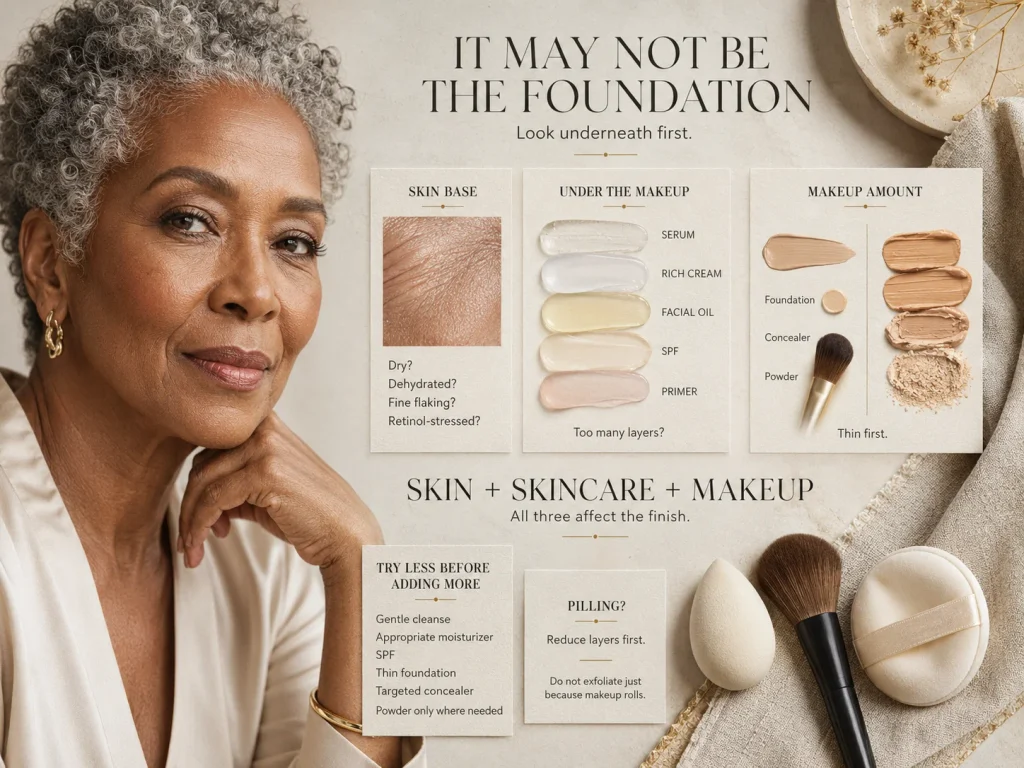
It is easy to blame foundation when makeup looks uneven.
But foundation may be revealing what is happening underneath.
For example:
Before replacing the foundation, review the complete routine.
A different foundation cannot always correct an uncomfortable skincare base.
Dehydrated skin lacks water.
It may feel:
When the skin is dehydrated, makeup may collect in fine surface lines because the surface feels less flexible.
A hydrating serum or more appropriate moisturizer may help support a smoother-looking base.
However, adding several hydrating layers may create pilling or heaviness.
The routine should remain purposeful.
Dry skin generally lacks oil or lipid comfort.
Dehydrated skin lacks water.
Mature skin may be:
This distinction affects makeup preparation.
May prefer:
May prefer:
A rich cream is not the answer for every type of makeup settling.
Foundation may cling to:
This can make makeup look:
Do not scrub flakes away immediately before makeup.
Aggressive exfoliation may leave the skin more reactive.
Instead:
Persistent, painful, bleeding, crusting, or worsening flaking should be medically evaluated.
A cleanser that leaves mature skin tight may affect the entire makeup finish.
After strong cleansing, the skin may:
Review whether the cleanser creates:
The skin should feel clean without feeling stripped.
Some mature skin may not need a full cleanser every morning.
A lukewarm-water rinse may be enough when the skin:
Other mature skin may still prefer a mild cleanser.
The decision should be based on skin type and comfort.
A strong morning cleanse may make foundation look drier later.
Very hot water may leave the skin:
Use lukewarm water.
Makeup preparation should not begin with unnecessary temperature stress.
Very cold water is not required either.
When moisturizer is insufficient, foundation may:
Signs the moisturizer may be too light include:
A more supportive moisturizer may help.
This does not automatically mean the richest cream is needed.
A heavy layer of moisturizer may cause:
Use enough moisturizer to support comfort, but not so much that the skin remains heavily coated.
Follow the product directions.
Allow the moisturizer to settle before sunscreen or makeup.
A mature-skin moisturizer may be:
The right choice depends on:
Dry mature skin may prefer a richer cream.
Oily mature skin may prefer a lightweight lotion.
Combination mature skin may use different amounts by area.
Mature skin does not automatically need the heaviest available texture.
A rich cream may support dry skin.
But too much may make makeup:
When using a richer cream:
The same rich cream may be more comfortable at night than under daytime makeup.
A lightweight lotion or emulsion may work well when:
However, a very light moisturizer may not be enough for dry mature skin.
The correct product should keep the skin comfortable beyond the first few minutes.
Not always.
A hydrating serum may help when:
A simple order may be:
Cleanser → hydrating serum → moisturizer → SPF → makeup
However, serum should be removed from the routine if it causes:
One appropriate moisturizer may be enough.
A morning routine may include:
Layering several serums may lead to:
Choose one main serum based on the most important concern.
Do not layer products only because each one has a different marketing name.
Facial oil may support comfort for some dry mature skin.
But it may also cause:
If facial oil is used:
Some people may prefer facial oil only at night.
A well-chosen eye product may support:
Too much eye cream may cause:
Use a small amount.
Keep it away from the immediate lash line.
Allow it to settle before applying concealer.
The eye area is delicate.
A thick layer of:
may become too much.
The under-eye area often looks smoother with fewer, thinner layers.
Do not coat the area in several products to hide fine lines.
Excess product may collect in those lines instead.
Retinol may support a smoother-looking complexion over time.
It may also cause:
If makeup begins looking suddenly patchy after retinol is introduced, review:
Do not exfoliate the retinol-related flakes immediately before makeup.
Pause or reduce retinol when the skin becomes uncomfortable.
Exfoliation may remove surface buildup and make the skin feel smoother.
But excessive exfoliation may later cause:
A smooth feeling immediately after exfoliation does not prove the routine is appropriate.
Mature skin should not depend on frequent peels or scrubs to make foundation sit well.
Texture under makeup may be connected to:
Exfoliation is only one possible factor.
Review hydration and product quantity first.
Sunscreen is part of a mature-skin daytime routine.
It may also affect makeup when it:
Do not skip sunscreen simply to improve the foundation finish.
Instead, review:
The morning routine may need fewer layers.
Pilling may happen because:
Do not exfoliate the skin to solve formula incompatibility.
Simplify the morning routine.
Primer may help with:
But primer is not always necessary.
It may create another layer that:
Test makeup with and without primer.
A comfortable moisturizer and compatible sunscreen may provide enough preparation.
A smoothing primer may temporarily blur the appearance of texture.
It cannot permanently remove lines.
Use a thin layer only where needed.
Too much primer may roll, pill, or collect around expression areas.
Do not apply thick primer into every line.
A hydrating primer may help dry mature skin when:
However, hydrating primer should not replace an appropriate moisturizer.
Primer is a makeup product.
Moisturizer serves a skincare purpose.
Mattifying primer may help oily areas.
But full-face use may make dry mature skin look:
Combination mature skin may use mattifying primer only on:
Dry cheeks and the eye area may not need it.
Foundation formulas may be:
No single texture works for every mature complexion.
May prefer:
May prefer:
May need:
The label “for mature skin” does not guarantee a good match.
Full-coverage foundation contains more pigment.
It may become noticeable when applied heavily across:
Consider using:
More foundation does not always create a smoother result.
Sheer or light coverage may:
It may not cover every mark.
That is acceptable when the goal is a natural, comfortable finish.
Coverage can be targeted instead of applied heavily everywhere.
Using too much foundation may increase:
Begin with a small amount.
Apply a thin layer.
Step back and assess before adding more.
Use additional foundation only where more coverage is genuinely needed.
Foundation may be applied with:
Each method can work when used gently.
May warm the product and provide light control.
May create a thinner, pressed-in finish.
May provide more coverage but can emphasize flakes when used aggressively.
Avoid rubbing repeatedly.
Press or spread gently.
Stop blending once the product is evenly distributed.
A sponge that is too wet may:
A sponge should be prepared according to the tool and product instructions.
Keep tools clean.
Replace damaged or difficult-to-clean applicators.
A dense brush may catch on:
Use light pressure.
Avoid repeated circular buffing over dry mature skin.
A sponge or fingers may feel gentler for some people.
Under-eye concealer may collect in lines when:
Use a small amount.
Apply only where discoloration or shadowing needs support.
Do not create a thick triangle of product by default.
Dark-circle appearance may involve:
Place concealer strategically.
For some people, only the inner under-eye area needs coverage.
Using less product over the outer eye area may reduce creasing.
Expression causes the eye area to move.
Some creasing may happen even with careful preparation.
After the concealer settles, use a clean fingertip or small sponge to gently press away excess product.
Do not repeatedly add more powder to every crease.
Natural movement is not a makeup failure.
Powder may help:
Too much may make mature skin look:
Use powder strategically.
The whole face may not need the same amount.
Depending on skin type, powder may be used on:
Dry cheeks, mouth corners, and outer eye areas may need little or no powder.
Heavy powder application under the eyes or across expression lines may emphasize texture.
Mature skin does not need to follow every makeup trend.
A light, controlled application may look more natural.
The goal is not to freeze the makeup in place.
A setting spray may help makeup look less powdery.
But formulas may contain:
Sensitive mature skin may experience:
Avoid spraying directly into open eyes.
Stop using the formula if discomfort repeats.
During the day, the skin experiences:
Some movement is normal.
A realistic routine should allow small touch-ups without requiring repeated heavy layering.
Before adding more product:
Do not place new foundation over thick, creased layers without first smoothing the existing product.
A mist may help makeup look fresher.
It may also:
Do not repeatedly mist the face as the only response to dehydration.
Review the cleanser and moisturizer first.
Foundation may collect around:
Possible contributors include:
Use less makeup around mobile areas.
Avoid active products on cracked-looking or irritated mouth corners.
Foundation may separate around the nose because of:
Use thin layers.
Press product into place rather than buffing repeatedly.
The nose and cheeks may need different amounts of makeup.
Foundation may collect in horizontal forehead lines when:
Use a thin layer.
Avoid pressing extra foundation into the lines.
Set only where necessary.
When foundation or body makeup is applied to the neck or décolleté:
The neck may be more sensitive than the face.
Do not use strong exfoliation immediately before applying body makeup.
A practical routine may be:
Gentle cleanser or rinse → hydrating serum if needed → supportive moisturizer → eye care → SPF → makeup
Helpful adjustments may include:
Allow every skincare layer to settle.
A practical routine may be:
Gentle cleanser → lightweight serum if needed → lightweight moisturizer if needed → SPF → makeup
Helpful adjustments may include:
Oily mature skin may still need hydration.
A practical routine may be:
Gentle cleanser → lightweight hydration → moisturizer according to area needs → SPF → makeup
Possible zone adjustments:
The entire face does not need identical preparation.
A practical routine may be:
Lukewarm-water rinse or gentle cleanser → tolerated moisturizer → tolerated SPF → minimal makeup
Optional eye care may be added when already tolerated.
Avoid:
Introduce one new formula at a time.
People concerned about uneven-looking tone may apply heavy foundation across the entire face.
A more flexible approach may be:
Do not use whitening language.
The goal is a more even-looking finish—not changing the person’s natural skin color.
Redness-prone mature skin may use:
Do not aggressively rub green corrector into the skin.
Persistent, painful, hot, swollen, eye-related, or worsening redness should be evaluated by a dermatologist.
Makeup should not replace medical assessment.
Blemish-prone mature skin may need:
Avoid picking or squeezing before applying makeup.
Painful, deep, swollen, infection-looking, persistent, or scarring blemishes should be evaluated by a dermatologist.
There is no universal number of minutes for every formula.
Allow the skincare to:
Some routines may need only a short pause.
Heavier formulas may need longer.
Waiting cannot fix an incompatible or over-layered routine.
A general mature-skin morning order may be:
Cleanser or rinse → tonic if needed → one serum if needed → eye care → moisturizer → SPF → primer if needed → foundation → concealer → powder where needed
The exact order may change according to product instructions.
Some specialty UV products have specific layering directions.
Follow the official directions for the selected formula.
For many people, this may be enough:
Lukewarm-water rinse → moisturizer → SPF → makeup
This is especially useful when:
A shorter routine may create a smoother and more predictable base.
Gentle cleanser → hydrating serum → moisturizer → eye care if needed → SPF → makeup
Use one serum.
Do not automatically add vitamin C, peptides, firmness serum, and facial oil.
Before an important event:
Use the products the skin already tolerates.
Predictability is more useful than chasing an overnight transformation.
A simple routine may be:
Gentle cleanser → hydrating or comfort-focused serum if already tolerated → moisturizer
Avoid the night before an important event:
The skin should wake up comfortable, not recovering from an experiment.
A practical sequence may be:
Do not massage the face until it becomes warm or red-looking.
A familiar hydrating mask may help some dry mature skin feel more comfortable.
But a mask is optional.
Avoid using a new mask immediately before an event.
A mask may contain:
If the daily moisturizer already provides comfort, another step may be unnecessary.
Dermaplaning is a professional treatment that may influence how makeup sits.
It may also temporarily increase sensitivity.
Do not perform aggressive at-home blade techniques before an event.
Professional services should include appropriate assessment and aftercare.
Avoid strong actives after dermaplaning according to provider instructions.
Gentle, appropriately scheduled exfoliation may support a smoother-looking surface for some skin.
It should not be performed every time makeup is worn.
Avoid exfoliating immediately before makeup when the skin is:
The goal is not to thin or polish the skin into temporary smoothness.
A mature-skin makeup routine is not complete without gentle evening removal.
At night, remove:
Use a cleanser appropriate for the amount and type of makeup.
Do not scrub.
Do not leave the skin tight or raw.
Long-wear foundation may require:
A second cleanser may be used only when necessary and comfortable.
If double cleansing causes tightness, review:
Long-wear makeup should not require aggressive removal.
Allow eye-makeup remover or an appropriate cleansing product time to loosen mascara and liner.
Avoid:
Eye-area friction may contribute to:
Use a small amount of eye care afterward only when needed and tolerated.
Review:
Do not apply more foundation immediately.
Gently assess whether the base is dry or over-layered.
A more flexible foundation or better moisturizer match may be needed.
Possible contributors include:
Use thinner makeup layers.
Review whether the moisturizer remains comfortable throughout the day.
Do not repeatedly spray the face with fragranced mist.
Possible contributors include:
Before applying more product:
A lighter morning routine may help.
Review:
Do not exfoliate automatically.
Remove unnecessary layers first.
Possible reasons include:
Use less product.
Apply only where needed.
Press away excess before adding a very small amount of powder.
Review:
Do not apply facial acids around the eyes.
Persistent eyelid dryness, swelling, crusting, pain, or discharge should be medically evaluated.
Use less powder.
Apply it only where makeup moves or shine needs control.
Avoid heavy powder over:
Hydration may help, but natural lines will still move with expression.
Use less foundation around the area.
After the foundation settles:
Natural movement will continue throughout the day.
Apply a thinner foundation layer.
Avoid heavy primer and powder.
After facial expression moves the makeup, press away excess rather than adding more.
Do not fill the line with foundation.
Review whether the area is:
Use less makeup.
Target preparation according to whether the area is dry or oily.
Possible contributors include:
Keep active products away from irritated mouth corners.
Use thin makeup layers.
Persistent rash-like or painful mouth-area changes should be evaluated by a dermatologist.
The skin may be oily and dehydrated.
Review:
Do not respond by stripping the skin further.
Lightweight hydration may help support a more flexible finish.
Try:
The skin may still need rich care, but not necessarily under daytime makeup.
Consider:
Do not apply several thin serums when one appropriate cream may be simpler.
Stop using it and test the foundation over moisturizer and sunscreen alone.
The primer may be:
Primer is not required for a polished result.
Stop applying the suspected product.
Review:
Do not cover burning skin with more makeup.
Persistent burning, swelling, blistering, rash-like changes, or eye symptoms need professional evaluation.
Remove it gently.
Stop the suspected product.
Review:
Persistent, severe, spreading, swollen, or rash-like itching should be evaluated by a dermatologist.
Possible contributors include:
Do not immediately add several acids.
Simplify.
Seek guidance if bumps are painful, itchy, swollen, infection-looking, persistent, or scarring.
Possible changes include:
Review what changed most recently.
Do not replace every product simultaneously.
That may mean:
Consider:
Makeup is optional.
Fine lines will not disappear completely.
Use makeup to support an even, polished appearance rather than trying to erase every sign of facial movement.
A natural finish may still show:
That does not mean the routine failed.
Gentle cleanse or rinse → moisturizer → eye care if needed → SPF
Thin foundation or complexion product → targeted concealer → minimal powder only where needed
This may be enough.
Primer, setting spray, facial oil, and several serums are optional.
Gentle cleanser → one hydrating serum → moisturizer → eye care → SPF
Thin flexible foundation → targeted concealer → light powder only where needed
Do not add another serum automatically.
Moisturizer → SPF → targeted concealer → optional light complexion product
This may work well for people who:
Makeup-free days are optional.
They may make it easier to observe:
The skin does not medically need to “breathe” without makeup.
The benefit is often practical: fewer layers and easier routine evaluation.
Seek dermatologist guidance when makeup begins emphasizing or covering skin changes that include:
Seek urgent medical care for:
Makeup should not be used to hide symptoms that require medical evaluation.
After consultation, our licensed esthetician may consider Janssen Cosmetics options based on the skin’s dryness, hydration, sensitivity, preferred texture, makeup routine, eye-area needs, and daytime protection requirements.
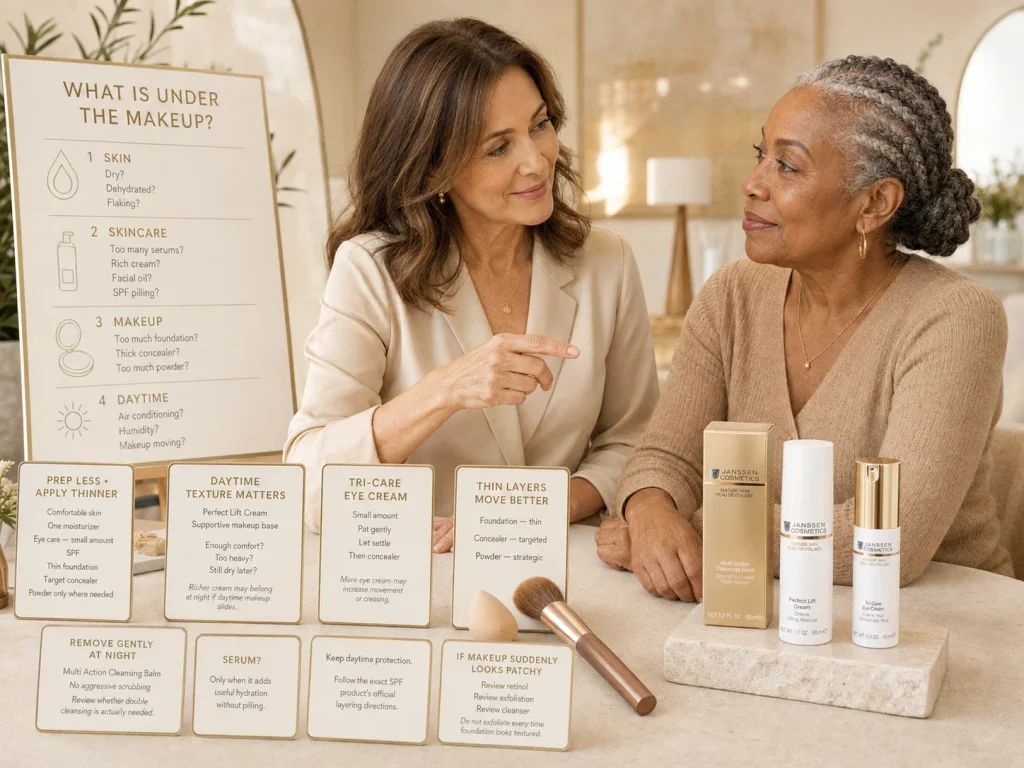
Possible mature-skin options may include:
These products should not all be layered together automatically.
The best makeup base may be a short routine.
Appropriate cleanser → selected moisturizer → Face Guard Advanced and moisturizer in their officially directed sequence → makeup
Appropriate cleanser → optional Micellar Skin Tonic → Age Perfecting Serum → selected moisturizer and Face Guard Advanced in their officially directed sequence → makeup
Multi Action Cleansing Balm or Luxury Oil Cleanser → optional Micellar Skin Tonic → Age Perfecting Serum if needed → Rich Recovery Cream in an appropriate amount → daytime protection → makeup
The routine should be adjusted when the richer cream causes:
A lighter daytime moisturizer may be more suitable, while Rich Recovery Cream may remain in the evening routine.
Appropriate cleanser → optional tonic → Age Perfecting Serum if needed → Perfect Lift Cream → daytime protection → makeup
The choice between Perfect Lift Cream and Rich Recovery Cream should depend on:
Gentle cleansing → Tri-Care Eye Cream in a small amount → daytime protection applied carefully → concealer
The verified Janssen guidance positions Tri-Care Eye Cream as a rich eye-care product that can also serve as an eye-makeup foundation.
Use only a controlled amount.
Too much may make concealer move or crease.
Keep it away from the immediate lash line.
Ceramide Protection may be considered when dry mature skin needs additional lipid-focused support.
It is applied before cream according to the official instructions.
However, its oil-like texture may not suit every daytime makeup routine.
For some clients, it may feel more practical:
Its official daytime order also involves Face Guard Advanced before the capsule, followed by the selected care cream.
This product-specific sequence should be followed rather than replaced with a generic layering rule.
Do not combine Ceramide Protection automatically with:
The routine may become too heavy.
Rejuvenating Mask may be considered as an occasional add-on for dry or tired-looking mature skin when it is already known to be tolerated.
It should not be introduced for the first time immediately before an event.
It is not a substitute for daily moisturizer.
In the evening, Multi Action Cleansing Balm or Luxury Oil Cleanser may help remove makeup and daytime product buildup according to skin type and preference.
A second cleanser should be added only when needed and comfortable.
The skin should not feel stripped after makeup removal.
If the skin is currently burning, painfully flaky, swollen, rash-like, or reacting to moisturizer or SPF, makeup and active products should be minimized while the reaction is assessed.
Professional exfoliation products belong in professional treatment settings and should not be used at home to create a temporary smoother makeup surface.
Do not treat natural fine lines as a failure.
Do not promise to erase every line with skincare or makeup.
Do not scrub the skin every time foundation looks textured.
Do not exfoliate immediately before every makeup application.
Do not use strong cleanser to create a squeaky-clean base.
Do not use very hot water.
Do not apply several serums without a clear purpose.
Do not apply facial oil automatically under foundation.
Do not layer rich cream, facial oil, heavy SPF, primer, and full-coverage foundation without reviewing the complete routine.
Do not use too much eye cream.
Do not place thick concealer across the entire under-eye area automatically.
Do not apply facial retinol close to the eyes or mouth corners.
Do not continue retinol through persistent flaking or burning.
Do not combine retinol, AHA, BHA, scrub, and peeling mask.
Do not exfoliate because sunscreen or foundation pills.
Do not mix sunscreen into foundation or moisturizer unless the product is specifically designed for that use.
Do not skip daytime protection simply to improve the makeup finish.
Do not apply excessive foundation into fine lines.
Do not use heavy powder across dry mature skin.
Do not bake the under-eye area when it repeatedly looks dry or creased.
Do not add more makeup over thick, separated layers without first pressing away excess.
Do not rub foundation aggressively.
Do not use dirty brushes or sponges.
Do not share makeup or eye products.
Do not use expired, changed, or contaminated-looking makeup.
Do not apply makeup over blistering, bleeding, crusting, infection-looking, or significantly swollen skin.
Do not use professional peel products at home before an event.
Do not expect makeup to replace medical evaluation.
Foundation may settle because of natural facial movement, dehydration, dryness, product texture, excessive foundation, powder, retinol, exfoliation, or incompatible skincare layers.
No. Mature skin can wear foundation. The skincare preparation, formula texture, product amount, and application method may need adjustment.
Begin with gentle cleansing, appropriate moisturizer, eye care if needed, and daytime SPF. Add only one serum when it serves a clear purpose.
Not always. A compatible moisturizer and sunscreen may provide enough preparation. Primer is optional.
The best texture depends on skin type. Dry mature skin may prefer a hydrating or smoothing primer, while oily mature skin may use a mattifying primer only on oily zones.
The primer may be incompatible with the moisturizer, sunscreen, or foundation. Too much product or insufficient settling time may also contribute.
A hydrating serum may help when the skin feels tight or dehydrated. It is optional when moisturizer alone provides enough comfort.
Facial oil is optional. It may help some dry skin but may also make foundation slide or separate.
Facial oil is optional. It may help some dry skin but may also make foundation slide or separate.
Dry mature skin may prefer a supportive cream, while oily or combination mature skin may prefer a lotion, emulsion, or light cream. The best texture should support comfort without pilling or heaviness.
Too much moisturizer, an overly rich texture, facial oil, heavy sunscreen, or insufficient settling time may cause movement.
The skin may be oily and dehydrated. Strong cleansing, alcohol-heavy toner, acids, matte foundation, and excessive powder may contribute.
Indoor air, weather, insufficient moisturizer, matte formulas, powder, retinol, and facial movement may affect the finish over time.
Some oily mature skin may prefer a soft-matte finish. Very dry or dehydrated mature skin may find strongly matte formulas less comfortable.
A flexible natural or softly radiant finish may suit some mature skin, but a very rich or shiny formula may feel heavy. Individual skin type matters.
It can, but full coverage may look heavier when applied thickly. Thin layers and targeted coverage may create a more flexible finish.
Begin with a small amount and apply a thin layer. Add coverage only where needed.
Both may work. A sponge may create a thinner pressed finish, while a brush may provide more coverage. Use gentle pressure and keep tools clean.
Too much concealer, heavy eye cream, dryness, facial movement, rich sunscreen, and excess powder may contribute.
Use less eye cream and concealer, keep products away from the lash line, allow layers to settle, and use only a small amount of powder if needed.
A very small amount may help some concealers stay in place. Too much may emphasize dryness and fine lines.
Powder may be used strategically on areas that become oily or where makeup moves. The entire face may not need it.
Facial movement, too much foundation, heavy powder, dryness, and product buildup may contribute.
Gently press away excess product with a clean fingertip or sponge before adding more coverage.
Not every time. Exfoliation should be scheduled according to skin tolerance and should not be used on dry, irritated, over-exfoliated, or retinol-stressed skin.
Retinol may create dryness or flaking. Reduce or pause it when the skin becomes uncomfortable and maintain moisturizer and SPF.
A familiar hydrating mask may support comfort for some dry mature skin. It should not be introduced for the first time immediately before an event.
Too many layers, facial oil, heavy moisturizer, incompatible textures, or repeated rubbing may contribute.
No. Foundation does not automatically replace an appropriate daytime protection routine.
A simple routine may be gentle cleansing or rinsing, moisturizer, SPF, and makeup. Add one serum or eye product only when needed.
Seek guidance for persistent burning, significant swelling, severe itching, painful cracking, bleeding, blistering, crusting, eye symptoms, infection-looking changes, or recurring reactions to multiple products.
If your foundation settles into fine lines, concealer looks dry, or makeup separates even after you add more primer and moisturizer, a free virtual consultation can help you review the skincare underneath.
At Zendevie, we look at your cleanser, moisturizer texture, hydration level, serum use, eye care, SPF, retinol schedule, exfoliation, primer, foundation, powder, climate, and skin type before discussing product options.
The goal is not to hide every natural line.
The goal is to help your skin feel comfortable and create a makeup base that looks softer, smoother, and more natural without unnecessary layers.

Zendevie is guided by Haby Diallo, a licensed esthetician with more than 20 years of professional skincare experience. Her approach is rooted in education, professional judgment, and personal care.
years of experience