



The right cleanser should do more than remove what is sitting on the skin.
It should also leave the skin comfortable enough for the next step.
Mature skin may need cleansing to remove:
But cleansing should not leave the skin:
A cleanser that worked well several years ago may no longer feel appropriate.
The skin may have become:
This does not mean every mature complexion needs a rich cleansing balm.
Mature skin can still be oily, combination, blemish-prone, or uncomfortable with heavy textures.
At Zendevie, our licensed esthetician begins by assessing how the skin behaves before and after cleansing.
The goal is not to select a cleanser based only on the words “anti-aging” or “mature skin.”
The goal is to choose the gentlest effective cleansing texture for the skin’s present needs.
The right mature-skin cleanser depends on:
A mature-skin cleanser should generally:
A simple cleansing routine may be:
Lukewarm-water rinse or one gentle cleanser, depending on oiliness and comfort
One effective gentle cleanser to remove sunscreen, makeup, and daily residue
Double cleansing may be useful for heavy or water-resistant products, but it is not automatically necessary every night.
Persistent burning, swelling, painful cracking, blistering, bleeding, crusting, eye symptoms, infection-looking changes, or reactions to water and basic products should be evaluated by a dermatologist.

Skin maturity and skin type are different.
Mature skin may be:
A cleanser should match both.
For example:
May prefer:
May prefer:
May prefer:
May prefer:
Age alone cannot determine the correct texture.
A cleanser should remove what is no longer needed on the skin.
This may include:
It does not need to remove every trace of the skin’s natural surface comfort.
A cleanser should not make the face feel as though nothing remains on it.
A very tight or squeaky feeling is not proof of deeper cleansing.
It may indicate that the formula or method is too strong for the skin.
After cleansing, the skin should generally feel:
It should not immediately feel:
Some temporary freshness is normal.
Persistent tightness or burning is useful information that the cleanser or cleansing method may need to change.
Some people associate tightness with cleanliness.
But mature skin that feels tight after cleansing may be experiencing:
If moisturizer must be applied immediately because the skin feels painfully tight, review the cleansing step first.
A richer moisturizer cannot always correct an overly aggressive cleanser.
A cleanser may feel different even when the product has not changed.
Possible reasons include:
A previously comfortable cleanser may begin feeling too strong.
That does not mean the earlier experience was wrong.
It means the skin’s current needs may be different.
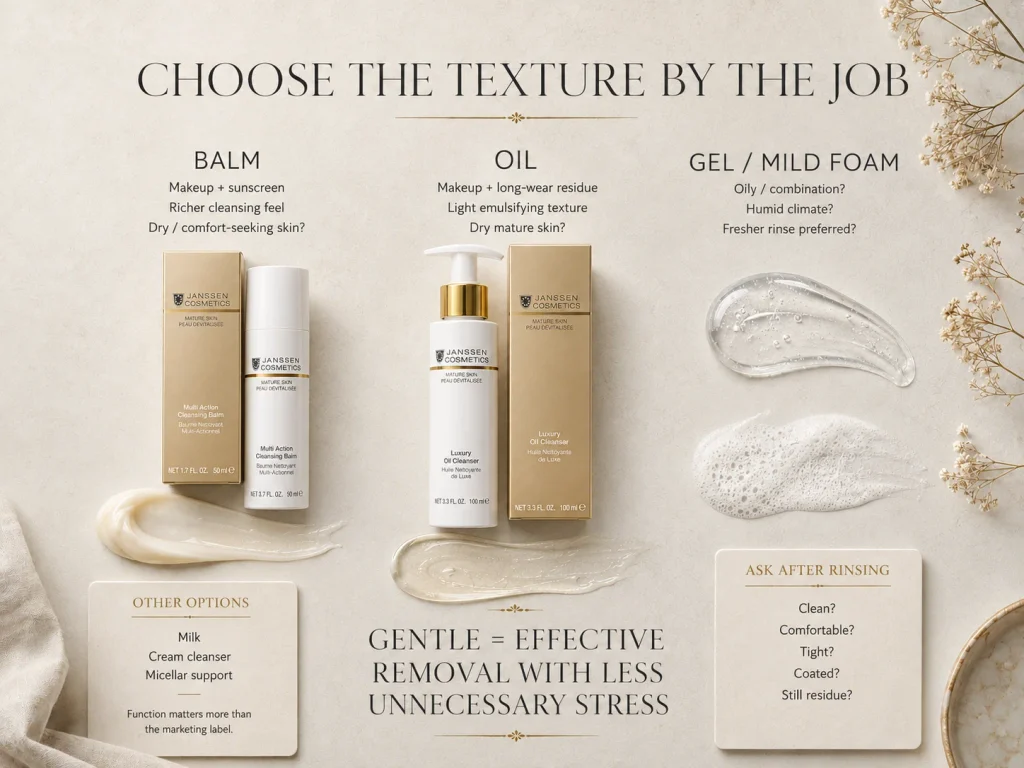
A cleansing balm begins as a richer solid, cream-gel, or buttery texture and changes as it is massaged onto the skin.
Depending on the formula, it may help dissolve:
A balm may suit mature skin that:
A balm should still emulsify or remove according to its directions.
It should not leave the skin feeling uncomfortably coated.
A well-matched cleansing balm may:
However, a balm is not automatically ideal for everyone.
It may feel too rich for:
The complete formula matters.
Follow the exact product directions.
A typical method may include:
Do not massage for an excessively long time.
Longer massage does not automatically create a better cleanse.
Stop if the skin becomes hot or uncomfortable.
Not always.
A cleansing balm may be designed to function as the main cleanser.
A second cleanser may be useful when:
A second cleanse may be unnecessary when:
Double cleansing should solve a specific removal problem.
It should not become an automatic rule.
A cleansing oil is designed to dissolve oil-soluble residue such as:
Many cleansing oils are formulated to emulsify with water and rinse away.
An oil cleanser may suit mature skin that:
A cleansing oil is not the same as applying ordinary facial oil and wiping it away.
A properly formulated cleansing oil contains ingredients that help it mix with water and rinse more effectively.
Possibly.
Oil-based cleansing is not limited to dry skin.
An emulsifying oil cleanser may help remove:
The important questions are:
Oily mature skin should not reject an oil cleanser only because it contains oil.
It should evaluate the finished formula and after-feel.
A cleansing milk usually has a soft, fluid, creamy texture.
It may suit skin that:
Depending on the product, cleansing milk may be:
Avoid aggressive cotton-pad rubbing.
A cleansing milk should leave the skin comfortable, not coated or insufficiently cleansed.
Cream cleansers may offer a richer feel than gels or foams.
They may suit:
However, a cream cleanser may not remove heavy makeup or water-resistant sunscreen by itself.
The product’s removal ability should match what is being worn.
Do not assume every gentle cleanser removes every long-wear formula.
A gel cleanser may work well for:
The gel should still be mild.
A mature-skin gel cleanser does not need to create abundant foam.
Look at how the skin feels afterward.
A gel that leaves the skin tight, shiny, hot, or uncomfortable may be too strong.
Foaming cleansers are not automatically unsuitable for mature skin.
Some mild foams may feel comfortable.
Problems may arise when the foam is:
Sensitive or dry mature skin may prefer low foam or a creamy alternative.
Oily mature skin may enjoy a light foam as long as it does not strip the skin.
Foam is a sensory quality.
It does not prove that a cleanser is:
A low-foaming cleanser may remove sunscreen and daily residue effectively.
A heavily foaming cleanser may feel satisfying while leaving the skin uncomfortable.
Judge the product by performance and after-feel, not foam volume alone.
Micellar products use cleansing agents arranged to help lift oil and residue.
They may be available as:
A micellar product may help with:
Not every micellar tonic is intended to replace the main cleanser.
Product function matters.
A tonic used after cleansing should not automatically be treated as the only makeup-removal step.
Follow the directions for the exact product.
Some formulas are intended to remain on the skin.
Others may feel better when followed by water or another step.
Sensitive mature skin should monitor for:
Do not rub repeatedly with cotton pads.
The physical friction may be more irritating than the formula itself.
Powder cleansers may create:
These are not automatically gentle because they begin as powder.
Review whether the product contains:
A powder cleanser with exfoliating action should be counted as an active product.
It may not be appropriate for daily use on dry or sensitive mature skin.
An active cleanser may include:
These products provide more than basic cleansing.
They should be selected carefully.
An active cleanser may feel too strong when mature skin is:
The routine should not contain multiple exfoliating steps without a clear plan.
AHA and BHA cleansers may be considered for selected concerns such as:
Because they are rinsed off, their contact time may differ from leave-on acids.
They can still cause:
Do not assume a rinse-off acid is too mild to count.
Sensitive mature skin may be better served by a non-active daily cleanser and a carefully scheduled separate treatment.
Scrub particles may provide physical exfoliation.
They may also create friction.
Avoid scrubbing when the skin is:
Mature skin does not need to feel polished or squeaky after cleansing.
A scrub should not be the primary daily cleanser.
Enzymes may help loosen surface buildup in certain exfoliating products.
They should be treated as an optional renewal step, not as mandatory cleansing.
Do not combine an enzyme product automatically with:
Mature skin should first tolerate its basic cleanser, moisturizer, and SPF.
Some people enjoy lightly scented cleansers.
Others find fragrance uncomfortable.
Fragrance may be more noticeable when the skin is:
A rinse-off product may still cause discomfort.
If a cleanser repeatedly creates:
stop and reassess.
The complete formula matters more than the marketing category.
Cleansers may contain aromatic oils such as:
A rinse-off formula may be tolerated by some people.
Others may experience discomfort.
Do not add undiluted essential oils to a cleanser.
Do not mix homemade aromatic oils into a cleansing balm.
Natural fragrance is still fragrance exposure.
The eye area is delicate.
Avoid allowing facial cleansers containing:
to sit over the eyelids unless the product is designed for eye use.
Eye-makeup removal may require a separate product or a cleanser verified for that area.
Do not scrub waterproof mascara away.
Allow the product time to dissolve makeup before gently removing it.
Waterproof mascara and long-wear eyeliner may require more effective oil-based removal.
A suitable cleansing oil or balm may help reduce rubbing.
However:
Persistent eye pain, discharge, crusting, swelling, or vision changes require medical guidance.
The mouth area may become dry or reactive because of:
Do not rub long-wear lip products away aggressively.
Use an appropriate remover.
Avoid applying active cleanser repeatedly over cracked-looking mouth corners.
Persistent, painful, rash-like, crusting, or spreading changes should be evaluated.
Mature-skin care may extend to the neck and décolleté.
These areas may collect:
Use gentle cleansing.
Avoid:
The neck may be more sensitive than the face.
A cleanser tolerated on the forehead may feel too strong on the neck.
Morning cleansing should be based on what is present on the skin.
A cleanser may be useful in the morning when the skin has:
A lukewarm-water rinse may be enough when the skin:
There is no universal rule that every mature complexion must cleanse with product every morning.
Evening cleansing often needs to remove:
A cleanser should be chosen according to what was worn.
One mild cleanser may be enough.
A cleansing balm or oil may be appropriate.
One thorough balm or oil cleanse—or a gentle double cleanse when needed—may be appropriate.
The goal is complete but comfortable removal.
Double cleansing usually means:
It may be useful for:
It may be unnecessary for:
Double cleansing should not be performed out of fear that one cleanser is never enough.
Review the routine if double cleansing causes:
Possible adjustments include:
There is no universal number of seconds for every formula.
Follow the product directions.
Cleanse long enough to:
Do not continue massaging for several minutes simply because facial massage feels luxurious.
Long contact time may increase:
Use:
The skin should not look bright red after cleansing.
A cleanser does not need aggressive massage to work.
If makeup is difficult to remove, the formula may not match the makeup.
Tools may add:
They may also create:
Mature skin does not need a cleansing brush every day.
Clean hands are often enough.
When using a cloth:
Tonic and micellar products are often applied with cotton pads.
Repeated wiping may irritate:
Use light strokes.
Do not continue wiping until the pad appears perfectly white.
If the main cleanser repeatedly leaves significant residue, review the cleanser rather than increasing cotton-pad friction.
Use lukewarm water.
Very hot water may increase:
Very cold water is not needed to “close” pores.
Pores do not open and close like doors.
Comfortable water temperature is more important than a dramatic temperature sensation.
After cleansing:
The skin may be left slightly damp for selected hydrating products when their directions support it.
Retinol and some active products may require fully dry skin.
A retinol night should begin with a gentle cleanser.
Avoid using:
before retinol unless a professionally designed routine specifically supports the combination.
A simple retinol-night sequence may be:
Gentle cleanser → allow skin to dry as directed → retinol → moisturizer
Do not begin retinol on already tight or irritated skin.
When using a separate exfoliant, the cleanser should generally remain simple.
Avoid stacking:
Acid cleanser → acid toner → exfoliating serum → scrub
Mature skin may become dry, tight, or reactive.
One exfoliating method is often easier to assess.
Professional peels belong in professional treatment settings.
Vitamin C is generally used after cleansing in the morning when tolerated.
If vitamin C stings, review whether the cleanser is:
The serum may not be the only contributor.
A gentler cleanser may improve routine comfort.
The goal of morning cleansing before makeup is a clean, comfortable surface.
Do not attempt to create a squeaky or oil-free base.
A practical routine may be:
Gentle cleanse or rinse → serum if needed → moisturizer → SPF → makeup
If foundation looks dry, review the cleanser before adding more primer.
Makeup removal is part of mature-skin care.
Sleeping in makeup may leave:
However, removal should remain gentle.
Choose a cleanser that can dissolve the makeup without repeated scrubbing.
Heavy makeup may need a balm or oil.
Light makeup may be removed with one effective cleanser.
After sweating, mature skin may need:
Do not automatically use a strong cleanser after every light workout.
Match the method to:
Repeated cleansing may increase tightness.
Heat and humidity may increase:
A mature-skin summer cleanser may be lighter than the winter cleanser.
Possible adjustments include:
Do not strip the skin because it feels sweaty.
Oily-looking skin may still be dehydrated.
Cold air and indoor heating may make mature skin:
A winter routine may include:
Seasonal cleanser changes are appropriate.
The same formula does not need to be used all year.
Travel may introduce:
Bring a familiar cleanser.
Do not rely on:
A simple travel routine may be:
Rinse or gentle cleanse → moisturizer → SPF
Gentle cleanser appropriate for makeup and sunscreen → moisturizer
Avoid introducing a new active cleanser during travel.
Water may feel different when traveling or moving.
The skin may feel:
Do not immediately scrub harder.
Review:
Different water may change the cleansing experience, but skincare content cannot diagnose water as the sole cause of a reaction.
Body or hand soap is not automatically suitable for the face.
It may leave mature skin:
Use a product formulated and directed for facial cleansing.
Do not depend on hotel soap or household soap as the daily face cleanser.
Wipes may be convenient.
They may also create:
Wipes should not automatically become the main nightly cleanser.
They may be used as one step in selected situations, but the skin should still be cleansed appropriately when needed.
Avoid rubbing until the skin becomes red-looking.
Dry mature skin may benefit from:
Look for a cleanser that:
Avoid automatically using:
The richest cleanser is not mandatory, but comfort should remain the priority.
Oily mature skin may benefit from:
Look for a cleanser that:
Avoid:
Oily mature skin still needs comfort.
Combination mature skin may benefit from:
The cleanser should address the whole face without stripping dry cheeks.
Avoid applying extra pressure to the T-zone.
Clogged-looking pores may need a targeted leave-on strategy rather than a stronger cleanser across every area.
Sensitive mature skin may benefit from:
Patch test a new cleanser when appropriate.
A rinse-off product can still cause a reaction.
Stop if the cleanser repeatedly creates:
Redness-prone mature skin may prefer:
Avoid:
Persistent, painful, hot, swollen, or eye-related redness should be evaluated by a dermatologist.
Blemish-prone mature skin may need a cleanser that removes:
without creating dryness.
Avoid combining:
The cleanser does not need to medically treat every blemish.
Painful, deep, swollen, infection-looking, persistent, or scarring blemishes should be evaluated by a dermatologist.
Heavy-makeup wearers may need:
Look for a formula that dissolves makeup without repeated rubbing.
Pay attention to:
Do not scrape or scrub makeup from fine lines.
Allow the cleanser time to loosen it.
The cleansing method depends on the sunscreen.
A light, non-water-resistant sunscreen may come off with one gentle cleanser.
A water-resistant or heavily layered sunscreen may need:
Do not assume every sunscreen requires double cleansing.
Assess actual removal and skin comfort.
The cleanser may be too strong when the skin:
Review the complete routine before assuming the moisturizer is too weak.
The cleanser may be insufficient when:
This does not automatically mean the cleanser should be stronger.
A balm, oil, or dedicated makeup-removal step may be a better solution.
A rich cleanser may not suit the skin when it:
Use less product or consider a lighter emulsifying formula.
Do not assume rich texture is necessary because the skin is mature.
A light cleanser may be insufficient when it:
A more effective balm, oil, or milk may actually create less friction.
Gentleness includes effective removal.
Review:
Try simplifying.
Do not immediately add several serums and oils to compensate.
The cleansing step itself may need to change.
The cleanser may have already made the skin reactive.
Pause:
Use only products that remain comfortable.
If cleanser, moisturizer, sunscreen, or water continues to burn, seek dermatologist guidance.
Possible reasons include:
Do not wash again immediately.
Assess whether the skin feels:
A cleanser may need better emulsification or a lighter texture.
This may suggest:
Do not respond with more cleansing.
Use a gentler cleanser and appropriate lightweight moisture support.
Check whether:
A mild second cleanse may be considered when needed.
However, if a second cleanser is required every night and creates tightness, a different first cleanser may be more practical.
The product may be migrating into the eyes.
Stop and rinse according to directions.
Keep the cleanser out of the eyes.
Review whether it is approved for eye-makeup removal.
Persistent eye pain, redness, discharge, or vision changes require prompt medical evaluation.
It may be appropriate.
Mature skin does not need to avoid foam as a category.
Continue to assess:
A cleanser can remain appropriate as long as the skin stays comfortable.
Use a more effective makeup-removal step.
Possible options include:
Do not scrub harder with the cream cleanser.
The issue may be removal ability, not user technique.
Consider:
Dry skin still has texture preferences.
Comfort does not require the richest option.
Consider:
Do not increase cleanser strength to control shine.
Over-cleansing may make the skin feel tight and uncomfortable.
Review:
Stop the cleanser if stinging repeats.
Return to the simplest tolerated routine.
Seek guidance when basic products continue to sting.
A seasonal cleanser change may be helpful.
For example:
Gentle gel or light emulsion
Milk, cream, oil, or balm
The entire routine may also need adjustment.
Reduce:
A lighter cleanser may feel better.
However, do not switch automatically to:
Sweat and humidity can increase shine without meaning the skin needs aggressive cleansing.
Dullness may involve:
Do not increase cleanser strength simply to create brightness.
Cleansing is one part of the routine.
Moisturizer, SPF, and carefully selected active products may also matter.
The cleanser may be creating temporary dryness or tightness.
Review:
Hydration may support a smoother-looking surface.
It cannot permanently remove natural lines.
The cleanser may be too strong.
Also review:
A gentler morning rinse may work better for dry mature skin.
Stop testing multiple formulas at once.
Review whether the skin is already:
Use only what remains comfortable.
Seek dermatologist guidance when multiple basic cleansers cause persistent burning, itching, swelling, or rash-like changes.
Avoid:
If lukewarm water continues to cause significant discomfort, seek dermatologist guidance.
This may require more than cosmetic product selection.
A morning water rinse may be appropriate for that skin.
Continue evening cleansing to remove sunscreen, makeup, and daily residue.
Monitor whether morning oil, sweat, or product buildup changes.
Routine frequency can be personalized.
That may be enough.
A routine does not require separate morning and evening cleansers.
Use one product when it:
A second cleanser should have a clear purpose.
“Anti-aging” does not tell you whether the cleanser suits:
Cleansers are rinse-off products.
The most important factors are:
Do not select a cleanser only because of age-focused marketing.
A rinse-off product can still create delayed discomfort.
Ask:
The best cleanser is the one that answers the skin’s actual cleansing needs.
Seek dermatologist guidance when cleansing is followed by:
Seek urgent medical care for:
Cosmetic cleanser selection cannot diagnose an allergy, dermatitis, infection, or another medical condition.
After consultation, our licensed esthetician may consider Janssen Cosmetics cleansing options based on the skin’s dryness, oiliness, sensitivity, makeup use, sunscreen, texture preference, and tolerance.

Possible options may include:
These products are possible consultation-led options.
They do not belong in one automatic routine.
The Janssen catalog positions Multi Action Cleansing Balm as a mature-skin cleanser with a texture that changes during use:
Cream-gel → rich oil → milky emulsion with water
It is designed to remove:
Its richer oils and butter-based texture may suit mature skin that feels dry or prefers a soft, nourishing cleansing experience.
A consultation should still assess:
A possible evening method may be:
The product should not be massaged aggressively or used as a reason for prolonged rubbing.
The catalog also describes optional mask and dry-area uses.
Those additional uses should not be added automatically to every routine.
The Janssen catalog positions Luxury Oil Cleanser for dry mature skin and describes it as a light, hydrophilic cleansing oil.
It may be considered when the routine needs to remove:
The formula is designed to emulsify with moist fingers and rinse with lukewarm water.
A possible evening sequence may be:
Luxury Oil Cleanser → Micellar Skin Tonic if appropriate → serum or moisturizer
A second facial cleanser is not automatically required.
The decision depends on:
Eye use should follow the verified product directions, and the product should be kept out of the eyes.
Micellar Skin Tonic is positioned as a mild, alcohol-free tonic for mature skin.
It may help remove final traces of:
while adding a light moisture-supporting step.
It is generally used after the main cleanser.
A possible order may be:
Cleanser → Micellar Skin Tonic → serum → moisturizer
The tonic is optional.
It should not be rubbed aggressively over the skin.
If a cotton pad creates visible friction or stinging, the application method should be reviewed.
Some mature skin may match the needs of the Dry Skin family more closely than the Mature Skin cleanser textures.
Mild Creamy Cleanser may be considered when the skin:
Product-family labels should not prevent a better skin-type match.
Some sensitive mature skin may prefer a gentle mousse rather than a balm or oil.
Soft Cleansing Mousse may be considered when:
This does not mean every sensitive mature complexion needs a foam.
The texture should be selected during consultation.
Lukewarm-water rinse or one appropriate cleanser → optional tonic → moisturizer → daytime protection
One appropriate cleanser → optional tonic → serum if needed → moisturizer
Multi Action Cleansing Balm or Luxury Oil Cleanser → optional mild second cleanse only when needed → optional Micellar Skin Tonic → moisturizer
Luxury Oil Cleanser, Multi Action Cleansing Balm, or Mild Creamy Cleanser according to preference → optional tonic → selected moisturizer
One mild tolerated cleanser → moisturizer
Optional tonic and serum should wait until the cleansing foundation feels comfortable.
Active Janssen cleansers or exfoliating products should not be combined blindly with:
If the skin is burning, painfully tight, swollen, rash-like, blistering, or reacting to moisturizer and water, product recommendation should wait while medical guidance is considered.
Professional peel products belong in professional treatment settings.
Do not choose a cleanser only because it says “anti-aging.”
Do not assume every mature complexion is dry.
Do not assume every mature complexion needs a balm.
Do not assume oily mature skin needs strong foam.
Do not use body soap or hotel bar soap as the regular facial cleanser.
Do not use very hot water.
Do not use very cold water to “close” pores.
Do not scrub until the skin feels squeaky.
Do not wash repeatedly to remove every trace of oil.
Do not double cleanse automatically every night.
Do not massage a cleanser for an unnecessarily long time.
Do not use cleansing brushes daily on sensitive or dry mature skin.
Do not rub aggressively with cotton pads or washcloths.
Do not scrub waterproof eye makeup away.
Do not apply active facial cleanser over irritated eyelids.
Do not use acid cleanser, acid toner, retinol, scrub, and enzyme peel in the same routine without professional direction.
Do not treat a cleansing powder as automatically gentle.
Do not add undiluted essential oils to a cleanser.
Do not keep using a cleanser that repeatedly burns or itches.
Do not compensate for a stripping cleanser with several serums, oils, and heavy creams.
Do not assume residue means the skin needs stronger scrubbing.
Do not use professional peel cleansers at home.
Do not ignore painful cracking, bleeding, blistering, swelling, crusting, eye symptoms, or infection-looking changes.
There is no single best cleanser. The right choice depends on dryness, oiliness, sensitivity, makeup, sunscreen, climate, and how the skin feels after cleansing.
No. Mature skin may be dry, oily, combination, sensitive, blemish-prone, or dehydrated.
A balm may suit dry or makeup-wearing mature skin. It may feel too rich for some oily or humid-weather skin.
A properly formulated emulsifying oil cleanser may help remove makeup and sunscreen gently, particularly for dry mature skin.
Yes, when the oil cleanser emulsifies and rinses comfortably. The complete formula and skin response matter.
Yes, when the oil cleanser emulsifies and rinses comfortably. The complete formula and skin response matter.
Yes. Oily or combination mature skin may prefer a mild gel as long as it does not cause tightness.
Yes, when the foam is gentle and the skin remains comfortable. Heavy foam is not required for effective cleansing.
Not always. Cream cleansers may suit dry skin, while gentle gels may suit oily or combination mature skin.
Not always. Cream cleansers may suit dry skin, while gentle gels may suit oily or combination mature skin.
Some mature skin benefits from a gentle morning cleanse. Dry or sensitive skin may prefer a lukewarm-water rinse.
Only when one cleanser does not comfortably remove makeup, sunscreen, or buildup. Double cleansing is optional.
Not necessarily. Some sunscreen formulas come off with one effective gentle cleanser. Water-resistant or heavily layered formulas may need an oil or balm step.
The first step is usually an oil-based cleanser, cleansing balm, or makeup remover.
The second step is usually a mild water-based cleanser. It should be used only when needed and comfortable.
The cleanser may be too strong, the water may be too hot, cleansing may be too frequent, or active ingredients may be contributing.
No. Tightness may indicate dryness, dehydration, or over-cleansing.
The cleanser may have already made the skin reactive. Retinol, acids, hot water, or friction may also contribute.
This may occur with over-cleansing or dehydrated oily skin. A gentler cleanser may be needed.
It may remove light residue, but not every micellar product is intended to replace the main cleanser. Follow the exact product directions.
It may remove light residue, but not every micellar product is intended to replace the main cleanser. Follow the exact product directions.
It may remove light residue, but not every micellar product is intended to replace the main cleanser. Follow the exact product directions.
Toner or tonic may remove final traces and prepare the skin, but it is optional and is not always a replacement for cleanser.
Only when appropriate and tolerated. Active cleansers should not be combined blindly with retinol, acids, scrubs, or peels.
Some oily or textured mature skin may use one carefully. Dry, sensitive, irritated, or retinol-stressed skin may find it too active.
They are not required. Brushes may create friction and may be too much for dry, sensitive, or over-exfoliated skin.
No. Lukewarm water is generally more comfortable.
Pat gently with a clean, soft towel. Avoid rubbing.
Follow the product directions. Longer cleansing is not automatically better.
Too much product, incomplete emulsification, inadequate rinsing, or a texture mismatch may contribute.
Not every oil cleanser clogs every complexion. A properly emulsifying formula may rinse cleanly, but individual tolerance matters.
A mild cleanser without unnecessary exfoliation or friction may be appropriate. Texture should match the individual’s preferences and tolerance.
Possible textures include balm, oil, milk, cream, or mild low-foaming cleanser.
A gentle gel, mild foam, light emulsion, or emulsifying oil cleanser may be appropriate.
A gentle cleanser that removes oil without stripping dry areas is usually a practical starting point.
Yes, when one cleanser remains comfortable and meets both routines’ needs.
Seek guidance for persistent burning, significant swelling, severe itching, painful cracking, bleeding, blistering, crusting, eye symptoms, spreading rash-like changes, or reactions to water and several basic cleansers.
If your cleanser leaves mature skin tight, coated, oily, dry, or uncomfortable, a free virtual consultation can help you determine whether the issue is the formula, texture, frequency, or cleansing method.
At Zendevie, we review your skin type, makeup, sunscreen, sensitivity, retinol use, exfoliation, climate, eye-area comfort, preferred texture, and how the skin feels after cleansing.
The goal is not to recommend the richest cleanser simply because the skin is mature.
The goal is to choose the gentlest effective cleansing step that removes what your skin needs removed while preserving comfort for the rest of your routine.

Zendevie is guided by Haby Diallo, a licensed esthetician with more than 20 years of professional skincare experience. Her approach is rooted in education, professional judgment, and personal care.
years of experience