
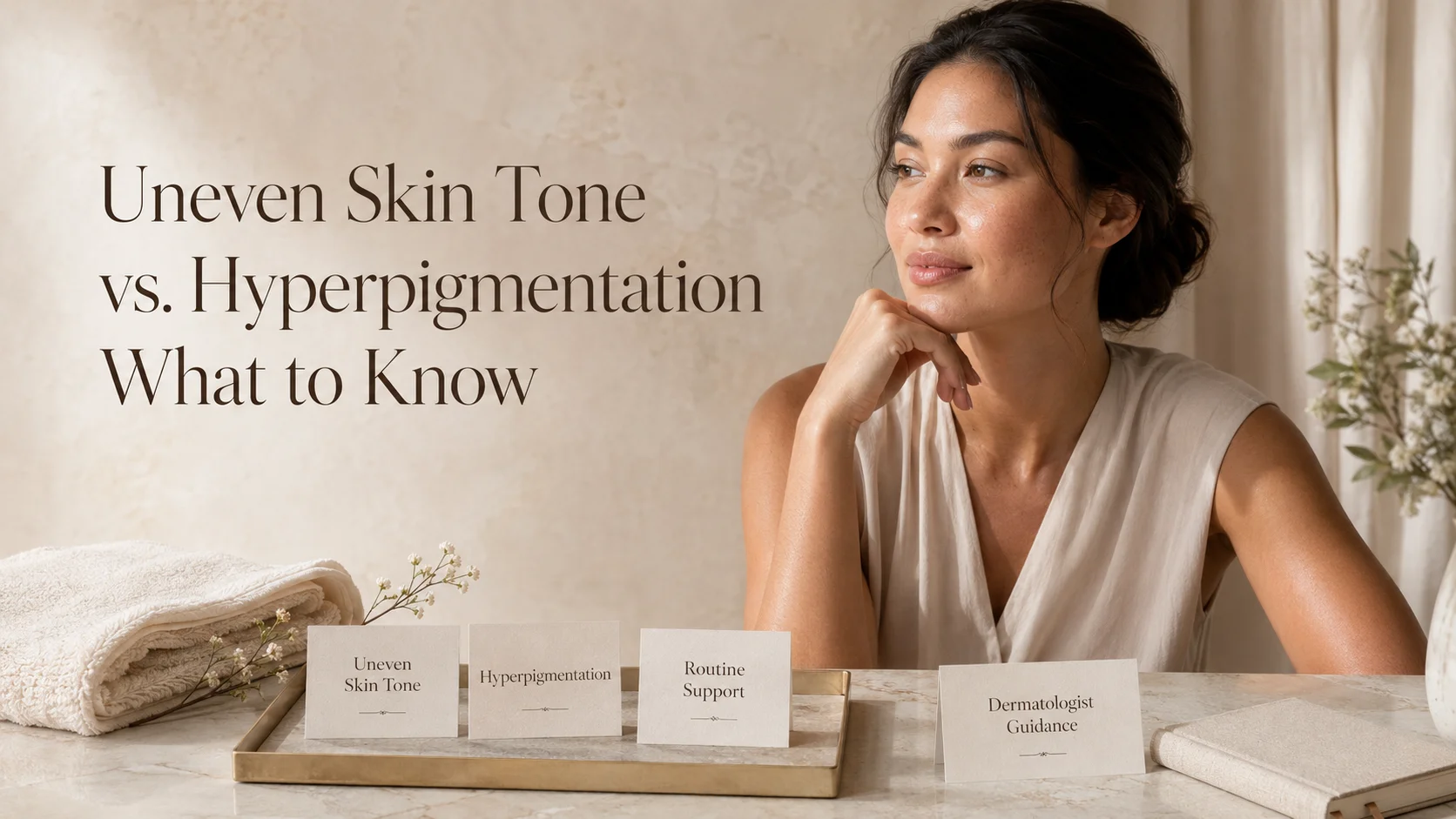
Uneven skin tone and hyperpigmentation are often used as if they mean the same thing.
But they are not exactly the same.
Uneven skin tone is a broad cosmetic description. It means the complexion does not look as even as you would like. It may include dark spot appearance, post-blemish marks, patchy-looking tone, sun-related unevenness appearance, around-mouth tone differences, forehead unevenness, or neck and décolleté tone differences.
Hyperpigmentation is a more clinical term. It generally refers to areas of skin that appear darker because of increased pigment. Some forms, such as melasma or age spots, are dermatology-related concerns and may need medical evaluation depending on the situation. The American Academy of Dermatology notes that sunlight can trigger the skin to produce more melanin in melasma-prone areas, and Mayo Clinic describes age spots as small, flat dark areas that often appear on sun-exposed areas such as the face, hands, shoulders, and arms.
At Zendevie, we do not diagnose hyperpigmentation through a skincare consultation. In consultation, our licensed esthetician can review cosmetic uneven-looking tone, routine habits, SPF use, dark spot appearance, post-blemish marks, sensitivity, dryness, dehydration, oiliness, and exfoliation habits.
But if a spot is changing, bleeding, crusting, painful, sudden, unusual, or worsening, dermatologist guidance should come first.
The goal is not to label your skin.
The goal is to understand what kind of support is appropriate.
Uneven skin tone is a broad cosmetic term for a complexion that looks patchy, marked, dull, or less even. Hyperpigmentation is a more clinical term for areas that appear darker because of increased pigment.
Uneven-looking tone may include:
Hyperpigmentation may include darker-looking areas such as melasma-like patches, sun-related spots, or post-inflammatory-looking marks, but it should not be self-diagnosed casually.
A supportive cosmetic routine may include:
Morning: Gentle cleanser → hydration or brightening-support serum if appropriate → moisturizer → SPF
Evening: Gentle cleanser → moisturizer or targeted support if appropriate
SPF is essential.
Dermatologist guidance is important for changing, bleeding, crusting, painful, sudden, unusual, or worsening spots.
Uneven skin tone describes how the complexion looks.
It is not a diagnosis.
It may show as:
Uneven tone can happen on all skin tones and skin types.
The goal is not to change natural skin color.
The goal is to support a more even-looking complexion.
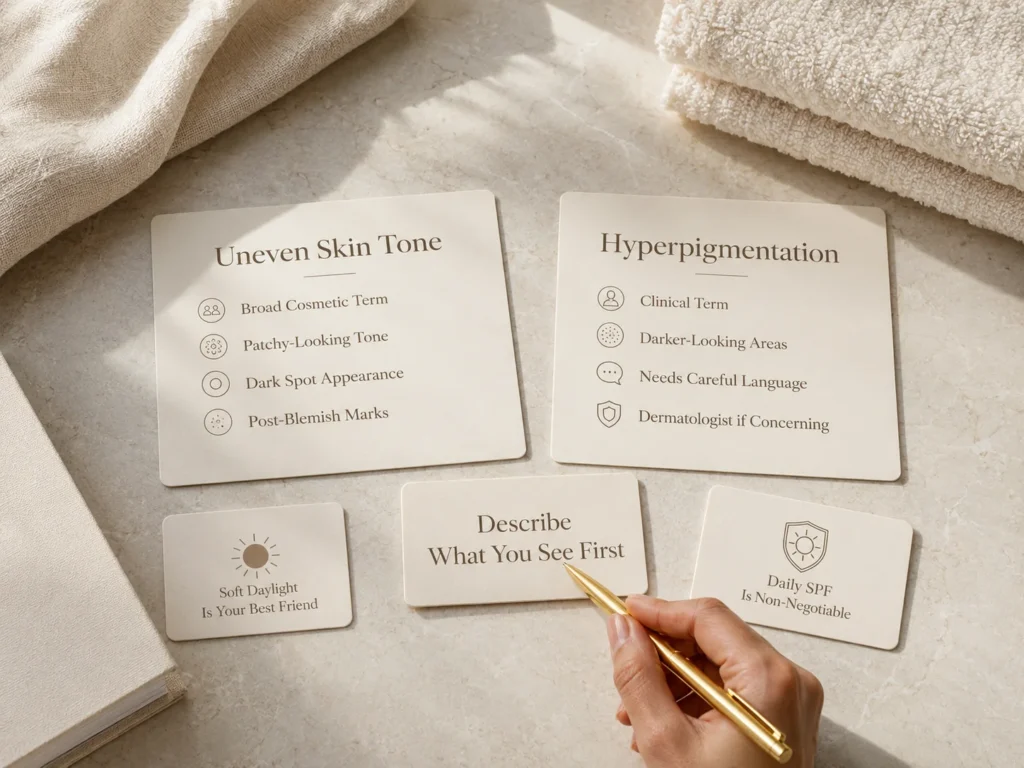
Hyperpigmentation is a broader clinical term used when areas of skin appear darker because of increased pigment.
People may use the word hyperpigmentation to describe:
Because hyperpigmentation can have different causes, it should be discussed carefully.
A skincare consultation can support cosmetic routine planning, but it cannot diagnose medical pigmentation concerns.
People confuse uneven skin tone and hyperpigmentation because both can make the complexion look less even.
For example:
The words often overlap in everyday conversation.
But the safest approach is to describe what you see before deciding what it is.
Uneven skin tone can include many visible concerns.
It may be caused or influenced by:
Not every uneven-looking area is hyperpigmentation.
Sometimes the skin looks uneven because it is dry, dull, dehydrated, textured, or irritated.
Hyperpigmentation is more specific because it refers to areas that appear darker due to increased pigment.
This may be connected to different visible patterns, including sun-related spots, post-inflammatory-looking marks, or melasma-like patches.
Mayo Clinic Health System describes melasma as irregular tan, brown, or brown-gray pigmentation that usually appears on the face, and AAD notes that melasma treatment commonly begins with sun protection and topical creams recommended for that concern.
Because some pigmentation patterns can look similar, professional evaluation matters when the concern is persistent, sudden, changing, or unclear.
For Shop Zendevie content, we should be careful with language.
Cosmetic-safe terms include:
More clinical terms include:
We can explain clinical terms educationally, but we should not diagnose them or promise to treat them with cosmetic skincare.
The distinction matters because different concerns may need different next steps.
A person with cosmetic uneven-looking tone may benefit from routine review, SPF consistency, hydration, moisturizer, and brightening-support products when appropriate.
A person with a changing or unusual spot may need a dermatologist.
A person with melasma-like patches may need medical guidance.
A person with irritation-related patchiness may need calming support first.
A person with dry dull skin may need hydration before brightening support.
The right path depends on what the skin is showing.
Sun exposure can make uneven-looking tone more noticeable.
After sun exposure, the skin may show:
SPF is essential for any routine focused on a more even-looking complexion.
Without SPF, brightening-support products may not be enough.
Post-blemish marks can make the complexion look uneven after a blemish has calmed.
These marks may look:
Post-blemish marks should not be picked, scrubbed, or treated aggressively.
They need protection, patience, and low irritation.
Dryness can make the skin look uneven even when pigment is not the main issue.
Dry uneven-looking skin may show:
If dryness is the cause, the skin may need comfort first.
Brightening-support products may not be the first step.
Dehydration can make the complexion look flat, tired, and uneven.
Dehydrated skin may show:
Hydration support may help the skin look fresher and smoother.
Hydration does not replace SPF.
Irritation can make skin look patchy and uneven.
This may happen after:
Irritated skin should not be pushed with more brightening products.
Calming and simplification may need to come first.
Over-exfoliation can make uneven-looking tone worse.
The skin may appear:
If the skin is over-exfoliated, pause strong active products.
A simple reset may help:
Morning: Mild cleanser → moisturizer → SPF
Evening: Mild cleanser → moisturizer
When a mark or patch looks darker than surrounding skin, it is tempting to self-diagnose it as hyperpigmentation.
But darker-looking areas can have different causes.
They may be related to:
A cosmetic routine can support appearance only when the skin is appropriate for skincare.
A dermatologist should evaluate spots that are changing, sudden, painful, bleeding, crusting, unusual, or worsening.
Melasma is a dermatology-related pigmentation concern that often appears as irregular tan, brown, or brown-gray patches on the face, and sun exposure is one of the factors commonly discussed in relation to it.
If a person suspects melasma, a dermatologist is the right place for diagnosis and treatment planning.
A skincare consultation can support cosmetic routine habits such as SPF consistency and product tolerance, but it should not replace medical evaluation.
Brightening-support products should not be presented as melasma treatment.
Some dark-looking spots may be related to sun exposure over time.
Mayo Clinic describes age spots as small, flat dark areas that usually appear on sun-exposed areas such as the face, hands, shoulders, and arms.
Many sun-related spots are cosmetic concerns, but any spot that changes, bleeds, crusts, hurts, looks unusual, or appears suddenly should be evaluated by a dermatologist.
Do not use brightening products to avoid checking a concerning spot.
Some people use the phrase post-inflammatory hyperpigmentation when discussing marks after breakouts, irritation, or skin stress.
For cosmetic content, it is safer to use “post-blemish mark appearance” unless a dermatologist has diagnosed the concern.
These marks may look more noticeable after:
The routine should focus on gentle care, SPF, and avoiding further irritation.
SPF is important for both uneven-looking tone and hyperpigmentation-looking concerns.
A morning routine without SPF is incomplete when the goal is a more even-looking complexion.
SPF matters especially when using:
SPF should be the final morning skincare step before makeup.
Brightening-support products can support the appearance of a more even-looking complexion.
But they should not be described as treating, curing, removing, healing, or eliminating hyperpigmentation.
A safer way to describe them:
The language matters.
It protects the reader and the brand.
When people hear “hyperpigmentation,” they may think they need the strongest product possible.
That can backfire.
Strong products may irritate the skin and make uneven-looking tone appear worse.
Be careful with:
A routine that the skin can tolerate is usually better than a routine that overwhelms it.
Harsh exfoliation can cause irritation.
Irritation can make uneven-looking tone look more noticeable.
Signs the routine may be too harsh include:
If this happens, pause active products and simplify.
Do not continue because you think peeling means progress.
Vitamin C support may be helpful for some uneven-looking tone routines when tolerated.
But vitamin C should not be forced onto irritated skin.
A simple morning structure may be:
Gentle cleanser → vitamin C support if appropriate → moisturizer → SPF
Vitamin C may need to wait if skin is:
Radiance support should not make the skin uncomfortable.
Moisturizer supports the skin’s comfort and appearance.
Even when the goal is a more even-looking complexion, moisturizer matters.
Skipping moisturizer can make the skin:
A brightening-support serum does not replace moisturizer.
Hydration can support a fresher, smoother-looking complexion.
This matters because dehydrated skin can make uneven tone look more visible.
Hydration may help the skin look:
Hydration is not a hyperpigmentation treatment.
It is part of supporting the overall complexion.
A harsh cleanser can make uneven-looking tone appear worse by making skin feel stripped, dry, or reactive.
A cleanser should remove the day without leaving the skin tight or uncomfortable.
If the cleanser is too harsh, the skin may become:
Gentle cleansing is part of a more even-looking routine.
Makeup may make uneven tone or hyperpigmentation-looking areas appear stronger if the skin underneath is dry, dehydrated, textured, or over-layered.
Makeup may:
If makeup makes the skin look worse, review skincare prep.
The issue may be dryness, dehydration, SPF texture, or product layering.
Some SPF formulas can leave a white, gray, or ashy-looking cast.
This may make dark spot appearance look more noticeable by increasing contrast.
If this happens, the answer is not to skip SPF.
Review:
SPF should be wearable and consistent.
When writing or speaking about hyperpigmentation, use careful language.
Use:
Avoid:
It may be cosmetic uneven tone if:
A skincare consultation may be helpful in these cases.
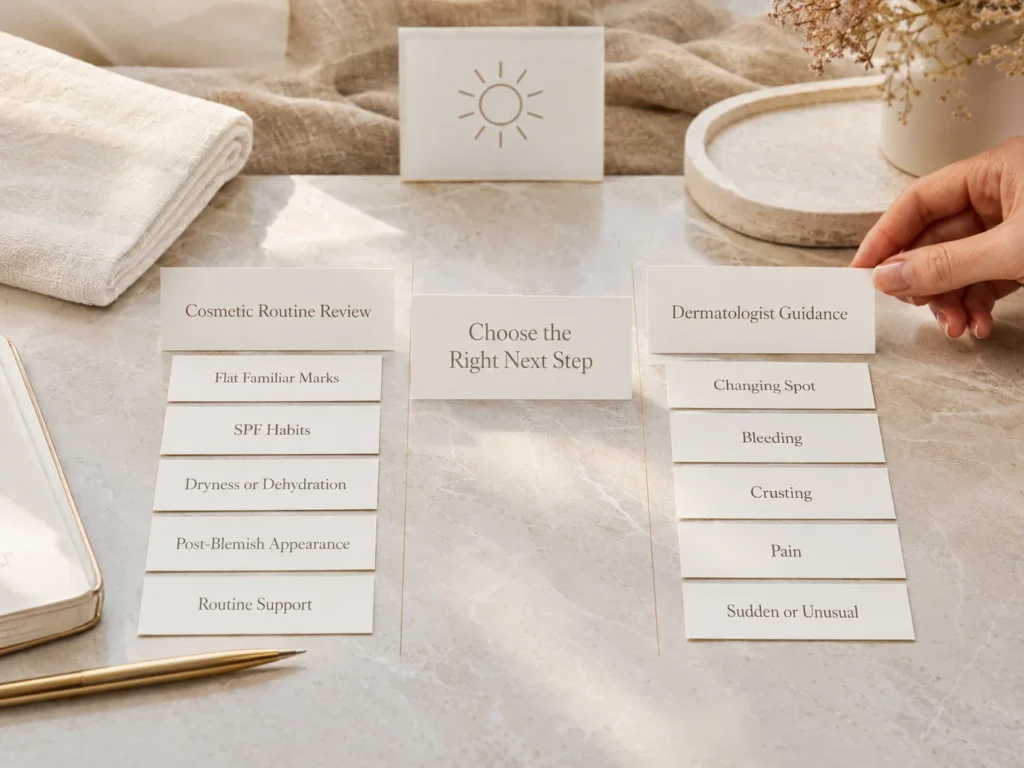
Dermatologist guidance is important if a spot or patch:
Do not self-diagnose concerning spots as simple uneven tone.
A simple morning routine may include:
Gentle cleanser → hydration or brightening-support serum if appropriate → moisturizer → SPF
If the skin is sensitive:
Mild cleanser → moisturizer → SPF
If the skin is dry:
Gentle cleanser → hydrating serum → moisturizer → SPF
If the skin is oily:
Gentle cleanser → lightweight hydration if needed → lightweight moisturizer → SPF
SPF should be the final skincare step.
A simple evening routine may include:
Gentle cleanser → moisturizer
If targeted support is appropriate:
Gentle cleanser → serum or cream → moisturizer
If wearing makeup or heavy SPF:
Makeup/SPF removal step if needed → gentle cleanser → moisturizer
Evening cleansing helps remove SPF, makeup, oil, sweat, and product residue.
Do not scrub aggressively.
Morning:
Gentle cleanser → antioxidant or brightening-support serum if appropriate → moisturizer → SPF
Evening:
Gentle cleanser → moisturizer or targeted support if appropriate
Avoid:
Dark spot appearance needs patience and protection.
Morning:
Gentle cleanser → hydration or brightening-support serum if appropriate → moisturizer → SPF
Evening:
Gentle cleanser → moisturizer or targeted support if appropriate
Avoid:
Post-blemish mark appearance often needs consistency, not aggression.
Morning:
Gentle cleanser → hydrating serum if needed → moisturizer → SPF
Evening:
Gentle cleanser → hydrating serum or moisturizer → cream if needed
Optional:
Brightening-support product only when the skin is stable and SPF is consistent
Avoid harsh scrubs and strong acids on tight skin.
Dry skin needs comfort before brightening support.
Morning:
Gentle cleanser → lightweight hydration if needed → lightweight moisturizer → SPF
Evening:
Gentle cleanser → lightweight moisturizer
Optional:
BHA only when clogged-looking pores, blackheads, whiteheads, or T-zone buildup are present and the skin is stable
Avoid stripping, over-cleansing, and skipping moisturizer.
Oily skin can still be uneven and dehydrated.
Morning:
Mild cleanser → moisturizer → SPF
Evening:
Mild cleanser → moisturizer
Optional later:
Gentle brightening-support product only when the skin is calm and stable
Avoid:
Sensitive skin needs calm first.
Morning:
Gentle cleanser → hydration or radiance support if tolerated → moisturizer → SPF
Evening:
Gentle cleanser → serum or moisturizer → cream if needed
Do not forget:
Mature uneven-looking skin may need hydration, comfort, SPF, and careful brightening support.
Avoid:
A safe routine starts with respect for the skin.
Professional guidance may help if:
A consultation can help identify what belongs in the routine and what should wait.
A dermatologist should evaluate uneven-looking tone, hyperpigmentation-looking patches, marks, or spots if there are warning signs such as:
Cosmetic skincare can support appearance, but changing or concerning marks need medical evaluation.
After consultation, our licensed esthetician may consider Janssen Cosmetics options depending on whether the concern is cosmetic uneven-looking tone, dullness, post-blemish mark appearance, dark spot appearance, dryness, dehydration, sensitivity, oiliness, or product buildup.

For uneven-looking tone and radiance support, possible options may include:
For dry or dehydrated uneven-looking skin, possible options may include:
For sensitive uneven-looking skin, comfort-focused options may come first, such as:
For oily skin with post-blemish marks, clogged-looking areas, or T-zone buildup, possible options may include:
For morning routines, Face Guard Advanced SPF 30 may be considered as the final daytime protection step when appropriate.
These are not automatic recommendations. Cosmetic products should not be positioned as medical treatment for hyperpigmentation. The correct routine depends on skin type, SPF habits, sensitivity, current products, and whether the concern is appropriate for cosmetic skincare or should be evaluated by a dermatologist.
Do not diagnose yourself based only on online photos.
Do not assume every uneven mark is hyperpigmentation.
Do not use brightening-support products without SPF.
Do not scrub dark spot appearance.
Do not pick post-blemish marks.
Do not apply active products to broken, crusted, bleeding, or painful skin.
Do not combine acids, scrubs, retinol-style products, and strong vitamin C blindly.
Do not use professional-only products at home.
Do not use whitening language or goals.
Do not ignore changing, bleeding, crusting, painful, sudden, or unusual marks.
Uneven skin tone is a broad cosmetic description for skin that looks patchy, marked, dull, or less even. Hyperpigmentation is a more clinical term for areas that appear darker because of increased pigment.
Not necessarily. Dark spot appearance can have different causes. A dermatologist can diagnose medical pigmentation concerns, especially if a spot is changing, unusual, painful, bleeding, or worsening.
Cosmetic skincare should not be described as treating hyperpigmentation. Skincare may support the appearance of a more even-looking complexion when appropriate, but diagnosis and medical treatment belong with a dermatologist.
Yes. SPF is essential because daylight exposure can make dark spot appearance, post-blemish marks, and uneven-looking tone look more noticeable.
Dark spots are a common way people describe darker-looking areas. Hyperpigmentation is a broader clinical term. If a spot is changing or concerning, it should be evaluated.
Some people use clinical terms for post-blemish marks, but for cosmetic skincare content, “post-blemish mark appearance” is safer unless a dermatologist has diagnosed the concern.
Vitamin C support may help some routines focused on radiance and more even-looking tone when tolerated. It should be paired with SPF and introduced carefully.
Do not exfoliate aggressively. Exfoliation may help some rough texture concerns, but harsh exfoliation can irritate the skin and make tone look patchier.
Timing varies. The appearance of uneven tone depends on SPF consistency, skin type, sun exposure, sensitivity, hydration, product tolerance, and whether the concern needs medical evaluation.
See a dermatologist if a spot changes in size, shape, or color; bleeds; crusts; hurts; itches severely; appears suddenly; looks unusual; has irregular-looking borders; or worsens quickly.
If you are unsure whether your concern is uneven skin tone, dark spot appearance, post-blemish marks, or a hyperpigmentation-looking concern, you do not have to guess.
At Zendevie, a free virtual consultation helps us review your skin type, SPF habits, sensitivity, cleanser, moisturizer, hydration level, exfoliation, current products, and tone concerns before recommending anything.
And if something looks changing, painful, sudden, crusted, bleeding, or medically concerning, we will always encourage you to speak with a dermatologist first.
The right routine starts with understanding the skin clearly.
Then supporting it with care.

Zendevie is guided by Haby Diallo, a licensed esthetician with more than 20 years of professional skincare experience. Her approach is rooted in education, professional judgment, and personal care.
years of experience