


Should Uneven-Looking Skin Use a Toner? What to Look For
Uneven-looking skin does not always need a toner.
A toner can be helpful when it matches the skin’s real need. But it can also make uneven-looking tone appear worse if it is too drying, too strong, too exfoliating, or used with too many active products.
This is why toner should not be added just because the skin has dark spot appearance, post-blemish marks, dullness, or patchiness.
The better question is:
What do you want the toner to do?
At Zendevie, we do not recommend toner blindly. In consultation, our licensed esthetician first looks at skin type, cleanser choice, hydration level, oiliness, sensitivity, SPF habits, exfoliation history, dark spot appearance, post-blemish marks, and whether the skin is already irritated or over-exfoliated.
Toner can support a routine.
But it should not stress the skin.
Quick Answer
Uneven-looking skin may use a toner if the toner supports the skin’s needs after cleansing. A toner may help the skin feel fresher, more hydrated, calmer, or more balanced depending on the formula.
A toner may be helpful if:
- Skin feels dull after cleansing
- Skin feels dehydrated
- Skin needs light hydration before serum or moisturizer
- Skin is oily but should not be stripped
- Skin feels coated from SPF or makeup residue
- Skin needs a gentle freshening step
- Skin needs calming support
- Skin can tolerate a mild exfoliating step when appropriate
A toner may not be right if:
- Skin is burning
- Skin is stinging
- Skin is rash-like
- Skin is over-exfoliated
- Moisturizer stings
- SPF stings
- The toner is drying
- The toner is used with too many acids
- The toner makes skin feel tight
- The skin is broken, crusted, bleeding, or painful
A simple routine may look like:
Morning: Cleanser → toner if appropriate → serum if appropriate → moisturizer → SPF
Evening: Cleanser → toner if appropriate → moisturizer or targeted support
Toner is optional.
SPF is essential.
What Toner Does in a Routine
Toner is used after cleansing.
Depending on the formula, toner may help the skin feel:
- Fresh
- Lightly hydrated
- Comfortable
- Balanced
- Less coated
- Prepared for serum
- Prepared for moisturizer
- Refreshed after cleansing
But toner is not one single type of product.
Some toners are hydrating.
Some are calming.
Some are freshening.
Some are exfoliating.
Some are more astringent and may feel drying.
The type matters.
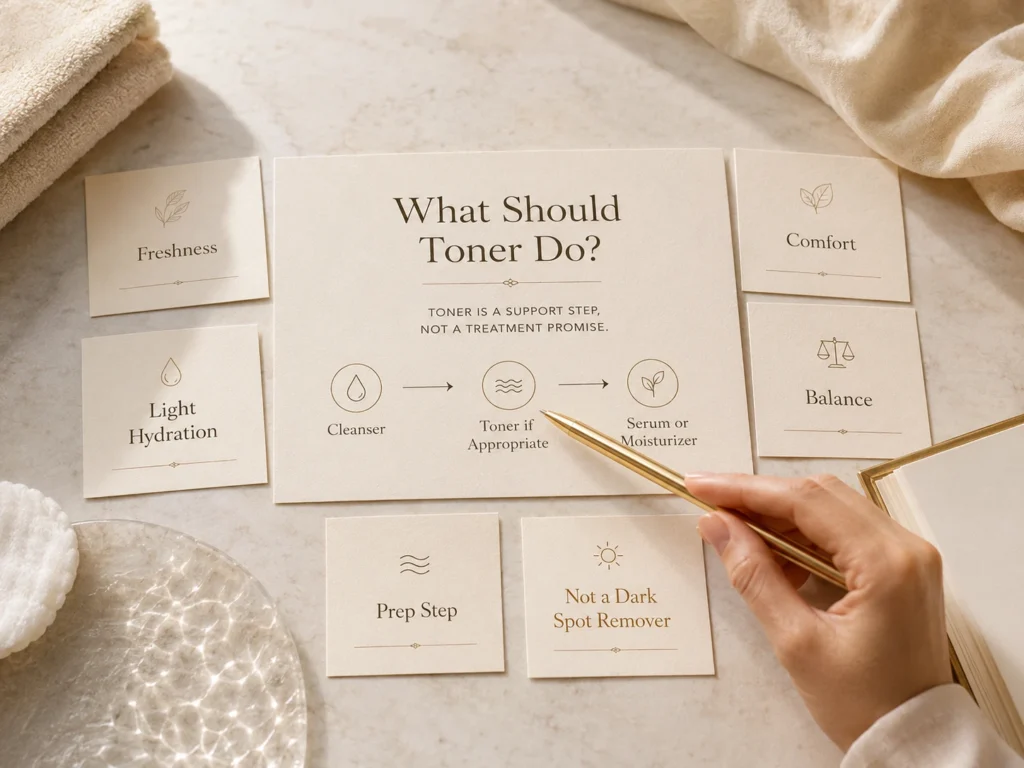
Toner Is Not a Dark Spot Remover
A toner does not remove dark spots.
Dark spot appearance should not be treated like something that can be wiped away.
A toner may support the routine by helping the skin feel fresh or prepared for the next step. But dark spot appearance usually needs:
- Daily SPF
- Gentle cleansing
- Moisturizer
- Hydration if needed
- Brightening-support products when appropriate
- Low irritation
- Patience
- Dermatologist guidance for changing or concerning marks
Do not use a harsh toner to scrub or dry out dark spots.
Toner Is Not a Shortcut for Post-Blemish Marks
Post-blemish marks should not be attacked with harsh toner.
A strong toner can irritate the area and make it look more noticeable, especially if the mark is recent or the skin was picked.
Post-blemish marks need:
- No picking
- Gentle cleansing
- Moisturizer
- SPF
- Low irritation
- Brightening-support care only when appropriate
- Time
If the skin is broken, crusted, bleeding, or painful, toner should not be applied to that area.
Toner Should Not Make Skin Feel Tight
A toner may be too harsh if your skin feels tight after applying it.
Tightness may be a sign that the toner is too drying or too strong for the skin.
A toner should not leave the skin feeling:
- Stripped
- Hot
- Burning
- Stingy
- Raw
- Dry
- Shiny but uncomfortable
- More sensitive
- More patchy
- Uncomfortable under moisturizer
If toner makes uneven-looking skin feel worse, it should be reviewed.
Hydrating Toner for Uneven-Looking Skin
A hydrating toner may be helpful when uneven-looking skin also feels dehydrated, tight, flat, or dull.
Hydrating toner may support:
- Comfort after cleansing
- A fresher-looking complexion
- Better moisturizer feel
- Smoother-looking makeup
- Skin that feels less tight
- A more comfortable SPF application
Hydrating toner is not a replacement for serum, moisturizer, or SPF.
It is a support step.
Calming Toner for Sensitive Uneven Skin
A calming toner may be helpful when uneven-looking skin is also sensitive, easily reactive, or redness-prone-looking.
Sensitive skin may need a toner that feels gentle and comforting.
A calming toner should not sting or burn.
It may support skin that feels:
- Tight
- Reactive
- Dry
- Patchy
- Easily irritated
- Sensitive after cleansing
- Uncomfortable with active products
If sensitive skin is actively irritated, toner may need to wait.
The routine should be simple first.
Freshening Toner for Dull Uneven Skin
A freshening toner may help dull uneven skin feel cleaner and more refreshed after cleansing.
This may be useful when skin feels:
- Coated
- Dull
- Less fresh
- Heavy from SPF
- Heavy from makeup
- Tired-looking
- Less smooth under moisturizer
A freshening toner should still be gentle.
It should not dry the skin or replace proper cleansing.
Balancing Toner for Oily Uneven Skin
Oily uneven-looking skin may benefit from a toner that helps the skin feel balanced after cleansing.
But oily skin should not be stripped.
A toner for oily skin should not leave the skin tight, burning, or dry.
Oily skin may need toner support when there is:
- T-zone shine
- Buildup
- Clogged-looking pores
- Makeup separation
- SPF heaviness
- Skin feeling oily but not fresh
- Post-blemish mark appearance after blemishes
Balance is the goal.
Not dryness.
Exfoliating Toner for Uneven-Looking Skin
Exfoliating toner may be helpful for some skin when rough surface buildup, dullness, or clogged-looking texture is part of the concern.
But exfoliating toner should be used carefully.
It may contain ingredients that exfoliate the skin surface.
This can be too much if the routine already includes:
- AHA
- BHA
- Scrubs
- Retinol-style products
- Strong vitamin C
- Peeling products
- Exfoliating cleanser
- Brightening-support serum
Exfoliating toner is not for every uneven-tone routine.
When Exfoliating Toner May Be Too Much
An exfoliating toner may be too much if the skin is:
- Sensitive
- Dry
- Burning
- Stinging
- Tight
- Flaky
- Rash-like
- Over-exfoliated
- Freshly picked
- Broken
- Crusted
- Bleeding
- Painful
- Reacting to moisturizer
- Reacting to SPF
If moisturizer or SPF stings, exfoliating toner should wait.
Toner and Over-Exfoliation
Toner can contribute to over-exfoliation if it contains exfoliating ingredients or is used too often.
Signs toner may be overworking the skin include:
- Tightness after toner
- Burning
- Stinging
- Flaking
- Shiny but dull skin
- Moisturizer burning
- SPF stinging
- Makeup clinging
- More patchiness
- Marks looking stronger
- Skin feeling raw
If this happens, stop the toner and simplify the routine.
Toner and SPF
Toner does not replace SPF.
SPF is essential for uneven-looking tone, dark spot appearance, and post-blemish marks.
A morning routine may look like:
Cleanser → toner if appropriate → serum if appropriate → moisturizer → SPF
SPF should remain the final morning skincare step before makeup.
If toner makes SPF sting or pill, the toner may not be right for that routine.
Toner and Serum
Toner usually comes before serum.If you are unsure whether serum belongs before cream, review that step before adding more products.
A simple order is:
Cleanser → toner → serum → moisturizer → SPF
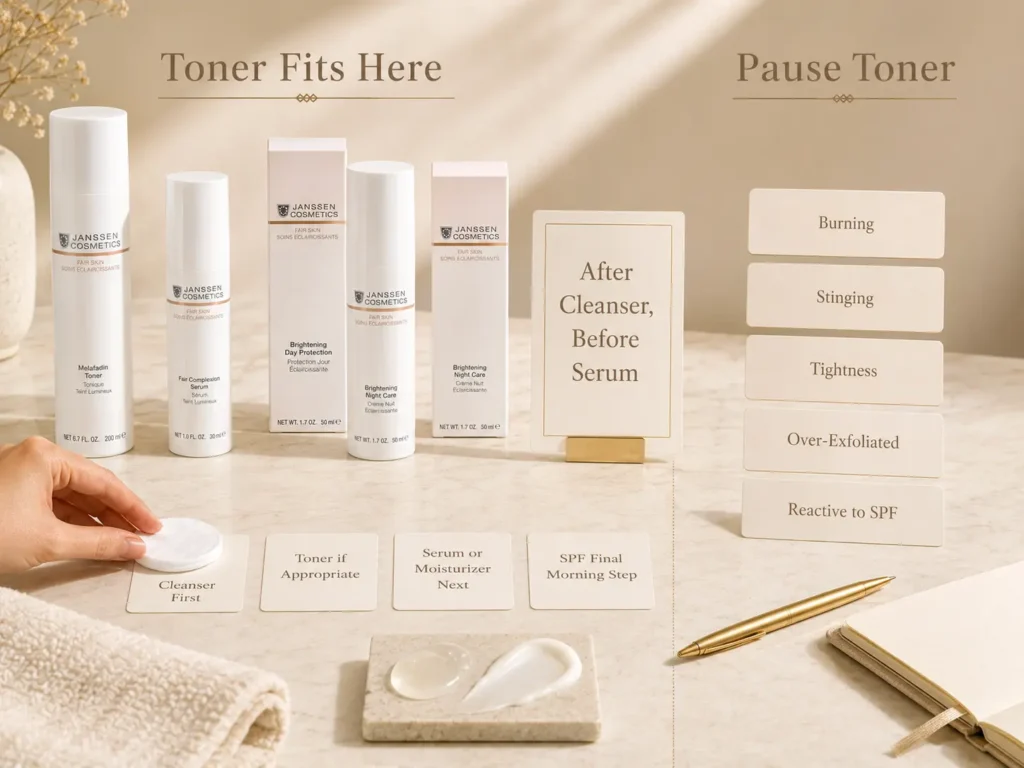
But not every routine needs both toner and serum.
If the skin is sensitive or easily overwhelmed, it may be better to keep the routine simple:
Cleanser → moisturizer → SPF
Toner should not be added just to make the routine longer.
Toner and Moisturizer
Toner does not replace moisturizer.
Even if toner feels hydrating, moisturizer still helps support comfort and softness.
Skipping moisturizer can make the skin feel:
- Tight
- Dry
- Flaky
- More reactive
- Less smooth under SPF
- Less comfortable under makeup
A toner may support the skin after cleansing, but moisturizer helps complete the comfort step.
Toner and Makeup
A toner may help makeup sit better if it supports hydration and freshness after cleansing.
But the wrong toner can make makeup look worse.
Makeup may look patchy if toner makes the skin:
- Tight
- Dry
- Flaky
- Sticky
- Over-exfoliated
- Irritated
- More textured
- Sensitive under foundation
If makeup looks worse after toner, the toner should be reviewed.
Toner and Product Buildup
Toner may help the skin feel fresher when product buildup is part of the concern.
But toner should not replace proper cleansing.
If skin feels coated from SPF, makeup, oil, sweat, or primer, the evening cleanse may need review.
A toner can support freshness, but cleanser does the main removal work.
Do not use toner as a harsh wiping step to remove makeup residue aggressively.
Toner for Dry Uneven-Looking Skin
Dry uneven-looking skin may benefit from a hydrating or comfort-focused toner.
Dry skin may look uneven because roughness, flaking, or tightness makes tone differences more visible.
A toner for dry uneven skin should not sting or dry the skin.
A routine may look like:
Morning: Gentle cleanser → hydrating toner if appropriate → hydrating serum if needed → moisturizer → SPF
Evening: Gentle cleanser → hydrating toner if appropriate → moisturizer or cream
Dry skin needs comfort before strong brightening support.
Toner for Dehydrated Uneven-Looking Skin
Dehydrated skin may look dull, tight, flat, and patchy.
A hydrating toner may help support the skin after cleansing.
Dehydrated skin may benefit from:
- Hydrating toner
- Hydrating serum
- Moisturizer
- SPF
- Gentle cleansing
- Less exfoliation
- Fewer drying products
If the skin feels tight after toner, it may not be hydrating enough.
Toner for Oily Uneven-Looking Skin
Oily uneven-looking skin may benefit from a freshening or balancing toner.
But avoid toners that make the skin feel stripped.
Oily skin can become oily but dehydrated when over-dried.
A routine may look like:
Morning: Gentle gel cleanser → toner if appropriate → lightweight moisturizer → SPF
Evening: Gentle cleanser → toner if appropriate → lightweight moisturizer
If clogged-looking pores or T-zone buildup are present, BHA may be reviewed carefully.
Toner for Combination Uneven-Looking Skin
Combination skin may need toner used thoughtfully.
The T-zone may like a freshening toner.
The cheeks may need hydration.
The mouth area may be sensitive.
A toner for combination skin should not make dry areas feel tight or oily areas feel coated.
Zone awareness matters.
Do not use a strong toner all over the face if only the T-zone needs balancing.
Toner for Sensitive Uneven-Looking Skin
Sensitive uneven-looking skin should be careful with toner.
A toner should not sting, burn, or make skin hot.
Sensitive skin may do best with:
- Mild cleanser
- Moisturizer
- SPF
- Calming support if appropriate
- Minimal steps
A toner may be helpful if it is gentle and comforting.
But if sensitive skin is irritated, toner may need to wait.
Toner for Mature Uneven-Looking Skin
Mature uneven-looking skin may benefit from a toner if it supports comfort, hydration, or freshness.
Mature skin may show:
- Dryness
- Dullness
- Texture
- Dark spot appearance
- Sun-related unevenness appearance
- Neck and décolleté tone differences
- Makeup settling
A toner should not make mature skin feel tight.
Mature skin often needs hydration, moisturizer, SPF, and gentle radiance support.
Toner for Dull Uneven Skin
Dull uneven skin may benefit from a toner if dullness is related to residue, dehydration, or lack of freshness.
A toner may help the skin feel more refreshed after cleansing.
But dull skin may also need:
- Better hydration
- Better evening cleansing
- Moisturizer
- SPF
- Less product buildup
- Gentle exfoliation only if appropriate
- Fewer active products if irritated
Toner is only one possible support step.
Toner for Post-Blemish Marks
Post-blemish marks need low irritation.
A toner may be used if it is gentle and does not sting.
Avoid using strong toner on:
- Fresh marks
- Picked areas
- Crusted areas
- Bleeding areas
- Painful blemishes
- Open skin
- Areas that sting with moisturizer
Post-blemish marks need SPF and patience more than aggressive toner use.
Toner for Dark Spot Appearance
A toner may be part of a routine for dark spot appearance, but it should not be seen as the main solution.
A routine may include:
Morning: Cleanser → toner if appropriate → brightening-support serum if appropriate → moisturizer → SPF
Evening: Cleanser → toner if appropriate → moisturizer or targeted support
Dark spot appearance still needs SPF, low irritation, and consistency.
Toner Around the Mouth
The area around the mouth can be sensitive.
Be careful using toner around:
- Upper lip
- Corners of the mouth
- Chin crease
- Dry patches
- Cracked areas
- Post-blemish marks
- Areas that sting easily
Avoid strong exfoliating toner near irritated around-mouth areas.
Apply SPF carefully around the upper lip during the day.
Toner on the Forehead
The forehead may benefit from toner if there is oil, sweat, product buildup, or dullness.
But forehead unevenness may also come from:
- Sun exposure
- Hair product residue
- SPF gaps
- Hats
- Picking
- Over-exfoliation
- Dryness
- Irritation
Toner may help freshness, but it may not be the only needed step.
Review cleansing and SPF placement too.
Toner on the Cheeks
Cheeks can be dry or sensitive.
Avoid strong toners on cheeks if they feel:
- Tight
- Dry
- Stingy
- Hot
- Flaky
- Redness-prone-looking
- Sensitive under makeup
- Reactive to moisturizer
Cheeks often need hydration and moisturizer before active toner support.
Toner on the Neck and Décolleté
The neck and décolleté can be more delicate than the face.
Avoid strong exfoliating toners on these areas without guidance.
These areas may need:
- Gentle cleansing
- Moisturizer
- SPF when exposed
- Hydrating or comfort-focused support if appropriate
- Dermatologist guidance for changing spots
Do not aggressively tone or exfoliate the neck and chest.
Should You Use Toner Morning and Night?
Some people may use toner morning and night.
Others may only need it once daily.
Some may not need toner at all.
Frequency depends on:
- Skin type
- Toner type
- Sensitivity
- Dryness
- Oiliness
- Active product use
- SPF habits
- Makeup wear
- Exfoliation history
An exfoliating toner should usually be used more carefully than a hydrating toner.
More often is not always better.
Should You Use Toner Every Day?
A gentle hydrating or calming toner may be used daily if the skin tolerates it.
But exfoliating toner should be used with more caution.
Do not use exfoliating toner daily if the skin becomes:
- Tight
- Burning
- Stinging
- Flaky
- Shiny but dull
- Patchy
- Sensitive to SPF
- Sensitive to moisturizer
Daily toner is not required for every routine.
Should You Apply Toner With Cotton or Hands?
Some toners can be applied with hands.
Some are applied with cotton.
The best method depends on the formula and product directions.
For sensitive uneven-looking skin, rubbing with cotton can be irritating if pressure is used.
Avoid aggressive wiping.
Toner should be applied gently.
The goal is support, not friction.
Should You Use Toner Before Vitamin C?
Toner usually comes before serum, including vitamin C, if the toner is appropriate.
A routine may look like:
Cleanser → toner → vitamin C support if appropriate → moisturizer → SPF
But if the skin is sensitive, skip toner if it makes the routine too much.
Vitamin C and exfoliating toner together can be too strong for some skin.
Should You Use Toner Before Brightening Serum?
Yes, toner usually comes before brightening-support serum.
A routine may look like:
Cleanser → toner → brightening-support serum → moisturizer → SPF
But the toner and serum should not both be strong active steps unless the skin can tolerate them.
If the skin stings, burns, or becomes patchy, simplify.
Should You Use Toner Before Retinol-Style Products?
Toner may come before retinol-style products, but caution is needed.
If the toner is exfoliating, combining it with retinol-style products may be too strong for some skin.
A safer evening may be:
Cleanser → moisturizer
or:
Cleanser → retinol-style product if appropriate → moisturizer
Keep exfoliating toner separate unless professionally guided.
Should You Use Toner After Exfoliation?
If you are already exfoliating, be careful adding toner.
A hydrating toner may support comfort if the skin tolerates it.
An exfoliating toner after exfoliation may be too much.
Avoid layering exfoliating toner with:
- Scrubs
- AHA
- BHA
- Peeling products
- Exfoliating cleanser
- Retinol-style products
The routine should not overwhelm the skin.
Simple Routine With Toner
A simple toner routine may look like:
Morning:
Cleanser → toner if appropriate → moisturizer → SPF
Evening:
Cleanser → toner if appropriate → moisturizer
If the skin needs serum:
Cleanser → toner → serum → moisturizer → SPF
Keep the routine simple enough for the skin to tolerate.
Routine Without Toner
A routine without toner is completely acceptable.
Morning:
Cleanser → moisturizer → SPF
Evening:
Cleanser → moisturizer
If the skin needs more support later:
Add serum, hydration, or toner only if appropriate.
Not using toner does not mean the routine is incomplete.
For uneven-looking tone, SPF is more important than toner.
Routine for Dry Uneven Skin With Toner
Morning:
Gentle cleanser → hydrating toner if appropriate → hydrating serum if needed → moisturizer → SPF
Evening:
Gentle cleanser → hydrating toner if appropriate → moisturizer or cream
Avoid drying toners, harsh exfoliating toners, and active stacking.
Dry uneven skin needs comfort first.
Routine for Oily Uneven Skin With Toner
Morning:
Gentle gel cleanser → balancing toner if appropriate → lightweight moisturizer → SPF
Evening:
Gentle cleanser → toner if appropriate → lightweight moisturizer
Optional:
BHA only when clogged-looking pores, blackheads, whiteheads, or T-zone buildup are present and the skin is stable
Avoid drying the skin aggressively.
Routine for Sensitive Uneven Skin With Toner
Morning:
Mild cleanser → calming toner if tolerated → moisturizer → SPF
Evening:
Mild cleanser → calming toner if tolerated → moisturizer
If toner stings, skip it.
Sensitive skin does not need toner if toner creates discomfort.
Comfort comes first.
Routine for Mature Uneven Skin With Toner
Morning:
Gentle cleanser → hydrating or comfort-focused toner if appropriate → radiance support if tolerated → moisturizer → SPF
Evening:
Gentle cleanser → toner if appropriate → serum or moisturizer → cream if needed
Do not forget the neck and décolleté if the product is appropriate for those areas.
Avoid strong exfoliating toner on delicate skin without guidance.
Routine for Dull Uneven Skin With Toner
Morning:
Cleanser → freshening toner if appropriate → radiance or hydration support if needed → moisturizer → SPF
Evening:
Cleanser → toner if appropriate → moisturizer
If dullness is from buildup, evening cleansing may matter more than toner.
If dullness is from dehydration, hydrating support may matter more.
Routine for Post-Blemish Marks With Toner
Morning:
Gentle cleanser → toner if appropriate → serum if appropriate → moisturizer → SPF
Evening:
Gentle cleanser → toner if appropriate → moisturizer
Avoid toner on broken, freshly picked, crusted, bleeding, or painful areas.
Post-blemish marks need gentle care.
Routine for Dark Spot Appearance With Toner
Morning:
Gentle cleanser → toner if appropriate → brightening-support serum if appropriate → moisturizer → SPF
Evening:
Gentle cleanser → toner if appropriate → moisturizer or targeted support
Avoid strong toner if the skin is sensitive, over-exfoliated, or irritated.
Dark spot appearance needs SPF and patience.
When to Stop Using Toner
Stop or pause toner if the skin becomes:
- Burning
- Stinging
- Tight
- Hot
- Flaky
- Rash-like
- Swollen
- Painful
- More patchy
- More sensitive
- Reactive to moisturizer
- Reactive to SPF
A toner should not make the skin feel worse.
If symptoms persist or worsen, seek dermatologist guidance.
When Professional Guidance Helps
Professional guidance may help if:
- You are unsure whether toner belongs in your routine
- Toner makes your skin sting
- Your skin feels tight after toner
- You are using exfoliating toner with other active products
- SPF stings after toner
- Makeup looks patchy after toner
- Your skin is sensitive and uneven-looking
- Your skin is oily but dehydrated
- You have post-blemish marks and are using strong toner
- You want a brightening-support routine without irritation
A consultation can help decide whether toner is useful or unnecessary.
When to See a Dermatologist
A dermatologist should evaluate skin if there are warning signs such as:
- Persistent rash-like irritation
- Swelling
- Pain
- Severe itching
- Burning that does not settle
- Crusting
- Bleeding
- Oozing
- Infection-looking areas
- Blistering
- Eye-area irritation
- Sudden discoloration
- A spot changing in size, shape, or color
- A spot that looks very different from others
- Skin reacting strongly to basic products
- Rapid worsening
Cosmetic skincare can support appearance, but medical-looking changes need medical evaluation.
Where Janssen Cosmetics Fits
After consultation, our licensed esthetician may consider Janssen Cosmetics toner options depending on whether the skin needs freshness, hydration, calming support, oil balance, or brightening-support routine preparation.
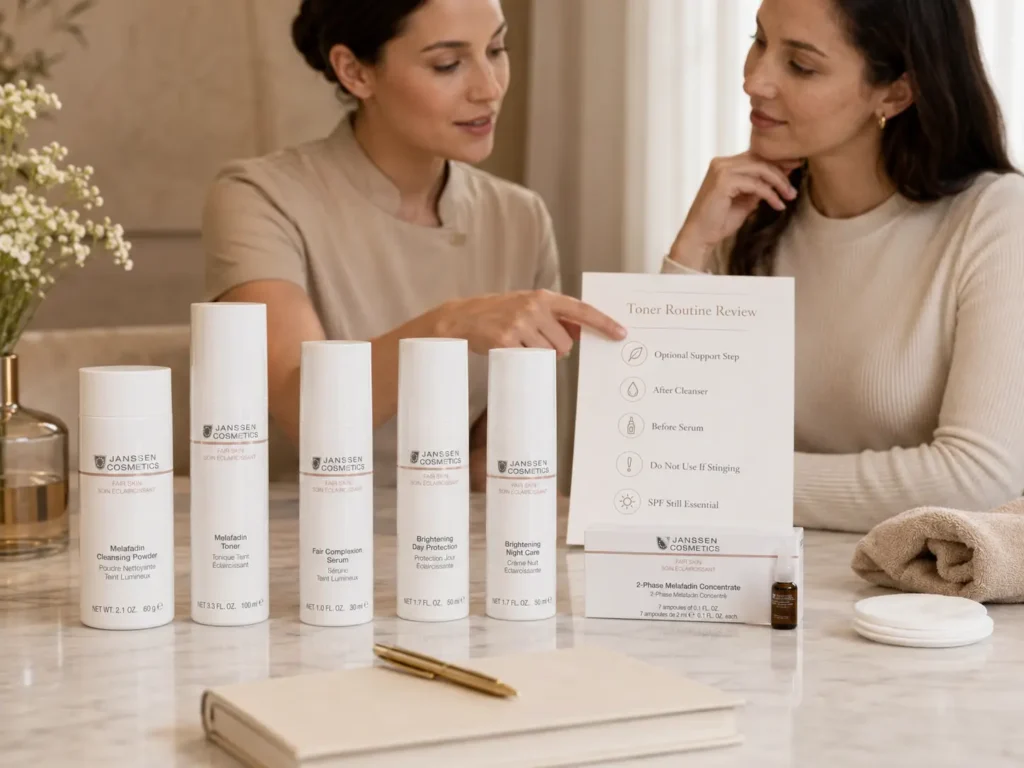
For uneven-looking, dull, or tired-looking skin, possible options may include:
- Brightening Face Freshener when a freshening tonic step fits a radiance-support routine
- Brightening Face Cleanser before the freshener when appropriate
For dry or moisture-deficient uneven-looking skin, possible options may include:
- Radiant Firming Tonic when a tonic step fits a dry or mature routine
- Mild Creamy Cleanser before the tonic when appropriate
For sensitive uneven-looking skin, possible options may include:
- Soft Soothing Tonic when a gentle calming tonic step fits
- Soft Cleansing Mousse before the tonic when appropriate
For oily or combination uneven-looking skin, possible options may include:
- Purifying Tonic only if tolerated and appropriate for oily or buildup-prone areas
- Purifying Cleansing Gel before the tonic when appropriate
For dry or dehydrated skin that needs more support after toner, possible options may include:
- Deep Xpress Moist Serum
- Hydro Active Gel
- Super Hydrating Cream
- Hyaluron³ Replenish Cream
For sensitive skin needing comfort before brightening support, options may include:
- Intense Calming Serum
- Intense Calming Cream or Intense Calming Lotion
- Instant Soothing Mask
For radiance and uneven-looking tone support after toner, possible options may include:
- Magic Glow Serum
- Vitaforce C Skin Complex only when vitamin C support is appropriate and tolerated
- Vitaforce C Cream
- Sensational Glow Cream
For morning routines, Face Guard Advanced SPF 30 may be considered as the final daytime protection step when appropriate and tolerated.
These are not automatic recommendations. Toner should be selected based on skin type, sensitivity, cleanser, SPF habits, current active products, and whether the skin needs hydration, calming, oil balance, or radiance support.
What Not to Do
Do not use toner as a dark spot remover.
Do not scrub post-blemish marks with toner.
Do not use drying toner on tight or irritated skin.
Do not use exfoliating toner with multiple acids, scrubs, and retinol-style products blindly.
Do not apply toner to broken, crusted, bleeding, or painful skin.
Do not skip moisturizer because you use toner.
Do not skip SPF because you use brightening toner.
Do not keep using toner that burns, stings, or makes skin more patchy.
Do not use professional-only exfoliation products at home.
Do not ignore changing, sudden, bleeding, crusting, painful, or unusual marks.
Frequently Asked Questions
Should uneven-looking skin use a toner?
Uneven-looking skin may use a toner if the toner supports the skin’s needs. Toner is optional and should be chosen based on skin type, sensitivity, hydration, oiliness, and routine goals.
Can toner help uneven skin tone?
A toner may support freshness, hydration, calming, or gentle routine preparation, but it does not remove dark spots or replace SPF.
What toner is best for uneven-looking skin?
The best toner depends on the skin. Dry skin may need hydrating toner, sensitive skin may need calming toner, oily skin may need balancing toner, and dull skin may need freshening support.
Should I use an exfoliating toner for uneven tone?
Only if the skin is stable and rough texture or buildup is part of the concern. Avoid exfoliating toner if the skin is irritated, dry, sensitive, or already using other active products.
Can toner make uneven tone worse?
Yes. A toner that is too drying, too strong, or overused can irritate the skin and make uneven-looking tone appear more patchy.
Does toner go before serum?
Yes. Toner usually goes after cleanser and before serum, moisturizer, and SPF.
Does toner replace moisturizer?
No. Toner does not replace moisturizer. Even hydrating toner should usually be followed with moisturizer.
Can sensitive skin use toner?
Sensitive skin can use toner only if it is gentle and does not sting or burn. If toner irritates the skin, skip it.
Should oily uneven skin use toner?
Oily uneven skin may benefit from a balancing toner, but it should not strip the skin. Oily skin still needs moisturizer and SPF.
When should I see a dermatologist?
See a dermatologist if skin has persistent rash-like irritation, swelling, pain, severe itching, burning that does not settle, crusting, bleeding, oozing, infection-looking areas, blistering, changing spots, or rapid worsening.
If you are not sure whether toner belongs in your uneven-tone routine, you do not need to guess.
At Zendevie, a free virtual consultation helps us review your cleanser, toner, moisturizer, SPF habits, skin type, sensitivity, hydration level, dark spot appearance, post-blemish marks, and current active products before recommending anything.
The right toner should make the routine feel more balanced.
Not more irritated.

About the Esthetician Behind Zendevie
Zendevie is guided by Haby Diallo, a licensed esthetician with more than 20 years of professional skincare experience. Her approach is rooted in education, professional judgment, and personal care.
20+
years of experience