



The best cleanser for uneven skin tone is not always the strongest cleanser.
It is not always the cleanser that makes the skin feel squeaky clean.
It is not always the cleanser with the most active ingredients.
For uneven-looking tone, the right cleanser should remove the day without making the skin feel stripped, tight, irritated, or raw. It should help prepare the skin for the rest of the routine: hydration, moisturizer, brightening-support products if appropriate, and SPF.
Uneven-looking tone can appear worse when the skin is dry, irritated, over-cleansed, over-exfoliated, or coated with product buildup. This is why cleanser choice matters.
At Zendevie, we do not recommend a cleanser blindly just because someone says they have dark spots or uneven tone. In consultation, our licensed esthetician first looks at skin type, sensitivity, makeup use, SPF habits, oil pattern, dryness, dehydration, product buildup, post-blemish marks, dark spot appearance, and current routine before recommending anything.
A cleanser should support the routine.
It should not fight the skin.
The best cleanser for uneven skin tone is a cleanser that removes SPF, makeup, oil, sweat, and buildup without stripping or irritating the skin.
A good cleanser for uneven-looking tone should help the skin feel:
The right cleanser depends on skin type:
A basic routine may look like:
Morning: Cleanser → serum if appropriate → moisturizer → SPF
Evening: Cleanser → moisturizer or targeted support if appropriate
The cleanser is the first step, but SPF remains essential for uneven-looking tone.
Cleanser matters because uneven-looking tone can look worse when the skin surface is not balanced.
If the cleanser is too harsh, the skin may become dry, tight, flaky, or irritated.
If the cleanser is not effective enough, SPF, makeup, oil, sweat, and residue may build up and make the complexion look dull or patchy.
A good cleanser helps remove:
But it should not leave the skin uncomfortable.
Uneven tone routines need a clean, calm starting point.
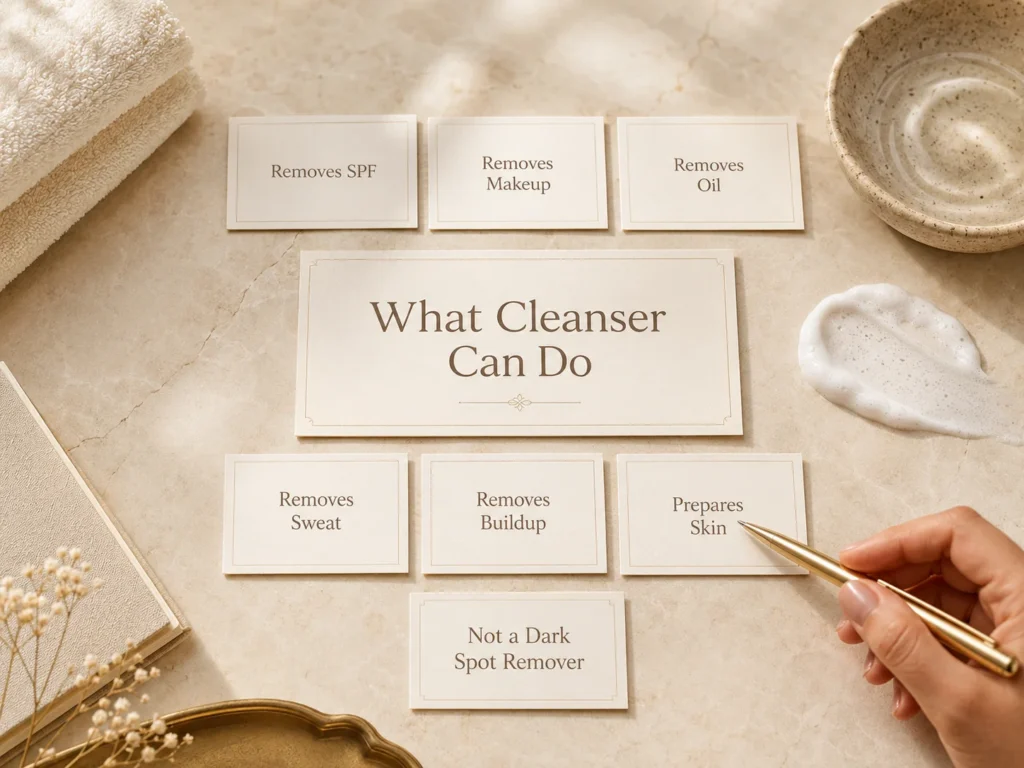
A cleanser can support the routine, but it does not remove dark spots.
Dark spot appearance should not be treated like dirt that can be washed away.
A cleanser can help by keeping the skin fresh, clean, and less coated. But dark spot appearance usually needs:
Do not choose a harsh cleanser because you want faster-looking tone change.
Harsh cleansing can make uneven-looking tone look worse.
Post-blemish marks should not be scrubbed away.
If a mark remains after a blemish calms down, aggressive cleansing can irritate the area and make it look more noticeable.
A cleanser should not be used with rough pressure over marks.
Post-blemish mark appearance needs:
If the skin is open, crusted, bleeding, or painful, avoid active products and seek medical guidance if needed.
A cleanser may be too stripping if your skin feels:
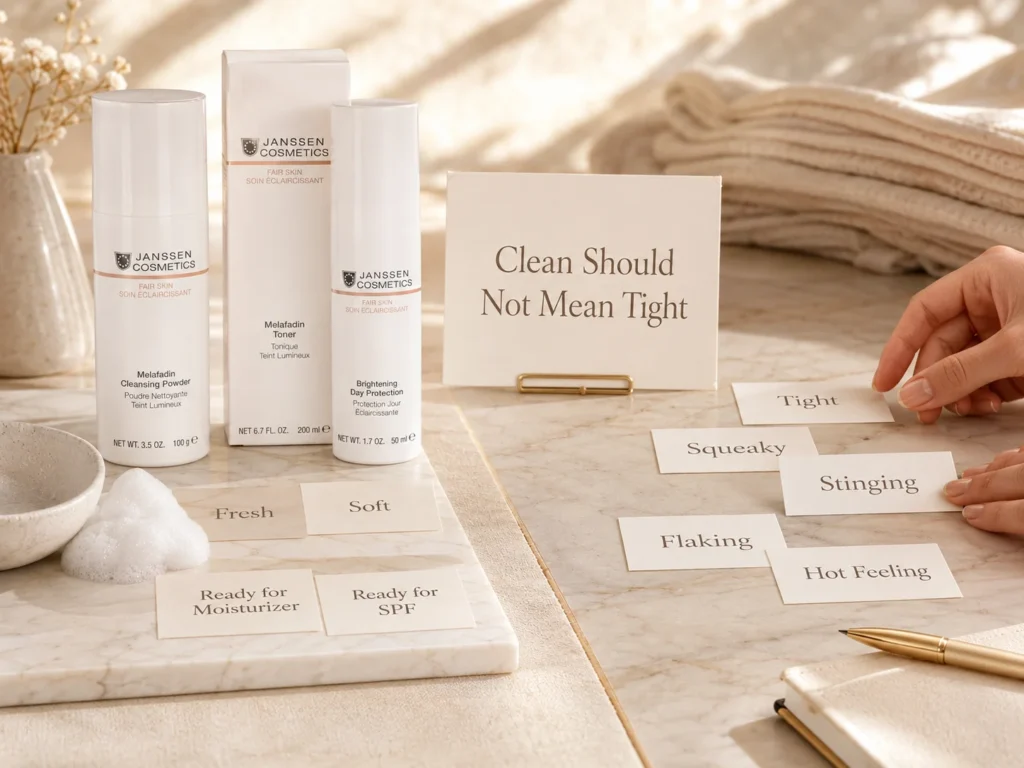
Stripped skin often looks less even.
It may appear dull, patchy, or irritated.
If the cleanser is too harsh, the rest of the routine may not sit well.
A cleanser should also rinse clean enough for your skin type.
If the cleanser leaves too much residue, skin may feel:
This does not mean every creamy cleanser is wrong.
It means the cleanser texture should match the skin.
Dry skin may love a creamy cleanser.
Oily skin may need a fresher gel texture.
Sensitive skin may need mild comfort.
Morning cleansing and evening cleansing may have different goals. After cleansing, toner is optional; review what uneven-looking skin should look for in a toner before adding the step.
In the morning, cleansing may help remove overnight oil, sweat, and skincare residue.
In the evening, cleansing should remove the day.
Evening cleansing is especially important if you wear:
If SPF and makeup are not removed well at night, the skin may look dull, patchy, or coated the next day.
SPF is essential for uneven-looking tone, but it should be removed properly at night.
If SPF builds up, the skin may look:
A good evening cleanse helps reset the skin.
The goal is to remove SPF without stripping the skin.
Washing too often can make uneven-looking tone look worse.
Over-cleansing may cause:
Cleansing should be effective but not excessive.
More washing is not always better.
Cleanser texture affects how the skin feels after washing.
Common cleanser textures include:
The best texture depends on skin type and what the skin needs.
Uneven tone does not automatically require one cleanser texture.
The skin type decides.
Dry uneven-looking skin usually needs a gentle, comfort-focused cleanser.
Dry skin may look uneven because roughness, flaking, or tightness makes tone differences stand out more.
A dry uneven-tone cleanser should help the skin feel:
Avoid harsh cleansers that leave dry skin feeling stripped.
Dry skin often needs comfort before brightening-support products.
Dehydrated skin can look dull, flat, tight, and patchy.
A dehydrated uneven-tone cleanser should not make the skin feel tighter.
After cleansing, the skin should feel comfortable enough to accept hydration and moisturizer.
A routine may look like:
Morning: Gentle cleanser → hydrating serum → moisturizer → SPF
Evening: Gentle cleanser → hydrating serum or moisturizer
If cleanser makes dehydrated skin feel tight, it may be making the uneven-looking tone appear worse.
Oily uneven-looking skin still needs gentle cleansing.
The goal is to remove excess oil and buildup without stripping the skin.
An oily uneven-tone cleanser should help with:
But it should not leave the skin tight.
Oily skin can become dehydrated when over-cleansed.
Stripping oily skin can make it feel oily and tight at the same time.
Combination skin can be tricky because different zones have different needs.
The T-zone may be oily.
The cheeks may be dry.
The mouth area may be sensitive.
The forehead may have buildup.
A cleanser for combination uneven-looking skin should cleanse the whole face without making dry areas feel stripped or oily areas feel coated.
Combination skin often needs balance.
Not the strongest cleanser.
Not the richest cleanser.
A comfortable middle-ground texture may be best.
Sensitive uneven-looking skin needs a mild cleanser.
A sensitive-skin cleanser should not leave the skin:
Sensitive skin may already look uneven because of irritation, dryness, post-blemish marks, or product reactions.
The cleanser should reduce unnecessary stress.
Not add to it.
Mature skin may show uneven-looking tone, dark spot appearance, dryness, dullness, and texture.
A cleanser for mature uneven-looking skin should remove the day without making the skin feel dry or tight.
Mature skin often benefits from:
Avoid harsh cleansing that makes skin look less fresh.
Dull uneven skin may need a cleanser that removes residue and buildup without over-exfoliating.
Dullness may come from:
A good cleanser helps the skin look fresher.
But if dullness is caused by dehydration or dryness, cleanser alone will not be enough.
If the skin has post-blemish marks, choose a cleanser that supports low irritation.
Post-blemish marks may look more noticeable when the cleanser is harsh.
Avoid:
A cleanser should help keep the area clean without irritating it.
SPF and patience are essential.
For dark spot appearance, cleanser should support the foundation of the routine.
It should not be chosen as a “dark spot remover.”
A good cleanser can help by:
Dark spot appearance still needs daily SPF and low irritation.
If you wear makeup, cleansing matters even more.
Makeup residue can make skin look dull, patchy, and uneven.
Evening cleansing should remove:
If makeup is long-wear or heavy, one cleanse may not always feel like enough.
But double cleansing should still be gentle.
Do not scrub aggressively.
SPF should be used daily for uneven-looking tone.
But SPF also needs proper removal at night.
If SPF is not removed well, skin may feel coated or look dull the next day.
A cleanser should remove SPF without drying the skin.
If SPF is heavy or water-resistant, the evening routine may need a makeup/SPF removal step before cleanser.
The goal is clean, comfortable skin.
Double cleansing may be helpful when you wear heavy SPF, makeup, primer, or long-wear products.
A double cleanse usually means:
But double cleansing is not for everyone.
Sensitive or dry skin may become irritated if both steps are too strong.
If double cleansing leaves skin tight, simplify or choose gentler textures.
An exfoliating cleanser may help some people with dullness or buildup.
But it is not the first choice for every uneven-tone routine.
Be careful if your routine already includes:
Too many active steps can irritate the skin.
If the skin is sensitive, dry, or over-exfoliated, choose a gentler cleanser.
A brightening cleanser may support a routine focused on radiance and uneven-looking tone.
But it should still be gentle.
A brightening cleanser should not leave the skin:
A brightening cleanser is still only the first step.
It does not replace serum, moisturizer, SPF, or consultation-based routine planning.
A gel cleanser may be helpful for oily, combination, or buildup-prone skin.
It may help the skin feel fresh without feeling heavy.
But a gel cleanser should not be too stripping.
A gel cleanser may be appropriate if the skin has:
If the gel cleanser leaves the skin tight, it may be too strong.
A cream cleanser may be helpful for dry, mature, or comfort-needing skin.
It may support the skin when dryness makes uneven-looking tone look worse.
A cream cleanser may be appropriate if the skin feels:
If a cream cleanser feels too heavy or leaves residue, the skin may need a different texture.
A foam or mousse cleanser may be helpful when it is gentle and not stripping.
For sensitive skin, the key is comfort after rinsing.
A mild mousse cleanser may be appropriate if the skin needs a light cleanser that still feels soft.
But if a foaming cleanser leaves the skin tight, dry, or reactive, it may not be right for that skin.
The feel after cleansing matters.
Scrub cleansers should be used carefully.
They may be too much for uneven-looking skin, especially if used with pressure or too often.
Avoid scrub cleansers if the skin is:
Do not use scrub cleansers to scrub dark spots or post-blemish marks.
A cleanser with acids may be helpful for some skin, especially if there is oily buildup or rough texture.
But acid cleansers can contribute to over-exfoliation.
Be careful if the routine already includes:
If the skin becomes tight, flaky, or stingy, pause active products and simplify.
Some people can use the same cleanser morning and night.
Others may need a lighter morning cleanse and a more thorough evening cleanse.
For example:
The best routine depends on daily habits.
Your cleanser may be helping if your skin feels:
A good cleanser supports the rest of the routine.
It should not create new problems.
Your cleanser may be too harsh if:
If this happens, cleanser should be reviewed.
Your cleanser may not be enough if:
The cleanser may need better removal power or the routine may need a separate first cleanse.
Cleansing supports SPF by preparing the skin.
Morning cleanser should leave the skin ready for:
Serum if appropriate → moisturizer → SPF
Evening cleanser should remove SPF so the skin does not stay coated overnight.
If SPF pills in the morning, review:
Cleanser is part of SPF success.
If makeup looks patchy, cleanser may be part of the issue.
Makeup may look worse if the skin is:
A balanced cleanser can help makeup sit better.
But moisturizer and SPF texture also matter.
Product buildup can make uneven-looking tone look worse.
A cleanser should help remove buildup from:
If buildup remains, the skin may look dull and patchy.
If cleansing is too harsh, the skin may look irritated and patchy.
Balance is the key.
A cleanser can contribute to over-exfoliation if it contains exfoliating ingredients or is used too aggressively.
Signs include:
If this happens, switch to a mild cleanser and pause active products.
Sensitive skin should be especially careful with cleanser choice.
Sensitive skin may react to:
A sensitive cleanser should leave the skin calm.
If the skin burns after washing, the cleanser may be too much.
Dry skin needs a cleanser that does not remove too much comfort from the skin.
Dry uneven-looking skin may look worse after harsh cleansing because flakes and tightness make tone differences more visible.
Dry skin may need:
Cleanser should not make dry skin feel worse.
Oily skin often needs thorough cleansing, but not stripping.
A good oily-skin cleanser should help remove oil and buildup while keeping the skin comfortable.
If oily skin feels tight after cleansing, the cleanser may be too harsh.
Oily skin may become:
Balance matters.
Combination skin should avoid extremes.
A cleanser that is too rich may feel heavy on the T-zone.
A cleanser that is too harsh may dry the cheeks.
The best cleanser for combination uneven-looking skin should feel balanced after rinsing.
If the T-zone needs more attention, targeted support can be added later.
Do not over-cleanse the whole face because one area is oily.
Mature skin often needs a cleanser that respects comfort.
A harsh cleanser can make mature skin look drier, duller, and less smooth.
Mature uneven-looking skin may need:
The cleanser should support softness and freshness.
Not tightness.
Around-mouth skin can become dry or irritated easily.
A cleanser may worsen this area if it is too harsh, used with hot water, or rubbed too strongly.
Around-mouth uneven tone may need:
Do not scrub around-mouth tone differences.
Forehead unevenness may be related to oil, sweat, hair products, SPF buildup, post-blemish marks, or sun exposure.
A cleanser can help remove:
But if the forehead becomes tight or flaky, the cleanser may be too strong.
Forehead care needs balance.
The neck and décolleté are often forgotten during cleansing and SPF application.
These areas may show uneven-looking tone from sun exposure, dryness, fragrance irritation, or product residue.
Use gentle cleansing.
Avoid harsh scrubs or strong facial cleanser pressure on the neck.
Apply moisturizer and SPF when exposed.
A simple morning routine may look like:
Cleanser → serum if appropriate → moisturizer → SPF
If the skin is dry:
Gentle cleanser → hydrating serum → moisturizer → SPF
If the skin is sensitive:
Mild cleanser → moisturizer → SPF
If the skin is oily:
Gentle gel cleanser → lightweight moisturizer → SPF
SPF is the final skincare step.
A simple evening routine may look like:
Cleanser → moisturizer
If wearing makeup or heavy SPF:
Makeup/SPF removal step if needed → cleanser → moisturizer
If using targeted support:
Cleanser → serum or cream if appropriate → moisturizer
Evening cleansing should remove the day without irritating the skin.
Morning:
Gentle creamy cleanser → hydrating serum if needed → moisturizer → SPF
Evening:
Gentle cleanser → hydrating serum or moisturizer → cream if needed
Avoid:
Dry uneven skin needs comfort first.
Morning:
Gentle gel cleanser → lightweight moisturizer → SPF
Evening:
Gentle gel cleanser → lightweight moisturizer
Optional:
BHA only when clogged-looking pores, blackheads, whiteheads, or T-zone buildup are present and the skin is stable
Avoid:
Oily uneven skin needs clean balance.
Morning:
Mild cleanser → moisturizer → SPF
Evening:
Mild cleanser → moisturizer
Avoid:
Sensitive skin needs calm cleansing.
Morning:
Balanced gentle cleanser → lightweight hydration if needed → moisturizer by zone → SPF
Evening:
Balanced gentle cleanser → moisturizer by zone
If the T-zone has buildup:
Targeted support may be reviewed later.
Do not over-cleanse the whole face because the T-zone is oily.
Morning:
Gentle cleanser → hydration or radiance support if tolerated → moisturizer → SPF
Evening:
Gentle cleanser → serum or moisturizer → cream if needed
Do not forget:
Mature skin should not feel stripped after cleansing.
Morning:
Gentle cleanser → radiance or hydration support if appropriate → moisturizer → SPF
Evening:
Cleanser → moisturizer
If dullness comes from buildup:
Evening cleansing should be reviewed first.
If dullness comes from dehydration:
Hydration support may be needed.
If dullness comes from over-exfoliation:
Pause actives and simplify.
Morning:
Gentle cleanser → brightening-support serum if appropriate → moisturizer → SPF
Evening:
Gentle cleanser → moisturizer or targeted support if appropriate
Avoid:
The cleanser prepares the skin.
It does not replace SPF.
Morning:
Gentle cleanser → serum if appropriate → moisturizer → SPF
Evening:
Gentle cleanser → moisturizer
Avoid:
Post-blemish marks need low irritation.
Consider changing your cleanser if:
A cleanser should be adjusted when the skin’s needs change.
Professional guidance may help if:
A consultation can help match cleanser texture to the full routine.
A dermatologist should evaluate skin if there are warning signs such as:
Cosmetic skincare can support appearance, but medical-looking changes need medical evaluation.
After consultation, our licensed esthetician may consider Janssen Cosmetics cleanser options depending on skin type, sensitivity, dryness, oiliness, makeup use, SPF habits, and whether the skin needs brightening support, comfort, or oil balance first.

For uneven-looking, dull, or tired-looking skin, possible options may include:
For dry or moisture-deficient uneven-looking skin, possible options may include:
For sensitive uneven-looking skin, possible options may include:
For oily or combination uneven-looking skin, possible options may include:
For skin that needs exfoliation support, exfoliating products should only be reviewed after cleanser tolerance, sensitivity, SPF habits, and active product use are understood.
For morning routines, Face Guard Advanced SPF 30 may be considered as the final daytime protection step when appropriate and tolerated.
These are not automatic recommendations. The cleanser should be chosen based on the skin’s condition, not only the uneven-tone concern.
Do not choose a harsh cleanser to “fade” dark spots.
Do not scrub post-blemish marks.
Do not use a cleanser that leaves your skin tight every day.
Do not over-cleanse oily skin.
Do not use exfoliating cleanser with multiple active products blindly.
Do not skip moisturizer after cleansing.
Do not skip SPF after cleansing in the morning.
Do not ignore cleanser residue if your skin feels coated.
Do not use professional-only exfoliation products at home.
Do not keep using a cleanser that burns, stings, or makes your skin look more patchy.
The best cleanser for uneven skin tone is one that removes SPF, makeup, oil, sweat, and buildup without stripping or irritating the skin. The right texture depends on your skin type.
No. A cleanser does not remove dark spots. It supports the routine by keeping the skin clean and prepared for moisturizer, SPF, and brightening-support products when appropriate.
A brightening cleanser may fit some uneven-looking or dull-looking skin routines, but it should still be gentle and should not replace SPF or moisturizer.
Dry uneven-looking skin often benefits from a gentle, comfort-focused cleanser that does not leave the skin tight or flaky.
Oily uneven-looking skin may benefit from a gentle gel cleanser that removes oil and buildup without stripping the skin.
Sensitive uneven-looking skin should be careful with exfoliating cleansers. If the skin stings, burns, or feels tight, exfoliation should wait.
Your cleanser may be too harsh, too drying, not removing residue well, or not matching your skin type. Patchiness may also come from dehydration, irritation, or product buildup.
Double cleansing may help if you wear heavy SPF or makeup, but it should be gentle. If double cleansing leaves your skin tight or irritated, adjust the routine.
Yes. A cleanser that strips, irritates, or leaves buildup can make uneven-looking tone appear more noticeable.
See a dermatologist if your skin has persistent rash-like irritation, swelling, pain, severe itching, burning that does not settle, crusting, bleeding, oozing, infection-looking areas, blistering, changing spots, or rapid worsening.
If you are choosing a cleanser for uneven-looking tone, start with what your skin feels like after washing.
Does it feel tight? Coated? Oily but dry? Comfortable? Stingy? Fresh?
At Zendevie, a free virtual consultation helps us review your skin type, cleanser, moisturizer, SPF habits, makeup use, sensitivity, dark spot appearance, post-blemish marks, and current routine before recommending anything.
The right cleanser should help your skin feel clean, calm, and ready for the rest of the routine.

Zendevie is guided by Haby Diallo, a licensed esthetician with more than 20 years of professional skincare experience. Her approach is rooted in education, professional judgment, and personal care.
years of experience