


Yes, sensitive skin can have uneven tone.
Sensitive skin can still show dark spot appearance, post-blemish marks, patchiness, dull uneven areas, around-mouth unevenness, forehead tone differences, or marks that look more noticeable after sun exposure. But sensitive skin needs a very different approach than skin that can tolerate stronger products easily.
When sensitive skin is pushed too hard, uneven tone can look worse.
Strong vitamin C, harsh scrubs, daily acids, retinol-style products, drying toners, and too many new products can make sensitive skin feel hot, tight, stingy, or irritated. When the skin is irritated, the complexion may look patchier, duller, and less even.
At Zendevie, we do not recommend brightening-support products blindly for sensitive skin. In consultation, our licensed esthetician first looks at sensitivity signs, cleanser choice, moisturizer comfort, SPF tolerance, hydration level, current active products, post-blemish marks, dark spot appearance, sun exposure, and whether the skin is already irritated or over-exfoliated.
Sensitive skin needs calm first.
Tone support comes after comfort.
Sensitive skin can have uneven tone, dark spot appearance, post-blemish marks, and patchy-looking areas. But sensitive skin should be supported gently because irritation can make uneven-looking tone appear worse.
Sensitive uneven-looking skin may need:
A simple sensitive uneven-tone routine may include:
Morning: Mild cleanser → moisturizer → SPF
Evening: Mild cleanser → moisturizer
Brightening-support products should only be considered when the skin feels calm, stable, and protected with SPF.
Sensitive skin is not protected from dark spot appearance.
Dark spot appearance may still happen after:
But sensitive skin may not tolerate aggressive brightening routines.
That means the routine needs to be slower, calmer, and more selective.
Sensitive skin can develop post-blemish mark appearance after blemishes calm down.
These marks may look:
If the skin is sensitive, do not pick, scrub, or apply strong active products to marks.
Post-blemish marks need SPF, patience, and low irritation.
Sensitive skin often looks patchy when it is irritated.
Patchiness may appear as:
Patchy sensitive skin should not be treated with harsh exfoliation.
It usually needs calming and routine simplification first.
Sensitive skin can look dull and uneven at the same time.
It may look:
This can be confusing because the skin may appear to need brightening, but it may first need comfort.
If skin is irritated, brightness should wait.
A routine for sensitive uneven-looking skin should be different from a stronger brightening routine.
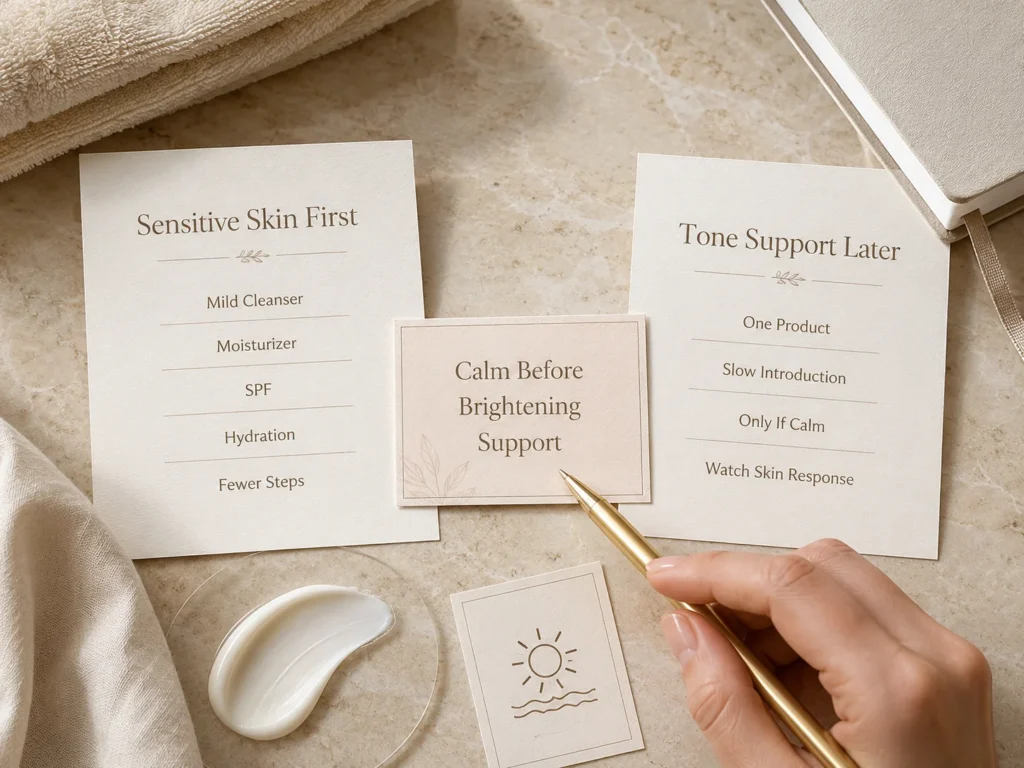
Sensitive skin often needs:
A sensitive uneven-tone routine should not feel intense.
It should feel supportive.
Irritation can make the complexion look more uneven.
When skin is irritated, it may appear:
This is why brightening-support routines must be gentle for sensitive skin.
Irritated skin often looks less even.
Sensitive skin can become patchier when it is over-exfoliated.
Over-exfoliation may happen from:
Signs include:
If this happens, pause active products and simplify.
Vitamin C support may help some routines focused on radiance and a more even-looking complexion.
But strong vitamin C can be too much for sensitive skin.
Vitamin C may need to wait if the skin is:
Radiance support should not hurt.
If vitamin C stings, the skin may need calming and hydration first.
Brightening-support serums can be helpful when appropriate, but sensitive skin needs a cautious approach.
Do not start several brightening products at once.
A safer approach:
Sensitive skin needs patience.
SPF is essential when sensitive skin has uneven-looking tone, dark spot appearance, or post-blemish marks.
But some sensitive skin may find SPF uncomfortable.
SPF may sting or feel heavy if:
Do not skip SPF as the first solution.
Review the routine so SPF can be worn more comfortably.
If sensitive skin is already uncomfortable, brightening-support products should wait.
Calming may need to come first when the skin feels:
A calm routine creates a better foundation for tone support later.
Sensitive skin can be dehydrated.
Dehydrated sensitive skin may look patchy, dull, and uneven.
It may feel:
Hydration support may help the skin look more comfortable and fresh.
Hydration does not replace SPF, but it can support the routine.
Moisturizer helps sensitive skin feel supported.
If moisturizer is missing or too light, the skin may feel tight, reactive, or dry.
A good sensitive routine often begins with:
Mild cleanser → moisturizer → SPF
At night:
Mild cleanser → moisturizer
Brightening-support products should not replace moisturizer.
Serum and moisturizer have different roles.
A harsh cleanser can make sensitive uneven-looking skin look worse.
Signs the cleanser may be too harsh include:
A mild cleanser can help reduce unnecessary irritation.
Cleansing should leave the skin comfortable.
The around-mouth area can be sensitive and prone to patchiness.
Uneven tone around the mouth may look more noticeable when there is:
Avoid scrubbing around the mouth.
Avoid strong products if the area feels irritated.
Forehead uneven tone may be affected by sun exposure, sweat, hair products, hats, SPF gaps, post-blemish marks, or irritation.
Sensitive forehead skin may react to:
The forehead may need gentler cleansing, SPF placement, and less irritation.
Not stronger scrubbing.
Cheeks often show sensitivity clearly.
Sensitive cheeks may look:
Cheeks usually need comfort first.
Avoid treating sensitive cheeks with strong oily-skin or acid-based products unless the skin can tolerate them.
The neck can be more sensitive than the face.
Uneven-looking tone on the neck may be connected to:
The neck should be treated gently.
Do not use strong facial actives on the neck without guidance.
The décolleté may show uneven-looking tone from sun exposure, dryness, fragrance, clothing friction, or skipped SPF.
This area can be delicate.
Care may include:
Do not treat the décolleté aggressively.
Sensitive skin may look patchy under makeup because it is dry, irritated, dehydrated, or reactive.
Makeup may:
If makeup looks patchy, review skincare comfort first.
The skin may need fewer products, not more coverage.
SPF may look patchy on sensitive skin when the skin is dry, dehydrated, irritated, or over-layered.
SPF may also sting if the skin is already compromised.
To support SPF comfort, review:
SPF should be made easier to wear.
Not removed from the routine.
Sensitive skin can still experience product buildup.
Too many products may make the skin feel:
Buildup may come from:
Sensitive skin often does better with fewer, well-chosen steps.
Sensitive skin can also be oily.
A person may have oily, sensitive, uneven-looking skin.
This may show as:
Oily sensitive skin should not be stripped.
It needs gentle balance.
Sensitive skin can also be dry.
Dry sensitive uneven-looking skin may show:
Dry sensitive skin needs comfort before active products.
Do not scrub dry sensitive skin.
Mature skin can also be sensitive and uneven-looking.
Mature sensitive skin may show:
A mature sensitive routine should prioritize hydration, comfort, SPF, and gentle radiance support only when tolerated.
Some sensitive skin may tolerate vitamin C support.
Some may not.
Vitamin C may be considered only when the skin is calm and stable.
A gentle structure may be:
Morning: Mild cleanser → vitamin C support if appropriate → moisturizer → SPF
But if vitamin C stings, burns, or makes skin patchier, pause.
Sensitive skin should never be forced to tolerate a product.
Sensitive skin may use exfoliation only if it is stable and the product is appropriate.
But exfoliation should be limited and careful.
Avoid exfoliation if the skin is:
Sensitive skin does not need frequent exfoliation to look cared for.
BHA may be considered when sensitive skin also has oily clogged-looking areas, blackheads, whiteheads, or T-zone buildup.
But it should be introduced carefully and only if the skin is stable.
Avoid BHA if the skin is:
Sensitive oily skin still needs moisturizer and SPF.
Retinol-style products may be too much for some sensitive skin, especially if the skin is already uneven-looking from irritation.
If retinol-style products are used, they should not be combined blindly with:
If the skin becomes flaky, tight, burning, or patchy, pause and simplify.
SPF is essential every morning.
Start with the foundation.
Morning:
Mild cleanser → moisturizer → SPF
Evening:
Mild cleanser → moisturizer
If the skin feels dehydrated:
Add gentle hydration support if tolerated.
If the skin is calm and SPF is consistent:
Brightening-support products may be reviewed carefully.
If the skin is irritated:
Do not add brightening products yet.
A simple routine may include:
Morning:
Mild cleanser → moisturizer → SPF
Evening:
Mild cleanser → moisturizer
This may sound too simple, but sensitive skin often needs fewer steps before it can tolerate more.
Once the skin is comfortable, a support product can be reviewed.
Do not rush.
Morning:
Mild cleanser → moisturizer → SPF
Evening:
Mild cleanser → moisturizer
Optional later:
Gentle brightening-support serum only when the skin is calm, stable, and protected with SPF
Avoid:
Dark spot appearance needs patience and protection.
Morning:
Mild cleanser → moisturizer → SPF
Evening:
Mild cleanser → moisturizer
Optional later:
Targeted support only if the skin is stable
Avoid:
Post-blemish marks on sensitive skin need a gentle approach.
Morning:
Mild cleanser → hydrating support if tolerated → moisturizer → SPF
Evening:
Mild cleanser → hydrating support if tolerated → moisturizer or cream
Avoid:
Dry sensitive skin needs comfort first.
Morning:
Mild cleanser → lightweight moisturizer → SPF
Evening:
Mild cleanser → lightweight moisturizer
Optional:
BHA only if clogged-looking pores or T-zone buildup are present and the skin is stable
Avoid:
Sensitive oily skin needs balance, not harsh control.
Morning:
Gentle cleanser → hydration support if tolerated → moisturizer → SPF
Evening:
Gentle cleanser → moisturizer or cream
Optional later:
Gentle radiance or brightening-support product only when tolerated
Do not forget:
Avoid strong active stacking and harsh exfoliation.
Morning:
Mild cleanser → moisturizer → SPF
Evening:
Mild cleanser → moisturizer
Avoid:
The around-mouth area often needs gentle care.
Morning:
Mild cleanser → moisturizer → SPF → makeup
Tips:
If makeup stings, the skin may be irritated.
Pause active products and simplify.
Sensitive skin may be ready for brightening-support products when:
Add one product at a time.
Use patience.

Avoid brightening-support products if sensitive skin is:
The skin is not ready.
Focus on comfort and seek guidance if symptoms persist.
Pause active products if sensitive uneven-looking skin becomes more reactive.
Pause:
Return to:
Mild cleanser → moisturizer → SPF
and:
Mild cleanser → moisturizer
If symptoms worsen or persist, seek dermatologist guidance.
Professional guidance may help if:
A consultation can help decide what your skin can tolerate.
A dermatologist should evaluate sensitive uneven-looking skin if there are warning signs such as:
Cosmetic skincare can support appearance, but medical-looking changes need medical evaluation.
After consultation, our licensed esthetician may consider Janssen Cosmetics options depending on whether sensitive uneven-looking skin needs calming, hydration, moisturizer support, SPF, or gentle radiance support first.

For sensitive uneven-looking skin, comfort-focused options may come first, such as:
For dry or dehydrated sensitive uneven-looking skin, possible options may include:
For uneven-looking tone and radiance support, options may be reviewed only when the skin is calm and stable, such as:
For morning routines, Face Guard Advanced SPF 30 may be considered as the final daytime protection step when appropriate and tolerated.
These are not automatic recommendations. Sensitive skin should be evaluated carefully before brightening-support products, exfoliation, acids, vitamin C, or retinol-style products are introduced.
Do not treat sensitive uneven tone with harsh scrubs.
Do not use strong vitamin C on stinging skin.
Do not apply acids to irritated skin.
Do not combine multiple brightening products at once.
Do not over-exfoliate.
Do not pick post-blemish marks.
Do not skip SPF.
Do not use professional-only products at home.
Do not apply active products to broken, crusted, bleeding, or painful skin.
Do not keep using products that burn, sting, swell, itch severely, or make the skin look more patchy.
Do not ignore changing, sudden, bleeding, crusting, painful, or unusual marks.
Yes. Sensitive skin can have uneven-looking tone, dark spot appearance, post-blemish marks, patchiness, and dull uneven areas.
Sensitive skin may look patchy because of irritation, dryness, dehydration, over-exfoliation, product reactions, sun exposure, or post-blemish marks.
Sensitive skin may use brightening-support products only when calm and stable. They should be introduced slowly and paired with SPF.
Yes. Some sensitive skin may sting or react to vitamin C. If this happens, pause and review the routine.
Only carefully and only if the skin is stable. Do not exfoliate sensitive skin that is burning, stinging, rash-like, flaky from irritation, or reacting to basic products.
Yes. SPF is essential for uneven-looking tone, dark spot appearance, and post-blemish marks. If SPF stings, the routine or formula may need review.
Yes. Post-blemish mark appearance can happen on sensitive skin, especially after picking, irritation, or sun exposure.
Start with mild cleanser, moisturizer, and SPF. Add hydration or calming support if needed. Brightening-support products should wait until the skin is stable.
Avoid harsh scrubs, strong acids, strong vitamin C on irritated skin, retinol-style products on reactive skin, active stacking, picking, and skipping SPF.
See a dermatologist if sensitive uneven-looking skin has persistent rash-like irritation, swelling, pain, severe itching, crusting, bleeding, oozing, blistering, eye-area irritation, sudden discoloration, changing spots, or worsening symptoms.
If your skin is sensitive and uneven-looking, the routine should be built gently.
At Zendevie, a free virtual consultation helps us review your sensitivity, cleanser, moisturizer, SPF habits, hydration level, post-blemish marks, dark spot appearance, exfoliation history, and current products before recommending anything.
The goal is not to force your skin into a strong brightening routine.
The goal is to help your skin feel calm, protected, and supported while working toward a more even-looking complexion.

Zendevie is guided by Haby Diallo, a licensed esthetician with more than 20 years of professional skincare experience. Her approach is rooted in education, professional judgment, and personal care.
years of experience