
Exfoliation can help dull-looking skin, but only when the skin actually needs it.
When skin looks flat, rough, tired, or uneven, it is easy to think, “I need to scrub this off.” But dullness is not always caused by surface buildup. Sometimes skin looks dull because it is dehydrated, dry, irritated, over-exfoliated, product-overloaded, oily under buildup, or not properly protected during the day.
That is why exfoliation should be thoughtful.
At Zendevie, we do not recommend exfoliation just because the skin looks dull. In consultation, our licensed esthetician first looks at the skin type, skin condition, current routine, product tolerance, SPF habits, sensitivity, dryness, oiliness, and whether the dullness is coming from buildup or irritation.
Exfoliation should help the skin look smoother and fresher.
It should not leave the skin feeling raw.
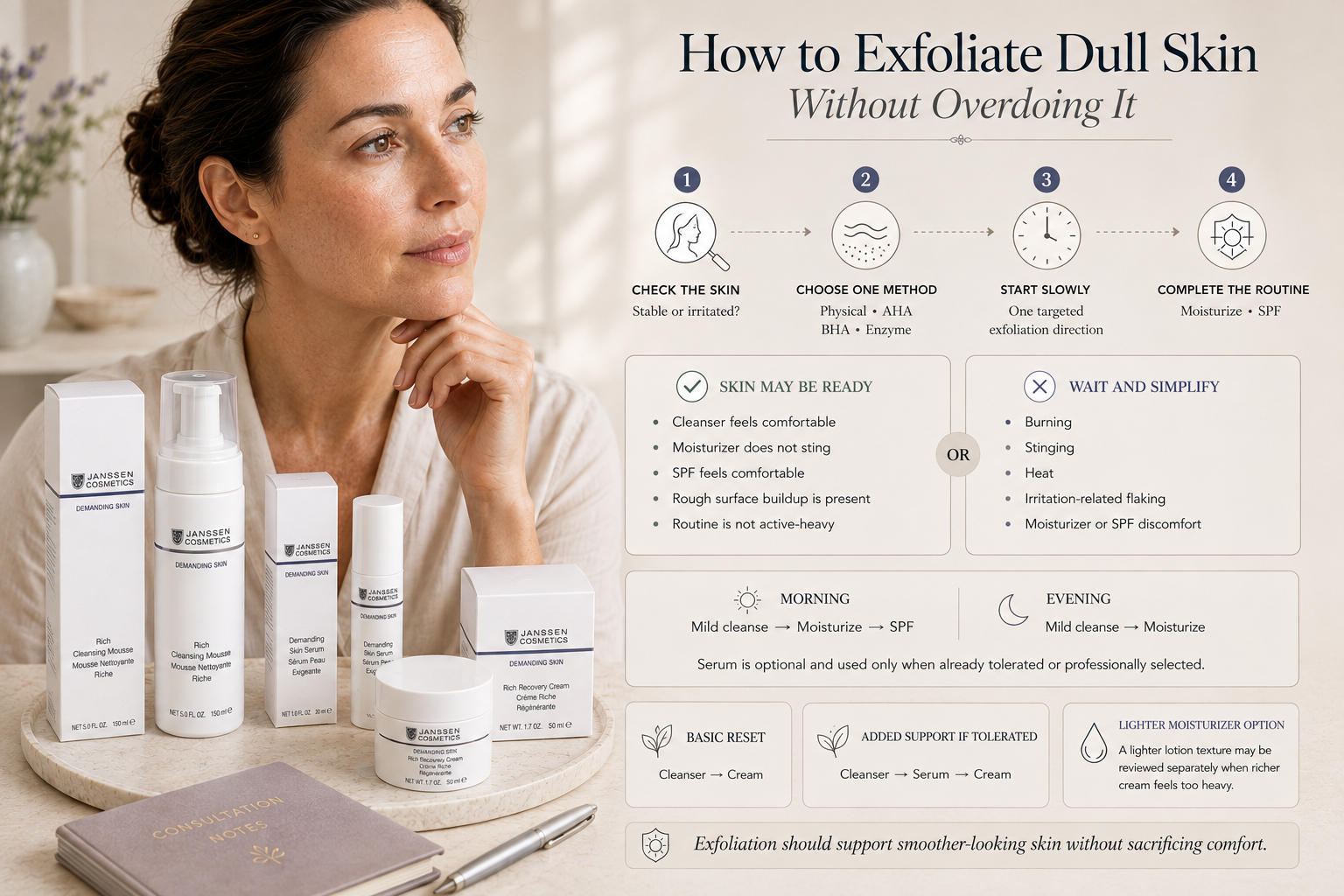
To exfoliate dull skin without overdoing it, start slowly, choose one exfoliating method at a time, avoid harsh scrubbing, moisturize well, and use SPF every day.
A careful approach may include:
Dull skin may benefit from exfoliation, but only when the skin is stable enough for it.
Exfoliation helps remove surface buildup that can make the skin look rough, uneven, or less fresh.
Surface buildup may include dead surface cells, product residue, oil, sweat, and texture that makes makeup sit unevenly.
When exfoliation is appropriate, it may help the skin look:
But exfoliation is not a daily requirement for everyone.
The skin needs balance, not constant polishing.
Dull skin may benefit from exfoliation when dullness is connected to surface buildup.
This may show as:
In this case, gentle exfoliation may be useful.
But if dullness comes from dehydration, irritation, or over-exfoliation, more exfoliation can make the skin look worse.
This is one of the biggest mistakes.
Dull-looking skin does not always mean the skin needs exfoliation.
Dullness may come from:
If the cause is not surface buildup, exfoliation may not solve the problem.
If your skin is already uncomfortable, do not exfoliate.
Avoid exfoliation when your skin is:
When skin is irritated, exfoliation can add more stress.
A calmer routine should come first.
Your skin may be ready for gentle exfoliation if:
A stable skin foundation matters before exfoliation.
Wait before exfoliating if:
When in doubt, simplify first.
There are different ways to exfoliate.
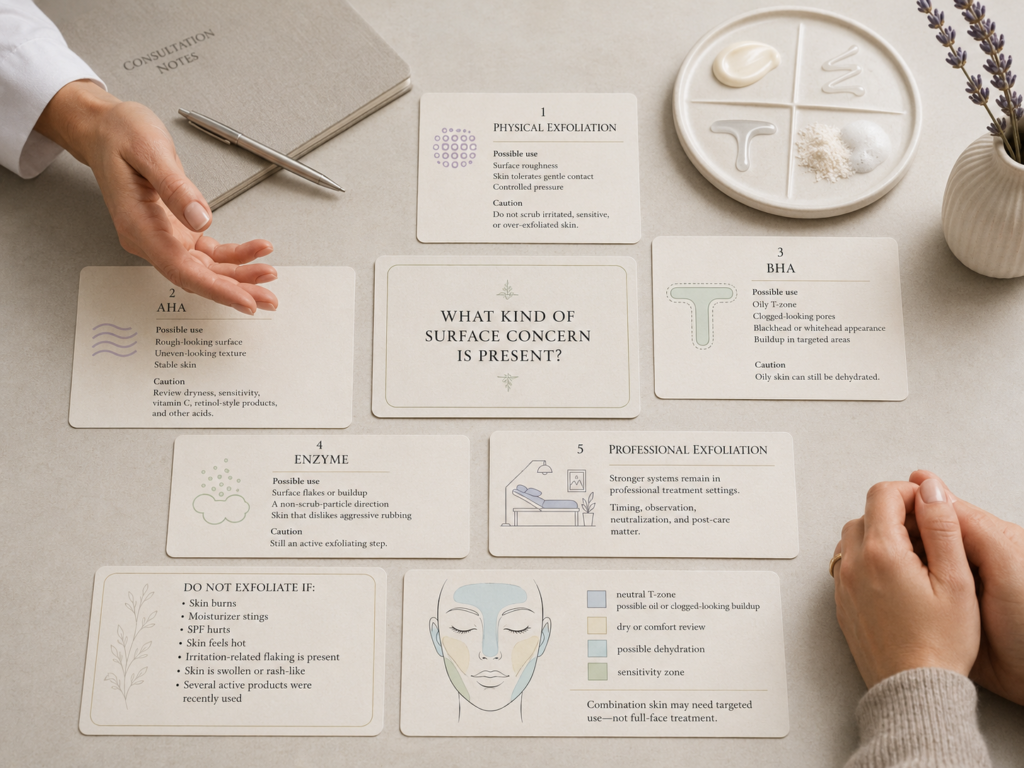
The main categories are:
Each can have a place, but none should be used carelessly.
The best choice depends on the skin type, concern, tolerance, and current routine.
Physical exfoliation uses particles, texture, cloths, or tools to manually smooth the skin surface.
This may include:
Physical exfoliation can feel satisfying, but it can also be overdone easily.
Avoid harsh pressure. Avoid sharp particles. Avoid scrubbing irritated skin.
For dull skin, gentle pressure is more important than intensity.
Chemical exfoliation uses ingredients such as AHA or BHA to loosen surface buildup.
AHA is often discussed for surface texture, dullness, and roughness.
BHA is often discussed for oily areas, clogged-looking pores, blackheads, whiteheads, and T-zone congestion.
Chemical exfoliation can be helpful, but it should not be layered blindly.
Avoid using multiple acid products together unless guided.
Enzyme exfoliation is often used as a gentler-feeling option for some skin types.
Enzyme-based products can help loosen surface buildup without scrub particles.
This may be helpful for people who dislike scrubs or whose skin feels easily stressed by rubbing.
Still, enzyme exfoliation is not automatically irritation-proof.
Sensitive skin should still patch test and start slowly.
Some exfoliation belongs only in professional settings.
Professional peels and stronger exfoliation systems should not be treated like home routines.
Professional exfoliation may involve stronger products, timing, neutralizing steps, and post-care.
At-home content should not turn professional treatments into DIY instructions.
If a product is professional-only, it should stay in the treatment room.
AHA may be considered when dullness is connected to surface roughness, uneven-looking texture, or buildup.
AHA can be helpful for some dull-looking skin, but it can also sting or over-dry the skin if used too often.
AHA should be used carefully if the skin is:
More AHA does not mean more radiance.
BHA may be considered when dullness is connected to oily skin, clogged-looking pores, blackheads, whiteheads, or T-zone buildup.
BHA is not only for dullness. It is more often considered when oil and congestion are part of the pattern.
BHA should be used carefully if the skin is:
Oily skin can still be dehydrated, so BHA should not replace hydration.
A scrub may help some dull-looking skin feel smoother, but it must be used carefully.
Avoid scrubs if your skin is:
If using a scrub, pressure matters.
The goal is gentle smoothing, not aggressive rubbing.
There is no one perfect schedule for everyone.
A safe starting point for many people is once weekly.
Some skin may tolerate more. Some skin may need less. Some sensitive or irritated skin may need no exfoliation at first.
A careful starting guide:
Your skin’s response matters more than a fixed rule.
Daily exfoliation can be too aggressive for many people.
Using acids, scrubs, active cleansers, or peeling products every day may cause the skin to become tight, shiny, flaky, irritated, or more dull.
Signs daily exfoliation may be too much:
Exfoliation should not create a cycle of damage and correction.
Many people overdo exfoliation without realizing it.
They may use:
This can be too much for many skin types.
Choose one exfoliating direction at a time.
A simple routine is easier to understand and adjust.
Retinol-style products and exfoliation should be combined carefully.
Both can affect how the skin feels and looks.
Using exfoliation and retinol-style products too close together may lead to:
If retinol-style products are already in the routine, exfoliation frequency should be reduced and introduced carefully.
Do not start both at the same time.
Vitamin C may support a fresher-looking complexion for some people, but it can also feel active on sensitive or dehydrated skin.
Using vitamin C and exfoliating acids together may be too much for some skin.
If your skin stings or looks irritated, do not layer vitamin C, acids, and exfoliation all at once.
Introduce one product category at a time.
The skin should tolerate the basics first.
SPF is essential when exfoliation is part of the routine.
Exfoliation can make the skin more vulnerable to visible effects from sun exposure if the skin is not protected.
Use SPF every morning, especially if you use:
SPF should be the final morning skincare step.
If SPF stings after exfoliation, the skin may be irritated.
Hydration should support any exfoliation routine.
After exfoliation, the skin may need moisturizer and comfort.
A routine that exfoliates but does not hydrate may leave the skin feeling tight or dull.
Hydration matters because smoother-looking skin also needs comfort and flexibility.
A fresh-looking complexion is not only about removing buildup.
It is also about keeping the skin well supported.
Moisturizer should not be skipped after exfoliation.
After exfoliation, the skin may need:
If moisturizer burns after exfoliation, that may be a warning sign.
Stop exfoliating and simplify.
Exfoliation can help makeup apply more smoothly when the skin truly has surface roughness.
But exfoliating right before makeup can backfire if the skin becomes irritated.
Avoid strong exfoliation right before:
If skin is sensitive, plan exfoliation carefully and not at the last minute.
Dry dull skin needs caution.
Dry skin may look flaky, but flakes do not always mean the skin needs scrubbing.
Dry skin may need:
Avoid aggressive scrubs or frequent acids if the skin feels tight, raw, or irritated.
Comfort comes before smoothing.
Dehydrated skin lacks water.
If dehydrated skin looks dull, hydration should often come before exfoliation.
Dehydrated skin may feel:
If you exfoliate dehydrated skin too often, it may look duller.
Hydrate first. Exfoliate only if rough surface buildup remains and the skin is stable.
Oily dull skin may benefit from careful exfoliation when buildup, clogged-looking pores, blackheads, whiteheads, or T-zone congestion are present.
BHA may be considered for oily clogged-looking areas.
Clay masks may be used carefully on oily zones.
But oily skin can still be over-exfoliated.
Avoid stacking multiple clarifying products.
Oily skin should feel balanced, not stripped.
Combination skin may not need exfoliation everywhere.
The T-zone may need more attention than the cheeks.
The cheeks may be dry or sensitive, while the nose and chin may look clogged or shiny.
A zone-based approach may be better.
For example:
Combination skin needs precision.
Sensitive dull skin needs the most caution.
If sensitive skin is dull because it is irritated, exfoliation can make it worse.
Sensitive skin should avoid exfoliation when it feels:
If exfoliation is considered, it should be introduced slowly and carefully after the skin is stable.
Patch testing matters.
Mature skin may look dull because of dryness, texture, makeup settling, and reduced surface smoothness.
Gentle exfoliation may help some mature skin look smoother, but the skin may also need hydration, moisturizer, and SPF.
Mature skin should avoid aggressive exfoliation that leaves it dry or irritated.
A better approach is:
Mature skin should feel comfortable after exfoliation.
Start simply.

A careful beginner approach:
Slow is better than irritated.
Exfoliation usually fits after cleansing and before moisturizer.
A simple evening routine may look like:
Cleanser → exfoliant if appropriate → moisturizer
Or, if toner is used and tolerated:
Cleanser → toner → exfoliant if appropriate → moisturizer
Do not use an exfoliant every night unless specifically guided and well tolerated.
Morning exfoliation may not be ideal for many people because SPF and daytime exposure need extra consistency.
Evening is often easier for careful use.
After exfoliation, keep the routine simple.
Use:
Avoid layering too many actives immediately after exfoliation.
Do not follow exfoliation with retinol-style products, strong vitamin C, or another acid unless guided.
The skin does not need to be challenged from every direction.
After exfoliation, avoid:
Keep the skin comfortable.
You may be exfoliating enough if your skin looks:
The skin should improve in appearance without feeling stressed.
You may be over-exfoliating if your skin becomes:
If these signs appear, stop exfoliation and simplify.
Skin may look duller after exfoliation if the exfoliation was too strong, too frequent, or layered with other active products.
This can happen because the skin becomes irritated or dehydrated-looking.
Dullness after exfoliation may mean:
Do not respond by exfoliating more.
If you think you over-exfoliated, pause active products.
For a few days, keep the routine simple:
Morning:
Mild cleanser → moisturizer → SPF
Evening:
Mild cleanser → moisturizer
Pause:
If the skin is painful, swollen, rash-like, crusting, bleeding, or worsening, seek dermatologist guidance.
Common mistakes include:
Dull skin improves better with rhythm than pressure.
Choose based on what your skin shows.
If skin is rough and dry-looking:
If skin is oily and clogged-looking:
If skin is sensitive:
If skin is mature:
If skin is product-overloaded:
The right choice depends on the skin pattern.
Patch testing is important before using exfoliating products, especially if your skin reacts easily.
Patch test when using:
Watch for burning, swelling, rash-like texture, itching, or persistent redness-looking changes.
If the test area reacts, do not apply the product to the full face.
Avoid exfoliating close to the eyes unless the product is specifically made for that area and professionally recommended.
The eye area is delicate.
Exfoliating too close to the eyes may cause:
Eye-area dullness or tiredness needs a different approach than facial exfoliation.
The mouth corners and area around the nose can be sensitive.
Avoid applying strong exfoliants too close to these areas if they sting, flake, or feel tight.
Product migration can also irritate these zones.
Use a small amount and keep application controlled.
More product does not mean better results.
Do not start a new exfoliant right before travel.
Travel can make skin more reactive because of:
Use products your skin already tolerates before and during travel.
Do not experiment with exfoliation right before an event.
If the skin reacts, makeup may look worse.
Avoid starting new:
A fresh-looking finish comes from consistency, not last-minute intensity.
A cautious beginner plan may look like:
Week 1: Use one gentle exfoliant once, if skin is stable.
Week 2: Observe how the skin responds. Repeat once if comfortable.
Week 3: Continue once weekly if the skin feels good.
Week 4: Adjust only if needed.
Do not increase frequency quickly.
If the skin feels tight, irritated, or stingy, reduce or pause.
Morning:
Gentle cleanser → hydrating serum if needed → moisturizer → SPF
Evening:
Gentle cleanser → moisturizer
Exfoliation:
Gentle exfoliation occasionally if the skin is stable
Dry dull skin should not be scrubbed aggressively.
Morning:
Gentle cleanser → lightweight moisturizer → SPF
Evening:
Gentle cleanser → lightweight moisturizer
Exfoliation:
Targeted BHA or gentle exfoliation may be considered if clogged-looking pores or buildup are present
Oily dull skin should not be stripped.
Morning:
Mild cleanser → moisturizer → SPF
Evening:
Mild cleanser → moisturizer
Exfoliation:
Wait until the skin is stable. Introduce only with caution if appropriate.
Sensitive dull skin needs comfort first.
Morning:
Gentle cleanser → hydrating serum if needed → moisturizer → SPF
Evening:
Gentle cleanser → serum or moisturizer → cream if needed
Exfoliation:
Gentle and occasional if tolerated
Mature skin should not feel tight or raw after exfoliation.
After consultation, our licensed esthetician may consider Janssen Cosmetics options depending on the cause of dullness and the skin’s tolerance.
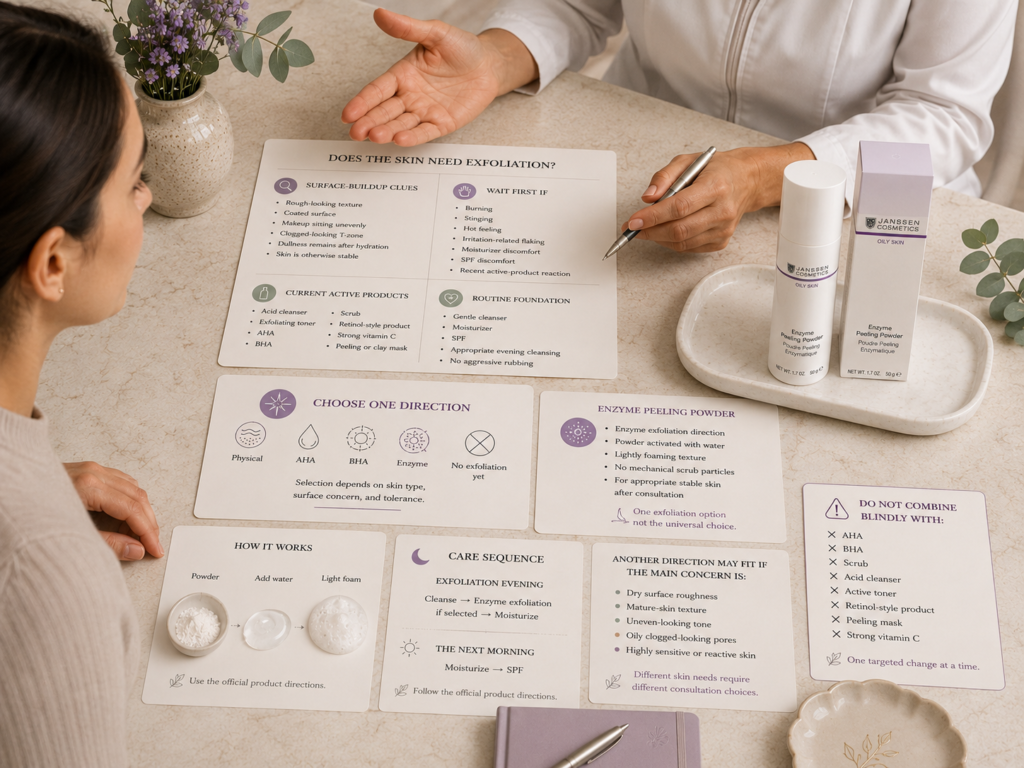
For dull or tired-looking skin, possible options may include:
For dullness connected to dry or dehydrated skin, hydration-focused options may be reviewed, such as:
For dullness connected to oily skin, clogged-looking pores, or T-zone buildup, options may include:
For dry or mature skin needing gentle smoothing, options such as Mild Face Rub or Skin Refining Enzyme Peel may be reviewed depending on skin type and tolerance.
Professional exfoliation systems should remain in professional treatment settings and should not be presented as home-use routines.
These are not automatic recommendations. Exfoliation should be selected only after understanding the skin type, sensitivity, current products, and SPF habits.
Do not exfoliate every day because your skin looks dull.
Do not scrub until the skin feels raw.
Do not use acids and scrubs together without guidance.
Do not use retinol-style products and exfoliating acids on the same night if your skin is not clearly tolerating them.
Do not exfoliate irritated, swollen, rash-like, or painful skin.
Do not skip moisturizer after exfoliation.
Do not skip SPF the next morning.
Do not use professional peels as home routines.
Do not assume stronger exfoliation means better results.
Do not ignore burning, swelling, crusting, bleeding, severe itching, eye-area irritation, or persistent worsening.
Many people should start with once weekly. Some skin may tolerate more, and some sensitive or irritated skin may need less or none at first. Your skin’s response matters more than a fixed schedule.
Yes, exfoliation may help dull-looking skin when dullness is caused by surface buildup or rough texture. But dullness can also come from dehydration, dryness, oil, product buildup, or irritation.
Yes. Over-exfoliation can make skin look tight, shiny, flaky, irritated, rough, or more dull under makeup.
AHA may be considered for surface texture and dullness if the skin is stable and not irritated. It should be introduced carefully.
BHA may be considered when dullness is connected to oily areas, clogged-looking pores, blackheads, whiteheads, or T-zone buildup.
A gentle scrub may help some skin, but harsh scrubbing can irritate the skin and make dullness worse. Sensitive, irritated, or over-exfoliated skin should avoid scrubs.
Yes. Moisturizer helps the skin feel comfortable after exfoliation. If moisturizer burns after exfoliating, you may have overdone it.
Yes. SPF is important every morning, especially when exfoliating products, retinol-style products, vitamin C, or brightening-support products are part of the routine.
Sometimes, but only carefully and only when the skin is stable. If sensitive skin is burning, stinging, hot, rash-like, or reactive, exfoliation should wait.
See a dermatologist if dullness or exfoliation reactions come with persistent rash-like irritation, swelling, pain, crusting, bleeding, infection-looking areas, severe itching, eye-area irritation, sudden changes, or worsening symptoms.
If your skin looks dull and you are not sure whether you need exfoliation, hydration, better cleansing, or a simpler routine, a free virtual consultation can help.
At Zendevie, we review your skin type, product history, cleanser, moisturizer, SPF, exfoliation habits, active products, and sensitivity before recommending a routine. The goal is to help your skin look fresher without overdoing it.

Zendevie is guided by Haby Diallo, a licensed esthetician with more than 20 years of professional skincare experience. Her approach is rooted in education, professional judgment, and personal care.
years of experience