
Dull-looking skin is not always about dryness or dead skin buildup.
Sometimes the skin looks tired because it is exposed to daily stress from the environment, sun exposure, pollution, lack of sleep, indoor air, makeup, SPF layers, and routine imbalance. Over time, these daily factors can make the complexion look less fresh, less even, and less radiant.
This is where antioxidants can be helpful.
Antioxidants are often used in skincare to support the look of skin that appears dull, tired, uneven, or stressed by daily environmental exposure. They are not a replacement for cleanser, moisturizer, or SPF. They are a support step that may help the skin look fresher when used correctly.
At Zendevie, we do not recommend antioxidant products blindly. In consultation, our licensed esthetician first looks at the skin type, sensitivity, hydration level, current routine, SPF habits, exfoliation use, and whether the skin is ready for active support.
Antioxidants can be helpful.
But they work best when the routine foundation is already right.
Antioxidants may help dull-looking skin by supporting the look of a fresher, more radiant, and more even-looking complexion, especially when the skin is exposed to daily environmental stress.
Antioxidants may be helpful for dull skin that looks:
Common antioxidant-support ingredients discussed in skincare include:
But antioxidants are not always the first step. If skin is burning, stinging, over-exfoliated, very dry, or sensitive, hydration and comfort may need to come first.
In skincare, antioxidants are ingredients that help support the skin’s appearance when it is exposed to daily environmental stress.
They are often used in routines for:
Antioxidants are not magic. They are supportive ingredients that work best as part of a complete routine.
A good routine still needs cleansing, moisture, SPF, and consistency.
Dull-looking skin may benefit from antioxidants when the complexion looks tired, flat, uneven, or less fresh because of daily exposure.
This may happen after:
Antioxidants may support the look of skin that appears less radiant from these daily lifestyle and environmental factors.
But if dullness is mostly from dehydration or over-exfoliation, antioxidants may not be the first need.
Before adding an antioxidant serum, it is important to understand why the skin looks dull.
Dullness may come from:
If the skin is already irritated, a strong antioxidant product may make the routine feel uncomfortable.
The cause matters.
Antioxidants and SPF are not the same.
SPF is a daytime protection step.
Antioxidants may support the skin’s appearance when used as part of a morning routine, but they do not replace sunscreen.
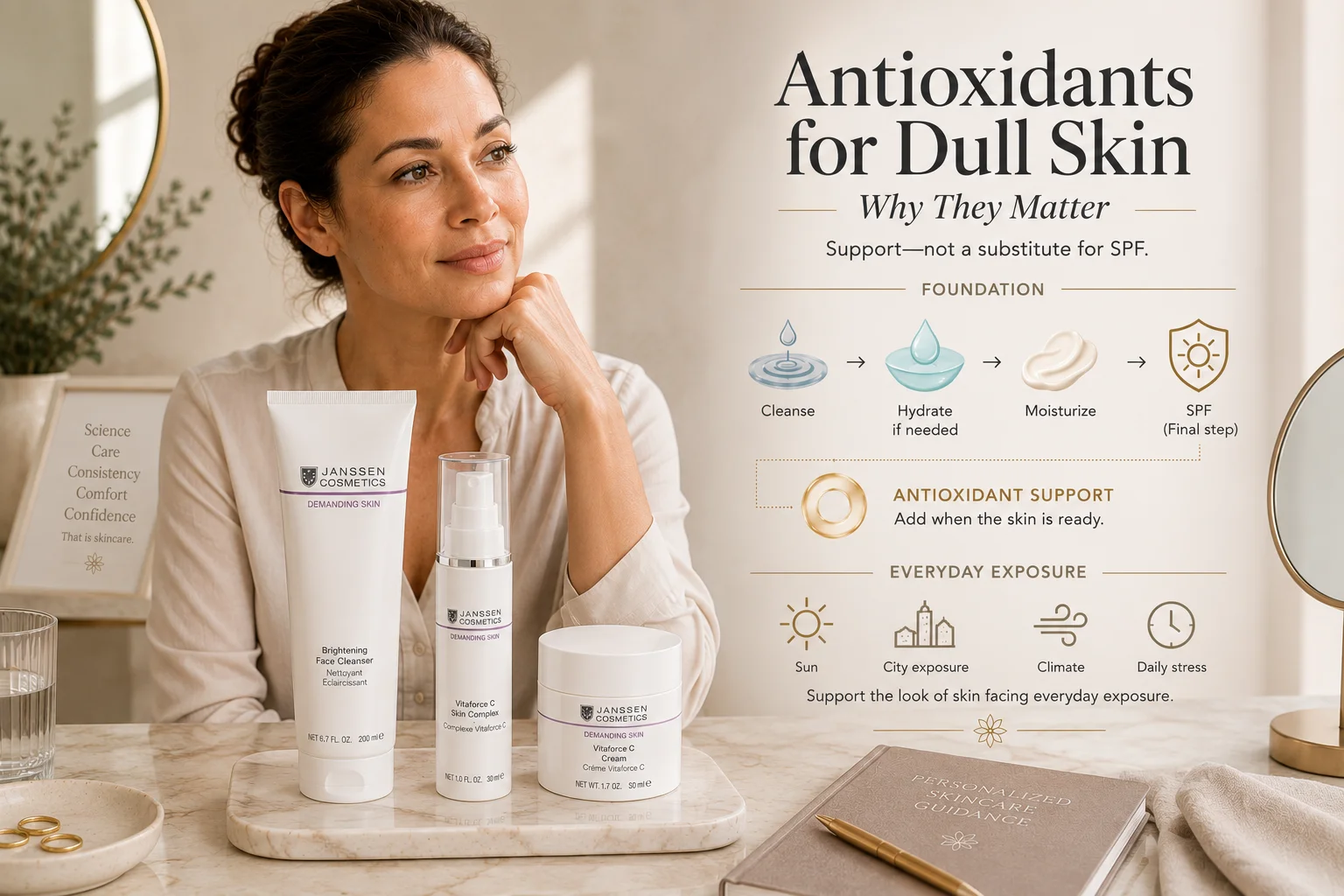
A simple morning routine may look like:
Cleanser → antioxidant serum if tolerated → moisturizer → SPF

SPF should still be the final morning skincare step.
If dull skin is also uneven-looking, brightening-support care should not be used without SPF.
Sun exposure can make uneven-looking tone, dryness, texture, and dullness appear more noticeable over time.
Antioxidants may be helpful in a morning routine, but SPF is still essential.
This is especially important if the routine includes:
Antioxidants support the routine.
SPF protects the routine’s purpose.
Daily environmental stress can affect how the skin looks.
This may include:
Skin exposed to these factors may look dull, tired, or less fresh by evening.
Antioxidants may help support the look of skin that faces these daily exposures.
People in city environments may notice that their skin looks dull by the end of the day.
This may happen because oil, sweat, SPF, makeup, and environmental residue collect on the skin surface.
Antioxidants can be one part of a city-skin routine, but cleansing is also very important.
A city-exposed dull skin routine may need:
Antioxidants should not be added on top of a poorly cleansed routine.
Tired-looking skin may appear dull, flat, or less rested.
This can happen after stress, lack of sleep, travel, or a long workday.
Antioxidant support may help the skin look fresher when paired with a balanced routine.
But tired-looking skin also needs:
Skincare can support the look of the skin, but it does not replace rest.
Dullness and uneven-looking tone often appear together.
A person may notice:
Antioxidant support, especially vitamin C support, is often discussed for dullness and uneven-looking tone.
But brightening-support routines need patience and SPF.
Without SPF, the routine is incomplete.
Dry dull skin may look rough, flaky, tight, or less radiant.
Antioxidants may support radiance, but dry skin often needs moisture and comfort first.
Dry dull skin may need:
If dry skin is tight or flaking, do not start with strong active products.
Comfort comes first.
Dehydrated dull skin lacks water.
It may look flat, tight, creased, shiny but uncomfortable, or patchy under makeup.
Antioxidants can be helpful later, but hydration may be more important first.
A simple routine may be:
Gentle cleanser → hydration support → moisturizer → SPF
Once the skin feels stable, antioxidant support can be considered.
If antioxidant serum stings on dehydrated skin, the skin may need more comfort before active support.
Oily skin can look shiny and dull at the same time.
Oil, SPF, makeup, sweat, and pollution can mix on the skin and make the complexion look heavy or tired.
Oily dull skin may benefit from antioxidant support if the texture is lightweight and the skin tolerates it.
But oily dull skin also needs:
Oily skin should not be stripped before adding antioxidants.
Combination skin may show dullness in different ways.
The T-zone may look oily and heavy.
The cheeks may look dry or tired.
The outer face may need more comfort, while the center may need lighter layers.
An antioxidant serum may be useful, but the amount and texture matter.
Combination skin often benefits from:
The same product amount may not be right for every zone.
Sensitive dull skin needs caution.
Some antioxidant products, especially strong vitamin C formulas, may sting or feel too active for sensitive skin.
Sensitive dull skin should focus first on:
If the skin burns, stings, feels hot, or reacts easily, antioxidant support may need to wait.
A gentle routine is still a complete routine.
Mature skin may look dull because of dryness, dehydration, texture, makeup settling, and reduced surface freshness.
Antioxidants may support a fresher-looking complexion as part of a mature skin routine.
Mature dull skin may benefit from:
Mature skin should not be pushed with too many active products at once.
Antioxidant serum may help some skin look fresher under makeup, especially when dullness is connected to lack of radiance or daily exposure.
But serum texture matters.
If the antioxidant serum is sticky, heavy, or does not layer well, makeup may pill or separate.
Before makeup, antioxidant serum should:
If makeup looks worse after antioxidant serum, review product amount and layering.
Product buildup can make skin look dull.
If dullness comes from too many layers, adding an antioxidant serum may make the skin feel more coated.
Before adding antioxidant support, review:
A routine with too many layers may need simplification before antioxidants.
Over-exfoliated skin can look dull, shiny, tight, flaky, and irritated.
If this is happening, antioxidant support may need to wait.
Over-exfoliated skin should pause:
The skin may need a simple reset:
Mild cleanser → moisturizer → SPF
Once the skin feels stable, antioxidant support can be reconsidered.
Vitamin C is one of the most commonly discussed antioxidants for dull-looking skin.
It is often used to support the look of radiance, freshness, and more even-looking tone.
Vitamin C may be helpful when skin looks:
But vitamin C should be introduced carefully.
It may not be right for skin that is burning, stinging, over-exfoliated, or highly sensitive.
Vitamin E is another antioxidant often used in skincare formulas.
It is frequently included in products designed to support comfort, softness, and a more nourished skin feel.
Vitamin E may be found in moisturizers, serums, creams, or formulas designed for dry or mature skin.
The full formula matters more than one ingredient.
A vitamin E product that is too rich for oily skin may feel heavy, while dry skin may enjoy more comfort.
Green tea extract is often discussed for antioxidant support and comfort-focused skincare.
It may be included in formulas for skin that looks stressed, tired, or sensitive.
For dull-looking skin, green tea-style support may be helpful when the routine needs a calmer antioxidant direction instead of a very active feel.
Sensitive skin should still patch test.
Gentle does not mean every formula works for everyone.
Coenzyme Q10 is often discussed in skincare for antioxidant support and mature skin appearance.
It may be included in products that support the look of vitality, smoothness, and well-aging routines.
For mature dull skin, antioxidant-support ingredients may be useful when paired with hydration, moisturizer, and SPF.
But Q10 is not a replacement for the routine foundation.
Resveratrol is another antioxidant ingredient sometimes included in skincare.
It is often discussed for skin that appears stressed by daily environmental exposure.
For dull skin, ingredients like resveratrol may be part of a routine designed to support the look of freshness and resilience.
Again, the full product matters.
Do not choose skincare from one ingredient alone.
Niacinamide is not always described only as an antioxidant, but it is often used in routines for uneven-looking tone, visible pores, oil balance, and skin comfort.
It may be helpful for some dull-looking skin, especially when the skin also looks uneven, oily, or stressed.
Niacinamide should still be introduced carefully if the skin is sensitive or already irritated.
No ingredient works for everyone.
Many botanical extracts are used in skincare for antioxidant support.
These may include ingredients from fruits, plants, leaves, seeds, or roots.
Botanical does not automatically mean gentle.
Some people with sensitive skin may react to botanical extracts, fragrance, or essential oils.
If your skin reacts easily, patch testing is important.
The goal is supportive care, not irritation.
Antioxidants can appear in serums, creams, masks, ampoules, or SPF-adjacent products.
An antioxidant serum may feel more targeted and lightweight.
An antioxidant cream may provide support along with moisture and comfort.
The right choice depends on:
The product form matters because it affects how the routine feels.
Antioxidants are often used in morning routines because they can support the skin’s appearance during the day.
A simple morning routine may look like:
Cleanser → antioxidant serum if tolerated → moisturizer → SPF
This can be helpful for people concerned with dullness, environmental exposure, uneven-looking tone, or tired-looking skin.
But if the antioxidant product stings in the morning, the skin may need a gentler approach.
Some antioxidant products can be used at night, depending on the formula.
Night use may be better if the product feels sticky under SPF or makeup.
A simple night routine may look like:
Cleanser → antioxidant support if tolerated → moisturizer
But avoid stacking antioxidant products with exfoliating acids, retinol-style products, or strong active products if the skin is sensitive.
A routine does not need every active product in one night.
Some antioxidant products can be used daily if the skin tolerates them.
Others may need slower introduction.
Daily use depends on:
Start slowly when introducing a new antioxidant product.
Your skin’s comfort matters.
Yes, some antioxidant products can irritate the skin, especially if they are strong, acidic, fragranced, or layered with too many active products.
Possible signs include:
If this happens, pause the product and simplify.
If symptoms are persistent or worsening, speak with a dermatologist.
Yes, antioxidant serums can pill if the texture does not layer well.
Pilling may happen when:
If pilling happens, use less product or simplify the morning routine.
Antioxidants may support a fresher-looking base when dullness is linked to tired-looking skin or environmental exposure.
But makeup finish depends on the full routine.
Makeup may still look flat or patchy if the skin is:
Antioxidants are not a makeup primer.
They support the skincare routine.
Antioxidants may support the look of healthier, fresher skin, but texture concerns often need more than antioxidant support alone.
Texture may be related to:
If texture is rough or congested-looking, cleansing, hydration, moisturizer, SPF, and gentle exfoliation may also need review.
Some antioxidant-support products, especially vitamin C-focused formulas, are often discussed for dark spot appearance and uneven-looking tone.
But these routines need patience, consistency, and daily SPF.
Do not expect overnight change.
Do not combine every brightening-support ingredient at once.
If dark spot appearance is persistent, changing, irregular, or concerning, speak with a dermatologist or medical provider.
A strong dull-skin routine often pairs antioxidant support with SPF.
Antioxidants may support the look of skin exposed to daily environmental stress.
SPF helps protect the skin during the day.
A simple pairing may look like:
Morning: antioxidant support → moisturizer → SPF
But if antioxidant support irritates the skin, pause and focus on the basics.
The best routine is the one your skin can tolerate consistently.
Antioxidants are often more comfortable when the skin is well hydrated.
If the skin is dehydrated, antioxidant products may sting or feel too active.
Hydration helps the skin feel more flexible and comfortable.
For dull skin, hydration and antioxidants may work together when chosen well:
Hydration supports comfort.
Antioxidants support radiance and environmental stress appearance.
SPF protects the morning routine.
None of these steps should overwhelm the skin.
Antioxidants and exfoliation can both be part of a dull-skin routine, but they should not be over-layered.
Be careful when combining:
If the skin stings, flakes, or looks duller, simplify.
Dull skin does not need every active step at the same time.
Retinol-style products may be used in some routines, but they should be introduced carefully.
If retinol-style products are already in the routine, antioxidant support should be added thoughtfully.
Too many active products may cause:
If the skin is not stable, active products should wait.
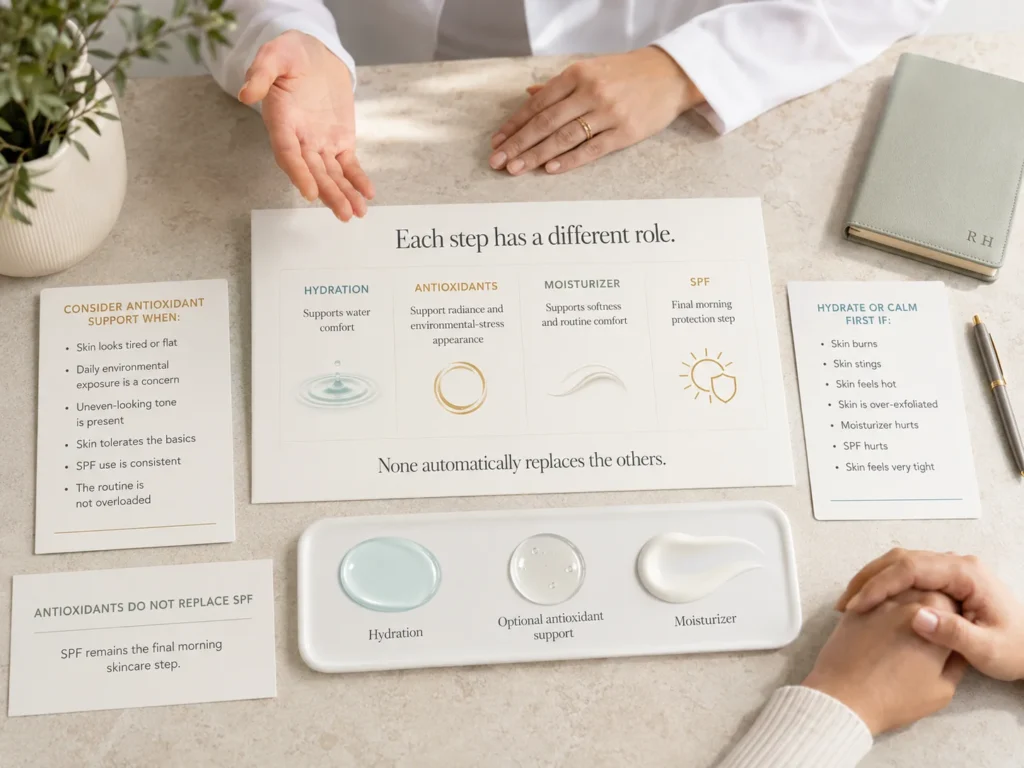
A simple way to add antioxidant support:
The routine should become clearer, not more complicated.
Antioxidant support may be helping if the skin gradually looks:
The skin should not feel irritated for the routine to be working.
An antioxidant product may not be right if it causes:
Stop and simplify if the skin reacts.
A simple morning routine may look like:
Gentle cleanser → antioxidant serum if tolerated → moisturizer → SPF
For dry skin, choose a more comforting moisturizer.
For oily skin, choose lightweight layers.
For sensitive skin, introduce antioxidant support slowly or wait until the skin is stable.
For mature skin, pair antioxidant support with hydration and SPF.
A simple evening routine may look like:
Cleanser → antioxidant support if tolerated → moisturizer
If you are also using exfoliation or retinol-style products, avoid stacking too many active steps on the same night.
For dull skin, consistency is more helpful than intensity.
Dull skin can still have a complete routine without antioxidant products.
Morning:
Cleanser → moisturizer → SPF
Evening:
Cleanser → moisturizer
This may be best if the skin is sensitive, irritated, over-exfoliated, or reacting easily.
Antioxidants can be added later when the skin feels stable.
Morning:
Gentle cleanser → hydrating support if needed → antioxidant support if tolerated → moisturizer → SPF
Evening:
Gentle cleanser → hydration or comfort support → moisturizer
Dry dull skin should not be pushed with strong antioxidant products before moisture and comfort are in place.
Morning:
Gentle cleanser → hydration serum → antioxidant support if tolerated → moisturizer → SPF
Evening:
Gentle cleanser → hydration support → moisturizer
If the antioxidant product stings, focus on hydration first.
Dehydrated skin needs comfort before stronger active support.
Morning:
Gentle cleanser → lightweight antioxidant support if tolerated → lightweight moisturizer → SPF
Evening:
Gentle cleanser → lightweight moisturizer
If clogged-looking pores are present, BHA may be considered separately and carefully.
Do not stack too many active products.
Morning:
Gentle cleanser → antioxidant support if tolerated → moisturizer by zone → SPF
Evening:
Gentle cleanser → hydration or moisturizer by zone
Use lighter layers on the T-zone and more comfort where the skin feels dry.
Combination skin needs adjustment, not a one-size-fits-all approach.
Morning:
Mild cleanser → moisturizer → SPF
If antioxidant support is added later, introduce it slowly and choose a gentle direction.
Avoid strong vitamin C, acids, retinol-style products, and exfoliating toners when the skin is already reactive.
Sensitive skin should not be forced into an active routine.
Morning:
Gentle cleanser → hydration support if needed → antioxidant support if tolerated → moisturizer → SPF
Evening:
Gentle cleanser → serum or moisturizer → cream if needed
Mature dull skin often benefits from comfort, hydration, antioxidant support, and SPF working together.
Avoid adding too many active products at once.
Common mistakes include:
The goal is support, not stress.
Wait before using antioxidant products if the skin is:
A calm routine should come first.
Professional guidance may help if you are unsure whether antioxidants belong in your routine.
This is especially helpful if:
A consultation can help choose the right step and timing.
A dermatologist should evaluate the skin if dullness or product reactions come with:
Cosmetic skincare can help with appearance and routine structure, but medical-looking changes need medical evaluation.
After consultation, our licensed esthetician may consider Janssen Cosmetics options depending on why the skin looks dull and whether antioxidant support is appropriate.
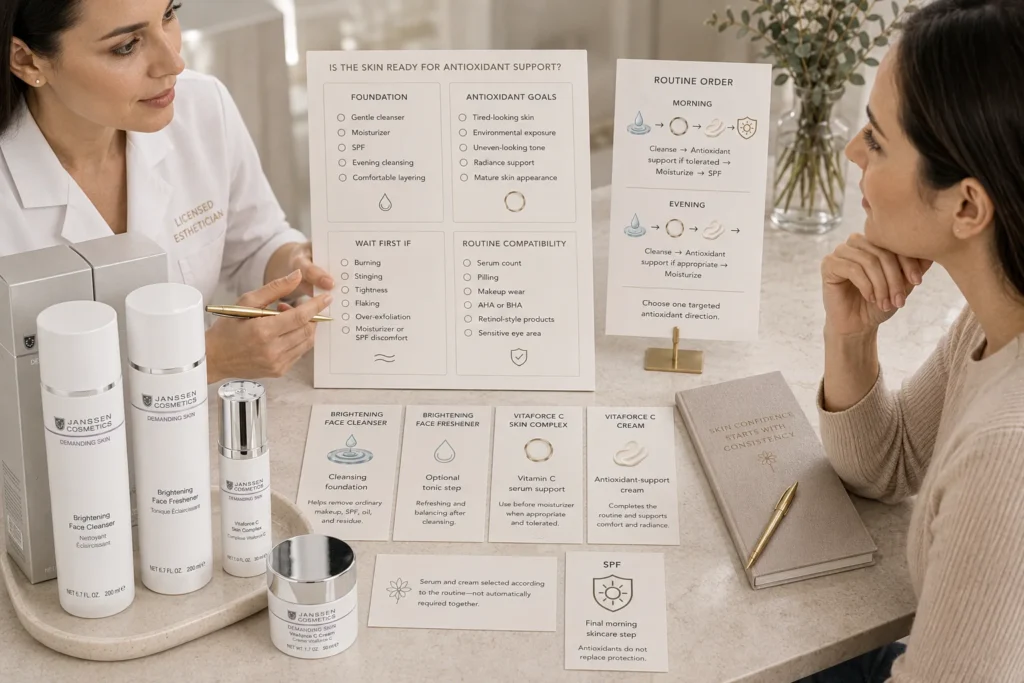
For tired-looking, demanding dull skin, possible options may include:
For dry or dehydrated dull skin, hydration support may come before antioxidant support. Possible options may include:
For sensitive dull skin, calming support may come before active antioxidant products. Possible options may include:
For oily dull skin, lightweight textures and oil-balance support may be reviewed before adding antioxidant steps. Possible options may include:
For morning routines, Face Guard Advanced SPF 30 may be considered as the final daytime protection step after moisturizer when appropriate.
These are not automatic recommendations. The correct routine depends on skin type, sensitivity, hydration level, product tolerance, SPF habits, and whether the skin is ready for antioxidant support.
Do not use antioxidants instead of SPF.
Do not use strong vitamin C on irritated or over-exfoliated skin.
Do not layer vitamin C, AHA, BHA, retinol-style products, scrubs, and brightening-support products all at once.
Do not skip moisturizer because you are using serum.
Do not apply active antioxidant serum close to the eyes unless it is made for that area.
Do not ignore pilling, stinging, burning, or worsening dullness.
Do not expect overnight transformation.
Do not choose a product based on one ingredient without considering skin type and formula texture.
Do not ignore swelling, rash-like irritation, pain, crusting, bleeding, severe itching, eye-area irritation, or persistent worsening.
Antioxidants may be helpful for dull-looking skin because they can support the look of freshness, radiance, and more even-looking tone when used as part of a balanced routine.
Vitamin C is commonly discussed for dull-looking skin, but the best antioxidant depends on skin type, sensitivity, hydration level, and product tolerance.
Vitamin C may support a fresher-looking, more radiant-looking complexion when the skin can tolerate it. Sensitive or over-exfoliated skin should be cautious.
No. Antioxidants do not replace SPF. SPF should still be the final morning skincare step.
Many antioxidant products are used in the morning before moisturizer and SPF. Some may also be used at night, depending on the formula and skin tolerance.
Yes, some antioxidant products can irritate sensitive skin, especially strong vitamin C formulas or products layered with too many active ingredients.
Yes, oily skin can use antioxidant serum if the texture is lightweight and does not feel sticky, greasy, or heavy.
Yes, antioxidant serums can pill if too much is used, if the texture is sticky, or if the product does not layer well with moisturizer, SPF, primer, or makeup.
Sometimes, but carefully. Do not layer antioxidants with multiple acids, scrubs, or retinol-style products if the skin is sensitive, dry, or irritated.
See a dermatologist if dullness or product reactions come with persistent rash-like irritation, swelling, pain, crusting, bleeding, infection-looking areas, severe itching, eye-area irritation, sudden major skin changes, burning that does not settle, worsening symptoms, or changing irregular marks.
If your skin looks dull, tired, uneven, or less fresh, antioxidant support may be helpful — but only if it fits your skin.
At Zendevie, a free virtual consultation helps us understand whether your skin needs hydration, calming support, antioxidant care, SPF adjustment, exfoliation guidance, or a simpler routine first. We review your skin type, sensitivity, current products, makeup, SPF, and daily routine before recommending products.
The goal is not to add more steps.
The goal is to choose the right support for your skin.

Zendevie is guided by Haby Diallo, a licensed esthetician with more than 20 years of professional skincare experience. Her approach is rooted in education, professional judgment, and personal care.
years of experience