


What Is Combination Skin? Signs, Causes, and How to Care for It
Combination skin can be confusing because your face does not behave the same way everywhere. Your forehead, nose, and chin may feel oily by midday, but your cheeks may feel normal, tight, or dry. A moisturizer may feel perfect on one part of your face and too heavy on another. A cleanser for oily skin may help your T-zone, but leave your cheeks uncomfortable.
If you have ever felt like your skin is sending mixed messages, you may have combination skin. That mixed feeling is explained more fully in why combination skin feels oily and dry at the same time.
The key with combination skin is balance. You do not want to treat the whole face like oily skin if only the T-zone is shiny. You also do not want to use a heavy cream everywhere if only the cheeks feel dry. Combination skin often needs a routine that respects different zones of the face.
At Zendevie, combination skin is approached with consultation and education first. Before choosing products, it helps to understand which areas are oily, which areas need comfort, and how your skin changes throughout the day.
Quick Answer
Combination skin means your face has both oily and dry or normal areas. Most often, the T-zone, which includes the forehead, nose, and chin, looks shiny or feels oily, while the cheeks may feel normal, dry, or tight.
A good combination skin routine should cleanse gently, support balance, moisturize without heaviness, and treat different zones only when needed. The goal is not to dry out the whole face. The goal is to help each area feel comfortable.
For many people, a simple routine works best: gentle cleanser, lightweight balancing moisturizer, targeted T-zone support when needed, and SPF during the day.
What Does Combination Skin Mean?
Combination skin means your skin has more than one behavior pattern on the same face. One area may produce more oil, while another area may need more moisture or comfort.
The most common pattern is:
- Oily forehead
- Oily nose
- Oily chin
- Normal, dry, or tight cheeks
This is why combination skin can feel difficult to shop for. Products made for oily skin may feel too drying on the cheeks. Products made for dry skin may feel too rich on the T-zone.
Combination skin is not a problem to fix. It is a skin type to understand.
Common Signs of Combination Skin
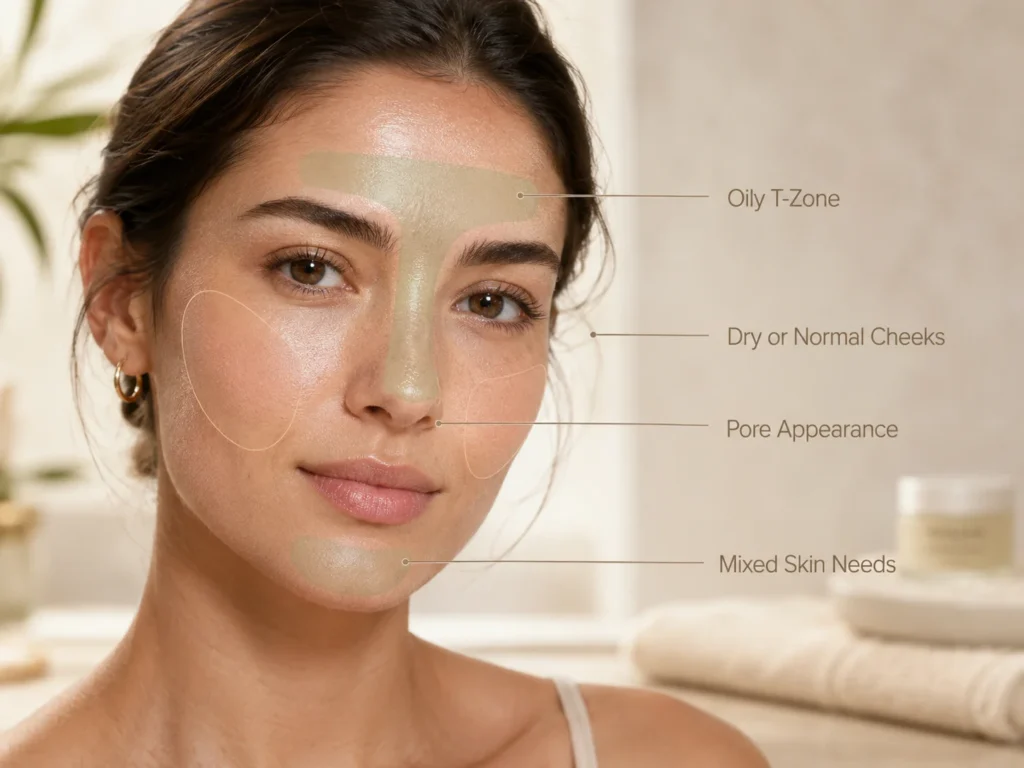
You may have combination skin if you notice:
- Shine on the forehead, nose, or chin
- Cheeks that feel dry, tight, or normal
- Makeup separating on the T-zone but clinging to dry areas
- Enlarged-looking pores around the nose
- Blackheads or clogged-looking pores mainly on the T-zone
- Moisturizer feeling too heavy in some areas but not enough in others
- Skin that changes with the weather Seasonal changes can shift which zones need more or less support, so review why combination skin changes with the weather before replacing the entire routine
- Some areas feeling oily while other areas feel dehydrated
A very common clue is this: your nose gets oily, but your cheeks still need comfort.
Why Is My T-Zone Oily but My Cheeks Are Dry?
The T-zone naturally has more oil glands than some other areas of the face. This is why the forehead, nose, and chin often become shiny faster.
The cheeks may have fewer active oil glands, or they may be more affected by dryness, weather, cleansing, or irritation. This can make the cheeks feel tight even while the center of the face looks oily.
That mixed pattern is exactly why one product may not work perfectly everywhere.
For a deeper look at this pattern, read about oily T-zone and dry cheeks before choosing products for the whole face.
Combination Skin vs. Oily Skin
Oily skin usually produces more oil across most of the face. The cheeks may also feel oily, and shine may appear quickly all over.
Combination skin usually has shine in the T-zone, but the cheeks feel different. They may be normal, dry, sensitive, or tight.
This difference matters because oily skin may need more clarifying support across the face, while combination skin often needs targeted care only in certain areas.
Combination Skin vs. Dry Skin
Dry skin usually feels tight, rough, flaky, or uncomfortable across most areas of the face.
Combination skin may have dry cheeks, but the T-zone still produces oil. If you use only rich dry-skin products, your T-zone may feel greasy or congested. If you use only oily-skin products, your cheeks may feel stripped.
Combination skin needs balance, not extremes.
Can Combination Skin Be Dehydrated?
can-combination-skin-be-dehydrated
Yes. Combination skin can be dehydrated. This means the skin may have oil on the surface but still lack water.
You might notice shine on the nose but tightness after cleansing. You might feel oily and dry at the same time. This usually means the skin needs lightweight hydration, not harsh drying products.
Hydration does not have to mean heavy cream. Combination skin often does well with lightweight moisture that supports comfort without making the T-zone feel greasy.
Can Combination Skin Be Sensitive?
Yes. Combination skin can also be sensitive. The cheeks may sting, flush, or feel tight, while the T-zone still becomes shiny.
If this happens, avoid treating the whole face aggressively. Strong exfoliation, harsh scrubs, and alcohol-heavy products can make the cheeks feel worse.
When combination skin is also sensitive, the routine should stay gentle and simple.
Ingredients That Can Help Combination Skin
Combination skin usually does best with ingredients and textures that support balance. The goal is to hydrate dry or normal areas while keeping the T-zone from feeling heavy.
To choose products more carefully, review the best ingredients for combination skin so oily and dry areas are supported without extremes.
Lightweight Hydrators
Ingredients that help support hydration can be useful for both the cheeks and T-zone. Lightweight hydration helps the skin feel comfortable without adding a greasy finish.
Balancing Ingredients
Some ingredient systems are designed to help the skin feel more balanced, especially when one area is oily and another area feels dry or normal. These are helpful in moisturizers made specifically for combination skin.
Soothing Support
If the cheeks feel tight or sensitive, soothing ingredients can help support comfort. Combination skin should not be forced into an oily-skin routine if parts of the face feel delicate.
Gentle Clarifying Ingredients
If the T-zone has clogged-looking pores or oily shine, gentle clarifying support may help. The key is to use clarifying products where needed instead of drying out the whole face.
SPF
Combination skin still needs daytime protection. A lightweight SPF or SPF-support routine can help protect the skin without making it feel too heavy.
A Simple Morning Routine for Combination Skin
A morning routine for combination skin should feel fresh, balanced, and not overloaded.
Step 1: Cleanse gently
Use a cleanser that removes oil and buildup without leaving the cheeks tight. If the cleanser makes your cheeks feel dry, it may be too strong.
Step 2: Apply lightweight moisture
Choose a moisturizer that gives comfort without a heavy finish. Combination skin often needs a texture that feels smooth and light.
Step 3: Add targeted T-zone support if needed
If the T-zone becomes very shiny, a targeted product or mattifying support may be used in that area. You may not need it on the cheeks.
Step 4: Finish with SPF
Daytime protection is important for every skin type. Choose a texture that feels comfortable and does not make the T-zone feel overly greasy.
A simple morning structure:
Cleanser → Lightweight Balancing Moisturizer → Targeted T-Zone Support if needed → SPF
For step-by-step order, follow a simple combination skin routine that keeps cleansing, lightweight moisture, T-zone support, and SPF balanced.
A Simple Evening Routine for Combination Skin
At night, the routine should remove the day’s buildup and support comfort.
Step 1: Cleanse
Remove makeup, sunscreen, oil, and daily residue without scrubbing harshly.
Step 2: Moisturize according to zones
You may apply a lightweight moisturizer all over, then add a little more comfort to the cheeks if they feel dry. For exact placement guidance, learn how to moisturize combination skin by zone. The T-zone may need less product.
Step 3: Use a mask only where needed
If the T-zone feels oily or congested, a clarifying mask may be used on that area only. The cheeks do not always need the same mask.
A simple evening structure:
Cleanser → Balancing Moisturizer → Optional T-Zone Mask when needed
Zone-Based Care: The Secret to Combination Skin
Combination skin often improves when you stop treating the whole face the same way.
If your T-zone is oily, focus clarifying support there. If your cheeks feel dry, give them more hydration and comfort. If your chin is clogged but your cheeks are sensitive, do not use the same active product everywhere.
This does not mean your routine needs to be complicated. It simply means you listen to each area of the face.
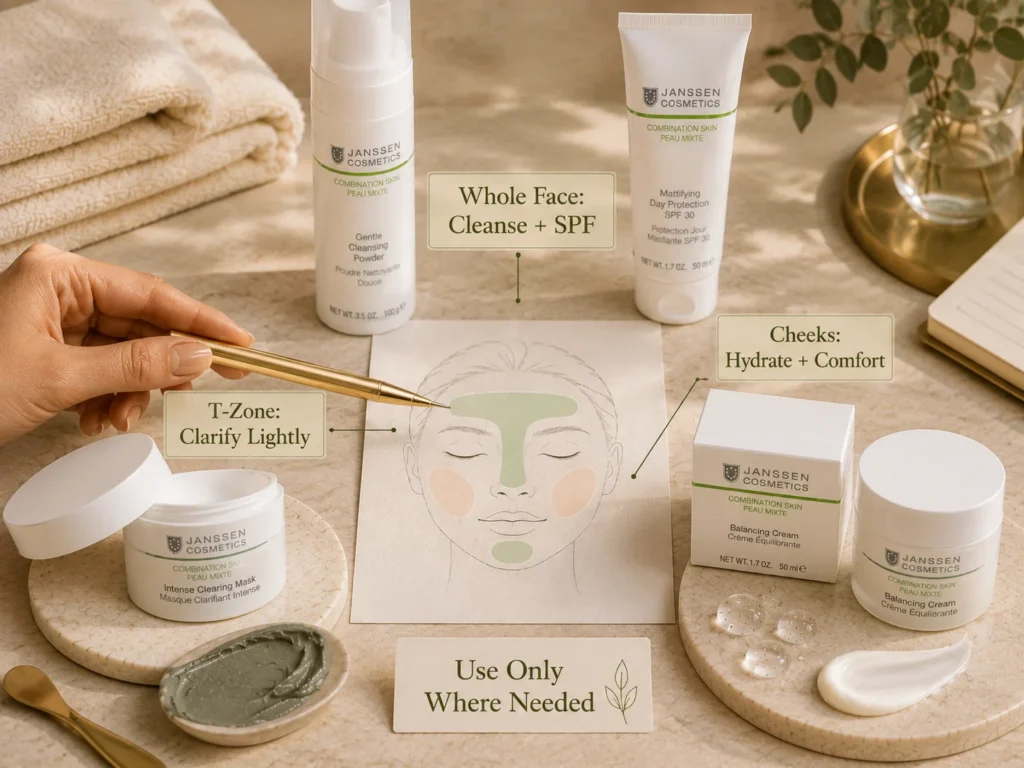
A simple example:
- Use a lightweight moisturizer all over
- Apply a little extra moisturizer on dry cheeks if needed
- Use a clarifying mask only on the T-zone
- Avoid strong active products on areas that feel sensitive
Where Janssen Cosmetics Fits Into a Combination Skin Routine
Zendevie carries Janssen Cosmetics through a consultation-first model. That means combination skin products are not recommended blindly. The right routine depends on which areas are oily, which areas feel dry, whether the skin is sensitive, and how the skin behaves during the day.
A personalized combination skin consultation can help decide which areas need oil-balance support, which areas need comfort, and which products should be used only by zone.
Janssen Cosmetics includes a Combination Skin family designed to support skin with oily and dry or normal zones.
Products that may be discussed during a consultation include:
- Gentle Cleansing Powder for mild cleansing of combination skin
- Balancing Cream for lightweight balancing moisture
- Tinted Balancing Cream for a low-lipid tinted moisturizer option when appropriate
- Intense Clearing Mask for oily T-zone support when appropriate
- Face Guard Advanced for daytime protection when appropriate
These are examples, not automatic recommendations. A consultation helps decide what belongs in the routine and whether certain products should be used only on specific zones.

What Not to Do If You Have Combination Skin
Do not treat the whole face as oily if only the T-zone is shiny.
Do not apply a heavy cream everywhere if only the cheeks are dry.
Do not use a clay or clarifying mask over the entire face if the cheeks feel tight.
Do not over-cleanse to control shine. Harsh cleansing can make the cheeks uncomfortable.
Do not skip moisturizer. Combination skin still needs hydration and comfort.
Do not add too many active products at once. It becomes hard to know what is helping and what is irritating.
When to Seek Professional Guidance
Combination skin is usually a cosmetic skin type, not a medical concern. But if you are dealing with painful breakouts, persistent irritation, rash-like changes, severe dryness, swelling, burning, or symptoms that do not improve, it is best to speak with a dermatologist or healthcare professional.
A skincare consultation can help with product selection and routine structure, but it does not replace medical diagnosis or treatment. For a fuller safety guide, review when combination skin may need a dermatologist.
Frequently Asked Questions
What is combination skin?
Combination skin means your face has both oily and dry or normal areas. The T-zone is usually oily, while the cheeks may feel dry, tight, or balanced.
How do I know if I have combination skin?
You may have combination skin if your forehead, nose, or chin gets shiny while your cheeks feel normal, dry, or tight. Makeup may separate in oily areas and cling to dry patches.
Why is my T-zone oily but my cheeks are dry?
The T-zone has more active oil glands, so it often becomes shiny faster. The cheeks may have less oil or may be affected by dryness, weather, or cleansing habits.
Is combination skin the same as oily skin?
No. Oily skin usually produces oil across most of the face. Combination skin has oily areas and dry or normal areas at the same time.
Does combination skin need moisturizer?
Yes. Combination skin still needs moisturizer. The key is choosing a lightweight texture and adjusting the amount by zone.
Should I use different products on different areas?
Sometimes, yes. You may use a clarifying mask only on the T-zone and more comfort on the cheeks. This is called zone-based care.
What is the best cleanser for combination skin?
The best cleanser removes oil and buildup without leaving the cheeks feeling tight. A gentle cleanser is usually better than a harsh one.
Can combination skin be sensitive?
Yes. Combination skin can also be sensitive, especially on the cheeks. If the skin feels stingy, tight, or reactive, keep the routine gentle and avoid strong actives.

About the Esthetician Behind Zendevie
Zendevie is guided by Haby Diallo, a licensed esthetician with more than 20 years of professional skincare experience. Her approach is rooted in education, professional judgment, and personal care.
20+
years of experience