

Combination skin can make skincare feel confusing because your face does not act the same everywhere. Your forehead may look shiny, your nose may feel oily, but your cheeks may feel dry, tight, or completely normal.
This is why many people choose the wrong routine. They treat the whole face like oily skin and the cheeks become uncomfortable. Or they treat the whole face like dry skin and the T-zone becomes too shiny.
Combination skin is not “bad” skin. It simply means different areas of your face need different support.
At Zendevie, we look at the full pattern of the skin before recommending products. With combination skin, the goal is balance, not extremes.
You may have combination skin if your T-zone — forehead, nose, and chin — becomes oily or shiny, while your cheeks feel normal, dry, tight, or more delicate.
Combination skin often needs a simple routine with gentle cleansing, lightweight moisture, SPF, and zone-based care when needed.
The key is not to treat the whole face as oily or the whole face as dry. Combination skin needs balance.
For the full overview, start with what combination skin means before changing your routine.
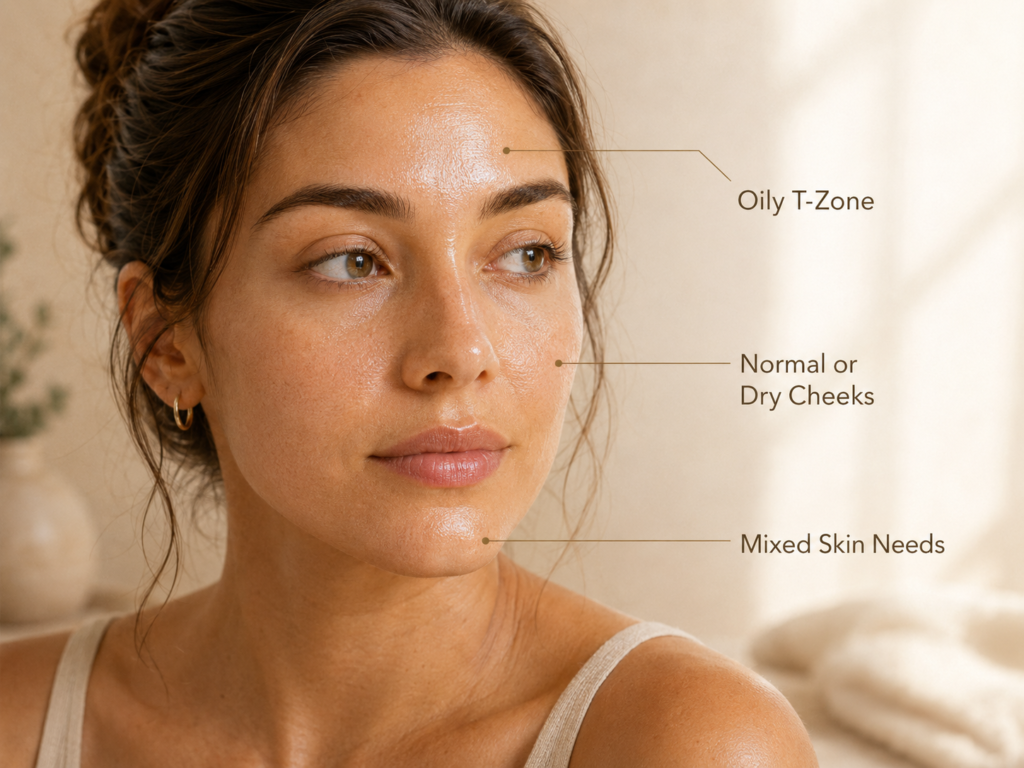
Combination skin often has two different patterns on the same face.
The most common pattern is:
Some people also notice clogged-looking pores around the nose or chin, while the cheeks feel smooth but dry. Others notice shine by midday only in the center of the face.
This mixed behavior is the biggest clue.
The T-zone naturally has more oil glands than some other areas of the face. That means the forehead, nose, and chin may become shiny faster than the cheeks.
If your nose gets oily by midday but your cheeks still feel normal or dry, this may be combination skin.
A fully oily skin type usually has oil across most of the face, not just the center.
This is one of the clearest signs.
Your cheeks may feel:
If a cleanser helps your T-zone but makes your cheeks feel uncomfortable, your skin may be combination.
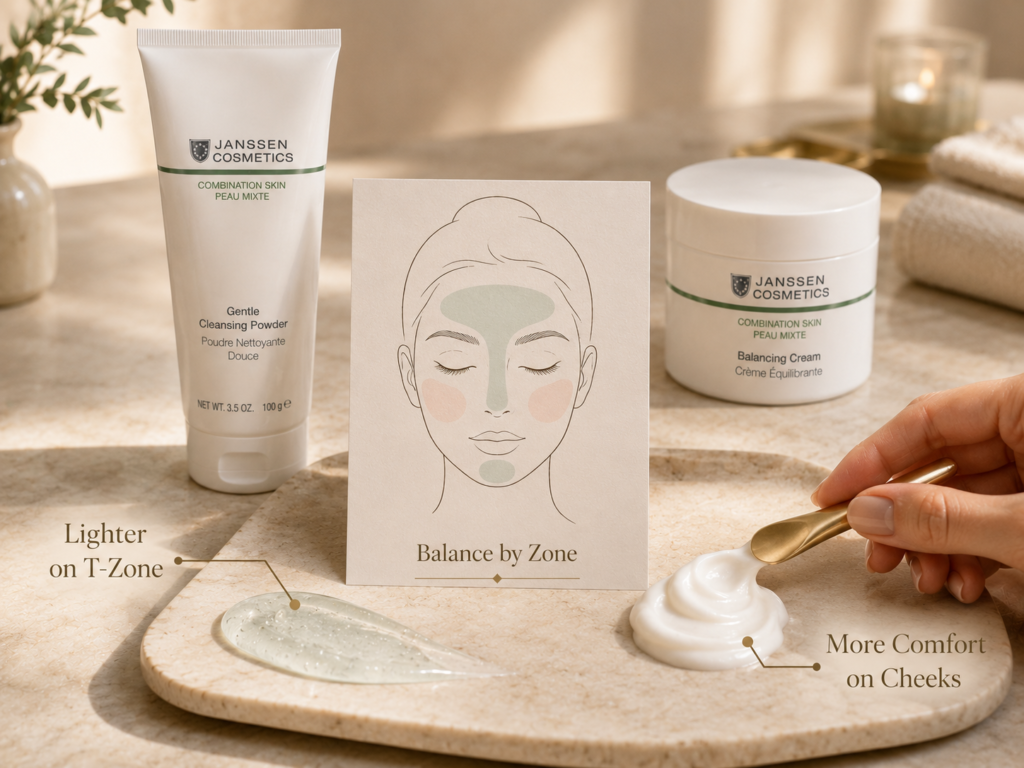
Combination skin often makes moisturizer tricky.
A cream may feel perfect on the cheeks but too heavy on the nose. A lightweight lotion may feel great on the T-zone but not comforting enough on the cheeks.
This does not mean your skin is impossible. It means the texture may need to be balanced, or you may need to adjust how much product you use in each area.
If moisturizer feels confusing, reviewing the best ingredients for combination skin can help you choose lighter textures for the T-zone and comfort for the cheeks.
For example:
Use a lighter layer on the T-zone.
Use a little more comfort on the cheeks.
Makeup can reveal a lot about combination skin.
You may notice:
This usually means the skin is not behaving the same everywhere.
Combination skin can shift by season.
In summer, the T-zone may feel oilier. In winter, the cheeks may feel drier. During travel, indoor heating, or air conditioning, the skin may feel more dehydrated.
This is why combination skin routines should be flexible. Your routine does not need to change completely every season, but texture and product amount may need small adjustments.
Many people with combination skin say:
“My skin is oily, but it still feels dry.”
This can happen when the T-zone produces oil, but the cheeks or deeper-feeling surface lacks hydration.
You may also have dehydrated combination skin, where the skin looks shiny but feels tight.
This is why stripping the skin is not the answer.
Oily skin usually looks shiny across most areas of the face. The cheeks may also feel oily.
Combination skin usually has an oily T-zone, but the cheeks feel different.
This difference matters because oily skin may need more balancing support across the face, while combination skin may need more targeted care.
Dry skin usually feels tight, flaky, rough, or uncomfortable across most of the face.
Combination skin may have dry cheeks, but the T-zone still becomes oily.
If you use only rich dry-skin products, the T-zone may feel greasy. If you use only oily-skin products, the cheeks may feel stripped.
Combination skin needs a middle path.
Try observing your skin for one day.
After cleansing in the morning, apply only a light moisturizer and SPF. A few hours later, look at your skin.
Ask yourself:
Once you understand your pattern, a simple combination skin routine can help you care for the T-zone and cheeks without overcomplicating the steps.
This simple observation can help you understand your skin pattern.
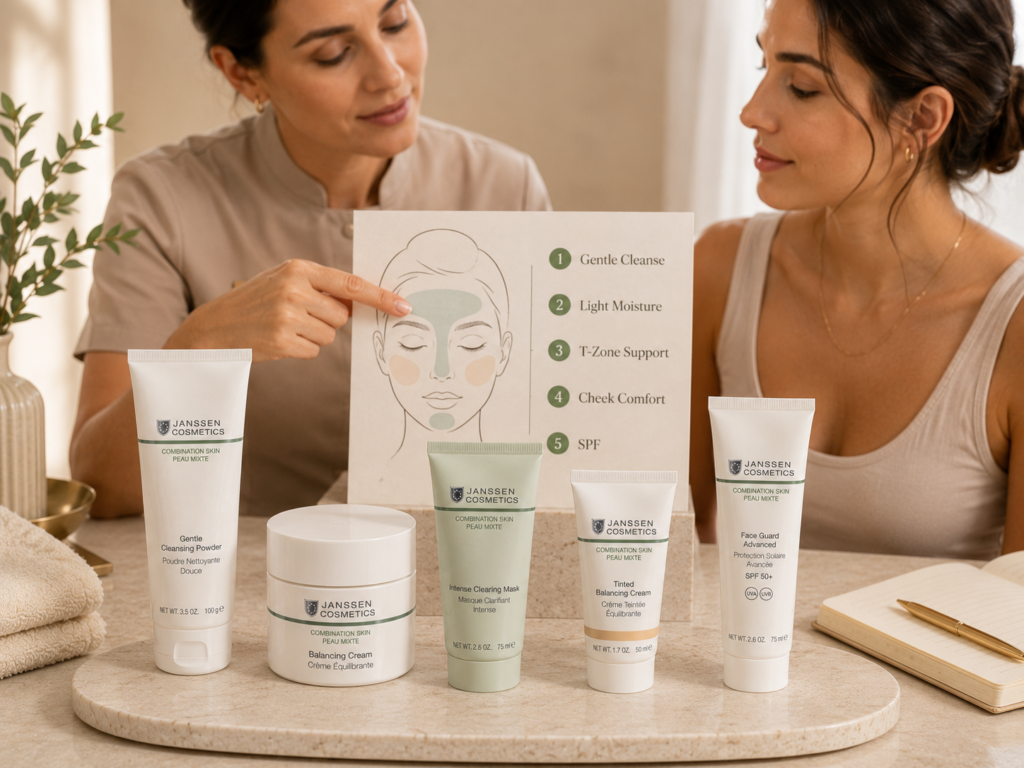
Zendevie carries Janssen Cosmetics through a consultation-first model. That means combination skin products are not recommended blindly.
Products that may be discussed during a combination skin consultation include:
These are examples, not automatic recommendations. A consultation helps decide what your skin needs by zone.
Do not treat the whole face as oily if only your T-zone is shiny.
Do not use heavy cream everywhere if only your cheeks feel dry.
Do not use a clarifying mask all over if your cheeks feel tight.
Do not skip moisturizer.
Do not keep switching products without understanding your skin pattern.
Do not ignore sensitivity on the cheeks.
You may have combination skin if your T-zone gets oily while your cheeks feel dry, tight, normal, or less oily.
Not always, but if your nose is oily and your cheeks are dry or normal, combination skin is likely.
Yes. Combination skin can have oil in some areas and still lack water.
Yes. The cheeks may be sensitive while the T-zone is oily.
Sometimes, yes. You may use a clarifying mask only on the T-zone and extra comfort only on dry cheeks.
Yes. Combination skin still needs moisturizer, but the texture should be lightweight and balanced.:

Zendevie is guided by Haby Diallo, a licensed esthetician with more than 20 years of professional skincare experience. Her approach is rooted in education, professional judgment, and personal care.
years of experience