



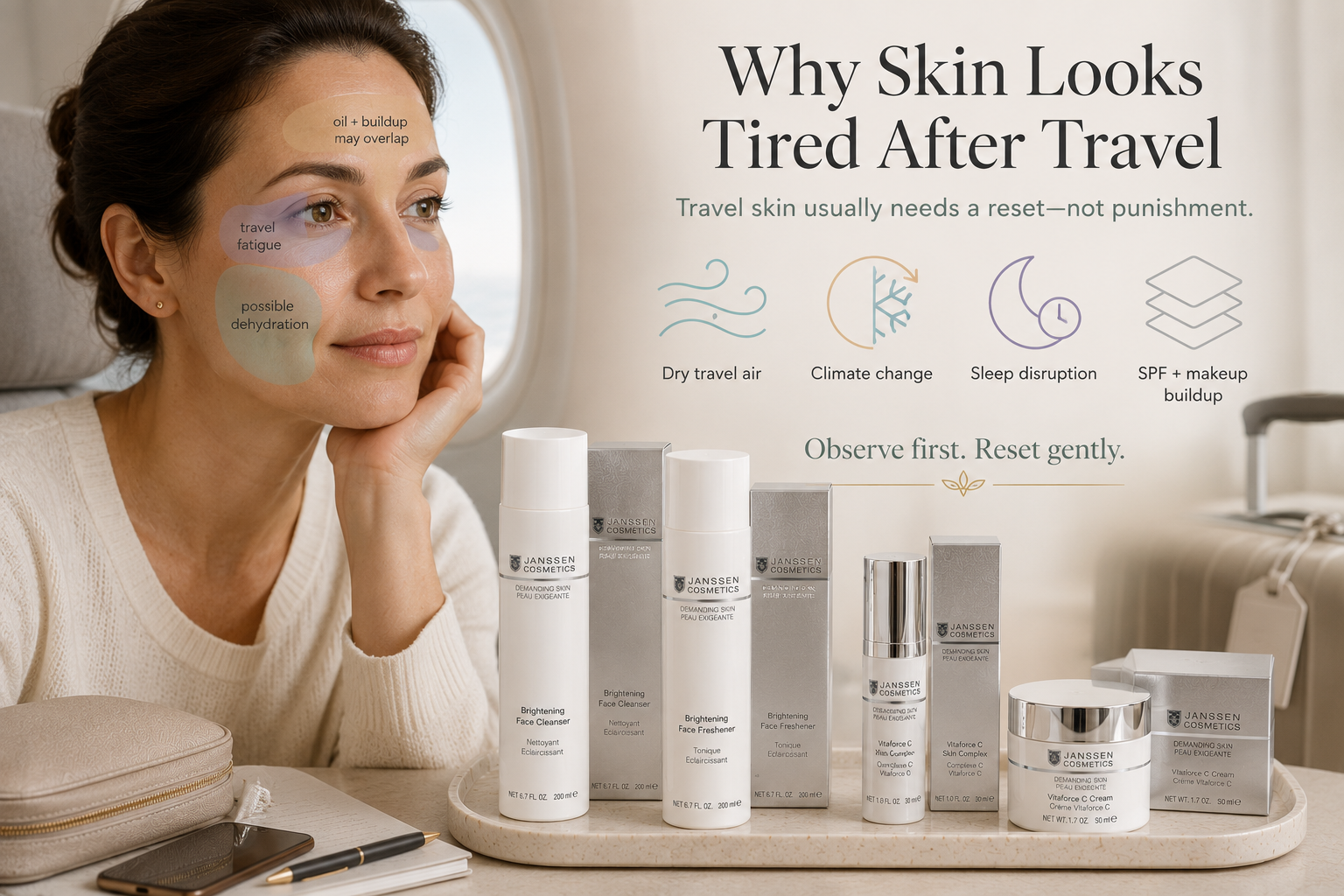
Travel can be exciting, but your skin may not always feel the same way.
After a flight, road trip, hotel stay, vacation, conference, or busy weekend away, the skin may look dull, tired, puffy, dry, oily, uneven, textured, or patchy under makeup. Some people notice tight cheeks. Others notice an oily T-zone. Some notice that SPF feels heavy, makeup separates, or their usual moisturizer suddenly does not feel like enough.
This does not mean your skin is “bad.”
It may simply be responding to change.
Travel can interrupt sleep, water intake, climate, cleansing habits, SPF use, makeup wear, stress level, and routine consistency. All of those changes can affect how fresh the skin looks.
At Zendevie, we do not treat post-travel dullness as an automatic reason to exfoliate harder. In consultation, our licensed esthetician first looks at what changed during travel: flight time, sun exposure, SPF use, makeup, sleep, hydration, weather, sensitivity, and product routine.
Travel skin usually needs a reset.
Not punishment.
Skin can look tired after travel because of dehydration, dry airplane air, climate changes, lack of sleep, stress, more SPF, makeup buildup, sweat, sun exposure, disrupted cleansing, and routine inconsistency.
After travel, skin may look:
A simple post-travel reset may include:
Morning: Gentle cleanser → hydration support if needed → moisturizer → SPF
Evening: Gentle cleanser → moisturizer or hydration support → moisturizer
Avoid harsh scrubs, strong acids, and new active products right after travel if the skin feels sensitive, dry, or irritated.

Travel changes the skin’s environment quickly.
Even a short trip can involve:
Your skin may look tired because it is adjusting to several changes at once.
Airplane cabins can feel very dry.
After flying, the skin may look flat, tight, or less smooth because it lacks water comfort.
This may show as:
This is why hydration is often one of the first post-travel steps to review.
When traveling, many people drink less water than usual.
They may avoid drinking too much before flights, skip water during busy travel days, drink more coffee, or spend long hours without normal routines.
The skin may respond by looking:
Skincare hydration can support the appearance of the skin, but body hydration and rest also matter.
Travel often changes sleep.
Early flights, late arrivals, time zone changes, hotel discomfort, excitement, stress, and busy schedules can make the face look less rested.
Lack of sleep may make skin look:
Skincare can help support the appearance of tired-looking skin, but it cannot replace rest.
After travel, keep the routine gentle and consistent while the body settles.
Travel can be stressful even when the trip is enjoyable.
Packing, airports, driving, delays, events, meetings, family plans, weather changes, and schedule pressure can all affect how the face looks.
Stress-related dullness may appear as:
During stressful travel periods, avoid changing too many products at once.
A simple routine often works better.
Going from one climate to another can affect the skin quickly.
A humid place may make skin feel oily and heavy.
A dry place may make skin feel tight and flaky.
A cold place may make skin feel rough.
A hot place may increase sweat, SPF, and oil buildup.
Climate changes may lead to:
The skin may need adjustment, not a completely new routine.
Hotel rooms often have strong air conditioning or heating.
This can make the skin look dull, tight, or dry by morning.
You may notice:
If hotel air affects your skin, focus on hydration, moisturizer, and gentle cleansing.
Avoid using a harsh exfoliant just because the skin looks dull.
Some people notice skin changes when washing their face with different water while traveling.
The skin may feel:
If your skin feels different while traveling, your cleanser, water temperature, and moisturizer timing may matter.
Use lukewarm water and avoid over-cleansing.
Travel often means more SPF, especially during vacation, outdoor events, beach days, sightseeing, or summer trips.
SPF is important, but it must be removed properly at night.
If SPF builds up, skin may look:
Do not skip SPF. Instead, cleanse well at night without stripping the skin.
During travel, many people wear more makeup than usual.
Conferences, photos, events, dinners, vacations, and long days can lead to heavier foundation, powder, concealer, primer, and setting products.
If makeup is not removed properly, the skin may look dull the next morning.
Makeup-related travel dullness may show as:
Evening cleansing becomes especially important during travel.
Travel can involve heat, walking, airport stress, outdoor activities, and long days.
Sweat and oil can mix with SPF, makeup, powder, and pollution.
This can make the skin look:
Oily travel skin should not be stripped aggressively.
It needs effective cleansing and lightweight hydration or moisturizer.
Oily skin can become dehydrated during travel.
This can be confusing because the skin may look shiny but feel tight.
Oily dehydrated travel skin may show:
The answer is not to over-cleanse.
Oily skin still needs balanced hydration and moisturizer.
Dry skin may look more dull after travel because of airplane air, hotel heating, cold weather, wind, or sun exposure.
Dry travel skin may show:
Dry travel skin often needs gentle cleansing, hydration, moisturizer, and SPF.
Avoid harsh scrubs on dry flakes.
Sensitive skin may react to travel changes more quickly.
Triggers may include:
Sensitive travel skin may feel:
If sensitive skin is reacting, simplify the routine.
Mature skin may show travel stress through dryness, dehydration, makeup settling, texture, and tired-looking eyes.
After travel, mature skin may look:
Mature skin often benefits from hydration, moisturizer, gentle cleansing, SPF, and avoiding heavy powder or harsh exfoliation.
The eye area often shows travel fatigue first.
This may happen because of:
The eye area may look:
Do not use harsh facial scrubs, acids, or strong active products near the eyes unless they are made for that area.
Even people with good skincare routines may skip steps during travel.
Common travel changes include:
The skin may look tired because the routine became inconsistent.
A simple travel routine is better than an advanced routine you cannot follow.
Skin may look dull after a flight because of airplane dryness, stress, less water intake, long sitting, lack of sleep, and makeup or SPF sitting on the skin for hours.
After a flight, skin may feel:
After flying, focus on gentle cleansing, hydration, moisturizer, and rest.
Avoid using a strong exfoliant immediately if the skin feels tight or sensitive.
Vacation dullness can happen even when you had fun and spent time outside.
Common causes include:
Vacation skin may need a reset, not an aggressive correction.
Support it gently for a few days before adding stronger steps.
Road trips can also make skin look tired.
Long hours in the car may involve:
Road trip skin may look dehydrated, tired, oily, or dull.
Daily SPF and evening cleansing still matter, even when you are not flying.
Travel for conferences, weddings, conventions, or events can affect the skin because the schedule is often full.
You may wear more makeup, sleep less, eat differently, drink less water, and spend long hours indoors under air conditioning.
The skin may look:
After event travel, avoid rushing into strong exfoliation.
Start with recovery and hydration.
Makeup may look worse after travel because the skin underneath is dehydrated, dry, oily, coated, or irritated.
Foundation may:
This often means the skin needs better prep, not more coverage.
SPF may feel heavier after travel if the skin is dehydrated, oily, sweaty, under-cleansed, or wearing too many layers.
SPF can also pill or look dull if:
SPF is still important. Adjust the routine around it.
Tightness after travel is often a dehydration clue.
It may come from:
If the skin feels tight, do not start with strong exfoliation.
Start with hydration and moisturizer.
Puffiness can happen after flights, lack of sleep, stress, salty foods, or schedule changes.
Skincare may help the face feel refreshed, but puffiness can also relate to lifestyle factors.
Support the skin with:
If swelling is sudden, painful, severe, one-sided, or comes with other symptoms, seek medical guidance.
Uneven-looking tone may appear more noticeable after travel because of sun exposure, heat, dryness, SPF buildup, makeup, or irritation.
This may show as:
SPF is very important before, during, and after travel.
Brightening-support care should not replace protection.

The first night after travel should be simple.
Focus on removing the day and supporting comfort.
A simple routine may be:
Gentle cleanser → hydration support if needed → moisturizer
If you wore heavy SPF or makeup, cleanse thoroughly but gently.
Do not use a harsh scrub just because the skin looks dull.
Let the skin rest.
The morning after travel, focus on hydration, comfort, and SPF.
A simple routine may be:
Gentle cleanser → hydration support if needed → moisturizer → SPF
If your skin feels sensitive, skip strong actives.
If your skin feels oily but tight, use lightweight hydration and moisturizer.
If your skin feels dry, use a more comforting moisturizer.
SPF should still be the final morning step.
Right after travel, avoid:
The skin needs recovery before intensity.
Maybe, but not immediately for everyone.
Exfoliation may help if dullness is from surface buildup and the skin feels stable.
But wait if the skin is:
Hydrate and moisturize first.
Exfoliation can wait until the skin feels comfortable.
A mask may be helpful after travel, but choose based on skin need.
If skin feels dry or tight, a hydration-focused mask may be useful.
If the T-zone feels oily and heavy, a clearing mask may be considered carefully only on oily areas.
If the skin is sensitive or reactive, a calming-style mask may be more appropriate.
Do not use a strong mask just because the skin looks tired.
Vitamin C support may be helpful for dull-looking skin if the skin can tolerate it.
But after travel, the skin may be dehydrated or sensitive.
If vitamin C stings, pause it and focus on hydration and comfort first.
If your trip included sun exposure, SPF is especially important.
A morning routine with vitamin C support should still end with SPF.
Be careful with retinol-style products after travel.
If the skin is dry, tight, flaky, or irritated, retinol-style products may feel too strong.
Wait until the skin feels stable.
When retinol-style products are used, SPF should be consistent every morning.
Do not combine retinol-style products with harsh exfoliation after travel.
Not always.
Sometimes the best post-travel routine is your normal routine done consistently.
Change only what needs support.
If skin feels dehydrated, add hydration carefully.
If skin feels coated, improve cleansing.
If skin feels sensitive, simplify.
If skin feels oily but tight, use lightweight hydration.
If skin feels dry, use more moisturizer comfort.
Avoid changing everything at once.
For many people, a simple post-travel reset may look like:
Morning:
Gentle cleanser → hydration support if needed → moisturizer → SPF
Evening:
Gentle cleanser → moisturizer
Optional add-ons if appropriate:
Keep the reset simple for a few days.
Morning:
Gentle cleanser → hydrating serum if needed → moisturizer → SPF
Evening:
Gentle cleanser → hydrating serum or moisturizer → cream if needed
Avoid:
Dry post-travel skin needs comfort first.
Morning:
Gentle cleanser → lightweight hydration if needed → lightweight moisturizer → SPF
Evening:
Gentle cleanser → lightweight moisturizer
Optional:
Targeted BHA or clearing mask later only if clogged-looking pores are present and the skin is stable
Avoid:
Oily post-travel skin still needs balance.
Morning:
Gentle cleanser → lightweight hydration → moisturizer by zone → SPF
Evening:
Gentle cleanser → moisturizer by zone
Use less product on oily areas and more comfort where skin feels tight.
Combination skin may need a zone-based reset.
Do not treat the whole face like one concern.
Morning:
Mild cleanser → moisturizer → SPF
Evening:
Mild cleanser → moisturizer
Avoid:
Sensitive post-travel skin needs calm consistency.
Morning:
Gentle cleanser → hydrating serum if tolerated → moisturizer → SPF
Evening:
Gentle cleanser → serum or moisturizer → cream if needed
Optional:
Hydrating mask when appropriate
Avoid:
Mature post-travel skin often needs hydration, comfort, and SPF.
A good travel skin plan starts before you leave.
Before travel:
Travel is not the best time to experiment.
During travel, keep the routine realistic.
A simple travel routine may include:
Morning:
Cleanser or gentle refresh → moisturizer → SPF
Evening:
Cleanser → moisturizer
Add serum only if your skin already tolerates it and you can use it consistently.
Do not pack five active products if you know you will not use them carefully.
Simple routines travel better.
After travel, observe before reacting.
Ask:
Your answers help decide whether you need hydration, cleansing adjustment, SPF support, calming care, or gentle exfoliation.
To help prevent post-travel dullness:
Prevention is easier than aggressive correction.
Common mistakes include:
Travel skin needs consistency, not chaos.
Professional guidance may help if your skin always looks tired after travel.
This is especially helpful if:
A consultation can help create a simple travel routine that protects the skin without overloading it.
A dermatologist should evaluate the skin if travel-related skin changes include:
Cosmetic skincare can support the appearance and routine structure, but medical-looking changes need medical evaluation.
After consultation, our licensed esthetician may consider Janssen Cosmetics options depending on how travel affected the skin.

For dry or dehydrated post-travel dullness, possible options may include:
For tired-looking post-travel dullness, possible options may include:
For sensitive post-travel skin, comfort-focused options may come first, such as:
For oily post-travel dullness, lightweight balance may be reviewed, such as:
For morning routines during and after travel, Face Guard Advanced SPF 30 may be considered as the final daytime protection step when appropriate.
These are not automatic recommendations. The correct post-travel routine depends on whether the skin is dry, dehydrated, oily, sensitive, mature, over-exfoliated, product-overloaded, or affected by sun exposure and climate change.
Do not scrub aggressively after travel because your skin looks dull.
Do not start several new active products right after a trip.
Do not skip SPF during travel.
Do not sleep in makeup.
Do not use hotel soap on your face if your skin is sensitive or dry.
Do not use strong vitamin C, acids, or retinol-style products on irritated skin.
Do not use clay masks on tight, dry skin.
Do not over-cleanse oily but dehydrated skin.
Do not ignore burning, swelling, rash-like irritation, pain, crusting, bleeding, severe itching, eye-area irritation, severe sunburn-looking changes, or persistent worsening.
Skin may look tired after travel because of dehydration, airplane air, lack of sleep, stress, climate change, more SPF, makeup buildup, sun exposure, and disrupted skincare routines.
Airplane air can make skin feel dehydrated and tight. Long travel days, stress, makeup, SPF, and less water intake can also make skin look flat or tired after flying.
Not immediately if your skin feels tight, sensitive, hot, stingy, or irritated. Hydration and moisturizer should come first. Exfoliation may be considered later if the skin is stable and surface buildup is present.
Makeup may look patchy because the skin is dehydrated, dry, oily but tight, product-overloaded, or not properly cleansed after SPF and makeup wear.
Oily but dull skin may be dehydrated underneath. Oil, sweat, SPF, makeup, and travel stress can make skin look shiny but not fresh.
Cleanse gently but thoroughly, especially if you wore SPF or makeup. Then apply moisturizer or hydration support if needed. Avoid harsh scrubs or strong actives if skin feels sensitive.
Use a gentle cleanser, hydration support if needed, moisturizer, and SPF. Keep the routine simple and avoid strong active products if the skin feels irritated.
Yes. Climate changes, different water, stress, lack of sleep, more SPF, fragrance exposure, and routine changes can make sensitive skin feel more reactive.
Pack a gentle cleanser, moisturizer, SPF, and any serum your skin already tolerates. Avoid testing strong new products while traveling.
See a dermatologist if travel-related skin changes include persistent rash-like irritation, swelling, pain, crusting, bleeding, infection-looking areas, severe itching, eye-area irritation, sudden changes, burning that does not settle, severe sunburn-looking changes, or worsening symptoms.
If your skin always looks tired, dull, dry, oily, or patchy after travel, a free virtual consultation can help you build a simple travel routine.
At Zendevie, we review your skin type, travel habits, SPF use, makeup wear, hydration needs, cleanser, moisturizer, sensitivity, and how your skin reacts to climate changes before recommending products.
The goal is to help your skin feel supported before, during, and after travel.
Not overwhelmed.

Zendevie is guided by Haby Diallo, a licensed esthetician with more than 20 years of professional skincare experience. Her approach is rooted in education, professional judgment, and personal care.
years of experience
