
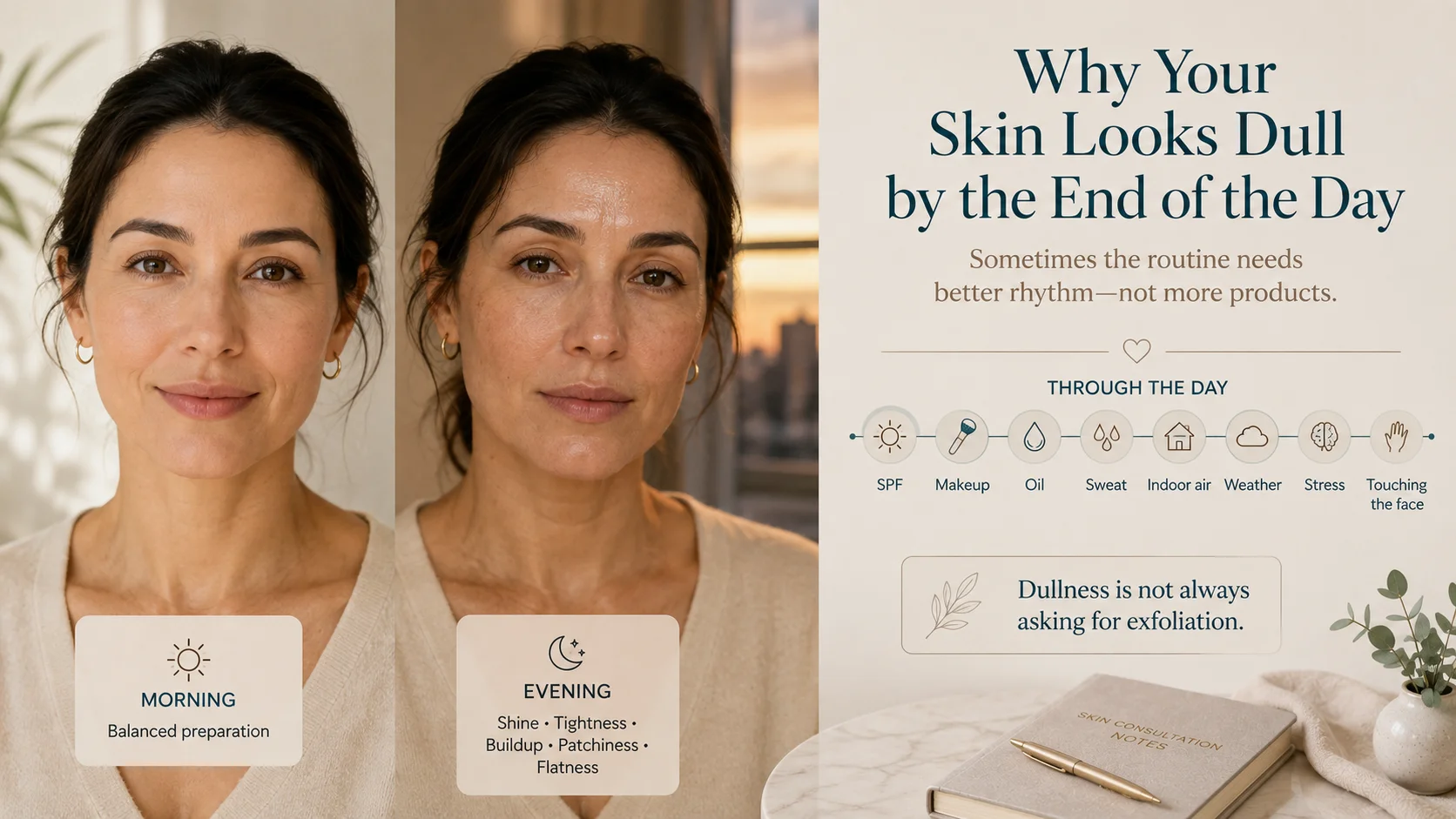
Same woman shown with balanced morning skin and subtle evening T-zone shine, makeup separation, dehydration texture, and a flatter-looking complexion.

Why Your Skin Looks Dull by the End of the Day

Your skin may look smooth, moisturized, and refreshed immediately after your morning routine.

A few hours later, the same complexion may appear:

  • Flat
  • Tired
  • Shiny
  • Dry
  • Textured
  • Uneven
  • Patchy beneath makeup
  • Less vibrant around the eyes
  • Coated rather than fresh

This does not automatically mean that you need a stronger brightening product.

Visible freshness can change throughout the day because the skin is interacting with:

  • Indoor and outdoor air
  • Heat
  • Cold
  • Humidity
  • Air conditioning
  • Sweat
  • Surface oil
  • Sunscreen
  • Makeup
  • Facial expressions
  • Friction
  • Environmental residue

At Zendevie, our licensed esthetician first compares how the skin behaves in the morning with how it behaves later.

Important questions include:

  • Does the skin feel tight or only look flat?
  • Is the face oily or dehydrated?
  • Does dullness appear before or after makeup?
  • Is the moisturizer too rich?
  • Does sunscreen pill?
  • Are several serums being layered?
  • Is powder collecting around dry areas?
  • Does the complexion improve after cleansing?
  • Is the eye area creating most of the tired appearance?
  • Does the concern happen only in one season or environment?

These details help separate a hydration problem from a texture, product, makeup, or routine problem.


Quick Answer

Your skin may look dull by the end of the day because:

  1. Water-based hydration is not lasting throughout the day.
  2. Surface oil is increasing without balanced hydration.
  3. Your moisturizer is too heavy or too light.
  4. Several skincare layers are creating buildup.
  5. Sunscreen and makeup are beginning to separate.
  6. Powder is collecting around dry or textured areas.
  7. Air conditioning or indoor heating is increasing tightness.
  8. Sweat, oil, and environmental residue are mixing on the surface.
  9. Your skin was over-cleansed that morning.
  10. Retinol or exfoliating products are making the surface less comfortable.
  11. The eye area is becoming more shadowed or dehydrated.
  12. The complexion is showing uneven-looking tone more clearly in changing light.
  13. The morning routine creates temporary glow but not lasting moisture balance.
  14. The skin needs routine simplification rather than another product.

A simple morning routine may be:

Gentle cleanser or rinse → one purposeful serum → suitable moisturizer → SPF

A simple evening routine may be:

Thorough but gentle cleansing → suitable moisturizer

Exfoliation, ampoules, masks, facial oil, and glow products should remain optional.


Morning Glow Can Be Temporary

Immediately after skincare, the complexion may look more radiant because:

  • The skin is freshly cleansed.
  • Water is still present on the surface.
  • Moisturizer has softened dry texture.
  • Serum has formed a smooth film.
  • Makeup contains light-reflecting ingredients.
  • The face has not yet accumulated oil, sweat, or residue.
  • Indoor or bathroom lighting is flattering.

This initial freshness may not reflect how well the routine will perform for the next eight to twelve hours.

A routine should be evaluated by:

  • Comfort at midday
  • Oil balance
  • Makeup wear
  • Tightness
  • Pilling
  • Texture
  • End-of-day appearance

A product can create a beautiful first impression and still be unsuitable for all-day wear.


Shine Is Not the Same as Radiance

By afternoon, the face may look shiny across the:

  • Forehead
  • Nose
  • Upper cheeks
  • Chin

This can happen while the complexion still looks flat.

Surface Shine

Shine may come from:

  • Sebum
  • Sweat
  • Heavy moisturizer
  • Facial oil
  • Emollient sunscreen
  • Makeup breakdown

It often appears concentrated in certain areas.

Balanced Radiance

Balanced-looking radiance usually appears:

  • More even
  • Softer
  • Smoother
  • Fresh rather than greasy
  • Comfortable rather than tight
  • Present across the complexion rather than only the T-zone

The goal is not to remove every trace of oil.

It is to support a balanced surface that looks fresh without appearing coated.


Dehydration May Become More Visible During the Day

A complexion can begin the morning feeling comfortable and become dehydrated later.

Possible contributors include:

  • Air conditioning
  • Indoor heating
  • Low humidity
  • Long flights
  • Insufficient moisturizer
  • Strong cleanser
  • Mattifying products
  • Excess powder
  • Retinol
  • Exfoliating acids

By afternoon, dehydration may appear as:

  • Fine lines
  • Tightness
  • Creasing beneath the eyes
  • Patchy foundation
  • A shiny but uncomfortable surface
  • Less flexible-looking skin
  • Roughness around the mouth

Why the Skin Can Look Oily and Dehydrated

Oil and water are not the same.

The skin may produce or retain surface oil while still lacking water.

This can create a complexion that is:

  • Shiny across the T-zone
  • Tight through the cheeks
  • Fine-lined beneath the eyes
  • Patchy around the mouth
  • Dull overall

Applying a stronger oil-control cleanser may make this pattern worse.


Your Morning Hydration May Not Be Lasting

A hydrating toner or serum may create an immediate plumped appearance.

However, that hydration may not remain comfortable when:

  • No moisturizer follows.
  • The moisturizer is too light.
  • The environment is dry.
  • Several humectant layers become sticky.
  • The skin is over-cleansed.
  • A mattifying sunscreen sits on top.
  • Makeup absorbs surface moisture.

Possible Signs

  • The skin looks fresh for one or two hours only.
  • Tightness develops by midday.
  • Fine lines become more noticeable.
  • Makeup catches on the cheeks.
  • Facial mist helps only briefly.
  • The skin becomes oily while still feeling dry.

A More Balanced Approach

Consider:

Gentle cleanser → one hydrating serum → suitable moisturizer → SPF

The moisturizer helps support water retention.

Several toners, essences, mists, and hyaluronic serums are not automatically necessary.


Air Conditioning Can Change the Way Skin Looks

Long periods in air-conditioned environments may contribute to:

  • Tightness
  • Surface dehydration
  • Increased visibility of fine lines
  • Dry eye-area appearance
  • Makeup catching on texture
  • Reduced visible freshness

This is common in:

  • Offices
  • Cars
  • Shopping centers
  • Airplanes
  • Hotels

What May Help

  • Use a moisturizer appropriate for the environment.
  • Avoid over-cleansing in the morning.
  • Use one purposeful hydrating layer.
  • Apply makeup in thin layers.
  • Avoid repeatedly misting without supporting moisture retention.
  • Reduce drying powder on areas that become tight.

A facial mist can feel refreshing, but repeatedly wetting the surface without suitable moisturizer may not provide lasting support.


Indoor Heating Can Have a Similar Effect

During colder months, indoor heating may make the skin appear:

  • Rougher
  • Less flexible
  • More fine-lined
  • Patchy beneath makeup
  • Tired by evening

The moisturizer that worked during summer may no longer provide enough support.

Possible seasonal adjustments include:

  • A gentler cleanser
  • A richer evening moisturizer
  • A balanced daytime cream
  • Less frequent exfoliation
  • Reduced powder
  • A hydrating serum beneath moisturizer

Seasonal adjustment is different from replacing the entire routine.


A Heavy Moisturizer May Become More Noticeable Later

A rich cream may look beautiful immediately after application.

As the day progresses, it may combine with:

  • Surface oil
  • Sunscreen
  • Primer
  • Foundation
  • Heat
  • Sweat

The result may look:

  • Greasy
  • Waxy
  • Uneven
  • Heavy
  • Flat beneath makeup
  • Shiny around the nose
  • Coated across the forehead

Signs the Moisturizer May Be Too Rich for Daytime

  • Foundation slides.
  • Sunscreen pills.
  • The T-zone becomes oily quickly.
  • Skin feels warm beneath the products.
  • More powder is needed.
  • The face looks fresher after products are removed.
  • The cream works better at night than in the morning.

A Better Approach

Try:

  • Less moisturizer
  • A lighter daytime texture
  • Rich cream only on dry areas
  • Richer product at night
  • No facial oil underneath
  • Fewer serum layers

The appropriate daytime and nighttime moisturizer may be different.


A Moisturizer May Also Be Too Light

A lightweight moisturizer may absorb beautifully in the morning but fail to maintain comfort.

Possible signs include:

  • Cheeks become tight by noon.
  • Makeup clings to dry areas.
  • Fine lines appear more visible.
  • The face looks flat after several hours.
  • Skin feels better when an additional cream is applied.
  • Cold weather makes the problem worse.

The answer may be:

  • A more balanced moisturizer
  • Hydrating serum beneath the cream
  • Richer care on the cheeks
  • Seasonal adjustment
  • Less aggressive cleansing

Applying more of a very lightweight product is not always equivalent to using a better-matched texture.


Facial Oil May Create Shine Without Lasting Freshness

Facial oil may make the complexion look luminous immediately.

Later, it may:

  • Mix with sebum
  • Move foundation
  • Increase shine
  • Create a coated appearance
  • Emphasize texture
  • Cause sunscreen or makeup to shift

Oil can support softness and emollient comfort.

It does not provide water-based hydration.

When the skin is dehydrated, facial oil may create a surface shine while the complexion still looks:

  • Tight
  • Fine-lined
  • Flat
  • Tired
  • Patchy beneath makeup

A better approach may be:

Hydrating serum → moisturizer

Facial oil can remain optional for selected dry areas or evening use.


Too Many Skincare Layers Can Reduce Freshness

A morning routine may contain:

  • Toner
  • Essence
  • Hydrating serum
  • Vitamin C serum
  • Peptide serum
  • Facial oil
  • Moisturizer
  • SPF
  • Primer
  • Foundation

Each product may have value individually.

Together, they may create:

  • Pilling
  • Rolling
  • Stickiness
  • Uneven foundation
  • Excess shine
  • A heavy film
  • Product movement
  • A flat-looking finish

Signs the Routine Is Overlayered

  • Small pieces roll off during application.
  • Foundation separates.
  • Sunscreen forms visible streaks.
  • The skin feels coated before makeup.
  • The face looks fresher on days when fewer products are used.
  • Powder becomes necessary to control heaviness.
  • Products do not fully settle.

A Simpler Morning

Try:

Cleanser or rinse → one serum → moisturizer → SPF

Primer remains optional.

The serum should address the highest-priority need.


Toner May Be Adding an Unnecessary Layer

An alcohol-free hydrating tonic may support comfort and remove light residue.

However, toner may become unnecessary when:

  • The cleanser rinses cleanly.
  • A hydrating serum is already present.
  • Cotton-pad friction creates redness.
  • The routine pills.
  • The skin feels sticky.
  • Several water-based layers are being used.

Toner should remain purposeful.

It is not mandatory simply because it appears on a traditional routine chart.


Sunscreen and Skincare May Be Interacting Poorly

Daytime protection is essential for supporting the appearance of demanding or dull-looking skin.

However, sunscreen may not wear well when applied over:

  • Too much moisturizer
  • Facial oil
  • Several serums
  • A sticky toner
  • Products that have not settled

This may lead to:

  • Pilling
  • Uneven application
  • Rolling
  • Visible texture
  • Makeup separation
  • A dull film

What to Adjust

  • Reduce unnecessary skincare layers.
  • Use smaller amounts of serum and moisturizer.
  • Allow products to settle.
  • Avoid rubbing repeatedly.
  • Apply sunscreen in an even layer according to its directions.
  • Do not mix sunscreen into moisturizer or foundation.

Do not reduce the sunscreen amount simply to prevent pilling.

Simplify the products underneath instead.


Sunscreen Can Affect the Cosmetic Finish

Different SPF products may leave:

  • A natural finish
  • A matte finish
  • A dewy finish
  • A tinted finish
  • A visible film on some skin tones

A sunscreen that looks beautiful on one person may look heavy on another.

The cosmetic finish may also change depending on:

  • Moisturizer
  • Primer
  • Foundation
  • Skin oil
  • Humidity
  • Application amount

In consultation, daytime protection and moisturizer should be evaluated as a system rather than separately.


Makeup Can Look Dull After Several Hours

A fresh morning makeup application may become flat because:

  • Foundation absorbs surface oil unevenly.
  • Powder collects around dry areas.
  • Concealer settles beneath the eyes.
  • Sunscreen and foundation separate.
  • Skin becomes dehydrated.
  • Shade undertone looks different in natural light.
  • Matte products reduce visible dimension.
  • Several layers begin to move.

Signs Makeup Is a Major Contributor

  • Bare skin looks fresher than foundation.
  • Dullness appears only after powder.
  • The face looks flat while the neck looks normal.
  • Foundation becomes orange, gray, or uneven-looking.
  • Concealer makes the eye area appear heavier.
  • The skin looks better immediately after makeup removal.

This does not always require more skincare.

The makeup amount, finish, shade, and layering may need adjustment.


Foundation Oxidation Can Change the Appearance

Some foundations become darker or warmer after interacting with:

  • Surface oil
  • Air
  • Skincare
  • Sunscreen
  • Skin chemistry

This may make the complexion look:

  • Less fresh
  • Uneven
  • Orange
  • Gray
  • Heavy

The issue may be more noticeable by the end of the day.

Possible adjustments include:

  • Testing the shade for several hours before choosing
  • Using thinner foundation layers
  • Reducing facial oil
  • Allowing skincare to settle
  • Using less powder
  • Reviewing sunscreen compatibility

Skincare exfoliation will not correct an unsuitable foundation shade.


Powder Can Make the Complexion Look Flat

Powder can help control shine.

Too much may:

  • Absorb moisture
  • Emphasize texture
  • Settle into fine lines
  • Make the skin look one-dimensional
  • Collect around dry patches
  • Make the eye area look tired

A Better Approach

Apply powder only where needed, such as:

  • Forehead
  • Sides of the nose
  • Chin

Use less on:

  • Dry cheeks
  • Eye area
  • Mouth area
  • Areas with visible flakes

A radiant finish should not require the entire face to remain powder-free, but powder should be controlled.


Repeated Blotting Can Create Texture

Blotting papers or tissues may help remove surface oil.

Repeated rubbing or pressing may:

  • Disturb foundation
  • Remove sunscreen
  • Emphasize dryness
  • Create patchiness
  • Increase friction

Use gentle pressure.

Do not repeatedly wipe the face.

When oil returns quickly, review:

  • Moisturizer texture
  • Facial oil
  • Foundation
  • Heat
  • Skin dehydration
  • Product layering

Sweat Can Mix With Products

Heat, exercise, commuting, or stress may increase perspiration.

Sweat can combine with:

  • Sunscreen
  • Makeup
  • Surface oil
  • Environmental residue

This may make the skin appear:

  • Shiny
  • Uneven
  • Coated
  • Patchy
  • Less fresh

Do not aggressively cleanse the face several times during the day.

After significant sweating, use a gentle approach appropriate to the situation and reapply daytime protection when needed.


Environmental Exposure May Affect the Surface

Throughout the day, the complexion may be exposed to:

  • Dust
  • Traffic residue
  • Smoke
  • Dry air
  • Wind
  • Heat
  • Cold
  • Indoor climate control

These factors may contribute to:

  • Surface discomfort
  • Makeup breakdown
  • Increased oiliness
  • Dryness
  • A less refreshed appearance

Skincare cannot create a complete physical shield against every environmental factor.

A balanced routine can help support comfort, and evening cleansing removes the day’s residue.


Touching the Face Can Make Skin Look Less Fresh

The face may be touched while:

  • Working
  • Using a phone
  • Adjusting glasses
  • Resting the chin on the hand
  • Blotting oil
  • Fixing makeup

This can transfer:

  • Oil
  • Hand cream
  • Hair products
  • Makeup
  • Surface residue

It can also create friction.

Reducing unnecessary touching may help makeup and skincare remain more even.


Hair Products May Transfer to the Face

Hair oil, leave-in conditioner, styling spray, or edge products may move onto:

  • Forehead
  • Temples
  • Cheeks
  • Jawline

This may contribute to:

  • Shine
  • A coated appearance
  • Small bumps
  • Makeup movement
  • Congested-looking areas

Review whether dullness or texture is strongest near the hairline.

Keep hair products away from facial skin when possible.


Over-Cleansing in the Morning Can Affect the Entire Day

A strong morning cleanser may leave the skin feeling extremely clean.

Later, the complexion may become:

  • Tight
  • Shiny
  • Fine-lined
  • Rough
  • Sensitive
  • Patchy beneath makeup

Possible contributors include:

  • Strong degreasing cleanser
  • Hot water
  • Cleansing brush
  • Long cleansing time
  • Exfoliating cleanser
  • Double cleansing in the morning

A demanding or tired-looking complexion does not need to be stripped before applying radiance products.

A gentle morning cleanse—or a water rinse for selected skin—may support a more comfortable day.


Incomplete Evening Cleansing Can Affect the Next Day

If sunscreen, makeup, or heavy products are not fully removed at night, the complexion may begin the next morning with:

  • Residue
  • Rough texture
  • Congested-looking areas
  • Product buildup
  • Uneven makeup application

The morning moisturizer may temporarily soften the surface, but dullness can return later.

Review whether the evening cleanser removes:

  • Foundation
  • Tinted sunscreen
  • Waterproof makeup
  • Facial oil
  • Long-wear products

Double cleansing is conditional.

It should be used only when one cleanser does not remove the day completely.


Exfoliation May Be Missing—or Excessive

Uneven surface buildup may affect how light reflects from the complexion.

Selected stable skin may benefit from gentle exfoliation.

However, exfoliation can also make the skin look duller when overused.

Signs Gentle Exfoliation May Be Worth Assessing

  • Stable rough texture
  • No burning
  • No active peeling
  • Makeup catches on surface buildup
  • Basic moisturizer feels comfortable
  • The skin is not using several active ingredients

Signs Exfoliation Should Wait

  • Water stings.
  • Moisturizer burns.
  • Fine peeling is present.
  • The face feels hot.
  • The eye or mouth corners are irritated.
  • Retinol was recently increased.
  • Several acid products are already being used.

A dull appearance is not permission to scrub the skin aggressively.


Retinol Can Affect End-of-Day Texture

Retinol may support smoother-looking texture over time when appropriate.

During adjustment or overuse, it may contribute to:

  • Fine peeling
  • Tightness
  • Makeup catching
  • Eye-corner irritation
  • Increased visibility of dryness lines
  • A shiny but uncomfortable surface

These changes may be more visible later in the day.

A Simple Retinol Routine

Morning

Gentle cleanser or rinse → moisturizer → SPF

Retinol Evening

Gentle cleanser → retinol according to directions → moisturizer

Avoid adding an exfoliating toner, scrub, peel, and strong acid serum on the same evening.


Vitamin C May Not Be the Only Missing Step

Vitamin C is often recommended for dull-looking skin.

It may support:

  • Antioxidant care
  • A fresher-looking complexion
  • More even-looking tone
  • Visible radiance

However, vitamin C may not solve:

  • Heavy moisturizer
  • Makeup oxidation
  • Product buildup
  • Dehydration
  • Over-exfoliation
  • Poor sunscreen compatibility
  • Incomplete cleansing

Before adding vitamin C, review whether the foundation of the routine is working.

A serum should have a clear role.


The Eye Area May Change the Appearance of the Whole Face

By evening, the eye area may look:

  • Drier
  • More creased
  • Puffy
  • Shadowed
  • Heavy beneath concealer

This can make the entire complexion appear tired even when the cheeks remain comfortable.

Possible contributors include:

  • Reduced sleep
  • Dehydration
  • Eye rubbing
  • Heavy concealer
  • Excess powder
  • Makeup migration
  • Air conditioning
  • Long screen use

A suitable eye product may support hydration and smoother-looking dryness lines.

It cannot correct eye disease, vision changes, or severe swelling.

Seek prompt eye-care guidance for:

  • Eye pain
  • Vision changes
  • Light sensitivity
  • Significant redness inside the eye
  • Discharge
  • Persistent watering

Uneven-Looking Tone May Become More Visible Later

Changing light throughout the day can make uneven-looking tone more noticeable.

Areas may include:

  • Post-blemish marks
  • Sun-related spots
  • Darker-looking patches
  • Redness-looking areas
  • Shadows around the eyes

Moisturizer may make the surface softer without changing the contrast between these areas.

A routine may need:

  • Consistent SPF
  • Antioxidant support
  • Carefully selected tone-supporting ingredients
  • Gentle exfoliation when appropriate
  • Patience
  • Consultation

Avoid combining several dark-spot products blindly.


Dull-Looking Dry Skin by Evening

Dry skin may look fresh after rich morning cream and become dull later because:
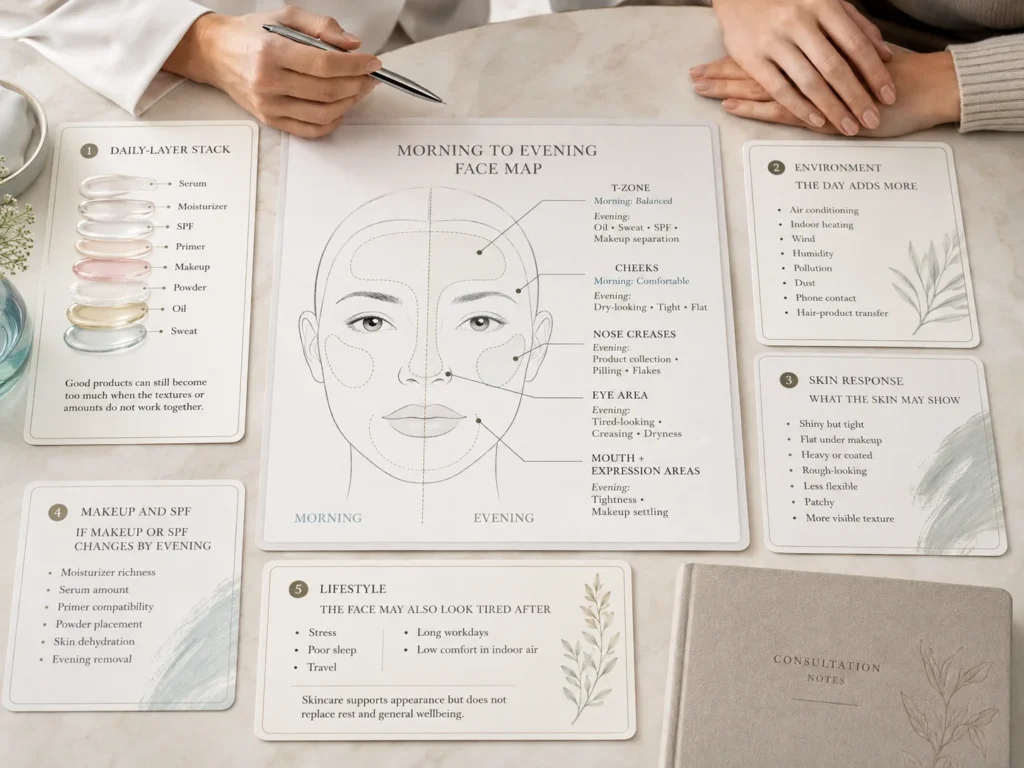
Morning-to-evening facial-zone map showing how SPF, makeup, oil, sweat, indoor air, dehydration, and product layers may contribute to dull-looking skin.
  • Hydration was insufficient.
  • The environment is dry.
  • The cream was too light.
  • Powder absorbed moisture.
  • The cleanser was too strong.
  • The skin needs more lasting moisture support.

Possible Routine

Morning

Gentle creamy cleanser or rinse → hydrating serum when needed → suitable moisturizer → SPF

Evening

Gentle cleanser → moisturizer

Optional:

  • Gentle exfoliation when stable
  • Hydrating mask
  • Richer night cream

Dull-Looking Oily Skin by Evening

Oily skin may become shiny and flat at the same time.

Possible contributors include:

  • Dehydration
  • Strong cleanser
  • Heavy moisturizer
  • Facial oil
  • Thick foundation
  • Excess powder
  • Congested-looking texture

Possible Routine

Morning

Gentle cleanser → lightweight serum when useful → light moisturizer → SPF

Evening

Gentle cleanser → one targeted serum → light moisturizer

Do not strip the skin to chase a matte finish.


Dull-Looking Combination Skin by Evening

Combination skin may show:

  • Shiny forehead
  • Oily nose
  • Dry cheeks
  • Tight mouth area
  • Patchy foundation

One moisturizer amount may not suit the entire face.

Possible Routine

Morning

Gentle cleanser → lightweight hydration → moisturizer by zone → SPF

Evening

Gentle cleanser → moisturizer by zone

Use:

  • Less cream on the T-zone
  • More support on dry cheeks
  • Targeted rather than full-face exfoliation

Dull-Looking Sensitive Skin by Evening

Sensitive-feeling skin may lose freshness because the routine is overwhelming it.

Possible contributors include:

  • Strong cleanser
  • Fragrance
  • Several active ingredients
  • Daily exfoliation
  • Retinol
  • Repeated product changes
  • Cotton-pad friction
  • Hot water

Possible Routine

Morning

Gentle rinse or cleanser → tolerated moisturizer → tolerated SPF

Evening

Gentle cleanser → tolerated moisturizer

Comfort comes before glow.

Persistent burning, itching, swelling, blistering, oozing, or recurring rash needs medical evaluation.


Dull-Looking Mature Skin by Evening

Mature skin may show more visible changes as hydration and makeup shift during the day.

These may include:

  • Dryness lines
  • Under-eye creasing
  • Loss of makeup freshness
  • Rougher-looking texture
  • Reduced surface flexibility

A routine may include:

Morning

Gentle cleanser → one hydrating or antioxidant serum → suitable moisturizer → SPF

Evening

Gentle cleanser → serum when useful → moisturizer

Mature skin does not need every active ingredient at once.


Why Your Skin May Look Better After Cleansing

If the complexion looks fresher after evening cleansing, the daytime dullness may involve:

  • Makeup
  • Sunscreen buildup
  • Surface oil
  • Sweat
  • Powder
  • Environmental residue
  • Heavy skincare layers

This does not mean you should cleanse repeatedly during the day.

It means the daytime product combination should be reviewed.

Ask:

  • Which product begins the pilling?
  • Is the moisturizer too rich?
  • Is the makeup too heavy?
  • Does powder create flatness?
  • Is facial oil necessary?
  • Does sunscreen work with the moisturizer?

Why Your Skin May Look Worse After Cleansing

If the skin looks more tired immediately after cleansing, the cleanser or technique may be contributing.

Signs include:

  • Tightness
  • Fine lines
  • Redness-looking areas
  • Roughness
  • Squeakiness
  • Immediate need for moisturizer

Review:

  • Cleanser type
  • Water temperature
  • Amount
  • Massage time
  • Double cleansing
  • Washcloth or brush use

Cleansing should remove residue without making the complexion less comfortable.


A Midday Refresh Should Remain Simple

When the complexion looks dull at midday, the instinct may be to add:

  • Facial mist
  • Serum
  • Cream
  • Oil
  • Highlighter
  • More powder

Layering several products over makeup may create more buildup.

A Simple Midday Approach

Depending on makeup and environment:

  1. Gently blot excess oil where needed.
  2. Avoid rubbing.
  3. Correct only areas that need attention.
  4. Reapply daytime protection as appropriate.
  5. Use a small amount of makeup rather than another full layer.
  6. Avoid applying facial oil over foundation.

The best midday method depends on the SPF and makeup being worn.


What Not to Add at Midday

Avoid automatically applying:

  • Exfoliating toner
  • Acid serum
  • Retinol
  • Thick night cream
  • Heavy facial oil
  • Scrub
  • Several glow products

Midday dullness is usually better addressed by correcting the morning routine and evening cleansing.


A Step-by-Step Troubleshooting Plan

Step 1: Compare Bare Skin and Makeup Days

Ask:

  • Does the dullness happen without makeup?
  • Does foundation make it worse?
  • Does powder create flatness?
  • Does concealer affect the eye area?

This helps separate skin behavior from makeup behavior.

Step 2: Check for Tightness

If the face feels tight:

  • Review cleanser
  • Review hydration
  • Review moisturizer texture
  • Review air conditioning
  • Review retinol and acids

Do not move immediately to a stronger exfoliant.

Step 3: Check for Excess Shine

If the face is shiny:

  • Review facial oil
  • Review rich moisturizer
  • Review sunscreen finish
  • Review foundation
  • Review dehydration

Do not assume the skin needs a stripping cleanser.

Step 4: Check for Pilling

If products roll:

  • Use less toner
  • Reduce serum layers
  • Allow products to settle
  • Remove unnecessary oil
  • Review moisturizer and sunscreen compatibility

Step 5: Check the Eye Area

If most tiredness is concentrated around the eyes, the full-face routine may not be the main issue.

Step 6: Review Exfoliation

Count:

  • Acid cleanser
  • Exfoliating toner
  • AHA serum
  • BHA serum
  • Scrub
  • Peel
  • Retinol

The total active load matters.

Step 7: Review Daytime Protection

Consistent SPF is part of supporting a more even-looking and fresh complexion.

Step 8: Simplify for One Week

A simple routine may reveal which layer is causing the problem.

Morning

Gentle cleanser or rinse → one serum if needed → moisturizer → SPF

Evening

Gentle cleanser → moisturizer


Morning Routine for Longer-Lasting Freshness

Step 1: Cleanse Gently

Use:

  • Lukewarm water
  • Mild cleanser
  • Short contact time
  • Minimal friction

Do not begin the day with squeaky skin.

Step 2: Choose One Priority Serum

Possible priorities include:

  • Hydration
  • Antioxidant support
  • Tone support
  • Comfort

Choose one main need.

Step 3: Use the Correct Moisturizer Texture

The moisturizer should:

  • Absorb comfortably
  • Support the skin through the day
  • Work beneath SPF
  • Avoid creating unnecessary heaviness

Step 4: Apply Daytime Protection

Follow the product directions.

Do not mix it into another product.

Step 5: Keep Makeup Thin

Use:

  • Targeted concealer
  • Controlled foundation
  • Powder only where needed
  • Minimal product around dry areas
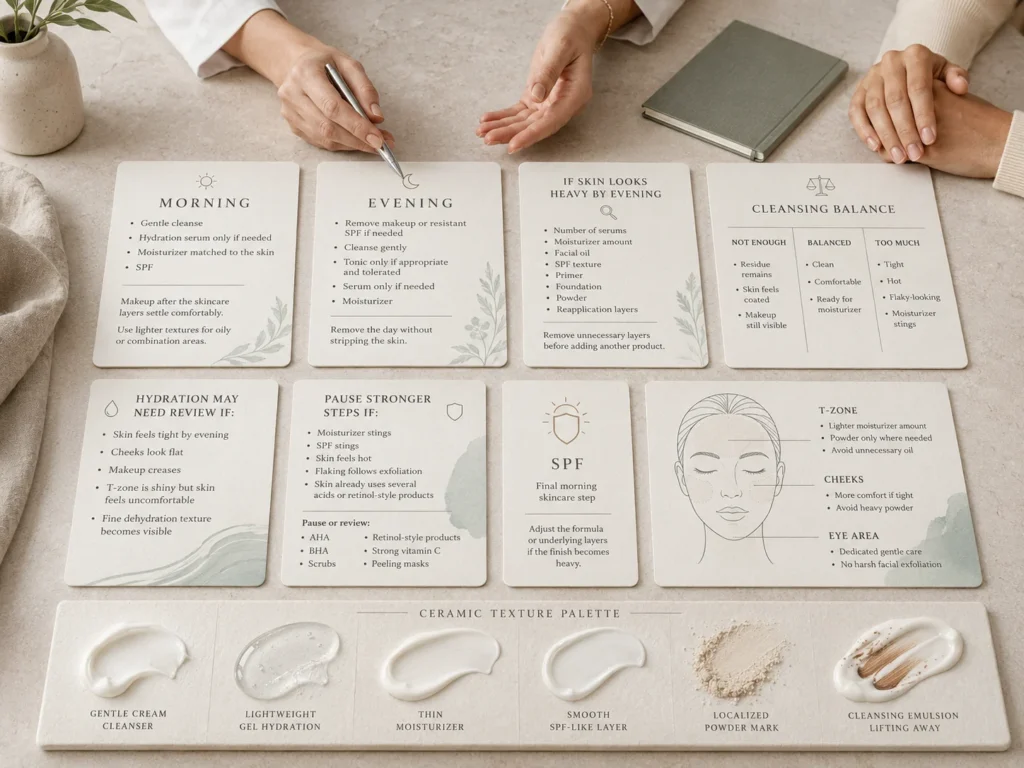
Morning and evening routine guide showing lighter daytime layers, final morning SPF, appropriate makeup removal, gentle cleansing, moisturizer, and active-product pauses.

Evening Routine for Removing the Day

Step 1: Remove Makeup and Sunscreen

One appropriate cleanser may be enough.

Use oil, balm, or cleansing milk when the day’s products require it.

Step 2: Use a Second Cleanser Only When Needed

A second step may help after:

  • Waterproof makeup
  • Water-resistant sunscreen
  • Heavy foundation

It is unnecessary when the first cleanser removes everything comfortably.

Step 3: Apply One Purposeful Treatment

This may be:

  • Hydrating serum
  • Antioxidant serum
  • Retinol on scheduled evenings
  • No serum

Step 4: Moisturize

Choose the texture according to the skin’s evening comfort.


When Lifestyle Factors May Be Contributing

Skin may look more tired later in the day during periods of:

  • Reduced sleep
  • High stress
  • Travel
  • Inconsistent meals
  • Dehydration
  • Increased alcohol consumption
  • Long hours in dry indoor air
  • Disrupted skincare routines

Skincare can support surface comfort and appearance.

It cannot replace:

  • Rest
  • General healthcare
  • Nutrition
  • Hydration habits
  • Medical assessment

Avoid expecting one product to erase every sign of fatigue.


When a Change May Need Medical Evaluation

A dull or tired-looking complexion is often cosmetic.

Seek healthcare guidance when the change is:

  • Sudden
  • Persistent
  • Widespread
  • Associated with significant fatigue
  • Accompanied by unusual paleness
  • Accompanied by yellowing of the skin or eyes
  • Associated with pain
  • Associated with severe itching
  • Associated with swelling
  • Associated with a spreading rash
  • Associated with unexplained weight or health changes

Cosmetic skincare cannot diagnose anemia, thyroid concerns, nutritional deficiencies, liver conditions, allergy, dermatitis, infection, or another medical issue.


Where Janssen Cosmetics Fits

Janssen Cosmetics’ Demanding Skin family includes cleansing, tonic, moisturizer, vitamin C, eye-care, mask, and retinol options designed around tired, dry, environmentally stressed, or less radiant-looking skin. The official catalog identifies products including Brightening Face Cleanser, Brightening Face Freshener, Vitalizing Skin Refiner, Vitaforce C Cream, Vitaforce C Skin Complex, Rich Energy Mask, and Smooth + Lift Eye Cream within this family.

Licensed esthetician reviewing daytime SPF, makeup, oil, dehydration, product layers, and evening cleansing beside verified Janssen Brightening Face Cleanser and Brightening Face Freshener.

These are possible consultation-led matches.

They should not all be used in one routine.

The first question is what changes by the end of the day:

  • Hydration
  • Oil
  • Texture
  • Makeup
  • Residue
  • Eye-area appearance
  • Daytime protection

Brightening Face Cleanser

Brightening Face Cleanser is a water-soluble cleansing emulsion from the Demanding Skin family.

Its verified formula includes:

  • White-mulberry-root extract
  • Nonionic cleansing agents

It is designed to loosen:

  • Makeup
  • Dirt
  • Surface secretions

while supporting a clean, refreshed feeling without unnecessary tightness. The official directions recommend morning and evening use on the face and neck, with gentle circular fingertip movements followed by lukewarm water or damp compresses. A two-application method is described for very heavy makeup.

When It May Fit

It may be considered when:

  • The skin feels dry or demanding.
  • Strong foam creates tightness.
  • Makeup needs gentle removal.
  • The complexion looks dull partly because of residue.
  • A creamy cleansing texture is preferred.

Important Boundary

A cleanser prepares the skin.

It should not be expected to create lasting glow by itself.


Brightening Face Freshener

Brightening Face Freshener is the alcohol-free tonic within the Demanding Skin system.

Its verified formula includes:

  • Glycerin
  • White-mulberry-root extract

The product is designed to follow cleansing, remove final traces of cleanser or tap-water residue, add light moisture support, and prepare the skin for subsequent care. It is applied with a cotton pad in the morning and evening.

When It May Fit

It may suit someone who:

  • Uses Brightening Face Cleanser
  • Appreciates a post-cleansing tonic
  • Wants light hydration
  • Tolerates cotton-pad application

When It May Be Unnecessary

It may be skipped when:

  • Cotton-pad friction feels uncomfortable.
  • The cleanser rinses cleanly.
  • A hydrating serum is already present.
  • The morning routine pills.
  • Fewer layers wear better throughout the day.

Toner remains optional within Shop Zendevie’s consultation-first guidance.


Vitalizing Skin Refiner

Vitalizing Skin Refiner is a lightweight moisturizer within the Demanding Skin family.

The official product information identifies:

  • Cranberry bio peptide
  • Camu camu extract
  • Long- and short-chain hyaluronic acid
  • Lipid-support ingredients
  • Amino acids
  • Squalane
  • Shea butter

The product is positioned as a fast-absorbing moisturizer that supports hydration, smoother-looking texture, skin comfort, and visible luminosity. It is also described as suitable beneath makeup.

When It May Fit

It may be considered when:

  • A rich cream becomes heavy by afternoon.
  • The skin needs hydration without an extremely rich finish.
  • Makeup wears poorly over the current moisturizer.
  • Normal-to-dry demanding skin needs a daytime texture.
  • The complexion loses visible freshness later in the day.

Important Lesson

A more suitable moisturizer texture may be more useful than adding another glow serum.


Vitaforce C Skin Complex

Vitaforce C Skin Complex is a vitamin C serum in the Demanding Skin family.

The verified product information includes:

  • Stabilized vitamin C phosphate
  • Lemon extract
  • Hyaluronic acid

It is positioned to support hydration, antioxidant care, a smoother-looking complexion, and visible radiance. The official catalog places it before moisturizer within the routine.

When It May Fit

It may be considered when:

  • Antioxidant support is a priority.
  • The complexion looks tired and dehydrated.
  • One serum is needed beneath moisturizer.
  • Uneven-looking tone contributes to dullness.

When It May Be Unnecessary

It may be unnecessary when:

  • Another vitamin C serum is already being used.
  • The routine contains several antioxidant products.
  • The skin is actively irritated.
  • Vitamin C causes stinging.
  • Product layering is already excessive.

Vitaforce C Cream

Vitaforce C Cream combines moisturizer and vitamin C support within the Demanding Skin family.

It may be considered when the person wants:

  • A moisturizer step
  • Antioxidant support
  • Hydration
  • Fewer separate layers

This can be useful when serum plus moisturizer creates too much product beneath sunscreen and makeup.

A separate Vitaforce C serum is not mandatory when the cream already meets the routine’s needs.


Sensational Glow Cream

Sensational Glow Cream belongs to the All Skin Needs collection.

Its verified formula includes:

  • Long- and short-chain hyaluronic acid
  • Saccharide isomerate
  • Algae ferment
  • Niacinamide
  • Aloe vera
  • Allantoin
  • Shea butter
  • Soft-focus pigments

The catalog positions it as a moisturizing cream that combines ongoing moisture support with an immediate optical smoothing and glow effect. The official directions recommend applying it to cleansed skin in the morning and evening.

When It May Fit

It may be considered when:

  • The moisturizer itself should provide a luminous finish.
  • The skin needs hydration and optical smoothing.
  • A matte moisturizer makes the complexion look flat.
  • The person wants a glow-supporting cream rather than several separate products.

Important Distinction

The soft-focus effect is cosmetic.

It should not be presented as correcting every cause of dullness.


Magic Glow Serum

Magic Glow Serum is an All Skin Needs serum formulated with hydrating ingredients and light-reflecting pigments.

The verified product information includes:

  • Long- and short-chain hyaluronic acid
  • Saccharide isomerate
  • Algae-derived ingredients
  • Niacinamide
  • Caffeine
  • Soft-focus and glow pigments

The catalog allows it to be used as a standalone light moisturizer for selected skin, with Sensational Glow Cream, as a makeup primer, or locally as a highlighter.

When It May Fit

It may be considered for:

  • Immediate cosmetic radiance
  • Event makeup
  • Targeted highlighting
  • A fresh-looking makeup finish
  • Skin that looks flat beneath matte products

Important Boundary

Magic Glow Serum should not be used to cover:

  • Irritation
  • Over-exfoliation
  • Severe dehydration
  • Incomplete cleansing
  • An unsuitable foundation shade
  • A medical-looking change

An instant glow effect and long-term routine correction are different goals.


Face Guard Advanced

Face Guard Advanced is Janssen’s SPF 30 protection concentrate.

Its verified formula includes:

  • Photostable UVA and UVB filters
  • Broad-spectrum filter support
  • Thermus thermophilus ferment
  • Ectoin
  • Long- and short-chain hyaluronic acid
  • Glycerin

The product-specific directions state that it should be spread over the skin every morning after cleansing and followed by the selected day cream.

Verified Janssen Order

Cleanser → compatible toner or serum when needed → Face Guard Advanced → selected Janssen day cream

Do not mix Face Guard Advanced into:

  • Serum
  • Facial oil
  • Moisturizer
  • Primer
  • Foundation

If it pills, reduce unnecessary layers underneath instead of reducing the protection amount.


Janssen Routine Options

Minimal Demanding-Skin Morning Routine

Brightening Face Cleanser or another suitable cleanser → Face Guard Advanced → Vitalizing Skin Refiner

This may be enough when the skin needs:

  • Gentle cleansing
  • Daytime protection
  • Lightweight moisture

Hydration and Antioxidant Routine

Suitable cleanser → Vitaforce C Skin Complex → Face Guard Advanced → Vitalizing Skin Refiner

Use this only when the serum and cream layer comfortably.

Brightening Face Freshener remains optional.


Shorter Vitamin C Routine

Suitable cleanser → Face Guard Advanced → Vitaforce C Cream

This may be more appropriate when:

  • Too many layers cause pilling.
  • A separate serum is unnecessary.
  • The person prefers a shorter morning routine.

Immediate Glow Routine

Suitable cleanser → Face Guard Advanced → selected moisturizer → Magic Glow Serum used lightly according to the desired finish

For targeted use, apply only to selected areas.

Do not apply heavily across an oily T-zone.


Glow-Support Moisturizer Routine

Suitable cleanser → Face Guard Advanced → Sensational Glow Cream

A separate glow serum is optional.


Makeup-Friendly Demanding-Skin Routine

Gentle cleanser → one lightweight serum when needed → Face Guard Advanced → Vitalizing Skin Refiner → thin makeup layers

Avoid adding:

  • Facial oil
  • Several serums
  • Thick primer
  • Excess powder

unless each step has a clear purpose.


Evening Reset Routine

Brightening Face Cleanser or another suitable makeup-removing cleanser → Brightening Face Freshener when useful → selected moisturizer

Optional:

  • Vitaforce C Skin Complex
  • Scheduled retinol
  • Hydrating treatment

Choose one main treatment.


When No New Glow Product Should Be Recommended

A new glow, vitamin C, retinol, exfoliating, or brightening product should wait when the skin has:

  • Persistent burning
  • Severe itching
  • Significant swelling
  • Blistering
  • Oozing
  • Crusting
  • Bleeding
  • Painful cracking
  • A spreading rash
  • Infection-looking changes
  • Reactions to water
  • Reactions to basic moisturizer
  • Severe eye symptoms
  • A changing or non-healing lesion

Medical evaluation comes before another cosmetic product.


What Not to Do

Do not assume end-of-day dullness always means dryness.

Do not use shine as proof of healthy radiance.

Do not strip oily skin.

Do not apply more moisturizer without reviewing its texture.

Do not use facial oil as the only hydration step.

Do not layer several hydrating serums automatically.

Do not use toner, essence, multiple serums, oil, cream, SPF, and primer without a clear reason.

Do not reduce SPF because the routine pills.

Do not mix sunscreen into moisturizer or foundation.

Do not apply heavy night cream beneath daytime makeup automatically.

Do not powder the entire face repeatedly.

Do not rub with blotting papers.

Do not apply acid toner at midday.

Do not use retinol during the day.

Do not exfoliate because foundation looks uneven one afternoon.

Do not scrub flakes caused by retinol.

Do not combine several acids.

Do not use a cleansing brush aggressively.

Do not wash the face repeatedly throughout the day.

Do not assume every dull complexion needs vitamin C.

Do not use instant glow pigments as proof that the skin concern has been corrected.

Do not apply several glow products heavily.

Do not use makeup to hide persistent burning or rash-like changes.

Do not use whitening language.

Do not promise instant transformation.

Do not use sales data as evidence that a product works.

Do not present demanding skin as a medical diagnosis.

Do not ignore unusual pallor, yellowing, significant fatigue, pain, swelling, or spreading rash.


Frequently Asked Questions

Why does my skin look dull by the afternoon?

Hydration changes, surface oil, air conditioning, makeup breakdown, sunscreen interaction, environmental residue, and product buildup may contribute.

Why does my face look fresh in the morning but tired at night?

Morning skincare temporarily softens and hydrates the surface. As the day progresses, moisture, oil, makeup, environmental exposure, and facial movement can change the appearance.

Is end-of-day dullness caused by dry skin?

Not always. Dry, oily, combination, dehydrated, sensitive, and mature skin may all look dull later in the day.

Can oily skin look dull?

Yes. Oil creates shine, but dehydration, texture, congestion, or heavy products may still make the complexion look flat.

Is shine the same as glow?

No. Shine usually comes from surface oil or products. Balanced-looking radiance appears more even and fresh.

Why does my skin become oily and dull at the same time?

The skin may be oily but dehydrated, or rich skincare and makeup may be combining with sebum.

Can air conditioning make skin look dull?

It may contribute to tightness, dehydration, dryness lines, and makeup texture.

Can indoor heating make my complexion look tired?

Yes. Heated indoor air may increase dryness and roughness.

Why does my moisturizer look good in the morning but greasy later?

The texture may be too rich for daytime or may be combining with oil, sunscreen, heat, and makeup.

Why does lightweight moisturizer stop working by afternoon?

It may not provide enough lasting moisture support for the skin or environment.

Should I use a richer moisturizer?

Possibly, especially on dry areas or during colder weather. The full face may not need the same amount.

Can I use one moisturizer on my cheeks and another on my T-zone?

Yes. Zone-based moisturizing can be useful for combination skin.

Why does facial oil make me look shiny but not radiant?

Oil adds emollient softness but not water-based hydration. It may also move sunscreen or makeup.

Does facial oil cause dullness?

It may create a coated or heavy appearance when the texture is unsuitable or too much is used.

Why does my skincare pill by midday?

Too many layers, incompatible formulas, excessive amounts, or insufficient settling time may contribute.

Does pilling mean I need exfoliation?

No. Pilling is usually a product-layering issue.

Should I remove toner from my morning routine?

Possibly, when it duplicates serum, causes friction, or contributes to pilling.

Do I need toner and serum?

Not necessarily. One purposeful hydration step may be enough.

Why does sunscreen make my skin look dull?

The finish may not suit the skin, or it may be interacting with moisturizer, oil, primer, or makeup.

Can I mix sunscreen with moisturizer?

No. Apply sunscreen according to its directions.

Should I use less sunscreen to prevent pilling?

No. Simplify the products underneath.

Why does foundation look darker later?

Foundation may oxidize or interact with oil, skincare, sunscreen, and air.

Can I mix sunscreen with moisturizer?

No. Apply sunscreen according to its directions.

Should I use less sunscreen to prevent pilling?

No. Simplify the products underneath.

Why does foundation look darker later?

Foundation may oxidize or interact with oil, skincare, sunscreen, and air.

Can foundation make my skin look gray?

An unsuitable shade, undertone, finish, or interaction with skincare may contribute.

Why does powder make my face look tired?

Excess powder can absorb moisture, emphasize texture, and flatten the complexion.

Should I stop using powder?

Not necessarily. Apply it only where needed.

Why does concealer make my eyes look more tired?

It may be too thick, dry, matte, light, dark, or heavily powdered.

Can the eye area make my whole face look dull?

Yes. Dryness, shadows, puffiness, and creasing around the eyes can affect the overall appearance.

Should I use eye cream?

It may support hydration and smoother-looking dryness lines when appropriate.

Can I apply face serum under my eyes?

Only when the product is suitable for that area and does not cause irritation.

Why does my skin look better after washing off makeup?

Makeup, powder, sunscreen, oil, and product buildup may have been contributing to the dull appearance.

Does that mean I should wash my face during the day?

Not automatically. Repeated cleansing may increase dryness and irritation.

Why does my skin look worse after cleansing?

The cleanser, hot water, friction, or double cleansing may be too strong.

Can over-cleansing cause dullness?

Yes. Tightness, dehydration, and roughness may reduce visible freshness.

Can incomplete cleansing make skin look dull?

Yes. Makeup, sunscreen, and cleanser residue may create a coated surface.

Do I need to double cleanse every evening?

Only when one cleanser does not adequately remove the day’s products.

Should I exfoliate when my skin looks dull at night?

Not automatically. First determine whether the skin is rough, dehydrated, irritated, or covered with product residue.

Can over-exfoliation make my skin look duller?

Yes. Peeling, tightness, redness-looking areas, and sensitivity may reduce visible radiance.

Can retinol make makeup look patchy?

Yes, especially when it causes fine peeling or dryness.

Should I stop retinol if my skin is peeling?

Pause and reassess when peeling is accompanied by burning, pain, swelling, or persistent irritation.

Does dull skin need vitamin C?

Not always. Vitamin C may provide antioxidant and radiance support, but the routine foundation should be assessed first.

Can vitamin C be used in the morning?

Many vitamin C products are designed for morning use, but follow the specific directions.

Can vitamin C cause stinging?

Yes, depending on the formula, skin condition, and other active products.

Can stress make my skin look tired by evening?

Stress may coincide with reduced sleep, facial tension, routine changes, and a more tired-looking appearance.

Can lack of sleep make skin look dull?

It may influence the eye area and overall visible freshness.

Can dehydration from not drinking enough water cause dull skin?

General hydration may influence wellbeing, but topical skincare and overall health factors also matter. Persistent concerns should not be reduced to one explanation.

Should I spray facial mist throughout the day?

A mist may feel refreshing, but it does not replace moisturizer or correct an unsuitable morning routine.

Can I apply moisturizer over makeup?

It may disturb makeup and create buildup. Correct the morning moisture balance instead.

Can I apply facial oil over makeup?

It may move foundation and increase shine. Use caution.

How can I refresh dull makeup?

Use gentle blotting, targeted correction, minimal additional makeup, and appropriate SPF reapplication.

Should I reapply highlighter during the day?

You may use a small amount cosmetically, but avoid layering heavily over oily or textured areas.

What is demanding skin?

Demanding skin is a cosmetic care category used for skin that may appear tired, dry, stressed, less radiant, or show early visible aging changes. It is not a medical diagnosis.

Is demanding skin the same as mature skin?

No. Demanding skin may show tiredness or early visible changes, while mature skin may have different hydration, texture, firmness, and comfort needs.

Can younger adults have demanding skin?

Yes. Lifestyle, climate, dryness, stress, and routine habits may influence a tired-looking complexion at different ages.

What is Brightening Face Cleanser?

It is a Janssen Demanding Skin cleansing emulsion containing white-mulberry-root extract.

Can Brightening Face Cleanser remove makeup?

It is designed to remove makeup and daily residue. The catalog includes a two-application method for very heavy makeup.

What is Brightening Face Freshener?

It is an alcohol-free tonic containing glycerin and white-mulberry-root extract.

Is Brightening Face Freshener mandatory?

No. It may be skipped when the skin prefers fewer layers or cotton-pad use feels uncomfortable.

What is Vitalizing Skin Refiner?

It is a lightweight Janssen moisturizer for demanding skin that supports hydration, smoother-looking texture, comfort, and luminosity.

Is Vitalizing Skin Refiner suitable under makeup?

The official product information positions its fast-absorbing texture as suitable beneath makeup.

What is Vitaforce C Skin Complex?

It is a Janssen vitamin C serum containing stabilized vitamin C phosphate, lemon extract, and hyaluronic acid.

Do I need Vitaforce C Skin Complex and Vitaforce C Cream together?

No. They may be paired, but one product may be enough depending on the routine.

What is Sensational Glow Cream?

It is a Janssen moisturizer combining hydration-support ingredients with soft-focus pigments for an immediate smoother-looking glow.

What is Magic Glow Serum?

It is a glow-support serum containing hydrating ingredients and light-reflecting pigments.

Can Magic Glow Serum be used as a highlighter?

Yes. The official product information allows targeted application as a highlighter.

Does Magic Glow Serum replace SPF?

No

Can I use Sensational Glow Cream and Magic Glow Serum together?

The catalog allows them to be combined, but using both is optional.

What is Face Guard Advanced?

It is Janssen’s SPF 30 daytime protection concentrate.

What is the verified Janssen order for Face Guard Advanced?

Apply it after cleansing and compatible serum steps, then follow with the selected Janssen day cream.

When should a dull complexion be checked medically?

Seek guidance when the change is sudden, persistent, associated with significant fatigue, unusual paleness, yellowing, rash, pain, swelling, itching, or other concerning symptoms.

About the Esthetician Behind Zendevie

Zendevie is guided by Haby Diallo, a licensed esthetician with more than 20 years of professional skincare experience. Her approach is rooted in education, professional judgment, and personal care.

20+

years of experience