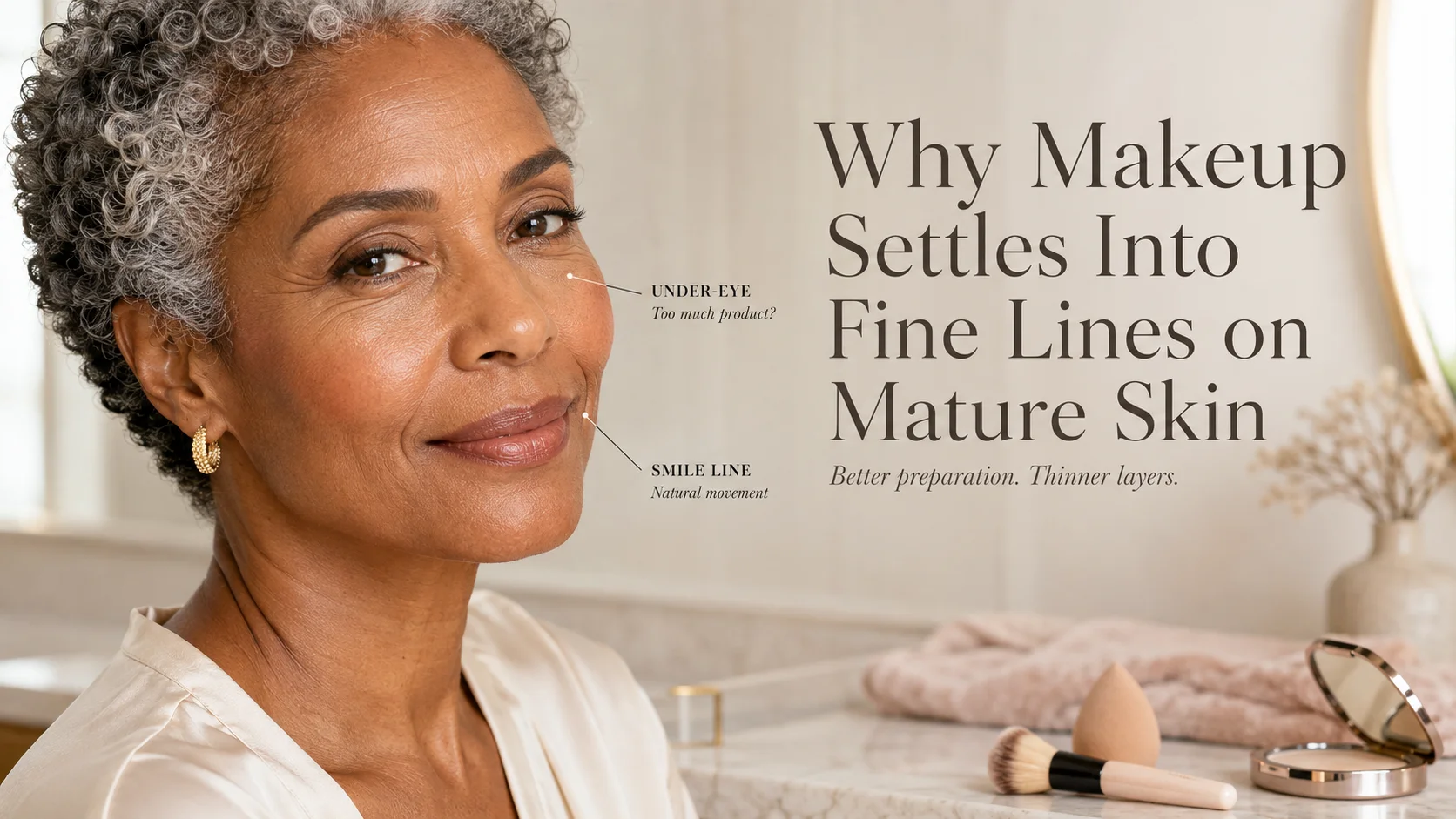


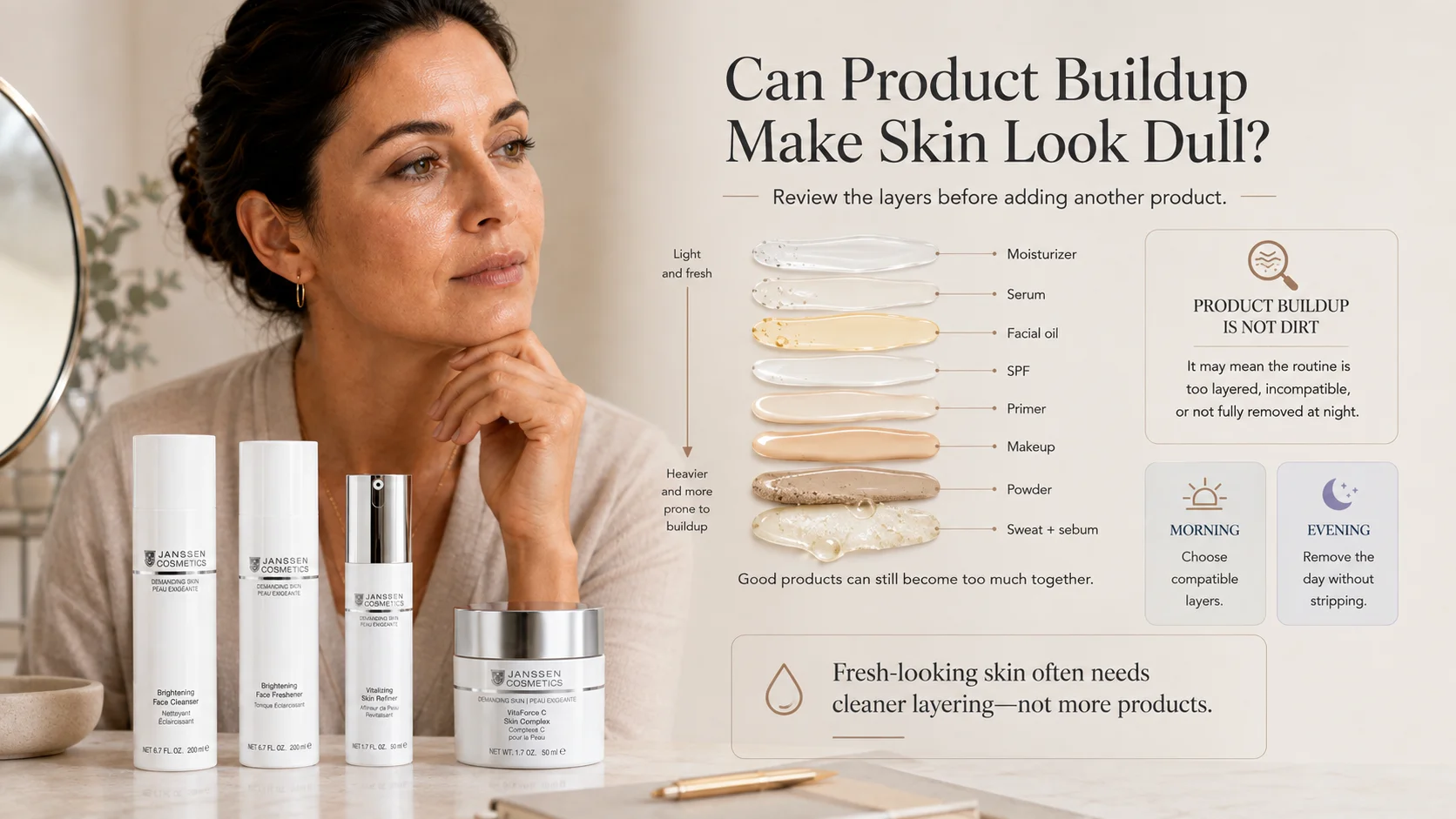
Yes, skincare product buildup can make skin look dull.
Sometimes the skin does not look dull because it is dry. It may not even look dull because it needs more exfoliation. It may look dull because too many layers are sitting on the skin or because the day has not been cleansed away properly.
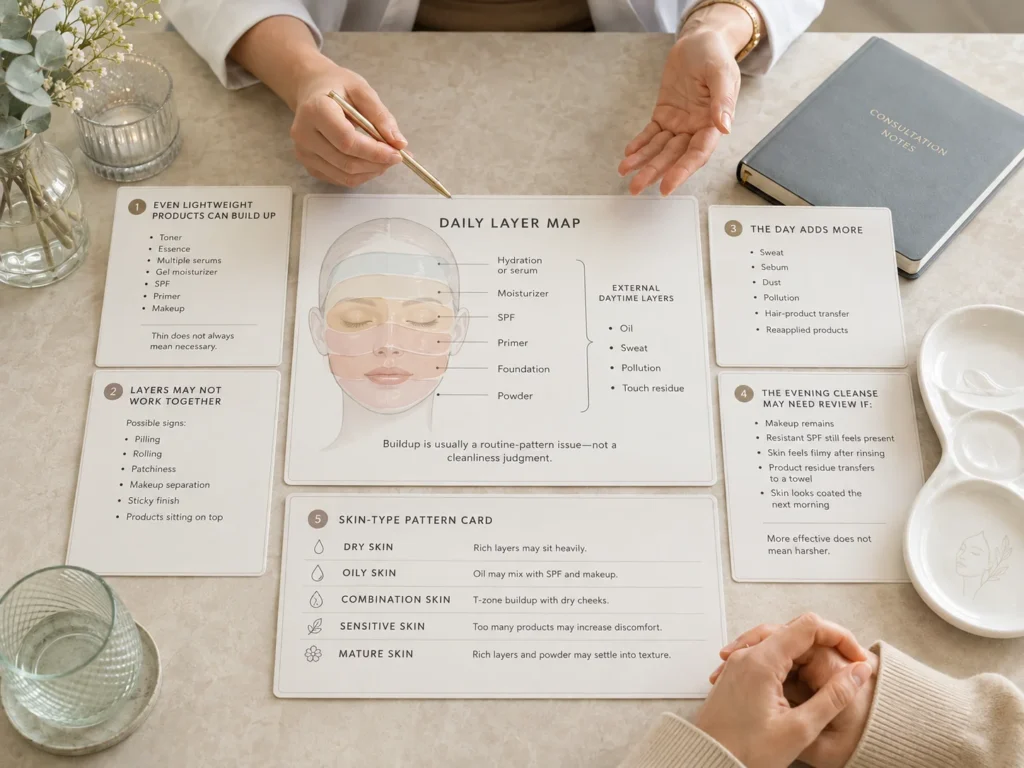
This can happen with moisturizer, SPF, makeup, primer, facial oils, powder, sweat, sebum, pollution, and products that do not layer well together.
By the end of the day, the skin may look coated, heavy, flat, greasy, textured, or less fresh. Makeup may separate. SPF may pill. The T-zone may look shiny but tired. The cheeks may look patchy. Products may feel like they sit on top instead of blending into the skin.
At Zendevie, we do not assume dull-looking skin automatically needs a scrub or acid. In consultation, our licensed esthetician first looks at the full routine: cleanser, toner, moisturizer, SPF, makeup, active products, texture choices, and how well the skin is being cleansed at night.
Dullness is sometimes a product-layering problem.
Skincare product buildup can make skin look dull when layers of SPF, makeup, moisturizer, oil, sweat, sebum, primer, powder, and pollution sit on the skin or are not removed properly.
Signs of product buildup may include:
The answer is not always stronger exfoliation. Often, the first step is better cleansing, lighter layering, improved product compatibility, and a routine that matches your skin type.
Product buildup happens when skincare, makeup, SPF, oil, sweat, and environmental residue collect on the skin surface.
It may come from:
A small amount of product on the skin is normal during the day.
The problem begins when layers become too heavy, do not work well together, or are not removed properly at night.
Healthy-looking skin often appears smoother and more even.
When product layers collect on the surface, the skin may not reflect light evenly. Instead of looking fresh, the complexion may look coated or flat.
Product buildup can make the skin appear:
This type of dullness can happen even if the skin is not truly dry.
Product buildup does not mean your skin is dirty.
It often means your routine has too many layers, products are not compatible, or cleansing is not removing the day well enough.
Even good products can create buildup if they are:
The goal is not to scrub the skin aggressively. The goal is to help the routine work more cleanly.
SPF is important, but it can contribute to buildup if the formula is too heavy or layered over too many products.
SPF buildup may show as:
This does not mean you should skip SPF.
It means your SPF texture, moisturizer, and morning layers may need review.
Makeup can contribute to dullness when it combines with oil, SPF, powder, and sweat.
By evening, makeup may no longer sit smoothly.
Makeup buildup may look like:
If makeup looks dull, the issue may be product layering, skin prep, cleansing, or dehydration — not only the makeup itself.
Moisturizer should help the skin feel comfortable.
But if the moisturizer texture is too rich for your skin, it may sit on top and create a dull, coated finish.
A moisturizer may be too heavy if:
This is especially common with oily and combination skin using creams that are too rich for the full face.
Product buildup is not only caused by rich creams.
Lightweight serums, gels, toners, essences, primers, and SPF can also create buildup if too many are layered together.
Even thin products can cause:
A routine can be lightweight and still overloaded.
More steps do not always mean better results.
Facial oils may work for some skin, but they can make dullness worse for others if used incorrectly.
Oil may create a heavy surface when layered with moisturizer, SPF, primer, and makeup.
This can make the skin look shiny but not fresh.
Facial oil may not be the best morning layer for someone whose skin already gets oily or whose SPF separates easily.
If oil is used, placement, amount, and timing matter.
Primer is often used to smooth makeup, but it can create buildup when it does not work well with moisturizer, SPF, or foundation.
Primer-related buildup may show as:
If makeup looks dull by evening, review whether primer is helping or adding another layer that the skin does not need.
Powder can reduce shine, but too much powder can make buildup more visible.
Powder may cling to SPF, oil, sweat, or moisturizer and create a textured finish.
By evening, the skin may look:
Powder should manage shine without making the skin look lifeless.
Hair products can transfer to the forehead, temples, cheeks, and jawline.
This can contribute to a coated feeling, clogged-looking pores, or dullness around the edges of the face.
Possible sources include:
If dullness or clogged-looking areas happen near the hairline, hair product transfer may be part of the pattern.
Throughout the day, the skin is exposed to the environment.
Sweat, sebum, dust, and pollution can mix with product layers.
This may make the skin look less fresh by evening, especially if you wear SPF and makeup or work in indoor/outdoor environments.
Even if you do not wear makeup, evening cleansing still matters because SPF, oil, sweat, and environmental residue may remain on the skin.
If the evening cleanse does not remove the day well, buildup can remain.
Signs of under-cleansing may include:
Under-cleansing does not mean you need harsh cleansing. It means you may need a more effective but still skin-appropriate cleansing method.
The opposite can also happen.
If you cleanse too aggressively to remove buildup, the skin may become tight, dry-looking, or irritated.
Over-cleansing may cause:
Clean skin should feel comfortable, not stripped.
Some people who wear heavy SPF or makeup may benefit from a double cleanse.
Double cleansing usually means using one step to loosen makeup/SPF and a second gentle cleanser to cleanse the skin.
But double cleansing is not automatically needed for everyone.
It may be helpful if:
It may be too much if:
The method should match the skin.
Toner can help some routines feel more complete after cleansing.
It may remove light residue and prepare the skin for the next step.
But toner is optional.
A toner should not burn, sting, or leave the skin tight.
If the skin is sensitive, redness-prone, or dry, toner must be chosen carefully.
If toner makes the skin feel sharp, it may not be the right step.
If dullness is caused by surface buildup, exfoliation may help.
But exfoliation should not be the first automatic answer.
Exfoliation may be considered when the skin has:
Avoid exfoliation if the skin is:
Buildup needs thoughtful removal, not harsh removal.
Product buildup and dead skin buildup are not the same.
Product buildup comes from layers sitting on the skin, such as SPF, makeup, moisturizer, oils, sweat, and sebum.
Dead skin buildup refers to surface cells that can make the skin feel rough or look less smooth.
Both can make the skin look dull.
But the solution may be different.
Product buildup may need better cleansing and layering.
Dead skin buildup may need gentle exfoliation if the skin can tolerate it.
Product buildup can make the skin feel coated.
Dehydration can make the skin feel tight.
Sometimes both happen together.
For example, oily skin may feel coated from SPF and makeup while also feeling tight underneath from dehydration.
That skin may need:
Do not assume a coated feeling means the skin has enough hydration.
Dry skin can look dull from flaking and roughness.
Product buildup can look dull from heaviness and residue.
Dryness may feel:
Product buildup may feel:
Some skin can be both dry and product-overloaded, especially when heavy creams are layered without effective cleansing.
Over-exfoliated skin can look dull too.
If you keep exfoliating because your skin looks dull, you may make the skin more irritated.
Over-exfoliation may show as:
If these signs are present, pause exfoliation.
The dullness may be irritation, not buildup.
Morning dullness can happen when the skin is not fully cleansed at night or when heavy night products sit on the surface.
Morning dullness may be caused by:
If the skin looks coated in the morning, review the evening routine.
Evening dullness can happen because the day adds layers.
By evening, the skin may have:
This is why a routine that looks beautiful at 9 a.m. may look heavy at 6 p.m.
Morning product choices need to last through real life.
Pilling happens when products roll or flake off the skin in small pieces.
It can happen when:
Pilling can make skin look dull, textured, and uneven.
It often means the routine needs fewer layers or better texture matching.
Products may sit on top when the skin is overloaded, dehydrated, oily, or covered with residue.
They may also sit on top when the product texture is not right for the skin type.
For example:
When products sit on top, the skin may look dull and coated instead of fresh.
A coated look may come from too much product or the wrong product combination.
Ask:
The answer may be simplification.
When product buildup sits around pores, pores can look more noticeable.
This can happen especially in oily and combination skin.
Pores may look more visible when:
Pores do not need to be attacked. The routine needs to be balanced.
Sticky skin can happen when too many hydrating layers are used or when products do not absorb well together.
Stickiness may make the skin look dull because the surface catches makeup, dust, and oil.
Sticky skin may come from:
Sticky does not always mean hydrated.
This is often seen in oily dehydrated skin.
The skin may have oil on the surface but still lack water underneath.
This can make the face look dull under shine.
A better routine may include:
Do not strip the skin just because the surface feels greasy.
To reduce buildup, focus on routine quality.
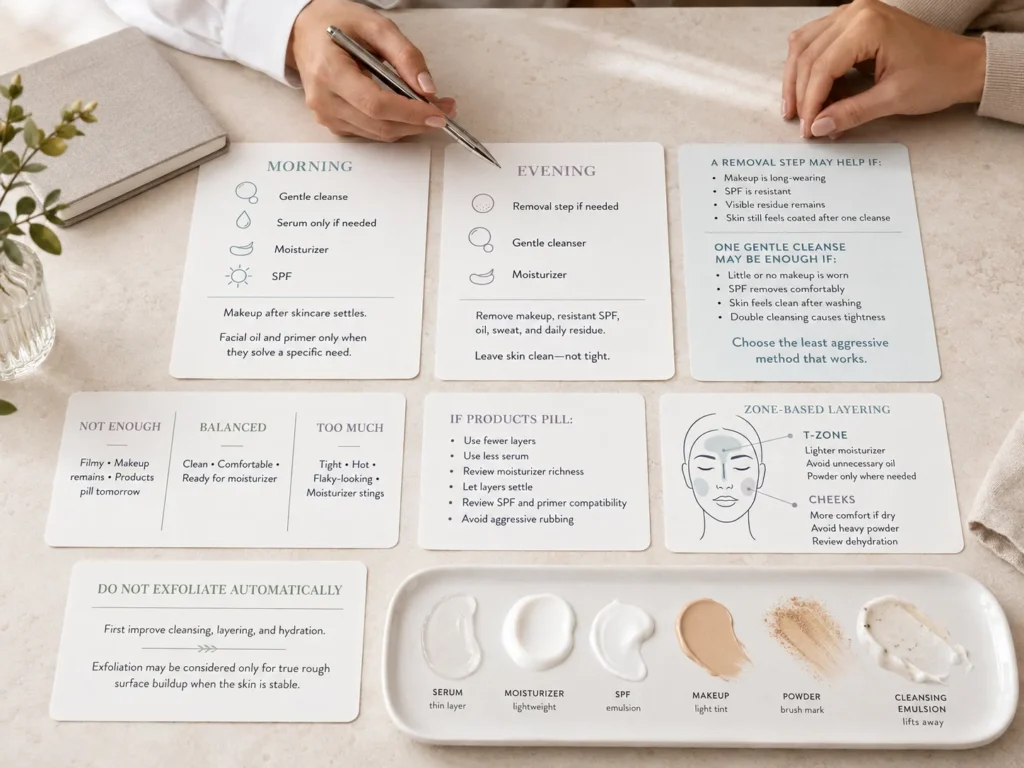
Try:
The goal is fresh, comfortable skin — not squeaky-clean skin.
A simple morning routine may look like:
Gentle cleanser → serum if needed → moisturizer → SPF
For oily or combination skin, keep textures light.
For dry skin, choose more comforting hydration and moisturizer.
For sensitive skin, avoid too many active products.
If makeup is used, allow skincare layers to settle before applying foundation.
A simple evening routine may look like:
Cleanser → toner if tolerated → moisturizer
If wearing heavy SPF or makeup:
Makeup/SPF removal step if needed → gentle cleanser → moisturizer
Avoid harsh scrubbing.
The evening routine should remove the day and leave the skin comfortable.
Use less product if your skin often looks:
Many people use more product than their skin needs.
A smaller amount may layer better and look fresher.
Simplify if your routine includes:
Not every step is wrong, but too many layers can make the skin look dull.
A simplified routine can help you identify which products are truly helping.
Texture matters.
Your product may be good but not right for your skin texture needs.
Oily dull skin may need lighter textures.
Dry dull skin may need more comfort.
Combination dull skin may need different amounts by zone.
Sensitive dull skin may need fewer layers and softer formulas.
Mature dull skin may need hydration and comfort without a heavy coated finish.
Product texture should match the skin’s behavior.
Exfoliation may help if the skin has true surface buildup or rough texture and is not irritated.
Use caution if your routine already includes:
Too many active steps can create irritation, which can also look dull.
Do not exfoliate if your skin is:
In that case, a calmer routine is more appropriate.
Dry skin can have product buildup too.
This may happen when rich creams, oils, balms, SPF, and makeup layer heavily without proper cleansing.
Dry skin with buildup may look:
Dry skin still needs cleansing, but cleansing must remain gentle.
Oily skin may show buildup more quickly because oil mixes with product layers.
Oily skin with buildup may look:
This skin often needs better evening cleansing, lightweight layers, and targeted active care only when appropriate.
Combination skin may experience buildup in the T-zone and dryness on the cheeks.
The T-zone may look oily and dull, while the cheeks may look tight or patchy.
This skin may need:
The whole face does not always need the same product amount.
Sensitive skin may look dull when too many products overwhelm it.
Sensitive skin may react to buildup, fragrance, active products, or cleansing residue.
Signs may include:
Sensitive skin should simplify before adding more products.
Mature skin can look dull when heavy layers settle into texture or fine lines.
This may happen with rich cream, SPF, primer, foundation, powder, or facial oils.
Mature skin may need comfort, but the routine should still layer well.
A fresher-looking mature routine often depends on:
Rich does not always mean better if the product sits heavily.
After consultation, our licensed esthetician may consider Janssen Cosmetics options depending on whether dullness is connected to product buildup, dryness, dehydration, oiliness, sensitivity, makeup wear, or tired-looking skin.
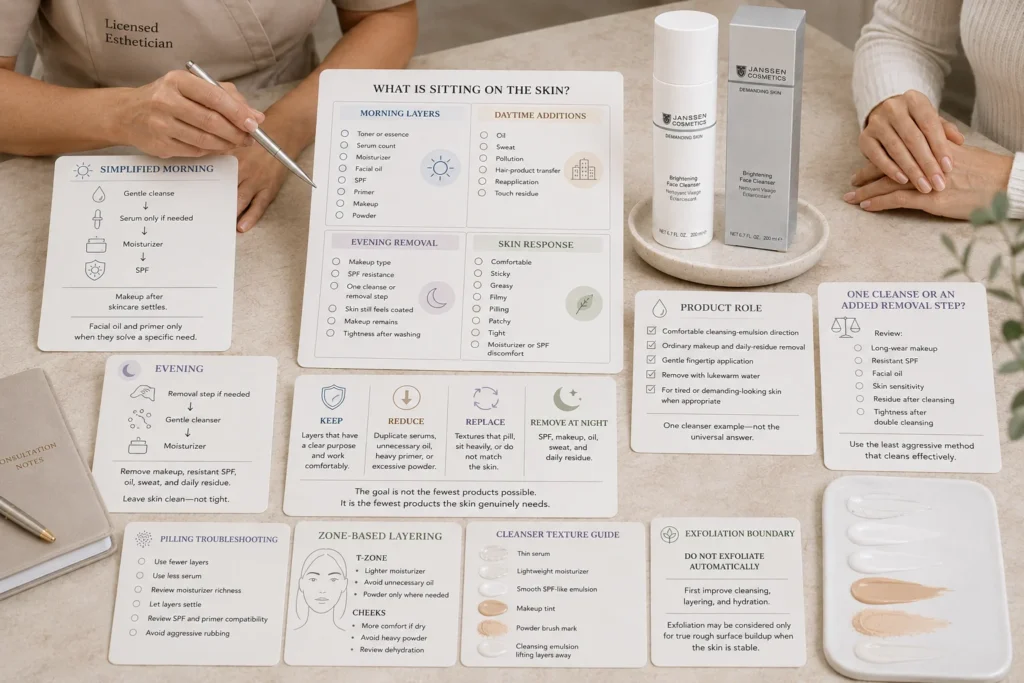
For tired-looking skin and daily buildup, possible options may include:
If buildup is related to dryness or dehydration, hydration-focused options may be reviewed, such as:
If buildup is related to oily skin, clogged-looking pores, or T-zone heaviness, oily-skin options may be reviewed carefully, such as:
If the skin is sensitive or reactive, calming products may come before active exfoliation or brightening-support steps.
These are not automatic recommendations. The correct routine depends on the skin type, product layers, cleansing habits, and how the skin feels after each step.
Do not scrub the skin aggressively to remove buildup.
Do not use harsh cleanser twice a day if your skin feels tight.
Do not exfoliate every night because the skin looks dull.
Do not layer more products when the skin already feels coated.
Do not skip SPF because it feels heavy.
Do not assume every dullness problem is dryness.
Do not assume every dullness problem is dead skin buildup.
Do not use acid cleanser, acid toner, BHA serum, retinol-style products, scrub, and mask all at once.
Do not ignore burning, swelling, rash-like irritation, pain, crusting, bleeding, or persistent worsening.
Yes. Product buildup from SPF, makeup, moisturizer, oil, sweat, sebum, primer, powder, and pollution can make the skin look heavy, flat, greasy, or less fresh.
Your skin may feel coated, sticky, heavy, or greasy. Makeup may separate, SPF may pill, pores may look more visible, and skin may look dull by evening or in the morning.
Not always. Product buildup may need better cleansing, fewer layers, or better product texture. Exfoliation may help only if the skin has rough surface buildup and is not irritated.
SPF can contribute to buildup if it is heavy, layered over too many products, not removed well, or does not work with your moisturizer or makeup. SPF should still be used; the formula and layering may need adjustment.
Yes. A moisturizer that is too heavy or not right for your skin type can make the skin look coated, greasy, or dull.
Your routine may have too many layers, incompatible textures, incomplete cleansing, dehydration, over-exfoliation, or a moisturizer/SPF mismatch.
Some people benefit from double cleansing when wearing heavy SPF or makeup. But sensitive or dry skin should avoid over-cleansing. The method should leave skin clean but comfortable.
See a dermatologist if dullness comes with persistent rash-like irritation, swelling, pain, crusting, bleeding, infection-looking areas, severe itching, eye-area irritation, sudden changes, or worsening symptoms.
If your skin looks dull, coated, heavy, or patchy even though you are using skincare, a free virtual consultation can help you understand whether product buildup may be part of the problem.
At Zendevie, we review your cleanser, toner, moisturizer, SPF, makeup, product textures, active products, and evening cleansing habits before recommending products. The goal is to help your skin look fresher without overwhelming it.

Zendevie is guided by Haby Diallo, a licensed esthetician with more than 20 years of professional skincare experience. Her approach is rooted in education, professional judgment, and personal care.
years of experience