




Layering matters when skin looks dull.
A good product can feel disappointing if it is placed in the wrong order, used with too many other products, or layered over skin that is not properly cleansed. Dull-looking skin may need hydration, moisturizer, SPF, gentle cleansing, radiance support, or exfoliation — but not all at once and not without a plan.
The goal is not to create the longest routine.
The goal is to create the right routine.
At Zendevie, we do not recommend product layering blindly. In consultation, our licensed esthetician first looks at why the skin looks dull: dehydration, dryness, oil buildup, makeup residue, SPF buildup, sensitivity, over-exfoliation, uneven-looking tone, mature skin changes, or product overload.
Layering should help the skin feel supported.
It should not make the skin feel sticky, heavy, irritated, or confused.
A simple skincare layering order for dull skin is:
Morning:
Cleanser → toner if used → serum if needed → moisturizer → SPF
Evening:
Cleanser → toner if used → serum if needed → moisturizer
Optional steps such as exfoliation, masks, ampoules, or retinol-style products should be added carefully and only when the skin can tolerate them.
For dull skin, the most important rule is this:
Start with the basics before adding active products.
A dull skin routine should not skip cleanser, moisturizer, or SPF just to add stronger serums or exfoliants.
Product order affects how the routine feels and performs.
If products are layered in the wrong order, the skin may feel:
Correct layering helps each product have a clear role.
It also helps avoid overloading the skin.
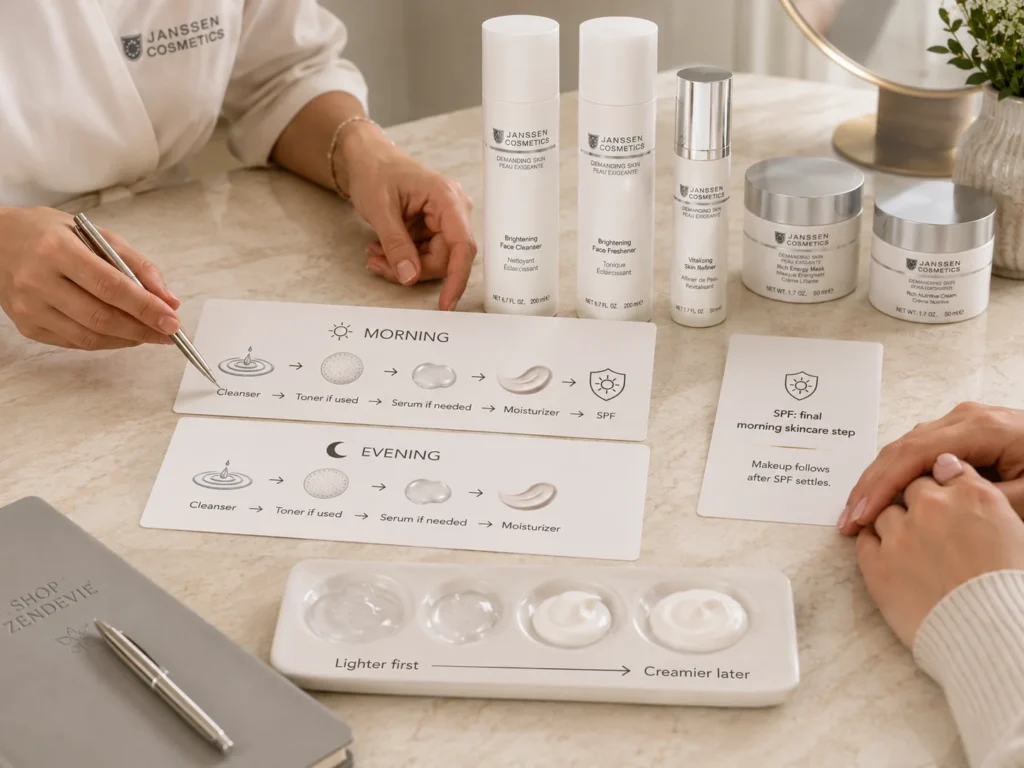
A basic skincare rule is to apply lighter textures before heavier textures.
This often means:
Cleanser → toner → serum → moisturizer → SPF
Lighter products usually go first.
Creamier or richer products usually go later.
SPF always comes last in the morning skincare routine.
This simple order helps keep the routine organized.
Cleanser is the first step.
For dull-looking skin, cleanser helps remove:
A cleanser should leave the skin clean but comfortable.
If your cleanser leaves your skin tight, raw, or squeaky-clean, it may make dullness worse.
If your cleanser does not remove SPF and makeup well, dullness may also continue because residue remains on the skin.
Cleanser sets the foundation for every product that follows.
Toner is optional.
It usually comes after cleansing and before serum or moisturizer.
A toner may help:
But toner should not burn, sting, or make the skin tight.
If toner causes discomfort, skip it and simplify.
Dull skin does not need toner if the toner is not helping.
Serum usually comes after cleansing and toner.
For dull-looking skin, serum may support:
But serum is not always necessary.
If the skin is over-exfoliated, burning, stinging, or reacting easily, serum may need to wait.
If serum pills under moisturizer or SPF, the texture, amount, or product order may need review.
Serum should support the routine, not make it heavier.
Moisturizer usually comes after serum.
Moisturizer helps the skin feel comfortable and supported.
For dull skin, moisturizer may help improve the look of:
Moisturizer texture should match the skin type.
Dry skin may need more comfort.
Oily skin may need a lightweight texture.
Combination skin may need different amounts by zone.
Sensitive skin may need a simple, gentle moisturizer.
SPF is the final morning skincare step.
A simple morning routine should end with SPF:
Cleanser → toner if used → serum if needed → moisturizer → SPF
SPF is especially important if your dull skin routine includes:
If SPF pills, looks heavy, or makes makeup separate, review the layers underneath before skipping SPF.
SPF should stay in the routine.
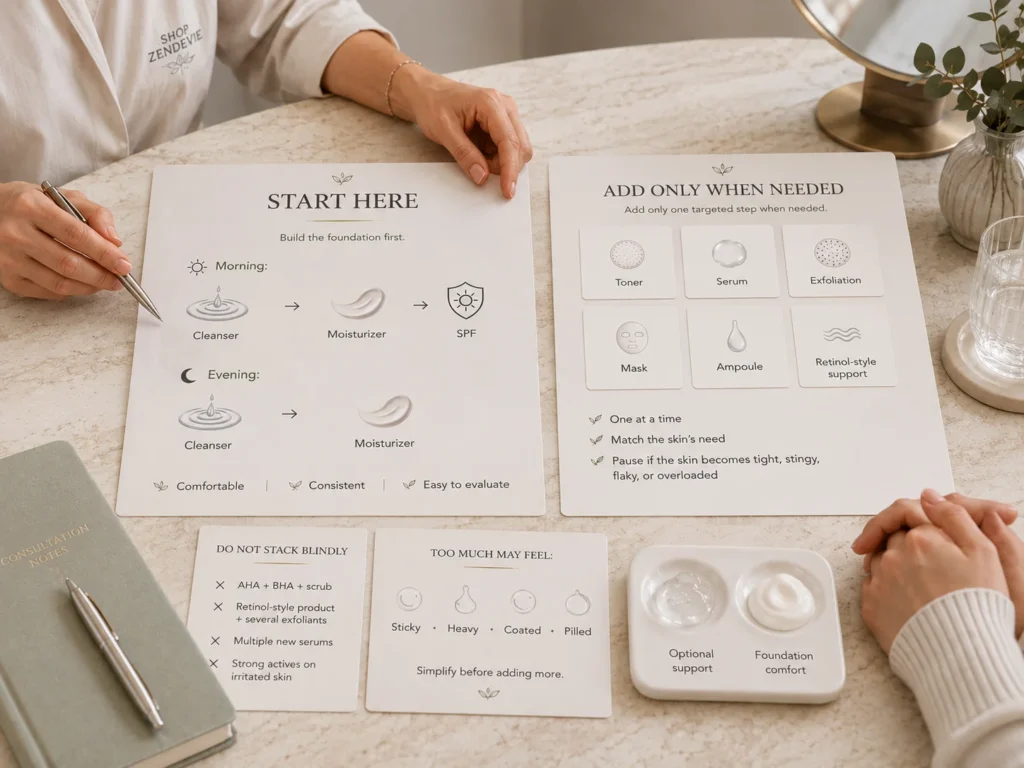
Exfoliation is not a daily basic step for everyone.
When used, exfoliation usually comes after cleansing and before moisturizer.
A simple exfoliation night may look like:
Cleanser → exfoliant → moisturizer
If toner is used and tolerated:
Cleanser → toner → exfoliant → moisturizer
But exfoliation should not be used every night unless the skin clearly tolerates it and the routine has been professionally reviewed.
Dull skin does not need constant exfoliation.
Masks are add-on steps.
They are not required every day.
A mask may fit after cleansing and before moisturizer, depending on the type of mask.
A hydrating mask may help dull skin that feels tight, dry, or tired.
A clearing mask may help oily areas when appropriate.
A calming mask may help sensitive-feeling skin when the formula fits.
A mask should match the skin’s need.
It should not be used just because the skin looks dull.
Ampoules are usually targeted support steps.
They often fit after cleansing and toner, before moisturizer.
A simple order may be:
Cleanser → toner if used → ampoule → moisturizer
Ampoules should be used with purpose.
Do not combine multiple ampoules, serums, acids, and masks without knowing how the skin will respond.
For dull skin, more active steps do not always mean better results.
Retinol-style products should be used carefully.
They are usually part of an evening routine, not a casual add-on.
A basic evening order may look like:
Cleanser → retinol-style product if appropriate → moisturizer
But retinol-style products should not be layered with multiple exfoliating products, harsh toners, scrubs, or strong active products unless guided.
If the skin is dry, flaky, burning, or sensitive, retinol-style products may need to wait.
SPF is important every morning when retinol-style products are used.
A simple morning routine for dull skin may be:
Cleanser → toner if used → serum if needed → moisturizer → SPF
This routine supports the skin for the day.
Morning products should help the skin feel:
If the morning routine pills or feels coated, reduce layers.
A simple evening routine for dull skin may be:
Cleanser → toner if used → serum if needed → moisturizer
If wearing makeup or heavy SPF:
Makeup/SPF removal step if needed → cleanser → moisturizer
Evening is when the skin should be cleansed from the day.
SPF, makeup, sweat, oil, and product residue should not sit on the skin overnight.
Dry dull skin usually needs comfort.
A simple morning routine may be:
Gentle cleanser → hydrating serum if needed → moisturizer → SPF
A simple evening routine may be:
Gentle cleanser → hydrating serum if needed → moisturizer or cream
Dry dull skin may not need frequent exfoliation.
If the skin is flaky, first review cleanser, hydration, and moisturizer before using a scrub or acid.
Dehydrated skin lacks water.
It may feel tight, flat, or shiny but uncomfortable.
A simple morning routine may be:
Gentle cleanser → hydrating serum → moisturizer → SPF
A simple evening routine may be:
Gentle cleanser → hydrating serum → moisturizer
Hydration should come before stronger active products if the skin feels tight or sensitive.
Dehydrated skin often looks dull because it lacks flexibility.
Oily skin can still look dull.
A simple morning routine may be:
Gentle cleanser → lightweight serum if needed → lightweight moisturizer → SPF
A simple evening routine may be:
Gentle cleanser → lightweight moisturizer
If clogged-looking pores, blackheads, whiteheads, or T-zone buildup are present, BHA may be considered carefully.
But oily skin should not be stripped.
Skipping moisturizer can make oily dull skin feel more unbalanced.
Combination skin needs balance.
The T-zone may be oily, while the cheeks feel dry or tight.
A simple morning routine may be:
Gentle cleanser → lightweight hydration → moisturizer by zone → SPF
A simple evening routine may be:
Gentle cleanser → moisturizer by zone
Combination skin may need less product on oily areas and more comfort on dry areas.
Do not treat the whole face like one concern.
Sensitive dull skin should stay simple.
A simple morning routine may be:
Mild cleanser → moisturizer → SPF
A simple evening routine may be:
Mild cleanser → moisturizer
If serum is added, introduce it slowly.
Avoid layering strong vitamin C, acids, retinol-style products, scrubs, and active toners when the skin is reactive.
Sensitive skin needs calm before radiance support.
Mature dull skin may need hydration, comfort, and SPF.
A simple morning routine may be:
Gentle cleanser → hydrating serum if tolerated → moisturizer → SPF
A simple evening routine may be:
Gentle cleanser → serum if needed → moisturizer or cream
Mature skin may also benefit from gentle eye-area care.
Avoid heavy powder over dry texture and avoid aggressive exfoliation.
If dullness comes with uneven-looking tone, SPF becomes especially important.
A simple morning routine may be:
Cleanser → antioxidant or radiance-support serum if tolerated → moisturizer → SPF
At night:
Cleanser → moisturizer or targeted support if appropriate
Brightening-support products should not be used without daily SPF.
Do not combine every brightening-support ingredient at once.
Patience and consistency matter.
If the skin feels coated, heavy, sticky, or greasy, layering may be too much.
Product buildup can happen from:
In this case, the best routine may be simpler:
Morning: Cleanser → moisturizer → SPF
Evening: Cleanser → moisturizer
Do not add more products until the buildup pattern improves.
Over-exfoliated skin may look dull, shiny, tight, flaky, or irritated.
If this happens, pause active products.
A reset routine may look like:
Morning: Mild cleanser → moisturizer → SPF
Evening: Mild cleanser → moisturizer
Pause:
The skin should feel stable before active steps return.
Pilling happens when products roll off the skin.
To reduce pilling:
If SPF pills, do not automatically blame SPF.
Look at all the layers underneath.
If products make the skin greasy, review texture and amount.
Try:
Oily skin needs light support, not no support.
If products make the skin dry or tight, review cleanser, toner, and active products.
Dryness may come from:
Layering should leave the skin comfortable.
If moisturizer burns, the routine may be too active.
To avoid irritation:
A routine should be built slowly.
Skin does not need to be rushed.
Vitamin C support may fit some dull skin routines when the skin can tolerate it.
A simple morning order may be:
Cleanser → vitamin C support → moisturizer → SPF
If toner is used:
Cleanser → toner → vitamin C support → moisturizer → SPF
Do not force vitamin C if the skin is burning, stinging, over-exfoliated, or sensitive.
SPF should follow in the morning.
A hydrating serum usually goes before moisturizer.
A simple order:
Cleanser → hydrating serum → moisturizer → SPF
At night:
Cleanser → hydrating serum → moisturizer
Hydrating serum is especially helpful when skin looks dull, tight, flat, or patchy under makeup.
But it should not replace moisturizer.
BHA may be considered when dullness is connected to oily areas, clogged-looking pores, blackheads, whiteheads, or T-zone buildup.
A simple evening order may be:
Cleanser → BHA if appropriate → moisturizer
Do not use BHA with too many other active products at once.
Avoid BHA if the skin is tight, burning, flaky, or over-exfoliated.
AHA may be considered for dullness connected to rough surface texture.
A simple evening order may be:
Cleanser → AHA if appropriate → moisturizer
AHA should not be combined blindly with scrubs, retinol-style products, acid toners, and other exfoliants.
Use SPF every morning when exfoliating products are part of the routine.
Masks usually fit after cleansing.
A general order:
Cleanser → mask → rinse if required → serum or moisturizer
A hydrating mask may fit when skin feels tight or tired.
A clearing mask may fit oily areas when appropriate.
A calming mask may fit sensitive-feeling skin when tolerated.
Do not mask over irritated skin with strong active products.
Eye cream usually goes after serum and before or around moisturizer, depending on texture.
A simple order may be:
Cleanser → serum → eye cream → moisturizer → SPF
The eye area is delicate.
Do not apply facial exfoliating acids, harsh scrubs, or strong active serums close to the eyes unless the product is made for that area.
Eye-area dullness needs gentle care.
SPF goes last in the morning skincare routine.
A proper morning order:
Cleanser → toner if used → serum if needed → moisturizer → SPF
Then makeup, if used.
SPF should not be placed under serum or moisturizer.
If makeup is used, let SPF settle before applying foundation.
Be careful with combinations such as:
Dull skin does not need every active step at the same time.
Dull skin does not need a long routine by default.
A basic routine may be:
Morning: Cleanser → moisturizer → SPF
Evening: Cleanser → moisturizer
A more supportive routine may be:
Morning: Cleanser → serum → moisturizer → SPF
Evening: Cleanser → serum → moisturizer
A more advanced routine may include toner, masks, or exfoliation, but only if the skin needs and tolerates them.
The routine should match the skin.
Add a new product when:
Do not add products out of frustration.
Add them with purpose.
Remove or pause a product if:
Skin feedback matters.
Keep the routine simple if the skin is:
A simple routine can be very effective when the skin needs calm.
Common morning mistakes include:
Morning skincare should prepare and protect.
Common evening mistakes include:
Evening skincare should cleanse and support.
If makeup looks flat or patchy, review skincare layering first.
A simple makeup-prep order:
Gentle cleanser → hydration support if needed → moisturizer → SPF → makeup
Avoid too many layers before makeup.
Too many products can make foundation pill, separate, or look heavy.
If makeup clings, the skin may need hydration or moisturizer.
If makeup slides, the routine may be too rich or the skin may be oily but dehydrated.
SPF should be used every morning.
If SPF feels heavy or pills, review:
SPF should remain the final skincare step.
Adjust the routine around it.
Travel routines should be simple.
A travel routine may be:
Morning: Cleanser or gentle refresh → moisturizer → SPF
Evening: Cleanser → moisturizer
If your skin needs hydration:
Add one hydration serum your skin already tolerates.
Do not travel with a complicated routine full of new active products.
Travel skin often needs consistency.
Winter dull skin may need more comfort.
A winter routine may be:
Morning: Gentle cleanser → hydrating serum → moisturizer → SPF
Evening: Gentle cleanser → hydrating serum → moisturizer or cream
Exfoliation should be gentle and occasional if the skin is stable.
Avoid hot water and harsh scrubs.
Summer dull skin may need lighter textures.
A summer routine may be:
Morning: Gentle cleanser → lightweight hydration if needed → lightweight moisturizer → SPF
Evening: Cleanser → lightweight moisturizer
If SPF, sweat, and makeup build up, evening cleansing becomes especially important.
Do not skip moisturizer just because it is hot.
Your product order may be working if the skin feels:
A good routine should feel organized and comfortable.
Your routine may be too much if the skin feels:
If this happens, simplify before adding more.
Morning:
Gentle cleanser → moisturizer → SPF
Evening:
Gentle cleanser → moisturizer
After the basics feel comfortable, add one support step if needed:
Add only one at a time.
Morning:
Cleanser → toner if tolerated → serum → moisturizer → SPF
Evening:
Cleanser → toner if tolerated → serum or moisturizer → moisturizer if needed
Optional weekly:
Gentle exfoliation or mask only if appropriate
This routine gives structure without becoming too complicated.
An active dull skin routine may include vitamin C, exfoliation, BHA, AHA, or retinol-style products.
But active routines should be personalized.
A safe principle:
Do not use every active product at the same time.
Separate active steps.
Use moisturizer.
Use SPF.
Watch skin response.
Pause if the skin becomes tight, flaky, stingy, or duller.
Professional guidance may help if:
A consultation can help simplify the routine and make each step purposeful.
A dermatologist should evaluate the skin if product use or dullness comes with:
Cosmetic skincare can support appearance and routine structure, but medical-looking changes need medical evaluation.
After consultation, our licensed esthetician may consider Janssen Cosmetics options based on skin type, dullness pattern, sensitivity, hydration level, and routine tolerance.
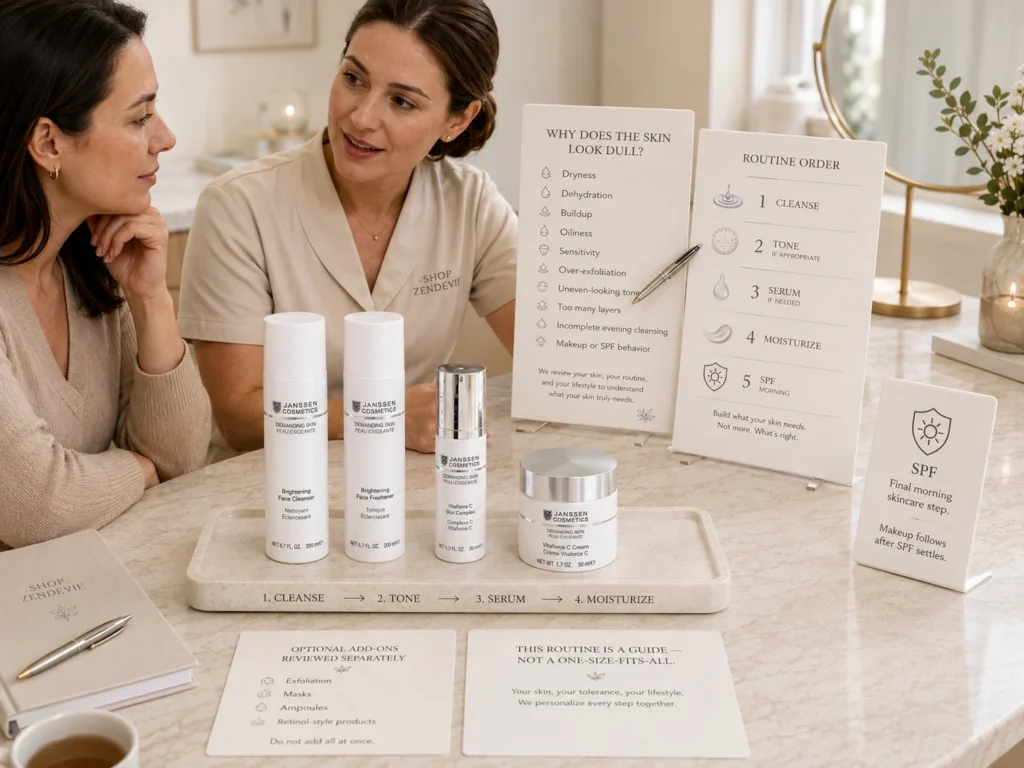
For tired-looking dull skin, a possible routine structure may include:
For dry or dehydrated dull skin, a possible routine structure may include:
For sensitive dull skin, a possible routine structure may include:
For oily dull skin, a possible routine structure may include:
For weekly or occasional add-ons, masks or exfoliating products may be reviewed only after the basic routine is understood. Professional exfoliation systems should remain in professional treatment settings.
These are not automatic recommendations. The correct layering plan depends on skin type, product tolerance, SPF habits, makeup use, sensitivity, and whether dullness is from dryness, dehydration, oil, buildup, over-exfoliation, or uneven-looking tone.
Do not layer products without understanding their purpose.
Do not skip moisturizer because you are using serum.
Do not skip SPF because you are using vitamin C or brightening-support products.
Do not apply SPF before serum or moisturizer unless a product direction specifically requires it.
Do not combine acids, scrubs, retinol-style products, and active toners blindly.
Do not apply strong facial actives close to the eyes.
Do not keep adding products when skin feels sticky, heavy, or irritated.
Do not use professional-only products as home-use routine steps.
Do not ignore burning, swelling, rash-like irritation, pain, crusting, bleeding, severe itching, eye-area irritation, or persistent worsening.
A simple order is cleanser, toner if used, serum if needed, moisturizer, and SPF in the morning. At night, use cleanser, toner if used, serum if needed, and moisturizer.
Yes. Serum usually goes before moisturizer because it is usually lighter and more targeted.
SPF goes after moisturizer as the final morning skincare step.
Not always. Toner is optional. It can help refresh the skin after cleansing, but it should not burn, sting, or make skin tight.
Exfoliation usually comes after cleansing and before moisturizer. It should not be used every night unless the skin clearly tolerates it and the routine has been reviewed.
Some skin may tolerate both in a routine, but they should not be stacked carelessly. Sensitive, dry, or over-exfoliated skin should be cautious.
Pilling may happen because of too many layers, too much serum, heavy moisturizer, incompatible SPF, rubbing too much, or product buildup.
Dull skin may only need cleanser, moisturizer, and SPF at first. Serum, toner, exfoliation, or masks can be added only when the skin needs and tolerates them.
Yes. Oily dull skin still needs moisturizer, but the texture should be lightweight and appropriate.
See a dermatologist if product use or dullness comes with persistent rash-like irritation, swelling, pain, crusting, bleeding, infection-looking areas, severe itching, eye-area irritation, sudden changes, burning that does not settle, changing marks, or worsening symptoms.
If your skincare routine feels confusing or your skin still looks dull despite using several products, a free virtual consultation can help.
At Zendevie, we review your cleanser, toner, serum, moisturizer, SPF, exfoliation habits, makeup wear, skin type, sensitivity, and product order before recommending anything.
The goal is not to add more steps.
The goal is to layer the right steps in the right order for your skin.

Zendevie is guided by Haby Diallo, a licensed esthetician with more than 20 years of professional skincare experience. Her approach is rooted in education, professional judgment, and personal care.
years of experience
