


Dull skin may benefit from serum before moisturizer, but not always.
A serum can be helpful when the skin needs more targeted support than moisturizer alone can provide. For dull-looking skin, that may mean hydration support, antioxidant support, radiance support, smoother-looking texture support, or support for a fresher-looking complexion.
But serum is not a magic step.
If the cleanser is too harsh, the moisturizer is wrong, SPF is missing, or the routine already has too many active products, adding serum may not solve the dullness. In some cases, it can make the routine feel sticky, heavy, irritating, or overloaded.
At Zendevie, we do not add serum just because skin looks dull. In consultation, our licensed esthetician first looks at why the skin looks dull: dehydration, dryness, oil buildup, makeup wear, SPF buildup, product overload, over-exfoliation, sensitivity, mature skin changes, or uneven-looking tone.
Serum can be helpful.
But it should be chosen for the reason behind the dullness.
Dull skin may use serum before moisturizer when the skin needs targeted hydration, radiance support, antioxidant support, or smoother-looking texture support.
Serum usually goes after cleansing and toner, if toner is used, and before moisturizer.
A simple routine order may be:
Cleanser → toner if used → serum → moisturizer → SPF
At night:
Cleanser → toner if used → serum → moisturizer
Dull skin may benefit from serum if:
Dull skin may not need serum yet if:
The basic routine should feel comfortable before serum is added.
Serum is usually a lightweight step used after cleansing and before moisturizer.
It is often designed to give more targeted support than a basic moisturizer.
Depending on the formula, serum may support:
Serum does not replace moisturizer.
It supports the routine before moisturizer finishes the step.
Moisturizer helps the skin feel comfortable and supported.
Depending on the formula and texture, moisturizer may help skin feel:
Moisturizer is often more important than serum for daily comfort.
If your skin feels tight, dry, or uncomfortable, moisturizer should not be skipped.
Serum and moisturizer have different jobs.
Serum is usually the targeted support step.
Moisturizer is usually the comfort and finishing step.
A simple way to understand it:
Serum supports a specific concern.
Moisturizer helps the skin feel comfortable and complete.
For dull skin, serum may help address dehydration, tired-looking skin, or radiance support.
Moisturizer helps finish the routine so the skin does not feel tight or unsupported.
Serum usually goes before moisturizer because it is often lighter in texture.
A typical order is:
Cleanser → toner → serum → moisturizer
The moisturizer comes after serum to complete the routine.
If SPF is used in the morning, SPF comes last:
Cleanser → toner → serum → moisturizer → SPF
Layering matters because heavier products can block lighter products from applying smoothly.
But the exact order may depend on product texture.
No.
Not every dull skin routine needs serum.
A simple routine can still be effective:
Cleanser → moisturizer → SPF
This may be enough if the dullness is caused by harsh cleansing, dryness, lack of SPF, or routine inconsistency.
Serum becomes more useful when the basics are already working and the skin needs more targeted support.
Do not add serum just to make the routine look more advanced.
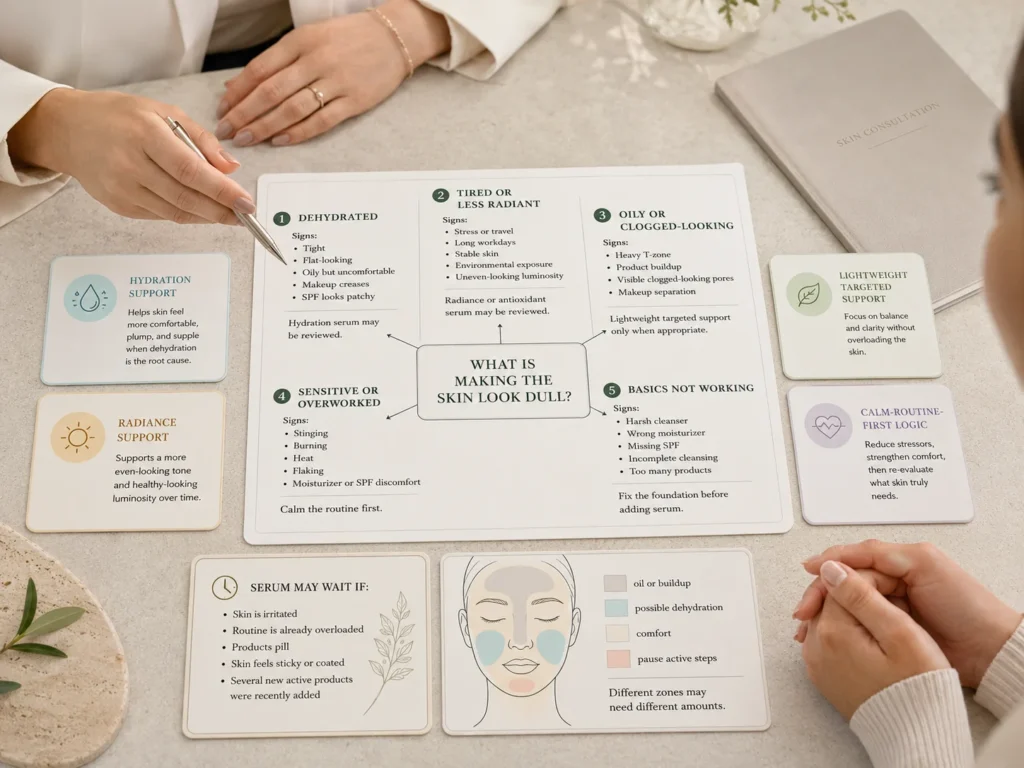
Serum may help dull-looking skin when the skin needs something more specific than moisturizer alone.
Serum may be useful when dullness is linked to:
A serum should fit the skin’s need.
The best serum for dry dull skin may not be the best serum for oily dull skin.
Serum may not help if the real issue is a routine mismatch.
Serum may not solve dullness caused by:
In those cases, adding serum may make the routine more complicated.
Serum can make dullness worse if it is the wrong formula, wrong texture, or used at the wrong time.
Serum may create problems if:
A serum should make the routine better, not heavier.
A hydration-focused serum may help when dullness is connected to water loss.
This is common when skin looks flat, tight, creased, or less smooth.
Hydration serum may be helpful if skin:
Hydration serum should usually be followed by moisturizer.
Vitamin C serum is often discussed for dull-looking skin because it can support the look of radiance and antioxidant care.
It may be helpful when skin looks tired, uneven, or less fresh.
But vitamin C is not for every skin at every moment.
Be careful if the skin is:
Vitamin C support should come after skin comfort.
Antioxidant-support serums may be useful when dullness is connected to daily environmental exposure, tired-looking skin, or uneven-looking tone.
They are often used in morning routines before moisturizer and SPF.
A simple morning order may be:
Cleanser → antioxidant serum → moisturizer → SPF
But if the skin is sensitive, antioxidant serums should be introduced carefully.
The skin should tolerate the basics first.
A radiance-focused serum may help skin look fresher when dullness is connected to tired-looking skin, lack of glow, or uneven-looking surface appearance.
But radiance support should not mean irritation.
A radiance serum should not burn, sting, or make the skin tight.
If a radiance product causes discomfort, the skin may need hydration or calming support first.
Fresh-looking skin should still feel comfortable.
Dry dull skin may benefit from serum when moisturizer alone is not enough.
A serum for dry dull skin may focus on hydration before cream.
Dry dull skin may show:
In this case, a hydrating serum followed by a comfortable moisturizer may support a smoother-looking complexion.
Dry skin should not rely on serum alone.
Dehydrated dull skin often needs water support.
This skin may look flat, tight, or shiny but uncomfortable.
A hydration serum may help before moisturizer.
Dehydrated dull skin may show:
Hydration serum can be very helpful here, but moisturizer should still finish the routine.
Oily dull skin may still benefit from serum, but texture matters.
A serum for oily dull skin should feel lightweight and should not make the skin sticky or greasy.
Oily dull skin may need serum if:
Avoid rich or sticky serums that make oily skin feel coated.
Combination dull skin may need different support in different zones.
The T-zone may feel oily and heavy.
The cheeks may feel dry, tight, or tired.
A serum may be used lightly on the whole face or more intentionally where needed, depending on the formula.
Combination skin may benefit from:
The same amount of serum may not be needed everywhere.
Sensitive dull skin needs caution.
A serum may help if it supports hydration or comfort, but active serums may be too much when the skin is reactive.
Sensitive dull skin should be careful with:
If the skin burns, stings, feels hot, or reacts easily, serum may need to wait.
A simple routine may be better first.
Mature dull skin may benefit from serum before moisturizer when the skin needs more hydration, comfort, or radiance support.
Mature dull skin may show:
A serum can support the routine before cream.
But mature skin should avoid too many active products at once.
Serum can help makeup look smoother if the skin is dehydrated or dull.
But too much serum can make makeup pill or separate.
A makeup-friendly serum should:
If makeup looks worse after serum, the serum texture or amount may not be right.
If SPF pills after serum, the issue may be layering.
SPF may pill when:
Try reducing the amount of serum or simplifying the routine before changing everything.
SPF should remain the final morning step.
If skin looks dull because of product buildup, serum may not be the first answer.
Buildup may come from:
Adding serum to buildup may make the skin feel more coated.
Improve cleansing and layering first.
If skin looks dull because it is over-exfoliated, active serum may make it worse.
Over-exfoliated skin may feel:
In this case, pause exfoliating serums, strong vitamin C, acids, and retinol-style products.
Focus on a simple routine until the skin feels stable.
Some dull-looking skin also has uneven-looking tone.
A serum may be helpful when radiance or antioxidant support is appropriate.
But uneven-looking tone routines must include SPF.
Without daytime protection, brightening-support routines are incomplete.
A simple morning routine may be:
Cleanser → radiance-support serum if tolerated → moisturizer → SPF
If the skin is sensitive or over-exfoliated, brightening-support serum may need to wait.
Tired-looking skin may benefit from serum when dullness is connected to stress, lack of sleep, indoor air, travel, or dehydration.
A serum may help support the look of:
But tired-looking skin also needs lifestyle support: sleep, water, less stress where possible, and consistency.
Serum helps the routine. It does not replace rest.
Not every facial serum should be used near the eyes.
The eye area is delicate.
Do not apply strong vitamin C, exfoliating acids, retinol-style products, or active facial serums near the eyes unless the product is made for that area and professionally recommended.
If dullness is mainly from tired-looking eyes, eye-area care may be more appropriate than applying facial serum close to the eyes.
No.
Serum should not replace moisturizer for most people.
Serum provides targeted support.
Moisturizer helps the skin feel comfortable and finished.
If you use serum without moisturizer, the skin may still feel tight, especially if it is dry or dehydrated.
A good routine usually layers serum before moisturizer.
No.
Serum and toner are different.
Toner is usually a light step after cleansing.
Serum is usually a more targeted support step.
Some people use both. Some people skip toner and use serum. Some people skip serum and use moisturizer only.
The best routine is the one that serves the skin without unnecessary steps.
No.
Serum does not replace SPF.
SPF is the final morning skincare step.
This is especially important if your routine includes:
A serum can support the look of the skin, but SPF helps protect the skin during the day.
Some serums are better used in the morning. Others are better used at night.
A morning serum may focus on hydration, antioxidant support, or radiance support before SPF.
A night serum may focus on hydration, comfort, or other routine support before moisturizer.
Active serums should not be used blindly morning and night.
The timing depends on the formula and skin tolerance.
Sometimes, but not always.
Using multiple serums can become too much, especially for dull skin that is already sensitive, dehydrated, or product-overloaded.
Too many serums may cause:
Start with one serum and observe the skin.
More is not always better.
Some serums can be used daily if the skin tolerates them.
Hydration serums are often easier to use consistently than strong active serums.
Active serums such as strong vitamin C, acids, or retinol-style products may need slower introduction.
Daily use should depend on:
Your skin’s comfort matters more than a product label.
Some serums may feel too heavy, sticky, or incompatible for certain skin types.
If serum leaves the skin coated or contributes to clogged-looking areas, the texture may not be right.
This can happen especially when serum is layered with:
If clogged-looking areas appear after adding serum, review product texture and routine layering.
Yes.
Some serums leave a sticky finish, especially if too much is used or if several hydrating layers are combined.
Sticky skin may make SPF pill or makeup separate.
If serum feels sticky:
Serum should not make the routine uncomfortable.
Yes, some serums can sting, especially active serums.
Stinging may happen when:
If stinging is persistent, pause the serum and simplify.
If stinging comes with swelling, rash-like irritation, severe itching, pain, crusting, or eye-area irritation, seek dermatologist guidance.
More serum does not mean better results.
Using too much serum can create stickiness, pilling, or product buildup.
Use a small amount and apply evenly.
The skin should feel lightly supported, not drenched or coated.
If the serum does not absorb comfortably, the amount or formula may not be right.
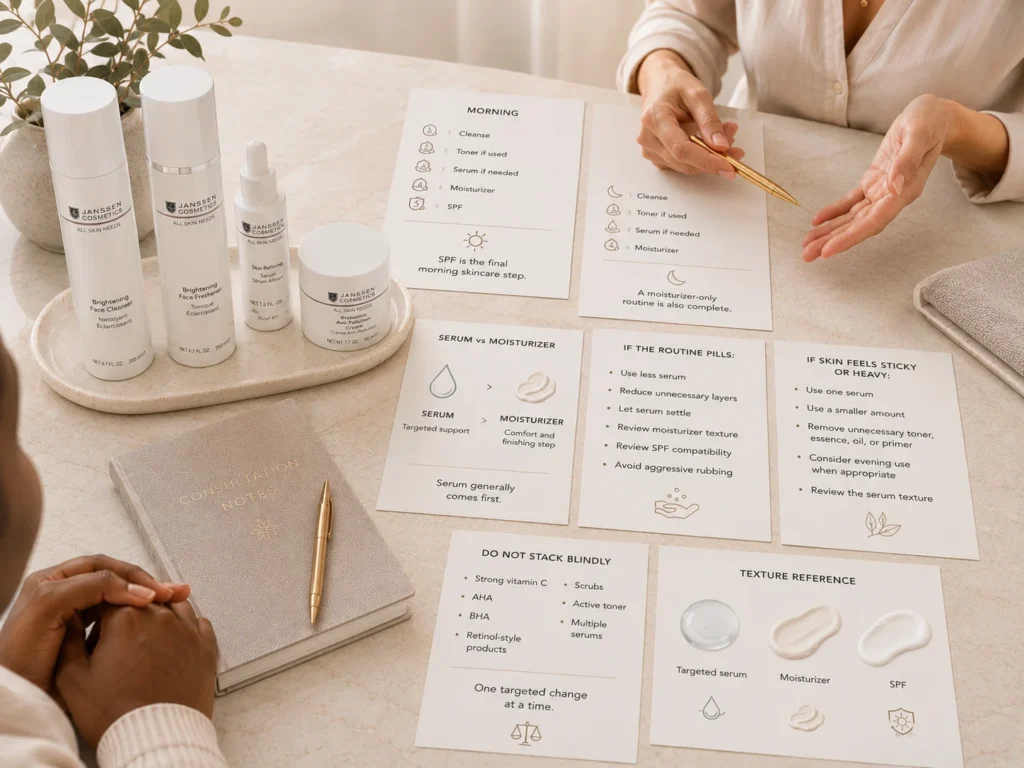
A simple serum application method:
Avoid rubbing aggressively.
Avoid applying active serums too close to the eyes unless the product is meant for that area.
You do not need to wait a long time.
Let the serum settle enough that it does not feel slippery or overly wet.
Then apply moisturizer.
If serum pills under moisturizer, you may be using too much serum, the formula may not layer well, or the routine may have too many products.
Layering should feel smooth.
In the morning, serum should be followed by moisturizer if needed, then SPF.
Let each layer settle enough to apply the next product smoothly.
If SPF pills, review:
SPF should remain the final morning step.
A simple morning routine for dull skin may look like:
Cleanser → toner if used → serum → moisturizer → SPF
This may be useful when skin needs hydration, antioxidant support, or radiance support.
For oily skin, use lightweight textures.
For dry skin, follow serum with a more comforting moisturizer.
For sensitive skin, keep serum gentle and introduce slowly.
A simple evening routine may look like:
Cleanser → toner if used → serum → moisturizer
This may be useful when skin needs hydration or comfort overnight.
If the serum is active, avoid using it on the same night as other strong active products unless guided.
If the skin feels sensitive, use moisturizer only and let serum wait.
Dull skin can still have a complete routine without serum.
Morning:
Cleanser → moisturizer → SPF
Evening:
Cleanser → moisturizer
This may be best if the skin is irritated, over-exfoliated, very sensitive, or overwhelmed by too many products.
Once the basics feel comfortable, serum can be considered later.
Morning:
Gentle cleanser → hydration serum → moisturizer → SPF
Evening:
Gentle cleanser → hydration serum if tolerated → moisturizer
Dry dull skin may need serum plus moisturizer, not serum alone.
If the skin stings, pause active products and focus on comfort.
Morning:
Gentle cleanser → hydration serum → lightweight or comforting moisturizer → SPF
Evening:
Gentle cleanser → hydration serum → moisturizer
Dehydrated dull skin often benefits from hydration before moisturizer.
If the skin is oily but tight, choose lightweight textures.
Morning:
Gentle cleanser → lightweight serum if needed → lightweight moisturizer → SPF
Evening:
Gentle cleanser → lightweight serum if tolerated → lightweight moisturizer
Oily dull skin should avoid sticky, heavy, or overly rich layers.
If clogged-looking pores are present, active serums may be considered carefully after skin tolerance is reviewed.
Morning:
Gentle cleanser → lightweight serum → moisturizer by zone → SPF
Evening:
Gentle cleanser → serum if needed → moisturizer by zone
Use less product on oily areas and more comfort on dry areas if appropriate.
Combination skin does not always need the same amount everywhere.
Morning:
Mild cleanser → gentle serum only if tolerated → moisturizer → SPF
Evening:
Mild cleanser → moisturizer
Sensitive skin may not need serum at first.
If serum is added, introduce one product at a time and watch carefully.
Avoid strong active serums when the skin is already reactive.
Morning:
Gentle cleanser → hydrating or radiance-support serum if tolerated → moisturizer → SPF
Evening:
Gentle cleanser → serum if needed → moisturizer or cream
Mature dull skin often benefits from hydration and comfort.
Avoid using too many active serums at once.
Add serum when:
Serum should be added with purpose.
Wait before adding serum if:
The skin should feel stable first.
A careful approach:
Slow introduction helps you understand the skin’s response.
Serum may be helping if skin begins to look:
Results should be gradual and comfortable.
A good serum should not make the skin feel stressed.
A serum may not be right if:
Stop and simplify if the skin reacts.
Common serum mistakes include:
Serum should support consistency, not overwhelm the skin.
If serum pills, try:
Pilling is usually a layering issue.
It does not always mean the serum is bad.
If serum stings, pause it.
Review:
If stinging continues or comes with swelling, rash-like irritation, pain, crusting, bleeding, severe itching, or eye-area irritation, seek dermatologist guidance.
If serum makes makeup worse, the issue may be texture or layering.
Try:
Makeup should not feel heavy or patchy because of serum.
Sticky serum may be too much for your routine or skin type.
Try:
Sticky does not always mean effective.
The skin should feel comfortable.
Serum and exfoliation should be planned carefully.
If your serum contains active ingredients and you also exfoliate, the routine may become too much.
Be careful with combinations such as:
Dull skin does not need every active product at once.
Retinol-style products should be introduced carefully.
If you use a retinol-style serum, avoid adding too many exfoliating products.
Retinol-style products may not be appropriate when the skin is:
Comfort comes before intensity.
Vitamin C serum may support radiance for some dull-looking skin, but it should be introduced carefully.
Avoid using strong vitamin C on skin that is already irritated.
Use SPF every morning.
If vitamin C stings, your skin may not be ready or the formula may not be the right match.
Vitamin C is not the only way to support dull-looking skin.
Serum does not replace SPF.
If you use serum in the morning, the order is usually:
Cleanser → serum → moisturizer → SPF
SPF should be the final skincare step.
This is especially important with radiance-support, exfoliation, vitamin C, or uneven-tone routines.
If SPF pills over serum, adjust layering.
Do not skip SPF.
Serum and moisturizer must work together.
If serum is lightweight but moisturizer is too heavy, the skin may look dull or coated.
If serum is active and moisturizer is too light, the skin may feel uncomfortable.
If serum is sticky and moisturizer is rich, makeup may pill.
The product combination matters.
Choose serum based on skin type and skin condition.
Dry dull skin: Hydration and comfort support may be helpful.
Dehydrated dull skin: Hydration-focused serum may be useful.
Oily dull skin: Lightweight serum is usually better.
Combination dull skin: Use serum thoughtfully by zone if needed.
Sensitive dull skin: Gentle support first; avoid strong actives.
Mature dull skin: Hydration, comfort, and radiance support may be considered.
Over-exfoliated dull skin: Pause active serums and simplify.
There is no one universal dull-skin serum.
After consultation, our licensed esthetician may consider Janssen Cosmetics serum options depending on why the skin looks dull.
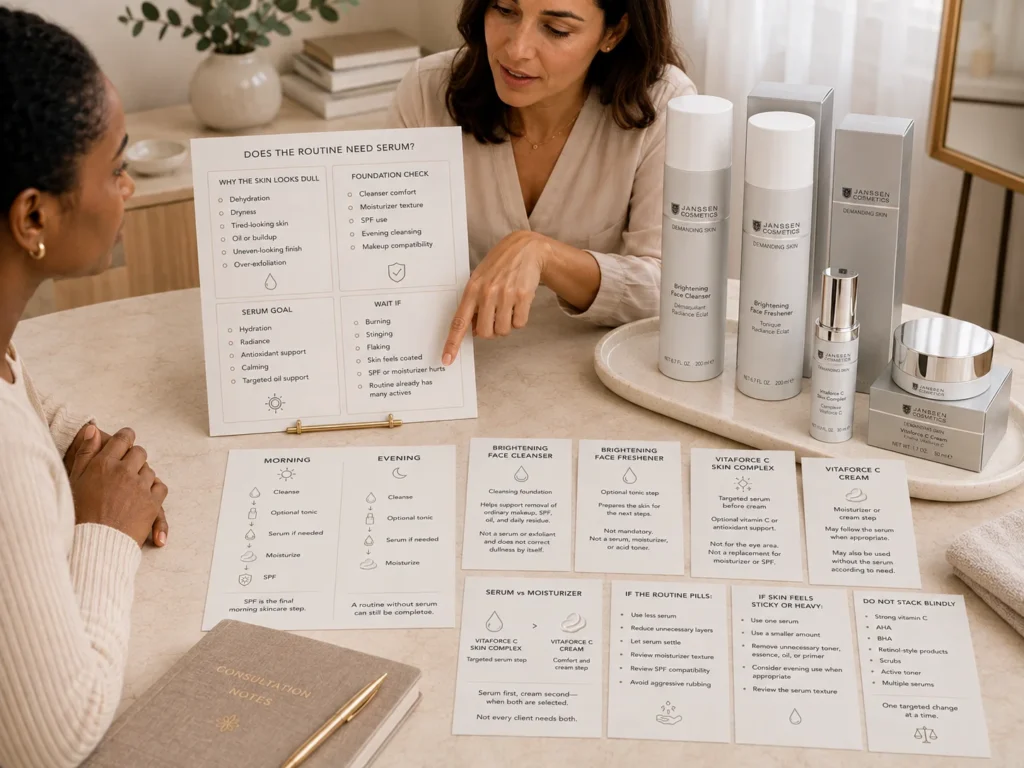
For tired-looking or demanding dull skin, possible options may include:
For dry or dehydrated dull skin, possible options may include:
For sensitive dull skin, possible options may include:
For oily dull skin, possible options may include:
For mature dull skin, serum options may be reviewed based on hydration, firmness appearance, texture, and comfort needs.
These are not automatic recommendations. The correct serum depends on the skin type, skin condition, current routine, SPF habits, sensitivity, and whether the skin can tolerate active products.
Do not add serum before fixing cleanser, moisturizer, and SPF.
Do not use serum instead of moisturizer if your skin feels dry or tight.
Do not use serum instead of SPF.
Do not layer multiple active serums at once.
Do not use vitamin C, acids, retinol-style products, and exfoliation all together without guidance.
Do not apply strong facial serum close to the eyes unless it is made for that area.
Do not keep using a serum that burns, stings, pills, or makes your skin feel coated.
Do not assume the most active serum is the best serum.
Do not ignore swelling, rash-like irritation, pain, crusting, bleeding, severe itching, eye-area irritation, or persistent worsening.
Dull skin may benefit from serum before moisturizer if the skin needs hydration, radiance support, antioxidant support, or smoother-looking texture support. But serum is not required for every dull skin routine.
Serum usually comes before moisturizer. A simple order is cleanser, toner if used, serum, moisturizer, and SPF in the morning.
Yes. A routine with cleanser, moisturizer, and SPF can still support dull-looking skin, especially if the skin is sensitive, irritated, or just needs a simpler routine.
No. Serum should not replace moisturizer for most people. Serum supports a specific concern, while moisturizer helps the skin feel comfortable and complete.
The best serum depends on why the skin looks dull. Dehydrated dull skin may need hydration support. Tired-looking skin may need radiance support. Sensitive dull skin may need comfort-focused support. Oily dull skin may need lightweight support.
Vitamin C serum may support a brighter-looking, fresher-looking complexion when the skin can tolerate it. Sensitive or irritated skin should be cautious.
Yes, oily dull skin can use serum, but the texture should be lightweight and not sticky or heavy. Oily skin may still be dehydrated.
Yes, if the serum is too sticky, too active, too heavy, or layered with too many products, it may make skin look coated, irritated, or duller.
It depends on the serum and your skin. Hydration serums may fit morning or night if tolerated. Antioxidant or radiance-support serums are often used in the morning before SPF. Active serums should be introduced carefully.
See a dermatologist if serum use or dullness comes with persistent rash-like irritation, swelling, pain, crusting, bleeding, infection-looking areas, severe itching, eye-area irritation, sudden changes, burning that does not settle, or worsening symptoms.
If you are not sure whether your dull skin needs a serum, a free virtual consultation can help.
At Zendevie, we review your cleanser, toner, serum, moisturizer, SPF, skin type, sensitivity, makeup wear, and how your skin changes throughout the day before recommending products. The goal is to choose a serum only if it truly supports your skin’s needs.
A serum can be helpful.
But the right serum should fit your skin, not overwhelm it.

Zendevie is guided by Haby Diallo, a licensed esthetician with more than 20 years of professional skincare experience. Her approach is rooted in education, professional judgment, and personal care.
years of experience