
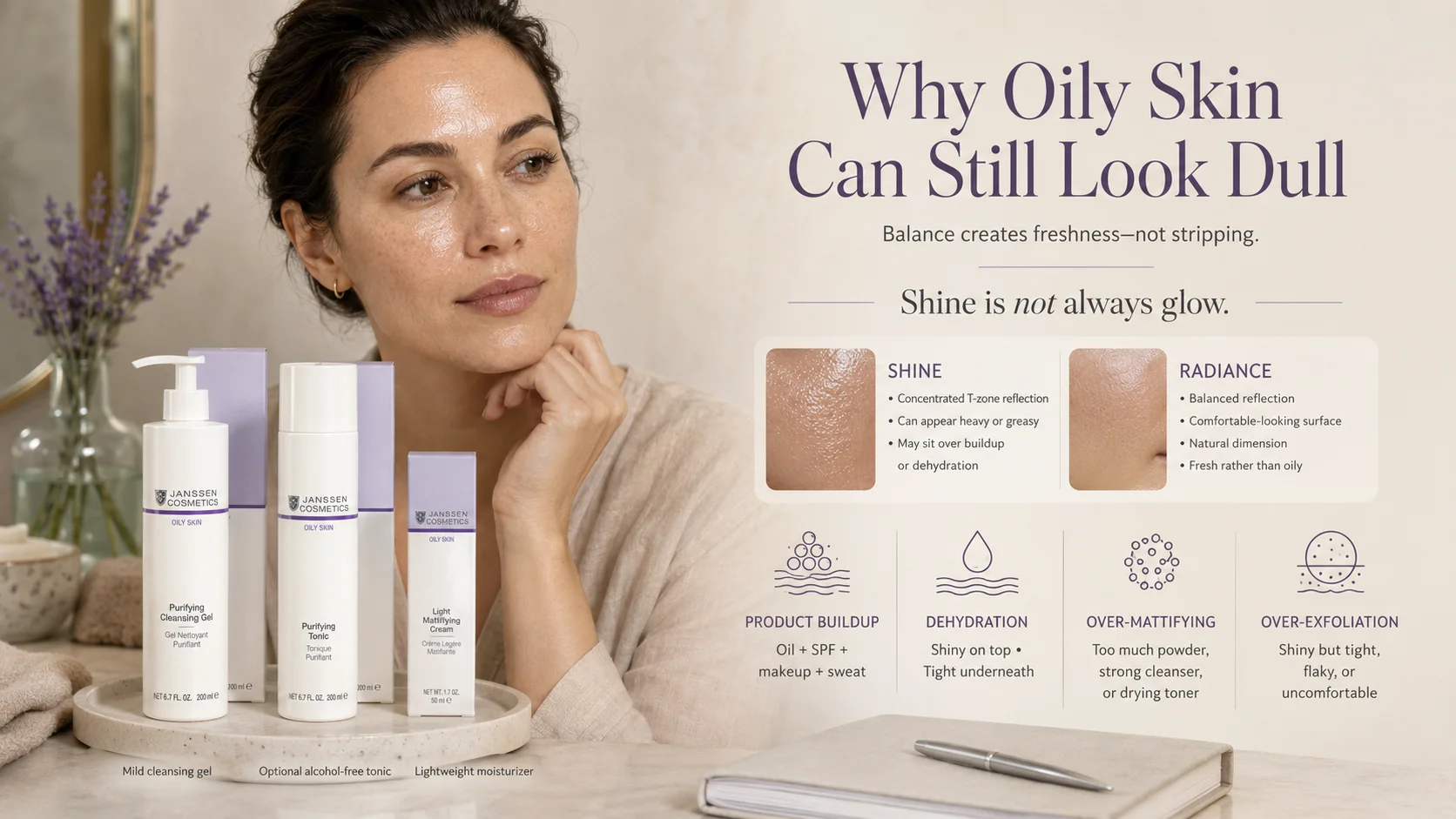
Oily skin can shine and still look dull.
This is one of the most confusing skin patterns because many people expect oil to create radiance. But shine is not the same as freshness. Skin can look greasy, heavy, tired, uneven, or flat even when the T-zone is oily.
By the end of the day, oil may mix with SPF, makeup, sweat, pollution, and product layers. The skin may look shiny on the surface, but underneath that shine, the complexion can still look dull.
This does not mean oily skin needs to be stripped.
At Zendevie, we do not treat oily dull skin by automatically adding stronger cleansers, more toner, more acids, and more masks. In consultation, our licensed esthetician first looks at whether the skin is oily, dehydrated, over-cleansed, product-overloaded, congested-looking, sensitive, or using products that are too heavy.
Oily skin still needs balance.
Oily skin can look dull when oil mixes with buildup, SPF, makeup, sweat, pollution, or heavy product layers. It can also look dull when it is dehydrated, over-cleansed, over-mattified, over-exfoliated, or not properly moisturized.
Common signs of oily dull skin include:
The solution is not to remove every trace of oil. The solution is to cleanse properly, hydrate lightly, moisturize with the right texture, avoid stripping, use SPF, and add active products only when the skin can tolerate them.
Radiance usually looks fresh, smooth, and balanced.
Oily shine can look heavy, greasy, or uneven.
When oil sits on top of product buildup, SPF, makeup, sweat, or pollution, the skin may reflect light in a way that looks shiny but not healthy-looking.
This is why oily skin can look dull and shiny at the same time.
The goal is not to make oily skin dry. The goal is to help the skin look clearer, fresher, and more balanced.
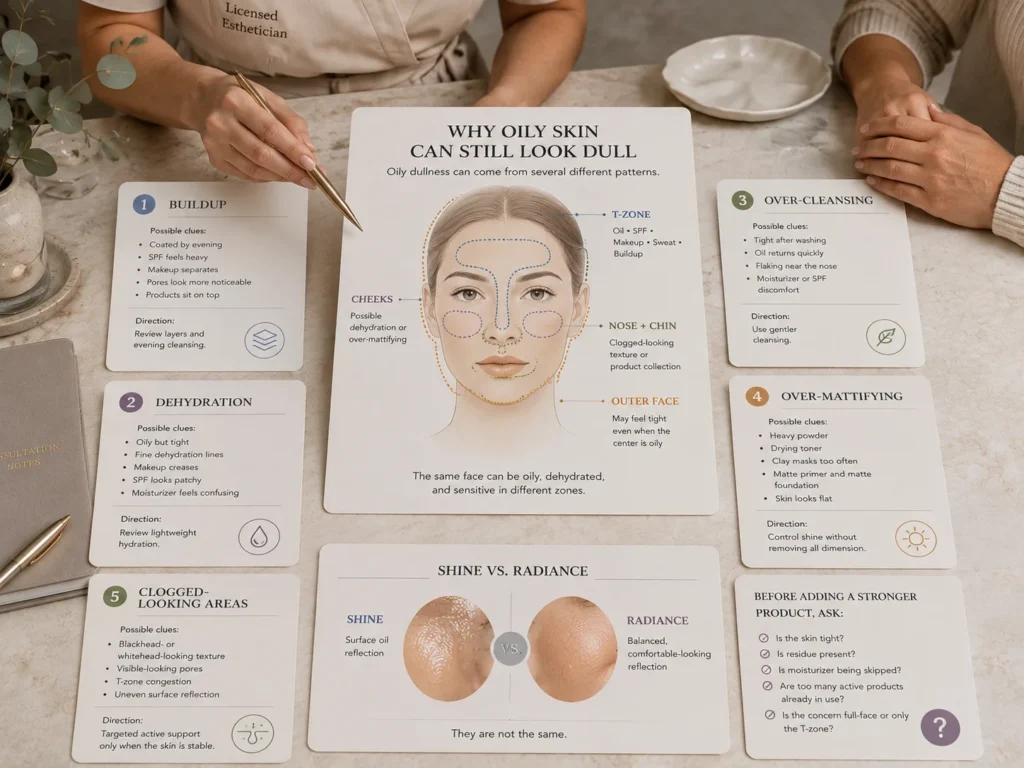
Oily skin often changes throughout the day.
In the morning, the skin may look clean and fresh. By evening, oil production, SPF, makeup, sweat, and environmental buildup may create a heavier surface.
By the end of the day, oily skin may look:
This is why evening cleansing and morning product layering both matter.
Oily skin can collect buildup quickly.
Daily buildup may include:
When these layers mix, the skin can look coated.
That coated look often appears as dullness.
The skin may not be dry, but it may still look tired because the surface is overloaded.
SPF is important for oily skin, especially when using exfoliating acids, retinol-style products, brightening-support products, or blemish-focused routines.
But some SPF formulas can feel heavy on oily skin.
SPF may make oily skin look dull if:
This does not mean SPF should be skipped.
It means the texture and layering need to be reviewed.
Oily skin often struggles with makeup staying fresh.
Foundation may look smooth in the morning and separated by afternoon.
Powder may reduce shine at first but make the skin look flat later.
Primer may help some people but cause buildup for others.
Makeup can look dull on oily skin when:
When makeup looks dull on oily skin, the issue may be skin prep, not only makeup.
This is very important.
Oily skin can still lack water.
When oily skin is dehydrated, it may look shiny but feel tight or uncomfortable.
Oily dehydrated skin may show:
Dehydrated oily skin does not need more stripping.
It often needs lightweight hydration and a better moisturizer texture.
Many people with oily skin cleanse aggressively because they want a matte finish.
But over-cleansing can make oily skin look dull, tight, and irritated.
Signs of over-cleansing include:
A cleanser should remove oil and buildup without leaving the skin stripped.
Oily skin does not need to be punished with harsh toner.
A strong, drying toner may make the skin feel matte at first, but later it may look flat, tight, or irritated.
A toner that is too harsh may cause:
Toner can be useful for oily skin, but it should not make the face feel stripped.
Mattifying products can help oily skin, but too much mattifying can make the complexion look flat.
This can happen with:
A balanced finish often looks fresher than a completely flat matte finish.
Oily skin can be controlled without being dried out.
Many people with oily skin skip moisturizer because they worry it will make them greasier.
But skipping moisturizer can make oily skin feel less balanced.
Without the right moisturizer, oily skin may become:
Oily skin needs moisturizer too. The key is texture.
A lightweight moisturizer may help the skin look fresher without feeling heavy.
Oily skin needs moisturizer, but not every moisturizer texture is right.
If a moisturizer is too rich for oily skin, it can make the skin look heavy, greasy, or coated by midday.
A moisturizer may be too heavy if:
Oily skin usually needs hydration and comfort in a lighter texture.
When pores look clogged, the skin surface may look uneven.
Blackheads, whiteheads, and congested-looking areas can make the complexion appear less smooth and less fresh.
Clogged-looking pores may contribute to dullness around:
This does not always mean the entire face needs strong exfoliation.
Sometimes only the T-zone needs targeted care.
Blackheads and whiteheads can make oily skin look textured or dull.
Blackheads may make pores look more noticeable.
Whiteheads may create small bumps under the skin surface.
When light hits uneven texture, the skin may not look as fresh or smooth.
BHA may be considered for clogged-looking pores, but only when the skin can tolerate it.
If skin is sensitive, tight, or over-exfoliated, active products should be introduced carefully.
Oily skin can be over-exfoliated too.
When dullness appears, many people increase acids, scrubs, masks, or active cleansers. But too much exfoliation can make oily skin look worse.
Over-exfoliated oily skin may look:
If products sting or moisturizer burns, pause exfoliation.
AHA and BHA may be useful for oily skin when used correctly.
BHA is often discussed for clogged-looking pores, blackheads, whiteheads, and oily T-zone care.
AHA may be discussed for surface texture and dullness.
But oily skin does not need every acid product at once.
Avoid stacking:
Too many active products can make oily skin look irritated and dull.
Clay masks may help oily areas look less shiny and more refined.
But clay masks can also be overused.
If used too often or over the whole face when only the T-zone is oily, a clay mask may leave the skin tight or dull.
Clay mask use should depend on the skin pattern.
For combination skin, a T-zone application may make more sense than full-face use.
Powder helps manage shine, but too much powder can make oily skin look dull.
Heavy powder may settle into texture, cling to dehydrated areas, or create a flat finish.
If your skin looks dull after powder, review:
Sometimes less powder and better skin prep creates a fresher look.
Oily skin can trap environmental buildup on the surface.
Throughout the day, oil may mix with dust, pollution, and airborne particles.
This can make the skin look less fresh by evening.
If you live or work in an environment with more pollution, city exposure, cooking heat, sweat, or indoor air changes, evening cleansing becomes especially important.
The goal is to remove the day without stripping the skin.
Stress can affect how the skin looks.
A long day may make oily skin look more tired, especially when combined with poor sleep, dehydration, makeup, indoor air, or increased oil production.
Stress-related oily dullness may look like:
Skincare can support the look of the skin, but stress, sleep, hydration habits, and routine consistency also matter.
When you do not sleep well, the whole face may look less rested.
For oily skin, lack of sleep may make the skin look:
A tired-looking face does not automatically need acids.
Sometimes the better answer is a simple routine, proper cleansing, hydration, moisturizer, SPF, and eye-area care.
Travel can make oily skin look dull because routines change.
Travel dullness may come from:
Oily skin may become shiny and dehydrated at the same time during travel.
Travel is not the best time to test strong new products.
Summer can make oily skin look extra shiny and still dull.
Heat, sweat, SPF, and humidity can create a heavy surface.
Summer oily dullness may show as:
Summer routines may need lighter textures, better evening cleansing, and careful SPF layering.
Winter can also make oily skin look dull.
Cold air and indoor heating can dehydrate the skin. The T-zone may still produce oil, but the skin underneath can feel tight.
Winter oily dullness may show as:
Oily skin may still need hydration in winter.
Your dullness may be from buildup if:
This type of dullness may need better cleansing and less product overload.
Your dullness may be from dehydration if:
This type of dullness may need lightweight hydration and moisturizer.
Your dullness may be from over-exfoliation if:
This type of dullness needs a pause from active products.
Your dullness may be from heavy products if:
This type of dullness may need lighter textures and fewer layers.
Oily dull skin may need:
The solution depends on the cause.
A simple morning routine may look like:
Gentle cleanser → lightweight moisturizer → SPF
If hydration is needed:
Gentle cleanser → lightweight hydrating serum → lightweight moisturizer → SPF
If the skin is sensitive, avoid adding too many active products at once.
If the skin gets oily quickly, review texture and amount before adding more products.
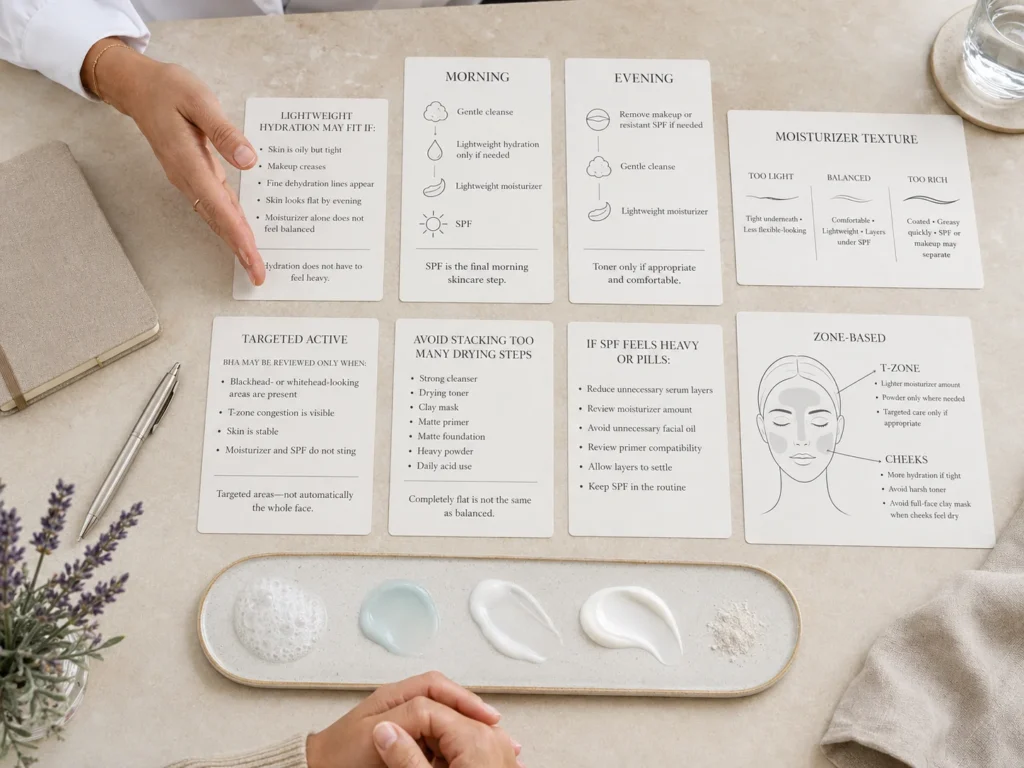
A simple evening routine may look like:
Gentle cleanser → lightweight moisturizer
If wearing makeup or heavier SPF, cleansing should be thorough but still gentle.
If clogged-looking pores are present and the skin can tolerate active products, a targeted BHA step may be considered on certain areas.
Do not use every clarifying product every night.
BHA may make sense when oily dull skin also has:
But BHA should be introduced carefully.
If the skin is tight, burning, flaky, or sensitive, BHA may need to wait.
AHA may make sense when dullness is related to surface texture and the skin is not irritated.
But oily skin does not need AHA automatically.
AHA should be used carefully if the routine already includes:
More active products do not always create a fresher-looking complexion.
Avoid exfoliation when oily skin is:
In those moments, the skin needs comfort before correction.
Oily skin still needs moisturizer because cleansing, toner, SPF, actives, and environmental exposure can leave the skin feeling unbalanced.
A lightweight moisturizer can help the skin feel more comfortable without creating heaviness.
The right moisturizer should:
Skipping moisturizer often makes oily skin harder to manage.
Oily dull skin still needs SPF every day.
Sun exposure can make uneven-looking tone, texture, and tired-looking skin more noticeable over time.
SPF is especially important if using:
If SPF feels heavy, the routine may need a lighter moisturizer or different layering.
SPF should not be removed from the routine without a better option.
Do not use harsh cleanser just to remove shine.
Do not skip moisturizer.
Do not use drying toner to force a matte finish.
Do not overuse clay masks.
Do not use BHA, AHA, retinol-style products, scrubs, and active cleansers together.
Do not assume oily skin cannot be dehydrated.
Do not apply heavy creams everywhere if only some areas need comfort.
Do not skip SPF because it looks shiny.
Do not keep exfoliating if your skin burns or flakes.
Do not treat shine as the only problem.
Professional guidance can help when oily skin feels confusing.
This is especially helpful if your skin:
A consultation can help determine whether your skin needs clarifying support, hydration, texture adjustment, or simplification.
A dermatologist should evaluate the skin if oily dullness is accompanied by:
Cosmetic skincare can help with routine structure and appearance, but medical-looking concerns need medical evaluation.
After consultation, our licensed esthetician may consider Janssen Cosmetics options depending on whether oily skin looks dull because of oil buildup, clogged-looking pores, dehydration, texture, makeup separation, or overactive product use.
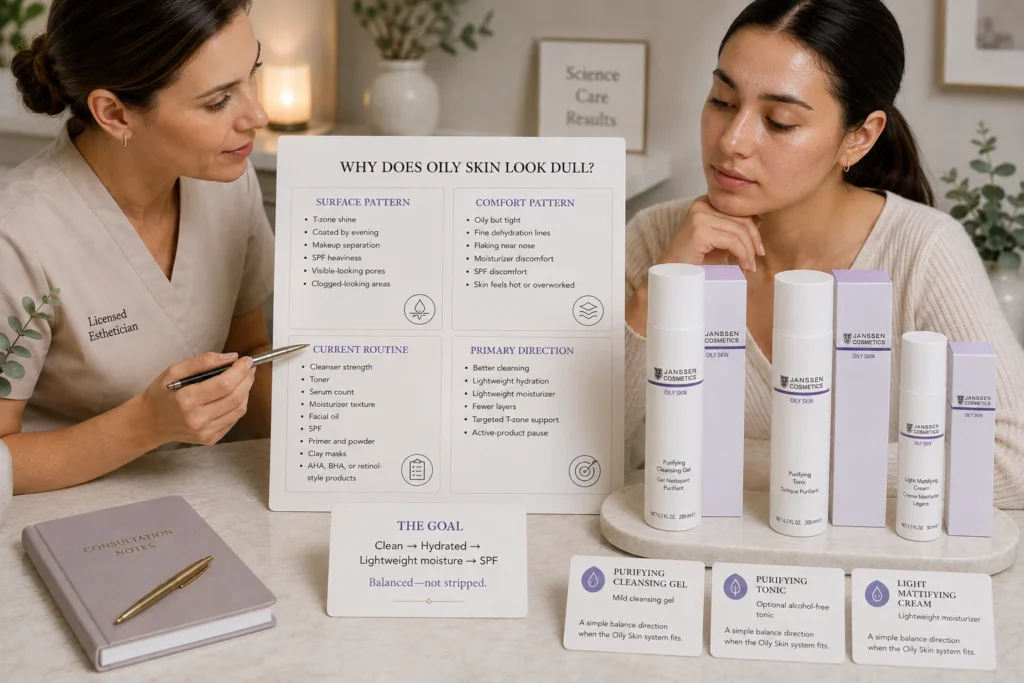
For oily dull skin, possible options may include:
If dullness is more connected to tired-looking skin instead of oil congestion, Demanding Skin options may be reviewed carefully, such as:
If the skin is oily but dehydrated, hydration-focused support may also be discussed.
These are not automatic recommendations. The correct routine depends on whether the skin is oily, dehydrated, congested-looking, sensitive, over-exfoliated, mature, or product-overloaded.
Yes. Oily skin can look dull when oil mixes with SPF, makeup, sweat, product buildup, pollution, or heavy layers. It can also look dull when it is dehydrated or over-exfoliated.
Shine is not the same as freshness. Oil can make the skin reflective, but if the surface is coated, dehydrated, textured, or clogged-looking, the complexion may still look dull.
Yes. Oily skin can lack water. It may feel tight after cleansing while still getting shiny during the day.
Maybe, but not automatically. If dullness comes from buildup or clogged-looking pores, exfoliation may help. If the skin is tight, burning, flaky, or over-exfoliated, exfoliation can make dullness worse.
Yes. Oily skin still needs moisturizer. The texture should be lightweight and appropriate for the skin.
Makeup may look dull when oil, SPF, primer, foundation, powder, sweat, and product buildup mix throughout the day. Dehydration can also make makeup look less fresh.
BHA may be useful when oily dull skin has clogged-looking pores, blackheads, whiteheads, or T-zone congestion. It should be introduced carefully and not layered with too many other active products.
See a dermatologist if oily dullness is accompanied by painful blemishes, deep or cystic-looking bumps, persistent rash-like irritation, swelling, crusting, bleeding, infection-looking areas, severe itching, eye-area irritation, sudden changes, or worsening symptoms.
If your skin gets oily but still looks dull, flat, textured, or tired by evening, a free virtual consultation can help you understand what is really happening.
At Zendevie, we review your cleanser, toner, moisturizer, SPF, makeup, exfoliation habits, oil pattern, hydration level, and clogged-looking areas before recommending products. The goal is to help oily skin look fresher without stripping it.

Zendevie is guided by Haby Diallo, a licensed esthetician with more than 20 years of professional skincare experience. Her approach is rooted in education, professional judgment, and personal care.
years of experience