

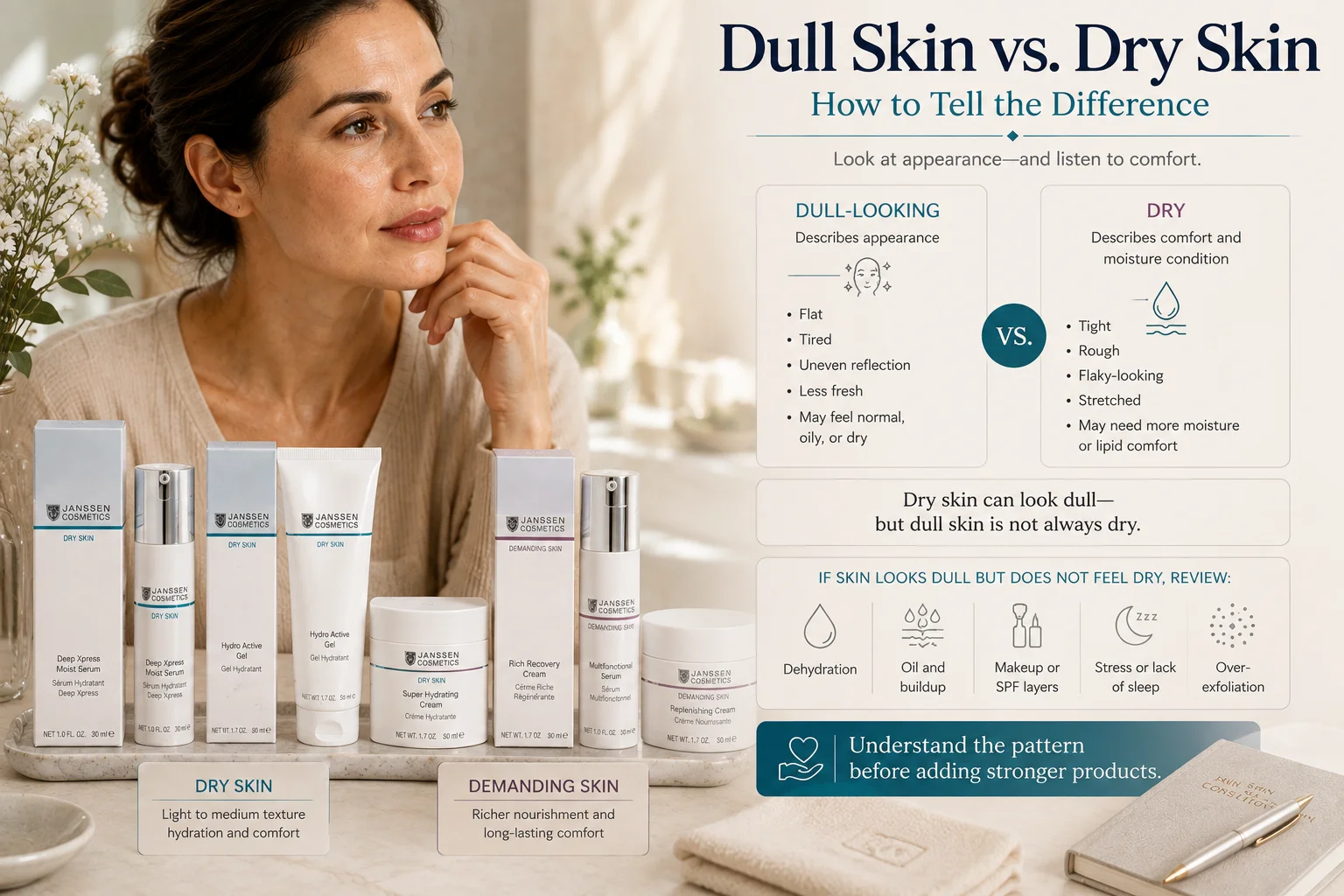
Dry skin and dull-looking skin can appear similar in a mirror.
Both may show:
However, they are not interchangeable.
Dry skin is usually identified by a repeated lack of comfort, moisture, or lipid support.
Dullness is identified by a complexion that appears:
A dull complexion may be dry—but it may also be oily, combination, congested, over-exfoliated, or covered with too many products.
At Zendevie, our licensed esthetician does not choose a rich moisturizer simply because the skin looks dull.
The first assessment includes:
The correct routine depends on what the skin is communicating—not only what one photograph appears to show.
A simple starting routine may be:
Gentle cleanser or rinse → one purposeful serum when needed → suitable moisturizer → SPF
Gentle cleanser → suitable moisturizer
Do not add exfoliation, vitamin C, retinol, several serums, and a rich mask at the same time.
| Question | Dry Skin | Dull-Looking Skin |
|---|---|---|
| Is it mainly about appearance or comfort? | Primarily comfort and moisture balance | Primarily visible freshness and radiance |
| Can it feel tight? | Commonly | Sometimes |
| Can it be oily? | Less commonly, although combination patterns exist | Yes |
| Can it flake? | Commonly | Sometimes |
| Can moisturizer help? | Often improves comfort | May help, but may not correct the full concern |
| Can exfoliation help? | Only when stable and appropriate | Sometimes, but not automatically |
| Can over-exfoliation worsen it? | Yes | Yes |
| Can product buildup contribute? | Possibly | Commonly |
| Can uneven-looking tone contribute? | It may coexist | Yes |
| Can SPF matter? | Yes | Yes |
| Can the two occur together? | Yes | Yes |
This comparison is educational.
Individual skin may not fit perfectly into one column.
Dry skin is a skin type or recurring skin pattern that does not retain enough moisture, lipids, or both to remain consistently comfortable.
It may feel:
The Janssen Dry Skin system is organized around both moisture-deficient and lipid-deficient dry skin, with gentle cleansing and moisturizer textures ranging from light gel care to richer lipid-supportive cream.
A person may have dry skin without dramatic visible peeling.
Possible early signs include:
The way the skin feels is important.
Do not wait for severe flaking before recognizing dryness.
Dull-looking skin describes a visible appearance rather than one fixed skin type.
It may appear:
Dullness may be influenced by:
This is why dull-looking skin should not be treated as one diagnosis.
Dryness is frequently noticeable before it is obvious in the mirror.
You may feel:
A person with dry skin may say:
“My face feels uncomfortable if I do not moisturize.”
This sensation-based information is highly useful in consultation.
Dullness may be visible even when the skin feels comfortable.
You may notice:
A person with dull-looking skin may say:
“My skin feels fine, but it does not look fresh.”
That pattern is different from classic dryness.
Yes.
Dry skin may look fresh when it receives:
Dry skin is not permanently destined to look dull.
Radiance does not require an oily surface.
It may come from a smoother, more comfortable, evenly hydrated appearance.
Yes.
Oiliness and radiance are not the same.
Oily skin may look dull because of:
The complexion may be shiny across the nose and forehead while still looking flat overall.
Do not treat oily dull-looking skin with rich dry-skin cream automatically.
Do not treat it with an aggressively stripping cleanser either.
Combination skin may show:
The dry areas may need more moisture support.
The oily areas may need lighter texture.
A full-face rich cream can make the T-zone heavy while the cheeks remain comfortable.
A full-face oil-control routine can make the cheeks tighter.
Possible adjustments include:
Dry skin and dehydrated skin are also different, although they can overlap.
Usually relates to a repeated lack of lipids, moisture, or both.
It may be a long-term skin tendency.
Relates primarily to insufficient water.
It may affect:
Dehydrated skin may look:
The next article in this sequence will examine dull skin and dehydration in greater depth.
For now, remember:
A dull complexion that is oily may need hydration rather than rich oil-based care.
One of the clearest comparison points is the period immediately after washing.
It may feel:
Possible causes include:
It may:
If dullness disappears after cleansing, buildup or makeup may be contributing.
If tightness appears after cleansing, the cleanser and skin type need closer review.
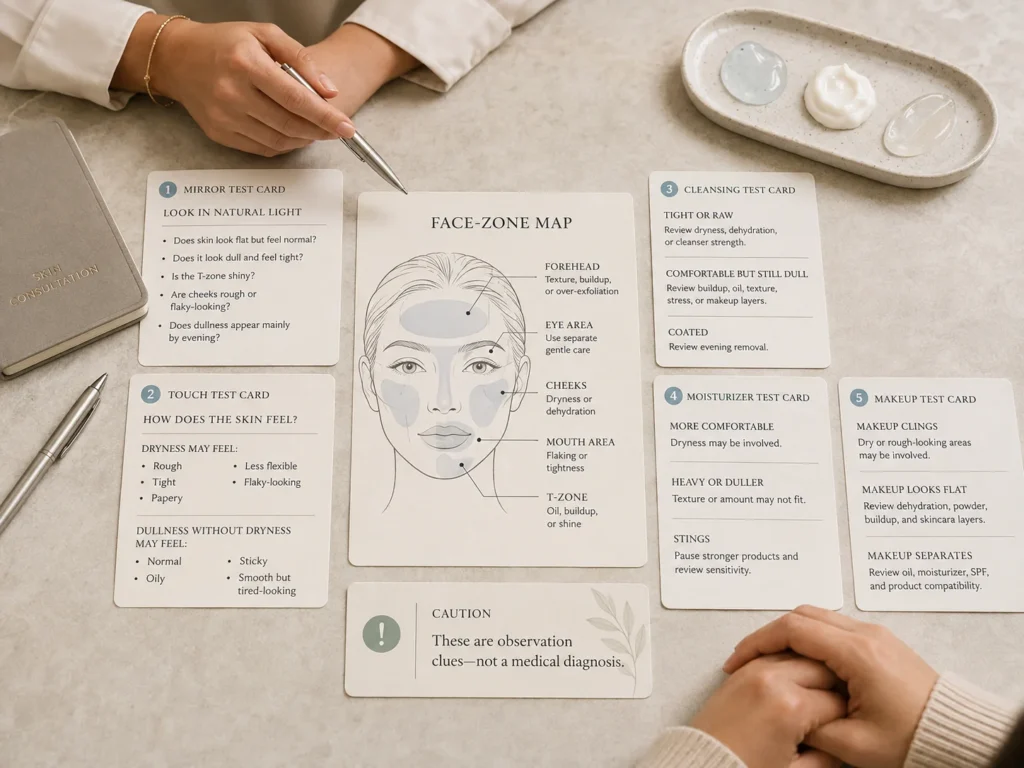
Moisturizer response can also help differentiate the concern.
Moisturizer may:
Moisturizer may:
If moisturizer improves comfort but not freshness, another factor may be contributing to dullness.
Do not assume the answer is simply more cream.
A rich moisturizer may suit dry skin.
It may be excessive when:
This pattern may occur in dull-looking oily or combination skin.
It may also occur when a dry-skin moisturizer is applied too heavily during warm or humid weather.
A moisturizer may be too light when:
This pattern supports dryness more strongly than dullness alone.
A more suitable texture, additional hydrating serum, or seasonal adjustment may be useful.
Flakes can appear because of:
Ask:
Flaking caused by irritation should not be treated with more exfoliation.
Dryness-related flakes may improve with gentler cleansing and more appropriate moisture support.
Roughness may be caused by:
A rough surface may reflect light unevenly and appear dull.
Before exfoliating, assess whether the skin also feels:
If discomfort is present, skin comfort comes before renewal.
Makeup on dry skin may:
Possible adjustments include:
Makeup may look dull because of:
Bare skin may look reasonably fresh while makeup makes the complexion appear tired.
In that situation, replacing the moisturizer or adding an acid may not solve the problem.
The makeup system should also be reviewed.
Dryness may become more noticeable during:
The skin may need:
A familiar moisturizer may work in summer and feel insufficient in winter.
Dull-looking skin may become more noticeable during winter because of:
It may become more noticeable during summer because of:
Seasonal dullness does not always require the same routine.
Uneven-looking tone may make the complexion appear less radiant even when the surface feels moisturized.
This may include:
A rich moisturizer may improve softness without changing the visible contrast.
A tone-supporting routine may include:
Avoid layering several corrective products blindly.
Dryness lines may appear more noticeable when the skin lacks moisture.
They may improve visibly when the surface becomes:
This does not mean every visible line is caused by dryness.
Moisture support can soften the appearance of dryness-related lines without claiming to permanently remove wrinkles.
Radiance is influenced by the way light reflects from the complexion.
A smoother surface may reflect light more evenly.
A rough, coated, oily, or heavily powdered surface may scatter light unevenly.
This can make the complexion appear:
This explains why dullness is partly visual.
It also explains why applying more oil does not always create balanced radiance.
Dry skin may appear flaky, but exfoliation is not always the first step.
First assess:
Exfoliation may be considered when:
Do not scrub uncomfortable skin.
Dullness may come from:
An exfoliant cannot correct every cause.
Before adding one, ask:
Skin interpretation comes before exfoliation.
Yes.
Over-exfoliated skin may look:
Possible contributors include:
A temporary simplified routine may be:
Gentle cleanser or rinse → moisturizer → SPF
Gentle cleanser → moisturizer
Resume active products only when the skin feels consistently comfortable.
Yes.
Product buildup may appear as:
This can be mistaken for peeling skin.
Observe whether the particles:
If so, the issue may be product interaction rather than dry skin.
Do not exfoliate pilling.
Simplify the routine.
Yes.
Cleansing milk, balm, oil, sunscreen, or makeup residue may leave the complexion looking:
Review:
Do not respond by using an excessively strong cleanser.
Improve the removal technique or choose a more suitable cleanser texture.
Dry skin may feel uncomfortable without being highly reactive.
Sensitive-feeling skin may respond to products with:
The two may overlap.
Dry-sensitive skin generally benefits from:
Persistent burning, swelling, blistering, oozing, or recurring rash needs medical evaluation.
Dullness and tiredness also overlap.
A tired-looking complexion may be influenced by:
The cheeks may be adequately hydrated while the face still looks tired because of the eye area.
Do not treat every tired-looking face with a stronger facial exfoliant.
Review:
Dullness may relate more to:
Dryness may be a major factor.
Dullness may involve texture, tone, buildup, or makeup.
The moisturizer may be too rich.
Product buildup, oil, sunscreen, or makeup may contribute.
The cleanser may be too strong, or dryness may be present.
Do not assume dryness is the primary concern.
Assess dehydration, combination skin, buildup, and product texture.
Pause glow-focused actives and simplify.
Comfort comes before exfoliation, vitamin C, or retinol.
Gentle cleanser or rinse → suitable moisturizer → SPF
Gentle cleanser → suitable moisturizer
Optional:
No glow product is automatically needed.
Gentle cleanser → one antioxidant or hydration serum when useful → lightweight moisturizer → SPF
Gentle cleanser → one purposeful serum when needed → moisturizer
Optional:
Avoid heavy dry-skin products when the complexion is oily or comfortable.
Gentle creamy cleanser or rinse → hydrating or antioxidant serum → balanced moisturizer → SPF
Gentle cleanser → hydrating serum when needed → moisturizer

Optional:
Choose one optional treatment at a time.
Gentle cleanser → lightweight serum → light moisturizer → SPF
Gentle cleanser → one targeted treatment → light moisturizer
Avoid:
Gentle cleanser → lightweight hydration → moisturizer by zone → SPF
Gentle cleanser → moisturizer by zone
Use:
Water rinse or gentle cleanser → tolerated moisturizer → tolerated SPF
Gentle cleanser → tolerated moisturizer
Wait before adding:
A simpler routine may help the complexion look fresher by reducing irritation.
Gentle cleanser → one hydrating or antioxidant serum → suitable moisturizer → SPF
Gentle cleanser → serum when useful → moisturizer
Optional:
Mature skin does not need every strong active at once.
Dry or dull-looking skin is often cosmetic.
Seek healthcare or dermatologist guidance when the change is accompanied by:
Seek prompt eye-care guidance for:
Cosmetic skincare cannot diagnose dermatitis, allergy, infection, anemia, thyroid concerns, or another medical condition.
Ask:
The product category should follow the answers.
Janssen Cosmetics separates Dry Skin and Demanding Skin into different product families because their routine priorities are not identical.

The Dry Skin family includes products focused on gentle cleansing, hydration, lipid comfort, and moisturizer textures for different degrees of moisture or oil deficiency. The Demanding Skin family includes products positioned around tired, stressed, less radiant-looking skin, including gentle cleansing, lightweight radiance-support care, vitamin C products, richer creams, and selected renewal options.
A person does not automatically need every product from one family.
Cross-family selection may be appropriate after consultation.
Mild Creamy Cleanser is a rich cleansing milk from the Dry Skin family.
Its verified formula includes avocado oil.
It is designed to remove:
while supporting a softer, more comfortable post-cleansing feel.
The official application directs morning and evening use on the face and neck, gentle fingertip massage, and removal with plenty of lukewarm water or damp compresses.
It may be considered when:
It may be less suitable when:
A cleanser should be chosen by skin behavior and texture preference.
Brightening Face Cleanser is a cleansing emulsion from the Demanding Skin family.
Its verified formula includes white-mulberry-root extract and nonionic cleansing agents.
It is designed to loosen makeup, dirt, and surface secretions while leaving the skin feeling clean and refreshed.
It may be considered when:
The word “brightening” does not mean changing the person’s natural skin color.
Within Shop Zendevie content, it refers to supporting a fresher, clearer, more even-looking appearance.
Neither cleanser is automatically better.
A consultation helps determine whether dryness or visible dullness is the stronger priority.
Hydro Active Gel is the lightest moisturizer texture in the Dry Skin family.
It is positioned for extremely moisture-deficient skin that prefers a light, quickly absorbing gel-cream.
Its verified formula includes:
The catalog positions it as refreshing care that may suit summer or use beneath makeup.
It may be considered when:
A light texture can still belong to a dry-skin routine.
Dry skin does not always require the richest available cream.
Super Hydrating Cream is positioned for dry, moisture-deficient skin.
The catalog describes a fast-absorbing cream containing multiple moisture-support ingredients, including hyaluronic acid, that helps support lasting hydration and smoother-looking dryness lines.
It may be considered when:
Hyaluron³ Replenish Cream is the richest of the main Dry Skin moisturizer textures.
The product line positions it for dry skin needing both moisture and lipid support, especially during winter or when the complexion feels significantly dry.
It may be considered when:
It may feel excessive when:
Do not choose it simply because the complexion lacks glow.
Vitalizing Skin Refiner belongs to the Demanding Skin family.
The verified product information positions it as a lightweight, fast-absorbing care cream that supports moisture, smoother-looking texture, skin comfort, and visible luminosity. Its formula includes cranberry bio peptide, camu camu extract, hyaluronic acid, amino acids, squalane, and shea butter.
It may be considered when:
Vitalizing Skin Refiner may support both moisture and luminosity, but it is not automatically the best moisturizer for very dry, lipid-deficient skin.
Vitaforce C Skin Complex is a vitamin C serum from the Demanding Skin family.
Its verified formula includes:
It is positioned for antioxidant support, hydration, smoother-looking texture, and visible radiance.
It may be considered when:
It may be unnecessary or poorly timed when:
Vitamin C is not the first solution for irritated dry skin.
Vitaforce C Cream combines a moisturizer step with vitamin C and hydration support.
It may suit a person who wants:
A separate vitamin C serum is not automatically necessary when the cream already fulfills the routine’s purpose.
Face Guard Advanced is Janssen’s SPF 30 protection concentrate.
Its verified formula includes photostable UVA and UVB filters, broad-spectrum filter support, Thermus thermophilus ferment, ectoin, hyaluronic acid, and glycerin.
The official product order is:
Apply every morning after cleansing and compatible serum steps → follow with the selected day cream.
Daytime protection matters for both dry and dull-looking skin because environmental exposure may influence:
Do not mix Face Guard Advanced into:
If pilling occurs, simplify the products underneath rather than reducing the protection amount.
Mild Creamy Cleanser or water rinse → Face Guard Advanced → Hydro Active Gel, Super Hydrating Cream, or Hyaluron³ Replenish Cream according to texture need
Mild Creamy Cleanser → selected Dry Skin moisturizer
Optional:
Choose one moisturizer texture.
Brightening Face Cleanser → optional Brightening Face Freshener → Vitaforce C Skin Complex when appropriate → Face Guard Advanced → Vitalizing Skin Refiner or Vitaforce C Cream
Brightening Face Cleanser → selected moisturizer
Do not use every optional step automatically.
Suitable gentle cleanser → Vitaforce C Skin Complex or a hydration serum—not necessarily both → Face Guard Advanced → moisturizer chosen according to dryness level
Possible moisturizer options may include:
Gentle cleanser → selected serum when needed → suitable moisturizer
The product family may be mixed after consultation when the skin’s needs overlap.
Gentle cleanser → lightweight antioxidant or hydrating serum → Face Guard Advanced → lightweight moisturizer
Gentle cleanser → one targeted serum → light moisturizer
Avoid automatically choosing a rich Dry Skin cream.
Previously tolerated gentle cleanser or rinse → Face Guard Advanced when tolerated → simple moisturizer
Gentle cleanser → simple moisturizer
Delay:
until the skin is consistently comfortable.
A new dry-skin, glow, vitamin C, exfoliating, or retinol product should wait when the skin has:
Medical evaluation comes before another cosmetic product.
Do not use “dry” and “dull” as if they mean the same thing.
Do not assume every dull complexion needs rich cream.
Do not assume every dry complexion needs exfoliation.
Do not use shine as proof of radiance.
Do not strip oily dull-looking skin.
Do not apply facial oil as the only hydration step.
Do not use the richest moisturizer simply because the skin lacks glow.
Do not exfoliate pilling.
Do not scrub retinol-related flakes.
Do not combine acid cleanser, exfoliating toner, scrub, peel, and retinol.
Do not use hot water.
Do not cleanse until the skin squeaks.
Do not double cleanse automatically.
Do not leave cleansing balm or makeup residue on the skin.
Do not use toner, essence, several serums, facial oil, cream, and balm without a clear purpose.
Do not use vitamin C on actively burning skin.
Do not expect moisturizer to correct foundation oxidation.
Do not use powder to hide a moisturizer that is too heavy.
Do not skip SPF while using tone-supporting or renewal products.
Do not mix separate sunscreen into moisturizer or makeup.
Do not reduce the SPF amount because skincare pills.
Do not use whitening or natural-skin-color-changing language.
Do not claim a cosmetic product permanently corrects every cause of dullness.
Do not use sales data as proof that a product is right for an individual.
Do not ignore persistent burning, swelling, rash, unusual pallor, yellowing, or significant fatigue.
No. Dry skin primarily relates to moisture and lipid comfort, while dullness describes reduced visible freshness or radiance.
Yes. Flaking, roughness, dehydration, and uneven texture may reduce visible radiance.
Yes. Appropriate cleansing, hydration, moisture support, and SPF can help dry skin look fresh and comfortable.
Yes. Oiliness, dehydration, buildup, makeup, and uneven texture may create shine without balanced radiance.
Common signs include tightness, roughness, flaking, discomfort after washing, and a repeated need for moisturizer.
The complexion may look flat, tired, less luminous, uneven, coated, or less fresh despite feeling comfortable.
Yes. The two concerns commonly overlap.
The shine may come from facial oil, rich moisturizer, sunscreen, or dehydration beneath a coated surface.
The skin may be dehydrated, over-cleansed, irritated, or receiving unsuitable products.
Every routine may need appropriate moisture support, but dullness does not automatically require a rich cream.
Not automatically. First address cleanser comfort, hydration, moisturizer texture, and SPF.
Not always. Vitamin C may support antioxidant care and visible radiance, but it should match the skin’s tolerance and routine.
Possibly, when the skin is stable and loose surface flakes remain. It should not be automatic.
Sometimes, but dullness may also come from dehydration, buildup, makeup, uneven-looking tone, or over-exfoliation.
Yes. It may contribute to tightness, fine peeling, redness-looking areas, and uneven makeup.
Product pilling usually forms during application and rolls away. Dry flakes are part of the skin surface and may remain before products are applied.
No. Scrubbing may worsen discomfort and sensitivity.
The moisturizer may be improving comfort while texture, buildup, tone, makeup, or another factor continues to affect visible radiance.
The texture may be too rich, too much may be applied, or it may be combining poorly with sunscreen and makeup.
Yes. Some dry or dehydrated skin prefers a light gel-cream, particularly during summer or beneath makeup.
A richer texture may help when lighter care does not relieve tightness, roughness, or winter discomfort.
Possibly on dry areas, but the T-zone may need less product or a lighter texture.
Matte foundation, excess powder, oxidation, pilling, heavy skincare, or shade mismatch may contribute.
The cosmetic finish or interaction with skincare may affect appearance, but protection should not be reduced. Adjust the underlying routine instead.
Yes. Daytime exposure may influence comfort, texture, and visible signs of environmental stress.
Yes. Consistent protection supports a more even-looking complexion and is especially important with vitamin C, retinol, or exfoliation.
Stress may coincide with reduced sleep, routine changes, dehydration, and a more tired-looking appearance.
It may make the complexion look tired, but persistent dryness should be assessed separately.
Yes. Airplane air, climate changes, different water, sunscreen, makeup, and reduced sleep may contribute.
Yes. Cold air and indoor heating may increase roughness, tightness, and reduced visible freshness.
Yes. Sweat, oil, sunscreen buildup, and uneven-looking tone may influence the appearance.
No. Demanding skin is a cosmetic care category associated with tired, stressed, less radiant-looking skin and early visible changes. It may be dry, but dryness is not the only concern.
Demanding skin may appear dull or tired, but the product family also considers moisture balance, environmental stress, and early visible aging changes.
Yes. Lifestyle, stress, climate, sleep, and routine habits may influence visible freshness at different ages.
It is a Janssen Dry Skin cleansing milk containing avocado oil.
It is a Janssen Demanding Skin cleansing emulsion containing white-mulberry-root extract.
The correct choice depends on whether tightness and lipid deficiency or tired-looking dullness and residue are the stronger priorities.
It is a lightweight Janssen Dry Skin gel-cream positioned for extremely moisture-deficient skin.
No. It belongs to the Dry Skin family and may suit dry or dehydrated skin that dislikes heavy cream.
It is a Janssen moisturizer for dry, moisture-deficient skin needing balanced, lasting hydration support.
It is a richer Janssen Dry Skin moisturizer for skin needing both moisture and lipid support.
It is a lightweight Janssen Demanding Skin moisturizer designed to support hydration, smoother-looking texture, comfort, and visible luminosity.
The catalog positions its lightweight, fast-absorbing texture as suitable for makeup preparation.
It is a Janssen vitamin C serum with stabilized vitamin C phosphate, lemon extract, and hyaluronic acid.
Not automatically. It may be considered after cleanser, hydration, moisturizer, and skin tolerance are assessed.
Possibly. Cross-family pairing may be appropriate after consultation when dryness and dullness overlap.
No. Select only the steps that serve a clear need.
Apply it after cleansing and compatible serum steps, then follow with the selected Janssen day cream.
Seek guidance for persistent burning, severe itching, swelling, blistering, oozing, painful cracking, spreading rash, infection-looking changes, or reactions to basic products.
Seek guidance when a sudden or persistent change is associated with unusual paleness, yellowing, significant fatigue, pain, swelling, or other concerning symptoms.

Zendevie is guided by Haby Diallo, a licensed esthetician with more than 20 years of professional skincare experience. Her approach is rooted in education, professional judgment, and personal care.
years of experience