
Mature skin is often told to use the richest cream possible. That advice sounds simple. But mature skin is not one skin type.
It may be:
A rich cream may feel deeply comfortable for one mature complexion. The same cream may feel heavy, warm, greasy, or difficult under makeup for another. A lightweight moisturizer may feel elegant and comfortable for oily mature skin. The same texture may leave dry mature skin feeling tight again by lunchtime. This is why moisturizer should not be chosen from age alone.
At Zendevie, our licensed esthetician looks at how the skin feels before cleansing, immediately after cleansing, after moisturizer, under SPF, beneath makeup, and several hours later. The goal is not to give every mature complexion the heaviest product. The goal is to find a texture that helps the skin feel supported, flexible, comfortable, and appropriately moisturized without unnecessary heaviness.
The right moisturizer texture for mature skin depends on:
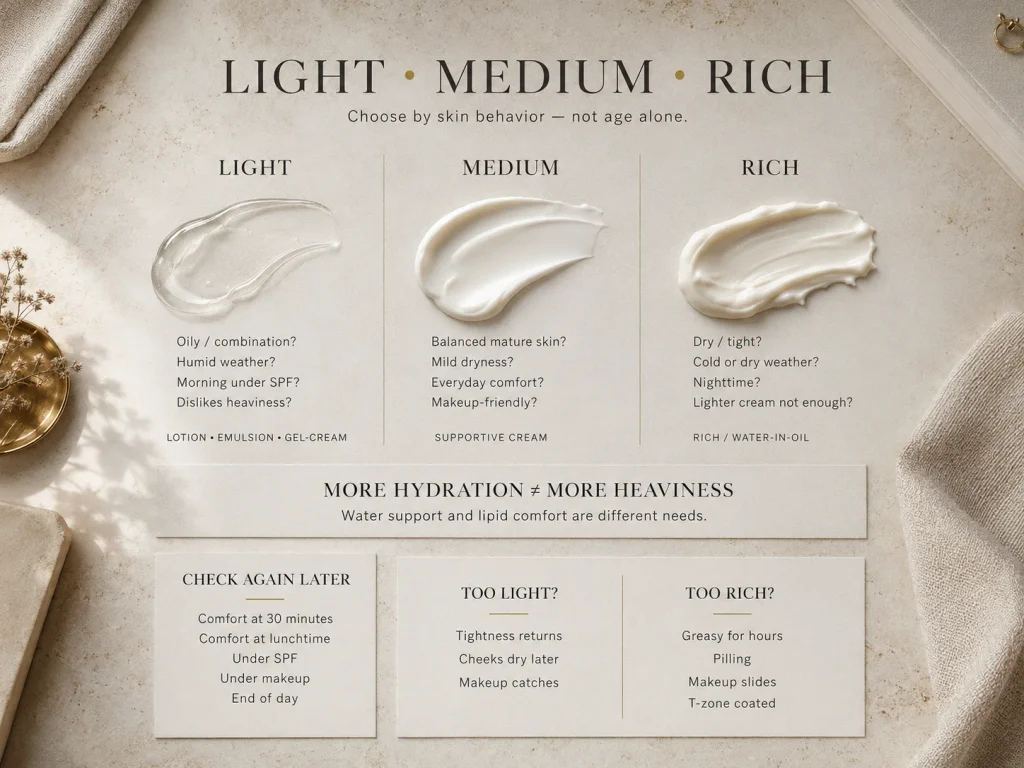
A general texture guide may look like this:
May suit:
May suit:
May suit:
May suit:
May suit:
A basic routine may be:
Gentle cleanser or rinse → serum if needed → appropriate moisturizer → SPF
Gentle cleanser → serum if needed → appropriate moisturizer
A different moisturizer may be used in the morning and evening. The skin does not need to stay loyal to one texture when its daytime, nighttime, or seasonal needs differ.
Mature skin describes changes that may occur over time. It does not define the person’s oil level. Mature skin may still produce noticeable oil.
It may have:
Choosing the richest moisturizer simply because the skin is mature may create:
The correct moisturizer should match both skin maturity and skin type.
A moisturizer may help support:
A moisturizer does not need to feel thick to perform its role. Likewise, a thick cream is not automatically more appropriate. The finished formula, texture, ingredients, application amount, and surrounding routine all matter.

A moisturizer may be highly hydrating without feeling rich. Another product may feel oily or heavy without providing the water-binding support the skin needs.
This is because moisturizer formulas may contain different combinations of:
A lightweight hydrating lotion may help dehydrated oily skin feel more comfortable. A richer cream may help dry, lipid-deficient skin feel softer and less tight. The goal is not to decide that one category is better. The goal is to identify what the skin lacks.
Humectant ingredients help attract or bind water within the skin’s upper layers.
Examples may include:
These may be included in:
A separate hydrating serum is not always necessary if the moisturizer already provides sufficient hydration. Several humectant layers may also feel sticky or pill under SPF.
Emollients help the skin surface feel:
They may include:
Dry mature skin may appreciate more emollient support. Oily mature skin may prefer a lighter formula with fewer rich oils.
More occlusive textures help form a surface layer that may reduce moisture loss.
These may include:
They may be useful for:
They may feel too heavy for:
Occlusive does not automatically mean better.
Dry mature skin may feel:
It may need:
Adding only a watery serum may not provide enough lasting comfort. A serum may need to be followed by a supportive cream.
Dehydrated skin lacks water.
It may still be oily.
Signs may include:
A lightweight hydrating serum and lotion may feel more appropriate than a thick cream. Using a very rich product on dehydrated oily skin may create heaviness without addressing the routine factors contributing to dehydration.
Review:
A lotion or emulsion is usually lighter than a traditional cream.
It may spread easily and settle quickly.
This texture may suit:
A lotion should still provide enough comfort. If tightness returns quickly, it may be too light or the cleanser may be too strong.
A lotion may suit the skin when it:
The skin should be evaluated beyond the first few minutes. A moisturizer may feel pleasant during application but become insufficient later.
A lotion may be too light when:
Possible adjustments include:
Gel-creams combine a lighter gel-like feel with moisturizing components.
They may suit:
A gel-cream may feel refreshing.
But some formulas may not provide enough support for dry mature skin.
The skin’s comfort later in the day matters.
A gel-cream may be too light when:
A richer cream may be used at night while the gel-cream remains in the morning routine.
A medium-weight cream may suit mature skin that needs more support than a lotion but dislikes a very rich finish.
It may work well for:
This texture may provide a practical middle ground.
It can support comfort without automatically feeling heavy.
A rich cream generally contains more oils, butters, lipids, or occlusive support than a lotion.
It may suit:
Rich creams should still spread comfortably.
The skin should not feel:
A water-in-oil emulsion is generally a richer cream structure. It may form a more protective surface film and support dry skin comfort.
This type of cream may be helpful for:
It may feel too rich for:
The emulsion structure matters, but personal tolerance matters just as much.
Balms generally have a dense, protective texture.
They may be useful for:
A balm is not automatically required across the whole face.
Full-face use may create:
Targeted application may be more practical.
Facial oil may help the skin feel softer or reduce the feeling of dryness. It does not automatically replace a moisturizer containing water-binding ingredients.
A possible routine may be:
Hydrating serum → moisturizer → small amount of facial oil
However, many mature-skin routines do not need all three.
Facial oil is optional.
It may be used:
Facial oil may not suit the routine when it causes:
Do not keep adding oil because mature skin is expected to be dry. The skin’s actual response comes first.
The morning moisturizer must work with:
The evening moisturizer does not need to support foundation or sunscreen.
It may be:
A common approach may be:
Light or medium moisturizer
Medium or richer moisturizer
This is optional. Some people prefer the same cream morning and evening.
A morning moisturizer should generally:
A lighter daytime moisturizer may suit someone who uses:
Too many rich layers may cause movement.
An evening moisturizer may focus more on:
A richer cream may feel more appropriate at night. But the skin should not be buried under unnecessary layers.
Avoid automatically combining:
Serum → rich cream → balm → facial oil → sleeping mask
One well-selected moisturizer may be enough.
Mature skin may need different textures across the year.
The skin may prefer:
The skin may prefer:
Changing moisturizer seasonally is not inconsistency.
It is a response to the environment.
Cold air and wind may make mature skin feel:
A richer cream may provide more comfort. Additional protective clothing may also help. Do not depend on moisturizer alone while exposing the skin to unnecessary cold or wind.
Indoor heating may contribute to:
The moisturizer may need to become richer during heating season. The cleanser and active-product schedule may also need adjustment. Adding more cream without reducing an overly strong cleanser may not fully solve the problem.
Air conditioning may affect mature skin during:
The skin may feel oily outdoors but tight indoors. A lightweight hydrating serum under a lotion may help some people. Others may need a medium cream. The answer depends on how the skin feels throughout the day.
In humidity, a rich cream may feel:
A lighter lotion or gel-cream may feel more practical. Do not stop moisturizing automatically. Oily-looking skin may still feel dehydrated.
Dry mature skin may prefer:
A simple routine may be:
Gentle cleanser or rinse → hydrating serum if needed → supportive cream → SPF
Gentle cleanser → comfort-focused serum if needed → rich cream
Avoid:
Oily mature skin may prefer:
A simple routine may be:
Gentle cleanser → lightweight moisturizer if needed → SPF
Gentle cleanser → lightweight moisturizer
Avoid:
Oily mature skin can still be dehydrated.
Combination mature skin may need different support by area.
For example:
A simple routine may be:
Gentle cleanser → lightweight hydration → moisturizer according to area needs → SPF
Gentle cleanser → targeted treatment when appropriate → moisturizer by zone
The same amount does not need to be applied everywhere.
Sensitive mature skin may benefit from:
The ideal texture should not cause:
When the skin is actively reacting, a new rich cream is not always the answer. Simplify first.
Redness-prone mature skin may prefer:
Avoid choosing a very occlusive cream simply because it is marketed as calming. Some redness-prone skin may feel hot under heavy products. Persistent, painful, swollen, eye-related, or worsening redness-looking changes should be evaluated by a dermatologist.
Blemish-prone mature skin may still need moisturizer.
A suitable texture may be:
Avoid combining:
without a clear reason.
Painful, deep, swollen, infection-looking, persistent, or scarring blemishes should be evaluated by a dermatologist.
A person concerned about dark spots or uneven-looking tone may focus on active serums. But the moisturizer still matters.
A suitable texture may support:
The routine should include patience and consistent daytime protection. Do not use whitening language. The goal is a more even-looking complexion—not changing the person’s natural skin color.
Retinol may increase:
The moisturizer may need to become more supportive. However, a richer cream should not be used to force the skin through excessive retinol irritation.
If moisturizer burns or the skin becomes painfully flaky:
A moisturizer supports comfort. It does not make an overly aggressive retinol schedule appropriate.
AHA, BHA, enzyme products, and other exfoliants may affect moisturizer needs.
If the skin becomes:
reduce or pause exfoliation.
Do not simply add a heavier cream while continuing several exfoliating products.
The active-product schedule may be the underlying issue.
Vitamin C may be used in a morning routine when appropriate.
A possible sequence may be:
Gentle cleanser → vitamin C serum → moisturizer → SPF
If the vitamin C and moisturizer pill:
If vitamin C stings, pause it rather than covering it with a rich cream.
A serum may be used before cream when the skin needs:
However, serum is optional.
A moisturizer may be enough when:
Do not assume mature skin needs multiple serums before cream.
A rich cream may provide both hydration and lipid support.
It may make a separate hydrating serum unnecessary.
However, a serum may still serve a different targeted purpose.
The decision should depend on:
Product count should not be treated as a measure of routine quality.
A daytime moisturizer should support makeup without leaving the skin overly wet or coated.
Possible signs of a good match include:
The moisturizer should be allowed to settle before sunscreen and makeup.
Possible adjustments include:
Do not apply less sunscreen simply to reduce heaviness.
Adjust the skincare beneath it.
A lightweight moisturizer may be insufficient when foundation:
Consider:
The morning moisturizer and sunscreen should work together.
Problems may include:
Review:
Do not mix a separate sunscreen into moisturizer unless the product is specifically designed and directed for that use.
Many general routines apply sunscreen after moisturizer.
Some specialty protection products have different official directions.
Follow the instructions for the exact product.
A consultation should organize the order when:
General charts should not override official product directions.
The eye area may need a separate product when the facial moisturizer:
Use a small amount.
Avoid applying facial moisturizer directly into the lash line.
A separate eye product is optional when the facial moisturizer remains comfortable and is appropriate for the area.
The neck and décolleté may feel:
The facial moisturizer may be extended to these areas when appropriate.
A richer texture may be used at night.
Do not assume the neck will tolerate every facial active or moisturizer in the same amount.
Introduce products carefully.
Follow the product directions.
The appropriate amount depends on:
Too little may leave the skin tight.
Too much may cause:
More moisturizer does not automatically create more hydration.
Use:
Apply according to the product directions.
Some moisturizers may be used on slightly damp skin.
Others are applied after serum has settled.
Avoid rubbing until the face becomes hot or red-looking.
Applying moisturizer to slightly damp skin may help selected formulas spread comfortably.
However:
Damp-skin application is not a universal rule.
There is no universal waiting time.
Allow the moisturizer to:
Waiting longer cannot fix an incompatible formula or an overly heavy routine.
A moisturizer may be too light when:
Before changing the product, also review:
A moisturizer may be too rich when:
A lighter moisturizer may be more appropriate.
The rich cream may still fit nighttime or winter use.
Stop and reassess when moisturizer repeatedly causes:
The issue may involve:
Do not keep applying the product because it is marketed for mature skin.
Fast absorption does not always mean the skin needs more product.
Observe how the skin feels:
If the skin remains comfortable, the amount may be appropriate.
If tightness returns, a more supportive texture may be needed.
Possible reasons include:
Try reducing unnecessary layers.
Do not rub harder to force absorption.
Review:
A medium-weight cream may provide enough comfort without excessive occlusion.
Targeted rich cream on dry zones may be better than full-face use.
This may suggest dehydration or over-cleansing.
Review:
A lightweight lotion or gel-cream may support comfort without adding heavy richness.
Shine may come from:
Determine whether the skin feels:
A visible glow is not automatically a problem.
The texture should still feel practical.
Pilling may be caused by:
Try:
Do not exfoliate automatically.
Review:
A lighter morning moisturizer may help.
Do not mix sunscreen into moisturizer to solve pilling.
The moisturizer may be too rich for daytime use.
Try:
Do not powder heavily to compensate for an overly rich skincare base.
Possible reasons include:
A rich cream may provide oil comfort but not fully address dehydration.
One hydrating serum may help when appropriate.
Stop and reassess.
Possible contributors include:
Pause active products.
If several basic moisturizers continue to burn, seek dermatologist guidance.
Possible changes include:
Options may include:
Review what changed before replacing the entire routine.
Possible changes include:
A lighter moisturizer may be appropriate.
The richer product may remain useful in winter or at night.
Consider:
Review whether the cleanser leaves residue or several serums are being used.
Mature skin does not need a traditional rich cream to have a complete routine.
Consider:
One more appropriate cream may be simpler than several lightweight layers.
Zone-based moisturizing may help.
For example:
Do not assume every area must receive the same amount.
Some oily mature skin may find that a moisturizing SPF provides enough daytime comfort.
This depends on:
Do not skip moisturizer because of a trend.
Assess whether the skin remains comfortable.
That is useful information.
The routine does not require:
A simple moisturizer may provide sufficient support.
Optional products should have a clear purpose.
Moisturizer may support a softer and smoother-looking surface.
It cannot permanently remove natural lines or stop facial movement.
Fine lines may remain visible because of:
The goal is comfort and a healthy-looking finish—not an unrealistic line-free surface.
Travel may involve:
Bring a moisturizer the skin already tolerates.
A practical strategy may include:
Do not transfer products into unclean containers.
Do not introduce a new rich cream immediately before an important event.
A new product may cause:
Use the moisturizer already known to work.
Do not attempt an overnight transformation with several new layers.
A product may feel comfortable initially but become too heavy later.
Ask:
The answer may be different in summer and winter.
Seek dermatologist guidance when moisturizer use is followed by:
Seek urgent medical care for:
Cosmetic moisturizer selection cannot diagnose an allergy, dermatitis, infection, or another medical condition.
After consultation, our licensed esthetician may consider Janssen Cosmetics options according to the skin’s dryness, oiliness, sensitivity, climate, preferred texture, makeup routine, serum use, and daytime protection needs.

Possible mature-skin moisturizer options may include:
These products should not all be used together automatically.
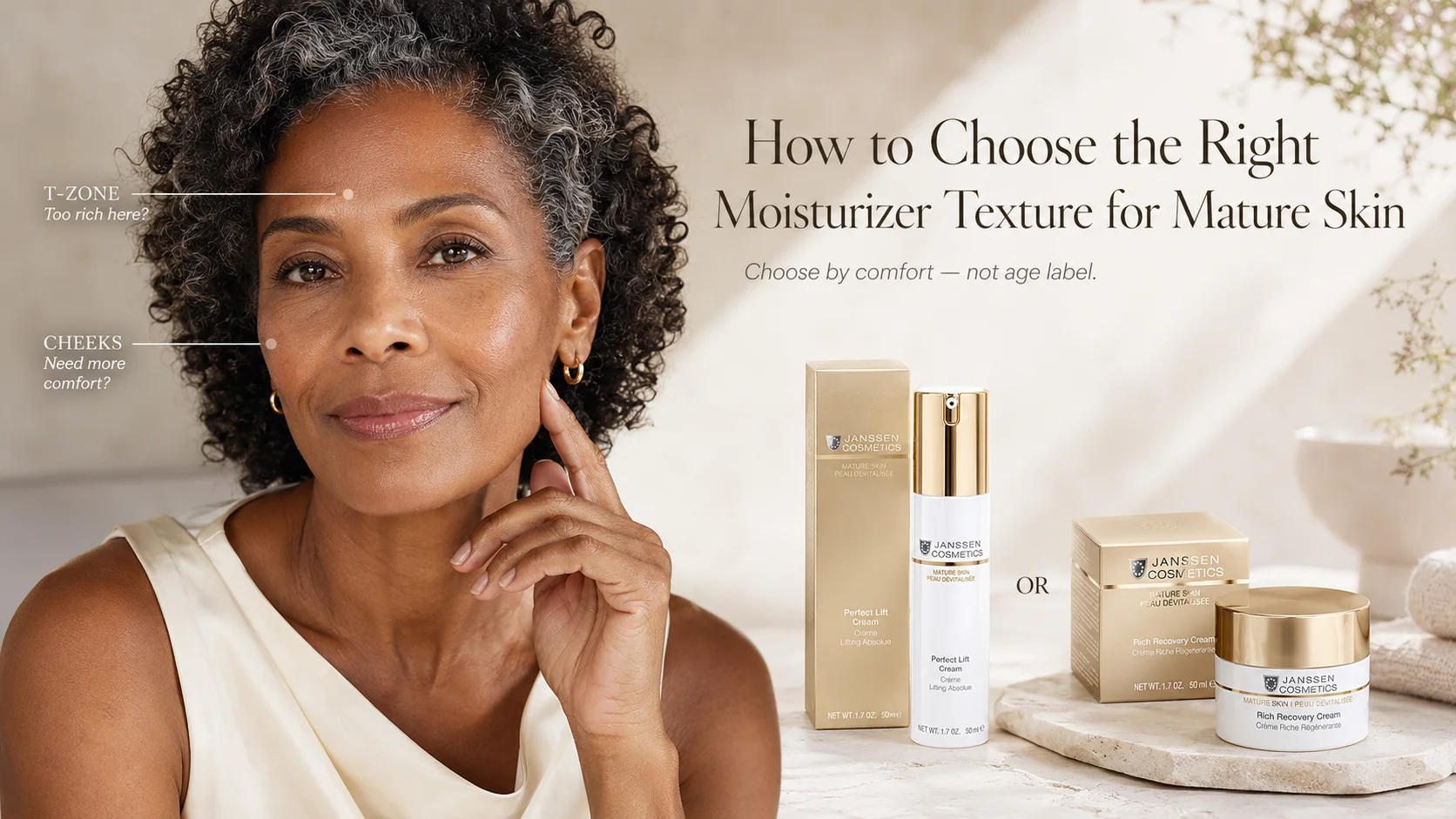
Perfect Lift Cream may be considered when mature skin wants a supportive cream without automatically choosing the richest option.
Its formula includes moisture-supporting and emollient components such as:
It may support:
The official Janssen guidance positions it for morning and/or evening use on cleansed face and décolleté.
It may suit mature skin that:
A consultation should still assess:
Rich Recovery Cream is the richer alternative to Perfect Lift Cream.
It has a water-in-oil emulsion structure and includes lipid-supporting components such as:
It may be considered when mature skin:
It may feel less appropriate when the skin:
The official guidance allows morning and/or evening use, but the routine may personalize it as:
A simplified comparison may be:
May suit:
May suit:
The correct selection depends on the whole routine.
Age Perfecting Serum is a lightweight serum intended to complement the cream step.
A possible routine may be:
Cleanser → optional Micellar Skin Tonic → Age Perfecting Serum → selected moisturizer
It should not be added automatically when the cream alone already feels sufficient.
If the combination pills or feels heavy:
Night Recovery Serum may be considered as a separate nighttime serum before cream.
It should not automatically be layered with Age Perfecting Serum.
A possible evening structure may be:
Cleanser → optional tonic → Night Recovery Serum → Perfect Lift Cream or Rich Recovery Cream
The moisturizer should be selected according to the skin’s nighttime dryness and comfort.
Ceramide Protection contains ceramide-focused lipid support in single-use capsules.
It is used before skincare cream according to the official directions.
A possible evening routine may be:
Cleanser → Ceramide Protection → selected cream
This does not mean the capsules should be combined automatically with:
The combination may become unnecessarily rich.
For daytime use, Janssen provides a product-specific sequence involving Face Guard Advanced before Ceramide Protection, followed by the care cream.
That official sequence should be followed rather than replaced by a generic sunscreen chart.
Face Guard Advanced is a lightweight SPF 30 protection concentrate.
The official Janssen directions position it beneath the selected care cream during the day.
A possible Janssen daytime sequence may be:
Cleanser → optional tonic → serum if appropriate → Face Guard Advanced → selected cream
When Ceramide Protection is used during the day, the official product-specific order should be followed.
Do not mix Face Guard Advanced into moisturizer.
Tri-Care Eye Cream may be considered when the mature eye area needs a separate rich eye-care texture.
Use a small amount according to its directions.
Do not layer it heavily with:
Excessive eye-area product may contribute to puffiness, migration, or makeup creasing.
A mature complexion whose main concern is sensitivity may be better matched with a product from the Sensitive Skin family.
Possible textures may include:
The choice should depend on dryness and tolerance rather than forcing the skin into the Mature Skin family.
Oily or dehydrated mature skin may need a lighter Janssen moisturizer from another family rather than Rich Recovery Cream.
A consultation should assess:
Product family labels should not replace skin assessment.
Appropriate cleanser → optional tonic → one serum if needed → Face Guard Advanced in its officially directed position → selected moisturizer
Appropriate cleanser → optional tonic → one serum if needed → Perfect Lift Cream or Rich Recovery Cream according to dryness
Appropriate cleanser → selected cream
During the day, add officially directed protection.
If the skin is burning, swollen, rash-like, painfully flaky, or reacting to basic moisturizer, active ingredients and new product introductions should wait.
Professional peel products belong in professional treatment settings.
Do not choose the richest cream only because the skin is mature.
Do not assume mature skin is always dry.
Do not skip moisturizer because the skin looks oily.
Do not use a heavy balm across the entire face automatically.
Do not confuse facial oil with a complete moisturizer.
Do not add several hydrating serums without a clear purpose.
Do not layer lotion, cream, balm, oil, and sleeping mask automatically.
Do not use a very rich cream to force the skin through excessive retinol irritation.
Do not keep exfoliating while moisturizer burns.
Do not apply more product simply because the moisturizer absorbs quickly.
Do not rub aggressively to force a rich cream into the skin.
Do not mix sunscreen into moisturizer unless the product is specifically designed and directed for that use.
Do not reduce sunscreen amount because the moisturizer feels heavy.
Do not apply the same moisturizer amount to every facial zone automatically.
Do not use heavy eye-area layers.
Do not assume a moisturizer labeled “anti-aging” is appropriate for every mature complexion.
Do not continue a moisturizer that repeatedly burns, itches, or causes swelling.
Do not introduce a new moisturizer, serum, sunscreen, and foundation on the same day.
Do not use professional peel products to make moisturizer absorb more deeply.
Do not expect moisturizer to permanently remove natural lines.
Do not ignore painful cracking, bleeding, blistering, crusting, eye symptoms, swelling, or infection-looking changes.
There is no single best texture. The right choice depends on dryness, oiliness, sensitivity, climate, makeup, serum use, and how the skin feels several hours after application.
No. Oily, combination, or humid-weather mature skin may prefer a lotion, emulsion, or gel-cream.
A lotion may be enough when the skin remains comfortable throughout the day. Dry mature skin may need a medium or richer cream.
A gel or gel-cream may suit oily or dehydrated mature skin. It may feel too light for very dry skin.
Lotion is generally lighter, while cream usually contains more emollient or lipid support. Exact formulas vary.
It is a richer emulsion structure that may form a more protective surface layer. It may suit dry mature skin but feel heavy for oily skin.
Not necessarily. A lighter morning moisturizer and richer evening cream may be more practical.
Yes. One cream may be used morning and evening when it remains comfortable and layers well with daytime protection.
Not always. Serum is optional and should serve a clear purpose.
Some oily mature skin may use a lightweight serum with a moisturizing SPF, but dry mature skin will often still need cream.
Facial oil is optional. It may support comfort for dry skin but may feel heavy for oily or combination skin.
Facial oil is commonly applied after water-based products and moisturizer unless the exact product directions state otherwise.
Not always. Oil may support lipid comfort but may not provide the same water-binding hydration as a complete moisturizer.
Dry mature skin may prefer a medium or rich cream with hydration, emollient, and lipid support.
Oily mature skin may prefer a lightweight lotion, emulsion, or gel-cream.
A lightweight moisturizer may be used across the face with additional cream on dry zones.
A simple, well-tolerated lotion or cream matched to dryness may be appropriate. Patch testing and gradual introduction can help.
The skin may be dehydrated or over-cleansed. Strong cleanser, alcohol-heavy toner, acids, and skipped moisturizer may contribute.
Fast absorption may be normal. Assess whether the skin remains comfortable several hours later before adding more product.
The product may be too rich, too much may be used, or several layers underneath may be preventing it from settling.
The formula may be too rich, too much may be applied, facial oil may be underneath, or the climate may be humid.
A rich or occlusive texture may trap warmth. Fragrance, essential oils, irritation, or another reaction may also contribute.
Too many layers, excessive product, incompatible textures, facial oil, or repeated rubbing may contribute.
The moisturizer may be too heavy, too much may be used, or the formulas may be incompatible.
The morning moisturizer may be too rich or may not have settled. Facial oil and heavy SPF may also contribute.
Many people need more support during cold weather and indoor heating. Seasonal adjustment is appropriate.
A lotion or gel-cream may feel more comfortable in heat and humidity.
Yes. Combination mature skin may use lighter care on the T-zone and richer support on dry cheeks.
Moisturizer may support a smoother-looking surface and reduce the appearance of fine dryness lines. It cannot permanently remove natural lines.
The skin may be irritated or overusing retinol. Pause retinol and simplify the routine.
Pause active products and seek dermatologist guidance when several basic moisturizers, cleanser, SPF, or water continue causing significant discomfort.
Seek guidance for persistent burning, significant swelling, severe itching, painful cracking, bleeding, blistering, crusting, eye symptoms, spreading rash-like changes, or reactions to several basic products.
If your moisturizer feels too light, too heavy, greasy, sticky, or no longer comfortable, a free virtual consultation can help you understand what texture your mature skin may need now.
At Zendevie, we review your dryness, oiliness, dehydration, sensitivity, cleanser, serum use, retinol, exfoliation, climate, makeup, sunscreen, eye-area comfort, and texture preferences before discussing products.
The goal is not to give every mature complexion the richest cream.
The goal is to choose a moisturizer that supports comfort, layers well, fits your daily routine, and respects how your skin feels today.

Zendevie is guided by Haby Diallo, a licensed esthetician with more than 20 years of professional skincare experience. Her approach is rooted in education, professional judgment, and personal care.
years of experience