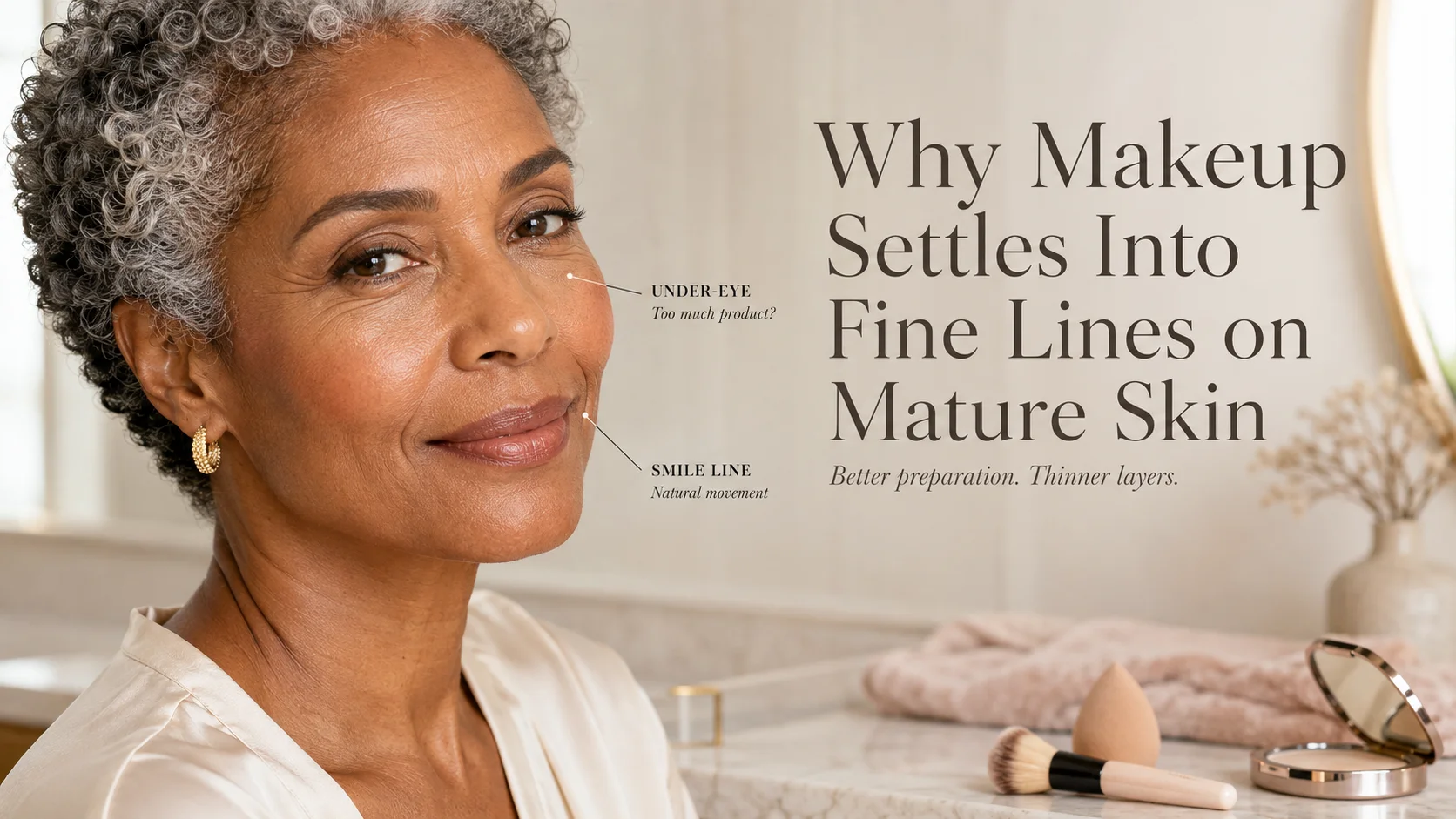



A more even-looking complexion does not come from punishing the skin.
When people notice uneven-looking tone, dark spot appearance, post-blemish marks, or patchy areas, they often feel tempted to use stronger products. More exfoliation. Stronger vitamin C. More brightening serums. Daily acids. Scrubs. Peels. Retinol-style products. Anything that promises faster-looking change.
But harsh skincare can make uneven-looking tone appear worse.
When the skin becomes irritated, dry, tight, flaky, or over-exfoliated, the complexion can look patchier, duller, and less comfortable. Makeup may cling. SPF may sting. Dark spot appearance may stand out more because the surrounding skin looks stressed.
At Zendevie, we approach uneven-looking tone with care. In consultation, our licensed esthetician first looks at your skin type, SPF habits, sensitivity, dark spot appearance, post-blemish marks, dryness, dehydration, oiliness, exfoliation history, cleanser, moisturizer, and current active products before recommending anything.
The goal is not to force the skin.
The goal is to support a more even-looking, comfortable, protected complexion.
You can support a more even-looking complexion without harsh products by focusing on:
A simple routine may look like:
Morning: Gentle cleanser → hydration or brightening-support serum if appropriate → moisturizer → SPF
Evening: Gentle cleanser → moisturizer or targeted support if appropriate
A more even-looking complexion needs patience, protection, and low irritation.
Not aggression.
Harsh products may make the skin feel like something is happening, but that does not mean the skin is improving.
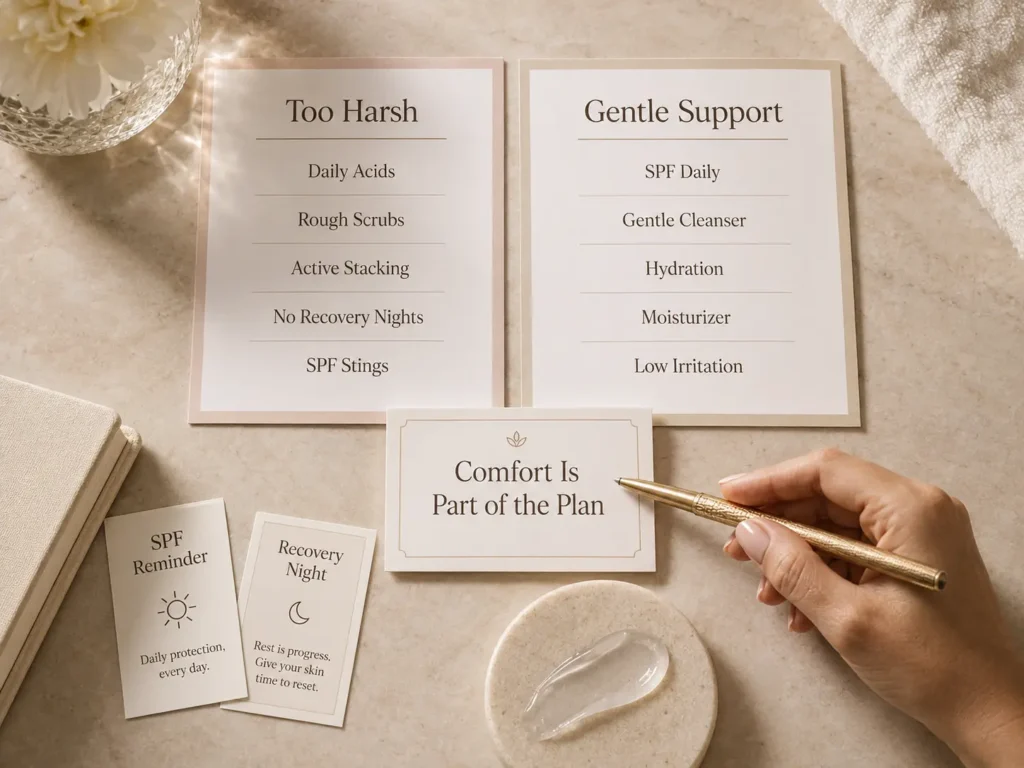
Too much intensity can lead to:
When the skin is irritated, it often looks less even.
Comfort is part of the brightening-support strategy.
A product may feel harsh if it overwhelms your skin.
This can include:
A product is not automatically wrong because it is active.
The issue is whether it fits your skin, your routine, your tolerance, and your current condition.
A brightening-support routine should not make the skin feel raw.
Your routine may be too harsh if your skin feels:
A routine should support the skin’s appearance while keeping the skin comfortable.
Discomfort is feedback.
SPF is the foundation of an uneven-tone routine.
If SPF is skipped, dark spot appearance, post-blemish marks, and patchy-looking tone may continue to look more noticeable after daylight exposure.
SPF matters especially if your routine includes:
SPF should be the final morning skincare step before makeup.
Cleansing is one of the most important steps in an uneven-tone routine.
A cleanser should remove the day without stripping the skin.
A gentle cleanser helps remove:
But cleansing should not leave the skin tight, raw, or uncomfortable.
If your cleanser makes your skin feel dry or squeaky clean, it may be too harsh for your uneven-tone routine.
Dehydrated skin can make uneven-looking tone more noticeable.
When the skin lacks water comfort, it may look flat, tight, dull, or patchy.
Hydration support may help the skin look:
Hydration does not replace SPF or brightening-support care.
But it helps the skin look healthier and more comfortable.
Moisturizer is not only for dry skin.
Even oily skin needs the right moisturizer texture.
Moisturizer helps the skin feel:
If moisturizer is skipped, the skin may become dry, tight, oily-but-dehydrated, or more reactive.
That can make uneven-looking tone appear more noticeable.
Brightening-support products can be helpful when chosen carefully.
But they should not be layered aggressively.
A brightening-support product should fit:
The goal is not to use the strongest product.
The goal is to use the right product at the right time.
Vitamin C support may help some uneven-looking skin appear fresher and more radiant-looking when tolerated.
But vitamin C should not be forced onto irritated skin.
Vitamin C may be too much if the skin is:
A simple vitamin C routine may look like:
Morning: Gentle cleanser → vitamin C support if appropriate → moisturizer → SPF
SPF should always come after.
Exfoliation may help when uneven-looking tone is paired with rough surface buildup or dull texture.
But exfoliation should be gentle and limited. Before adding an acid, scrub, or enzyme step, review how to exfoliate uneven-looking skin safely.
Exfoliation may be too much if the skin is:
A simple exfoliation routine may look like:
Evening: Gentle cleanser → gentle exfoliation if appropriate → moisturizer
Not every night should be an exfoliation night.
AHA may support the look of smoother skin when rough surface texture is part of the concern.
But AHA should be used carefully.
Avoid using AHA with:
SPF is essential when AHA is part of the routine.
BHA may be helpful when uneven-looking tone is connected to oily skin, clogged-looking pores, blackheads, whiteheads, or post-blemish mark appearance after blemishes.
But BHA is not needed for every uneven-tone routine.
BHA may be too much if the skin is:
Oily skin still needs moisturizer and SPF.
BHA should not be used as punishment for oil.
Retinol-style products may fit some routines, but they should be introduced carefully.
They should not be stacked with every other active product.
Avoid combining retinol-style products blindly with:
If the skin becomes flaky, stingy, patchy, or more sensitive, the routine may be too strong.
SPF should be consistent every morning.
Picking can make post-blemish mark appearance more noticeable.
Picking may lead to:
If the skin is open, broken, crusted, or bleeding, do not apply brightening-support products.
Let the area settle and seek medical guidance if needed.
Dark spot appearance is not dirt.
It cannot be scrubbed away safely.
Harsh scrubbing may irritate the surrounding skin and make the complexion look more uneven.
Instead of scrubbing, focus on:
A more even-looking complexion should not come at the cost of skin comfort.
Using several brightening-support products at once can overwhelm the skin.
Avoid layering:
all at the same time.
If irritation happens, it becomes difficult to know what caused it.
Start with one support step.
Watch how the skin responds.
Recovery nights are simple evenings without strong active products.
A recovery night may look like:
Gentle cleanser → moisturizer
or:
Gentle cleanser → hydration support → moisturizer
Recovery nights help the skin stay comfortable.
They are especially important if the routine includes exfoliation, vitamin C, BHA, AHA, or retinol-style products.
More active nights are not always better.
Moisturizer helps support the skin barrier feel and overall comfort.
Skipping moisturizer can make uneven-looking tone appear more noticeable because the skin may become dry, tight, flaky, or irritated.
A brightening-support serum does not replace moisturizer.
Serum and moisturizer do different jobs.
A balanced routine usually needs both when appropriate.
If your brightening-support products make the skin too sensitive for SPF, that is a sign the routine needs review.
SPF should not be removed from an uneven-tone routine.
Instead, consider whether the skin needs:
The routine should support SPF use, not make SPF impossible.
A more even-looking complexion routine should be built in the right order.
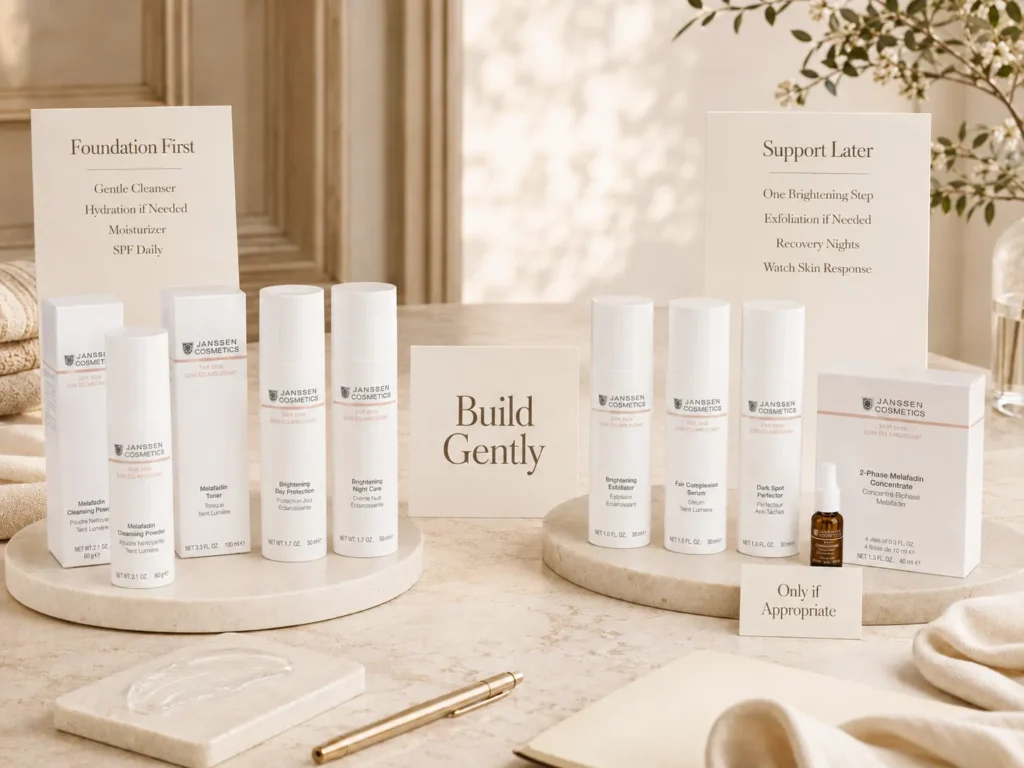
Step 1: Understand the skin type
Step 2: Review sun exposure and SPF habits
Step 3: Choose a gentle cleanser
Step 4: Add hydration if needed
Step 5: Choose the right moisturizer texture
Step 6: Use SPF every morning
Step 7: Add brightening-support products only if appropriate
Step 8: Add exfoliation only if needed and tolerated
Step 9: Adjust slowly
Step 10: Seek dermatologist guidance for concerning marks
Routine order matters.
A beginner routine should be simple.
Morning:
Gentle cleanser → moisturizer → SPF
Evening:
Gentle cleanser → moisturizer
If the skin feels tight or dehydrated:
Morning:
Gentle cleanser → hydration support → moisturizer → SPF
Evening:
Gentle cleanser → hydration support → moisturizer
Start here before adding stronger products.
A gentle brightening-support routine may look like:
Morning:
Gentle cleanser → brightening-support serum if appropriate → moisturizer → SPF
Evening:
Gentle cleanser → moisturizer
This routine keeps brightening support simple.
It avoids active overload.
If the serum stings or irritates the skin, pause and review.
Dry uneven-looking skin usually needs comfort first.
Morning:
Gentle cleanser → hydrating serum if needed → moisturizer → SPF
Evening:
Gentle cleanser → hydrating serum or moisturizer → cream if needed
Optional:
Brightening-support product only when the skin is stable and SPF is consistent
Avoid:
Dry skin needs softness before intensity.
Dehydrated skin may look dull, flat, tight, and uneven.
Morning:
Gentle cleanser → hydrating serum → moisturizer → SPF
Evening:
Gentle cleanser → hydrating serum → moisturizer
Optional later:
Brightening-support serum if appropriate and tolerated
Avoid over-exfoliating dehydrated skin.
Hydration comes first.
Oily skin can have uneven-looking tone, dark spot appearance, and post-blemish marks.
Morning:
Gentle cleanser → lightweight hydration if needed → lightweight moisturizer → SPF
Evening:
Gentle cleanser → lightweight moisturizer
Optional:
BHA only when clogged-looking pores, blackheads, whiteheads, or T-zone buildup are present and skin is stable
Avoid:
Oily skin needs balance, not harshness.
Combination skin often needs zone awareness.
Morning:
Gentle cleanser → lightweight hydration → moisturizer by zone → SPF
Evening:
Gentle cleanser → moisturizer by zone
Optional:
Targeted support only where needed
Avoid treating the whole face as oily or the whole face as dry.
Combination skin may need one approach for the T-zone and another for dry areas.
Sensitive uneven-looking skin should start calmly.
Morning:
Mild cleanser → moisturizer → SPF
Evening:
Mild cleanser → moisturizer
Optional later:
Gentle brightening-support product only when the skin is calm and stable
Avoid:
Sensitive skin needs comfort first.
Mature uneven-looking skin may need hydration, comfort, SPF, and gentle radiance support.
Morning:
Gentle cleanser → hydration or radiance support if tolerated → moisturizer → SPF
Evening:
Gentle cleanser → serum or moisturizer → cream if needed
Do not forget:
Avoid aggressive scrubbing, heavy powder over texture, and strong active stacking.
Post-blemish marks need patience and protection.
Morning:
Gentle cleanser → hydration or brightening-support serum if appropriate → moisturizer → SPF
Evening:
Gentle cleanser → moisturizer or targeted support if appropriate
Avoid:
Post-blemish marks should be supported gently.
A gentle routine for dark spot appearance may include:
Morning:
Gentle cleanser → antioxidant or brightening-support serum if appropriate → moisturizer → SPF
Evening:
Gentle cleanser → moisturizer or targeted support if appropriate
Avoid:
Dark spot appearance needs protection and consistency.
The area around the mouth can be sensitive.
Morning:
Gentle cleanser → moisturizer → SPF
Evening:
Gentle cleanser → moisturizer
Optional:
Targeted brightening-support product only if the area is stable and not irritated
Avoid:
Gentle care is important around the mouth.
Forehead uneven tone may be affected by sun exposure, hair products, sweat, SPF placement, hats, or post-blemish marks.
Morning:
Gentle cleanser → lightweight support if needed → moisturizer → SPF
Evening:
Gentle cleanser → moisturizer
Review:
The forehead may need better cleansing and SPF placement before stronger products.
The neck and décolleté are often forgotten.
Morning:
Gentle cleanse or apply skincare after face → moisturizer → SPF when exposed
Evening:
Gentle cleanse → moisturizer
Avoid:
The neck and décolleté should be cared for gently.
Introduce brightening-support products slowly.
A safe approach:
The skin should feel supported, not overwhelmed.
A product may be too strong if it causes:
If this happens, pause the product and simplify the routine.
If symptoms persist or worsen, speak with a dermatologist or medical provider.
If your skin feels irritated from harsh products, simplify.
Morning:
Mild cleanser → moisturizer → SPF if tolerated
Evening:
Mild cleanser → moisturizer
Pause:
Once the skin feels calm, routine support can be reviewed again.
There is no guaranteed timeline.
Uneven-looking tone, post-blemish mark appearance, and dark spot appearance often need patience.
The appearance may be affected by:
A safe routine should not promise overnight correction.
It should support the skin steadily.
A routine used consistently and tolerated well is usually better than a strong routine that irritates the skin.
Consistency includes:
A more even-looking complexion is supported by habits, not pressure.
Professional guidance may help if:
A consultation can help simplify the routine and reduce irritation.
A dermatologist should evaluate uneven-looking tone or spots if there are warning signs such as:
Cosmetic skincare can support the appearance of uneven-looking tone, but changing or concerning marks need medical evaluation.
After consultation, our licensed esthetician may consider Janssen Cosmetics options depending on whether the uneven-looking tone is connected to sun exposure, post-blemish marks, dark spot appearance, dullness, dryness, dehydration, sensitivity, oiliness, or product buildup.
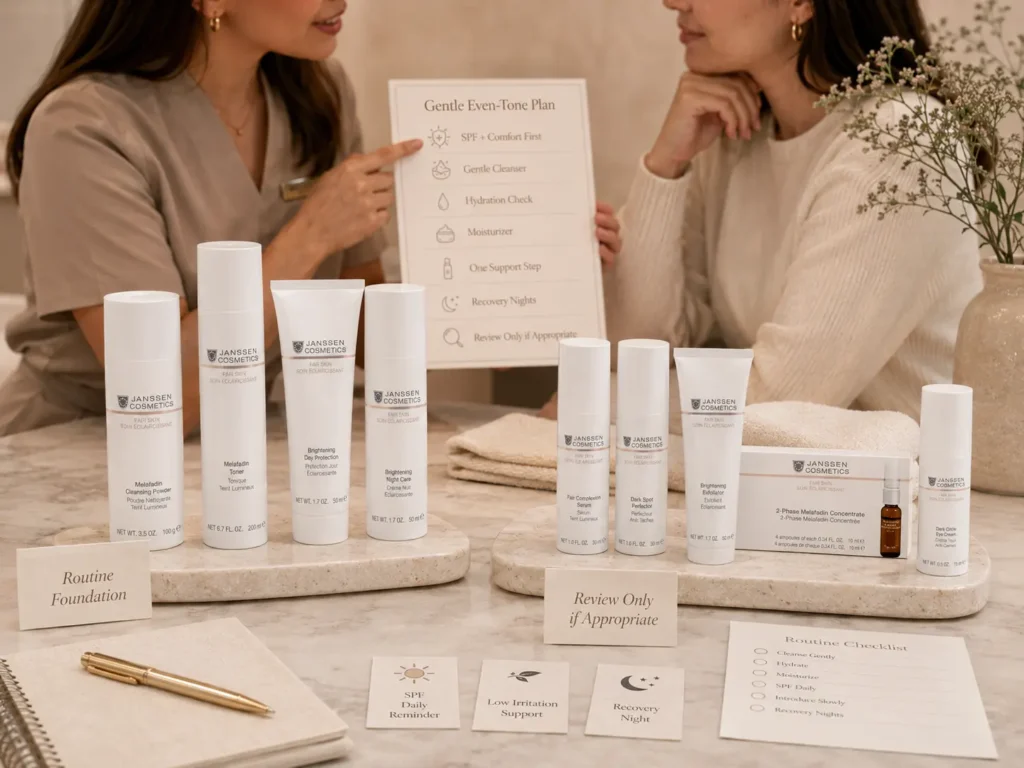
For uneven-looking tone and radiance support, possible options may include:
For dry or dehydrated uneven-looking skin, possible options may include:
For sensitive uneven-looking skin, comfort-focused options may come first, such as:
For oily skin with post-blemish marks, clogged-looking areas, or T-zone buildup, possible options may include:
For morning routines, Face Guard Advanced SPF 30 may be considered as the final daytime protection step when appropriate.
These are not automatic recommendations. The correct routine depends on your skin type, skin tone concern, SPF habits, sensitivity, hydration level, oil pattern, current products, and whether the skin needs calming, hydration, oil balance, exfoliation, or brightening support first.
Do not use harsh scrubs on uneven-looking tone.
Do not try to scrub away dark spots.
Do not pick post-blemish marks.
Do not skip SPF.
Do not use brightening-support products without daytime protection.
Do not combine acids, scrubs, retinol-style products, and strong vitamin C blindly.
Do not apply active products to broken, crusted, bleeding, or painful skin.
Do not use professional-only products at home.
Do not keep using products that burn, sting, or make the skin look more uneven.
Do not ignore spots that change, bleed, crust, hurt, appear suddenly, or look unusual.
Yes. A more even-looking complexion can be supported with daily SPF, gentle cleansing, hydration, moisturizer, careful brightening-support products, and consistency.
No. Dark spot appearance should not be scrubbed aggressively. Harsh exfoliation can irritate the skin and make uneven tone look more noticeable.
Vitamin C support may help some routines when tolerated, but it is not the first step for everyone. SPF, cleanser, moisturizer, hydration, and skin comfort come first.
Yes. Over-exfoliation can cause tightness, burning, flakes, sensitivity, and patchiness, which may make uneven-looking tone appear worse.
SPF is one of the most important steps. Without daily protection, dark spot appearance and post-blemish marks may continue to look more noticeable.
Yes. Oily skin can have dark spot appearance, post-blemish marks, and patchy tone. Oily skin still needs SPF, moisturizer, and gentle care.
Sensitive skin may need calming and comfort first. Brightening-support products should be introduced carefully only when the skin is stable.
A serum may be helpful if it matches the skin’s need, but it should not replace moisturizer. Serum and moisturizer have different roles.
Timing varies. Uneven-looking tone often needs consistent SPF, low irritation, hydration, and patience. Avoid guaranteed timelines.
See a dermatologist if a spot changes in size, shape, or color; bleeds; crusts; hurts; itches severely; appears suddenly; looks unusual; or worsens quickly.
If you want a more even-looking complexion, you do not need to start with the strongest product.
You need to understand what your skin can tolerate and what it needs first.
At Zendevie, a free virtual consultation helps us review your skin type, SPF habits, dark spot appearance, post-blemish marks, cleanser, moisturizer, hydration level, sensitivity, exfoliation, and current products before recommending anything.
The goal is a brighter-looking, more even-looking complexion that still feels calm, comfortable, and cared for.

Zendevie is guided by Haby Diallo, a licensed esthetician with more than 20 years of professional skincare experience. Her approach is rooted in education, professional judgment, and personal care.
years of experience