


Uneven Tone on the Forehead: What It May Mean
Uneven tone on the forehead can show up in different ways.
Some people notice the forehead looks darker than the rest of the face. Some see patchiness near the hairline. Others notice post-blemish marks, oily shine, clogged-looking pores, rough texture, dullness, or makeup separating across the forehead.
The forehead is part of the T-zone, so it can behave differently from the cheeks.
It may be oilier.
It may collect sweat.
It may be affected by hair products.
It may receive more sun exposure.
It may also be missed during SPF application, especially near the hairline.
At Zendevie, we do not recommend products blindly for forehead unevenness. In consultation, our licensed esthetician first reviews skin type, oiliness, dryness, sensitivity, SPF habits, hair products, cleanser, moisturizer, exfoliation habits, post-blemish marks, dark spot appearance, and whether the area looks irritated or needs dermatologist guidance.
The forehead may not need the strongest product.
It may need the right reason identified first.
Quick Answer
Uneven tone on the forehead may happen because of sun exposure, SPF gaps near the hairline, sweat, oil buildup, hair product residue, hats or headbands, post-blemish marks, dryness, dehydration, over-exfoliation, makeup texture, or irritation from active products.
Common appearance-related reasons include:
- SPF missed near the hairline
- Sun exposure on the upper forehead
- Oily T-zone buildup
- Sweat and heat
- Hair product residue
- Forehead blemishes
- Post-blemish marks
- Clogged-looking pores
- Blackheads or whiteheads
- Dry flakes
- Dehydrated-looking skin
- Over-exfoliation
- Strong actives used too often
- Makeup separating or clinging
- Hats, scarves, or headbands causing friction
- Sensitive skin irritation
A simple starting routine may be:
Morning: Gentle cleanser → lightweight moisturizer → SPF carefully to the hairline
Evening: Gentle cleanser → moisturizer
If the forehead is clogged-looking or oily, targeted support may be reviewed. If it is dry, irritated, or stinging, calming and hydration should come first.
Why the Forehead Often Looks Different
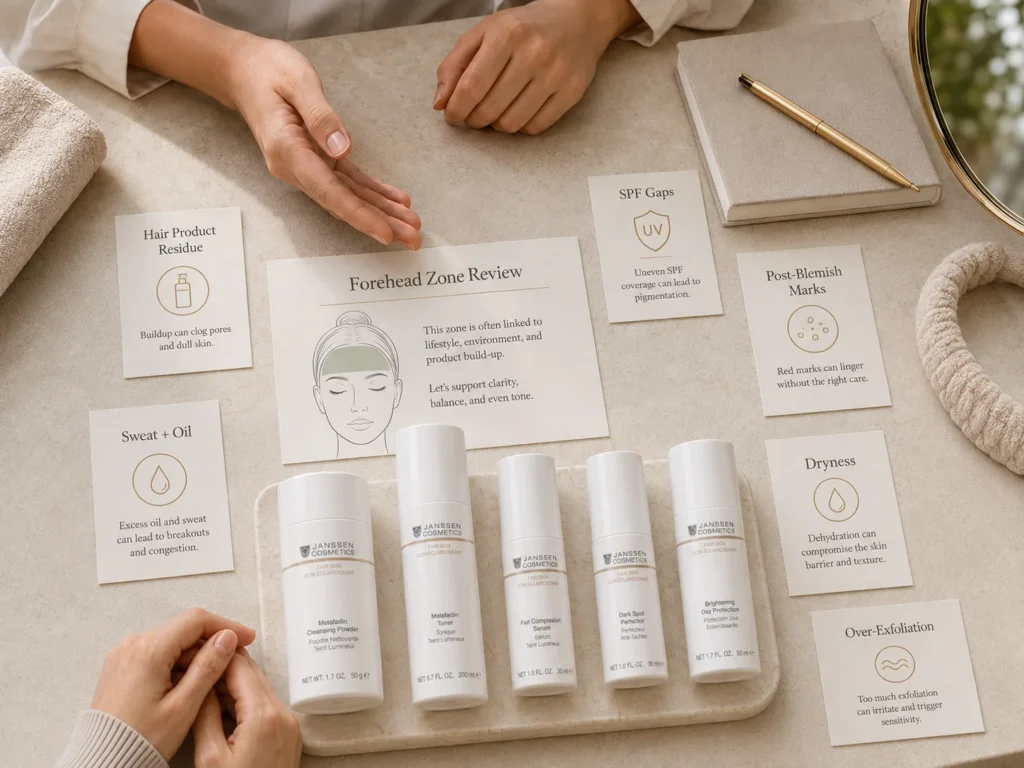
The forehead often looks different because it has its own behavior.
It is part of the T-zone, which means it may produce more oil than the cheeks. It is close to the hairline, so hair products can migrate onto the skin. It is also exposed to sun, sweat, hats, scarves, headbands, and makeup layering.
This can make the forehead look:
- Shinier
- Duller
- More textured
- More patchy
- More marked after blemishes
- Darker near the hairline
- Uneven under makeup
- Different from the cheeks
The forehead should be assessed as its own zone.
Not every area of the face needs the same routine.
Forehead Unevenness Is Not Always Hyperpigmentation
A darker-looking forehead does not always mean hyperpigmentation.
The forehead may look uneven because of:
- Oil buildup
- Product residue
- Sweat
- Dryness
- Dehydration
- Makeup texture
- SPF pilling
- Post-blemish marks
- Hair product irritation
- Over-exfoliation
- Sun exposure
- Friction from hats or headbands
Hyperpigmentation is a more clinical term and should not be self-diagnosed casually.
If a spot is changing, bleeding, crusting, painful, sudden, or unusual, dermatologist guidance is important.
Sun Exposure Can Make Forehead Unevenness Look Stronger
The forehead often receives a lot of sun exposure.
The upper forehead and hairline can be easy to miss when applying SPF. Some people also avoid SPF near the hairline because they do not want the hair to feel greasy.
But missed SPF can make the forehead look more uneven over time.
This matters for:
- Dark spot appearance
- Sun-related unevenness appearance
- Mature skin tone changes
- Post-blemish marks
- Upper forehead patchiness
- Hairline tone differences
SPF should be applied evenly to the forehead and hairline area.
SPF Gaps Near the Hairline
SPF gaps are common near the hairline.
People may apply SPF well to the cheeks and nose but use less on the forehead edges.
Missed areas include:
- Upper forehead
- Hairline
- Temples
- Between eyebrows
- Sides of forehead
- Around baby hairs
- The area under hats or scarves that shift during the day
If the forehead looks uneven, review SPF placement before adding stronger products.
SPF should be the final morning skincare step before makeup.
Sweat Can Affect Forehead Appearance
The forehead sweats easily.
Sweat can mix with SPF, makeup, hair products, and oil. This may make the forehead look shiny, dull, patchy, or congested-looking.
Sweat does not mean the skin is dirty.
But if sweat and product residue are not cleansed properly at night, the forehead may look coated or uneven the next day.
Evening cleansing matters.
A simple evening routine may be:
Gentle cleanser → moisturizer
If heavy SPF or makeup is worn, a removal step may be needed before cleanser.
Hair Products Can Affect the Forehead
Hair products can migrate onto the forehead.If residue or buildup is part of the problem, review how to choose a cleanser for uneven skin tone.
This may include:
- Hair oils
- Leave-in conditioner
- Edge control
- Styling gel
- Hair spray
- Heat protectant
- Dry shampoo
- Fragrance-heavy products
- Heavy creams
- Scalp treatments
These products may leave residue near the hairline.
For some people, this can contribute to clogged-looking pores, dullness, irritation, or post-blemish marks.
If forehead unevenness is close to the hairline, hair products should be reviewed.
Hats, Headbands, and Scarves Can Create Friction
Anything that touches the forehead regularly can affect the skin.
This may include:
- Hats
- Headbands
- Scarves
- Helmets
- Workout bands
- Hair wraps
- Wig bands
- Tight caps
- Sweatbands
Friction and trapped sweat may make the forehead look irritated, shiny, bumpy, or uneven.
If forehead unevenness appears where fabric touches, reduce friction when possible and cleanse gently after sweating.
Oily Forehead and Uneven Tone
The forehead is often oilier than the cheeks.
Oiliness may make the forehead look darker, shinier, or more textured in certain lighting.
Oily forehead concerns may include:
- Shine
- Clogged-looking pores
- Blackheads
- Whiteheads
- Post-blemish marks
- Makeup separation
- SPF sliding
- Dullness from buildup
The answer is not to strip the skin.
Oily skin still needs gentle cleansing, lightweight moisturizer, and SPF.
Clogged-Looking Pores on the Forehead
Forehead pores may look clogged when oil, sweat, makeup, SPF, or hair product residue builds up.
This may appear as:
- Tiny bumps
- Rough texture
- Whiteheads
- Blackheads
- Uneven makeup texture
- Dullness
- Oily but uneven-looking skin
If clogged-looking pores are present, targeted support may be reviewed.
But BHA or exfoliation should only be used if the skin is stable enough.
Do not apply strong active products to irritated skin.
Post-Blemish Marks on the Forehead
Forehead blemishes can leave post-blemish mark appearance.
This may happen when blemishes are:
- Picked
- Scrubbed
- Dried out
- Treated aggressively
- Exposed to sun without SPF
- Covered with heavy makeup
- Irritated by hair products
Post-blemish marks need patience and low irritation.
Do not scrub them.
Do not pick them.
Do not apply active products to broken skin.
Dryness Can Make the Forehead Look Patchy
Some foreheads are oily, but others become dry and flaky.
Dry forehead skin may look:
- Dull
- Tight
- Rough
- Patchy
- More textured
- Less smooth under makeup
- More noticeable under SPF
Dryness can make uneven-looking tone appear stronger because the skin surface reflects light unevenly.
If the forehead is dry, hydration and moisturizer may need to come before brightening support.
Dehydration Can Make the Forehead Look Dull
A dehydrated forehead may feel oily but tight.
It may look shiny and dull at the same time.
Signs of dehydration may include:
- Tightness after cleansing
- Fine dehydration lines
- Makeup creasing
- SPF pilling
- Skin feeling oily but uncomfortable
- Dullness by midday
- Patchy texture
Dehydrated skin may need water-supporting hydration and lightweight moisturizer.
Do not dry it out more.
Over-Exfoliation Can Make the Forehead Look Worse
The forehead is often over-exfoliated because people try to smooth bumps, shine, or dark-looking areas quickly.
Over-exfoliation may cause:
- Burning
- Stinging
- Tightness
- Flaking
- Shiny but dull skin
- Moisturizer burning
- SPF stinging
- Makeup clinging
- More visible texture
- More patchy-looking tone
If this happens, pause exfoliation and simplify the routine.
A damaged-looking surface can make the forehead look more uneven.
Strong Actives Can Irritate the Forehead
Strong active products can be too much if layered together.
Be careful with:
- AHA
- BHA
- Scrubs
- Exfoliating toner
- Retinol-style products
- Strong vitamin C
- Peeling products
- Strong brightening-support serums
- Drying spot products
These may be appropriate for some skin, but not all at once.
If the forehead stings, burns, flakes, or becomes more patchy, simplify.
Makeup Can Make Forehead Unevenness Look Stronger
Makeup can make forehead unevenness look more noticeable when the skin is oily, dry, textured, or layered with too many products.
Makeup may:
- Separate on an oily forehead
- Cling to dry flakes
- Emphasize bumps
- Look gray or dull
- Pill over SPF
- Settle into lines
- Look patchy near the hairline
Before adding another active product, review cleanser, moisturizer, SPF texture, and product layering.
SPF Can Pill on the Forehead
SPF pilling on the forehead may happen when:
- Too much serum is used
- Moisturizer is too heavy
- The forehead is oily
- Hair products are on the skin
- There is product buildup
- Layers are applied too quickly
- Dry flakes are present
- The sunscreen texture does not match the routine
If SPF pills, do not skip it.
Simplify the routine underneath:
Cleanser → lightweight moisturizer → SPF
Then add serum later if needed.
Forehead Unevenness and Sensitive Skin
Sensitive skin may show uneven-looking tone on the forehead when irritated.
Sensitive forehead skin may react to:
- Harsh cleanser
- Exfoliating toner
- Scrubs
- Strong vitamin C
- AHA
- BHA
- Retinol-style products
- Hair products
- Fragrance
- Sweat
- Heat
- Hats or headbands
If the forehead is sensitive, calm first.
Brightening support should wait.
Forehead Unevenness and Dry Skin
Dry forehead skin may look uneven because of flakes, roughness, or tightness.
Dry skin may need:
- Gentle cleanser
- Hydration support
- Moisturizer
- SPF
- Less hot water
- Less exfoliation
- Fewer strong actives
- Less friction from hats or towels
Do not scrub dry forehead patches.
Dryness needs comfort.
Forehead Unevenness and Oily Skin
Oily forehead skin may look uneven because of shine, clogged-looking pores, post-blemish marks, or product buildup.
Oily skin may need:
- Gentle gel cleanser
- Lightweight moisturizer
- SPF
- Targeted BHA only if clogged-looking pores are present and the skin is stable
- Better evening cleansing
- Less heavy hair product near the hairline
The goal is balance.
Not stripping.
Forehead Unevenness and Combination Skin
Combination skin often shows oiliness on the forehead and dryness on the cheeks.
The forehead may need lightweight care while the cheeks need more comfort.
A combination routine may include:
Morning: Gentle cleanser → lightweight moisturizer by zone → SPF
Evening: Gentle cleanser → moisturizer by zone
If the forehead is clogged-looking, targeted support may be used only where needed.
Do not over-treat the cheeks because the forehead is oily.
Forehead Unevenness and Mature Skin
Mature skin may show forehead unevenness from sun exposure, dryness, texture, expression lines, and dullness.
Mature forehead care may need:
- Gentle cleansing
- Hydration
- Moisturizer or cream
- SPF
- Careful radiance support if tolerated
- Less harsh exfoliation
- Makeup texture review
- Neck and décolleté care too
Mature skin should be supported, not stripped.
Forehead Unevenness and Dull Skin
The forehead can look dull when there is buildup, dehydration, dryness, over-exfoliation, or makeup residue.
Dull forehead skin may need:
- Better evening cleansing
- Hydration support
- Lightweight moisturizer
- SPF
- Gentle exfoliation only if stable
- Less product overload
Dullness does not always mean the skin needs a strong brightening serum first.
Forehead Unevenness and Dark Spot Appearance
Dark spot appearance on the forehead may be related to sun exposure, post-blemish marks, irritation, or other factors.
Do not scrub dark spot appearance.
Do not apply active products to irritated skin.
A supportive routine may include:
Morning: Gentle cleanser → brightening-support serum if appropriate → moisturizer → SPF
Evening: Gentle cleanser → moisturizer or targeted support if appropriate
Changing or unusual spots should be evaluated by a dermatologist.
Forehead Unevenness After Sun Exposure
After sun exposure, the forehead may look darker, duller, or patchier.
This can happen if SPF was missed, applied unevenly, or worn down by sweat.
After sun exposure, do not respond with harsh exfoliation.
Return to basics:
Morning: Gentle cleanser → moisturizer → SPF
Evening: Gentle cleanser → moisturizer
If the forehead is burned, blistered, swollen, painful, or severely irritated, seek medical guidance.
Forehead Unevenness After Travel
Travel can make the forehead look oily, dehydrated, dull, or uneven.
Common travel triggers include:
- Airplane dryness
- Sweat
- Sun exposure
- New climate
- Hotel air conditioning
- Heavy SPF
- Makeup buildup
- Hair product changes
- Skipped evening cleansing
- Stress
During travel, keep the routine simple and consistent.
Do not test strong new products on the forehead while traveling.
Forehead Unevenness From Hairline Buildup
If unevenness is mostly near the hairline, look at what touches that area.
Possible contributors include:
- Hair oils
- Edge control
- Styling gel
- Leave-in conditioner
- Sweat
- Hats
- Wig bands
- Scarves
- Headbands
- Incomplete cleansing near the hairline
Gently cleanse the hairline area at night.
Avoid dragging harsh active products into sensitive areas.
Forehead Unevenness From Picking
Picking the forehead can make marks look more noticeable.
This includes:
- Squeezing bumps
- Scratching flakes
- Picking whiteheads
- Rubbing texture
- Scrubbing post-blemish marks
- Using harsh spot treatments repeatedly
Picking can create more visible post-blemish mark appearance.
Low irritation matters.
Forehead Unevenness Between the Brows
The area between the brows may look uneven because of oil, sweat, makeup buildup, tweezing irritation, SPF gaps, or dryness.
It may also react to brow products.
Review:
- Brow gel
- Pencil or pomade
- Waxing or threading
- Makeup removal
- SPF placement
- Cleansing between brows
- Retinol-style products or acids applied too close
If the area is irritated or flaky, simplify.
Forehead Unevenness Near the Temples
Temple unevenness may be influenced by:
- Sun exposure
- Hair products
- Friction from glasses
- Hats
- Scarves
- Makeup residue
- SPF gaps
- Post-blemish marks
- Dryness
The temples are often missed during cleansing and SPF application.
Include them gently in the routine.
What to Do First
If the forehead looks uneven, start by observing the pattern.
Ask:
- Is the forehead oily?
- Is it dry or flaky?
- Is unevenness close to the hairline?
- Do I wear hats or headbands?
- Am I using hair products that touch the skin?
- Am I missing SPF near the hairline?
- Do I have bumps or clogged-looking pores?
- Am I picking forehead blemishes?
- Does SPF pill only on the forehead?
- Does makeup separate on the forehead?
- Am I over-exfoliating?
The answer helps guide the routine.
Simple Routine for Forehead Unevenness
Morning:
Gentle cleanser → lightweight moisturizer → SPF carefully to the hairline
Evening:
Gentle cleanser → moisturizer
This is a good starting point if the forehead is mildly uneven, oily, dry, or sensitive.
Once the skin is stable, targeted support can be reviewed.
Routine for Oily Forehead Unevenness
Morning:
Gentle gel cleanser → lightweight moisturizer → SPF
Evening:
Gentle cleanser → lightweight moisturizer
Optional:
BHA only when clogged-looking pores, blackheads, whiteheads, or T-zone buildup are present and the skin is stable
Avoid:
- Stripping cleanser
- Drying toner
- Skipping moisturizer
- Picking bumps
- Using BHA too often
Oily forehead skin needs balance.
Routine for Dry Forehead Unevenness
Morning:
Gentle cleanser → hydrating serum if needed → moisturizer → SPF
Evening:
Gentle cleanser → hydrating serum if needed → moisturizer or cream
Avoid:
- Harsh cleanser
- Hot water
- Strong exfoliation
- Scrubbing flakes
- Brightening products on irritated skin
- Skipping moisturizer
Dry forehead skin needs comfort before brightening support.
Routine for Sensitive Forehead Unevenness
Morning:
Mild cleanser → moisturizer → SPF
Evening:
Mild cleanser → moisturizer
Optional later:
Calming or hydration support if tolerated
Avoid brightening-support products, acids, scrubs, and retinol-style products until the skin feels calm.
Sensitive skin needs a slower approach.
Routine for Forehead Post-Blemish Marks
Morning:
Gentle cleanser → serum if appropriate → moisturizer → SPF
Evening:
Gentle cleanser → moisturizer
Optional targeted support may be reviewed when the skin is calm.
Avoid:
- Picking
- Scrubbing
- Applying actives to broken skin
- Over-exfoliating
- Skipping SPF
Post-blemish marks need patience and low irritation.
Routine for Forehead Dark Spot Appearance
Morning:
Gentle cleanser → brightening-support serum if appropriate → moisturizer → SPF
Evening:
Gentle cleanser → moisturizer or targeted support if appropriate
Avoid:
- Scrubbing dark spot appearance
- Skipping SPF at the hairline
- Using several brightening products together
- Applying active products to irritated skin
- Ignoring changing or unusual spots
Dark spot appearance should be supported gently.
Routine for Forehead Product Buildup
If product buildup is making the forehead look dull or uneven:
Morning:
Gentle cleanser → lightweight moisturizer → SPF
Evening:
Makeup/SPF removal step if needed → gentle cleanser → moisturizer
Also review:
- Hair products
- SPF texture
- Makeup removal
- Heavy creams near the hairline
- Sweat after workouts
- Hats or headbands
The goal is clean skin without stripping.
Routine for Makeup Separation on the Forehead
If makeup separates on the forehead:
Morning:
Gentle cleanser → lightweight moisturizer → SPF → makeup
Review:
- Too much serum
- Heavy moisturizer
- Oily T-zone
- SPF texture
- Product pilling
- Hair product residue
- Dry flakes
- Over-exfoliation
Do not immediately add more exfoliation.
Simplify first.
When Brightening Support May Be Appropriate
Brightening support may be appropriate for forehead unevenness when:
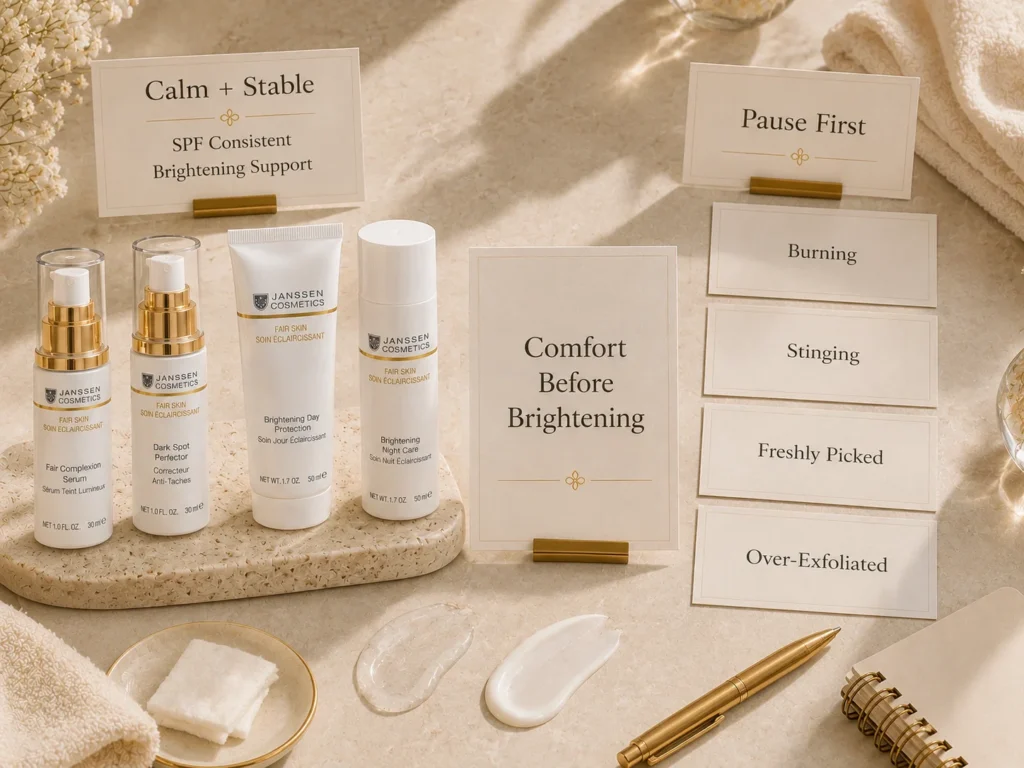
- The skin is calm
- The forehead is not burning or stinging
- SPF is used daily
- Moisturizer feels comfortable
- The concern is dark spot appearance or uneven-looking tone
- Product buildup has been addressed
- The routine is not already overloaded
- The skin can tolerate active support
Introduce only one new support product at a time.
When Brightening Support Should Wait
Brightening support should wait if the forehead is:
- Burning
- Stinging
- Tight
- Flaky
- Rash-like
- Swollen
- Painful
- Crusted
- Bleeding
- Freshly picked
- Over-exfoliated
- Reacting to moisturizer
- Reacting to SPF
Comfort comes first.
Do not brighten irritated skin.
When BHA May Be Appropriate
BHA may be reviewed if the forehead has:
- Clogged-looking pores
- Blackheads
- Whiteheads
- Oily T-zone buildup
- Rough clogged-looking texture
- Post-blemish marks from oily breakouts
But BHA should not be used just because the forehead looks darker.
BHA should wait if the forehead is irritated, dry, stinging, peeling, cracked, or over-exfoliated.
When Exfoliation May Be Appropriate
Gentle exfoliation may be reviewed if the forehead has rough surface buildup and the skin is stable.
Exfoliation should not be used aggressively.
Avoid exfoliation if the forehead is:
- Burning
- Stinging
- Rash-like
- Very dry
- Freshly picked
- Broken
- Crusted
- Bleeding
- Painful
- Over-exfoliated
Exfoliation should support smoothness, not create irritation.
When to Pause Active Products
Pause active products if the forehead becomes:
- Tight
- Burning
- Stinging
- Hot
- Flaky
- More patchy
- More sensitive
- Painful
- Rash-like
- Reactive to moisturizer
- Reactive to SPF
Return to:
Morning: Mild cleanser → moisturizer → SPF
Evening: Mild cleanser → moisturizer
Seek guidance if symptoms persist or worsen.
When Professional Guidance Helps
Professional guidance may help if:
- The forehead keeps looking uneven
- You are unsure if the concern is oil, dryness, product buildup, or dark spot appearance
- SPF pills only on the forehead
- Makeup separates on the forehead
- Hair products seem to affect the hairline
- You have post-blemish marks on the forehead
- Strong products make the forehead worse
- The forehead is oily but tight
- The forehead is dry but bumpy
- You do not know what to pause or add
A consultation can help decide whether the forehead needs hydration, oil balance, calming support, brightening support, SPF correction, or dermatologist guidance.
When to See a Dermatologist
A dermatologist should evaluate forehead unevenness, spots, bumps, or irritation if there are warning signs such as:
- A spot changing in size, shape, or color
- Bleeding
- Crusting
- Pain
- Severe itching
- Sudden discoloration
- Irregular-looking borders
- A spot that looks very different from others
- Rapid worsening
- Persistent rash-like irritation
- Swelling
- Oozing
- Infection-looking areas
- Blistering
- Skin reacting strongly to basic products
- Eye-area involvement
- Severe sunburn-looking changes
Cosmetic skincare can support appearance, but changing or concerning marks need medical evaluation.
Where Janssen Cosmetics Fits
After consultation, our licensed esthetician may consider Janssen Cosmetics options depending on whether forehead unevenness appears related to oiliness, clogged-looking pores, dryness, sensitivity, dullness, dark spot appearance, or SPF habits.
For oily forehead concerns or clogged-looking T-zone areas, possible options may include:
- Purifying Cleansing Gel
- Purifying Tonic only if tolerated
- Purifying BHA Serum only when clogged-looking pores, blackheads, whiteheads, or T-zone buildup are present and the skin is stable enough
- Light Mattifying Cream
- Intense Clearing Mask when appropriate for oily areas
For dry or dehydrated forehead unevenness, possible options may include:
- Mild Creamy Cleanser
- Radiant Firming Tonic if tolerated
- Deep Xpress Moist Serum
- Hydro Active Gel
- Super Hydrating Cream
- Hyaluron³ Replenish Cream
- Deep Xpress Hydro Mask
For sensitive or irritated-looking forehead skin, comfort-focused options may come first, such as:
- Soft Cleansing Mousse
- Soft Soothing Tonic
- Intense Calming Serum
- Intense Calming Cream or Intense Calming Lotion
- Instant Soothing Mask
For dull, tired-looking, or uneven-looking forehead tone when the skin is stable, possible radiance-support options may include:
- Brightening Face Cleanser
- Brightening Face Freshener
- Magic Glow Serum
- Vitaforce C Skin Complex only when vitamin C support is appropriate and tolerated
- Vitaforce C Cream
- Sensational Glow Cream
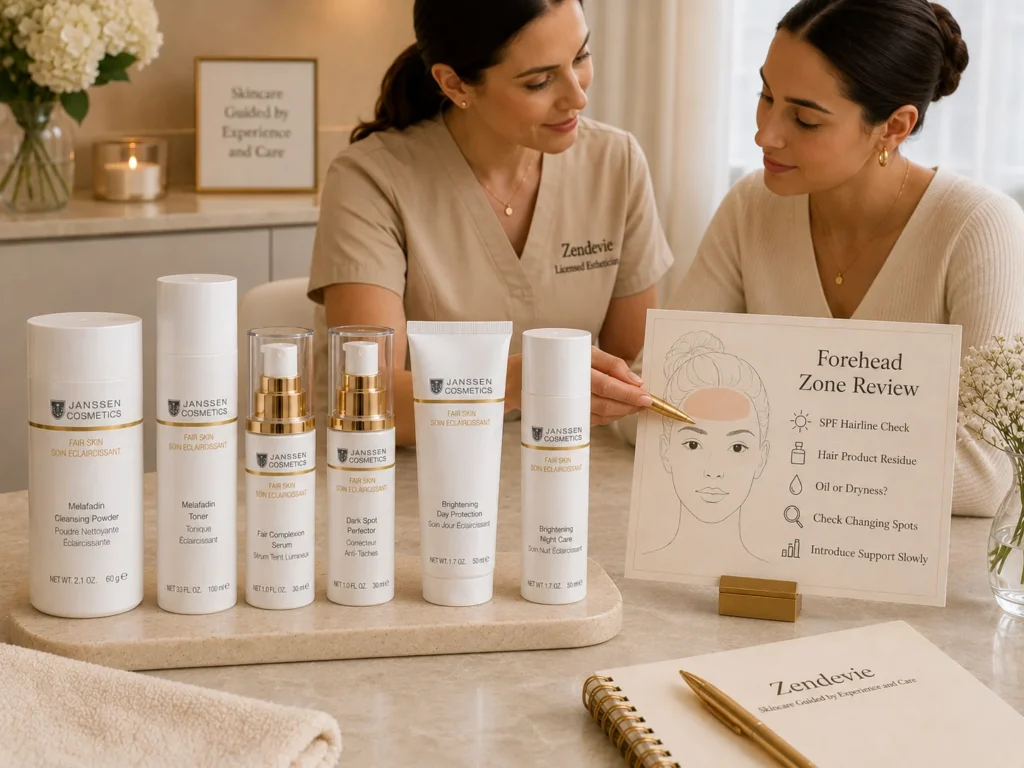
For more targeted uneven-looking tone or dark spot appearance, options from the uneven-tone category may be reviewed after consultation, such as:
- Melafadin Cleansing Powder
- Melafadin Toner
- Fair Complexion Serum
- Dark Spot Perfector
- Brightening Day Protection
- Brightening Night Care
For morning routines, Face Guard Advanced SPF 30 may be considered as the final daytime protection step when appropriate and tolerated.
These are not automatic recommendations. Forehead unevenness should be evaluated based on skin type, oiliness, dryness, sensitivity, hairline habits, SPF placement, and current product use.
What Not to Do
Do not scrub forehead unevenness.
Do not skip SPF near the hairline.
Do not use BHA just because the forehead looks darker.
Do not apply strong actives to irritated forehead skin.
Do not over-exfoliate bumps or post-blemish marks.
Do not pick forehead blemishes.
Do not ignore hair product residue near the hairline.
Do not use heavy products on an oily forehead without reviewing texture.
Do not strip oily forehead skin.
Do not apply active products to broken, crusted, bleeding, painful, or freshly picked skin.
Do not assume every darker-looking area is hyperpigmentation.
Do not ignore changing, sudden, bleeding, crusting, painful, or unusual marks.
Frequently Asked Questions
Why is my forehead uneven in tone?
Forehead unevenness may be related to sun exposure, SPF gaps near the hairline, sweat, oil buildup, hair product residue, post-blemish marks, dryness, dehydration, over-exfoliation, or makeup texture.
Why does my forehead look darker than the rest of my face?
The forehead may look darker because of sun exposure, missed SPF, oiliness, buildup, dry texture, post-blemish marks, or product residue near the hairline.
Can SPF help forehead unevenness?
SPF is essential for uneven-looking tone routines. Apply it carefully across the forehead, hairline, temples, and between the brows.
Can hair products cause forehead unevenness?
Hair products can leave residue near the hairline. For some people, this may contribute to clogged-looking pores, irritation, dullness, or post-blemish marks.
Should I exfoliate uneven tone on my forehead?
Only if rough buildup is present and the skin is stable. Do not exfoliate if the forehead is burning, stinging, flaky, rash-like, broken, crusted, bleeding, painful, or over-exfoliated.
Should I use BHA on my forehead?
BHA may be reviewed if clogged-looking pores, blackheads, whiteheads, or oily T-zone buildup are present and the skin is stable. It is not automatically needed for every uneven forehead concern.
Why does makeup separate on my forehead?
Makeup may separate because of oil, sweat, heavy moisturizer, SPF texture, product buildup, too much serum, dry flakes, or over-exfoliation.
Why does SPF pill on my forehead?
SPF may pill if there are too many layers underneath, heavy moisturizer, product residue, dry flakes, or incompatible textures. Simplify the routine before skipping SPF.
What is the safest first step for forehead unevenness?
Start with gentle cleanser, lightweight moisturizer, and SPF applied carefully to the hairline. Then review oiliness, dryness, hair products, and active product use.
When should I see a dermatologist?
See a dermatologist if a spot changes in size, shape, or color; bleeds; crusts; hurts; itches severely; appears suddenly; looks unusual; has irregular-looking borders; or worsens quickly.
If your forehead looks uneven, the answer may not be stronger exfoliation or another brightening product.
It may be SPF placement, oil balance, hair product residue, hydration, or a simpler routine.
At Zendevie, a free virtual consultation helps us review your forehead concerns, skin type, oiliness, dryness, hair products, SPF habits, cleanser, moisturizer, post-blemish marks, and current active products before recommending anything.
The forehead often needs zone-specific care.
And the right routine begins with understanding what is making it look uneven.

About the Esthetician Behind Zendevie
Zendevie is guided by Haby Diallo, a licensed esthetician with more than 20 years of professional skincare experience. Her approach is rooted in education, professional judgment, and personal care.
20+
years of experience