


Travel can change more than your location.
It can change:
Sensitive skin may respond to several of these changes at once.
A cleanser that feels comfortable at home may suddenly leave the skin tight after a long flight.
A moisturizer that feels light and comfortable in a humid climate may feel insufficient in an air-conditioned hotel.
A rich cream that works during winter may feel heavy in a tropical destination.
SPF may begin stinging after the skin has been exposed to sun, wind, salt water, chlorine, or repeated cleansing.
Hotel soap may be used once and leave the face feeling raw.
Retinol may begin to burn even though it was previously tolerated.
At Zendevie, our licensed esthetician looks at travel sensitivity as a complete pattern rather than assuming one ingredient caused everything.
The goal is to understand what changed, protect the basic routine, and avoid creating more uncertainty with several unfamiliar products.
Travel may make sensitive skin react because of:
A simple travel routine may be:
Morning: Gentle cleanser or rinse if appropriate → moisturizer → SPF
Evening: Gentle cleanser → moisturizer
Optional products should only be packed when the skin already tolerates them and they serve a clear purpose.
Do not begin retinol, AHA, BHA, strong vitamin C, fragranced skincare, or an essential-oil product immediately before or during a trip.
If the skin becomes persistently painful, significantly swollen, blistering, crusting, bleeding, infection-looking, severely itchy, close to the eyes, or continues to worsen after suspected products are stopped, seek medical guidance.
Seek urgent medical care for rapid swelling of the face, lips, tongue, or eyes, breathing difficulty, throat tightness, faintness, or another severe reaction.
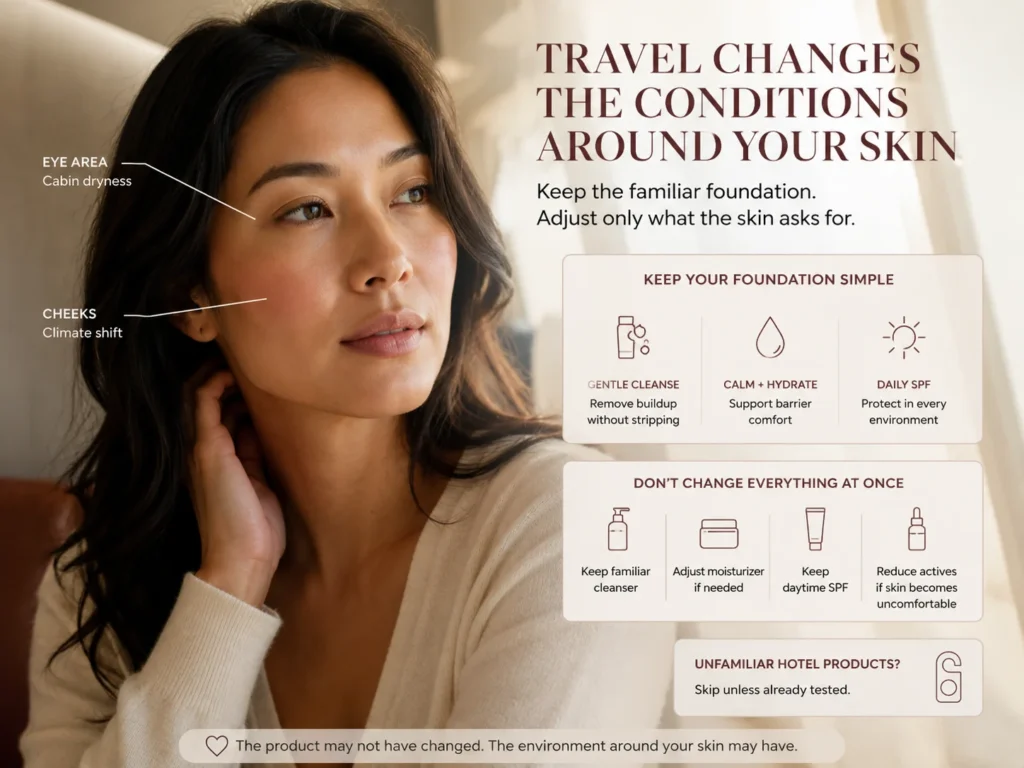
Sensitive skin often responds best to consistency.
Travel may interrupt that consistency through:
The skin may react even when no single product is clearly responsible.
For example, the face may feel tight because of airplane air, strong hotel air conditioning, repeated cleansing, and a lightweight moisturizer that is no longer enough.
The entire travel environment matters.

Airplane cabins often feel dry.
During a long flight, sensitive skin may begin to feel:
This does not mean the skin needs a complicated in-flight routine.
Repeatedly layering mist, serum, moisturizer, oil, and mask may create more product buildup and more opportunities for irritation.
A simple approach is often easier to manage.
Before a flight, a simple routine may include:
Gentle cleanser → moisturizer → SPF when daytime exposure is expected
If the flight is at night and sun exposure is not relevant during departure, the routine may remain:
Gentle cleanser → moisturizer
Use products the skin already tolerates.
Do not begin a new acid, retinol, mask, fragrance, or essential-oil product before boarding.
Some people prefer to apply moisturizer during a long flight.
Others find that touching the face or layering products in the cabin causes discomfort.
Consider:
Do not treat the airplane as a place to test a full skincare routine.
If an additional moisturizer application is needed, use a product the skin already knows.
Facial mists may feel refreshing.
However, a mist is not automatically necessary for hydration.
Some mists contain:
Repeated misting without moisturizer may not provide lasting comfort for every skin type.
A mist may also move toward the eyes.
Sensitive skin does not need a mist simply because it is traveling.
In-flight sheet masks are popular in travel content.
They are not required.
A mask may contain:
Using a new sheet mask in a dry cabin may make it difficult to manage a reaction.
If the skin is already comfortable, there may be no reason to add a mask.
Travel often involves touching:
Repeatedly touching the face may transfer residue and create friction.
Avoid rubbing:
This does not mean the face must be repeatedly cleansed.
Gentle habits are more useful than constant washing.
Air conditioning is common in:
Sensitive skin may feel:
A destination may be humid outdoors but dry indoors.
This is why the skin may look oily outside and feel tight after several hours inside.
Travel may move the skin from:
A routine designed for one environment may feel different in another.
This does not always require a completely new product collection.
It may require:
When traveling from humid weather to dry air, the skin may feel:
A lightweight lotion may no longer feel sufficient.
However, do not add several rich products at once.
A more supportive moisturizer may be enough.
When traveling from dry weather to humidity, a rich routine may feel:
The skin may prefer:
Do not respond to humidity by stripping the skin.
Cold air and wind may make sensitive skin feel:
A winter travel routine may need:
Do not use very hot water simply because the weather is cold.
Heat may increase:
A hot-weather travel routine may need:
Do not apply strong active products to skin that still feels hot or sweaty.
Wind may leave sensitive skin:
The face may also experience friction from:
Use products the skin already tolerates.
Do not begin a strong exfoliating routine because wind-exposed skin looks rough.
Higher-altitude destinations may involve:
Sensitive skin may need a simpler routine and consistent daytime protection.
Do not assume cool weather means the skin is not receiving sun exposure.
Travel may expose the skin to water with a different mineral content or treatment process.
The skin may feel:
This does not mean the water is unsafe.
It means the cleansing experience may be different.
Review:
Do not scrub the skin because the water feels different.
Hotel bar soap and body wash are not automatically appropriate for sensitive facial skin.
They may contain:
Using a hotel product once may leave the face:
Bring a facial cleanser the skin already tolerates.
Hotel body lotion is designed for body use.
It may feel:
Do not use unfamiliar body lotion as facial moisturizer simply because the usual product was forgotten.
Use products according to their intended area.
A travel routine should not depend on random availability.
Hotel toiletries may change between locations.
Sensitive skin benefits from consistency.
Pack the foundational products the skin already tolerates:
Optional products should remain limited.
Retinol may already require careful introduction.
Travel can add:
Starting retinol immediately before or during a trip may make a reaction harder to manage.
If retinol is already well tolerated, frequency may still need adjustment based on the destination and skin response.
Retinol is generally used at night, but daytime habits remain important.
During a sunny trip:
A vacation is not the time to force the skin through irritation.
AHA and BHA may cause:
These changes may become harder to manage during travel.
Do not start an acid toner or peel immediately before:
The skin should be stable before departure.
Some people exfoliate aggressively before vacation so makeup looks smoother or the skin appears brighter.
This may leave sensitive skin less comfortable during:
Do not combine:
in the days before travel.
Professional treatments should be scheduled with enough time for appropriate aftercare.
Do not plan a strong professional exfoliation immediately before:
Follow the provider’s aftercare instructions.
Professional peel systems should not be copied at home.
A vitamin C product may remain part of the routine if the skin already tolerates it.
However, it may begin to sting when the skin is:
If vitamin C begins creating heat or persistent stinging, pause it.
Do not assume the product must be used every day during the trip.
Travel may add fragrance from:
Sensitive skin may tolerate one fragranced product but become uncomfortable when several are combined.
Review total exposure.
Hotel spas, travel kits, and wellness products may contain:
A product described as natural or relaxing is not automatically appropriate for sensitive facial skin.
Do not apply undiluted essential oils.
Do not use a new aromatic facial oil simply because it is offered during travel.
A facial at a destination spa may sound relaxing.
Before the treatment, explain:
Do not assume every spa treatment is appropriate for sensitive skin.
Professional analysis should come before exfoliation or active treatment.
Pool water may leave some sensitive skin feeling:
After swimming:
Do not apply strong acids or retinol immediately after swimming.
Salt water may feel drying or sting areas that are:
Rinse gently after swimming when appropriate.
Do not scrub salt residue away.
Use a moisturizer the skin already tolerates.
Travel may involve more time outdoors than usual.
This may include:
Sensitive skin should not wait until it feels hot or burned before thinking about protection.
Use the SPF product the skin tolerates and follow its directions.
SPF may begin stinging because:
Do not continue strong active products while avoiding SPF because the skin feels uncomfortable.
Review the full routine.
Reapplication may become important during extended outdoor exposure.
However, repeated layers over:
may feel uncomfortable.
Keep the morning routine simple enough that additional daytime protection remains manageable.
Avoid aggressive rubbing.
Travel may involve more makeup for:
Makeup may feel different when the skin is:
If makeup begins clinging or separating, do not scrub the skin.
Review the skincare underneath.
At the end of a long day, sensitive skin still needs gentle cleansing.
Avoid:
If heavy makeup or water-resistant SPF is worn, an appropriate removal method may be needed.
The skin should not feel raw afterward.
Wipes may feel convenient.
However, they may involve:
A wipe should not become the main cleansing strategy if it leaves the skin tight or stingy.
Use a gentle cleansing method the skin already knows.
Travel may involve:
When tired, people may:
A shorter routine is easier to maintain.
Travel can be enjoyable and stressful at the same time.
Delays, unfamiliar environments, schedules, and poor sleep may affect how the skin feels.
Stress does not prove that every reaction is psychological.
It is one factor among many.
Do not dismiss persistent burning, swelling, itching, or rash-like changes as “just stress.”
Medical-looking reactions still need appropriate evaluation.
Jet lag may make it difficult to decide when to use morning or evening products.
Keep the routine practical.
Use SPF during the destination’s daytime when exposure is expected.
Use the gentle evening routine before sleep.
Do not try to compensate for missed skincare by applying several active products at once.
A longer day does not mean the skin needs two complete active routines.
Focus on:
Retinol and acids should not be repeated simply because the travel day feels unusually long.
Road trips may involve:
Redirect air vents away from the face when possible.
Do not leave skincare or SPF in extreme heat unless the product directions permit it.
Cruise travel may involve:
Keep the routine consistent.
Do not begin several new products from onboard shops or spa treatments at the same time.
A beach trip may add:
Avoid:
Rinse gently and use familiar products.
Cold-weather outdoor trips may involve:
Sensitive skin may need:
Do not use very hot water after returning indoors.
Business travel may involve:
A simple routine is more realistic:
Morning: Cleanser or rinse → moisturizer → SPF
Evening: Makeup and SPF removal with gentle cleanser → moisturizer
Do not introduce a new active serum immediately before important meetings or events.
Before an important event, people may feel pressure to:
Sensitive skin often needs predictability before an event.
Use products the skin already tolerates.
Do not chase an overnight transformation.
Travel-sized packaging may be convenient.
However, confirm that:
Do not place several different creams or serums in unlabeled containers.
It becomes harder to identify products and reactions.
Do not combine:
inside one travel container.
Products are formulated to remain stable in their intended packaging and composition.
Mixing them may change texture, distribution, or use.
Products may be exposed to:
Follow product storage directions.
Do not continue using a product that has changed significantly in:
without assessing whether it remains appropriate.
Travel logistics may separate you from your checked luggage.
Keep the most essential permitted items accessible when practical:
Follow current transportation rules for liquids and containers.
The skincare strategy should remain simple enough to manage even if optional products are unavailable.
Sensitive skin travel essentials should begin with:
Optional products may include:
Do not pack every product simply because it fits.
Samples are convenient but may contain formulas the skin has never tried.
Do not rely on unknown samples for:
during an important trip.
Patch test well before departure when possible.
If a new product must be considered, test it before the trip.
A careful approach may include:
A patch test does not guarantee full-face tolerance.
Sensitive skin should not make major changes immediately before travel.
The exact timing depends on the product and skin history.
The principle is simple:
Give the skin enough time to show whether a product feels comfortable before you are away from home.
Do not start several products during the final days before departure.
If travel reactions happen repeatedly, write down:
Patterns may become easier to identify over several trips.
Dry-sensitive skin may experience:
A travel routine may need:
Do not add several oils and masks automatically.
Oily-sensitive skin may become:
Common travel mistakes include:
A lightweight moisturizer may still be appropriate.
Combination-sensitive skin may experience:
The whole face may not need the same treatment.
Use targeted care only when the skin is stable and the product has a clear purpose.
Travel may expose redness-prone skin to:
A simple routine may help reduce unnecessary product stress.
Persistent, painful, swollen, eye-related, or worsening redness-looking reactions should be evaluated by a dermatologist.
Mature sensitive skin may notice:
Do not respond with stronger retinol or more exfoliation.
Focus on:
Travel may change:
Blemish-prone sensitive skin may develop more bumps or clogged-looking areas.
Avoid combining:
Painful, deep, swollen, infection-looking, crusting, bleeding, persistent, or scarring blemishes should be evaluated by a dermatologist.
The eye area may react to:
Avoid applying strong facial products close to the lash line.
Use eye-area products only as directed.
Seek medical guidance for:
The mouth area may become uncomfortable because of:
Avoid applying active products to cracked-looking, burning, or rash-like areas.
Persistent mouth-area irritation should be evaluated by a dermatologist.
Use a familiar moisturizer if needed and practical.
Avoid:
Do not wash the face repeatedly during the flight.
Review:
Return to the simplest tolerated routine.
Do not immediately exfoliate because the skin looks dull or rough.
The skin may be responding to:
Do not wash more aggressively.
Review the texture and number of layers.
This may suggest that the skin is oily and dehydrated or over-cleansed.
Review:
A lightweight moisturizer may be more appropriate than no moisturizer.
Use less friction.
Keep cleansing brief and gentle.
Use lukewarm water.
Apply the tolerated moisturizer.
Do not use a scrub to remove a coated or tight feeling.
Stop using it on the face.
Return to the familiar cleanser.
Pause active products if the skin feels tight, hot, or stingy.
If the reaction becomes painful, swollen, rash-like, blistering, or worsening, seek guidance.
The moisturizer may not be the original cause.
Review:
Pause active products.
Use only products that remain comfortable.
If basic moisturizer continues to burn, seek dermatologist guidance.
Review:
Do not continue strong actives while skipping daytime protection.
A calmer routine or different SPF formula may be needed.
Stop applying facial products close to the eyes.
Review:
Seek medical guidance for swelling, pain, crusting, discharge, vision changes, or persistent irritation.
Pause:
Do not scrub away the flakes.
Use gentle cleansing and moisturizer.
Persistent, painful, rash-like, crusting, or worsening flaking should be evaluated.
The skin may be affected by:
Allow the face to cool.
Cleanse gently when appropriate.
Do not apply retinol or acids to hot-feeling skin.
Rinse gently.
Avoid scrubbing.
Pause active products.
Use a familiar moisturizer.
If the skin is painful, swollen, blistering, or worsening, seek medical guidance.
Possible contributors include:
Do not immediately add several acids or spot products.
Simplify.
Seek dermatologist guidance if bumps are painful, itchy, swollen, rash-like, infection-looking, spreading, persistent, or scarring.
Review:
Do not squeeze or scrub aggressively.
A targeted BHA step may be considered only after the skin feels stable.
Review:
Do not begin several clarifying products at once.
Pause it.
Travel may have changed the skin’s tolerance through:
Do not restart until cleanser, moisturizer, and SPF feel consistently comfortable.
Pause AHA and BHA.
Do not use a scrub to remove roughness.
Review whether an active cleanser, acid toner, and retinol are being combined.
Travel is not the time to increase exfoliation frequency.
The product may not have changed.
The skin’s environment may have changed.
Review:
Stop if repeated discomfort continues.
Stop using the sample.
Do not test another new sample immediately.
Return to the basic products the skin already tolerates.
Record the product name and reaction if possible.
That may suggest the travel environment or routine contributed.
Possible factors include:
Document the pattern for future trips.
Stop unnecessary active products.
Use the simplest tolerated routine.
If burning, itching, swelling, rash-like changes, pain, eye-area symptoms, crusting, bleeding, or worsening discomfort continue, seek dermatologist guidance.
Stop introducing new products.
Pause:
Use only the simplest products that remain comfortable.
If cleanser, moisturizer, SPF, or water continues to cause significant discomfort, seek dermatologist guidance.
Gentle cleanser or lukewarm-water rinse if appropriate → moisturizer → SPF
Gentle cleanser → moisturizer
Optional products should be added only if they are already tolerated and serve a clear purpose.
Gentle cleanser → moisturizer → SPF if daytime exposure is expected
Use an additional familiar moisturizer only if needed.
Avoid experimenting with masks, acids, retinol, or new samples.
Gentle cleanser if needed → moisturizer
Allow the skin to adjust before adding active products.
Gentle cleanser or rinse → lightweight moisturizer if needed → SPF
Gentle cleanser → appropriate moisturizer
Use fewer layers.
Pause actives when the skin feels sun-stressed, hot, or irritated.
Gentle cleanser or rinse → supportive moisturizer → SPF
Gentle cleanser → moisturizer
Reduce exfoliation and retinol if the skin becomes dry or reactive.
Lukewarm-water rinse or gentle cleanser if needed → tolerated moisturizer → tolerated SPF
Gentle cleanser → tolerated moisturizer
Temporarily avoid:
The routine should feel simple, familiar, and predictable.
Once the skin feels stable:
Do not restart every active product on the first night home.
A travel routine may feel incomplete without multiple serums, masks, and active products.
But sensitive skin often benefits from fewer variables.
The most important travel routine may simply be:
A shorter routine is easier to follow when schedules change.
A dermatologist should evaluate the skin when a travel-related or product-related reaction includes:
Seek urgent medical care for breathing difficulty, throat tightness, faintness, or rapid swelling of the face, lips, tongue, or eyes.
Cosmetic skincare can help simplify a travel routine.
It cannot diagnose an allergy, infection, dermatitis, rosacea, or another medical condition.
After consultation, our licensed esthetician may consider Janssen Cosmetics options based on the skin’s sensitivity pattern, travel destination, climate, preferred texture, redness-looking areas, dryness, oiliness, eye-area sensitivity, and current routine tolerance.
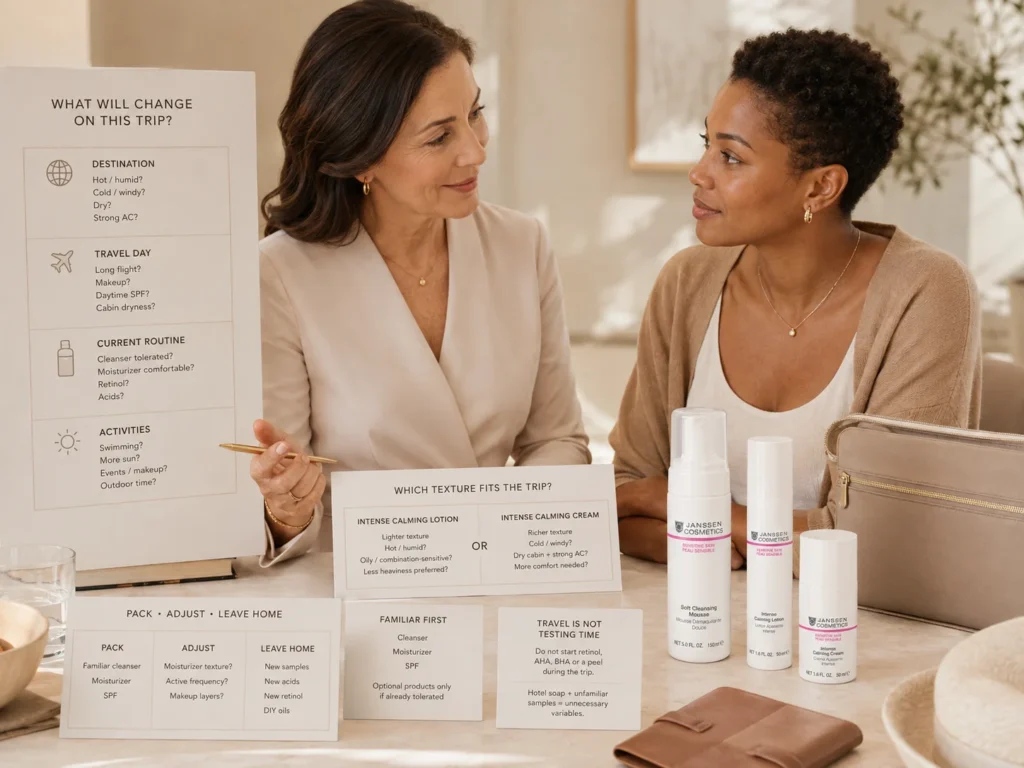
Possible sensitive-skin options may include:
These are possible options, not one automatic travel routine.
The travel routine should begin with the products the skin already tolerates.
For a hot or humid destination, Intense Calming Lotion may be considered when the skin prefers a lighter texture.
For a cold, windy, dry, or strongly air-conditioned destination, Intense Calming Cream may be considered when the skin needs richer comfort.
This does not mean climate alone determines the product.
Skin type, makeup, SPF, layering, oiliness, current dryness, and product history also matter.
A tonic, serum, mask, and eye product should not all be introduced immediately before a trip.
The cleanser, moisturizer, and SPF foundation should feel comfortable first.
If the skin is currently burning, hot, swollen, rash-like, flaky from irritation, or reacting to moisturizer or SPF, retinol, AHA, BHA, enzyme exfoliation, and strong vitamin C products should wait.
Professional exfoliation systems belong in professional treatment settings.
They should not be packed or used as home travel treatments.
Do not start a completely new routine immediately before travel.
Do not rely on unfamiliar samples for cleanser, moisturizer, or SPF.
Do not use hotel soap as facial cleanser.
Do not use hotel body lotion automatically on the face.
Do not begin retinol during a trip.
Do not begin AHA, BHA, or a peel during a trip.
Do not exfoliate aggressively to prepare for vacation photos or makeup.
Do not use professional exfoliation products at home.
Do not apply acids or retinol to sun-stressed, wind-stressed, hot, or recently shaved skin.
Do not layer retinol, acid toner, BHA serum, facial scrub, and strong vitamin C.
Do not introduce a new sheet mask during a flight.
Do not apply undiluted essential oils from hotel or spa products.
Do not assume natural spa products are always gentle.
Do not wash the face repeatedly because it feels different in unfamiliar water.
Do not scrub away travel-related flaking.
Do not touch the face repeatedly during transportation.
Do not rub the eyes when SPF, sweat, or makeup stings.
Do not apply facial actives close to the eye or mouth area.
Do not over-layer mist, serum, oil, cream, mask, and balm during a flight.
Do not mix skincare products together in one travel container.
Do not store skincare or SPF in a hot car or direct sunlight.
Do not use a product that has changed significantly in smell, color, texture, or consistency without reviewing it.
Do not continue a product that repeatedly burns.
Do not ignore persistent pain, significant swelling, blistering, crusting, bleeding, eye-area symptoms, infection-looking changes, or worsening reactions.
Travel may expose the skin to airplane dryness, climate changes, different water, air conditioning, wind, sun, unfamiliar products, more makeup, frequent SPF, disrupted sleep, and inconsistent cleansing.
Yes. Airplane cabins may leave sensitive skin feeling tight, dry, rough, or uncomfortable around the eyes and mouth.
Keep it simple. A familiar moisturizer may be used when needed, but a full mask-and-serum routine is not required.
A sheet mask is optional. Avoid trying an unfamiliar fragranced or active mask during the flight.
Dry cabin air, air conditioning, limited moisturizer support, makeup, and long wear of SPF may all contribute.
Different water may change how cleansing feels. The skin may feel tighter, more coated, or more sensitive, especially when a new cleanser or hotel soap is also used.
Hotel body or hand soap is not automatically suitable for sensitive facial skin. Bring a facial cleanser the skin already tolerates.
Yes. A product may feel different in dry, humid, cold, hot, windy, or air-conditioned environments.
Possibly. A lighter texture may feel better in humidity, while a richer texture may support comfort in dry or cold conditions. Skin type and routine still matter.
The skin may be oily and dehydrated, over-cleansed, exposed to air conditioning, or using a moisturizer that does not match the environment.
Some people may continue a well-tolerated retinol routine carefully. However, frequency may need to decrease, and retinol should pause if the skin is sun-stressed, dry, hot, or irritated.
Travel is not the best time to begin retinol because climate changes, sun exposure, and inconsistent routines may make a reaction harder to manage.
Avoid aggressive exfoliation immediately before travel. Sensitive skin may become less comfortable with sun, wind, flying, swimming, or repeated SPF application.
Only if the skin already tolerates them and remains comfortable. Pause acids if the skin becomes hot, flaky, tight, sun-stressed, or reactive.
The skin may be irritated by sun exposure, retinol, acids, frequent cleansing, sweat, or product migration toward the eyes.
Pool water may leave some sensitive skin feeling dry, tight, or itchy. Rinse gently, avoid scrubbing, and use a familiar moisturizer.
Salt water may sting over-exfoliated, freshly shaved, cracked-looking, sun-stressed, or irritated skin.
Possible contributors include sweat, heavy products, makeup, sunscreen, hair products, friction, disrupted cleansing, or irritation. Not every bump needs stronger exfoliation.
Begin with a gentle cleanser, moisturizer, and SPF that the skin already tolerates. Add optional products only when they serve a clear purpose.
See a dermatologist if the reaction is persistent, painful, significantly swollen, blistering, crusting, bleeding, infection-looking, close to the eyes, repeatedly returning, or not improving after suspected products are stopped.
If your skin becomes dry, tight, hot, oily, flaky, or more reactive every time you travel, a free virtual consultation can help you prepare a simpler routine before your next trip.
At Zendevie, we review your destination, climate, cleanser, moisturizer texture, SPF, makeup, retinol use, exfoliation schedule, fragrance exposure, swimming plans, air-conditioning exposure, and previous travel reactions before discussing product options.
The goal is not to pack the most skincare.
The goal is to help your skin travel with a familiar, comfortable foundation and add only the products it is already prepared to use.

Zendevie is guided by Haby Diallo, a licensed esthetician with more than 20 years of professional skincare experience. Her approach is rooted in education, professional judgment, and personal care.
years of experience