

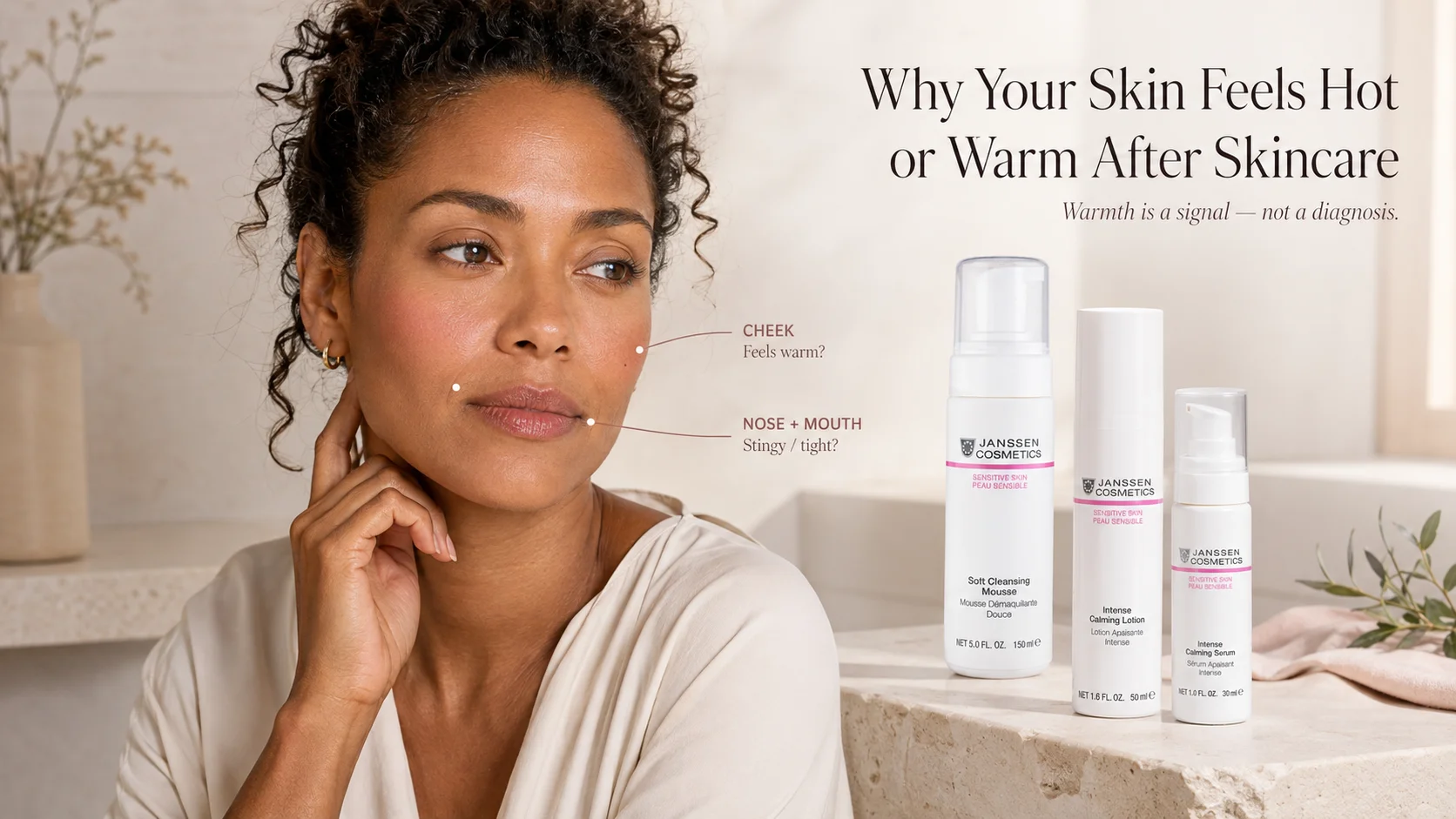
Skincare should not leave your face feeling as though it is heating up for a long time.
A brief feeling of warmth may occasionally happen after washing, massaging the skin, exercising, entering a warm room, or applying an active product.
But persistent heat is different.
If your face feels hot after cleansing, toner, serum, moisturizer, retinol, exfoliating acid, or SPF, the skin may be telling you that something in the routine is too active, too frequent, or not being tolerated well.
The warmth may appear with:
Sometimes the cause is one product.
Other times, the problem is the complete routine.
A cleanser may be too drying. The water may be too hot. The skin may have been rubbed for too long. An acid toner may be followed by vitamin C, retinol, and a fragranced moisturizer.
At Zendevie, our licensed esthetician first looks at the pattern: when the warmth begins, how long it lasts, which products were applied, whether the skin was recently exfoliated, and whether moisturizer or SPF has also started to sting.
The goal is not to immediately add another calming product.
The first step is understanding what may be creating the heat.
Your skin may feel hot or warm after skincare because of:
A simple starting routine may be:
Morning: Gentle cleanser or lukewarm-water rinse if appropriate → moisturizer → SPF
Evening: Gentle cleanser → moisturizer
Pause unnecessary active products while the skin feels hot.
Stop using a product if it repeatedly causes strong heat, burning, pain, swelling, rash-like irritation, blistering, crusting, bleeding, or worsening discomfort.
Seek urgent medical care for breathing difficulty, rapid facial swelling, throat tightness, faintness, or another severe reaction.
Not every brief feeling of warmth means something is seriously wrong.
Skin may feel temporarily warm after:
The important questions are:
Brief warmth that fades without discomfort is different from persistent heat that feels painful or increasingly uncomfortable.

People often use these words interchangeably, but they can describe different levels of sensation.
The skin feels slightly warmer than usual, but there is no pain, swelling, or lasting discomfort.
The skin feels lightly prickly or active.
Some formulas may create a brief tingling sensation, but tingling is not required for a product to work.
The skin feels sharper or more uncomfortable than a mild tingle.
Stinging may suggest that the skin is reactive or that a product is too active.
The skin feels intensely hot, painful, or increasingly uncomfortable.
Strong or persistent burning should not be ignored.
Sensitive skin should not be forced through repeated burning because a product is popular or described as effective.
Sensitive skin may react more strongly when its protective surface feels stressed.
The skin may become less tolerant after:
When the skin is already uncomfortable, products that were previously tolerated may begin to sting or feel hot.
This does not always mean the product formula changed.
The condition of the skin may have changed.
Some people continue using a product because they believe warmth means:
A product does not need to make sensitive skin feel painfully hot to be effective.
Strong or persistent warmth may be a reason to reduce frequency, pause the product, or stop it completely.
Do not use discomfort as the measurement of effectiveness.
Water temperature matters.
Very hot water may leave sensitive skin:
The skin may feel as though the cleanser caused the reaction when the water temperature was also involved.
Use lukewarm water.
The water should not leave the face hot after rinsing.
Long hot showers can also affect facial skin even when the face is not directly under the water.

Cleansing creates friction.
Sensitive skin may feel warm when cleansing includes:
A cleanser should loosen daily residue without turning cleansing into a massage treatment or exfoliation session.
Use gentle pressure.
Pat the skin dry rather than rubbing it with a towel.
Some cleansers remove oil and residue efficiently but leave sensitive skin uncomfortable.
A cleanser may be too strong when the skin feels:
Review whether the cleanser contains:
An active cleanser should be counted as an active product.
It should not be treated like a neutral cleansing step.
Sensitive skin may become more reactive when it is cleansed repeatedly.
This may happen when someone washes:
More washing may create more tightness and warmth.
After light sweating, some skin may only need a gentle lukewarm-water rinse.
The correct approach depends on makeup, SPF, exercise, oiliness, and the cleanser being used.
Double cleansing can be useful for heavy makeup or water-resistant sunscreen.
But two cleansers are not automatically required every night.
Sensitive skin may feel hot when:
A double cleanse should not leave the skin hot or stripped.
Facial steaming is often used to create a spa-like experience.
But steam exposes the skin to heat and moisture for an extended period.
Sensitive or redness-prone skin may feel:
Steam does not need to be part of a home sensitive-skin routine.
Do not apply strong acids, retinol, scrubs, or essential oils immediately after steaming.
Not all toners are gentle.
A toner may contain:
If toner makes the face feel hot, review the formula.
A toner should not be used simply because it is considered a required step.
Sensitive skin can have a complete routine without toner.
A gentle tonic may be considered when it serves a clear purpose and feels comfortable.
An acid toner is not only a refreshing preparation step.
It is an exfoliating product.
Using an acid toner every day may make sensitive skin feel:
Do not apply another AHA, BHA, scrub, or retinol simply because the first acid comes in a toner bottle.
The category name does not change the active function.
AHA and BHA may help support the appearance of texture, dullness, or clogged-looking pores.
They may also feel too active for sensitive skin.
Warmth may be more likely when acids are:
If an acid repeatedly makes the face feel hot, pause it.
Acid exfoliation is optional.
Over-exfoliation may happen through:
When the routine becomes too active, even a basic moisturizer may begin to burn.
Signs may include:
Do not add another exfoliant to remove the flakes.
Pause active products and simplify.
Retinol may be considered for visible aging concerns, rough texture, uneven-looking tone, or pore appearance.
Sensitive skin may feel hot when retinol is:
Retinol should not strongly burn.
If the skin feels hot every time retinol is used, stop and review the formula, frequency, and routine.
Vitamin C formulas vary in type, concentration, pH, texture, and supporting ingredients.
Some formulas may create a brief sensation.
However, persistent warmth or burning may suggest that:
Sensitive skin does not need to tolerate pain to receive antioxidant support.
If vitamin C repeatedly creates heat, pause it.
Some sensitive skin tolerates selected fragranced products.
Other skin may feel hot, itchy, stingy, or redness-prone.
Fragrance exposure may come from:
One lightly fragranced product may feel comfortable.
Several fragranced layers may increase total exposure.
If warmth appears after a scented product, review the complete formula rather than relying only on the product’s front label.
Essential oils may produce strong sensory effects.
Peppermint or eucalyptus may feel cooling.
Cinnamon, clove, or warming botanical oils may feel hot.
Citrus or tea tree oils may sting some sensitive skin.
A cooling or warming feeling does not automatically mean the product is supporting the skin.
Do not apply undiluted essential oils directly to sensitive facial skin.
Avoid homemade essential-oil mixtures.
If the product repeatedly burns or creates painful heat, stop using it.
Moisturizer is expected to support comfort.
If it makes the face feel hot, possible reasons include:
Do not assume the moisturizer is always the original cause.
Review the products applied before it.
A rich cream may feel helpful for dry-sensitive skin.
But an overly heavy or occlusive layer may feel uncomfortable in heat or humidity.
The skin may feel:
This does not mean rich creams are bad.
It means texture should match the skin, season, climate, and routine.
Oily-sensitive skin may prefer a lighter lotion.
Dry-sensitive skin may need a richer cream, especially in winter.
A routine may include:
Sensitive skin may feel warm under so many layers, particularly in humid weather.
The products may also move toward the eyes or mouth.
Use only the steps that serve a clear purpose.
More layers do not automatically create better hydration or results.
Facial oils may help reduce the feeling of dryness for some people.
But they may also:
If oil is applied, use only the amount needed.
Do not assume dry or sensitive skin needs oil in addition to serum, cream, and balm.
The routine may already contain enough emollient support.
Sunscreen may feel warm because of:
SPF remains important.
Do not respond by stopping daytime protection while continuing strong active products.
Instead, review the complete morning routine and consider whether a different texture may feel more comfortable.
Foundation, primer, setting spray, concealer, powder, and long-wear makeup may add several layers over skincare and SPF.
The face may feel warmer when:
If warmth appears only after makeup, review both the makeup and the skincare underneath.
Products used on the hair may touch:
Perfume sprayed on the neck, hair, scarf, or clothing may also come near the face.
If warmth or redness-looking areas appear around the hairline or sides of the face, review:
The cause may not be facial skincare alone.
Products stored:
may feel warmer during application.
Store products according to their directions.
Do not apply products that have changed significantly in smell, color, texture, or consistency without reviewing whether they are still suitable for use.
Some hydrating products work well on slightly damp skin.
However, active products applied to very wet skin may feel more intense.
Sensitive skin should be cautious when applying these to damp skin:
Follow the product directions.
Do not assume every product should be applied immediately to wet skin.
Skincare does not need to be pressed or massaged forcefully to work.
Aggressive application may create friction and warmth.
Be gentle around:
Apply products with light, controlled movements.
Do not continue massaging until the skin feels hot.
Large amounts of serum, moisturizer, oil, or SPF may increase:
Use the directed amount.
For active ingredients, more product may also increase irritation.
The eye area is delicate.
Facial products may migrate into this area and cause:
Keep facial acids, retinol, fragranced products, essential oils, and sprays away from the lash line.
Use products designed for the eye area when appropriate.
Seek medical guidance for significant swelling, pain, crusting, vision changes, or persistent irritation.
Products may collect in the folds around:
These areas may already be affected by:
Avoid applying active products to areas that are cracked-looking, flaky, burning, or rash-like.
Persistent mouth-area irritation should be evaluated by a dermatologist.
Dry-sensitive skin may feel hot when the routine removes too much surface comfort.
Review:
A simple routine may be:
Morning: Gentle cleanser or rinse → moisturizer → SPF
Evening: Gentle cleanser → moisturizer
If the skin is hot and flaky, active products should wait.
Oily-sensitive skin may look shiny while feeling hot or tight.
This can happen when the routine includes:
Do not respond by cleansing more often.
Review whether the skin is oily, dehydrated, over-exfoliated, or using too many clarifying products.
A lighter moisturizer may help support comfort.
Combination-sensitive skin may feel warm mainly on the cheeks while the T-zone remains oily.
The cheeks may not tolerate the same products or frequency as the forehead, nose, and chin.
A full-face acid or retinol routine may be too much.
Do not assume every area needs identical treatment.
Keep reactive areas simple.
Use targeted products only when they serve a clear purpose.
Redness-prone skin may look flushed and feel warm after:
Skincare cannot diagnose why redness and warmth occur.
If the pattern is persistent, painful, swollen, eye-related, or worsening, seek dermatologist guidance.
Mature sensitive skin may be drier and less tolerant of strong combinations.
Warmth may appear after:
A well-aging routine should not leave the skin raw, hot, or persistently tight.
Consistency, hydration, moisturizer comfort, and SPF may be more useful than frequent active treatments.
Blemish-prone sensitive skin may use several active products:
The complete routine may become too active.
If blemishes are painful, deep, swollen, cystic-looking, infection-looking, crusting, bleeding, persistent, or scarring, seek dermatologist guidance.
Do not attempt to manage painful heat by adding stronger spot products.
Shaving may temporarily increase skin sensitivity.
Warmth may become more noticeable when shaving is followed by:
Use gentle shaving habits.
Do not apply strong active products to freshly shaved areas.
Wait until the skin feels comfortable.
Waxing and threading may leave the skin more reactive.
Avoid applying:
immediately afterward.
If the area becomes painful, significantly swollen, blistered, rash-like, or infection-looking, seek professional guidance.
Dermaplaning, microdermabrasion, enzyme exfoliation, and professional peels may temporarily change product tolerance.
Follow the aftercare provided by the professional.
Do not immediately add:
Professional exfoliation systems should not be copied as home routines.
Do not apply active products to skin that feels:
After sun exposure, return to products the skin already tolerates.
If the skin is blistering, severely painful, significantly swollen, or worsening, seek medical guidance.
Heat, humidity, sweat, SPF layers, makeup, and frequent cleansing may make sensitive skin feel warmer.
During summer:
Warm weather may require a lighter routine.
Cold air and indoor heating may leave the skin dry and reactive.
The face may feel warm indoors after exposure to cold outdoor air.
A product may also sting more when the skin is weather-stressed.
During winter:
Travel may affect the skin through:
Do not begin several active products during travel.
Bring the basic routine the skin already tolerates.
If the face feels hot after travel, simplify before experimenting.
Exercise naturally increases body temperature.
Sweat, wiping, tight headbands, makeup, SPF, and hair products may also affect the face.
After exercise:
Do not apply strong acids or retinol while the face is still hot and sweaty.
Thick creams, balms, facial oils, sleeping masks, and multiple layers may feel too occlusive for some skin.
This may be more noticeable in:
A richer texture is not automatically better for sensitive skin.
Match the texture to the skin and environment.
Some masks are designed to feel cooling or warming.
Sensitive skin should not assume an intense sensation is necessary.
Remove the mask if it causes:
Do not leave a mask on longer than directed.
If skin reacts easily, patch test the finished cosmetic product before broad use.
Use a small amount on intact skin.
Observe for:
Do not patch test on skin that is recently shaved, exfoliated, sun-stressed, broken, or already irritated.
A comfortable patch test does not guarantee full-face tolerance.
Write down:
Patterns may become easier to identify when the routine is documented.
Brief warmth without pain, swelling, itching, or lasting redness-looking change may occur with some products.
Monitor it.
Ask whether the sensation becomes stronger with each use.
Stop the product if brief warmth progresses into:
Persistent warmth may suggest that the formula or routine is too active.
Review:
If the warmth is uncomfortable or increasing, remove or stop the product according to its directions.
Sensation and appearance do not always match.
The skin may feel hot without a strong visible color change.
This does not mean the sensation should be ignored.
Review how long the warmth lasts and whether it returns with each use.
If the sensation is persistent, painful, or worsening, stop the suspected product.
Redness-looking areas may appear without warmth.
Possible routine-related factors include:
Persistent or recurring redness-looking changes may need professional evaluation.
Skincare alone cannot diagnose the cause.
Review:
Switch back to the gentlest tolerated cleansing approach.
Do not follow hot-feeling skin with an acid toner or retinol.
Stop the toner temporarily.
Check whether it contains:
Toner is optional.
Sensitive skin should not keep using a toner that repeatedly creates heat.
Review the serum’s active ingredients.
Possible contributors include:
Use only one new serum at a time.
If warmth becomes burning, itching, swelling, or persistent redness-looking change, stop.
Pause the moisturizer and review the earlier routine steps.
The skin may have been irritated before the moisturizer was applied.
Check:
If every moisturizer begins to burn, simplify and consider dermatologist guidance.
Review:
Do not continue strong actives while avoiding SPF because the skin is uncomfortable.
The routine may need a more suitable sunscreen texture and fewer underlying layers.
Stop retinol until the skin feels stable.
Avoid:
Return to cleanser, moisturizer, and daytime SPF when tolerated.
Reconsider retinol only after the skin is comfortable with basic steps.
Pause exfoliation.
Do not scrub away flakes.
Avoid retinol and other acids.
Use a simple routine.
If the skin is painful, significantly swollen, blistering, crusting, bleeding, or worsening, seek medical guidance.
This may suggest that the skin is over-exfoliated or the exfoliating product was too active.
Do not assume the moisturizer is the only problem.
Pause the exfoliating product.
Use only products that remain comfortable.
If even basic products continue to burn, seek guidance.
Retinol or acids may have increased skin sensitivity.
Reduce or pause active products.
Review cleanser and moisturizer support.
A different SPF formula may also be needed.
Do not continue increasing active-product frequency while daytime care is uncomfortable.
Remove the makeup gently.
Review:
If symptoms occur every time the same makeup product is used, stop using it.
Cheeks may be drier or more redness-prone than the T-zone.
A full-face active product may be too much for them.
Keep the cheeks on a gentler routine.
Do not assume the same frequency is needed everywhere.
Products may collect in skin folds.
Avoid applying acids, retinol, strong vitamin C, fragrance, or essential oils directly to those areas.
Persistent cracking, rash-like changes, or pain should be evaluated by a dermatologist.
Stop applying facial products near the eyes.
Review:
Seek medical guidance for swelling, pain, crusting, vision changes, or persistent irritation.
Do not cleanse more aggressively.
The skin may be:
Review the complete routine.
A lighter moisturizer may support comfort without feeling heavy.
Pause:
Do not remove flakes mechanically.
Use a gentle cleanser and tolerated moisturizer.
Persistent or worsening flaking should be evaluated.
Stop the suspected product.
Do not scratch.
Avoid adding more botanical or fragranced products.
Persistent, spreading, severe, swollen, blistering, or sleep-disrupting itching should be evaluated by a dermatologist.
Stop the suspected product.
Significant swelling—especially around the eyes, lips, tongue, or throat—needs prompt medical attention.
Seek urgent care for:
Do not attempt to manage a severe reaction with additional skincare.
Stop introducing new products.
Return to the simplest products that remain comfortable.
The skin may be:
If water, cleanser, moisturizer, and SPF all create significant discomfort, seek dermatologist guidance.
That is useful information.
It may suggest that the earlier routine included:
Do not add everything back at once.
Reintroduce one product at a time only when it serves a clear purpose.
Pause retinol, acids, scrubs, strong vitamin C, and clarifying masks when the skin is:
Active products can wait.
Gentle cleanser or lukewarm-water rinse if appropriate → tolerated moisturizer → tolerated SPF
Gentle cleanser → tolerated moisturizer
Temporarily avoid:
The routine should feel predictable and comfortable.
A product may be reconsidered when the skin is:
Patch test the finished product.
Reintroduce only one product.
Use less frequently at first when appropriate.
If warmth returns, stop and reassess.
Feeling hot after skincare tells you that the skin is responding to something.
It does not identify the exact cause by itself.
The cause may involve:
Cosmetic skincare can help organize the routine.
It cannot diagnose why persistent facial heat or redness is occurring.
A dermatologist should evaluate the skin if warmth is accompanied by:
Seek urgent medical care for breathing difficulty, throat tightness, rapid swelling of the face, lips, tongue, or eyes, faintness, or another severe reaction.
After consultation, our licensed esthetician may consider Janssen Cosmetics options based on whether the skin is dry-sensitive, oily-sensitive, combination-sensitive, mature-sensitive, redness-prone, or currently uncomfortable.

For a simple sensitive-skin foundation, possible options may include:
These products should not be introduced as one automatic routine.
If the skin feels hot after skincare, the first step is not necessarily adding serum, tonic, mask, eye cream, and moisturizer together.
A consultation may begin by identifying which basic cleanser, moisturizer, and SPF steps the skin already tolerates.
The moisturizer texture also matters.
Intense Calming Lotion may be considered when the skin prefers a lighter texture.
Intense Calming Cream may be considered when the skin needs richer comfort.
A product should not be selected only because the skin feels sensitive. Dryness, oiliness, climate, product layering, and routine comfort should also be considered.
Active Janssen options from other product families—including AHA, BHA, enzyme exfoliation, retinol, and strong vitamin C products—should wait when the skin feels persistently hot, burns from moisturizer, or reacts to SPF.
Professional exfoliation systems belong in professional treatment settings.
They should not be used as home routines or applied to skin that is already warm, irritated, or reactive.
Do not use very hot water.
Do not cleanse for several minutes.
Do not scrub with a brush, sponge, rough cloth, or exfoliating pad.
Do not assume facial steaming is required.
Do not apply acid toner to skin that already feels hot.
Do not combine AHA, BHA, retinol, strong vitamin C, scrubs, and masks.
Do not treat burning as proof that a product works.
Do not continue retinol if the face feels hot every time.
Do not apply undiluted essential oils.
Do not use warming or cooling sensations as a measurement of effectiveness.
Do not apply active products immediately after shaving, waxing, threading, dermaplaning, or professional exfoliation.
Do not apply acids or retinol to sun-stressed skin.
Do not rub skincare aggressively.
Do not apply several heavy layers in hot or humid weather.
Do not assume every sensitive complexion needs a rich cream.
Do not skip moisturizer automatically because the skin looks oily.
Do not stop SPF while continuing strong active products.
Do not apply facial acids or retinol close to the eyes or mouth corners.
Do not add several calming products over a reaction without reviewing the cause.
Do not start several new products at once.
Do not copy professional peel protocols at home.
Do not ignore persistent heat, pain, swelling, blistering, crusting, bleeding, eye-area symptoms, or worsening reactions.
Possible reasons include hot water, friction, a strong cleanser, exfoliating acids, retinol, vitamin C, fragrance, essential oils, heavy layering, recent hair removal, sun exposure, or a product the skin does not tolerate.
A brief mild sensation may happen with some products. Persistent, painful, itchy, swollen, or worsening warmth is a reason to stop and review the routine.
The water may be too hot, the cleanser may be too strong, or the skin may be rubbed for too long. An active cleanser may also be contributing.
The toner may contain alcohol, AHA, BHA, fragrance, essential oils, or astringent ingredients. Toner is optional and should not repeatedly burn.
Serums may contain active ingredients such as vitamin C, retinol, AHA, BHA, fragrance, or botanical extracts. The formula may be too active for the skin’s current condition.
The moisturizer may not suit the skin, or the skin may already be irritated from cleansing, acids, retinol, shaving, weather exposure, or another product.
The SPF texture may feel heavy, the morning routine may have too many layers, or the skin may already be irritated. Fragrance and eye migration may also contribute.
Yes. Over-exfoliation may cause warmth, tightness, flaking, unusual shine, and stinging from products that were previously comfortable.
Yes. Retinol may feel too active when it is used too often, applied in a large amount, combined with acids, or used on already irritated skin.
Some vitamin C formulas may create a brief sensation. Persistent burning, heat, swelling, or rash-like irritation is not something sensitive skin should push through.
Fragrance may contribute to warmth, itching, stinging, or redness-looking areas for some sensitive skin.
Yes. Some essential oils create warming, cooling, or tingling sensations and may be uncomfortable for sensitive skin. Do not apply undiluted essential oils directly to the face.
Sensation may occur without a strong visible color change. Persistent or worsening heat should still be reviewed.
The skin may be over-cleansed, dehydrated, over-exfoliated, or covered with too many heavy layers. More cleansing may worsen the discomfort.
Stop the suspected product, avoid additional active ingredients, use a simple routine that remains comfortable, and monitor the skin.
If a rinse-off or newly applied product causes strong burning, remove it according to its directions using cool or lukewarm water. Do not scrub.
A mask is not always necessary. Some masks contain fragrance, clay, acids, or warming ingredients. Begin with the simplest tolerated routine instead.
Do not place ice directly on facial skin. Sudden extreme cold may create additional discomfort. Use cool—not freezing—conditions and seek guidance for significant reactions.
Pause until cleanser, moisturizer, and SPF feel consistently comfortable. Persistent or recurring heat should be evaluated by a dermatologist.
See a dermatologist if the warmth is persistent, painful, significantly swollen, blistering, crusting, bleeding, infection-looking, near the eyes, repeatedly returning, or not improving after products are stopped.
If your face feels hot after cleansing, moisturizer, serum, retinol, exfoliation, or SPF, a free virtual consultation can help you review the complete routine before adding another product.
At Zendevie, we look at your cleanser, water temperature, toner, serums, moisturizer, SPF, exfoliation schedule, retinol use, fragrance exposure, essential oils, makeup, weather, and reaction history.
The goal is not to cover warmth with more layers.
The goal is to identify which steps your skin tolerates, which products may be too active, and when a persistent reaction should be evaluated by a dermatologist.

Zendevie is guided by Haby Diallo, a licensed esthetician with more than 20 years of professional skincare experience. Her approach is rooted in education, professional judgment, and personal care.
years of experience