

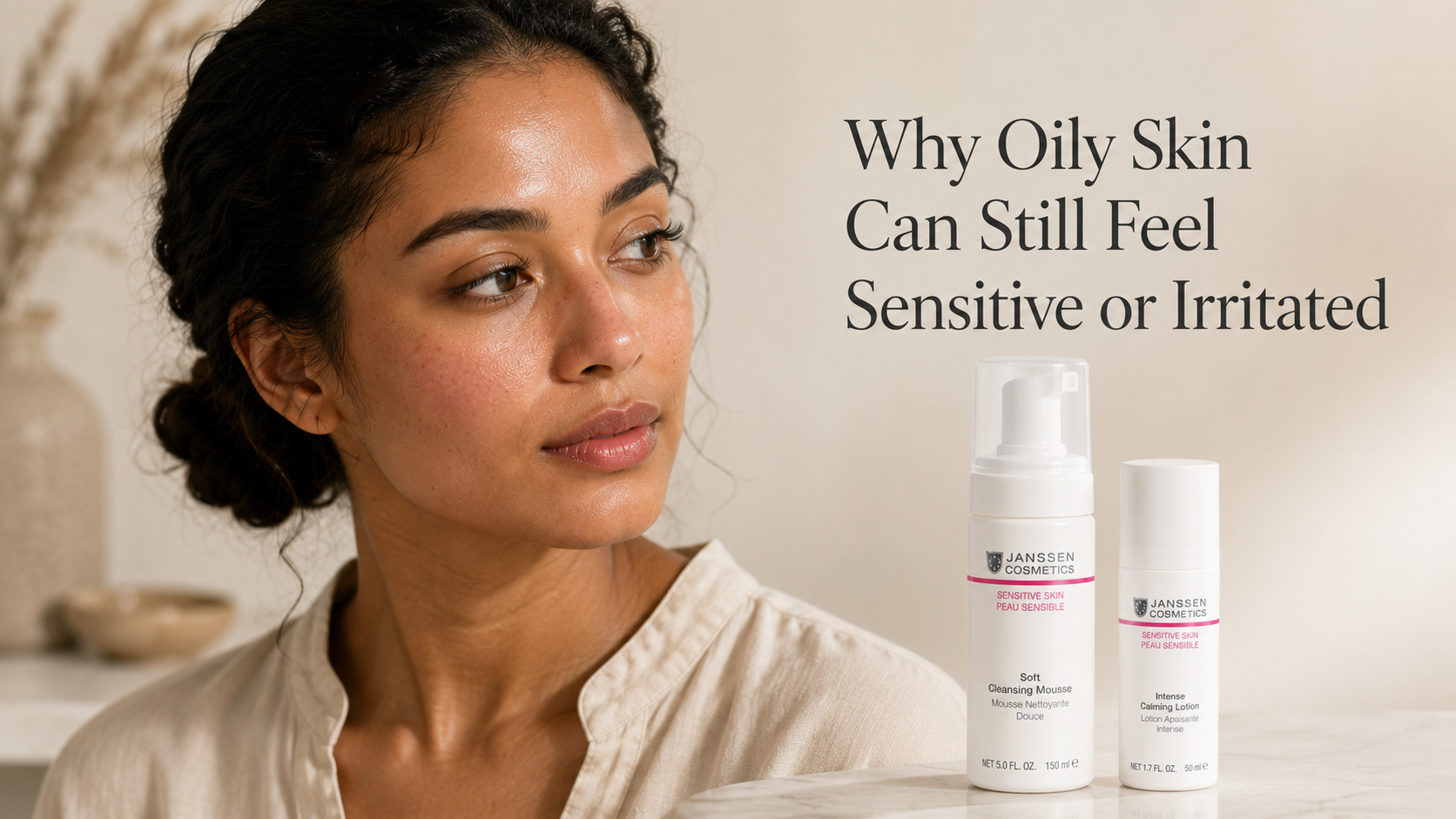
Oily skin is often treated as if it can handle anything.
Strong cleanser. Drying toner. BHA serum. Clay mask. Scrub. Retinol. Spot product. More washing when shine returns.
But oily skin can still sting. It can still burn after toner. It can still feel tight after cleansing. It can still become red-prone, flaky, rough, or reactive after too many active products.
This is one of the most misunderstood oily skin patterns.
A face can look shiny and still feel irritated. The T-zone may produce oil, while the skin underneath feels tight or easily triggered. Makeup may separate around the nose but cling around the mouth or cheeks. A product meant to control oil may leave the skin feeling raw.
In consultation, our licensed esthetician does not assume oily skin needs stronger products. We first look at what the skin is showing: oil, tightness, stinging, clogged-looking pores, product habits, and how much the skin can tolerate.
Oily skin can feel sensitive or irritated when it is over-cleansed, dehydrated, over-exfoliated, exposed to too many active products, or using formulas that are too harsh for its current condition.
Signs may include:
The answer is not always stronger oil control. Often, the first step is to simplify.
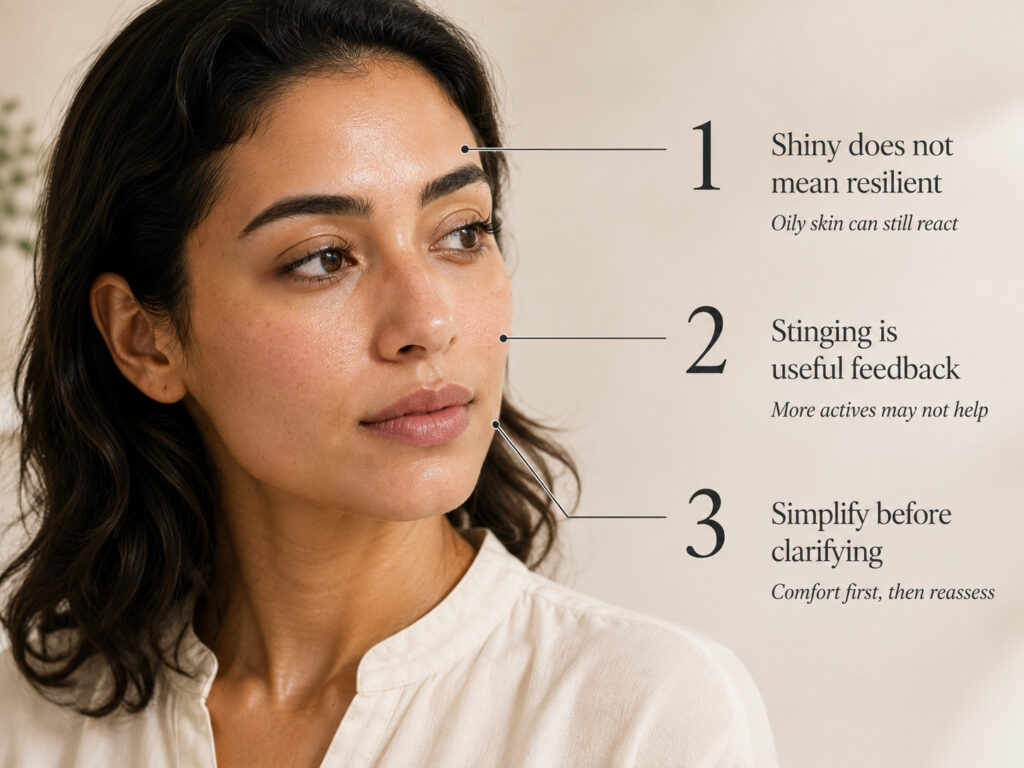
Oily skin describes oil production.
Sensitive-feeling skin describes how the skin reacts.
That means a person can have both at the same time. The skin may produce visible oil and still react easily to cleansing, acids, fragrance, scrubs, masks, or repeated product changes.
This is why “oily” is not enough information by itself.
Two people may both have oily skin, but one can tolerate BHA several nights a week while another stings after one use. One may need more clarifying steps. Another may need fewer products before the skin can be read clearly.
Oily skin is visible, so people often try to control it quickly.
If shine comes back, they cleanse again. If pores look clogged, they add acid. If the T-zone feels greasy, they apply a mask. If whiteheads show up, they add a drying spot product.
Each step may seem logical on its own.
The problem starts when all of those steps happen together.
Oily skin can become overwhelmed when the plan includes too many drying or exfoliating products. The skin may still look shiny, but it starts feeling tight, irritated, or unpredictable.
Tightness after cleansing is one of the first clues.
If your oily skin feels stretched right after washing, the cleanser may be too strong, the water may be too hot, or you may be washing too often.
That tight feeling is not proof that the skin is clean in a better way. It may mean the cleansing step is removing too much.
Oily skin should feel fresh after cleansing, not raw.
Toner can be useful for oily skin, but it should not feel sharp every time you use it.
If toner stings, burns, or leaves the face stretched, it may be too drying, too active, or not right for the skin at that moment.
This is especially common when toner is used after a strong cleanser or alongside acids, masks, and retinol-style products.
If toner makes your skin feel worse, pause and reassess. Oily skin does not need toner at any cost.
Moisturizer should usually make the skin feel less bare.
If moisturizer burns, the problem may not be the moisturizer alone. The skin may already be irritated before moisturizer is applied.
This can happen after:
When moisturizer stings repeatedly, the plan should become simpler before adding more clarifying products.
This is common with oily-dehydrated skin.
The face may look greasy, but the skin feels tight, dull, or rough. Makeup may separate in the T-zone but cling around the cheeks or mouth.
This can happen when the skin has oil on the surface but not enough water-based hydration. It can also happen when cleansing and exfoliation are too aggressive.
If your skin feels oily and tight, the answer is not to dry it out further. The plan may need lighter hydration and fewer harsh steps.
Flaking can happen even when the skin is oily.
You may see flakes around the nose, mouth, chin, or between the brows while the T-zone still gets shiny.
That can be a sign of dehydration, irritation, product overuse, or a cleanser that is too stripping.
Do not automatically scrub those flakes away. Scrubbing can make the skin feel more irritated and may make makeup look rougher.
If your usual products suddenly sting, the skin may be under stress.
This can happen after travel, weather changes, new products, frequent exfoliation, sun exposure, hot showers, or a period of over-cleansing.
When oily skin becomes reactive, do not keep adding new products to “fix” it. That can make it harder to know what the skin is reacting to.
The better move is to reduce variables.
Irritated oily skin often does not wear makeup well.
Foundation may separate in oily areas but look patchy or textured where the skin is tight. Powder may cling. Primer may pill. Concealer may settle around dry-looking areas.
When this happens, the issue is not always makeup.
The skin prep may be too harsh, too dry, too active, or too layered.
A smoother-looking makeup result often starts with a calmer daily plan.
Over-cleansing is one of the most common reasons oily skin becomes sensitive-feeling.
This may include:
Most oily skin does better with morning and evening cleansing. After sweating or heavy makeup, another cleanse may make sense. But repeated washing often creates more tightness than clarity.

Oily skin often benefits from exfoliating ingredients when the skin has clogged-looking pores, blackheads, whiteheads, or rough buildup.
But too much exfoliation can make oily skin feel irritated.
This can happen with:
If the skin feels stingy, flaky, tight, or rough under makeup, pause and simplify before adding another active step.
Many people with oily skin skip moisturizer because they do not want to feel greasy.
But skipping moisturizer can leave the skin feeling bare after cleansing. Then active products may sting more, makeup may look rougher, and the skin may feel tight even while it still produces oil.
The answer is not a heavy cream for everyone.
Oily sensitive skin often needs a light texture that makes the face feel less exposed without leaving a greasy finish.
Spot products should not become full-face products.
When blemish-prone areas appear, it can be tempting to apply drying products across the whole face. That may leave the skin tight, flaky, or irritated, especially around the cheeks and mouth.
If the concern is localized, product placement should be localized too.
The whole face does not always need the same strength.
Clay masks can be helpful for oily areas, especially the T-zone.
But using clay too often can leave the skin feeling dry or stretched. This is especially true if clay masks are used all over the face when only the nose and forehead are oily.
If your cheeks feel tight after a mask, consider applying the mask only where oil is visible.
Masking should match the area, not the whole face by default.
When skin reacts easily, the first step is usually not adding more.
It is reducing confusion.
If you are using several new products at once, you cannot tell what is helping and what is irritating. This is especially important with oily skin because active ingredients are often layered quickly.
A simpler plan can make the skin easier to read.
For a short time, that may mean:
Cleanser → Lightweight moisturizer → SPF in the morning
At night:
Cleanser → Lightweight moisturizer
Once the skin feels less reactive, toner, BHA, masks, or other steps can be reviewed again.
When oily skin feels irritated, think in phases.
First, calm the plan down.
Then, once the skin feels more stable, decide whether oil, clogged-looking pores, texture, or makeup separation still need more specific attention.
A short-term plan may include:
This does not mean the skin will never use active products again. It means the skin needs a clearer starting point.
Pause active products if your oily skin feels:
Products to pause may include:
Active products work best when the skin can tolerate them.
Once the skin feels calmer, clarifying steps can be considered again.
Do not restart everything at once.
Start with one decision:
If clogged-looking pores remain and the skin feels stable, BHA may be considered slowly.
If the T-zone feels heavy, a mask may be used occasionally and only where needed.
If the skin is mostly shiny but not clogged-looking, texture and moisturizer choice may matter more than acids.
Morning care should avoid making the skin feel tight before the day even starts.
A simple order may be:
Cleanser → Lightweight moisturizer → SPF
If toner is tolerated, it may fit after cleansing. If toner stings, skip it for now.
If the skin is oily but tight, choose a light moisturizer that gives enough hydration without feeling heavy.
SPF should still be part of morning care when the skin tolerates it. If SPF feels irritating, greasy, or dry, the texture may need to be reviewed.
Evening care should remove the day without creating more irritation.
A simple order may be:
Cleanser → Lightweight moisturizer
If sunscreen or makeup is heavy, cleansing needs to be thorough but not aggressive.
If the skin feels stable, a targeted product may be added later. But if the face is stinging or flaky, keep the evening plan simple.
Night is not the time to layer every active product just because the skin is oily.
Sensitive oily skin can still have clogged-looking pores.
The goal is to address them without overwhelming the skin.
BHA may be considered, but it should be introduced slowly and placed where it is needed. For example, the nose, chin, or forehead may need attention more than the cheeks.
If the skin reacts easily, BHA does not need to start every night. It also does not need to be combined with a scrub, clay mask, active toner, and retinol at the same time.
Whiteheads or closed comedones can appear on oily sensitive skin, especially when products are too heavy, cleansing is incomplete, or the skin is reacting to product overload.
Before adding more acids, look at:
Whiteheads are not always a sign that the skin needs harsher cleansing.
Red-prone oily skin should be handled carefully.
Do not assume every red area needs exfoliation. Redness-prone areas may become more noticeable when the skin is over-cleansed, rubbed, masked too often, or exposed to strong active products.
Use low-friction cleansing, avoid scrubbing, and reduce unnecessary steps.
If the redness is persistent, painful, swelling, rash-like, or worsening, a dermatologist or healthcare professional should evaluate it.
If BHA burns, stop and review the whole plan.
The issue may be:
BHA can be useful for clogged-looking pores, but it should not feel like the skin is being punished.
Some people with oily sensitive skin have trouble with SPF textures.
If SPF burns, stings, pills, or feels greasy, the problem may be the formula, the layers underneath, or the skin’s current irritation level.
Do not skip SPF permanently because one texture did not work. Review the cleanser, moisturizer, active products, and the SPF formula.
If the skin is very irritated, pause strong active products while finding a daytime option the skin can tolerate.
Some concerns need medical evaluation.
See a dermatologist or healthcare professional if you notice:
Skincare can help with cosmetic home care, but it should not replace medical advice when the skin needs evaluation.
After consultation, our licensed esthetician may consider Janssen Cosmetics options depending on whether the skin is oily, sensitive-feeling, clogged-looking, dehydrated, or reacting from product overload.

Possible oily-skin options may include:
If the skin feels too reactive for clarifying steps, sensitive-skin options may be discussed first, such as:
These are not automatic recommendations. The right choice depends on whether the skin needs clarifying care now or whether it first needs fewer active steps.
Do not assume oily skin can tolerate every strong product.
Do not keep using a cleanser that leaves the face tight.
Do not use toner if it burns every time.
Do not layer BHA, AHA, retinol, scrub, clay mask, and drying products all at once.
Do not apply active products to areas that are already flaky, raw, or irritated.
Do not skip moisturizer because the skin is shiny.
Do not use clay masks on dry or reactive cheeks.
Do not keep experimenting if the skin becomes painful, swollen, infected-looking, rash-like, or persistently burning.
Yes. Oily skin describes oil production, while sensitive-feeling skin describes how the skin reacts. A person can have both.
Your skin may be over-cleansed, over-exfoliated, dehydrated, or reacting to too many active products at once.
The cleanser may be too strong, the water may be too hot, or the skin may be dehydrated. Tightness after cleansing is a clue that the first step may need adjustment.
BHA may be considered if clogged-looking pores, blackheads, or whiteheads are present, but it should be introduced carefully and not layered with too many active products.
Only if the toner feels fresh and non-stripping. If it burns, stings, or leaves the face stretched, it may not be right at that time.
Yes. The texture should be light enough for oily areas but still make the skin feel less bare after cleansing.
Yes. Clay masks can feel too drying if used too often or applied to areas that are not oily. They may work better only on the T-zone.
A dermatologist should evaluate painful, deep, swollen, cystic-looking, infected-looking, scarring, rash-like, suddenly worsening, or persistent concerns.
If your skin is oily but also stings, burns, feels tight, or reacts easily, a free virtual consultation can help you slow the plan down and understand what your skin is showing.
At Zendevie, we look at your shine pattern, product reactions, cleansing habits, clogged-looking pores, and current active products before recommending next steps. The goal is to help your skin feel easier to manage without guessing.

Zendevie is guided by Haby Diallo, a licensed esthetician with more than 20 years of professional skincare experience. Her approach is rooted in education, professional judgment, and personal care.
years of experience