

Moisturizer is supposed to feel comforting.
So when it burns, stings, or makes your face feel hot, it can be confusing. You may wonder if the moisturizer is bad, if your skin is reacting, or if the burning means the product is working.
In most cases, moisturizer should not cause strong burning.
A brief mild sensation can sometimes happen when skin is very dry or when a product contains certain active ingredients. But repeated burning, sharp stinging, heat, swelling, rash-like irritation, or discomfort that lasts should not be ignored.
At Zendevie, we look at moisturizer burning as a signal. It tells us the skin may not be comfortable with the current routine, the current formula, or the current condition of the skin barrier.
In consultation, our licensed esthetician looks at what happened before the moisturizer was applied. The moisturizer may not be the only issue. The cleanser, toner, exfoliation, retinol-style products, vitamin C, weather, sun exposure, or too many new products may have made the skin more reactive.
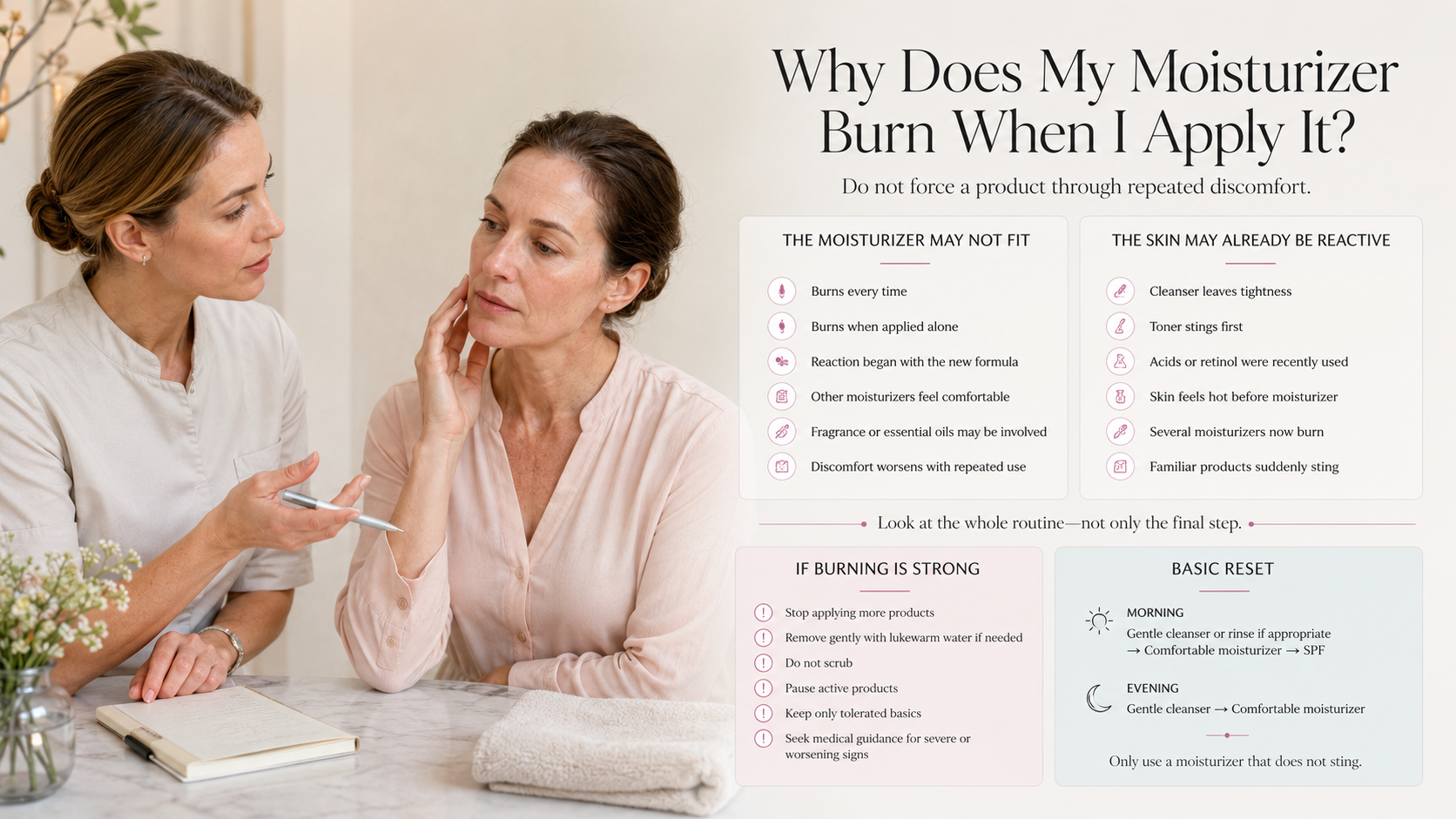
Your moisturizer may burn when you apply it because your skin is already irritated, dry, over-exfoliated, barrier-stressed, or reacting to an ingredient or product combination.
Common reasons include:
If moisturizer burns strongly or repeatedly, simplify your routine.
A basic reset may look like:
Morning: Gentle cleanser → Moisturizer that does not sting → SPF
Evening: Gentle cleanser → Moisturizer that does not sting
Pause active products until the skin feels calmer.
If burning comes with swelling, rash-like irritation, pain, crusting, bleeding, eye-area irritation, or persistent worsening, seek dermatologist guidance.
When moisturizer burns, the first answer is not to buy more products immediately.
The first answer is to slow down.
Burning can happen when the skin is overwhelmed. If you add more serums, exfoliants, masks, or spot products, the skin may become even harder to calm.
A better first step is to ask:
These answers help identify whether the issue is the moisturizer or the condition of the skin.
A moisturizer can burn for two different reasons.
First, the moisturizer itself may not suit your skin. It may contain fragrance, essential oils, certain active ingredients, or a texture that does not work for you.
Second, the moisturizer may be applied to skin that is already irritated. In that case, even a normally comfortable moisturizer may sting.
This is why we do not judge the moisturizer alone. We look at the whole routine.
If your moisturizer used to feel fine but suddenly burns, the skin may have changed. If a new moisturizer burns every time, the formula may not be a good match.
The skin barrier is the outer surface that helps keep moisture in and helps reduce the impact of outside stressors.
When this surface feels weakened or stressed, even simple products may sting.
Signs the skin barrier may be stressed include:
When the barrier feels stressed, active products often need to pause.
Dry skin may burn when moisturizer is applied because the surface is already uncomfortable.
When the skin is dry, tight, or flaky, product application can feel sharp. This is especially true if the moisturizer contains fragrance, active ingredients, or a formula that is not suited to the skin’s current condition.
Dry skin may become more reactive after:
If dryness is the issue, the routine should become simpler and more comfort-focused.
Dehydrated skin lacks water in the surface layers.
This can happen even if your skin is oily.
Oily skin can still feel tight, stingy, or dry underneath the shine. If you apply moisturizer over dehydrated, over-cleansed, or over-exfoliated oily skin, it may burn.
This is why oily skin should not be stripped.
A lightweight moisturizer may be more appropriate than skipping moisturizer completely, but if every moisturizer burns, the routine needs to be simplified first.
If your cleanser leaves your skin tight, the moisturizer may burn afterward.
The cleanser may be removing too much from the surface, or it may be used too often.
Signs your cleansing step may be too harsh include:
Sensitive skin needs cleansing that removes daily buildup without leaving the face raw.
Very hot water can make the skin feel cleaner, but it can also leave it more reactive.
After hot water, moisturizer may sting because the skin feels stripped or overheated.
Use lukewarm water instead.
Avoid scrubbing with towels, cleansing brushes, or rough cloths when the skin is already burning.
Soft application matters.
Sometimes the moisturizer is not the main reason for burning.
The toner applied before it may be making the skin reactive.
If toner stings, burns, or leaves the skin tight, moisturizer applied afterward may feel uncomfortable too.
Sensitive skin does not always need toner every day. If toner causes discomfort, pause it and see whether moisturizer feels better without it.
A toner should prepare the skin, not make the next step burn.
Over-exfoliation is one of the most common reasons moisturizer burns.
This can happen from:
Over-exfoliated skin may feel:
If moisturizer burns after exfoliation, stop exfoliating until the skin feels comfortable again.
AHA and BHA products can be useful when selected correctly, but sensitive skin needs caution.
If you use exfoliating acids too often, moisturizer may burn afterward.
AHA is often discussed for dull surface buildup and rough texture.
BHA is often discussed for clogged-looking pores, blackheads, and whiteheads.
But neither should be layered casually when the skin feels sensitive.
If moisturizer burns after acids, reduce frequency or pause them completely until the skin feels stable.
Retinol-style products can make skin feel dry, tight, or sensitive if introduced too quickly.
If moisturizer burns the morning after retinol-style care, your skin may need a slower schedule or a simpler routine.
Retinol-style products should not be layered with every exfoliating product, scrub, and active toner.
Sensitive skin may need:
If burning is strong or persistent, pause and seek guidance.
Vitamin C can be helpful in some routines, but it can also sting depending on the formula and the skin condition.
If you apply vitamin C before moisturizer and then the moisturizer burns, the skin may be reacting to the active step.
This can happen when:
Sensitive skin should not force vitamin C while the skin is burning.
Fragrance can be a reason moisturizer burns for some sensitive skin types.
Not everyone reacts to fragrance, but if your skin burns, stings, or becomes red-looking after scented products, fragrance should be reviewed.
Fragrance may appear in:
If your skin reacts easily, fragrance-free or low-fragrance options may be better to consider.
Essential oils may sound calming, but sensitive skin does not always tolerate them.
A moisturizer with essential oils can sting, especially when the skin is already dry, exfoliated, or irritated.
Natural does not automatically mean gentle.
If your skin burns after botanical or spa-style moisturizers, review essential oils and fragrance components as possible triggers.
After sun exposure, skin can feel warmer, drier, and more reactive.
Moisturizer that usually feels fine may suddenly sting.
This can also happen after:
If skin feels sun-stressed, keep the routine simple. Avoid exfoliating acids, retinol-style products, scrubs, and strong masks until the skin feels calmer.
Cold weather and indoor heating can make sensitive skin drier.
In winter, moisturizer may sting because the skin is already tight, wind-exposed, or dehydrated.
If this happens, review:
Winter skin may need fewer active steps and more comfort.
Summer can also make moisturizer burn.
Heat, sweat, humidity, SPF layers, and more frequent cleansing can make the skin reactive.
Moisturizer may sting if:
Summer sensitive skin may need lighter textures, not more stripping.
Sometimes moisturizer burns because too many steps came before it.
For example:
Cleanser → exfoliating toner → vitamin C → BHA → retinol-style product → moisturizer
This is too much for many sensitive skin types.
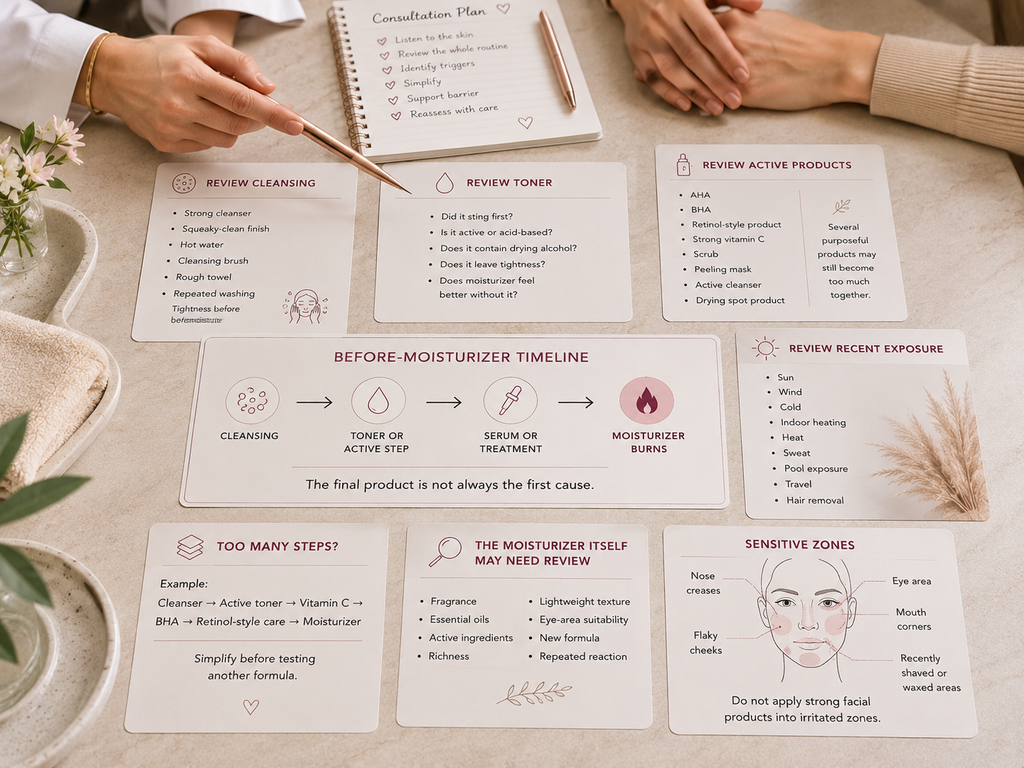
Even if each product has a purpose, the total routine may overwhelm the skin.
Sensitive skin usually improves when the routine becomes more intentional and less crowded.
If you started several new products and moisturizer burns, it becomes difficult to know what caused the reaction.
Sensitive skin does better when products are introduced one at a time.
A safer approach is:
Slow introduction makes the skin easier to understand.
The moisturizer may be the issue if:
If this happens, stop using it and choose a simpler option with guidance.
The routine may be the issue if:
In this case, the skin may need a reset before product selection.
If moisturizer burns strongly, stop and simplify.
If the product is making the skin increasingly uncomfortable, remove it gently with lukewarm water.
Avoid scrubbing.
Then use only the simplest products your skin tolerates.
Pause:
Let the skin calm before adding anything else.
When moisturizer burns, a simple reset may look like this:
Morning:
Gentle cleanser or rinse if appropriate → moisturizer that does not sting → SPF
Evening:
Gentle cleanser → moisturizer that does not sting
If even moisturizer and SPF burn, seek guidance. The skin may need dermatologist evaluation, especially if there is swelling, rash-like irritation, pain, or persistent burning.
Pause the products most likely to add irritation.

These may include:
This does not mean you can never use active products. It means the skin needs to feel stable first.
Keep only what the skin tolerates.
Usually, that means:
If the skin cannot tolerate basic care, do not keep experimenting. Seek professional guidance.
If moisturizer burns, applying more may not help.
Sometimes more moisturizer can make discomfort worse, especially if the formula itself is the problem.
Instead of adding more, step back.
Ask whether the moisturizer is the right formula, whether the skin is over-exfoliated, and whether active products need to pause.
Comfort comes from the right match, not just more product.
You may need to switch moisturizer if the formula burns repeatedly or seems to trigger discomfort.
But do not switch to many new moisturizers quickly.
Choose carefully.
For sensitive skin, consider whether the product is:
A consultation can help narrow the choice.
Not always.
Stopping every product may leave the skin dry and unprotected, especially during the day.
A better approach is to stop unnecessary active steps and keep simple basics if tolerated.
For most people, the skin still needs:
But if basic products burn, dermatologist guidance may be needed.
Burning around the nose can happen if the area is dry, rubbed, over-exfoliated, or irritated from frequent wiping.
It may also happen if active products collect around the nostrils.
Avoid applying acids, retinol-style products, or strong toner too close to irritated creases.
If the nose area is cracked, painful, crusting, or persistent, seek medical guidance.
The mouth area can become sensitive from toothpaste, lip products, licking, wiping, acids, retinol-style products, or over-cleansing.
If moisturizer burns around the mouth, avoid active products in that area.
If bumps, rash-like irritation, peeling, or burning persist around the mouth, dermatologist evaluation may be needed.
Do not treat every mouth-area reaction like ordinary dryness.
The eye area is delicate.
Moisturizer may burn around the eyes if it migrates, contains fragrance, contains active ingredients, or is not made for the eye area.
Avoid applying facial acids, retinol-style products, or strong active moisturizers close to the eyes unless directed and appropriate.
If there is eye-area swelling, pain, persistent burning, or irritation, seek medical guidance.
Oily skin can still experience moisturizer burning.
This often happens when oily skin is over-cleansed or over-exfoliated.
The skin may look shiny but feel tight underneath.
If this is your pattern, avoid trying to dry the skin out more. Use a lighter, comfortable moisturizer and pause strong active steps until the skin feels stable.
Oily sensitive skin needs balance, not aggression.
Dry skin may burn because the surface is already lacking comfort.
If moisturizer burns on dry skin, review the cleanser, toner, exfoliation frequency, and weather exposure.
Dry sensitive skin often needs:
If burning continues, professional evaluation may be needed.
Redness-prone skin can feel warm, reactive, or easily irritated after skincare.
If moisturizer burns and the face looks red or hot, simplify.
Avoid:
If redness-looking changes are persistent, painful, swelling, or worsening, seek dermatologist guidance.
Skin can sting after shaving, waxing, threading, or facial hair removal.
Moisturizer applied afterward may burn because the skin surface is temporarily more sensitive.
Avoid strong actives after hair removal, including acids, retinol-style products, scrubs, and fragranced products.
Use simple, calming care.
If burning, swelling, rash-like bumps, or irritation persists, seek professional guidance.
After a facial, peel, exfoliation, or professional treatment, the skin may be more reactive.
Moisturizer can sting if the skin is still sensitive.
Follow the aftercare instructions from the professional who performed the treatment.
Avoid adding your own acids, retinol-style products, scrubs, or strong masks afterward.
When the skin has recently been treated, less is usually safer.
If your skin reacts easily, patch testing can help.
Apply a small amount of moisturizer to a small area before using it on the whole face.
Watch for:
Patch testing does not guarantee no reaction, but it helps reduce surprises.
Do not reintroduce active products while moisturizer still burns.
Wait until:
Then add only one product at a time.
If the skin reacts again, you will know which step may be causing trouble.
Moisturizer burning is more concerning when it comes with:
These signs should not be managed by buying stronger skincare.
Seek dermatologist guidance.
Do not assume burning means the moisturizer is working.
Do not apply exfoliating acids to “smooth” the burning area.
Do not scrub flaking skin.
Do not use hot water.
Do not keep layering products over burning skin.
Do not add retinol-style products while the skin is reactive.
Do not test many new moisturizers in the same week.
Do not ignore swelling, rash-like irritation, pain, crusting, or persistent burning.
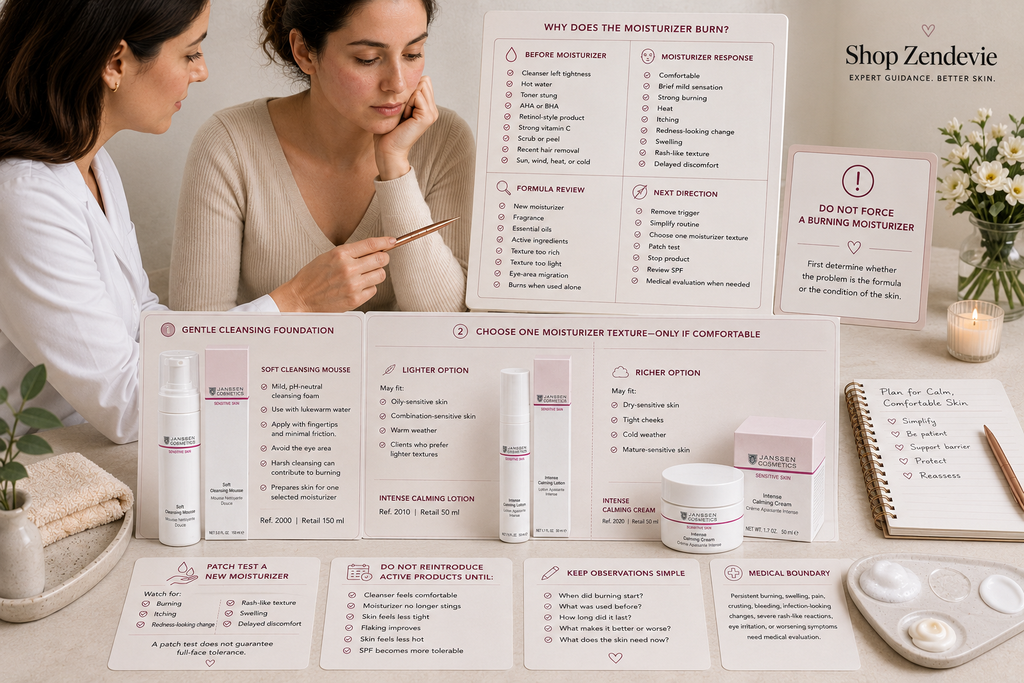
After consultation, our licensed esthetician may consider Janssen Cosmetics options depending on whether the skin is sensitive, dry-sensitive, oily-sensitive, redness-prone, barrier-stressed, or reacting from product overload.
Possible sensitive-skin options may include:
These options are not automatic recommendations. If moisturizer burning is strong, persistent, swelling, rash-like, painful, or worsening, dermatologist evaluation should come first.
Your moisturizer may burn because your skin is dry, irritated, over-exfoliated, barrier-stressed, or reacting to the formula. It may also happen after harsh cleansing, strong toner, acids, retinol-style products, sun exposure, or fragrance.
No. Moisturizer should not strongly burn. Repeated burning, heat, pain, swelling, or rash-like irritation is a sign to stop and reassess.
Your cleanser may be too harsh, the water may be too hot, or your skin may be stripped after cleansing. Moisturizer often burns more when applied to already tight skin.
Exfoliation can make skin more sensitive. If moisturizer burns after using AHA, BHA, scrubs, or peeling products, the skin may be over-exfoliated or not ready for that frequency.
If the burning is strong, worsening, or uncomfortable, remove it gently with lukewarm water. Do not scrub. Then simplify your routine.
Yes. Oily skin can still be dehydrated, over-cleansed, or over-exfoliated. Shine does not mean the skin barrier is comfortable.
Use only the simplest tolerated products and seek guidance. If even basic moisturizer burns, especially with swelling, rash-like irritation, pain, or persistent symptoms, see a dermatologist.
See a dermatologist if moisturizer burning is persistent, severe, swelling, rash-like, painful, crusting, bleeding, infection-looking, around the eyes, or not improving after stopping the product.
If your moisturizer burns and you are not sure whether the problem is the product, your cleanser, exfoliation, or your skin barrier, a free virtual consultation can help.
At Zendevie, we look at your cleanser, toner, moisturizer, SPF, exfoliation habits, active products, skin texture, and reaction pattern before recommending next steps. The goal is to help sensitive skin feel calmer before adding more products.

Zendevie is guided by Haby Diallo, a licensed esthetician with more than 20 years of professional skincare experience. Her approach is rooted in education, professional judgment, and personal care.
years of experience