
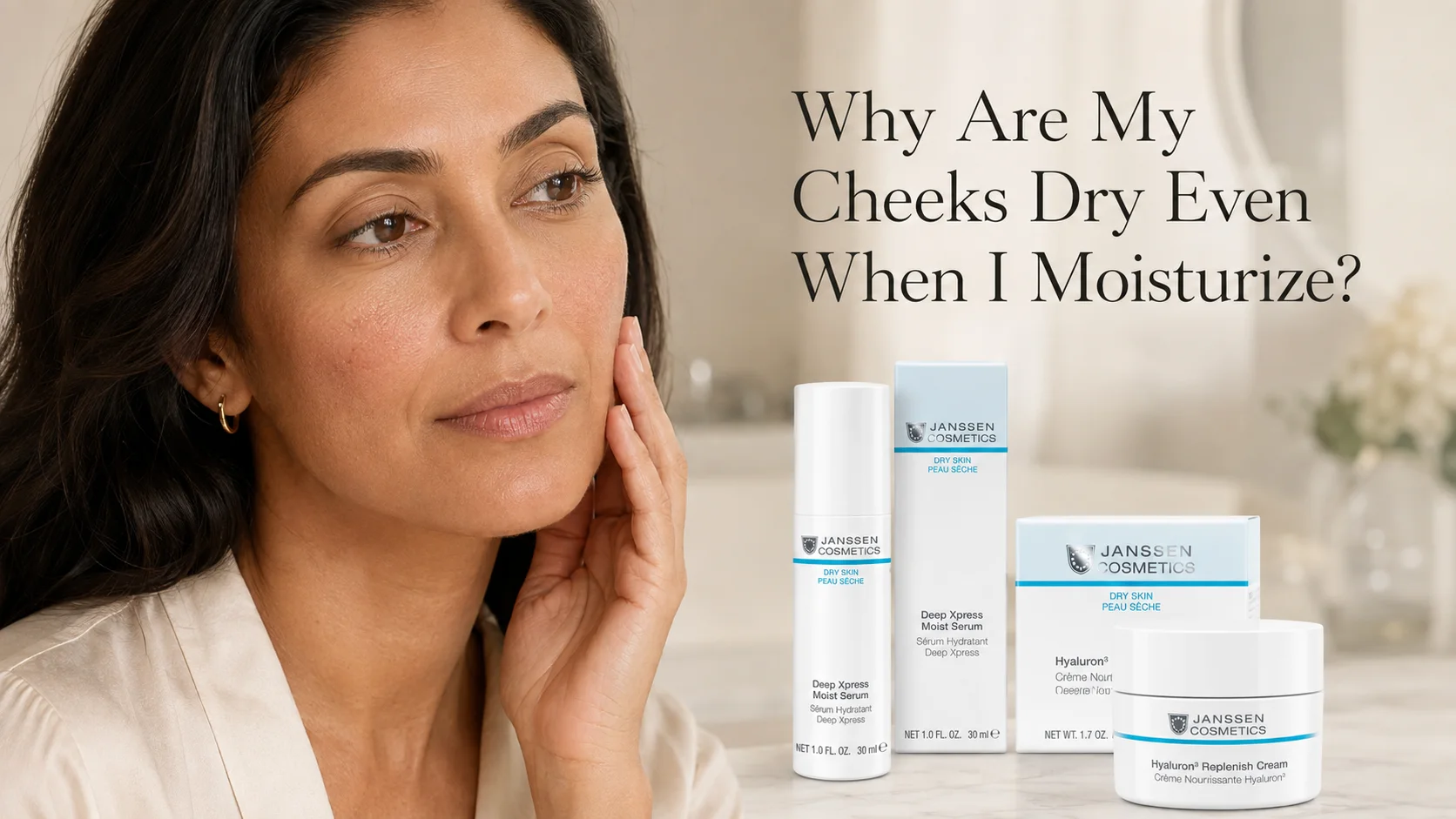
If your cheeks still feel dry even when you moisturize, the problem may not be that you are doing nothing. The issue may be that your cheeks need a different kind of support than the rest of your face.
The cheeks often feel drier than the T-zone because they may produce less oil, react more easily to weather, and show tightness faster after cleansing. This is especially common in dry skin, combination skin, mature skin, sensitive skin, and skin exposed to cold weather, air conditioning, sun, or travel.
At Zendevie, our licensed esthetician looks at where the dryness appears, not just whether the whole face feels dry. Dry cheeks can be a sign that the routine needs better hydration, moisturizer texture adjustment, gentler cleansing, or barrier comfort.
Your cheeks may still feel dry after moisturizer because your cleanser is too harsh, your skin is dehydrated, your moisturizer texture is too light, you are skipping serum, the cheeks need more cream than the T-zone, or the skin barrier feels stressed.
A helpful routine may look like:
Gentle Cleanser → Hydrating Tonic → Hydrating Serum → Comfort Cream → SPF in the morning
If your cheeks are painful, cracked, bleeding, swollen, rash-like, burning, or not improving, they should be checked by a dermatologist or healthcare professional.

The cheeks can be more prone to dryness than the forehead, nose, or chin.
Many people have oilier areas in the T-zone but drier cheeks. This can make the skin feel confusing because one part of the face feels shiny while the cheeks feel tight.
Dry cheeks may feel:
This means your routine may need to be adjusted by area instead of treating the whole face exactly the same.
A lightweight moisturizer may feel fine on the forehead or nose but not enough on the cheeks.
Your moisturizer may be too light for your cheeks if:
The cheeks may need a cream texture while the T-zone may need less product.
Dry cheeks may not only need cream. They may also need hydration.
Dehydrated cheeks can feel tight, dull, or less smooth even if you apply moisturizer. This can happen when the skin lacks water-based hydration.
Signs of dehydrated cheeks include:
In this case, a hydrating serum before moisturizer may help.
A harsh cleanser can make the cheeks feel dry before the routine even begins.
If the skin is stripped during cleansing, moisturizer may not feel like enough afterward.
Your cleanser may be too strong if:
Dry cheeks need cleansing that leaves the skin clean but comfortable.
Your cheeks and T-zone may not need the same amount of moisturizer.
If your T-zone gets shiny but your cheeks are dry, applying the same amount everywhere may not work well.
A better approach may be:
Skincare does not always need to be applied the same way on every part of the face.
Cheeks are often exposed to wind, cold weather, sun, and air conditioning.
In winter, cold air and indoor heating can make the cheeks feel tight or rough. In summer, sun exposure, air conditioning, swimming, and travel can leave the cheeks dehydrated.
If your cheeks feel worse during seasonal changes, your routine may need adjustment.
You may need:
If your cheeks are dry and sensitive, exfoliation may be making the issue worse.
Scrubs, acids, peels, exfoliating toners, and retinol-style products can leave the cheeks feeling tight, stingy, or rough when used too often.
Signs of over-exfoliated cheeks include:
When this happens, pause exfoliation and focus on comfort.
Dry cheeks may be a sign that the skin barrier feels stressed.
This can happen from harsh cleansing, weather, over-exfoliation, strong active products, or using too many new products at once.
Barrier-stressed cheeks may feel:
When the cheeks feel reactive, the routine should become simpler and gentler.
Mature skin often feels drier, and the cheeks may show this first.
The cheeks may feel less soft, less comfortable, or more textured over time. Makeup may also settle more or cling to dry areas.
Mature dry cheeks may benefit from:
The goal is support, not harsh correction.
Sometimes the moisturizer is fine, but the products layered over it make the cheeks look dry.
Matte SPF, long-wear foundation, powder, or drying primer may make dry cheeks more noticeable.
If makeup clings to your cheeks, the skin may need better prep:
Hydration → Moisturizer → SPF → Makeup
Let skincare settle before applying makeup, and avoid using too much powder on dry cheek areas.
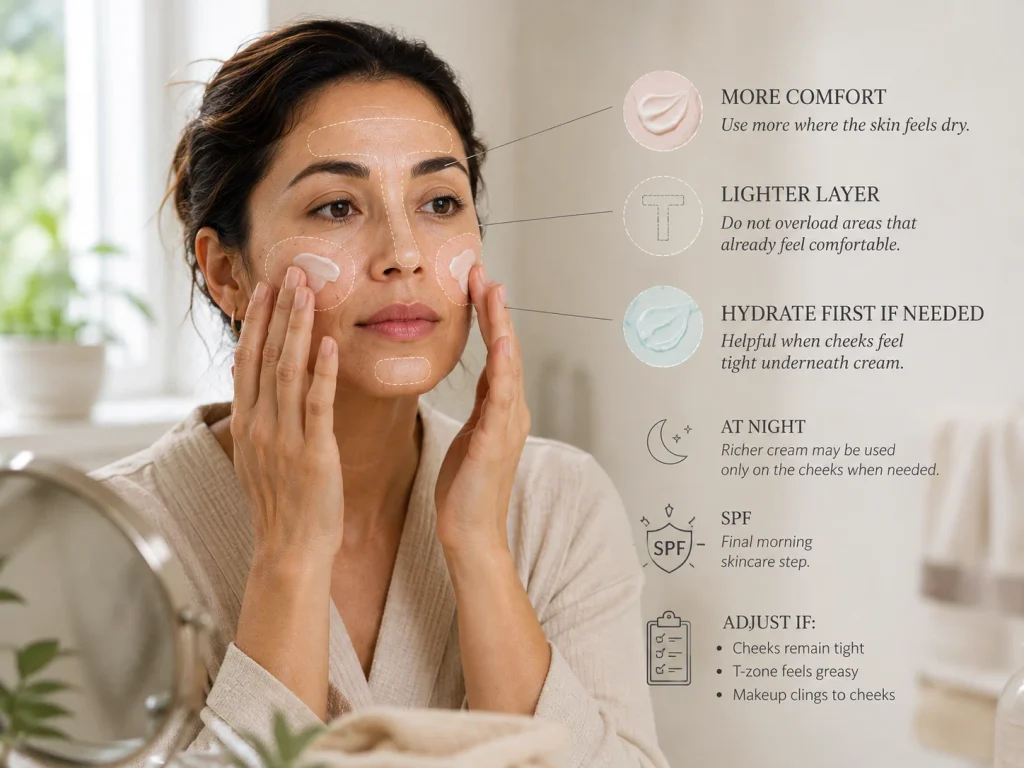
If your cheeks are dry but your T-zone gets oily, use a zone-based routine.
Try this approach:
This helps support dry areas without overloading the whole face.
Use a cleanser that does not leave the cheeks tight.
Prepare the skin for serum and moisturizer.
Apply hydration support if the cheeks feel tight or dehydrated.
Use more product on the cheeks if needed and less on areas that get oily.
Finish with daytime protection.
Morning structure:
Gentle Cleanser → Hydrating Tonic → Hydrating Serum → Moisturizer → SPF
Remove sunscreen, makeup, and buildup without stripping the cheeks.
Use a gentle tonic if tolerated.
Apply a hydrating serum if the cheeks feel tight or dull.
Use a cream that helps the cheeks feel supported overnight.
Apply a little more cream only where the cheeks feel dry.
Evening structure:
Gentle Cleanser → Tonic → Hydrating Serum → Comfort Cream
Yes, sometimes.
If your cheeks are dry but your T-zone feels normal or oily, you can use a richer moisturizer only on the cheeks.
This is especially helpful when:
Your skin does not need the same texture everywhere.
Be careful.
If your cheeks are flaky but also stingy, red-prone, or sensitive, exfoliation may make them worse.
Gentle exfoliation may be considered only when the skin feels stable and the dryness is connected to surface buildup.
Do not scrub dry cheeks aggressively.
Comfort comes before smoothing.
Your cheek routine may be working if:
Dry cheeks usually need consistency, not constant product changes.

Products that may be discussed during a Zendevie consultation for dry cheeks include:
If the cheeks feel dry and sensitive, sensitive skin support may also be discussed, such as:
These are examples only. A consultation helps decide whether your cheeks need hydration, richer cream, barrier support, gentler cleansing, or different product placement than the rest of the face.
Do not apply the same amount of moisturizer everywhere if only your cheeks are dry.
Do not scrub dry cheek patches aggressively.
Do not use a harsh cleanser that leaves cheeks tight.
Do not skip hydration if moisturizer feels like it sits on top.
Do not keep using active products that make cheeks sting.
Do not skip SPF.
Do not ignore painful, cracked, bleeding, swollen, or rash-like cheek patches.
Your cheeks may still feel dry because your moisturizer is too light, your skin is dehydrated, your cleanser is too harsh, your barrier feels stressed, or your cheeks need more product than the rest of your face.
This is common in combination skin. The cheeks may need more moisture while the T-zone needs lighter product.
Sometimes, yes. You may use a richer cream on the cheeks and a lighter amount on the T-zone.
Makeup may cling because the cheeks are dry, dehydrated, flaky, over-cleansed, or not prepped with enough hydration and moisturizer.
Yes. Over-exfoliation can make the cheeks feel tight, stingy, rough, or more sensitive.
A hydrating serum may help if your cheeks feel tight, dehydrated, dull, or dry even after moisturizer.
See a dermatologist if the cheeks are painful, cracked, bleeding, swollen, rash-like, infected-looking, burning, or not improving.

Zendevie is guided by Haby Diallo, a licensed esthetician with more than 20 years of professional skincare experience. Her approach is rooted in education, professional judgment, and personal care.
years of experience