

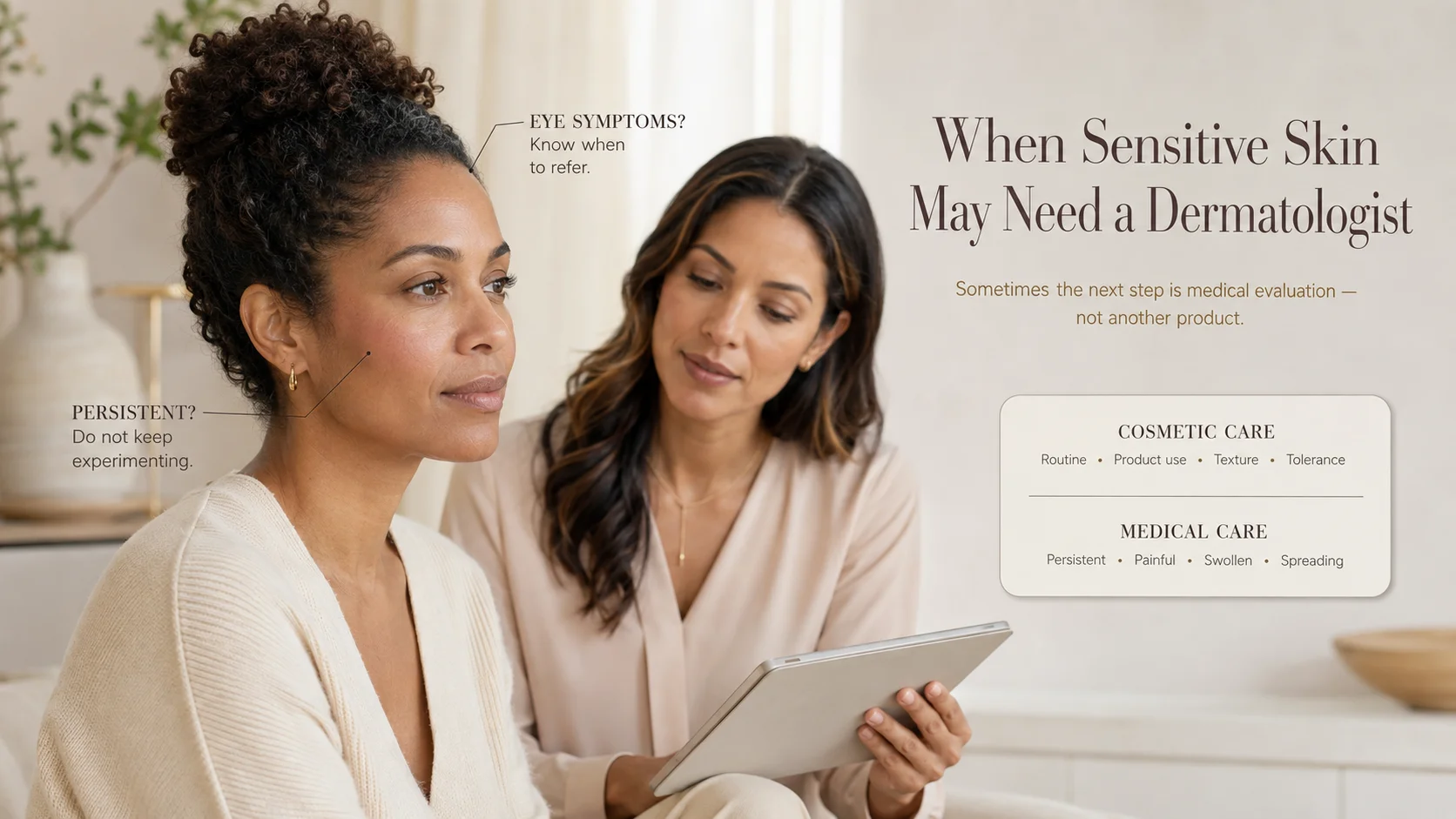
Sensitive skin can often be supported with a simpler routine.
Reducing exfoliation, changing cleanser, adjusting moisturizer texture, using lukewarm water, and introducing products one at a time may help the routine feel more comfortable.
But not every reaction should be managed through skincare alone.
Sometimes the skin is not simply asking for a gentler serum.
It may need a medical diagnosis.
A persistent rash-like change may not be ordinary sensitivity.
Repeated eye swelling may not be something to cover with eye cream.
Painful, deep blemishes may need more than an over-the-counter spot product.
Blistering, open skin, rapidly increasing swelling, discharge, crusting, or difficulty breathing should never be treated as a normal adjustment period.
At Zendevie, our licensed esthetician can help review cosmetic products, routine order, product frequency, texture preferences, exfoliation habits, and possible sources of unnecessary product stress.
However, a skincare consultation cannot diagnose:
Knowing when to stop cosmetic experimentation is part of responsible skincare guidance.
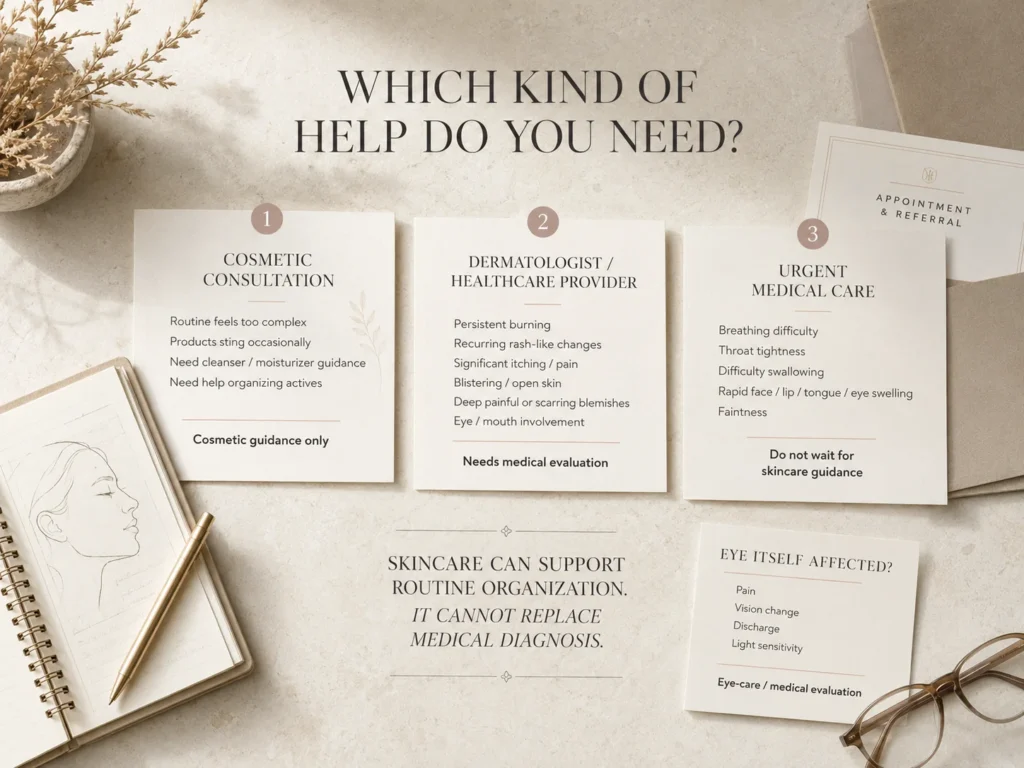
Consider seeing a dermatologist when sensitive skin:
The American Academy of Dermatology advises seeking medical attention for rash-like changes that spread rapidly, become painful, blister, turn into raw or open skin, involve the eyes or mouth, cover much of the body, or occur with illness. Trouble breathing or swallowing and swelling of the eyes or lips may require emergency medical attention.
Seek urgent medical care for:
These may be signs of a serious allergic reaction and should not be managed with additional skincare.
“Sensitive skin” is commonly used to describe skin that:
This description may be useful for organizing cosmetic care.
It does not explain the medical reason for every symptom.
Several different concerns can look or feel similar.
For example, burning and redness-looking areas may be connected to:
A visual appearance alone may not reveal the cause.
That is where a dermatologist’s medical evaluation becomes important.
A dermatologist can:
When a rash continues, identifying the cause may require a detailed, detective-like review. A dermatologist may ask the person to stop selected products, examine the skin’s pattern, and recommend medical patch testing when allergic contact dermatitis is suspected.
A Shop Zendevie consultation may help with:
It cannot:
When medical-looking symptoms are present, referral comes before product selection.
A mild product-related sensation may settle after the product is removed and the routine is simplified.
But dermatologist guidance may be needed when:
The FDA advises consumers who experience a problem with a cosmetic to stop using the product and contact a healthcare provider. Cosmetic reactions may also be reported to the FDA.
Do not continue testing replacement products while the original reaction is still active.
A recurring reaction may appear:
Repeated reactions may be difficult to understand without medical assessment.
A dermatologist can evaluate whether formal patch testing or another type of investigation is appropriate.
A home product test places a finished cosmetic on a small area to look for obvious discomfort before broader use.
Medical patch testing is a clinical procedure used by dermatologists to investigate possible delayed allergic reactions to specific substances.
During medical patch testing, selected allergens are placed on the skin and evaluated over several appointments because some reactions take days to appear. The results can help a dermatologist identify substances that may be contributing to recurring skin reactions.
A comfortable home patch test cannot:
Do not repeatedly home-test a product that already caused significant burning, swelling, blistering, or a spreading reaction.
Consider dermatologist guidance if the skin reacts to:
This may indicate that the skin is highly reactive or that the concern is more complicated than choosing a gentler serum.
Pause optional products such as:
Use only what remains comfortable.
If nothing feels tolerable, stop experimenting and seek medical guidance.
A brief mild sensation and persistent burning are different.
Dermatologist guidance may be needed when burning:
Do not describe persistent burning as proof that an active ingredient is working.
Pain is not a skincare goal.
Sensitive skin may feel uncomfortable.
Significant pain deserves more attention.
Pain may feel like:
The AAD identifies a painful rash as a reason to seek medical attention.
Do not cover painful areas with more makeup, exfoliation, or several calming products.
Mild dryness may create occasional itching.
Medical evaluation may be appropriate when itching:
Do not scratch.
Scratching may create open skin and increase the risk of further complications.
Use a simple routine while arranging appropriate care.
Swelling is not something to dismiss as ordinary purging.
Stop the suspected cosmetic.
Seek prompt medical guidance when swelling:
Facial, mouth, or throat swelling with breathing or swallowing difficulty may require urgent emergency care.
Do not apply another cream, mask, facial oil, or essential oil over rapidly swelling skin.
Blisters may appear with several different medical skin concerns.
Do not pop them.
Do not apply:
A rash-like change that blisters, becomes open, or creates raw skin should receive medical attention.
Frequent or unexplained blistering requires proper diagnosis rather than cosmetic trial and error.
Raw, broken, or open skin is not ready for active cosmetic ingredients.
Avoid:
Seek medical guidance, particularly when the area:
These changes may require evaluation for possible infection or another medical condition.
Seek professional guidance when skin develops:
Do not attempt to manage possible infection-looking changes with:
The AAD advises medical evaluation for rashes that may be infected, including those with increasing pain, pus, or drainage.
A rapidly spreading rash-like change needs medical attention.
Stop all suspected new products.
Do not keep testing which one caused it.
Document:
A rash that spreads rapidly is one of the warning signs identified by dermatologists as needing medical evaluation.
A reaction affecting much of the face, neck, chest, or body should not be treated like a small isolated patch.
Medical guidance may be needed when:
A widespread rash is among the signs that warrant medical attention.
A rash-like change paired with fever, weakness, or feeling unwell may involve more than cosmetic sensitivity.
Stop optional skincare.
Seek medical guidance.
Do not assume the reaction is only from:
A rash occurring with fever or illness should be medically assessed.
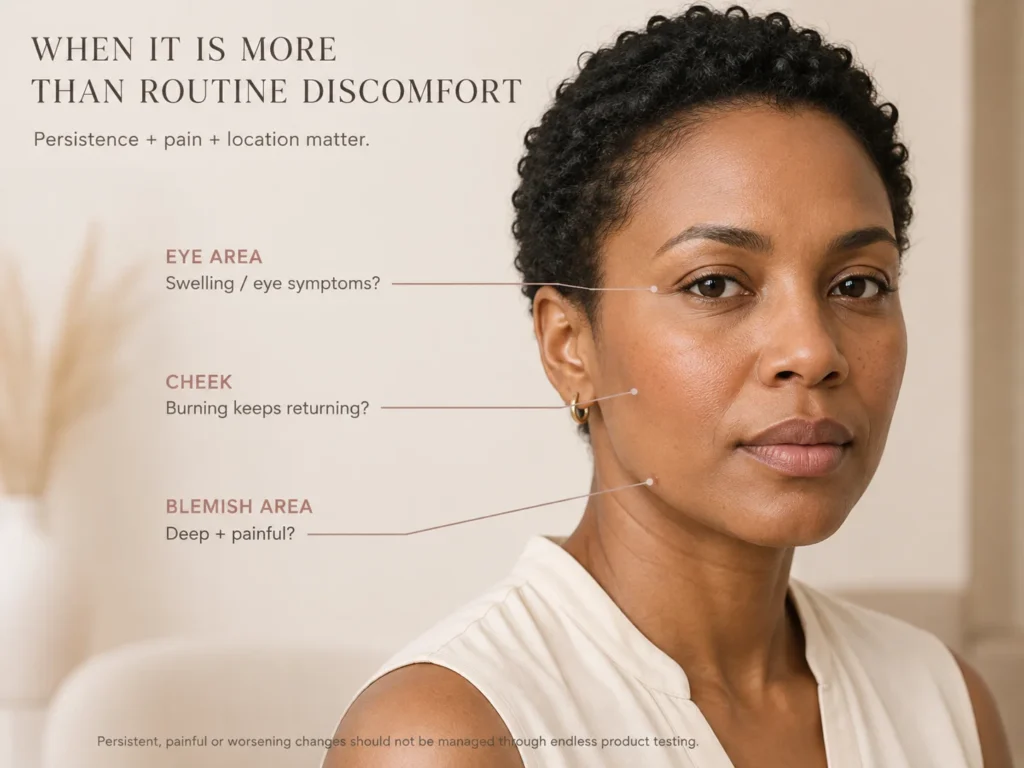
The eye area requires extra caution.
Seek medical or eye-care guidance when there is:
Eye pain and changes in vision can indicate a serious eye concern and may require urgent attention.
Do not apply facial retinol, exfoliating acids, essential oils, or fragranced products to symptomatic eyelids.
A dermatologist may assess the eyelid skin, while an ophthalmologist or another eye-care provider may be needed when the eye itself is affected.
A rash-like reaction involving the lips or mouth should receive medical attention, especially when paired with:
Do not apply:
over painful or blistered areas.
Rapid mouth, lip, tongue, or throat swelling may be an emergency.
Seek urgent medical care immediately when a skin or cosmetic reaction is paired with:
The FDA identifies shortness of breath, trouble swallowing, light-headedness, facial swelling, wheezing, and loss of consciousness among possible symptoms of a severe allergic reaction.
Do not wait for a virtual skincare consultation.
Do not apply another cosmetic product.
Temporary visible flushing may happen after:
Dermatologist guidance may be useful when redness-looking areas:
Several conditions can cause lasting facial redness, and a dermatologist can examine the skin and eyes to determine whether a medical diagnosis is present.
Do not diagnose rosacea from appearance alone.
Seek medical guidance when redness-prone facial skin is paired with:
Eye symptoms associated with facial redness should not be treated only with cosmetic eye cream. The AAD recommends prompt eye or dermatology care when irritated or red eyes occur alongside rosacea-related concerns.
Sensitive, blemish-prone skin may develop:
Dermatologist guidance is especially important when blemishes become:
Deep nodules and cysts can be painful and have a higher risk of leaving scars. The AAD recommends dermatologist care when acne is deep, painful, scarring, or not improving with nonprescription care.
Do not squeeze deep blemishes.
Picking can increase visible discoloration, infection risk, and scarring.
Do not wait until repeated deep breakouts have produced significant scarring before seeking guidance.
A dermatologist may help:
Cosmetic skincare cannot replace medical acne treatment when blemishes are deep, painful, or scarring.
Dermatologist guidance may be appropriate when:
Continuing to buy stronger products may create more irritation without addressing the underlying concern.
Seek help when skin symptoms interfere with:
A concern does not need to look dramatic to deserve professional care.
Persistent discomfort that affects daily life is a valid reason to seek evaluation.
Some people experience so many reactions that they become afraid to use:
A dermatologist may help distinguish between:
Do not continue testing random samples.
Bring the product list to a medical appointment.
A “hypoallergenic” label does not guarantee that every sensitive complexion will tolerate the product.
The FDA explains that the term generally reflects a manufacturer’s claim that a product is expected to produce fewer allergic reactions; it does not mean a cosmetic is reaction-proof for every person.
The skin may still react to:
A dermatologist may help investigate recurring product reactions.
A fragrance-free formula may remove one common concern.
It may still contain:
Do not assume a reaction proves the label is false.
It may mean another ingredient or the skin’s current condition is involved.
Medical patch testing may help identify certain contact allergens when clinically appropriate.
A prescribed product is different from an optional cosmetic.
If a prescribed cream, gel, or medication causes discomfort:
Seek urgent medical attention for severe swelling, breathing difficulty, faintness, or another rapidly worsening reaction.
After a professional treatment, follow the provider’s aftercare instructions.
Contact the provider or seek medical guidance when symptoms include:
Do not respond by applying:
Professional peels and intensive exfoliation belong in professional treatment settings.
Not every reaction comes from skincare.
Seek medical evaluation when a sudden skin change:
Do not assume the cause is stress, weather, or “sensitive skin” without evaluation.
A reaction affecting only one side may be connected to:
Persistent one-sided:
should be evaluated.
Do not keep treating only the visible side with stronger products.
A dermatologist may be appropriate for:
A primary-care provider may be a practical first contact when:
Seek urgent or emergency care for:
Seek an eye doctor or urgent eye care for:
Eye pain and vision changes require more than cosmetic eye-area guidance.
Unless a healthcare provider has given different instructions:
Do not wait for a routine appointment when emergency symptoms are present.
Write down:
A clear timeline may help the dermatologist identify patterns.
Photos may help document:
Use consistent lighting when possible.
Do not delay urgent care to take photographs.
Protect privacy when storing or sharing images.
Bring or photograph:
This may be useful when the reaction appears connected to a specific cosmetic.
Include more than facial skincare.
List:
A reaction near the hairline may involve haircare.
A reaction near the eyes may involve makeup, sunscreen, or spray products.
Useful questions may include:
Write down the answers.
Do not rely only on memory when several instructions are given.
Keep the appointment when:
Bring photographs showing the earlier stage.
Skin may look calmer on appointment day even when the pattern still needs evaluation.
A resolved reaction may not require immediate medical care when it was mild, isolated, and clearly linked to one optional product.
However, consider evaluation when:
Do not deliberately recreate a severe reaction to provide proof.
Follow the medical instructions.
Do not add Janssen products or another cosmetic routine against that guidance.
Ask:
Medical instructions take priority over cosmetic routines.
Some medical treatments may create dryness or discomfort.
Contact the prescriber rather than independently adding:
Ask what cleanser, moisturizer, and SPF are compatible with the medical plan.
A cosmetic consultation can support routine organization only after the prescriber’s boundaries are clear.
Follow the dermatologist’s preparation and appointment instructions.
Medical patch testing may involve:
Some allergic reactions take several days to appear, which is why follow-up readings are important.
Do not substitute home facial product testing for the medical process.
A negative first test does not always end the investigation.
The dermatologist may:
The AAD notes that some people need additional substances tested when an initial patch-testing series does not identify the cause.
Do not assume oiliness means the skin needs stronger cleansing.
Pause:
Painful or deep blemishes require dermatologist evaluation, especially when they repeatedly leave marks or scars.
Review:
Seek medical guidance when cracking is:
Do not exfoliate cracked-looking skin.
Daily facial heat may involve:
Simplify the routine.
Seek dermatologist guidance when heat:
Do not use warming or cooling products to mask the pattern.
Stop testing several sunscreens at once.
Review whether the skin is:
A dermatologist may help when multiple sunscreen formulas cause persistent burning, swelling, itching, or rash-like changes.
Use hats, clothing, shade, and other protective habits while receiving guidance about a tolerable sunscreen plan.
Avoid the suspected products.
Keep a list of:
A dermatologist may consider whether medical patch testing is appropriate.
Do not assume every botanical or “natural fragrance” will be safer.
Review:
Persistent, burning, cracking, rash-like, or spreading mouth-area changes should be evaluated.
Do not keep applying exfoliating products to remove the texture.
Stop facial actives near the eyes.
Review:
Seek medical guidance for persistent swelling, pain, discharge, crusting, severe redness, light sensitivity, or vision changes.
Stop scheduling additional treatments until the pattern is understood.
Bring information about:
Repeated reactions may require dermatologist evaluation before another facial or peel is performed.
Hormonal, medication, and health changes may affect skin tolerance.
Discuss persistent or significant reactions with an appropriate healthcare provider.
Do not begin strong active products or change prescribed medication without medical guidance.
Bring a complete product list to the appointment.
Use this only when the products remain comfortable and no clinician has instructed otherwise.
Lukewarm-water rinse or gentle cleanser if needed → familiar moisturizer → familiar SPF
Gentle cleanser → familiar moisturizer
Pause:
If basic products also burn, stop experimenting and contact a healthcare provider.
Janssen Cosmetics may support a cosmetic routine only when the skin is appropriate for home skincare and medical warning signs have been excluded or addressed.

Possible Sensitive Skin options may include:
These products do not diagnose, cure, or medically treat a skin condition.
They should not be used as substitutes for dermatologist care when the skin has:
During an active medical-looking reaction, the correct Janssen recommendation may be no new product recommendation at all.
A consultation may first advise the client to:
If a dermatologist has provided specific cleanser, moisturizer, SPF, or treatment instructions, those instructions take priority.
Professional Janssen peel products belong in professional treatment settings and should never be used as home solutions for unexplained sensitivity, rash-like changes, or recurring reactions.
Do not diagnose every reaction as sensitive skin.
Do not diagnose eczema, rosacea, dermatitis, allergy, or infection from a photograph alone.
Do not keep introducing new products while a reaction is active.
Do not continue a suspected cosmetic because it was expensive.
Do not continue burning products because tingling is described as normal.
Do not describe significant swelling as purging.
Do not pop blisters.
Do not pick open skin.
Do not squeeze deep, painful blemishes.
Do not scrub rash-like texture.
Do not exfoliate raw, cracked, bleeding, or blistered skin.
Do not apply retinol to an active reaction.
Do not apply AHA or BHA to painful or open areas.
Do not apply undiluted essential oils.
Do not use lemon juice, toothpaste, baking soda, vinegar, or harsh home remedies.
Do not cover infection-looking changes with makeup.
Do not apply cosmetic eye products when the eye has pain, discharge, crusting, or vision changes.
Do not wait for a skincare consultation when breathing or swallowing is difficult.
Do not ignore rapidly increasing facial, eye, lip, or tongue swelling.
Do not stop prescribed medication without contacting the prescriber unless emergency symptoms require urgent medical care.
Do not replace medical patch testing with repeated home testing.
Do not restart every cosmetic product immediately after symptoms settle.
Do not use professional peels at home.
Do not allow a product-focused goal to come before medical safety.
Consider seeing a dermatologist when burning, itching, redness-looking areas, swelling, flaking, rash-like changes, or product reactions are persistent, recurring, painful, spreading, or not improving after suspected products are stopped.
Sensitive skin is commonly used as a descriptive term. A dermatologist is needed to determine whether symptoms relate to a medical skin condition.
Seek guidance if several basic moisturizers burn, the burning persists after active products are stopped, or the reaction includes swelling, blistering, pain, or rash-like changes.
Stop active-product experimentation. Use the gentlest approach possible and seek dermatologist guidance when even lukewarm water or basic cleansing causes significant discomfort.
Persistent redness-looking areas, recurring flushing, visible vessels, eye symptoms, pain, or acne-like bumps may need dermatologist evaluation.
Yes. Repeated reactions may require a detailed product review, diagnosis, or medical patch testing.
Medical patch testing is a dermatologist-supervised procedure that evaluates delayed allergic reactions to selected substances over several days.
No. Home testing may screen one finished cosmetic for obvious discomfort. It cannot diagnose allergic contact dermatitis or identify specific allergens with medical certainty.
Yes. A rapidly spreading rash-like change should receive medical attention.
Yes. Blistering, open sores, or raw skin require medical evaluation.
Seek medical guidance. Oozing, pus, drainage, increasing warmth, pain, or crusting may require evaluation for possible infection or another condition.
Rapid swelling of the face, eyes, lips, tongue, mouth, or throat—especially with breathing difficulty, difficulty swallowing, or faintness—requires urgent medical care.
Persistent or significant eyelid swelling should be evaluated. Eye pain, discharge, crusting, light sensitivity, or vision changes need prompt eye or medical care.
Yes. A dermatologist may help evaluate recurring reactions, identify possible allergens or irritants, and guide a safer protection plan.
A dermatologist may recommend medical patch testing when allergic contact dermatitis is suspected.
Yes. Deep, painful, recurring, or scarring blemishes often require dermatologist care rather than repeated over-the-counter experimentation.
A cosmetic consultation may help organize gentle skincare for uneven-looking marks. Persistent breakouts, scarring, or uncertainty about the type of blemishes may still require dermatologist evaluation.
Stop newly introduced or suspected cosmetics, but follow any existing medical instructions. Contact the dermatologist’s office for appointment-specific guidance.
Bring the product names, ingredient lists, photographs, and a timeline. The actual packaging may also be useful.
No. Shop Zendevie’s consultation can review cosmetic routine structure and product suitability but cannot provide a medical diagnosis.
No. Janssen products are cosmetic skincare products. They do not replace diagnosis, prescription treatment, allergy testing, or medical care.
Follow the dermatologist’s instructions. Reintroduce cosmetic products only when medically appropriate, one at a time, and within the boundaries of the treatment plan.
Keep photographs and notes. Recurring, severe, eye-related, blistering, or significantly swollen reactions may still need evaluation even when they temporarily improve.
Seek emergency care for breathing difficulty, throat tightness, difficulty swallowing, faintness, or rapid swelling of the face, lips, tongue, or eyes.
If your skin feels sensitive but you are unsure whether the problem is routine-related or needs medical evaluation, a free virtual consultation can help you review your cosmetic products and identify warning signs that should be referred.
At Zendevie, we can look at your cleanser, toner, serums, moisturizer, SPF, retinol use, exfoliation schedule, fragrance exposure, essential oils, makeup, haircare, weather changes, and reaction history.
We will not diagnose a medical condition or recommend products over symptoms that need a dermatologist.
The goal is to protect your skin, simplify unnecessary product stress, and make sure professional cosmetic guidance never replaces appropriate medical care.

Zendevie is guided by Haby Diallo, a licensed esthetician with more than 20 years of professional skincare experience. Her approach is rooted in education, professional judgment, and personal care.
years of experience