

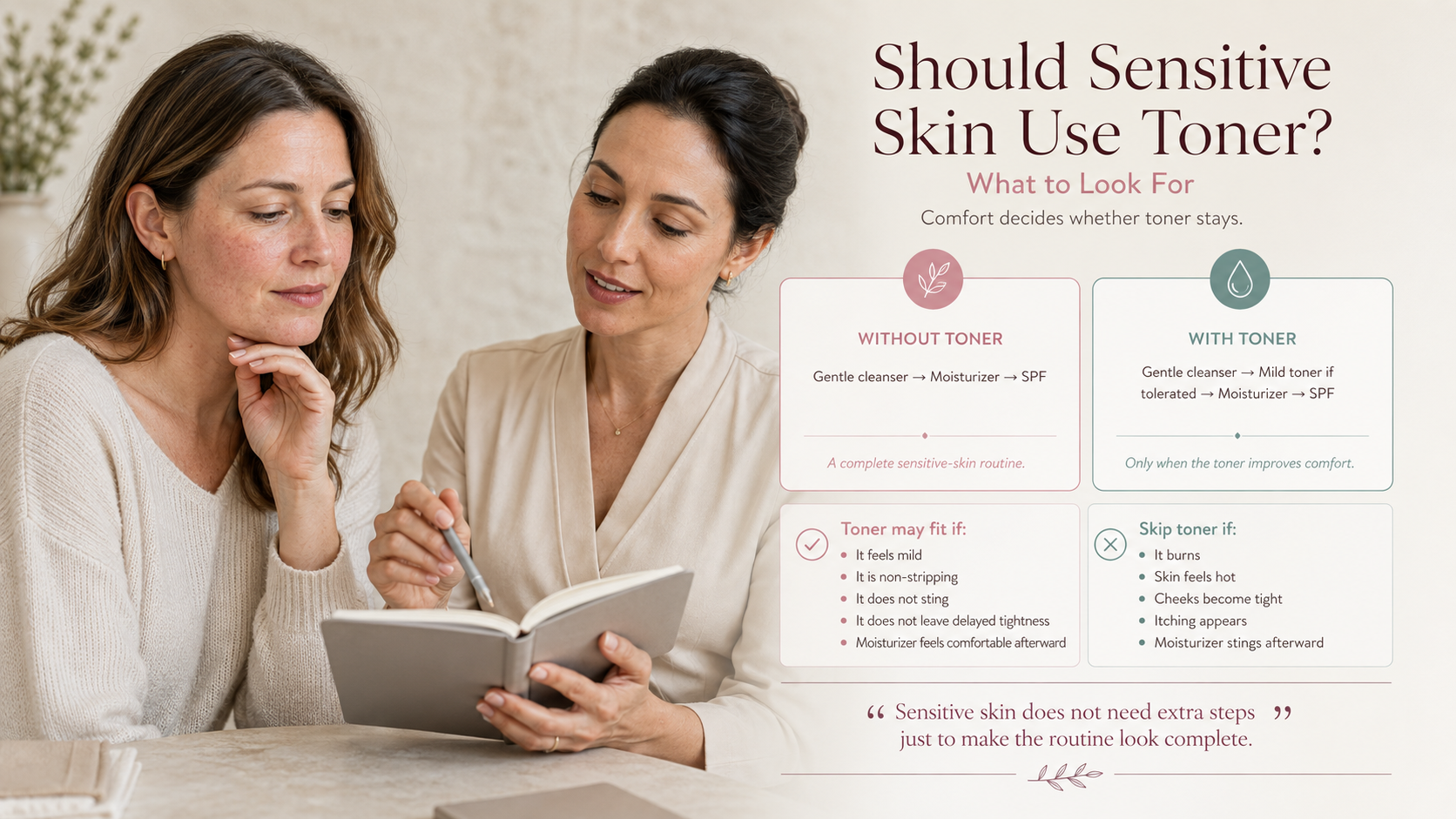
Sensitive skin does not automatically need toner.
This is important because many skincare routines make toner seem like a required step. Cleanser, toner, serum, moisturizer, SPF — it sounds complete. But sensitive skin does not care whether a routine looks complete on paper. It cares how each step feels.
For some sensitive skin, the right toner can feel refreshing after cleansing. It may help remove light residue, soften the feel of tightness, and prepare the skin for the next steps.
For other sensitive skin, toner can sting, burn, feel sharp, make the cheeks look red, or leave the skin feeling stretched.
That difference matters.
At Zendevie, we do not add toner just because it is a traditional step. In consultation, our licensed esthetician looks at the skin’s response after cleansing, whether moisturizer burns, whether the skin is dry or oily, and whether active products are already being used.
Toner should make the routine feel calmer and more complete. It should not make sensitive skin more reactive.
Sensitive skin can use toner if the toner is mild, alcohol-free, non-stripping, and well tolerated.
Sensitive skin should skip toner if it:
A simple sensitive skin routine can work without toner:
Morning: Gentle cleanser → moisturizer → SPF
Evening: Gentle cleanser → moisturizer
If toner fits, it usually goes after cleansing and before serum or moisturizer.

Toner is not mandatory.
Some sensitive skin routines improve when toner is added carefully. Other routines improve when toner is removed.
The question is not, “Should everyone use toner?”
The better question is, “Does this toner help this skin feel better after cleansing?”
If your cleanser already leaves your skin comfortable, and your moisturizer applies well, toner may not be necessary.
If your skin feels slightly tight after cleansing and a mild toner helps the next steps feel smoother, it may have a place.
Toner used to have a reputation for being strong, drying, and astringent.
Some toners were designed to remove oil aggressively or leave the skin feeling very matte. That type of toner can be too much for sensitive skin.
Modern toners can be very different. Some are hydrating, soothing, alcohol-free, and designed to leave the skin feeling refreshed rather than stripped.
Still, the category is broad.
A toner can be helpful, unnecessary, or irritating depending on the formula and the skin’s current condition.
A toner is usually applied after cleansing.
Depending on the formula, it may help:
But toner should not be used to aggressively remove oil, force the skin matte, or make the face feel squeaky.
Sensitive skin needs a toner that respects the skin’s comfort.
A toner should not make sensitive skin feel worse.
It should not:
If your toner does these things, it may not be the right toner for your skin right now.
Sensitive skin often does better with alcohol-free toner.
Alcohol-free does not automatically mean the toner will be perfect, but it may reduce the chance of a drying, sharp, stripped feeling.
For sensitive skin, a toner should feel soft and refreshing, not harsh.
When reviewing toner, look at how the skin feels five to ten minutes later.
If the skin feels calmer, hydrated, and ready for moisturizer, the toner may be a good fit.
If the skin feels tight, hot, or stingy, it may be too much.
Toner may sting sensitive skin for several reasons.
Common causes include:
Sometimes the toner is the problem. Sometimes the skin is too reactive for toner at that moment.
If your cleanser leaves your face tight, toner may sting more.
The problem may begin before the toner.
If the skin already feels stripped after cleansing, even a mild toner can feel uncomfortable.
Before changing toner, ask:
If cleansing is too harsh, toner may only reveal the problem.
When the skin barrier feels stressed, toner may sting more easily.
Signs the skin may be barrier-stressed include:
If these signs are present, toner may need to pause.
A simpler routine may be better until the skin feels more stable.
Dry-sensitive skin needs toner to feel soft, not sharp.
If toner is used, it should help the skin feel less tight after cleansing.
Dry-sensitive skin should be cautious with toners that feel:
Dry-sensitive skin may need a moisture-focused toner or may need to skip toner entirely until the cleanser and moisturizer are working well.
Oily-sensitive skin can be tricky.
The T-zone may feel greasy, but the cheeks may sting or feel tight.
A strong oily-skin toner may make the nose feel cleaner but make the rest of the face uncomfortable.
For oily-sensitive skin, toner may need to be used by zone.
For example:
Oily sensitive skin needs balance, not aggressive oil removal.
Redness-prone skin should be careful with toner.
If the cheeks look flushed or feel warm after toner, the toner may not be right.
A toner for redness-prone skin should feel mild, alcohol-free, and non-stripping.
Avoid toners that cause:
If redness-looking changes are persistent, painful, swollen, or rash-like, dermatologist guidance may be needed.
Combination-sensitive skin may need different placement.
The forehead, nose, and chin may tolerate toner better than the cheeks.
If the cheeks feel dry or sting after toner, do not force toner over the whole face.
Use toner only where it helps, or skip it completely.
The skin does not need equal product placement everywhere.
Mature sensitive skin may feel drier or less tolerant of strong formulas.
A toner should not make mature skin feel tight or make fine lines look more noticeable from dryness.
Mature sensitive skin may do better with a mild, moisture-friendly toner if it tolerates one.
If the skin feels thin, dry, hot, or reactive, toner should be added only after the basic routine feels comfortable.
If your skin is over-exfoliated, toner may burn.
This is especially true if the toner contains acids or is applied after active products.
Signs of over-exfoliation include:
If this is happening, pause toner and active products.
Use a simple routine until the skin feels calm.
Some toners contain exfoliating acids such as AHA or BHA.
These are not simple toners. They are active products.
Sensitive skin should treat acid toners carefully.
Do not use an acid toner if your skin is:
If exfoliation is needed, it should be planned carefully, not hidden inside multiple steps.
If you use vitamin C and toner, be careful with layering.
Sensitive skin may sting when too many active or acidic products are used together.
If toner stings after vitamin C or vitamin C stings after toner, simplify.
Use one active step at a time, and do not force the combination if the skin is reactive.
A brightening step should not come before skin comfort.
Sensitive skin should be cautious when combining toner with retinol-style products.
A mild toner may be fine for some skin, but active toners can make retinol-style routines harder to tolerate.
If your skin burns or flakes after using toner and retinol-style care, pause one or both and simplify.
Retinol-style products should not be layered with acid toner, scrubs, and strong exfoliating products unless the skin has been carefully assessed.
Fragrance may be a trigger for some sensitive skin.
A toner may smell fresh but still make the skin sting.
If your skin reacts to fragranced products, choose carefully.
Fragrance can be especially irritating when the skin is already dry, over-exfoliated, or redness-prone.
The skin’s response matters more than how pleasant the product smells.
Essential oils may sound gentle, but they are not always ideal for sensitive skin.
A toner with essential oils may sting or feel warm on reactive skin.
Natural does not automatically mean non-irritating.
If the skin feels hot or red-looking after a natural toner, review essential oils and fragrance components as possible triggers.
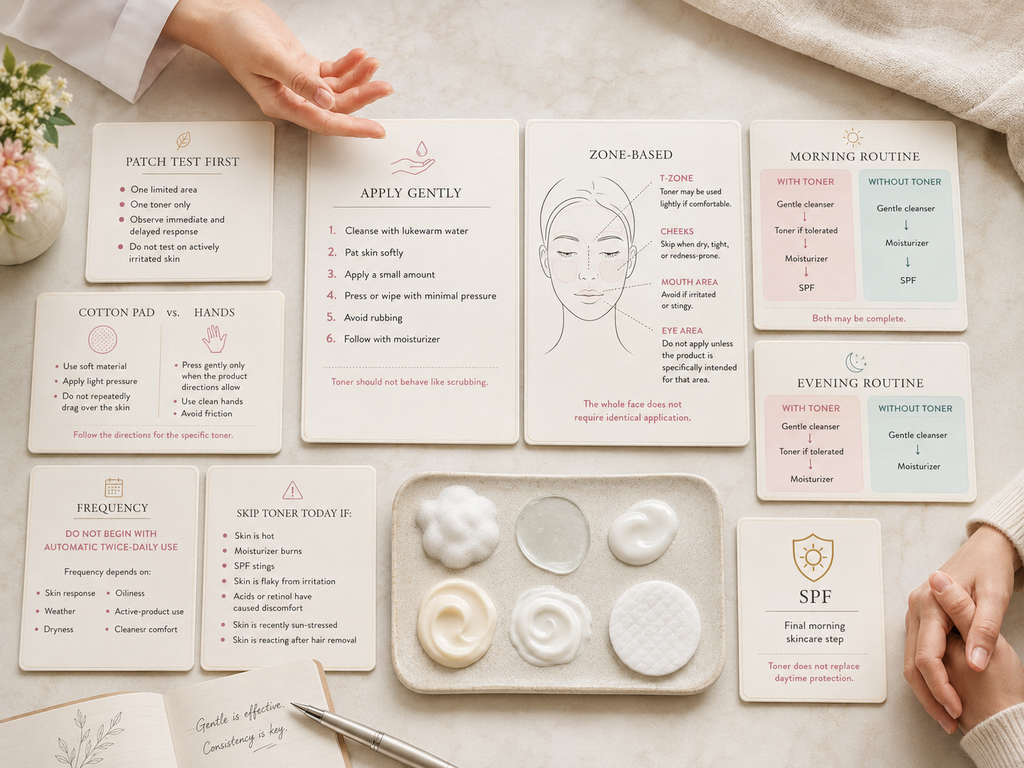
Application method matters.
To apply toner gently:
Sensitive skin often reacts to friction, not only ingredients.
Some toners are applied with a cotton pad. Some can be pressed in with hands.
For sensitive skin, cotton pads may cause friction if rubbed too strongly.
If cotton application irritates your skin, use less pressure or discuss whether hand application makes sense for your product.
Do not scrub the face with toner.
Toner should be applied softly.
Not always.
Sensitive skin may not need toner twice a day.
Some skin may tolerate toner once daily. Some may tolerate it morning and night. Some may need it only after heavier SPF or makeup days. Some may need to skip it entirely.
The right frequency depends on:
Frequency should be based on tolerance.
If toner fits your sensitive skin, it usually goes after cleansing.
A simple order is:
Morning: Cleanser → toner if tolerated → moisturizer → SPF
Evening: Cleanser → toner if tolerated → moisturizer
If using serum, toner usually comes before serum.
But if toner stings, skip it.
The routine should not be built around a step the skin does not tolerate.
Usually, yes.
A simple order may be:
Cleanser → toner → serum → moisturizer
But sensitive skin does not need a serum automatically.
If your skin is reactive, the routine may be better as:
Cleanser → moisturizer
Once the skin feels stable, toner or serum can be added carefully.
Yes, if toner is part of the routine.
A simple order is:
Cleanser → toner → moisturizer
Moisturizer helps finish the routine and reduce the bare feeling after cleansing.
If moisturizer burns after toner, the toner may be too strong, the skin may be irritated, or the cleanser may be too harsh.
If moisturizer burns after toner, pause the toner and observe.
Ask:
If moisturizer feels better without toner, toner may not be the right step for now.
A toner may feel refreshing at first but drying later.
This can happen when the formula is too astringent or when the skin is already dry.
Sensitive skin should feel comfortable after toner, not tight ten minutes later.
If delayed tightness happens, use toner less often or stop it.
If toner burns only on the cheeks, your cheeks may be dry, sensitive, redness-prone, or over-exfoliated.
Do not apply toner there just because the T-zone likes it.
Use zone-specific care:
The face does not always need the same product everywhere.
The mouth area can be sensitive.
Toner may burn there because of toothpaste, lip products, wiping, licking, acids, retinol-style products, or over-cleansing.
Avoid applying toner to irritated mouth-area skin.
If bumps, rash-like irritation, burning, or peeling persist around the mouth, seek dermatologist guidance.
Most facial toners should not be applied close to the eyes unless the product is made for that area.
The eye area is delicate.
If toner migrates into the eye area, it may sting or cause watering.
Avoid rubbing toner near the eyes.
If eye-area burning, swelling, pain, or persistent irritation happens, seek medical guidance.
If toner makes the skin look red, warm, or flushed, it may be too strong or the skin may be too reactive.
Stop and simplify.
Use only the products the skin already tolerates.
If redness-looking changes are persistent, swelling, painful, rash-like, or worsening, do not keep testing toner. Seek professional guidance.
If a mild toner helps reduce the feeling of tightness after cleansing, it may be a useful step.
This is more likely when the toner is alcohol-free, moisture-friendly, and not active in a harsh way.
Still, watch the skin response.
A toner that helps tightness should not create burning, itching, or redness-looking areas later.
That is fine.
Sensitive skin can have an effective routine without toner.
A complete basic routine may be:
Morning: Gentle cleanser → moisturizer → SPF
Evening: Gentle cleanser → moisturizer
Toner is an optional refinement, not the foundation of the routine.
The foundation is cleansing, moisturizer, and daytime protection.
Toner may be helpful when:
Toner should earn its place in the routine.
Skip toner when the skin is:
Sensitive skin does not need extra steps during a reaction.
Patch testing can help when skin reacts easily.
Apply a small amount of toner to a limited area before using it over the whole face.
Watch for:
Patch testing does not guarantee no reaction, but it can help reduce surprises.
If your skin is sensitive, introduce toner slowly.
A careful approach:
Sensitive skin usually does better with slow changes.
In winter, sensitive skin may be drier and more reactive.
A toner that felt fine in summer may sting in winter if the skin is wind-exposed or tight.
During winter, review:
If winter skin feels tight, toner should be mild or paused.
In summer, sweat, SPF, heat, and humidity can make the skin feel sticky or oily.
Toner may feel refreshing, but sensitive skin still needs caution.
Avoid strong astringent toners used only to create a matte finish.
If the skin is hot or flushed from heat, let it cool before applying products.
If toner stings in summer, the skin may be heat-stressed, sun-stressed, or over-cleansed.
After exercise, the skin may be warm and flushed.
Do not apply strong toner immediately while the skin is hot.
Cleanse or rinse gently, let the skin cool, then apply moisturizer.
If toner is used, it should be mild and well tolerated.
Redness-prone skin may react if toner is applied while the skin is overheated.
Skin may be more sensitive after shaving, waxing, threading, or facial hair removal.
Avoid strong toner after hair removal.
A mild, soothing toner may be considered only if the skin tolerates it, but do not apply anything that stings.
If hair removal causes swelling, rash-like bumps, pain, or persistent burning, seek professional guidance.
After sun exposure, sensitive skin may feel warmer, drier, or more reactive.
Do not apply active toner or exfoliating toner to sun-stressed skin.
Keep the routine simple:
Gentle cleanser → moisturizer → SPF during the day
If skin feels hot or irritated, pause toner until it feels stable.
Toner may help some people by making the skin feel fresher after cleansing before makeup.
But if toner is drying, makeup may look worse.
Drying toner can cause:
For sensitive skin, makeup sits better when the skin feels calm and comfortable.
Look for a toner that is:
The best toner is one your skin can tolerate consistently.
Be careful with toners that are:
A toner that makes the skin feel tight is not helping sensitive skin.
A dermatologist should evaluate the skin if toner use is followed by:
Cosmetic skincare can help with routine structure, but medical-looking reactions need medical evaluation.
After consultation, our licensed esthetician may consider Janssen Cosmetics options depending on whether the skin is sensitive, dry-sensitive, oily-sensitive, redness-prone, or reacting after cleansing.
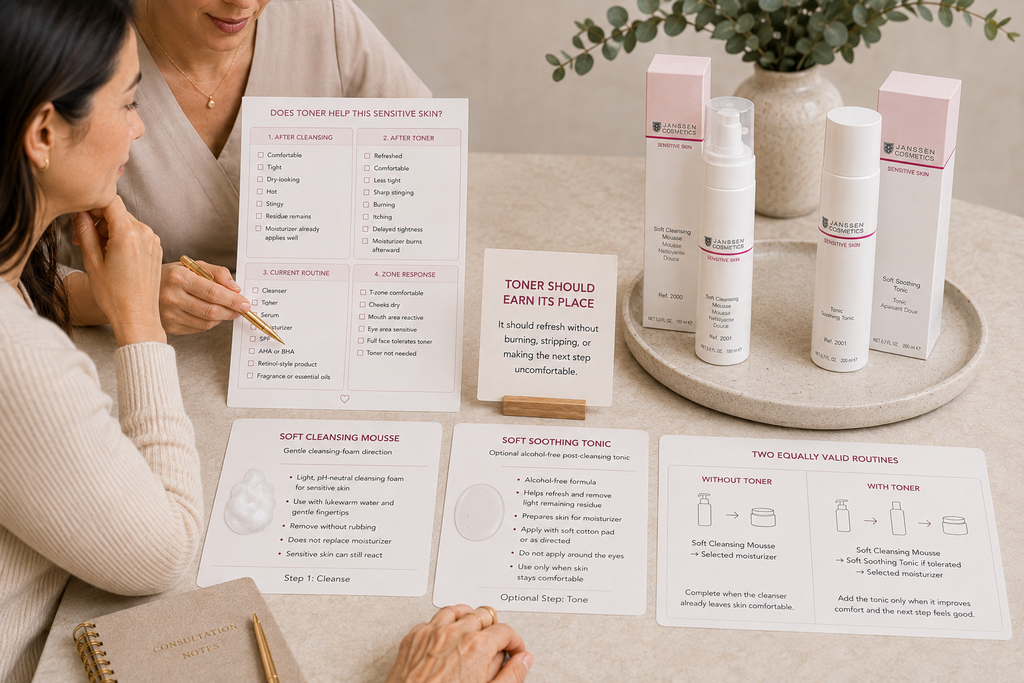
Possible sensitive-skin options may include:
Soft Soothing Tonic may be discussed as the toner step for sensitive or redness-prone skin when the skin can tolerate toner. If toner stings, burns, or makes the skin tight, the routine may need to simplify first.
These options are not automatic recommendations. The right toner decision depends on the skin’s response after cleansing, current irritation, product history, and whether the skin is stable enough for an extra step.
Do not use toner just because a routine says you need it.
Do not keep using toner that burns.
Do not assume alcohol-free means your skin will always tolerate it.
Do not use acid toner on over-exfoliated skin.
Do not apply toner with harsh rubbing.
Do not apply facial toner near the eyes unless it is made for that area.
Do not layer toner with too many active products.
Do not use toner to force oily skin matte.
Do not ignore swelling, rash-like irritation, pain, crusting, bleeding, eye-area irritation, or persistent worsening.
Sensitive skin can use toner if it is mild, alcohol-free, non-stripping, and well tolerated. Toner is optional, not required.
Sensitive skin usually does better with a mild, alcohol-free toner that refreshes without stinging, burning, or leaving tightness.
Yes. If toner stings, burns, or makes your skin feel hot or tight, pause it and simplify your routine.
Yes. Toner can make sensitive skin worse if it is too drying, active, fragranced, harsh, or applied with too much rubbing.
Toner usually goes after cleansing and before moisturizer.
Some sensitive skin can, but not all. Frequency depends on the toner formula and how the skin responds.
No. Toner is optional. If your basic routine works without toner, you do not need to add it.
See a dermatologist if toner causes persistent burning, swelling, rash-like irritation, pain, crusting, bleeding, infection-looking changes, eye-area irritation, or symptoms that do not improve after stopping the product.
If you are not sure whether toner belongs in your sensitive skin routine, a free virtual consultation can help you decide before adding another step.
At Zendevie, we review how your skin feels after cleansing, whether toner stings, whether moisturizer burns, and whether your skin is dry, oily, redness-prone, or over-exfoliated. The goal is to help you build a routine that your skin can tolerate, not a routine with unnecessary steps.

Zendevie is guided by Haby Diallo, a licensed esthetician with more than 20 years of professional skincare experience. Her approach is rooted in education, professional judgment, and personal care.
years of experience