

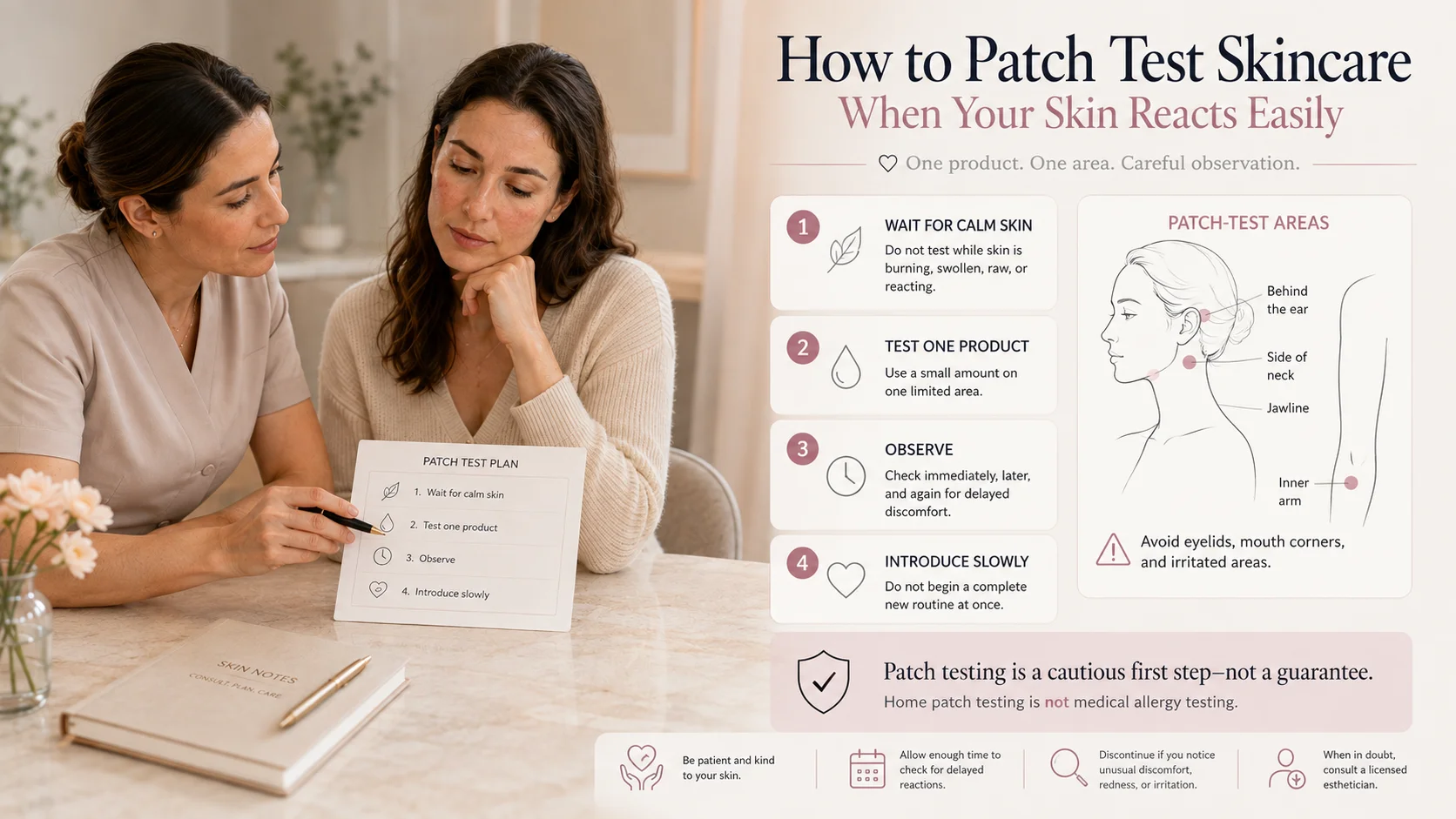
When your skin reacts easily, trying a new skincare product can feel risky.
A moisturizer may burn. A toner may sting. SPF may make the eye area water. Vitamin C may feel hot. Retinol-style products may cause flaking. Exfoliating acids may make the skin feel tight or raw. Even products labeled gentle may not feel gentle on your skin.
This is why patch testing matters.
Patch testing is a simple way to observe how your skin responds to a new product before applying it over the entire face. It does not guarantee that your skin will never react, but it can help reduce surprises.
At Zendevie, we do not recommend applying several new products at once, especially for sensitive skin. In consultation, our licensed esthetician looks at your current skin condition, product history, reaction pattern, and routine before deciding what should be tested first.
Sensitive skin needs patience before product layering.
To patch test skincare, apply a small amount of product to a limited area and observe how your skin responds before using it on your whole face.
Watch for:
Patch testing is especially important for sensitive skin before using:
If a product causes strong burning, swelling, pain, rash-like irritation, crusting, bleeding, or persistent worsening, stop using it and seek dermatologist guidance.

Patch testing means applying a new product to a small area of skin before using it widely.
The goal is to see whether the skin shows an uncomfortable reaction.
For sensitive skin, patch testing can help you avoid applying a product across the whole face too quickly.
It is not perfect. A product may pass a small patch test and still bother your face later. But patch testing gives you more information than applying a new active product everywhere on the first day.
A home patch test is not the same as medical allergy testing.
A dermatologist or medical professional can perform more formal testing when needed.
At-home patch testing is simply a cautious skincare step. It helps you observe your skin’s cosmetic response to a product.
If your skin has strong, repeated, swollen, rash-like, painful, or persistent reactions, do not rely on home patch testing alone. A dermatologist should evaluate the concern.

Sensitive skin can react more easily to products, weather, fragrance, active ingredients, exfoliation, and product layering.
A product that works well for someone else may sting on your skin.
Patch testing can help when your skin often experiences:
Patch testing gives the skin a slower introduction.
This is important.
A patch test can reduce risk, but it cannot promise that a product is perfect for your skin.
A product may feel fine on a small area but react when:
Patch testing is helpful, but it is only one part of careful skincare.
Patch testing is useful before starting any new product, but it is especially important when the product is active or when your skin is reactive.
Patch test before using:
The more sensitive your skin is, the more important this step becomes.
Sometimes the skin is too reactive even for patch testing.
Do not patch test a new skincare product when your skin is currently:
When the skin is already upset, testing a new product can make it harder to understand what is happening.
Simplify first.
If your skin is reacting easily, start with a simple routine before testing new products.
Morning:
Gentle cleanser → moisturizer → SPF
Evening:
Gentle cleanser → moisturizer
Pause:
Once the skin feels more stable, patch testing can make more sense.
Choose a small area that is easy to observe.
Common patch test areas include:
For facial products, the jawline or behind the ear may give more useful information than the arm because facial skin can react differently.
Avoid patch testing directly on the eyelids, under the eyes, around the mouth, or on irritated areas unless a professional has guided you.
Sensitive areas can react strongly.
Cleansers are rinsed off, so patch testing them is slightly different.
To patch test a cleanser:
A cleanser should not leave the test area feeling tight, hot, or stripped.
If a cleanser burns during the patch test, do not use it on your whole face.
To patch test a moisturizer:
Watch for:
A moisturizer should feel comfortable. If it burns strongly, it may not be the right product for your skin right now.
Toner can sting sensitive skin, especially if applied with rubbing.
To patch test toner:
If toner feels sharp, hot, drying, or makes moisturizer burn afterward, it may not fit your skin.
Toner is optional for sensitive skin.
Vitamin C is an active ingredient category, so sensitive skin should test it carefully.
To patch test vitamin C:
If vitamin C causes burning, heat, swelling, rash-like texture, or repeated stinging, stop using it.
Retinol-style products need extra caution for sensitive skin.
To patch test retinol:
Retinol-style products can cause delayed reactions, so do not judge only by how the skin feels in the first few minutes.
AHA and BHA products should be patch tested carefully.
To patch test exfoliating acids:
Stop if you notice burning, strong stinging, swelling, rash-like texture, or lasting discomfort.
Sensitive skin should not start acids aggressively.
SPF is important, but sensitive skin may react to certain formulas.
To patch test SPF:
SPF can also sting when the skin is already over-exfoliated or irritated. If several SPF products burn, review the skin condition, not only the SPF formula.
The eye area is delicate, so patch testing eye products needs caution.
Do not test a new product directly on the eyelid first.
Start near, but not inside, the eye area, such as the outer orbital area if appropriate and if the product is made for that use.
Watch for:
If eye-area irritation appears, stop and seek guidance.
There is no perfect timeline for every product or person.
Some reactions happen immediately. Others are delayed.
For sensitive skin, observe the area:
Active products such as retinol-style products, vitamin C, AHA, and BHA may need more observation because reactions can show later.
Do not rush from patch test to full-face use in one day if your skin reacts easily.
A product may not be a good match if the patch test causes:
Do not apply the product to your whole face if it fails the patch test.
A mild, brief sensation can happen with some active products.
But sensitive skin should be careful.
Stop if the sensation becomes:
Do not convince yourself that strong discomfort means the product is working.
This can happen.
Facial skin may react differently than the patch test area.
Your face may also react because the product was:
If your face reacts, stop the product and simplify.
Patch testing multiple products at the same time defeats the purpose.
If your skin reacts, you will not know which product caused the issue.
Test one new product at a time.
This is especially important for:
Sensitive skin needs clear information, not confusion.
A common mistake is starting an entire new routine in one day.
For example:
New cleanser → new toner → new vitamin C → new moisturizer → new SPF → new mask
If your skin reacts, it becomes difficult to identify the trigger.
A better approach is to introduce one product at a time.
Keep the rest of the routine stable.
Fragrance can be a trigger for some sensitive skin.
Patch test fragranced products carefully, even if they are labeled gentle, natural, or soothing.
Fragrance can appear in:
If a fragranced product causes stinging, itching, heat, or redness-looking changes, it may not be a good match.
Essential oils are not always gentle.
Sensitive skin may react to essential oils, especially when the skin is already dry, over-exfoliated, or redness-prone.
If you patch test a product with essential oils, watch for delayed reactions too.
Natural does not automatically mean low-risk.
The skin’s response matters more than the marketing language.
Do not patch test new active products when your skin is over-exfoliated.
Signs of over-exfoliation include:
If this is happening, pause testing.
Use a simple routine first.
Weather can affect how your skin responds to products.
A product that feels fine in mild weather may sting during winter dryness, summer heat, humidity, wind, or after sun exposure.
Sensitive skin may react more during:
Avoid testing strong new products when your skin is already weather-stressed.
Do not start a new product right before travel.
Travel can make sensitive skin more reactive because of:
Patch test and introduce new products well before travel, not during the trip.
Bring products your skin already tolerates.
Do not test a new product right before an important event.
Sensitive skin may react unpredictably.
Avoid starting new:
Use known products before events.
A calm routine is better than a last-minute experiment.
Dry-sensitive skin should patch test carefully because dryness can make products sting more.
If the skin is tight or flaky, pause active products before testing new ones.
Dry-sensitive skin should pay attention to:
If a patch test feels drying, the product may not be right for the skin right now.
Oily-sensitive skin may be tempted to test strong clarifying products.
Be careful with:
If the skin is shiny but tight, do not test stronger oil-control products immediately.
First, stabilize the routine with mild cleansing, lightweight moisturizer, and SPF.
Redness-prone skin should patch test slowly.
Watch for:
Avoid patch testing right after heat exposure, exercise, hot showers, or sun exposure.
Let the skin cool and settle before testing anything new.
Mature sensitive skin may react more easily to strong active products.
Be cautious with:
Mature sensitive skin may need more comfort before active steps.
A well-aging routine should not leave the skin raw or irritated.
If the patch test looks comfortable, do not immediately apply the product heavily all over the face.
Introduce slowly.
A careful approach:
This helps the skin adjust and gives you clearer information.
Keep notes when testing products.
Write down:
This helps you see patterns.
It also helps during a skincare consultation or dermatologist visit.
If a product causes discomfort, stop using it.
Do not cover the reaction with more active products.
Simplify the routine.
Use only products your skin already tolerates.
Avoid:
If symptoms are strong, swelling, rash-like, painful, or persistent, seek dermatologist guidance.
If the skin feels hot after testing a product, stop using it.
Heat can be a sign that the skin is irritated.
Avoid applying more products over the area.
Do not exfoliate.
Do not apply retinol-style products.
Do not use hot water.
If heat is severe, painful, swollen, rash-like, or does not improve, seek medical guidance.
Itching can be a sign that the product does not suit your skin.
Stop using the product and observe the area.
Do not scratch.
Avoid applying fragrance, acids, masks, or retinol-style products over the area.
If itching is persistent, rash-like, swollen, or worsening, seek dermatologist guidance.
If bumps appear after patch testing, stop the product.
Bumps may happen for different reasons, including irritation, clogged-looking response, formula mismatch, or sensitivity.
Do not assume the skin is “purging.”
Sensitive skin should be cautious with that assumption.
If bumps are painful, deep, swollen, rash-like, infected-looking, or persistent, dermatologist evaluation is appropriate.
If the eye area reacts to a product, stop using it near the eyes.
Watch for:
The eye area is delicate.
If symptoms continue, seek medical guidance.
If a product passes the patch test, use it carefully.
Do not apply more than directed.
Do not use it more often than recommended.
Do not combine it with multiple active products immediately.
Sensitive skin usually reacts more to overload than to one well-chosen step.
Do not test these combinations at the same time:
Test one change at a time.
After consultation, our licensed esthetician may consider Janssen Cosmetics options depending on whether the skin is sensitive, dry-sensitive, oily-sensitive, redness-prone, reactive after over-exfoliation, or easily triggered by product changes.
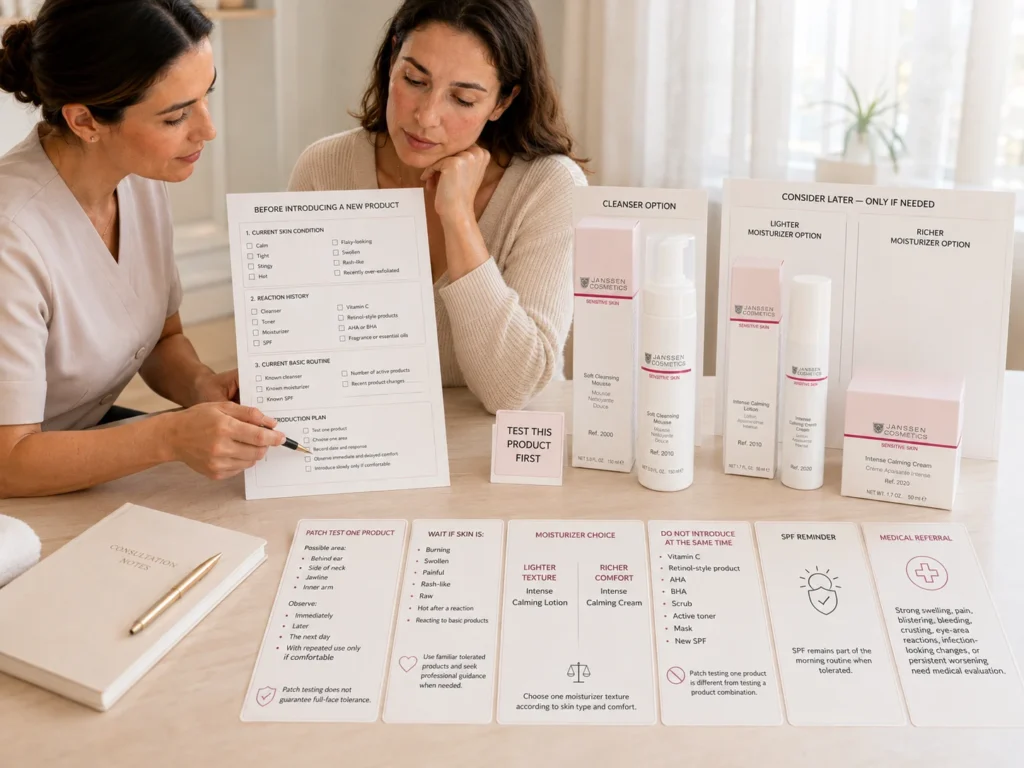
Possible sensitive-skin options may include:
If a client is considering active products such as vitamin C, retinol-style care, exfoliating acids, brightening-support products, or oily-skin clarifying products, those should be discussed only after the skin’s tolerance is understood.
Patch testing may be part of the introduction process, but it does not replace a proper consultation or dermatologist evaluation when reactions are strong.
Do not apply a new product all over your face immediately if your skin reacts easily.
Do not test several new products at once.
Do not patch test on skin that is already burning, swollen, rash-like, painful, or severely irritated.
Do not assume natural products are automatically safe for sensitive skin.
Do not assume stinging means a product is working.
Do not patch test strong acids, retinol-style products, or vitamin C right before travel or an event.
Do not apply active products near the eyes without caution.
Do not ignore swelling, rash-like irritation, pain, crusting, bleeding, infection-looking changes, eye-area reactions, or persistent worsening.
Apply a small amount of the product to a limited area, such as behind the ear, jawline, neck, or inner arm. Watch for burning, itching, swelling, rash-like texture, redness-looking changes, bumps, or delayed irritation before using it on the full face.
Some reactions happen quickly, while others appear later. Sensitive skin should observe the area right away, later the same day, the next day, and after repeated use if the first test is comfortable.
Common areas include behind the ear, side of the neck, jawline, or inner arm. For facial products, the jawline or behind the ear may be more useful than the arm.
Yes. A patch test reduces risk, but it does not guarantee no reaction. Full-face use, layering, frequency, weather, and sensitive areas can change how the skin responds.
Yes, especially if your skin is sensitive. Vitamin C can sting when the skin is dry, irritated, or over-exfoliated.
Yes. Retinol-style products can cause delayed dryness, flaking, burning, or irritation, so sensitive skin should test and introduce them slowly.
Yes, especially if SPF usually stings, burns, or irritates your eye area. SPF is important, but the formula and skin condition matter.
See a dermatologist if a product causes persistent burning, swelling, rash-like irritation, pain, crusting, bleeding, infection-looking changes, eye-area irritation, or symptoms that do not improve after stopping the product.
If your skin reacts easily and you are not sure how to introduce new products, a free virtual consultation can help you slow down the process.
At Zendevie, we review your current routine, reaction history, cleanser, moisturizer, SPF, active products, fragrance exposure, and skin sensitivity before recommending next steps. The goal is to help you test and introduce products more carefully instead of guessing.

Zendevie is guided by Haby Diallo, a licensed esthetician with more than 20 years of professional skincare experience. Her approach is rooted in education, professional judgment, and personal care.
years of experience