


Skincare layering can become complicated very quickly.
A routine may include:
At night, the same routine may also include:
Each product may seem useful.
But sensitive skin does not always benefit from using every category at once.
When too many products are layered, the skin may begin to:
The correct order matters.
But the number of products, active ingredients, frequency, application area, and condition of the skin matter just as much.
At Zendevie, our licensed esthetician does not begin by filling every possible step.
The first question is whether the skin can comfortably tolerate a gentle cleanser, appropriate moisturizer, and daytime SPF.
Optional layers are added only when they serve a clear purpose.
A general sensitive-skin routine may follow this order:
Gentle cleanser or lukewarm-water rinse if appropriate → gentle tonic if needed → one serum if needed → eye care if appropriate → moisturizer → SPF
Gentle cleanser → gentle tonic if needed → one treatment or serum if appropriate → eye care → moisturizer
The exact order may change according to the product formula and manufacturer directions.
For sensitive skin:
If products repeatedly burn, itch, cause swelling, create rash-like changes, or make basic moisturizer and SPF sting, simplify the routine and seek dermatologist guidance when symptoms are persistent or worsening.
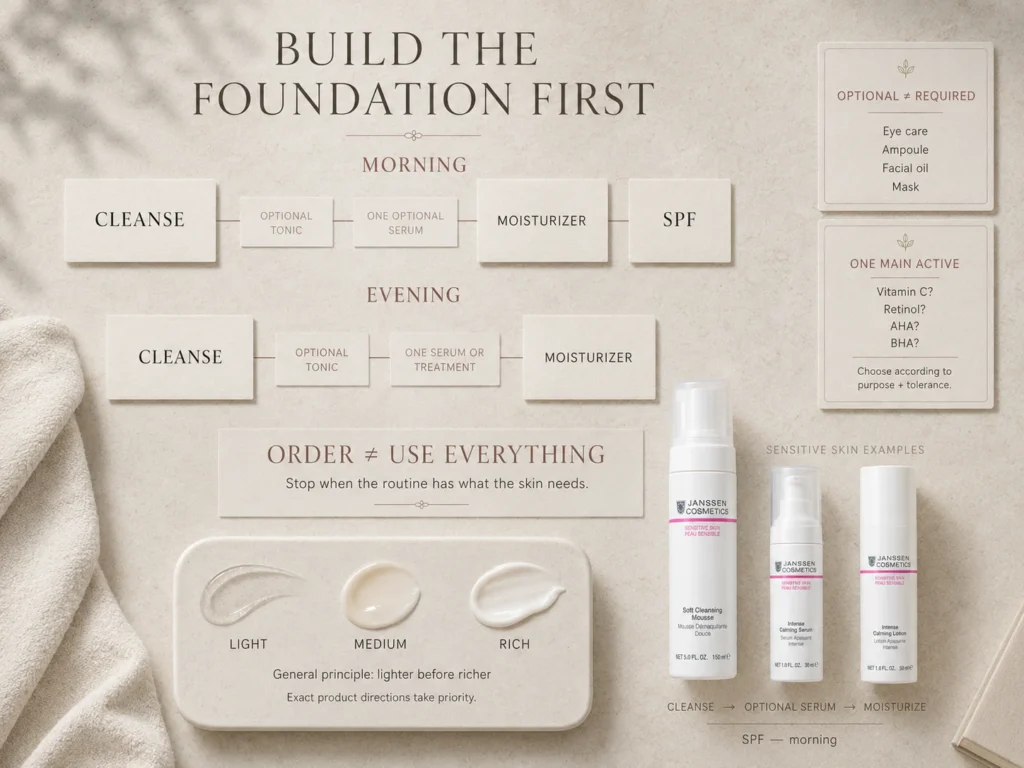
A complete routine can be simple.
For many people, the foundation may be:
Morning: Cleanser or rinse → moisturizer → SPF
Evening: Cleanser → moisturizer
This routine already addresses:
Toner, serum, eye cream, facial oil, masks, exfoliation, retinol, ampoules, and spot products are optional.
An optional product should be added because the skin has a clear need—not because the routine feels too short.
People often focus on whether serum goes before moisturizer.
That is useful, but layering also involves:
A technically correct order may still be too much for sensitive skin.
A common general approach is to apply lighter products before richer products.
For example:
Tonic → lightweight serum → lotion or cream
This may help thinner products spread more evenly before a richer moisturizer is applied.
However, texture alone does not determine every product’s order.
Manufacturer directions may differ because of:
Always check the directions for the exact product.
Not every serum, sunscreen, treatment, or oil is designed to be layered in the same way.
A product may instruct you to apply it:
Do not ignore the directions simply because a general skincare chart shows a different order.
A consultation can help organize the sequence when several products have different instructions.
Cleansing is generally the first step.
It helps remove:
Sensitive skin should use the gentlest effective cleansing method.
The skin should not feel:
If the skin already feels irritated after cleansing, adding several layers may make it more uncomfortable.
Some sensitive skin may prefer a gentle cleanser in the morning.
Other skin may prefer a lukewarm-water rinse when it feels dry or tight.
Morning cleansing depends on:
Evening cleansing may need to remove:
The same routine does not need to be repeated identically morning and night.
Double cleansing may be useful when the skin is wearing:
It is not automatically required every evening.
If double cleansing leaves the skin:
review whether both steps are necessary and appropriately gentle.
A gentle tonic may be used after cleansing when it serves a clear purpose and feels comfortable.
However, not every toner is the same.
A toner may be:
An acid toner is an exfoliating product.
It should not be treated like a neutral hydration step.
Sensitive skin can have a complete routine without toner.
Depending on the product directions, toner may be applied with:
Avoid rubbing aggressively.
If a cotton pad repeatedly leaves the skin red-looking or stingy, the friction may be part of the problem.
Do not apply toner to:
Essences, ampoules, and serums are generally applied before moisturizer because they often have lighter textures.
However, sensitive skin does not need all three categories at once.
Choose the product that addresses the main concern.
Possible purposes may include:
One purposeful serum is often easier to evaluate than three or four layered serums.
There is no required number.
For sensitive skin, one serum may be enough.
Several serums may introduce:
Do not layer serums simply because they have different names.
Review whether their ingredients and functions overlap.
A hydrating serum is generally applied before moisturizer.
A simple routine may be:
Cleanser → hydrating serum → moisturizer
The moisturizer helps complete the routine and may reduce the feeling of water loss.
However, a hydrating serum is optional.
If moisturizer alone feels comfortable, another hydration layer may not be necessary.
A comfort-focused serum may be used after cleansing or tonic and before moisturizer.
A simple evening order may be:
Cleanser → comfort-focused serum → moisturizer
Do not layer several comfort serums simply because the skin feels irritated.
If the skin is actively burning or reacting, fewer products may be more appropriate.
Ampoules are concentrated cosmetic products.
They may be used:
Do not assume an ampoule should be combined with a serum, retinol, acid, and facial oil.
Sensitive skin should use ampoules only when their purpose and compatibility are clear.
Treatment products may include:
These products require more caution than basic hydration steps.
Sensitive skin should usually use one main treatment at a time.
Do not apply every treatment simply because each targets a different concern.
The answer depends on the exact formulas and directions.
A general routine may place a lightweight treatment serum before moisturizer.
However:
Do not create a universal order for every active ingredient.
Review the selected products individually.
Eye care is optional.
A separate eye product may be helpful when the eye area feels:
Eye products are generally applied carefully around the orbital area according to their directions.
Avoid:
More eye cream does not create faster results.
Eye cream is commonly applied before or around the moisturizer step.
The exact order may depend on texture.
A lightweight eye emulsion may be used before a richer facial cream.
If the eye cream is thicker, it may be applied after a lightweight facial moisturizer.
The most important considerations are:

Do not apply facial:
directly to the eyelids or close to the lash line unless the product is specifically designed for that area.
Products may move after application.
Leave enough space around the eyes.
Moisturizer generally follows lighter serums and treatment products.
It may help support:
The correct moisturizer texture depends on:
Sensitive skin does not automatically need the richest cream.
A lotion or light emulsion may suit:
A richer cream may suit:
The correct choice should be based on the full skin pattern.
Some retinol formulas are applied before moisturizer.
Some sensitive skin may use moisturizer as a buffering step.
Possible approaches may include:
Cleanser → completely dry skin → retinol → moisturizer
or, when professionally appropriate:
Cleanser → moisturizer → retinol
or:
Cleanser → thin moisturizer layer → retinol → moisturizer
The correct method depends on:
Sensitive skin should not create a retinol sandwich automatically without reviewing whether it suits the selected formula.
A moisturizer may be used after an exfoliating acid when the product directions allow.
A general order may be:
Cleanser → acid treatment → moisturizer
However, sensitive skin should not use acids when it is:
Moisturizer does not make an overly aggressive acid routine safe.
Facial oil is generally applied after water-based serums and moisturizer, depending on the product directions.
A common order may be:
Cleanser → serum → moisturizer → facial oil
However, facial oil is optional.
It may:
Do not apply oil simply because the skin is sensitive.
Do not add concentrated:
to facial oil or moisturizer.
The mixture may not be evenly distributed.
The final concentration may be unpredictable.
Use professionally formulated products as directed.
In a general morning skincare routine, SPF is the final skincare step before makeup.
A simple order may be:
Cleanser → serum if needed → moisturizer → SPF
Allow the underlying products to settle enough that sunscreen can be applied evenly.
Do not mix sunscreen into:
unless the manufacturer specifically designed and directed the product that way.
Mixing may interfere with even application.
Some specialty protection products may have different application directions.
Always follow the instructions for the selected sunscreen or protective formula.
A consultation should organize the order when the directions differ from a general routine.
Do not assume every SPF product behaves identically.
Makeup generally follows sunscreen.
A simple morning order may be:
Cleanser → moisturizer → SPF → makeup
When serum is needed:
Cleanser → serum → moisturizer → SPF → makeup
Allow each layer to settle enough to avoid excessive rubbing or pilling.
There is no universal waiting time for every product.
Sensitive skin does not need to wait an exact number of minutes between each basic step unless the product directions say so.
Allow a layer to:
Some active products may require application to completely dry skin or a longer interval.
Follow their specific directions.
If products repeatedly:
waiting longer may not solve the problem.
The formulas may be incompatible, too much product may be used, or the routine may contain too many layers.
Sensitive skin does not need aggressive rubbing.
Apply products with:
Avoid rubbing until the skin feels warm.
Aggressive application may create:
Follow the directions for each product.
Using more may increase:
This is especially important for:
More product does not guarantee stronger cosmetic results.
Some hydrating products may be applied to slightly damp skin.
Other active products should be applied to completely dry skin.
Sensitive skin should not assume that every product works better on wet skin.
Applying an active formula to very damp skin may make it feel more intense.
Follow the directions for:
Vitamin C is generally used as a serum step before moisturizer and SPF.
A simple morning order may be:
Gentle cleanser → vitamin C serum → moisturizer → SPF
However, sensitive skin should first ask:
Vitamin C is optional.
It should pause when the skin is burning, swollen, painfully flaky, or reacting to basic products.
Some formulas may be compatible.
A general order may be:
Cleanser → vitamin C → hydrating serum → moisturizer → SPF
However, two serums may be unnecessary.
If both are used:
Layering strong vitamin C with exfoliating acids may be too active for some sensitive skin.
Possible problems include:
Sensitive skin may use the products at different times or on different days when professionally appropriate.
Do not combine them blindly.
Some people use vitamin C in the morning and retinol at night.
A possible structure may be:
Morning: Cleanser → vitamin C → moisturizer → SPF
Evening: Cleanser → retinol according to directions → moisturizer
This still may be too active for some sensitive skin.
Begin with one active product.
Confirm tolerance before adding another.
Retinol is usually an evening treatment.
A general routine may be:
Gentle cleanser → allow skin to dry as directed → retinol → moisturizer
Sensitive skin may need:
Retinol should not strongly burn.
Avoid or use extra caution around:
Product directions should determine where it may be applied.
A hydrating serum may be used on a non-retinol night or in the same routine when the formulas and skin tolerance support it.
Do not assume more hydration automatically prevents retinol irritation.
The simplest retinol routine may be easier to tolerate:
Cleanser → retinol → moisturizer
Retinol and AHA may be too much together for reactive skin.
Avoid beginning both during the same week.
A possible professional schedule may separate them onto different nights.
However, some sensitive skin may not need both.
The skin should tolerate the basic routine before either product is introduced.
Retinol and BHA may both be relevant to clogged-looking texture or blemish-prone skin.
They may also create:
Do not layer them blindly.
Use one main active at a time until tolerance is clear.
AHA is generally used as an exfoliating treatment step before moisturizer.
A simple evening order may be:
Gentle cleanser → AHA product according to directions → moisturizer
Do not add:
to the same routine automatically.
AHA is optional.
BHA may be considered for:
A simple routine may be:
Gentle cleanser → targeted BHA → moisturizer
BHA does not always need to be applied across dry or reactive cheeks.
For combination-sensitive skin, targeted use may be more appropriate.
Some professionally formulated products contain both AHA and BHA.
That is different from independently layering several acid products.
Do not combine:
simply because each product has separate directions.
The total routine matters.
Azelaic-acid cosmetic products may be used as a treatment step before moisturizer according to their directions.
Sensitive skin should:
Do not assume that a product considered suitable for sensitive skin cannot cause discomfort.
Niacinamide may appear in:
It may already be present in another product.
A separate niacinamide serum may be unnecessary.
Review the complete ingredient list before layering multiple formulas containing the same active ingredient.
Peptide serums are usually applied before moisturizer.
A simple order may be:
Cleanser → peptide serum → moisturizer
Sensitive skin does not need to combine peptides with every other active product.
A peptide serum may be used on simpler nights when retinol or acids are not being used.
Hyaluronic acid may appear in:
Using several hyaluronic-acid products is not automatically harmful, but it may be redundant.
A separate serum may not be necessary when the moisturizer already provides enough hydration support.
Spot products should generally be applied only where needed.
Avoid spreading them across the entire face unless the product directs full-face use.
Be cautious when spot products contain:
Do not place multiple spot treatments on the same blemish.
Clogged-looking areas may tempt people to layer:
Sensitive skin should not combine every clarifying method.
A targeted BHA step may be enough when appropriate.
Painful, deep, swollen, infection-looking, crusting, bleeding, persistent, or scarring blemishes need dermatologist evaluation.
One lightly fragranced product may feel comfortable.
Several fragranced layers may increase total exposure.
Fragrance may be present in:
If the skin becomes itchy, hot, or stingy, review the complete routine rather than one product alone.
Avoid layering several products containing:
Do not combine essential-oil products with acids or retinol on already reactive skin.
Do not apply undiluted essential oils directly.
A basic morning routine may be:
Gentle cleanser or rinse → moisturizer → SPF
A routine with one serum may be:
Gentle cleanser → one tolerated serum → moisturizer → SPF
A routine with tonic and eye care may be:
Gentle cleanser → gentle tonic → one serum → eye care → moisturizer → SPF
Every added step should have a clear purpose.
A basic evening routine may be:
Gentle cleanser → moisturizer
A routine with one comfort-focused serum may be:
Gentle cleanser → gentle tonic if needed → comfort-focused serum → eye care → moisturizer
An active-treatment evening may be:
Gentle cleanser → one active treatment according to directions → moisturizer
Do not use every evening product every night.
Sensitive skin may benefit from separating active nights from simpler nights.
Gentle cleanser → one active treatment → moisturizer
Gentle cleanser → comfort-focused serum if needed → moisturizer
This may reduce the temptation to combine several active ingredients.
Some routines divide products into scheduled exfoliation, retinol, and recovery nights.
This may help some people organize active use.
It is not required.
Sensitive skin may need:
Do not follow a trend more closely than the skin’s response.
A simple morning routine may be:
Gentle cleanser or rinse → hydrating or comfort-focused serum if needed → richer moisturizer → SPF
A simple evening routine may be:
Gentle cleanser → comfort-focused serum if needed → richer moisturizer
Avoid layering:
A simple morning routine may be:
Gentle cleanser → lightweight serum if needed → lightweight moisturizer → SPF
A simple evening routine may be:
Gentle cleanser → targeted treatment if appropriate → lightweight moisturizer
Do not skip moisturizer automatically.
Avoid:
Combination-sensitive skin may need different treatment by zone.
A morning routine may be:
Gentle cleanser → lightweight serum if needed → appropriate moisturizer → SPF
An evening routine may be:
Gentle cleanser → targeted BHA only on clogged-looking zones when appropriate → moisturizer
Do not apply strong acids to dry, reactive cheeks simply because the T-zone is oily.
A simple morning routine may be:
Gentle cleanser or rinse → antioxidant or hydrating serum if tolerated → moisturizer → SPF
A simple evening routine may be:
Gentle cleanser → one well-aging treatment or comfort-focused serum → moisturizer
Do not layer:
all together.
Mature skin care should support comfort, consistency, texture, hydration, and firmness appearance without creating persistent irritation.
A simple morning routine may be:
Gentle cleanser or rinse → one comfort-focused serum if needed → moisturizer → SPF
A simple evening routine may be:
Gentle cleanser → comfort-focused serum → moisturizer
Avoid:
Persistent, painful, swollen, or worsening redness-looking reactions need dermatologist evaluation.
A simple routine may be:
Gentle cleanser → lightweight moisturizer → SPF
Gentle cleanser → one targeted treatment when appropriate → lightweight moisturizer
Avoid combining:
The goal is not to dry the skin as much as possible.
Keep the eye-area routine simple.
A possible order may be:
Cleanser → lightweight serum kept away from the eyes → eye care → facial moisturizer → SPF
Avoid allowing facial products to collect near the lash line.
Use only a small amount of eye product.
Seek medical guidance for significant swelling, pain, crusting, discharge, vision changes, or persistent irritation.
The mouth corners may react more easily.
Avoid applying:
directly over cracked-looking, burning, or rash-like areas.
Keep facial treatments slightly away from the lips and mouth corners.
Products may collect in nostril folds.
Avoid applying active products directly into irritated creases.
Use less product around:
Persistent irritation should be professionally evaluated.
The neck may be more sensitive than the face.
Do not assume a retinol, acid, or strong vitamin C product tolerated on the forehead will automatically suit the neck.
Introduce neck products separately.
Use small amounts.
Stop if the area becomes hot, itchy, rash-like, or painfully dry.
Freshly shaved skin may be more reactive.
After shaving, avoid immediately applying:
Use a simple routine that the skin tolerates.
Pause active products on recently treated areas.
Do not apply:
until the skin feels comfortable.
Follow professional aftercare instructions.
After professional peels, microdermabrasion, dermaplaning, microneedling, laser procedures, or other intensive services:
Professional treatment products should remain in professional settings.
Do not layer strong active products on skin that feels:
Use the simplest familiar routine.
Seek medical guidance for blistering, significant swelling, severe pain, or worsening symptoms.
Winter layering may involve:
Do not automatically add toner, essence, several serums, facial oil, cream, balm, and sleeping mask.
The routine may become too heavy or difficult to evaluate.
Hot-weather layering may require:
Do not remove every moisturizing step simply because the skin looks shiny.
Oily-sensitive skin may still feel dehydrated.
Travel is not the best time to introduce a complicated routine.
Pack the foundation first:
Optional products should already be tolerated.
Do not combine new samples, hotel products, active serums, masks, and unfamiliar SPF formulas during the same trip.
Pilling may happen when:
Pilling does not always mean the skin needs exfoliation.
First reduce product amount and number of layers.
Try:
Do not rub harder.
Aggressive rubbing may create more pilling and friction.
Review:
A lighter morning routine may work better.
Do not mix the SPF into moisturizer to solve pilling.
Possible contributors include:
Simplify the base.
Pilling does not automatically mean the sunscreen is ineffective, but uneven disruption may affect how reliably the layer remains on the skin.
Apply products carefully.
The routine may contain:
Remove unnecessary steps.
Sticky skin does not always need a stronger cleanser.
Review:
A lighter moisturizer or fewer layers may be more comfortable.
Do not skip all moisturizer automatically.
Possible reasons include:
Adding another serum may not solve the problem.
Review the foundation.
Pause active products.
Review:
If heat becomes burning, painful, swollen, rash-like, or persistent, stop the suspected products and seek guidance.
The serum may have already irritated the skin.
The moisturizer may not be the original cause.
Stop the serum.
Return to the simplest routine that remains comfortable.
If moisturizer continues to burn, seek dermatologist guidance.
Review whether the earlier steps include:
Reduce unnecessary layers.
A different SPF formula may also be needed.
The products may be migrating toward the eyes.
Review:
Keep products farther from the lash line.
Seek medical guidance for significant swelling, pain, crusting, discharge, vision changes, or persistent irritation.
Possible contributors include:
Do not immediately add more exfoliation.
Simplify the routine and observe.
Seek guidance if bumps are painful, itchy, swollen, rash-like, infection-looking, spreading, persistent, or scarring.
Pause:
Do not exfoliate the flakes.
Use a gentle cleanser and tolerated moisturizer.
Stop introducing products.
Return to:
Morning: Gentle cleanser or rinse → tolerated moisturizer → tolerated SPF
Evening: Gentle cleanser → tolerated moisturizer
If cleanser, moisturizer, SPF, or water continues to cause significant discomfort, seek dermatologist guidance.
Remove products that do not serve a clear purpose.
Ask:
A shorter routine may be easier to follow consistently.
Missing an optional serum or toner does not mean the entire routine failed.
Do not double the amount later.
Continue with the next appropriate step.
Skincare should be practical enough to use consistently.
Do not guess.
Review:
A consultation can help determine whether the two products should be:
The routine may be too complex when:
More products do not automatically create better care.
Start with:
Gentle cleanser or rinse → moisturizer → SPF
Gentle cleanser → moisturizer
Once the foundation feels comfortable, add only one optional product.
Observe before adding anything else.
When adding a product:
Sensitive skin should not begin an entire product collection at once.
Write down:
A record may reveal which combinations feel comfortable and which do not.
Pause toner, serums, actives, masks, facial oils, and other optional steps when the skin is:
Return to the simplest tolerated routine.
Consider adding one optional product when the skin is:
This does not guarantee tolerance.
It creates a clearer starting point.
A dermatologist should evaluate the skin when layering or product use is followed by:
Seek urgent medical care for breathing difficulty, throat tightness, faintness, difficulty swallowing, or rapid swelling of the face, lips, tongue, or eyes.
Cosmetic skincare can help organize product order.
It cannot diagnose an allergy, dermatitis, rosacea, eczema, infection, or another medical condition.
After consultation, our licensed esthetician may organize Janssen Cosmetics products according to the skin’s sensitivity pattern, product texture, current concerns, and tolerance.

Possible sensitive-skin options may include:
These are possible products, not one automatic layered routine.
A simple consultation-led routine may begin with:
Soft Cleansing Mousse → one appropriate moisturizer → Face Guard Advanced according to its directions
Soft Cleansing Mousse → one appropriate moisturizer
Once the basic routine feels comfortable, an optional product may be added.
For example:
Soft Cleansing Mousse → Soft Soothing Tonic → appropriate moisturizer
Soft Cleansing Mousse → Soft Soothing Tonic if tolerated → Intense Calming Serum → Intense Calming Lotion or Intense Calming Cream
Soft Cleansing Mousse → optional tonic → optional serum → Comfort Eye Care → appropriate facial moisturizer
The moisturizer should match the skin:
The exact daytime order involving Face Guard Advanced should follow the product’s official directions and the personalized routine provided during consultation.
Do not independently change the sequence or mix the protection formula into another product.
Daily Couperose Serum should not be layered automatically with every other serum. It may be selected instead of another treatment serum when redness-prone appearance is the primary focus.
Instant Soothing Mask remains an occasional add-on. It should not be layered under the full daily routine or treated as an emergency requirement.
For oily-sensitive or combination-sensitive skin with clogged-looking pores, Purifying BHA Serum may be discussed as a targeted treatment only after the basic routine is stable.
It should not be combined blindly with:
Active Janssen options from other families—including AHA, BHA, enzyme exfoliation, retinol, vitamin C, or uneven-tone serums—should be introduced one at a time.
Professional exfoliation products belong in professional treatment settings.
They should not be layered into home care without professional direction.
Do not build a ten-step routine simply because every product is marketed for sensitive skin.
Do not use toner, essence, ampoule, several serums, facial oil, cream, and mask without a clear purpose.
Do not assume every serum must be layered.
Do not apply several treatment serums in one routine.
Do not combine AHA, BHA, retinol, scrub, and strong vitamin C blindly.
Do not treat an acid toner as a neutral hydration step.
Do not apply retinol directly around the eyes, mouth corners, or nostril folds unless the product is designed and directed for those areas.
Do not apply active products to recently shaved, waxed, threaded, or sun-stressed skin.
Do not apply products to very wet skin unless their directions support that method.
Do not assume waiting longer makes incompatible products suitable.
Do not rub products aggressively to make them absorb.
Do not use more product to create faster results.
Do not mix sunscreen into moisturizer, serum, oil, or foundation unless the product is specifically designed for that use.
Do not apply makeup before sunscreen.
Do not apply undiluted essential oils.
Do not mix essential oils into moisturizer or facial oil.
Do not assume every sensitive complexion needs a facial oil.
Do not apply a heavy winter cream automatically in humid weather.
Do not skip moisturizer automatically because the skin looks oily.
Do not exfoliate because products are pilling.
Do not add more acids because small bumps appear.
Do not layer several fragranced products without considering total exposure.
Do not apply professional peel products at home.
Do not continue layering products when the skin is burning, swollen, rash-like, painfully flaky, or reacting to basic steps.
Do not ignore significant swelling, blistering, crusting, bleeding, infection-looking changes, eye-area symptoms, breathing difficulty, or worsening reactions.
A general order is cleanser, optional tonic, one serum or treatment, eye care, moisturizer, and daytime SPF. Product-specific directions may change the order.
No. Toner is optional. A gentle tonic may suit some routines, while acid or alcohol-heavy toners may feel uncomfortable.
Lightweight serums are generally applied before moisturizer unless the product directions state otherwise.
There is no required number. One purposeful serum is often easier to tolerate and evaluate than several layered serums.
Some formulas may be compatible, but two serums are not always necessary. Review active ingredients, texture, product directions, and skin tolerance.
A lightweight eye product is commonly applied before facial moisturizer. The exact order may depend on product texture and directions.
Facial oil is commonly applied after water-based products and moisturizer, but exact directions may vary. Facial oil is optional.
In a general routine, SPF is the final skincare step before makeup. Follow the directions for the exact protection product.
Do not mix sunscreen into moisturizer unless the product is specifically designed and directed for that use.
Allow each product to settle enough for the next layer. There is no universal waiting time unless the product directions specify one.
Some hydrating products may suit slightly damp skin. Retinol, acids, and other active products may require completely dry skin. Follow the directions.
Some people use vitamin C in the morning and retinol at night, but sensitive skin should establish tolerance to one active before adding another.
The combination may be too active. They may need to be separated or one may be unnecessary.
The combination may increase dryness, flaking, or burning. Do not layer them blindly.
A professionally formulated product may contain both. Independently layering several acid products may be too active for sensitive skin.
Many retinol routines include moisturizer. The exact order depends on the retinol formula, directions, and skin tolerance.
Possibly, but more products do not automatically prevent irritation. Keep the retinol routine simple at first.
Pilling may result from too much product, incompatible textures, heavy layering, rubbing, or not allowing products to settle.
The serum may have already made the skin reactive. Stop the suspected serum and simplify the routine.
The skin may be over-exfoliated, reacting to a serum, dry, or experiencing product migration near the eyes. Too many morning layers may also contribute.
Stop introducing new products, pause optional actives, and return to the simplest tolerated cleanser, moisturizer, and SPF routine. Seek dermatologist guidance if basic products continue causing significant discomfort.
See a dermatologist when a reaction is persistent, painful, significantly swollen, blistering, crusting, bleeding, infection-looking, close to the eyes, repeatedly returning, or not improving after products are stopped.
If your routine contains several serums, active ingredients, oils, creams, and treatments but your skin still stings, pills, feels heavy, or becomes redness-prone, a free virtual consultation can help you organize the layers more clearly.
At Zendevie, we review your cleanser, tonic, serums, eye care, moisturizer, SPF, retinol, exfoliating products, makeup, skin type, preferred textures, climate, and reaction history before creating the order.
The goal is not to fit every product into one routine.
The goal is to build a simple foundation, choose only the layers your skin needs, and arrange them in a way that supports comfort, consistency, and safe product use.

Zendevie is guided by Haby Diallo, a licensed esthetician with more than 20 years of professional skincare experience. Her approach is rooted in education, professional judgment, and personal care.
years of experience