
Essential oils are often described as natural, botanical, pure, calming, or plant-based.
These words can make an essential-oil product sound especially appropriate for sensitive skin.
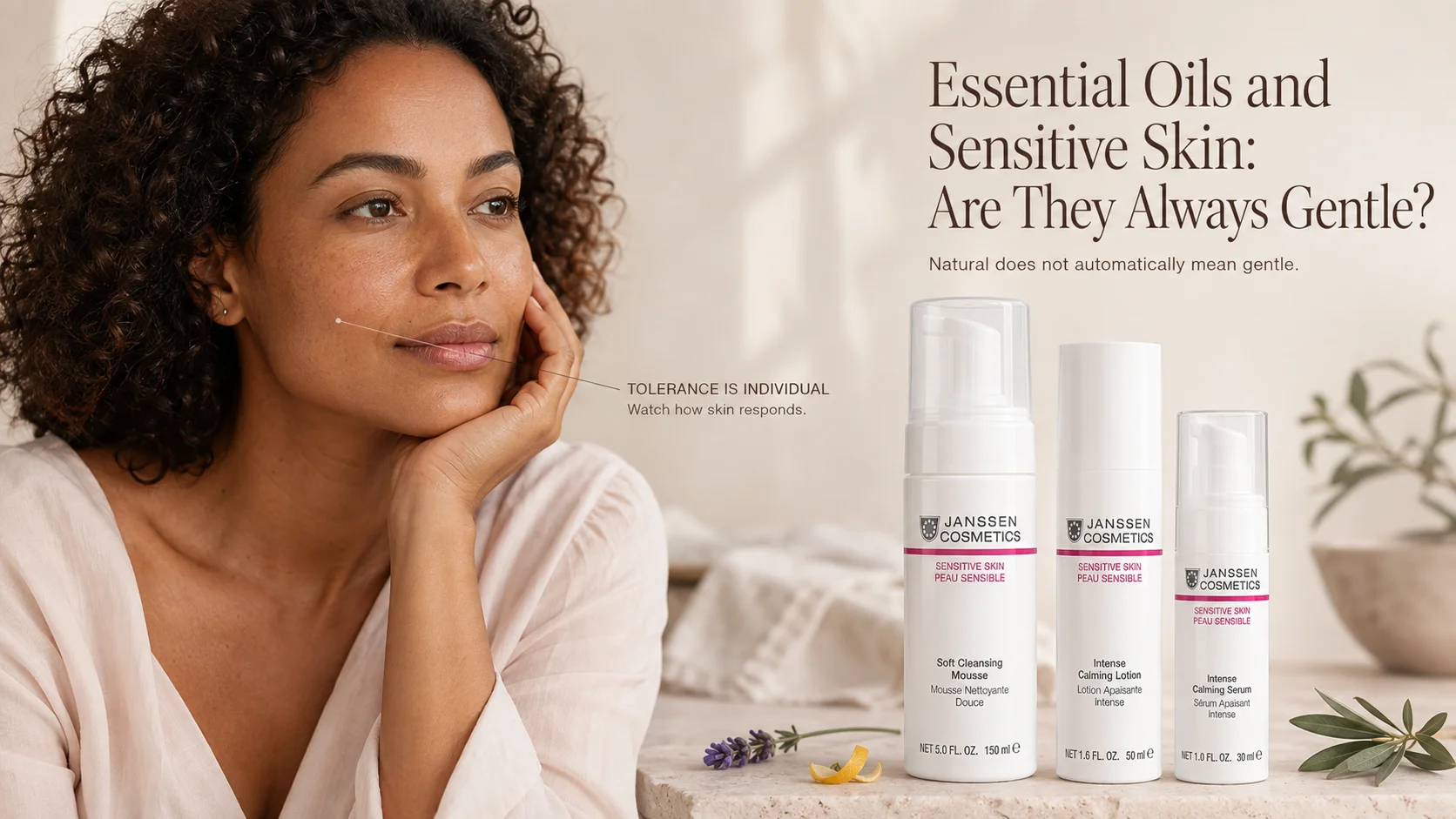
But natural does not automatically mean gentle.
Essential oils are concentrated aromatic materials obtained from plants. They may be added to facial oils, cleansers, toners, serums, moisturizers, masks, body products, haircare, and home fragrance products.
Some people use properly formulated products containing essential oils without visible discomfort.
Other people notice:
Sensitive skin needs more than a “natural” label.
At Zendevie, our licensed esthetician looks at the exact product, the complete ingredient list, the type of essential oil, how concentrated the formula may be, where it is being applied, what other active products are being used, and how the skin feels before application.
An essential oil may not be the only reason a product feels uncomfortable.
But it should not be assumed to be gentle simply because it came from a plant.
Essential oils are not always gentle for sensitive skin.
Some sensitive skin may tolerate a professionally formulated product containing a low amount of an essential oil. Other sensitive skin may sting, itch, feel hot, become dry, or develop redness-looking areas.
Sensitive skin should be especially cautious when essential oils are:
Do not apply concentrated essential oils directly to sensitive facial skin.
A simpler starting routine is:
Morning: Gentle cleanser → moisturizer → SPF
Evening: Gentle cleanser → moisturizer
Once the skin feels stable, introduce only one new product at a time and observe the response.
If an essential-oil product causes persistent burning, significant swelling, blistering, crusting, bleeding, infection-looking changes, severe itching, eye-area swelling, or a worsening rash-like reaction, stop using it and seek dermatologist guidance.
Essential oils are concentrated aromatic materials obtained from parts of plants.
Depending on the plant, they may come from:
Common essential oils used in personal-care products include:
Essential oils are not the same as ordinary plant oils used mainly for moisture and texture.
For example, jojoba oil, avocado oil, sunflower oil, and squalane are generally used as emollient or moisturizing ingredients. They are not automatically classified as essential oils.
Essential oils are usually much more aromatic and concentrated.
Essential oils may be added to skincare for:
Some products use a very small amount within a carefully designed formula.
Others use several essential oils together.
A strong scent does not tell you exactly how much essential oil is present.
A light scent also does not guarantee that the product will suit sensitive skin.
The complete formula matters.
“Natural” is often used as a shortcut for safe, mild, or non-irritating.
But plants naturally contain many active aromatic compounds.
Those compounds can affect sensitive skin differently.
A natural ingredient may still cause:
Synthetic ingredients are not automatically harsh.
Natural ingredients are not automatically mild.
Sensitive skin needs to be evaluated according to the actual product and the skin’s response.
An effective skincare routine does not need essential oils.
Essential oils are not necessary for:
A product may contain essential oils and still be enjoyable for someone who tolerates it.
But removing essential oils does not make a routine incomplete.
Sensitive skin should not feel pressured to use botanical aromatic ingredients because they are popular or described as clean.
Essential oils and fragrance are related, but they are not exactly the same.
A fragrance blend may contain:
An essential oil is a concentrated aromatic plant material.
A product may be marketed as:
These phrases do not mean the product is fragrance-free.
A product scented with essential oils is still fragranced.
Sensitive skin that reacts to fragrance should review essential oils as part of its total fragrance exposure.
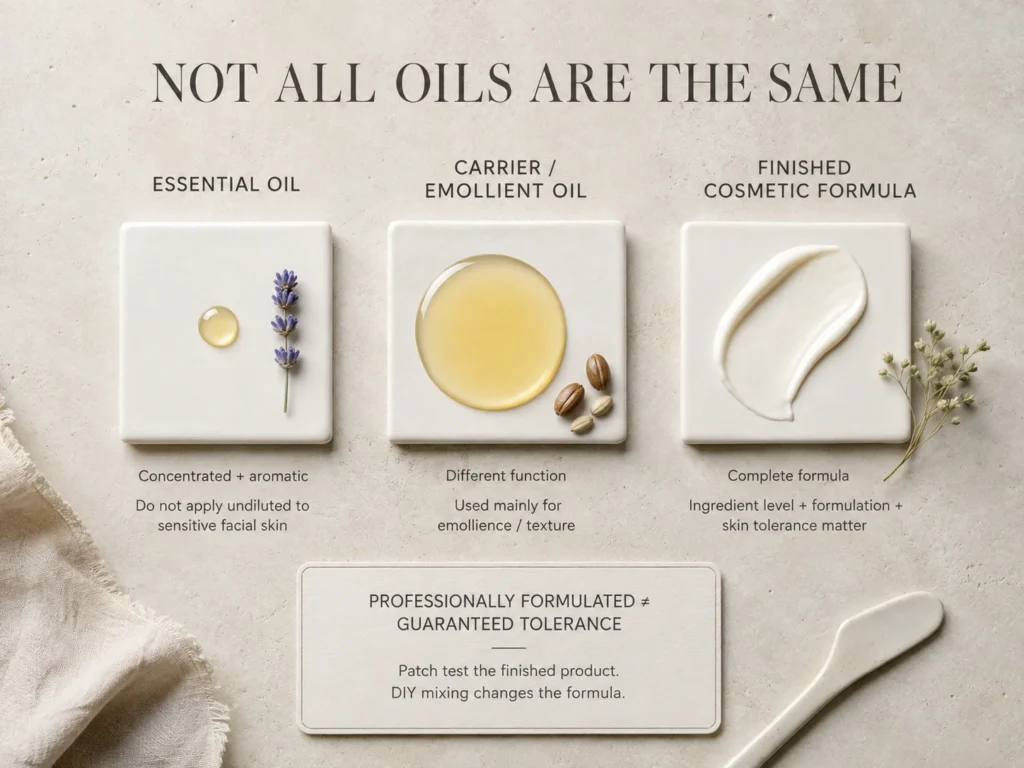
Carrier oils are usually used to dilute essential oils or provide emollient support.
Examples may include:
These oils have different functions and concentration patterns from essential oils.
However, a carrier oil is not automatically appropriate for every person.
A product may contain both a carrier oil and an essential oil.
The carrier oil does not guarantee that the aromatic ingredient will feel comfortable.
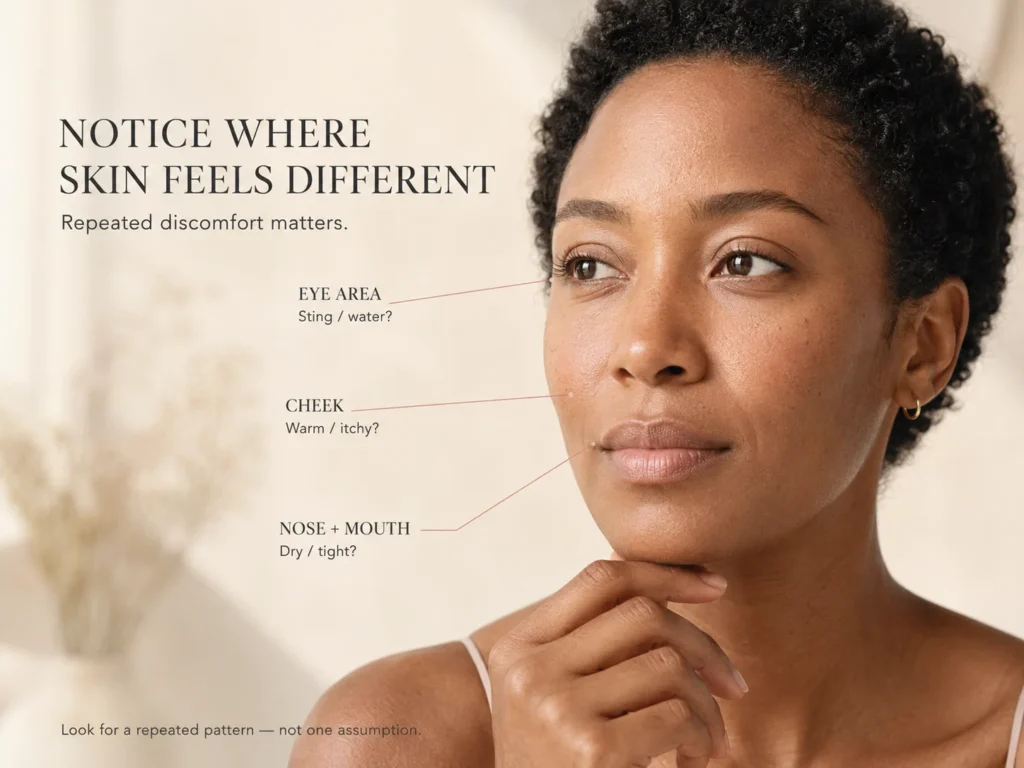
Sensitive skin may react more easily when its protective surface already feels stressed.
An essential-oil product may feel more uncomfortable when the skin is:
The essential oil may be one contributor.
The rest of the formula and routine may also matter.
For example, a peppermint acid toner may feel uncomfortable because of the peppermint oil, exfoliating acids, alcohol, frequent use, or the combination of all four.
A product may feel comfortable during the first few uses and become uncomfortable later.
This can happen when:
Do not assume a product must remain appropriate because it felt comfortable at first.
Repeated itching, burning, or rash-like changes should be taken seriously.
A product can irritate the skin without causing an allergy.
Irritation may appear as:
An allergic reaction may also involve:
It is not always possible to identify the difference through appearance alone.
Cosmetic skincare content should not diagnose the reaction.
Persistent, spreading, swollen, blistering, or recurring reactions should be evaluated by a dermatologist.
Do not apply undiluted essential oils directly to sensitive facial skin.
An undiluted oil is highly concentrated.
Applying it directly may increase the likelihood of:
Adding a drop of essential oil directly to the skin is not the same as using a professionally formulated cosmetic product.
A professional formula considers ingredient levels, stability, product texture, preservation, packaging, and intended use.
A homemade mixture may not provide the same control.
Adding lavender, tea tree, peppermint, citrus, or another essential oil directly to moisturizer may appear to dilute it.
But the final concentration may be uneven.
One part of the mixture may contain more essential oil than another.
The moisturizer was also not necessarily designed or tested with the added ingredient.
Sensitive skin should avoid turning a basic moisturizer into a homemade active or fragranced product.
Use products as directed.
Essential oils do not simply mix evenly into water.
Adding essential oil to a spray bottle, toner, or facial mist may create concentrated droplets.
Those droplets may land directly on sensitive skin or near the eyes.
Shaking the bottle does not always create a stable cosmetic formula.
Avoid homemade essential-oil facial mists.
A professionally formulated product containing an essential oil is different from applying the pure oil directly.
The product may contain:
This may improve the user experience.
However, professional formulation does not guarantee that every sensitive complexion will tolerate the product.
Patch testing and gradual introduction still matter.
Lavender oil is often described as calming or relaxing.
Its aroma may create a soothing sensory experience.
But a calming scent does not guarantee a calming skin response.
Some sensitive skin may tolerate a properly formulated product containing lavender oil.
Other skin may experience:
Do not apply undiluted lavender oil directly to the face.
If a lavender-containing product repeatedly causes discomfort, stop using it rather than assuming the skin must adjust.
Tea tree oil is commonly used in products marketed for oily, blemish-prone, or clogged-looking skin.
This can make it appealing to someone with blackheads, whiteheads, or visible blemishes.
However, sensitive blemish-prone skin may already be using:
Adding tea tree oil may make the routine more active.
Undiluted tea tree oil should not be applied directly to blemishes.
If a product causes burning, swelling, severe itching, or a spreading rash-like reaction, stop and seek guidance.
Painful, deep, swollen, infection-looking, crusting, bleeding, or scarring blemishes should be evaluated by a dermatologist.
Peppermint oil may create a cooling or tingling sensation.
That sensation can make a product feel refreshing.
But tingling does not automatically mean the product is helping the skin.
Sensitive skin may experience:
Do not apply peppermint oil near the eyes, nostrils, lips, or irritated areas.
A product should not need to burn or feel intensely cold to be effective.
Eucalyptus oil has a strong, recognizable aroma.
It may appear in facial steam products, masks, cleansers, body products, and aromatherapy-style formulas.
Sensitive skin may find strongly aromatic eucalyptus products uncomfortable, particularly near:
Do not apply eucalyptus oil directly to the face.
If the aroma makes the eyes water or the skin sting, remove the product and rinse according to its directions.
Citrus essential oils may include:
They are often added for a fresh scent or brightening-style marketing.
Sensitive skin should be cautious with citrus oils.
Some citrus-derived aromatic ingredients may be especially concerning when used in leave-on products before sun exposure.
Do not use homemade citrus-oil facial mixtures.
Do not apply citrus essential oil directly to dark spots, blemishes, or uneven-looking areas.
Daytime SPF remains important, but SPF should not be used as permission to apply concentrated citrus oil to the face.
Lemon oil or lemon juice should not be applied directly to dark spots or uneven-looking tone.
The word “brightening” can create the impression that citrus ingredients will quickly improve visible discoloration.
But concentrated or homemade citrus applications may irritate sensitive skin and make the complexion appear more uncomfortable or uneven.
Uneven-looking tone should be approached with:
Avoid kitchen-based facial treatments.
Bergamot oil may be used in fragranced products for its citrus aroma.
Sensitive skin should not assume that every bergamot-containing product is suitable for daytime facial use.
The complete formula, processing method, concentration, and product directions matter.
Avoid applying pure bergamot oil directly to the skin.
Follow the directions of professionally formulated products and use daytime SPF.
Rosemary oil may appear in facial, scalp, hair, and body products.
A person may tolerate rosemary oil on the scalp but react when the product touches:
If discomfort appears mainly near the hairline, review hair products as well as facial skincare.
Keep aromatic scalp products away from the face when possible.
Rinse the hairline carefully.
Chamomile is often associated with calming skincare.
But botanical reputation does not guarantee individual tolerance.
A chamomile-containing product may include:
These are not necessarily identical.
Some sensitive skin may use a chamomile formula comfortably.
Other skin may sting or itch.
Review the full ingredient list instead of relying on the product name.
Geranium oil may be used for floral scent and botanical positioning.
Strongly scented floral products may be uncomfortable for some redness-prone or reactive skin.
If a geranium-containing product causes repeated stinging, itching, warmth, or redness-looking areas, stop using it.
Do not continue simply because the product is described as balancing or natural.
Lemongrass, cinnamon, and clove oils may have strong aromas and active sensations.
Sensitive facial skin should approach these ingredients with particular caution.
Do not apply them undiluted.
Avoid using them in homemade facial treatments.
A warming sensation should not become painful burning.
If the skin becomes blistered, swollen, painful, crusting, or severely irritated, seek medical guidance.
Dry-sensitive skin may react more easily when it is already tight, rough, or flaky.
An aromatic facial oil may sound appropriate for dryness.
But essential oils do not replace the moisturizing role of a well-formulated moisturizer.
A facial oil may reduce the feeling of dryness for some people, but a strongly fragranced oil may also feel uncomfortable.
Before choosing an essential-oil product, review:
A simple dry-sensitive routine may be:
Morning: Gentle cleanser → moisturizer → SPF
Evening: Gentle cleanser → moisturizer
Essential oils are optional.
Oily-sensitive skin may be drawn to tea tree, peppermint, eucalyptus, citrus, or rosemary products.
These ingredients are often marketed as purifying, refreshing, or clarifying.
But oily skin can still become:
For oily-sensitive skin, ask:
Do not use essential oils to strip away shine.
The goal is balanced-looking skin, not a squeaky or painfully dry feeling.
Combination-sensitive skin may have an oily T-zone and dry or reactive cheeks.
A tea tree or peppermint product may feel tolerable on the nose but uncomfortable on the cheeks.
This does not mean the entire face needs the same product.
However, targeted use should still involve a professionally formulated product and a clear purpose.
Do not apply undiluted essential oils to the T-zone.
Redness-prone skin may be especially sensitive to warmth, strong aroma, rubbing, and multiple active products.
An essential-oil product may make the skin feel:
If the skin already feels hot after cleansing or moisturizer, essential oils should not be the next addition.
Begin with a simple comfort-focused routine.
If redness-looking changes are persistent, painful, swollen, rash-like, or worsening, seek dermatologist guidance.
Mature sensitive skin may be attracted to rich botanical oils marketed for visible aging concerns.
But mature skin may also be drier and less tolerant of strongly fragranced formulas.
Review:
A luxury botanical scent does not determine whether a product is appropriate.
Mature sensitive skin may benefit more from a consistent cleanser, serum, moisturizer, and SPF routine than from several concentrated botanical oils.
Blemish-prone skin is often exposed to many active products.
A routine may include:
This combination may create more routine stress than the skin can tolerate.
Do not apply pure tea tree, lavender, lemon, or peppermint oil directly to blemishes.
If blemishes are deep, painful, swollen, cystic-looking, infection-looking, crusting, bleeding, persistent, or scarring, seek dermatologist guidance.
Essential oils should not be applied directly to the eyelids or close to the eyes unless the product is specifically designed for that area.
Strong aromatic ingredients may contribute to:
Essential oils from facial products, hair products, diffusers, sprays, or perfume may also affect the eye area.
If the eyes or eyelids become swollen, painful, crusting, severely red, or persistently irritated, seek medical guidance.
The mouth corners and surrounding skin can react easily.
Avoid applying essential oils to areas that are:
Peppermint, cinnamon, citrus, and flavored aromatic lip products may feel especially noticeable.
Persistent mouth-area irritation should be evaluated by a dermatologist.
A cleanser containing essential oils is rinsed away, but rinse-off products can still feel uncomfortable.
A cleanser may be too active when it combines:
After cleansing, sensitive skin should not feel:
If it does, review the complete cleanser and cleansing method.
A toner containing essential oils is usually a leave-on product.
The aromatic ingredients remain on the skin under serum, moisturizer, and SPF.
Be cautious when a toner combines essential oils with:
If toner stings, do not keep using it because toner is considered a required step.
Sensitive skin does not need a toner that causes discomfort.
Serums are concentrated leave-on products.
An essential-oil serum may also contain:
If the serum burns, it may be difficult to identify the exact cause.
Introduce one serum at a time.
Do not begin an essential-oil serum during the same week as retinol or an exfoliating acid.
A moisturizer should help the skin feel comfortable.
If a moisturizer containing essential oils repeatedly causes:
it may not suit the skin.
However, moisturizer may also sting because the skin was irritated by a cleanser, toner, acid, retinol, or scrub used earlier.
Review the complete routine.
Facial oils may contain:
Read the ingredient list carefully.
A facial oil labeled botanical or natural may still be strongly fragranced.
Do not assume every facial oil is appropriate for dry-sensitive skin.
Do not use pure essential oil as a facial oil.
Masks may contain essential oils to create a spa-like scent or sensation.
Sensitive skin should be cautious when a mask also contains:
A mask should not cause intense heat, painful cooling, or strong burning.
Remove it according to the directions if discomfort develops.
Do not leave it on longer for stronger results.
Some sunscreen formulas contain botanical aromas or essential oils.
Sensitive skin may notice:
SPF may also sting because the skin is already irritated from acids, retinol, shaving, or over-cleansing.
Do not abandon daytime protection without reviewing alternatives.
The goal is to find a sunscreen the skin can use consistently.
Essential oils may appear in complexion products, primers, setting sprays, lip products, and makeup removers.
If makeup causes discomfort, review both the makeup and the skincare underneath.
Sensitive skin may react more when makeup is applied over:
The combined layers may matter more than one product alone.
Essential oils are common in:
These products may touch the:
If visible discomfort appears around the hairline, review haircare as well as facial skincare.
Keep strongly aromatic hair products away from the face when possible.
Essential oils may appear in:
A person may tolerate an essential-oil body product but not the same ingredient on the face.
Facial skin, eye-area skin, and body skin may have different tolerance levels.
Avoid transferring essential-oil body products to the face.
A diffuser does not apply essential oil directly to facial skin, but strong aromas may still feel uncomfortable for some people.
Possible complaints may include:
These symptoms are not a skincare diagnosis.
If a diffuser seems connected to discomfort, stop using it and observe whether the environment feels better.
Seek medical guidance for breathing difficulty, significant swelling, or severe symptoms.
Cold air, wind, and indoor heating can leave sensitive skin drier.
A product containing essential oils that felt comfortable in summer may sting in winter.
During colder weather, sensitive skin may need:
If the skin starts reacting, simplify before adding more botanical products.
Heat, sweat, sun exposure, and frequent cleansing may increase skin sensitivity.
Citrus, peppermint, eucalyptus, and strongly aromatic products may feel more noticeable in hot weather.
During summer:
If the skin is blistered, severely painful, or visibly burned, seek medical guidance.
Travel can change skin tolerance because of:
Do not introduce a new essential-oil product right before travel.
Bring products the skin already tolerates.
Avoid experimenting with hotel spa oils or strongly scented products when the skin is already reactive.
Do not apply undiluted essential oils after:
The skin may be more reactive after exfoliation.
Even a previously tolerated aromatic product may begin to sting.
After exfoliation, use a simple routine and follow professional aftercare instructions when applicable.
Retinol may make sensitive skin drier or more reactive.
A product containing essential oils may sting more when applied on a retinol night.
Do not begin:
at the same time.
Introduce one active change at a time.
If the skin burns, pause and simplify.
AHA and BHA can already feel active.
Combining them with peppermint, citrus, tea tree, eucalyptus, or another essential oil may be too stimulating for some sensitive skin.
If an acid product contains essential oils and causes discomfort, review:
Do not continue through repeated burning.
Vitamin C formulas can vary widely.
Some may also contain citrus oils or aromatic botanical ingredients.
Do not assume a citrus scent proves that the product’s main active ingredient is vitamin C.
If a vitamin C product stings, the reason may involve:
Patch test and introduce the product when the basic routine feels stable.
Recently shaved, waxed, threaded, epilated, or dermaplaned skin may be more reactive.
Avoid essential-oil products on freshly treated areas.
Peppermint, eucalyptus, citrus, tea tree, and other aromatic oils may sting.
Wait until the skin feels completely comfortable.
If the area becomes swollen, painful, blistered, rash-like, or persistently irritated, seek professional guidance.
Do not apply essential oils to skin that feels:
Avoid concentrated citrus oils before or after sun exposure.
Use a simple routine that the skin already tolerates.
If the skin is blistering, severely painful, swollen, or worsening, seek medical guidance.
Follow the aftercare provided after:
Do not add homemade essential-oil mixtures to post-treatment skin.
A product described as natural is not automatically appropriate during post-treatment sensitivity.
Patch testing may help when skin reacts easily.
Patch test the finished cosmetic product—not an undiluted essential oil.
Apply a small amount to a limited area according to the product directions.
Watch for:
Do not patch test on skin that is already scratched, recently shaved, or irritated.
A patch test cannot guarantee how the full face will respond.
It may still help identify an immediate or delayed reaction.
A careful introduction may look like this:
Sensitive skin needs enough time to show whether the product feels comfortable.
Write down:
A written record may make patterns easier to recognize.
It can also make a consultation or dermatologist appointment more useful.
A mild sensation may occur with some aromatic ingredients.
But tingling is not proof that a product is effective.
Stop the product if the sensation becomes:
Sensitive skin should not be forced through repeated discomfort.
If an essential-oil product burns every time, stop using it.
The essential oil may be one factor.
The complete formula may also be too active.
Return to a simple routine:
Morning: Gentle cleanser → moisturizer → SPF
Evening: Gentle cleanser → moisturizer
Once the skin feels comfortable, review the product before considering it again.
The skin may do better without it.
Stop the new product.
Do not scratch or scrub the area.
Avoid adding acids, retinol, or another botanical product.
If itching is severe, spreading, swollen, rash-like, persistent, affecting the eyes, or interfering with sleep, seek medical guidance.
Pause the product.
Review whether it also contains:
If redness-looking changes are persistent, painful, swollen, blistering, rash-like, or worsening, seek dermatologist guidance.
An essential-oil product may be too drying, too frequent, or combined with too many active products.
Do not scrub away the flakes.
Pause:
Return to cleanser, moisturizer, and daytime SPF when tolerated.
If moisturizer starts burning after an essential-oil product, the skin may already be irritated.
The moisturizer may not be the original cause.
Review:
Pause active products.
If even a previously tolerated moisturizer continues to burn, seek guidance.
SPF may sting because the skin has become more reactive.
Review:
Do not simply stop daytime protection.
A more comfortable SPF formula and a calmer routine may be needed.
Strong aromatic products may move into the eye area.
Stop using the product near the eyes.
Rinse according to the product directions.
Keep facial oils, sprays, hair products, and diffusers away from the immediate eye area.
If the eyes or eyelids become swollen, painful, crusting, severely red, or persistently irritated, seek medical guidance.
“Natural” does not guarantee tolerance.
A natural product may contain:
Stop focusing only on the marketing description.
Review the complete formula.
Skin tolerance may change because of:
Do not keep using a product through repeated discomfort simply because it worked before.
If the skin tolerates one professionally formulated product consistently, it may not need to be removed automatically.
Consider:
Sensitive skin does not always need to avoid every aromatic ingredient.
It needs a routine it can tolerate consistently.
Stop adding new botanical products.
Return to the simplest routine that remains comfortable.
Avoid:
If the skin also reacts to cleanser, moisturizer, SPF, or water, or symptoms are painful, swollen, rash-like, or worsening, seek dermatologist guidance.
Avoid or pause essential-oil products when the skin is:
Essential oils can wait.
A professionally formulated product may be considered when sensitive skin is:
This does not guarantee tolerance.
It creates a clearer starting point.
A simple morning routine may look like:
Gentle cleanser or rinse if appropriate → moisturizer → SPF
If a serum is needed:
Gentle cleanser → one tolerated serum → moisturizer → SPF
Do not start several botanical or aromatic products at once.
The routine should not leave the skin feeling hot, itchy, tight, or uncomfortable.
A simple evening routine may look like:
Gentle cleanser → moisturizer
If the skin tolerates an additional serum:
Gentle cleanser → one tolerated serum → moisturizer
Do not combine essential-oil products, acids, retinol, scrubs, and masks in one routine.
Despite the name, essential oils are not essential skincare steps.
Sensitive skin can have a complete routine without them.
The foundation remains:
A pleasant botanical scent is a sensory feature.
It is not proof that the product is necessary for the skin.
A dermatologist should evaluate the skin if an essential-oil product is followed by:
Cosmetic skincare can help organize the routine.
It cannot diagnose an essential-oil allergy, allergic contact dermatitis, or another medical condition.
After consultation, our licensed esthetician may consider Janssen Cosmetics options based on the skin’s sensitivity pattern, current comfort, dryness, oiliness, redness-looking areas, eye-area sensitivity, and reaction history.
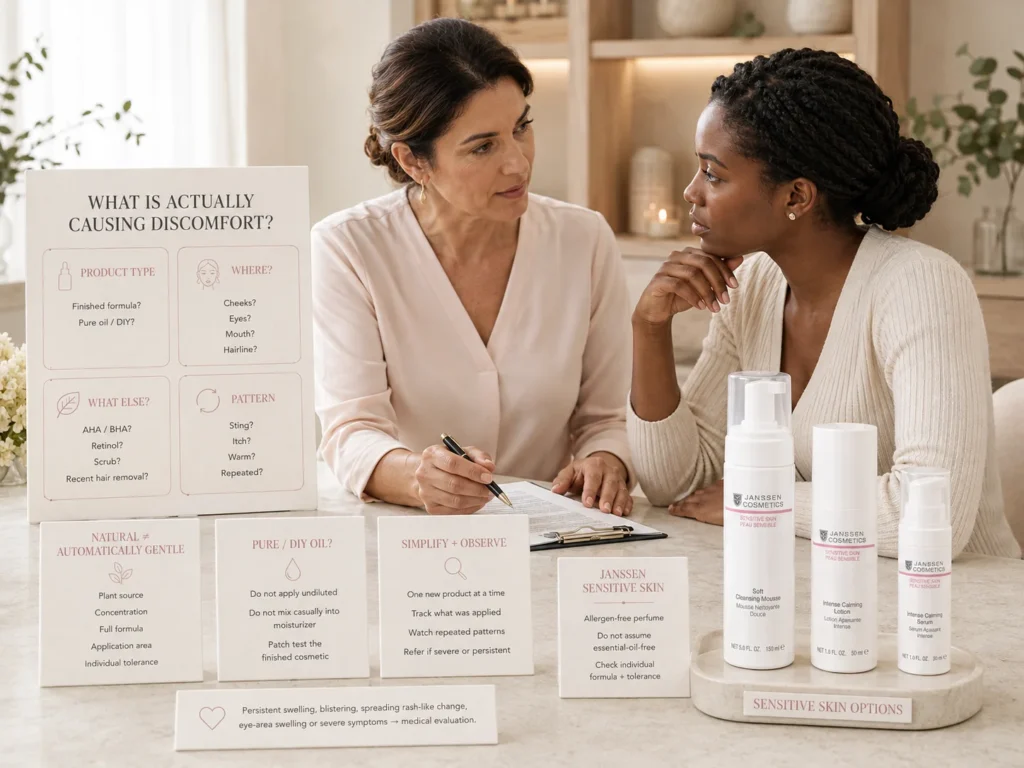
For a simple sensitive-skin routine, possible options may include:
These are possible options, not one automatic routine.
Product selection depends on the skin’s current condition, preferred texture, visible concerns, product history, and tolerance.
The Janssen Sensitive Skin family is described as containing an allergen-free perfume. This should not be interpreted as fragrance-free, essential-oil-free, odorless, or guaranteed to suit every reactive complexion.
Someone who knows that essential oils, fragrance, or aromatic botanical products cause discomfort should mention this during the consultation.
Janssen also has some professional or body products that may contain essential-oil concepts. A product designed for the body, massage, treatment room, or professional protocol should not automatically be used on sensitive facial skin.
Professional products should remain within their intended professional setting.
If the skin is currently burning, itching, swollen, rash-like, flaky from irritation, or reacting to basic products, the first step may be simplifying the routine rather than adding aromatic products.
Do not assume essential oils are gentle because they are natural.
Do not apply undiluted essential oils directly to the face.
Do not add essential oils directly to moisturizer.
Do not add essential oils to water, toner, or a facial mist.
Do not use homemade lemon-oil treatments for uneven-looking tone.
Do not apply pure tea tree oil directly to blemishes.
Do not apply peppermint, eucalyptus, citrus, cinnamon, clove, or another concentrated aromatic oil near the eyes.
Do not apply essential oils to mouth corners, broken skin, or rash-like areas.
Do not use essential oils immediately after shaving, waxing, threading, dermaplaning, or exfoliation.
Do not use essential oils on sun-stressed or sunburned skin.
Do not layer essential oils with AHA, BHA, retinol, scrubs, and strong vitamin C all at once.
Do not assume a cooling, tingling, or warming sensation means the product is working.
Do not continue using a product that repeatedly burns, itches, or causes visible discomfort.
Do not scratch or scrub irritated areas.
Do not assume a professionally formulated product is guaranteed to suit every sensitive complexion.
Do not use professional massage or treatment-room products as home facial care.
Do not try to diagnose an essential-oil allergy through skincare alone.
Do not ignore persistent swelling, blistering, crusting, bleeding, eye-area reactions, severe itching, or worsening symptoms.
Some sensitive skin may tolerate a properly formulated product containing a small amount of an essential oil. Other sensitive skin may sting, itch, become dry, or develop redness-looking areas. Tolerance is individual.
No. Natural ingredients can still be irritating or cause allergic reactions in some people.
Undiluted essential oils should not be applied directly to sensitive facial skin.
This is not recommended. The mixture may be uneven, and the moisturizer was not necessarily designed for the added ingredient.
Some people tolerate a professionally formulated lavender product, while others experience stinging, itching, dryness, or redness-looking areas. Lavender oil should not be applied undiluted.
A professionally formulated tea tree product may be tolerated by some oily or blemish-prone skin, but pure tea tree oil should not be applied directly to sensitive facial skin.
Yes. Peppermint oil may cause strong cooling, stinging, burning, eye watering, or dryness for some sensitive skin.
Sensitive skin should be cautious with citrus oils, particularly in homemade or concentrated leave-on applications. Do not apply pure citrus oils to the face.
Do not use pure lemon oil or homemade citrus treatments on dark spots. Uneven-looking tone needs a gentle routine, daily SPF, and carefully selected products.
No. Essential oils are aromatic ingredients. A product scented with essential oils is not fragrance-free.
No. Carrier oils such as jojoba or sunflower oil are different from concentrated aromatic essential oils.
Essential oils may contribute to allergic contact reactions in some people. A dermatologist should evaluate persistent, spreading, swollen, blistering, or recurring reactions.
Yes. Patch test the finished cosmetic product according to its directions. Do not patch test undiluted essential oil on sensitive skin.
The skin may be drier, over-exfoliated, using retinol, exposed to weather changes, or reacting after repeated use. Product age and storage may also matter.
Sensitive skin should avoid introducing both at the same time. Retinol may make the skin more reactive, causing aromatic products to sting.
The combination may be too active for sensitive skin. Introduce one product at a time and avoid layering when the skin feels dry, hot, or irritated.
A product does not need to tingle to be effective. Strong, persistent, painful, or increasingly intense tingling is a reason to stop.
Do not apply concentrated essential oils around the eyes. Use products specifically designed for the eye area when appropriate.
Stop using it, rinse it away if appropriate, avoid other active products, and return to a simple routine. Seek dermatologist guidance for persistent or severe reactions.
See a dermatologist if an essential-oil product causes persistent burning, severe itching, swelling, blistering, crusting, bleeding, infection-looking changes, eye-area swelling, a worsening rash-like reaction, or symptoms that do not improve after stopping the product.
If a product is described as natural or calming but your skin stings, itches, feels hot, or develops redness-looking areas, a free virtual consultation can help you review the complete routine.
At Zendevie, we look at more than the front label.
We review your cleanser, toner, serums, moisturizer, SPF, essential oils, fragrance exposure, exfoliation habits, retinol use, skin type, and reaction history before discussing product options.
The goal is not to create fear around botanical ingredients.
The goal is to understand whether the product’s formula suits your skin, whether the routine contains too many active steps, or whether a persistent reaction needs dermatologist evaluation.

Zendevie is guided by Haby Diallo, a licensed esthetician with more than 20 years of professional skincare experience. Her approach is rooted in education, professional judgment, and personal care.
years of experience