



Dry skin and sensitive skin often show up together.
The skin may feel tight after cleansing. Moisturizer may sting. SPF may feel uncomfortable. Fine flakes may appear around the nose, cheeks, or mouth. Makeup may cling to dry areas. The skin may look dull, rough, or redness-prone.
This can feel confusing because dryness sounds like one issue, while sensitivity sounds like another.
But they often connect.
When the skin feels dry, the surface may feel less comfortable and more reactive. When the skin is sensitive, it may react to products, weather, cleansing, exfoliation, fragrance, and active ingredients more easily. Together, dry and sensitive skin can create a cycle where the skin feels tight, then products sting, then the routine becomes harder to tolerate.
At Zendevie, we do not treat dry-sensitive skin as a reason to add many products immediately. We first look at what the skin is showing.
In consultation, our licensed esthetician studies the skin pattern, cleanser feel, moisturizer response, SPF tolerance, active product use, weather exposure, and whether the skin is naturally dry or temporarily irritated.
Dry and sensitive skin often happen together because dry skin can feel more reactive when the surface lacks comfort, and sensitive skin can become drier when the routine is too harsh, active, or stripping.
Common signs include:
A simple routine may look like:
Morning: Gentle cleanser → Moisturizer → SPF
Evening: Gentle cleanser → Moisturizer
Active products such as acids, retinol-style products, scrubs, strong vitamin C, and masks should be used carefully, if at all, when the skin feels dry and reactive.
Dry skin is usually about the skin feeling lacking in comfort, moisture, or softness.
Sensitive skin is about the skin reacting easily.
Dry skin may feel:
Sensitive skin may feel:
Dry-sensitive skin can feel like both at once.
The skin may be tight and flaky, but also sting when products are applied.
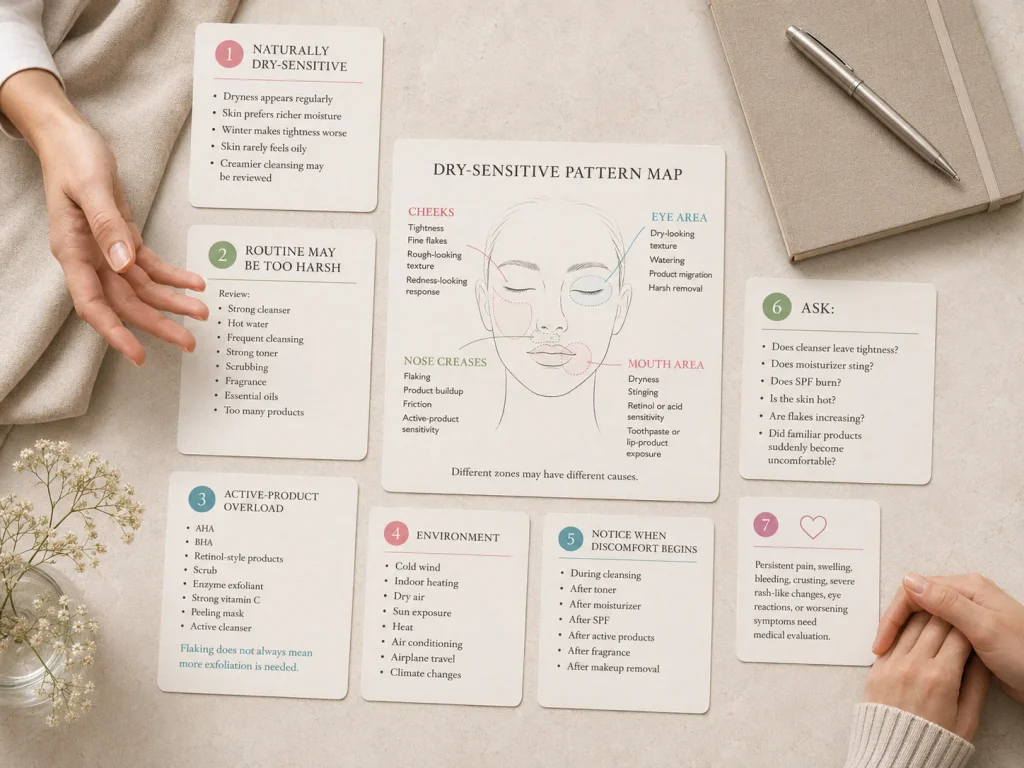
When skin feels dry, the surface may become more easily disturbed.
Products that would normally feel fine may sting. Cleansing may feel uncomfortable. SPF may burn. Makeup may sit unevenly.
Dry skin may become more sensitive after:
This does not always mean the skin is allergic to everything. It may mean the skin surface is not comfortable right now.
Sensitive skin may become dry when the routine is too strong.
For example, sensitive skin may react to:
When sensitive skin becomes irritated, it may feel tighter, rougher, and drier.
This is why a sensitive-skin routine should be built slowly.
Dryness and sensitivity often connect through the skin barrier.
The barrier is the outer surface that helps keep the skin comfortable and less reactive to outside stressors.
When this surface feels stressed, the skin may:
When the barrier feels stressed, the answer is usually not stronger active care. The answer is a simpler routine with better comfort.
Tightness after cleansing is one of the biggest signs that dry-sensitive skin needs a gentler plan.
If your skin feels tight before moisturizer, the cleanser may be too strong, the water may be too hot, or the routine may be too active overall.
Tightness can also happen after over-exfoliation, sun exposure, wind, cold weather, or using too little moisturizer.
Skin should feel clean after cleansing, not stretched.
Moisturizer can sting when the skin is already dry, irritated, or over-exfoliated.
This does not always mean the moisturizer is the only problem.
Ask what happened before moisturizer:
If moisturizer burns repeatedly, stop and reassess. The skin may need a simpler formula, fewer active products, or professional guidance.
SPF can burn when the skin is already reactive or when the formula does not suit the skin.
Dry-sensitive skin still needs SPF during the day, especially if exfoliation, brightening products, or retinol-style products are part of the routine.
If SPF stings, review:
Do not skip SPF automatically. Adjust the routine and product selection with care.
Some dry-sensitive skin does not tolerate toner well, especially if the toner is active, fragranced, or drying.
A toner should not make the skin feel sharp, tight, or hot.
If toner stings, pause it.
Toner is not required for every sensitive-skin routine. The skin may need cleanser, moisturizer, and SPF first.
Once the skin feels stable, toner can be reconsidered if there is a clear reason.
Exfoliation can make dry-sensitive skin feel smoother temporarily, but too much can cause stinging, flaking, tightness, and burning.
Dry-sensitive skin should be careful with:
If your skin is already flaky, do not scrub the flakes away.
Flaking often means the skin needs comfort, not more removal.
AHA may be discussed for dullness or rough surface buildup, but dry-sensitive skin needs caution.
AHA can sting when the skin is dry or barrier-stressed.
If AHA makes the skin burn, flake, or feel hot, pause it.
AHA should not be layered with scrubs, retinol-style products, strong vitamin C, and other exfoliating products when the skin is sensitive.
BHA is often discussed for clogged-looking pores, blackheads, and whiteheads.
But dry-sensitive skin does not always need BHA across the whole face.
If clogged-looking pores are only on the nose or chin, BHA may be considered only in those areas when the skin is stable.
If the cheeks are dry and reactive, avoid treating them like oily skin.
Placement matters.
Retinol-style products can be too much for dry-sensitive skin if introduced quickly.
They may cause dryness, peeling, stinging, or discomfort.
This does not mean dry-sensitive skin can never use retinol-style care. It means the skin must be prepared and the routine must be simple.
Retinol-style products should not be layered with acids, scrubs, and strong masks when the skin feels reactive.
Vitamin C may be useful in some routines, but dry-sensitive skin may sting with stronger vitamin C formulas.
If the skin is burning, flaky, or tight, vitamin C should wait.
A brightening step should not come before skin comfort.
Once the skin feels calmer, vitamin C-style care can be evaluated carefully.
Fragrance may be a trigger for some dry-sensitive skin.
If a product smells pleasant but leaves the skin burning, itching, or red-looking, fragrance may be part of the issue.
Fragrance can appear in:
If the skin reacts easily, fragrance exposure should be reviewed.
Essential oils can be irritating for some sensitive skin, especially when the skin is already dry or over-exfoliated.
Natural does not automatically mean gentle.
If your skin burns after botanical or spa-style products, essential oils may be worth reviewing.
Dry-sensitive skin needs products chosen by skin response, not by marketing language.
Weather often affects dry-sensitive skin.
Cold air, wind, indoor heating, heat, humidity, and sun exposure can all change how the skin feels.
In winter, the skin may become tighter and more flaky.
In summer, heat, sweat, SPF layers, and sun exposure may make the skin sting or feel hot.
A routine may need seasonal adjustment, but it should not become harsh.
Winter can make dry-sensitive skin feel more uncomfortable.
Common winter signs include:
In winter, the skin may need fewer active products and a more comforting moisturizer texture.
Summer can still trigger dry-sensitive skin.
Heat, sweat, air conditioning, sunscreen, pool exposure, travel, and extra cleansing can all make the skin reactive.
Summer dry-sensitive skin may need:
The goal is to keep the skin comfortable without creating heaviness.
Travel often makes dry-sensitive skin worse because many stressors happen together.
Possible triggers include:
Bring products your skin already tolerates.
Do not test a new active routine while traveling.

A simple dry-sensitive routine should focus on comfort first.
Morning:
Gentle cleanser → Moisturizer → SPF
Evening:
Gentle cleanser → Moisturizer
Once the skin feels stable, additional products can be added carefully if needed.
Do not build the routine around active ingredients first. Build it around tolerance.
Cleanser should remove daily buildup without leaving the skin tight.
A cleanser may be too strong if:
Dry-sensitive skin often needs a mild cleanser and lukewarm water.
Cleansing should be effective, but not aggressive.
Moisturizer is important for dry-sensitive skin.
The right moisturizer should leave the skin feeling more comfortable, not greasy, hot, or stingy.
Dry-sensitive skin may need a creamier texture than oily sensitive skin, but it still depends on the person.
A moisturizer should be chosen based on:
SPF should be part of the morning routine.
Dry-sensitive skin may need moisturizer underneath SPF to reduce the chance of stinging or tightness.
If SPF burns, review the skin condition and formula.
Do not apply SPF over irritated skin without understanding what is making the skin reactive.
If SPF repeatedly stings, a consultation can help evaluate texture, formula, and layering.
For dry-sensitive skin, layering should be simple.
A basic order is:
Cleanser → Moisturizer → SPF in the morning
At night:
Cleanser → Moisturizer
If toner or serum is added, it should be added only after the basic routine feels comfortable.
Too many layers may make the skin harder to understand.
Dry-sensitive skin should introduce products slowly.
Do not start cleanser, toner, serum, moisturizer, SPF, mask, and active products all at once.
A careful approach is:
Slow progress is safer than constant switching.
Patch testing can help dry-sensitive skin avoid surprises.
Apply a small amount of product to a limited area before using it on the full face.
Patch testing is especially useful for:
Patch testing does not guarantee no reaction, but it helps you proceed carefully.
Some people have skin that is oily in the T-zone but dry-sensitive on the cheeks.
This may be combination-sensitive skin.
In this case, do not use dry-skin products heavily across the whole face and do not use oily-skin products aggressively on the cheeks.
Use product placement:
The face may need different care by zone.
Mature skin may become drier or more reactive over time.
It may feel thinner, tighter, or less tolerant of strong products.
Mature dry-sensitive skin should be cautious with:
The goal is to support the look and feel of the skin without making it irritated.
Dryness can make redness-prone skin feel more reactive.
If the skin looks red, feels hot, or burns after products, simplify.
Avoid:
If redness-looking changes are persistent, painful, swollen, rash-like, or worsening, seek dermatologist guidance.
A hot feeling after products may mean the skin is irritated or reacting.
Stop active products and simplify.
Do not apply more exfoliation, masks, or strong serums.
If the hot feeling is severe, persistent, swollen, painful, or rash-like, dermatologist guidance is needed.
If every product stings, stop experimenting.
Use only the simplest tolerated routine.
If even basic cleanser, moisturizer, or SPF burns, seek professional guidance.
The skin may be too reactive for trial-and-error product testing.
Pause:
This gives the skin a clearer starting point.
Keep:
The skin needs fewer triggers while it feels reactive.
Do not reintroduce active products while the skin is still stinging or burning.
Wait until:
Then add one active product at a time only if there is a clear reason.
A dermatologist should evaluate dry-sensitive skin if there is:
Cosmetic skincare can help with routine structure and product selection, but medical-looking concerns need medical evaluation.
After consultation, our licensed esthetician may consider Janssen Cosmetics options depending on whether the skin is dry-sensitive, redness-prone, barrier-stressed, reactive after over-exfoliation, or naturally dry and delicate.
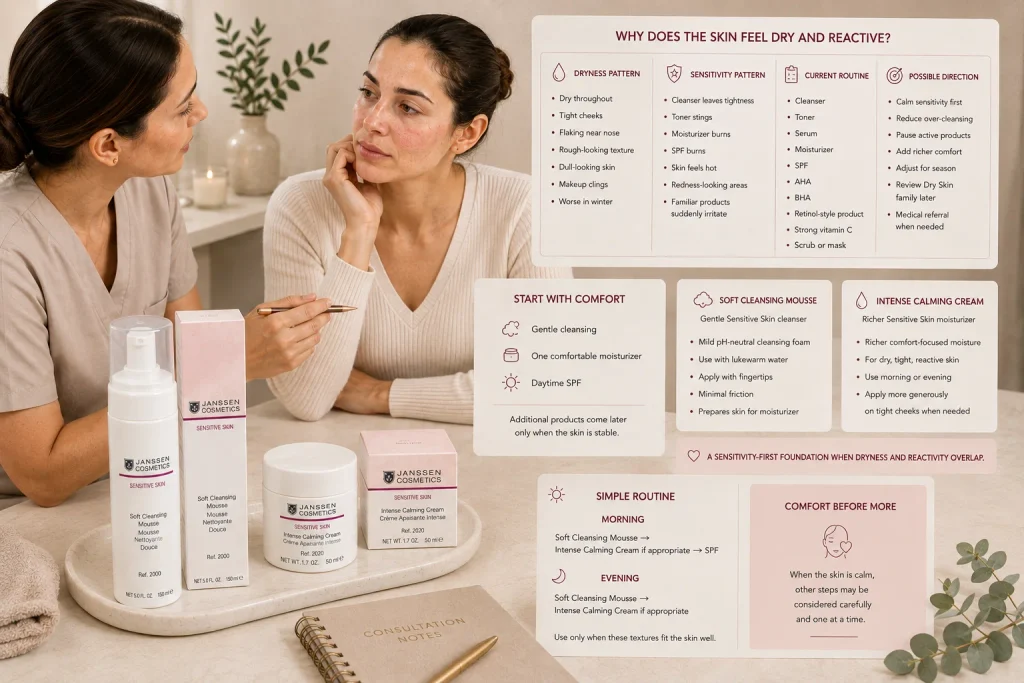
Possible sensitive-skin options may include:
For skin that is more dry than reactive, dry-skin care options may also be reviewed after consultation. The first step is understanding whether the skin is dry, sensitive, over-exfoliated, or reacting to the current routine.
These options are not automatic recommendations. If the skin is swollen, painful, rash-like, crusting, bleeding, infection-looking, or persistently worsening, dermatologist evaluation should come first.
Do not scrub dry flakes.
Do not use hot water to make skin feel clean.
Do not keep using toner that stings.
Do not layer AHA, BHA, retinol-style products, scrubs, and masks all at once.
Do not assume natural products are always gentle.
Do not test several new products in one week.
Do not skip SPF because the skin is dry.
Do not ignore persistent burning, swelling, rash-like irritation, eye-area irritation, pain, or worsening symptoms.
Dry skin can become more reactive when the surface lacks comfort. Sensitive skin can become drier when products, weather, cleansing, or active ingredients irritate it.
Yes. If the skin is very dry, over-exfoliated, or barrier-stressed, moisturizer may sting or burn.
A simple routine is best at first: gentle cleanser, moisturizer, and SPF in the morning; gentle cleanser and moisturizer at night.
Only if the toner is well tolerated. If toner stings, burns, or leaves the skin tight, pause it.
Sometimes, but carefully. Do not exfoliate when the skin is burning, flaky, hot, or reactive. Avoid layering acids, scrubs, and retinol-style products together.
Yes. Oily skin can be dehydrated or over-exfoliated, making it feel tight, stingy, or dry underneath the shine.
SPF may burn if the skin is already irritated, over-exfoliated, sun-stressed, or if the formula does not suit the skin.
See a dermatologist if there is persistent burning, swelling, rash-like irritation, pain, crusting, bleeding, infection-looking changes, eye-area irritation, or symptoms that do not improve after stopping products.
If your skin feels dry, tight, stingy, or sensitive and you are not sure what to use, a free virtual consultation can help you understand the pattern before buying more products.
At Zendevie, we review your cleanser, moisturizer, SPF, toner, active products, weather exposure, and skin response before recommending next steps. The goal is to help dry-sensitive skin feel more comfortable with a routine that fits what your skin is showing.

Zendevie is guided by Haby Diallo, a licensed esthetician with more than 20 years of professional skincare experience. Her approach is rooted in education, professional judgment, and personal care.
years of experience