
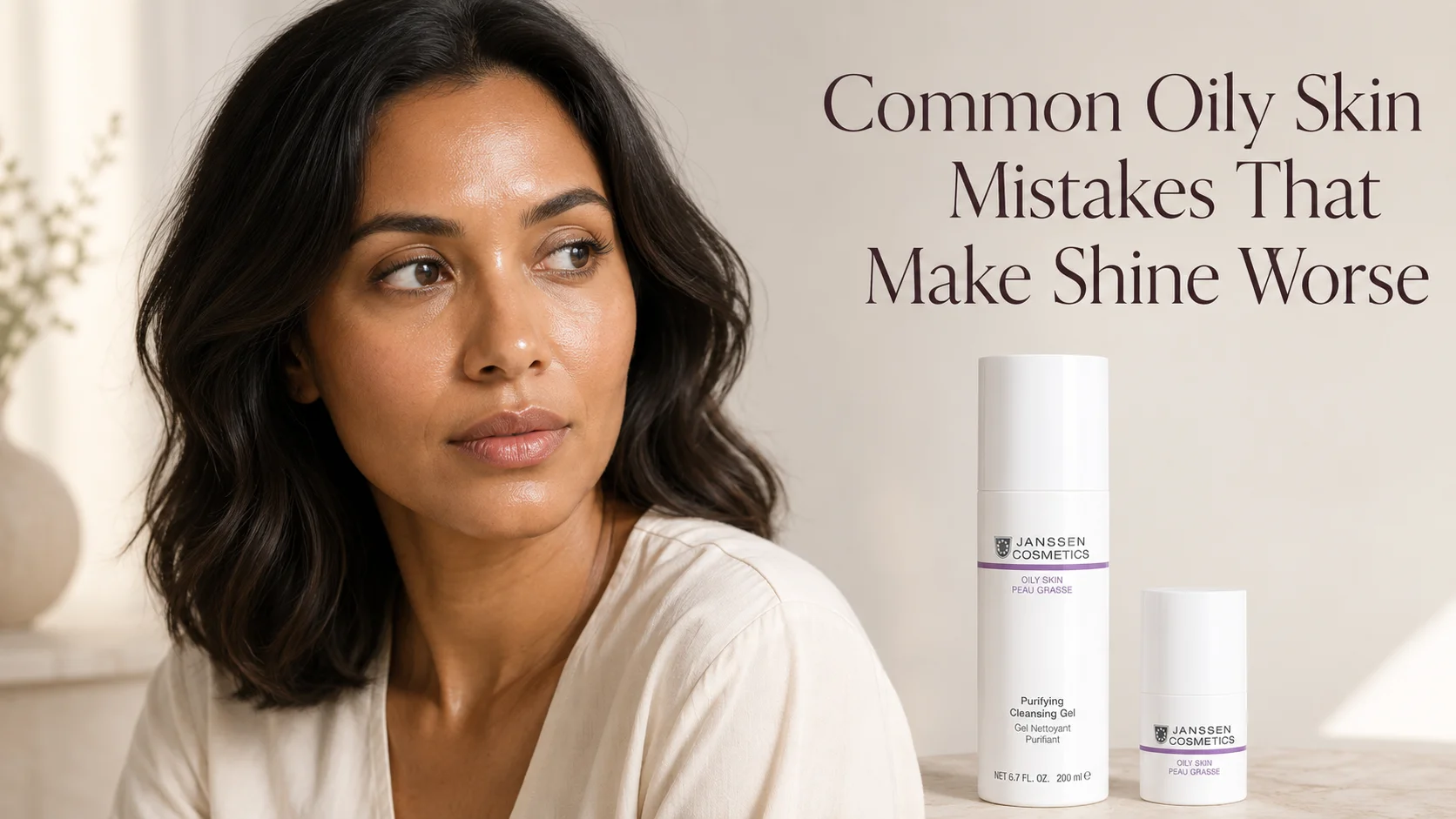
Oily skin can be frustrating because shine is visible.
You may wash your face, apply toner, avoid moisturizer, use a clay mask, and still feel oily again a few hours later. Makeup may separate around the nose. The forehead may look shiny in photos. The chin may feel congested. At the same time, the skin may feel tight after cleansing.
That is usually when people start doing more.
More washing. More toner. More exfoliation. More mattifying products. More masks.
But oily skin does not always get better with more. Sometimes shine becomes harder to manage because the skin is being stripped, dehydrated, or overloaded with too many active steps.
In consultation, our licensed esthetician looks at the whole pattern before recommending products. The question is not only, “How do we reduce shine?” The better question is, “Why is the skin producing oil, feeling tight, or looking congested in the first place?”
Common oily skin mistakes include washing too often, using harsh cleansers, choosing drying toners, skipping moisturizer, using too many exfoliating products, applying clay masks too often, ignoring dehydration, and using heavy products in the wrong areas.
If your skin looks oily but feels tight, the answer is not always a stronger oil-control product. The skin may need a calmer, more precise plan.
A simple oily skin structure may be:
Cleanser → Toner if appropriate → Targeted step if needed → Lightweight moisturizer → SPF in the morning
When shine returns quickly, washing again feels logical. The face feels greasy, so removing the oil seems like the obvious answer.
But repeated washing can leave oily skin feeling tight, dry, or unpredictable.
You may notice:
Most oily skin does better with cleansing morning and evening. After heavy sweating, exercise, or heavy makeup, an extra cleanse may make sense. But washing many times a day usually creates more tightness than clarity.
Many people with oily skin believe squeaky clean means the cleanser worked.
That feeling can be misleading.
A cleanser should remove excess oil, sunscreen, sweat, makeup, and daily buildup. It should not leave the face feeling raw or stretched.
If your skin feels tight within minutes after washing, the cleanser may be too strong, the water may be too hot, or you may be cleansing too aggressively.
Clean is good. Stripped is not.
Hot water can make the face feel cleaner temporarily, but it may leave oily skin feeling tight afterward.
This can be especially noticeable around the cheeks, mouth, and sides of the nose. The T-zone may still get shiny later, but the rest of the face feels less comfortable.
Lukewarm water is usually a better choice. It helps cleanse the skin without making the face feel shocked or overly dry.
If your skin looks shiny but feels tight after washing, water temperature is worth checking.
Toner can be useful for oily skin, but not every toner belongs on every oily face.
A toner that burns, stings, or leaves the skin stretched may be too harsh. Some drying toners feel satisfying at first because they reduce shine quickly, but they can make the skin feel dehydrated underneath.
A good toner for oily skin should leave the face feeling fresh, not punished.
If toner makes your moisturizer sting afterward, the toner may be too active, too drying, or not matched to your current skin condition.

This is one of the biggest oily skin mistakes.
Many people skip moisturizer because they do not want to feel greasy. But oily skin can still be dehydrated. It can also feel bare after cleansing if no moisturizer is applied.
Skipping moisturizer may leave the skin:
The answer is not necessarily a heavy cream. Oily skin often needs a lighter texture, such as a gel, gel-cream, light lotion, or mattifying cream.
Moisturizer matters, but texture matters even more.
A rich cream may feel too heavy for the T-zone. A very matte product may feel drying. No moisturizer may leave the face tight.
The right choice depends on what your skin shows.
If your whole face is oily, a lightweight moisturizer may make sense. If your T-zone is oily but cheeks are dry, you may need different amounts by area. If your skin feels oily and tight, lightweight hydration before moisturizer may help.
The goal is not to coat the face. The goal is to keep the skin from feeling bare after cleansing.
The forehead, nose, and chin often produce more visible oil. The cheeks may behave differently.
If you apply every oil-control product heavily over the whole face, the cheeks may become tight, dry, or irritated while the T-zone still shines.
This is common with:
A better approach may be zone-specific: stronger oil-control steps only where the skin actually needs them.
Oily skin is often given too many strong steps.
A person may use an active cleanser, exfoliating toner, BHA serum, AHA product, retinol, clay mask, and drying spot product in the same week.
That can be too much.
When oily skin is overworked, it may feel:
Active ingredients can be useful, but they need a clear purpose. More activity does not always mean clearer-looking skin.
Rough texture does not always mean the skin needs more exfoliation.
Sometimes the roughness comes from dehydration, over-cleansing, product buildup, or irritation from too many active products.
If you exfoliate every time the skin feels rough, you may create a cycle: roughness, exfoliation, tightness, more roughness.
Before exfoliating, ask what kind of roughness you are seeing.
If the roughness comes with clogged-looking pores, BHA may be considered. If it looks like dull surface buildup, AHA may be considered. If it comes with stinging or flaking, pause and simplify first.
Clay masks can be helpful for oily areas, especially the T-zone. They can make the skin look less shiny for a while and reduce that heavy feeling.
But using clay too often can leave the skin tight, especially on the cheeks.
Clay does not need to be used on the entire face every time. For many people, the nose, forehead, or chin may need it more than the cheeks.
If your mask leaves your whole face stretched and dry, it may be too frequent, too long, or applied to areas that do not need it.
Oily but tight skin is a sign worth paying attention to.
It often means the skin is producing oil but still lacks water-based hydration, or it is being stripped by cleansing and active products.
If the face feels oily and tight, do not automatically add more oil-control products.
Look at:
The skin may need less stripping and more lightweight hydration.
Oily skin needs SPF, but many people avoid it because it feels greasy.
Some choose the most matte SPF possible, but if the formula feels dry, pills, or makes the face tight, it may not be the best match.
The right SPF should protect the skin while layering well with moisturizer and makeup.
If SPF makes your skin look shiny, review the steps underneath too. Too much moisturizer, heavy layering, or product incompatibility can affect how SPF sits.
Even oily skin that looks shiny during the day still needs proper evening cleansing.
Sleeping in makeup, sunscreen, oil, sweat, and product residue can make the skin look congested and uneven.
Evening cleansing does not need to be aggressive, but it should be thorough.
If makeup is long-wear or SPF is heavy, cleansing needs to remove it properly without scrubbing the skin raw.
When skin has blackheads, whiteheads, or bumps, scrubbing can feel tempting.
But rough scrubbing can irritate the skin and make the surface look more uneven.
Blemish-prone oily skin may need clarifying ingredients, consistent cleansing, and lighter textures, but it does not need harsh friction.
If blemishes are painful, deep, swollen, scarring, or worsening, that is a dermatologist situation — not a reason to scrub harder.
When oily skin feels frustrating, it is easy to replace the whole plan in one day.
New cleanser. New toner. New serum. New mask. New moisturizer. New SPF.
If the skin reacts, you will not know what caused it.
A better approach is to change one area at a time. Start with the step that seems most suspicious: cleanser, toner, moisturizer texture, or active frequency.
This makes the skin easier to read.
Two people can both have oily skin and need different steps.
One person may be oily and clogged-looking. Another may be oily and dehydrated. Another may have an oily T-zone with dry cheeks. Another may be mature and still blemish-prone.
A routine that works for one person may be too drying, too heavy, or too active for another.
That is why consultation matters. We do not choose products only from the label “oily skin.” We look at the behavior of the skin.
If your skin feels oily but tight, stingy, or irritated, simplify the plan.
For a short period, focus on:
Cleanser → Lightweight moisturizer → SPF in the morning
At night:
Cleanser → Lightweight moisturizer
Once the skin feels easier to tolerate, toner, BHA, AHA, or masks can be reconsidered.
The first goal is to make the skin readable again.
If your face feels greasy, coated, or makeup slides quickly, look at texture and layering.
You may need:
Heavy products are not always wrong, but they may be wrong for the oily areas.

A simple oily skin plan may look like this:
Morning:
Cleanser → Toner if appropriate → Lightweight moisturizer → SPF
Evening:
Cleanser → Toner if appropriate → Targeted serum if needed → Lightweight moisturizer
If the skin is oily and tight, include lightweight hydration and reduce active products.
If the skin is clogged-looking, BHA may be considered.
If the skin is rough and dull, AHA may be considered.
If the skin is irritated, simplify before adding more.
After consultation, our licensed esthetician may consider Janssen Cosmetics options depending on whether the skin is oily, oily-dehydrated, congested-looking, mature-oily, or sensitive from product overload.

Possible options may include:
These are not automatic recommendations. The right match depends on which mistake is actually happening: over-cleansing, skipping moisturizer, over-exfoliating, using the wrong texture, or treating every facial zone the same way.
Do not wash repeatedly because shine returns.
Do not chase a squeaky-clean finish.
Do not use hot water to remove oil.
Do not skip moisturizer because the face is shiny.
Do not apply clay masks all over if only the T-zone is oily.
Do not use BHA, AHA, retinol, scrub, and mask all at once.
Do not keep using toner if it burns or leaves the face stretched.
Do not ignore painful, deep, swollen, infected-looking, scarring, or persistent blemishes.
One of the biggest mistakes is trying to strip the skin completely. Oily skin should be cleansed well, but it should not feel tight, raw, or dry after every wash.
Yes. Over-cleansing can make oily skin feel tight, dehydrated, and harder to manage, even if shine still returns.
No. Oily skin still needs a light moisturizer texture. Skipping it can make the skin feel bare after cleansing.
Oily but tight skin may be dehydrated, over-cleansed, over-exfoliated, or reacting to strong products.
Not always. Toner can be helpful if it feels fresh and non-stripping. It may be too harsh if it burns, stings, or makes the face feel stretched.
Clay masks can feel too drying if used too often or applied to areas that are not oily. Many people do better using them occasionally and mainly on the T-zone.
Start by simplifying. Use a cleanser that does not strip, choose light moisturizer, avoid too many active products at once, and adjust oil-control steps based on where the shine actually appears.
A dermatologist should evaluate painful, deep, swollen, cystic-looking, infected-looking, scarring, suddenly worsening, or persistent blemishes.
If your oily skin still feels shiny, tight, or congested even after trying many products, a free virtual consultation can help you find the mistake in the current plan.
At Zendevie, we look at how your skin behaves after cleansing, where shine appears, how makeup wears, and whether your products are stripping or overloading the skin. Then we help you choose steps that make sense for your skin instead of guessing.

Zendevie is guided by Haby Diallo, a licensed esthetician with more than 20 years of professional skincare experience. Her approach is rooted in education, professional judgment, and personal care.
years of experience