
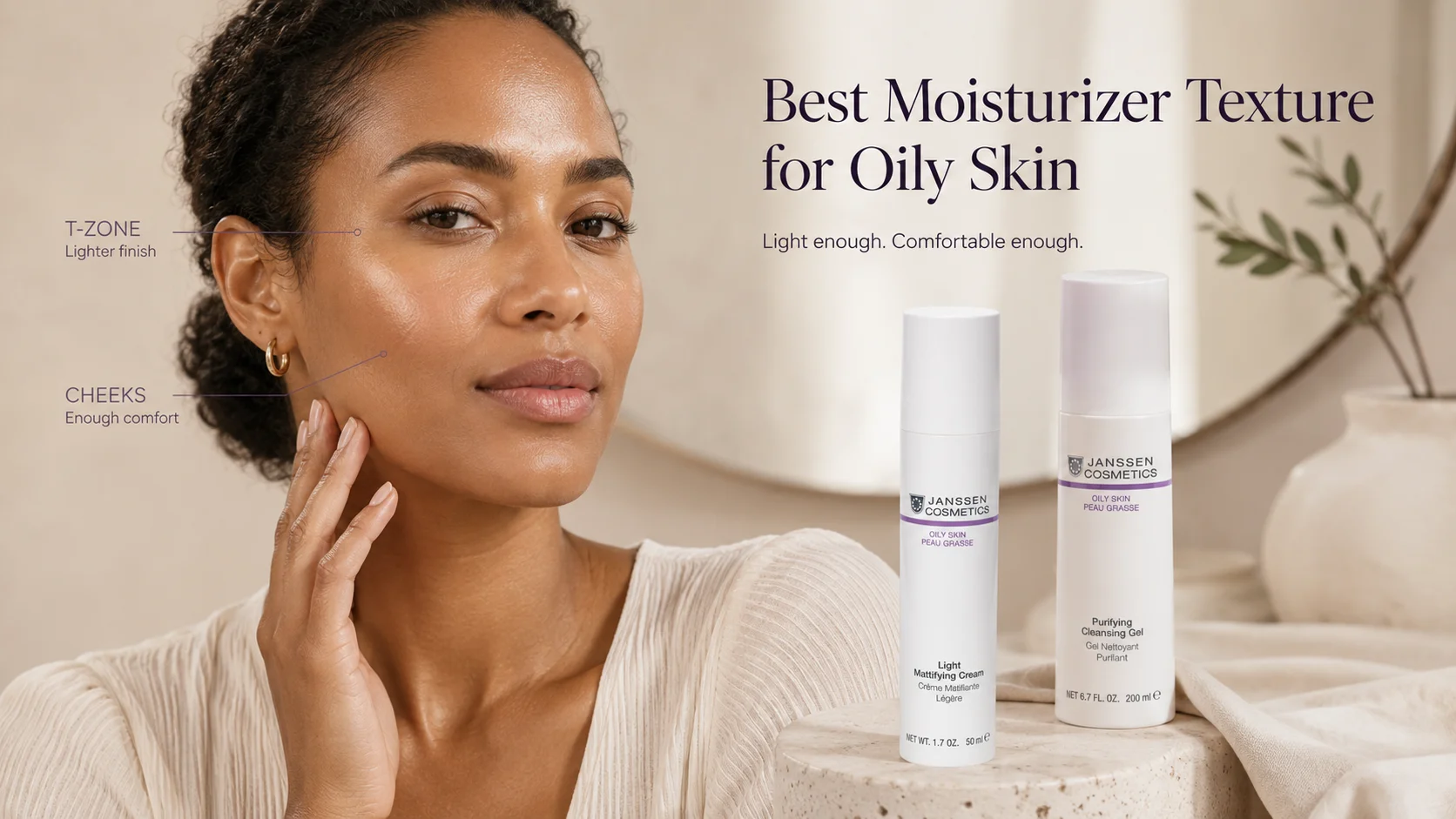
Oily skin and moisturizer can feel like a difficult match.
The face already looks shiny. The forehead gets greasy. The nose needs blotting. Makeup separates around the center of the face. Pores may look more noticeable. If whiteheads or blackheads are present, it is easy to think moisturizer will only make things worse.
So many people skip it.
But skipping moisturizer is not always the answer. Oily skin can still feel tight after cleansing. It can still be dehydrated underneath. It can still become irritated from cleansers, toners, acids, masks, or drying products. The issue is often not whether oily skin needs moisturizer. The issue is texture.
In consultation, our licensed esthetician looks at how the skin behaves after cleansing, how quickly shine returns, whether the cheeks feel tight, and how makeup wears before choosing a moisturizer texture.
The best moisturizer texture for oily skin is usually light, breathable, and not greasy.
Good texture options may include:
Oily skin usually does not need a heavy cream everywhere. But it also should not be left bare after cleansing, especially if the skin feels tight, stingy, or dehydrated.
A simple order may be:
Cleanser → Toner if appropriate → Targeted serum if needed → Lightweight moisturizer → SPF in the morning
Oily skin produces sebum, but sebum is not the same as hydration.
This is one of the biggest misunderstandings with oily skin. A face can be shiny and still feel tight. It can have oil on the surface and still lack water-based hydration. It can look greasy but feel uncomfortable after washing.
Moisturizer helps finish the skincare plan so the skin does not feel bare after cleansing or active products.
The right texture should make oily skin feel easier to manage, not heavier.
Skipping moisturizer may seem helpful at first because the face feels lighter.
But for many people, it creates a different problem.
You may notice:
This does not mean oily skin needs a rich cream. It means oily skin needs the right finish after cleansing.
Not all moisturizers feel the same.
A heavy cream may feel too rich for oily skin. A matte product may feel too dry. A gel may feel fresh but not enough for tight cheeks. A gel-cream may work better when the skin is oily but dehydrated.
This is why texture matters.
Instead of asking, “Should oily skin use moisturizer?” ask:
What texture does this skin actually tolerate?
That question leads to better decisions.
Gel moisturizers often feel light and fresh. They may be a good match for skin that gets oily quickly or dislikes cream textures.
A gel texture may make sense when:
But gel alone may not be enough if the skin feels tight, dehydrated, or dry on the cheeks. In that case, a gel-cream or light cream may be better.

A gel-cream can be helpful when oily skin feels tight underneath.
This texture is usually lighter than a rich cream but more cushioned than a plain gel.
It may make sense when:
For many oily-dehydrated skin types, gel-cream textures are a good middle ground.
A light lotion can work well when oily skin needs a little more softness than a gel but still cannot tolerate a rich finish.
This may be helpful for:
A light lotion should absorb well and not leave a thick film.
If the face feels coated or greasy, the texture may be too heavy for the oilier zones.
A mattifying cream may make sense when shine is one of the main concerns.
This type of texture can help the skin look less shiny while still giving the face a finished feel after cleansing.
It may be helpful when:
A mattifying cream should not make the skin feel tight or dry. If it does, the formula may be too drying or the skin may need lightweight hydration underneath.
Heavy creams are not automatically bad, but they are not always the best match for oily areas.
A heavy cream may feel wrong if:
If only the cheeks feel dry, a heavy cream may not need to go across the entire face.
Product placement can make a big difference.
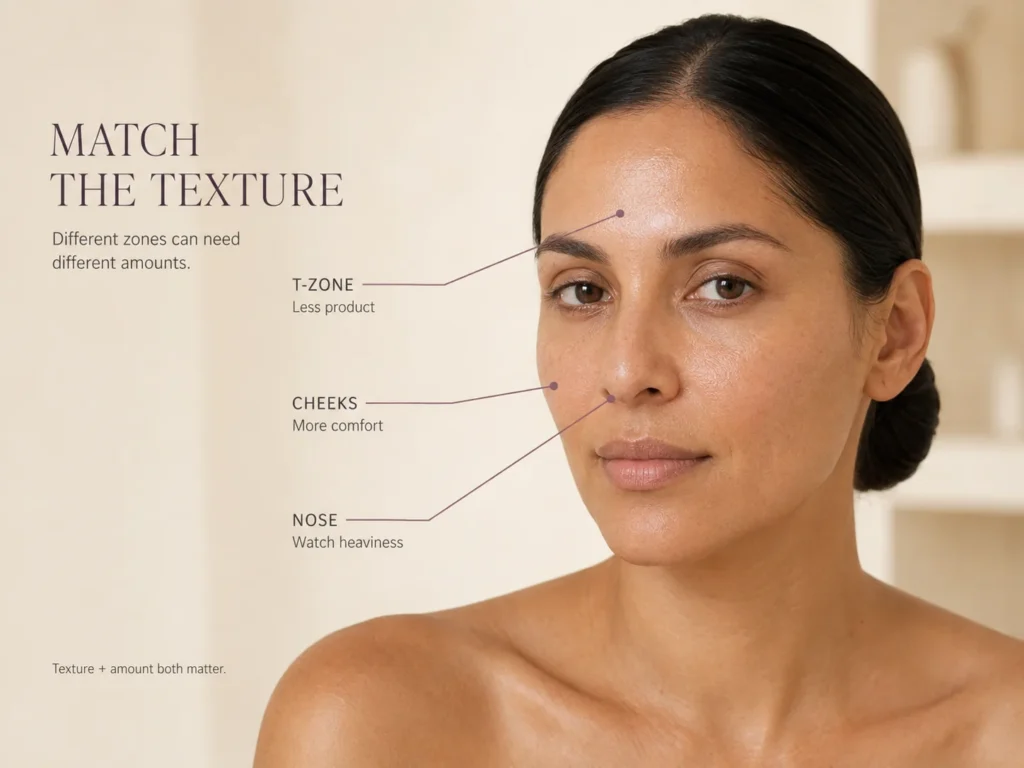
If your T-zone is oily but your cheeks feel dry, do not treat the whole face the same way.
You may need:
The face may need one moisturizer used differently by zone, or two textures depending on how different the areas are.
This is common with combination skin.
Oily-dehydrated skin can be tricky.
The skin may look shiny but feel tight, dull, rough, or uncomfortable. A heavy cream may sit on top without fixing the tight feeling.
This often means the skin needs lightweight hydration and then a light moisturizer.
A simple order may be:
Cleanser → Toner if appropriate → Lightweight hydration → Light moisturizer
If SPF follows in the morning, choose layers that do not become heavy.
The goal is not to cover the skin with more product. The goal is to help it feel less stretched.
If you use BHA, AHA, exfoliating cleanser, or other active products, moisturizer becomes more important.
Active products can make the skin feel dry or stingy if the skin is not finished with the right texture.
After exfoliating steps, oily skin may need:
If moisturizer stings after acids, the skin may be irritated. It may be time to reduce active steps rather than switch to a stronger product.
Clay masks can make oily areas look less shiny, but they can also leave the skin feeling tight if used too often.
After a clay mask, oily skin still needs a moisturizer step.
Choose a light texture and apply based on the area.
For example, the T-zone may need a thinner layer, while the cheeks may need a little more.
Do not leave the whole face dry after masking just because the skin is oily.
Moisturizer and SPF need to work together.
If your morning layers feel greasy, the issue may be:
If your skin feels tight under SPF, the moisturizer may be too light or too matte.
The goal is a morning texture that can carry you through the day without feeling oily or stretched.
Makeup can reveal whether moisturizer texture is right.
If makeup separates quickly, the moisturizer may be too heavy, too much product may be used, or the SPF may not layer well.
If makeup clings to dry patches, the skin may be dehydrated or the moisturizer may be too light.
If makeup pills, the layers may be incompatible or applied too quickly.
For oily skin, apply thin layers and let each step settle.
Good skin prep should help makeup sit better, not slide or cling.
In summer, oily skin may prefer lighter textures.
Gel, gel-cream, light lotion, or mattifying cream may feel more wearable in heat and humidity.
If the skin becomes oilier in summer, reduce heavy layers first before removing moisturizer completely.
Summer oily skin still needs SPF, and SPF often feels better when the moisturizer underneath is not too rich.
In winter, oily skin can still feel dry or tight, especially with indoor heating and cold air.
A moisturizer that works in summer may feel too light in winter.
You may need:
Oily skin can change by season. The texture may need to change too.
Mature oily skin can still produce oil, but it may also feel drier or less tolerant of harsh products.
A very matte texture may make the skin look flat or feel tight.
A richer cream may feel too heavy in oily zones.
A light lotion, gel-cream, or carefully chosen mattifying cream may work better depending on the skin pattern.
For mature oily skin, the goal is not to dry the face out. It is to keep the skin feeling hydrated while managing visible shine.
If oily skin stings, burns, or reacts easily, moisturizer texture should be chosen carefully.
Avoid choosing only by matte finish. A very matte product may feel drying if the skin is already irritated.
Sensitive oily skin often does better when the plan is simple:
Cleanser → Light moisturizer → SPF in the morning
Once the skin feels easier to tolerate, toner, BHA, mask, or other steps can be reconsidered.
Your moisturizer may be too heavy if:
This does not always mean the product is bad. It may mean the texture is wrong for the oily zones or you are applying too much.
Your moisturizer may be too light if:
If this happens, the skin may need a gel-cream, light lotion, or lightweight hydration before moisturizer.
Oily skin often needs less product than dry skin, especially through the T-zone.
Start with a thin layer.
Apply more where needed, such as cheeks or areas that feel tight.
Use less where the skin becomes oily quickly, such as the nose, forehead, or chin.
The amount can matter as much as the texture.
Some oily skin does well with oil-free textures. Others tolerate light oils or emollients inside a balanced formula.
The label matters less than the skin’s response.
A moisturizer may be a good match if it:
Choose by skin behavior, not only by the front label.
Many oily skin types do well with moisturizer both morning and evening.
Morning moisturizer should layer well under SPF.
Evening moisturizer should keep the skin from feeling bare after cleansing and any targeted step.
If you use active products at night, a light moisturizer can help reduce the chance of the skin feeling overly dry.
If the skin feels too heavy with twice-daily moisturizer, the texture or amount may need adjustment.
A simple morning plan for oily skin may be:
Cleanser → Toner if appropriate → Lightweight moisturizer → SPF
If the skin is oily but tight, add lightweight hydration before moisturizer or choose a moisturizer texture that gives more hydration without heaviness.
If makeup follows, let SPF settle before applying foundation or powder.
A simple evening plan may be:
Cleanser → Toner if appropriate → Targeted serum if needed → Lightweight moisturizer
If BHA or AHA is used, moisturizer should still finish the plan.
If the skin is irritated, skip active products and keep the evening plan simple.
If the T-zone is oily but cheeks are dry, apply moisturizer differently by area.
After consultation, our licensed esthetician may consider Janssen Cosmetics options depending on whether oily skin is shiny, tight, dehydrated, clogged-looking, mature-oily, or sensitive from product overload.

Possible options may include:
These options are not automatic recommendations. The right moisturizer texture depends on where the skin is oily, where it feels tight, whether makeup separates, whether whiteheads are present, and how many active products are already being used.
Do not skip moisturizer only because your skin is oily.
Do not use a heavy cream everywhere if only the cheeks feel dry.
Do not choose the most matte product if it makes the skin feel tight.
Do not use moisturizer to cover irritation from too many active products.
Do not apply thick layers under SPF if makeup separates quickly.
Do not ignore whiteheads that appear after heavy product layering.
Do not skip SPF because moisturizer already feels heavy.
Do not keep experimenting if blemishes are painful, deep, swollen, infected-looking, scarring, or persistent.
Oily skin often does well with gel, gel-cream, light lotion, mattifying cream, or lightweight cream textures. The right choice depends on shine, tightness, makeup behavior, and clogged-looking pores.
Yes. Oily skin can still feel tight, dehydrated, or irritated. A light moisturizer helps the skin feel less bare after cleansing.
Gel moisturizer can be a good option for oily skin that dislikes heavy creams. If the skin feels tight, a gel-cream may work better.
A mattifying moisturizer may help reduce the look of shine while giving the skin a finished feel after cleansing. It should not leave the skin tight.
The texture may be too heavy for your oily areas, or other products may be contributing to buildup. Review SPF, makeup, night cleansing, hair products, and active product use.
Usually yes. A light moisturizer can help the skin feel less bare under SPF. If layers feel heavy, adjust texture or amount.
The moisturizer may be too light, the cleanser may be stripping, or the skin may be dehydrated. You may need a different texture or lightweight hydration before moisturizer.
A dermatologist should evaluate painful, deep, swollen, cystic-looking, infected-looking, scarring, suddenly worsening, or persistent blemishes.
If you are not sure which moisturizer texture fits your oily skin, a free virtual consultation can help.
At Zendevie, we look at shine pattern, tightness, clogged-looking pores, makeup separation, SPF texture, and your current product steps before recommending products. That way, moisturizer becomes part of a thoughtful plan instead of a guessing game.
Zendevie is guided by Haby Diallo, a licensed esthetician with more than 20 years of professional skincare experience. Her approach is rooted in education, professional judgment, and personal care.
years of experience