
Oily skin does not need to be dried out to look better.
Many people with oily skin reach for the strongest cleanser, the most mattifying toner, or the harshest exfoliating product because shine feels frustrating. The face may look greasy by midday, makeup may separate around the nose, and pores may look more noticeable in the T-zone.
But if the skin starts feeling tight, stingy, flaky, or rough after using oil-control products, the plan may be too aggressive.
The best ingredients for oily skin are not simply the ones that remove oil. They are the ones that help the skin look clearer, less shiny, and more refined without leaving it feeling stripped.
In consultation, our licensed esthetician first looks at the skin pattern: Is the skin truly oily, oily and dehydrated, blemish-prone, sensitive from over-cleansing, or combination with dry cheeks? That answer changes which ingredients make sense.
The best ingredients for oily skin may include BHA, AHA, lightweight hydrators, glycerin, hyaluronic acid, panthenol, aloe vera, clay, silica, and sebum-focused ingredients such as oleanolic acid and Enantia chlorantha bark extract.
But not every oily skin type needs all of them.
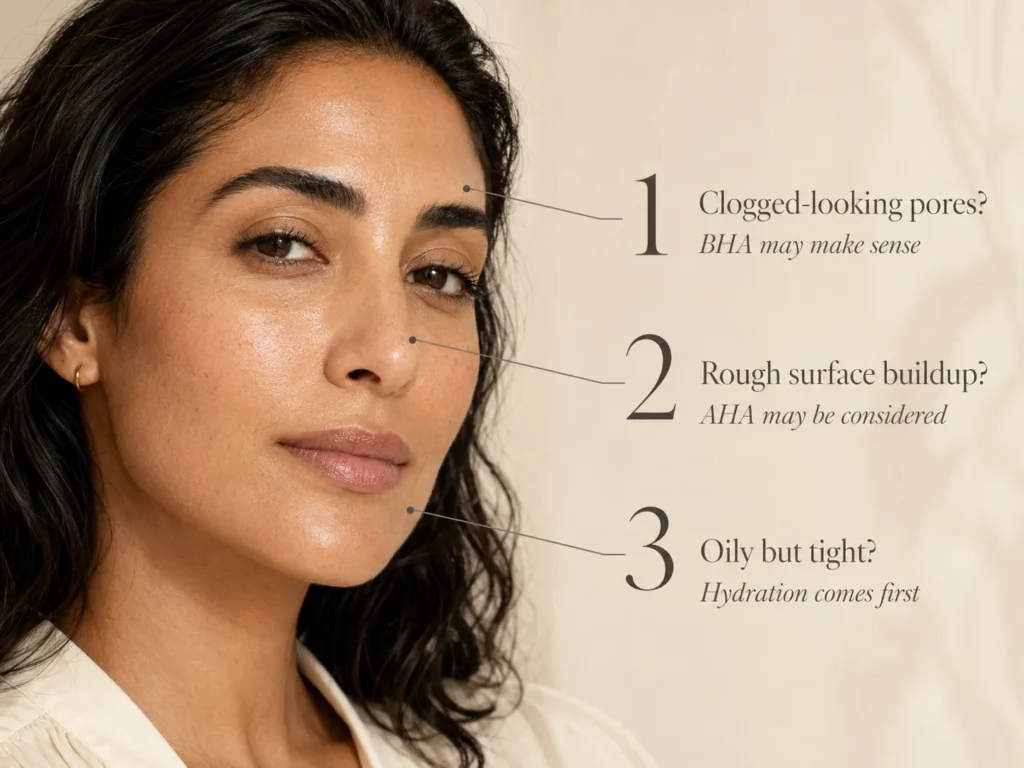
If the skin feels oily and tight, start by looking at cleansing, hydration, and moisturizer texture before adding more acids or masks. If clogged-looking pores are the main concern, BHA may be helpful. If rough surface buildup is part of the issue, AHA may be considered. If the face feels shiny but dehydrated, lightweight hydration matters.
Oily skin can look shiny for different reasons.
Some people naturally produce more sebum. Some have a T-zone that becomes oily while the cheeks feel normal or dry. Some people have clogged-looking pores or whiteheads. Others are using products that are too harsh, which leaves the face tight but still shiny.
That is why ingredient lists should not be read like a shopping checklist.
The same ingredient that helps one person may be too much for someone whose skin already feels over-cleansed. The right ingredient depends on what the skin is showing and how much the person is already doing at home.
BHA is often discussed for oily skin because it works well in oil-prone areas. Salicylic acid is the most common BHA used in skincare.
BHA may be considered when the skin shows:
For oily skin, BHA can make sense because it is often used in formulas designed for pore appearance and surface buildup in oilier zones.
But BHA should not be used everywhere without thought. If the cheeks are dry or the skin feels tight after washing, BHA may need to be introduced slowly, used only in certain areas, or paired with lighter hydration.
BHA can be useful, but more is not always better.
It may be too much if the skin feels:
If this happens, the skin may need fewer active steps before adding more BHA. Sometimes the first move is not a stronger serum. It is a less stripping cleanser and a lighter moisturizer that the skin can tolerate.
AHA is another exfoliating ingredient family. It is often used when the skin looks dull, rough, or uneven on the surface.
For oily skin, AHA may be considered when there is:
AHA is not automatically better or stronger than BHA. It has a different role. BHA is often chosen for oily, clogged-looking areas. AHA is more often considered for surface texture and dullness.
Some oily skin may need one. Some may need the other. Some may need neither until the skin feels less irritated.
A cleanser with acids, an exfoliating toner, a BHA serum, an AHA mask, and a retinol cream do not all need to be in the same week for every person.
When too many active products overlap, oily skin can start to feel dry, tight, or reactive.
A better question is:
What problem are we trying to solve first?
If the issue is clogged-looking pores, BHA may be considered. If the issue is dull surface buildup, AHA may be considered. If the issue is tightness, dehydration, or stinging, the skin may need a calmer plan before acids.
Glycerin is a classic hydration ingredient. It helps attract and hold water on the skin’s surface.
This can be helpful for oily skin that feels tight after washing or looks shiny but dehydrated.
Oily skin still needs water-based hydration. Skipping hydrating ingredients can leave the face feeling bare, which often leads people to use even stronger oil-control products.
Glycerin can be a good fit when the skin needs hydration without a heavy cream texture.
Hyaluronic acid is often used in formulas for dehydrated-looking skin because it helps the skin surface hold water.
For oily skin, this matters because some people need hydration but dislike rich creams.
Hyaluronic acid may be useful when:
This ingredient does not replace moisturizer. It works best inside a formula or step that is followed by a light cream, gel, or SPF depending on the time of day.
Panthenol is often used in skincare when the skin needs a calmer feel and better moisture retention.
For oily skin, this can matter when the face has been over-cleansed or over-exfoliated.
A person may still have shine, but the skin may also feel:
In that case, the ingredient plan should not be only about acids. The skin may need ingredients that help it feel less stressed.
Aloe vera is often used in products designed to feel lightweight and calming on the skin.
For oily skin, it can be helpful when the person wants a fresh finish but does not want the face to feel stripped.
It may fit well in formulas for oily skin that also feels easily irritated, mature, dehydrated, or dry in certain areas.
The full formula still matters. Aloe alone does not make a product right for everyone.
Clay can help absorb excess oil and reduce the look of shine temporarily.
This may be useful for:
But clay should be used with judgment.
If a clay mask leaves the whole face tight, try applying it only to the T-zone instead of the cheeks. Oily skin does not always need the same treatment everywhere.
Silica is often used in products that help create a more matte appearance.
This can be helpful for someone who wants less shine without using a very drying product.
Silica may make sense in a lightweight moisturizer, primer-style product, or mattifying cream when the skin needs a smoother finish under makeup.
But mattifying ingredients should not be used to hide dehydration. If the skin is shiny and tight, the plan should still include lightweight hydration.
Some formulas use ingredient complexes designed for oily skin and visible pore appearance. Janssen’s oily skin line, for example, uses an Equal Refining Complex with oleanolic acid and Enantia chlorantha bark extract in selected products.
From a professional perspective, this type of ingredient category may be considered when the skin shows ongoing shine, enlarged-looking pores, and oily T-zone behavior.
Still, ingredient complexes should not be treated as automatic answers. We first look at whether the skin is oily, dehydrated, sensitive, or over-exfoliated.
Some mature oily skin still gets clogged-looking pores, blemish-prone areas, or uneven texture. Retinol-style ingredients may be considered for visible texture and well-aging concerns.
But retinol is not the first step for every oily skin type.
It should be introduced slowly, especially if the skin is already using acids, active cleansers, masks, or strong exfoliating products. Daily SPF matters when using renewal-focused products.
If the skin feels tight, stingy, or reactive, retinol-style products may need to wait.
Oily skin may need caution with anything that leaves the face stripped or irritated.
Be careful with:
The goal is not to make the skin feel bare. The goal is to make it look clearer and feel easier to manage.
If your skin is shiny but not tight, you may need a cleanser, toner, lightweight moisturizer, and selective oil-control ingredients.
If your skin is oily and clogged-looking, BHA may make sense.
If your skin is oily and rough, AHA may be considered.
If your skin is oily but tight, hydration comes before stronger exfoliation.
If your skin is oily and sensitive, reduce variables before adding actives.
If your skin is oily in the T-zone but dry on the cheeks, use different textures by area.
This is how ingredient selection becomes more precise.
Morning care should reduce the look of excess shine without making the face feel tight.
A simple order may be:
Cleanser → Toner if appropriate → Lightweight Hydration if needed → Light Moisturizer → SPF
For some people, the hydration step may be built into the toner or moisturizer. For others, a separate lightweight serum may make the skin feel less tight under SPF.
Evening care should remove sunscreen, makeup, oil, sweat, and daily buildup without over-cleansing.
A simple order may be:
Cleanser → Toner if appropriate → BHA or other active step when needed → Light Moisturizer
Active products should be used with a purpose. If the skin feels irritated, keep the evening plan more basic until the skin feels easier to read.

There is no perfect schedule for everyone.
Some oily skin can tolerate active ingredients more often. Other skin becomes tight quickly. Mature oily skin, oily-dehydrated skin, and oily-sensitive skin usually need a slower pace.
A good sign is how the skin feels the next day.
If the face looks less congested and feels normal, the ingredient may be a good fit. If the skin feels tight, flaky, stingy, or rough, the plan may be too strong.
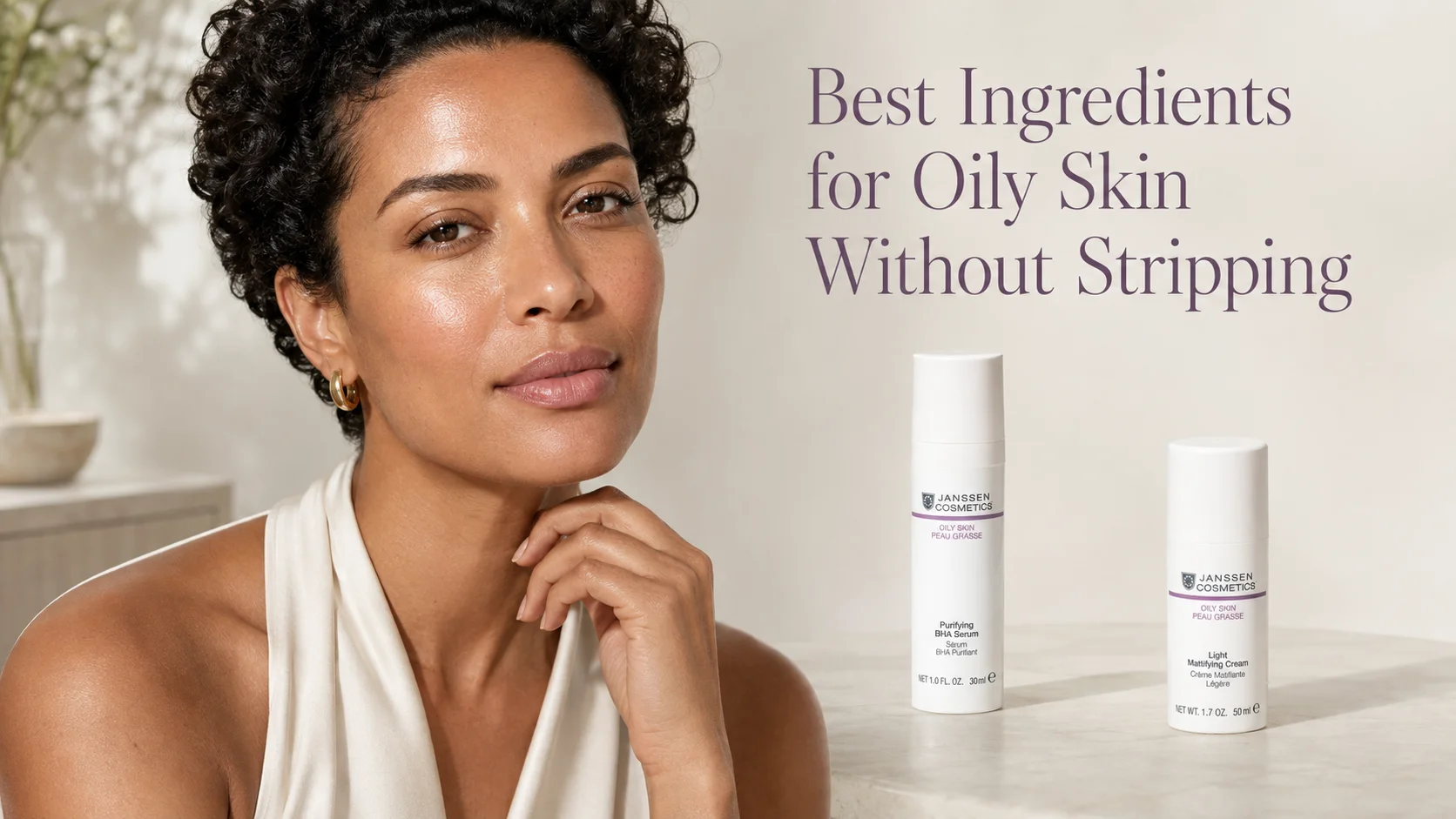
After consultation, our licensed esthetician may consider Janssen Cosmetics options depending on the skin’s oil pattern, congestion, dehydration, sensitivity, and current product habits.

Possible options may include:
These are options to discuss, not a one-size-fits-all list. The right match depends on how oily the skin is, whether it also feels tight, how often the person exfoliates, and whether the cheeks need a different approach than the T-zone.
Do not choose ingredients only because they sound strong.
Do not use BHA, AHA, retinol, clay masks, and drying products all at once.
Do not skip moisturizer because the face is shiny.
Do not use alcohol-heavy toner to chase a matte finish.
Do not apply a clay mask to dry cheeks just because the nose is oily.
Do not keep exfoliating if the skin feels tight, stingy, raw, or flaky.
Do not ignore painful, deep, swollen, infected-looking, or persistent blemishes.
BHA, AHA, lightweight hydrators, glycerin, hyaluronic acid, panthenol, aloe vera, clay, silica, and sebum-focused ingredient complexes may all make sense depending on what the skin is showing.
Salicylic acid may be helpful when oily skin has clogged-looking pores, blackheads, whiteheads, or congestion in the T-zone. It should be introduced carefully if the skin feels tight or sensitive.
Yes. Oily skin can still be dehydrated. Lightweight hydrators can help the skin feel less tight without adding a heavy finish.
No. Oily skin usually does better with a light moisturizer texture rather than no moisturizer at all.
Clay may help absorb excess oil and reduce visible shine, especially in the T-zone. It can feel too drying if used too often or applied to areas that are not oily.
AHA may be considered when oily skin looks dull or rough on the surface. It should not be layered aggressively with other active products.
A dermatologist should evaluate painful, deep, swollen, cystic-looking, infected-looking, scarring, suddenly worsening, or persistent blemishes.
If you are not sure whether your oily skin needs BHA, hydration, a lighter moisturizer, or fewer active products, a free virtual consultation can help.
At Zendevie, we first look at what your skin is showing: shine, tightness, clogged-looking pores, makeup separation, sensitivity, and current product habits. From there, we help you choose ingredients that make sense for your skin instead of guessing.

Zendevie is guided by Haby Diallo, a licensed esthetician with more than 20 years of professional skincare experience. Her approach is rooted in education, professional judgment, and personal care.
years of experience