

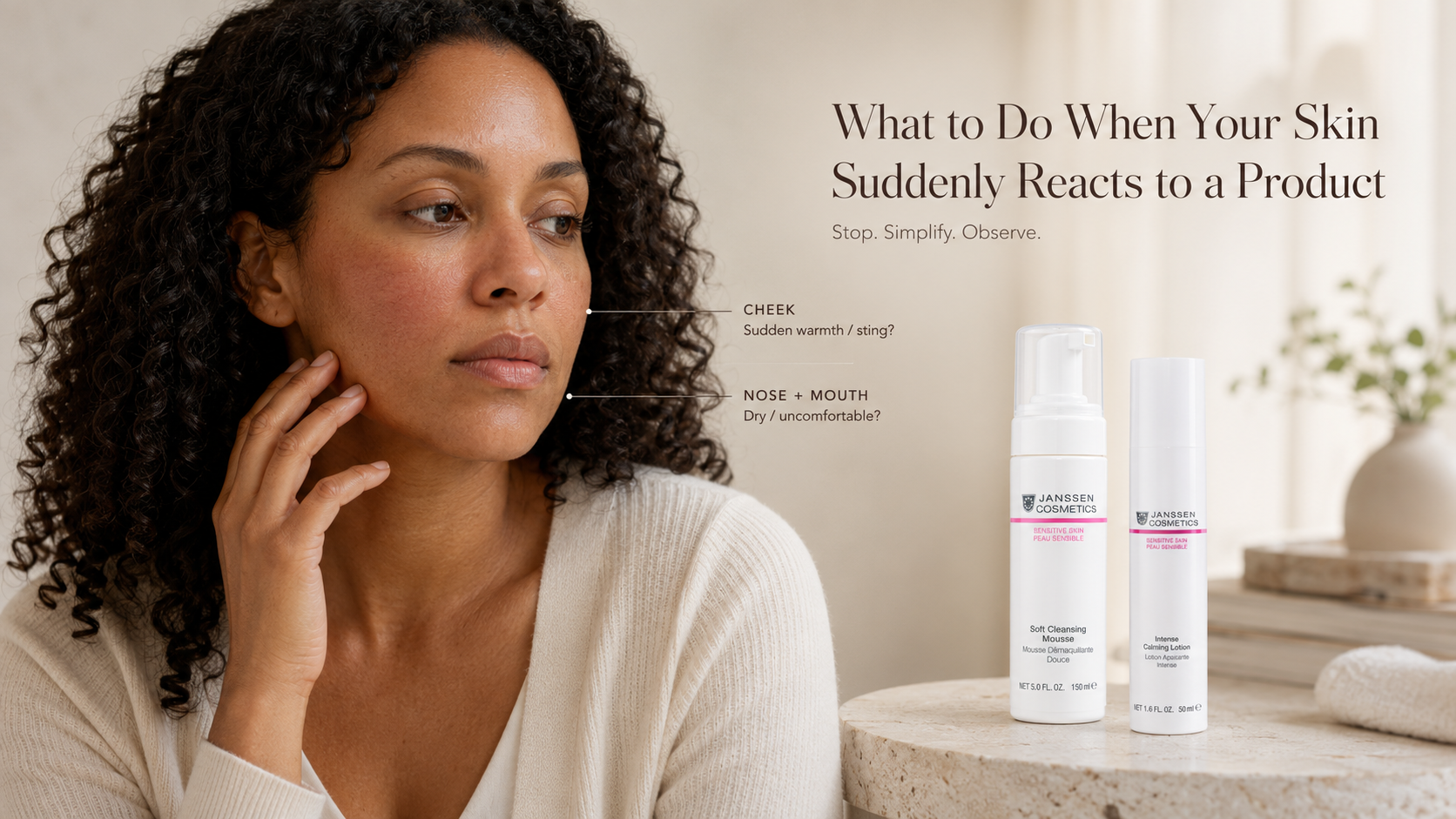
A skincare reaction can feel frightening, especially when it happens suddenly.
A product may have seemed comfortable at first.
Then the skin begins to:
The reaction may happen immediately.
It may appear several hours later.
It may also develop after the product has been used repeatedly.
When this happens, many people begin adding more products.
They may apply:
This can make the situation more difficult to understand.
At Zendevie, our licensed esthetician first focuses on stopping unnecessary product exposure, simplifying the routine, and identifying exactly what changed.
The goal is not to cover the reaction with more layers.
The goal is to reduce variables, protect comfort, and recognize when the skin needs medical evaluation rather than more skincare experimentation.
When your skin suddenly reacts to a product:
Seek urgent medical care for:
Do not try to manage a severe reaction with additional skincare.

The first step is to stop using the product that appears connected to the reaction.
Do not apply it again to see whether the same thing happens.
Do not reduce the amount and continue while the skin is still reacting.
Do not use it on another part of the face.
Repeated exposure may make it harder to understand whether the skin is improving.
The product may not be the only contributor, but stopping it removes one important variable.
If the product is still on the skin and is causing strong discomfort, remove it gently when appropriate.
For a rinse-off product such as:
rinse according to the product directions.
For a recently applied leave-on product such as:
a gentle rinse may be appropriate if the skin is strongly burning or becoming increasingly uncomfortable.
Use cool or lukewarm water.
Do not use:
The goal is to remove the product without creating more friction.
A reaction may create:
These changes may look as though they need exfoliation.
Do not use:
on the irritated area.
Scrubbing may make the skin feel more raw.
Roughness after a reaction is not proof that more exfoliation is needed.
Ice may seem like a quick way to reduce heat.
However, direct ice contact can create an extreme temperature change and additional discomfort.
Do not rub ice cubes over reactive skin.
If cool comfort is needed, use a clean, cool—not freezing—approach without pressure.
Significant swelling, pain, or rapidly worsening symptoms should be medically evaluated rather than managed with extreme cold.
Avoid applying:
to a skincare reaction.
A home remedy may introduce additional irritation, fragrance, acidity, alkalinity, or contamination.
Sensitive skin needs fewer variables, not more.
A product described as soothing may still contain:
Applying several calming serums, creams, oils, and masks makes it difficult to identify what the skin can tolerate.
Return to the simplest familiar products.
A skincare reaction may appear at different times.
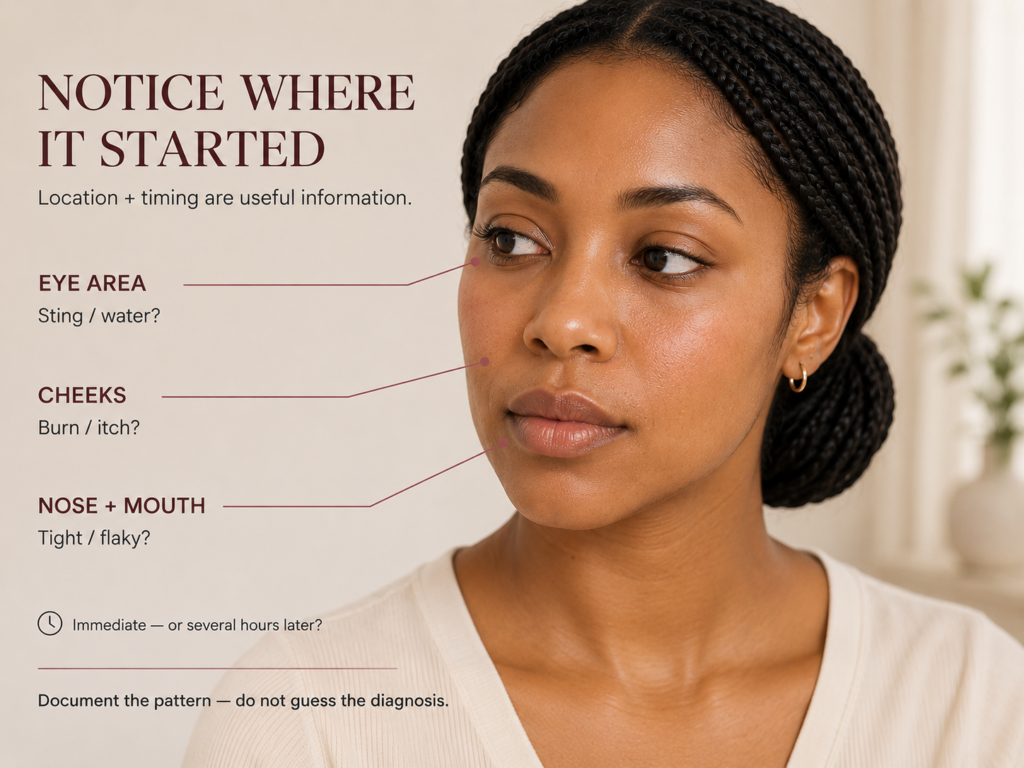
The skin may begin stinging, burning, itching, or feeling hot within seconds or minutes.
Possible contributors may include:
The skin may become uncomfortable several hours or days later.
Signs may include:
A delayed reaction is still important even if the product felt comfortable during application.
A product may seem comfortable at first and become irritating later.
This may happen because:
Do not assume that a product must still suit the skin because it worked previously.
A product does not need to burn to be effective.
Strong burning may indicate that:
Do not continue using a product because someone described burning as normal.
A mild, brief sensation may occur with some active products.
However, stop and reassess if tingling becomes:
Sensitive skin should not be forced through increasing discomfort.
Itching may be associated with:
Stop the suspected product.
Do not scratch.
Scratching may increase:
Persistent, severe, spreading, swollen, or sleep-disrupting itching should be evaluated by a dermatologist.
Mild puffiness and significant swelling are not the same.
Stop the suspected product if swelling appears.
Seek prompt medical guidance when swelling:
Do not apply more skincare over significant swelling.
The eye area is delicate.
Products may move toward the eyes through:
Stop applying the suspected product near the eye area.
Seek medical guidance for:
Do not apply facial acids, retinol, essential oils, or fragranced products to irritated eyelids.
Stop the suspected product.
Swelling of the lips, tongue, or mouth area may need prompt medical attention, especially when it is:
Do not wait for a severe reaction to improve through skincare.
Seek urgent medical care.
Breathing difficulty, throat tightness, wheezing, faintness, or rapid facial swelling are not routine cosmetic concerns.
Seek urgent medical care.
Do not:
Severe reactions require medical attention.
When the skin reacts, temporarily pause:
Even if these products were not the original cause, they may feel more irritating while the skin is reactive.
Retinol should wait when the skin is:
Do not try to continue retinol on unaffected areas while the face is actively reacting.
The routine needs stability first.
AHA and BHA may increase discomfort when the skin is already reacting.
Pause:
Do not use acids to remove reaction-related texture or bumps.
Vitamin C may remain comfortable for some people.
However, it should pause if the skin is:
Antioxidant support is not more important than immediate skin comfort.
Avoid:
A mask should not be used as an emergency response unless it is already known to be tolerated and professionally appropriate.
Fragrance does not cause every skincare reaction.
However, strongly fragranced products may be harder to tolerate while the skin is already uncomfortable.
Review:
Total fragrance exposure may matter.
Do not apply:
directly to the reaction.
Essential oils may create more burning, cooling, warming, or itching.
Natural does not automatically mean gentle.
A temporary simple routine may look like:
Lukewarm-water rinse or gentle cleanser if needed → familiar moisturizer → familiar SPF
Gentle cleanser → familiar moisturizer
Temporarily avoid optional products.
The routine should feel predictable.
A familiar product is one the skin has already used comfortably.
Do not assume a product is familiar if:
If a familiar moisturizer now burns, stop and reassess.
Stop using it temporarily.
Rinse gently with lukewarm water.
Possible reasons include:
If even very gentle cleansing causes significant or persistent discomfort, seek dermatologist guidance.
Water stinging may suggest that the skin is significantly reactive or irritated.
Avoid:
If lukewarm water continues to cause significant discomfort, seek medical evaluation.
The moisturizer may not be the original cause.
The skin may already be irritated by:
Stop the moisturizer if it repeatedly burns.
Do not test several new moisturizers in one day.
If no basic moisturizer is tolerated, seek dermatologist guidance.
SPF may sting because:
Do not continue strong actives while abandoning daytime protection.
A different formula or a calmer routine may be needed.
Makeup may:
Avoid covering skin that is:
A mild reaction may still feel worse under long-wear makeup.
Let skin comfort guide the decision.
The suspected product may not be the only issue.
A reaction may occur after:
Acid cleanser → acid toner → vitamin C → moisturizer → SPF
or:
Exfoliating cleanser → retinol → fragranced night cream
or:
Facial scrub → clay mask → essential-oil serum
The product used last may receive all the blame even though earlier steps made the skin more reactive.
Document the full order.
Ask:
The most recent change may provide an important clue.
A product may cause discomfort when it is:
This does not mean the reaction is your fault.
It means the method should be reviewed.
Stop using a product if it has changed significantly in:
Also review whether it was stored:
Do not assume a changed product is safe because it has not reached the printed date.
Some areas are more reactive:
A product may feel comfortable on the forehead and burn around the mouth.
Do not apply facial actives evenly across every area automatically.
Skin may react more easily after:
Avoid applying strong products immediately afterward.
A product tolerated on ordinary days may sting on freshly treated skin.
A reaction may occur because the skin was already exposed to:
A moisturizer or SPF may then begin burning even if it was not the original cause.
Sun-stressed skin may react to products that normally feel comfortable.
Do not apply strong actives to skin that feels:
If the skin is blistering, significantly swollen, or severely painful, seek medical guidance.
Weather may affect tolerance.
A product may sting more after:
The environment may not be the only cause, but it can lower skin comfort.
Facial reactions may be influenced by:
If irritation appears near the hairline, temples, ears, neck, or cheeks, facial skincare may not be the only contributor.
Makeup may contribute through:
A reaction may appear after makeup even when the skincare underneath seemed comfortable.
Review both.
Write down:
Photos may help document visible changes.
Protect privacy when storing or sharing images.
Do not apply the product again while the skin is still uncomfortable.
A repeated test may:
Wait until the skin is fully stable and professional guidance supports reconsideration.
Some products should not be restarted.
Patch testing a cosmetic product at home may help identify whether a small area reacts.
It cannot diagnose:
Dermatologist-supervised testing is different from home product testing.
Do not repeatedly patch test a product that already caused a strong reaction.
A mild reaction may include:
Monitor whether it:
A mild reaction may still mean the product is not a good match.
If the sensation is mild, brief, and not paired with swelling, pain, itching, or rash-like changes, monitor carefully.
Do not immediately reapply the product.
Ask:
Repeated brief reactions are still useful information.
Stop the product.
Remove it gently if appropriate.
Pause active ingredients.
Use only products the skin already tolerates.
Persistent or worsening burning should be evaluated by a dermatologist.
Stop the suspected product.
Avoid:
Persistent, painful, swollen, or worsening redness-looking areas need professional evaluation.
Small bumps may be associated with:
Do not assume the skin is purging.
Pause the suspected product.
Seek guidance if bumps are:
Pause:
Do not scrub the flakes.
Use gentle cleansing and a tolerated moisturizer.
Persistent, painful, crusting, bleeding, or worsening flaking should be evaluated by a dermatologist.
This may happen after over-exfoliation or strong cleansing.
The skin may look reflective while feeling:
Do not add more acids.
Simplify the routine.
Stop applying the suspected product near the eyes.
Review:
Seek medical guidance for significant swelling, pain, crusting, discharge, vision changes, or persistent irritation.
Possible contributors include:
Avoid active products on cracked-looking, burning, or rash-like areas.
Persistent mouth-area reactions should be evaluated by a dermatologist.
Products may collect in nostril folds.
Possible contributors include:
Keep active products away from irritated folds.
Do not scrub the area.
Review:
The facial skincare product may not be the only factor.
Stop the moisturizer.
Review whether:
Do not assume every moisturizer will cause the same reaction.
However, test alternatives carefully and one at a time.
Stop the cleanser.
Use lukewarm water.
Avoid:
A cleanser should not repeatedly leave the face hot, raw, itchy, or painfully tight.
Stop the toner.
Check whether it contains:
Toner is optional.
Do not replace it immediately with another toner simply because the routine feels incomplete.
Stop the serum.
Review its active ingredients.
Possible contributors may include:
Do not test another serum immediately.
Return to cleanser, moisturizer, and SPF.
Pause retinol.
Also pause:
Use a gentle cleanser and tolerated moisturizer.
Continue daytime SPF when tolerated.
Do not restart retinol until the skin feels consistently comfortable.
Stop the acid.
Do not apply another acid to balance or correct the reaction.
Avoid:
Use a simple routine.
Seek medical guidance for significant burning, blistering, swelling, or worsening discomfort.
Pause vitamin C.
Review:
Vitamin C is optional while the skin is reactive.
Stop the suspected formula if it repeatedly causes discomfort.
Review:
Daytime protection remains important.
A different formula may be needed after the skin stabilizes.
Stop the suspected makeup product.
Remove it gently.
Review:
Avoid reapplying makeup over irritated skin.
Remove the mask according to its directions.
Rinse gently.
Pause:
Do not leave a mask on longer to see whether the skin adjusts.
Stop the product.
Do not apply another essential oil to calm the skin.
Avoid undiluted:
Return to the simplest familiar routine.
Stop the suspected product.
Review total fragrance exposure from:
Do not replace every product at once.
Keep only the familiar basics that remain comfortable.
Pause:
Use a gentle routine.
If the area becomes painful, significantly swollen, blistering, infection-looking, or worsening, seek guidance.
Avoid active and fragranced products.
Do not exfoliate the area.
Follow aftercare instructions.
Seek professional or medical guidance for significant swelling, blistering, pain, or persistent rash-like changes.
Do not apply strong active products.
Use only products the skin already tolerates.
If the skin is:
seek medical guidance.
Return to familiar products.
Stop:
Review:
Seek medical care locally if the reaction is severe or worsening.
Possible reasons for a new reaction include:
Stop and reassess rather than assuming the skin must continue tolerating it.
That is useful information.
Do not immediately reapply the suspected product.
Keep the routine simple.
Wait until cleanser, moisturizer, and SPF feel consistently comfortable.
Then review whether the product needs to return at all.
Stop the product.
Repeated discomfort suggests that it may not suit the skin or that it is being used in an incompatible way.
Do not continue because it was expensive, popular, or recommended by someone else.
Seek dermatologist guidance when symptoms persist despite stopping the suspected product and simplifying the routine.
The reaction may need medical assessment.
Do not continue switching between new products.
Stop introducing new products.
Pause:
Use only the simplest products that remain comfortable.
If cleanser, moisturizer, SPF, or water continues to cause significant discomfort, seek dermatologist guidance.
There is no universal number of days.
Keep the routine simple until:
Persistent or severe symptoms should not be managed by waiting indefinitely.
Seek medical guidance.
Once the skin feels stable:
Do not reintroduce the suspected product first without a clear reason.
Not always.
Reintroduction may be inappropriate when the product caused:
A dermatologist may need to assess the reaction before the product is considered again.
Lukewarm-water rinse or gentle cleanser if needed → familiar moisturizer → familiar SPF
Avoid unnecessary layers.
Do not apply strong vitamin C, acid toner, or several serums while the skin is still reactive.
Gentle cleanser → familiar moisturizer
If the cleanser burns, use the gentlest appropriate approach and seek guidance if basic cleansing remains uncomfortable.
Gentle cleanser or rinse → supportive familiar moisturizer → SPF
Gentle cleanser → familiar moisturizer
Avoid:
Gentle cleanser → lightweight familiar moisturizer if needed → SPF
Gentle cleanser → lightweight moisturizer
Do not use:
Oily-sensitive skin can still be irritated and dehydrated.
Gentle cleanser → moisturizer according to area needs → SPF
Gentle cleanser → moisturizer
Do not apply the same active product to every area.
Keep dry or reactive cheeks simple.
Gentle cleanser or rinse → moisturizer → SPF
Gentle cleanser → moisturizer
Pause:
A well-aging routine should not leave the skin raw or painful.
Gentle cleanser → lightweight moisturizer → SPF
Gentle cleanser → lightweight moisturizer
Pause:
Painful, deep, swollen, infection-looking, crusting, bleeding, persistent, or scarring blemishes should be evaluated by a dermatologist.
Purging is often used to explain bumps after active products.
Not every reaction is purging.
Stop and reassess when bumps are:
Do not continue an uncomfortable product based only on online explanations.
A product reaction may involve irritation, sensitivity, overuse, product combinations, or another concern.
It is not always possible to determine the cause from appearance alone.
Do not diagnose an allergy through skincare content.
A dermatologist may need to evaluate persistent or recurring reactions.
It may be appropriate to contact the company when:
Keep:
Do not share unnecessary private information publicly.
A dermatologist should evaluate the skin when a product reaction includes:
A dermatologist may also help determine whether formal medical patch testing is appropriate.
Seek urgent medical care for:
Do not attempt to manage these symptoms with additional skincare.
After consultation, our licensed esthetician may consider Janssen Cosmetics options only after identifying which foundational steps the skin can still tolerate.
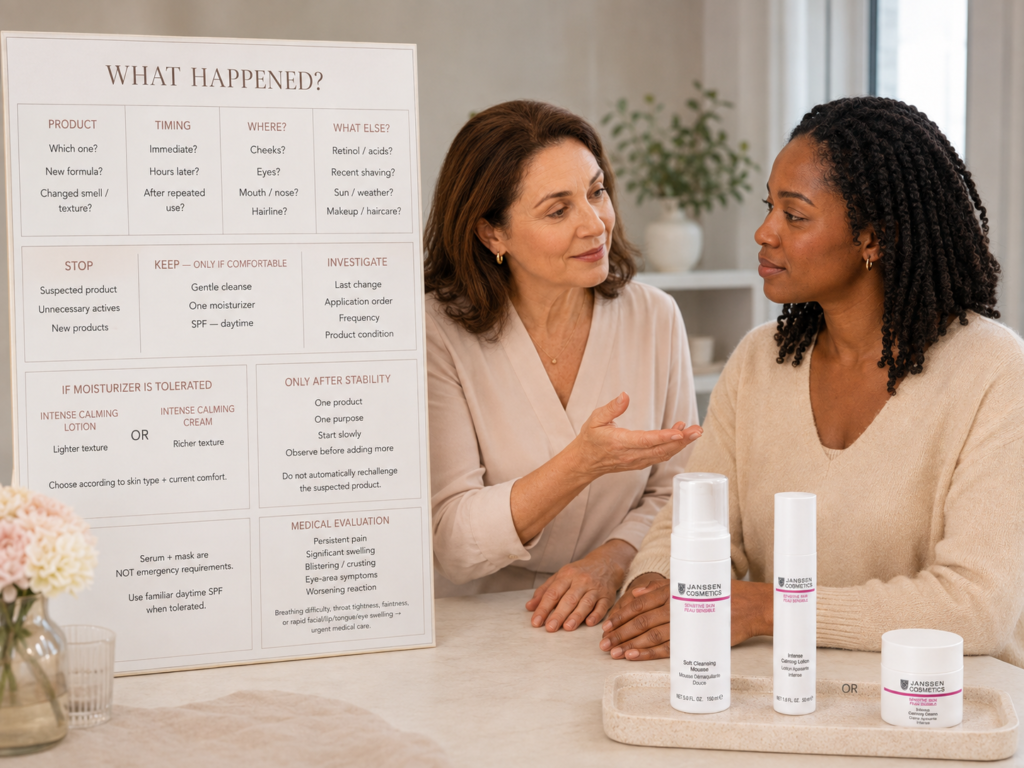
Possible sensitive-skin options may include:
These are possible options, not an emergency routine and not one automatic product set.
When the skin has suddenly reacted, the first Janssen-related discussion may focus only on:
One gentle cleansing step → one appropriate moisturizer → daytime SPF when tolerated
A tonic, serum, mask, and eye product should not all be introduced immediately.
Intense Calming Lotion may be considered when the skin prefers a lighter texture.
Intense Calming Cream may be considered when the skin is dry and prefers richer comfort.
The choice depends on:
Soft Soothing Tonic should only be considered when the skin can tolerate an optional post-cleansing step.
Intense Calming Serum should wait until the cleanser and moisturizer foundation feels comfortable.
Instant Soothing Mask should not be treated as an emergency requirement.
Active Janssen products from other families—including retinol, AHA, BHA, enzyme exfoliation, and stronger vitamin C options—should wait while the skin is burning, hot, swollen, rash-like, painfully flaky, or reacting to moisturizer or SPF.
Professional exfoliation systems belong in professional treatment settings and should never be used as home solutions for a product reaction.
Do not reapply the suspected product to test the reaction.
Do not scrub the skin.
Do not use AHA, BHA, retinol, facial scrubs, or peeling masks over the reaction.
Do not apply ice directly to the face.
Do not use very hot or freezing water.
Do not apply lemon juice, baking soda, toothpaste, vinegar, or other home remedies.
Do not add several soothing serums and creams at once.
Do not apply undiluted essential oils.
Do not use fragrance-heavy products on already reactive skin.
Do not cover severe swelling, blistering, crusting, or bleeding with makeup.
Do not continue retinol through burning or swelling.
Do not assume every bump is purging.
Do not assume every reaction is an allergy without medical evaluation.
Do not introduce several replacement products immediately.
Do not apply active products close to irritated eyes, mouth corners, or nostril folds.
Do not use strong products after shaving, waxing, threading, dermaplaning, sun exposure, or professional exfoliation.
Do not use hotel soap or unfamiliar samples during an active reaction.
Do not use professional peel products at home.
Do not ignore product changes in smell, color, texture, or packaging.
Do not continue a product because it was expensive or popular.
Do not share private medical information publicly when contacting a retailer or brand.
Do not ignore significant swelling, blistering, crusting, bleeding, infection-looking changes, eye-area symptoms, breathing difficulty, throat tightness, or worsening reactions.
Stop using the suspected product. Remove it gently if it is still on the skin and causing discomfort, then pause active ingredients and simplify the routine.
If the product is still on the skin and causes strong burning, rinse it gently with cool or lukewarm water according to the product directions. Do not scrub.
Use only a moisturizer the skin already tolerates. Stop if the moisturizer also burns or makes the reaction worse.
Pause retinol, AHA, BHA, scrubs, strong vitamin C, acid toners, masks, drying spot products, essential oils, and new or strongly fragranced products.
A mask is not automatically necessary. It may contain fragrance or active ingredients. Begin with the simplest familiar routine.
Do not place ice directly on facial skin. Extreme cold may create additional discomfort.
No. Scrubbing or using acids may make irritated skin feel more raw.
The earlier product may have already irritated the skin. The moisturizer may not be the original cause.
The skin may be over-exfoliated, dry, using retinol, or already irritated. The sunscreen formula or eye migration may also contribute.
Yes. Itching, flaking, swelling, bumps, or redness-looking changes may appear hours or days after application.
Yes. Skin condition, weather, frequency, product combinations, storage, formula changes, or developing sensitivity may affect tolerance.
Do not retest it while the skin is reacting. Strong or recurring reactions may require dermatologist guidance before the product is reconsidered.
A mild brief sensation may occur with some formulas, but strong, persistent, painful, or worsening burning should not be ignored.
No. Itchy, rash-like, painful, swollen, spreading, or burning bumps should not automatically be described as purging.
Fragrance may contribute to stinging, itching, warmth, or redness-looking areas for some people. The complete formula and routine should be reviewed.
Do not apply undiluted essential oils to reactive skin. They may create more burning, tingling, or itching.
Keep it simple until cleanser, moisturizer, and SPF feel consistently comfortable and burning, swelling, or irritation-related flaking has settled.
Stop introducing new products and seek dermatologist guidance if cleanser, moisturizer, SPF, or water continues to cause significant discomfort.
See a dermatologist if the reaction is persistent, painful, significantly swollen, blistering, crusting, bleeding, infection-looking, close to the eyes, repeatedly returning, or not improving after the product is stopped.
Seek urgent medical care for breathing difficulty, throat tightness, faintness, difficulty swallowing, or rapid swelling of the lips, tongue, face, or eyes.
If your skin suddenly burns, stings, itches, flakes, or becomes redness-prone after a product, a free virtual consultation can help you review what happened before you add another formula.
At Zendevie, we look at the suspected product, the full application order, cleanser, toner, serums, moisturizer, SPF, retinol use, exfoliation schedule, fragrance exposure, essential oils, makeup, haircare, weather, recent hair removal, and reaction history.
The goal is not to guess which product will calm the skin fastest.
The goal is to identify what should stop, which basic steps remain comfortable, and when the reaction needs dermatologist or urgent medical attention.

Zendevie is guided by Haby Diallo, a licensed esthetician with more than 20 years of professional skincare experience. Her approach is rooted in education, professional judgment, and personal care.
years of experience