


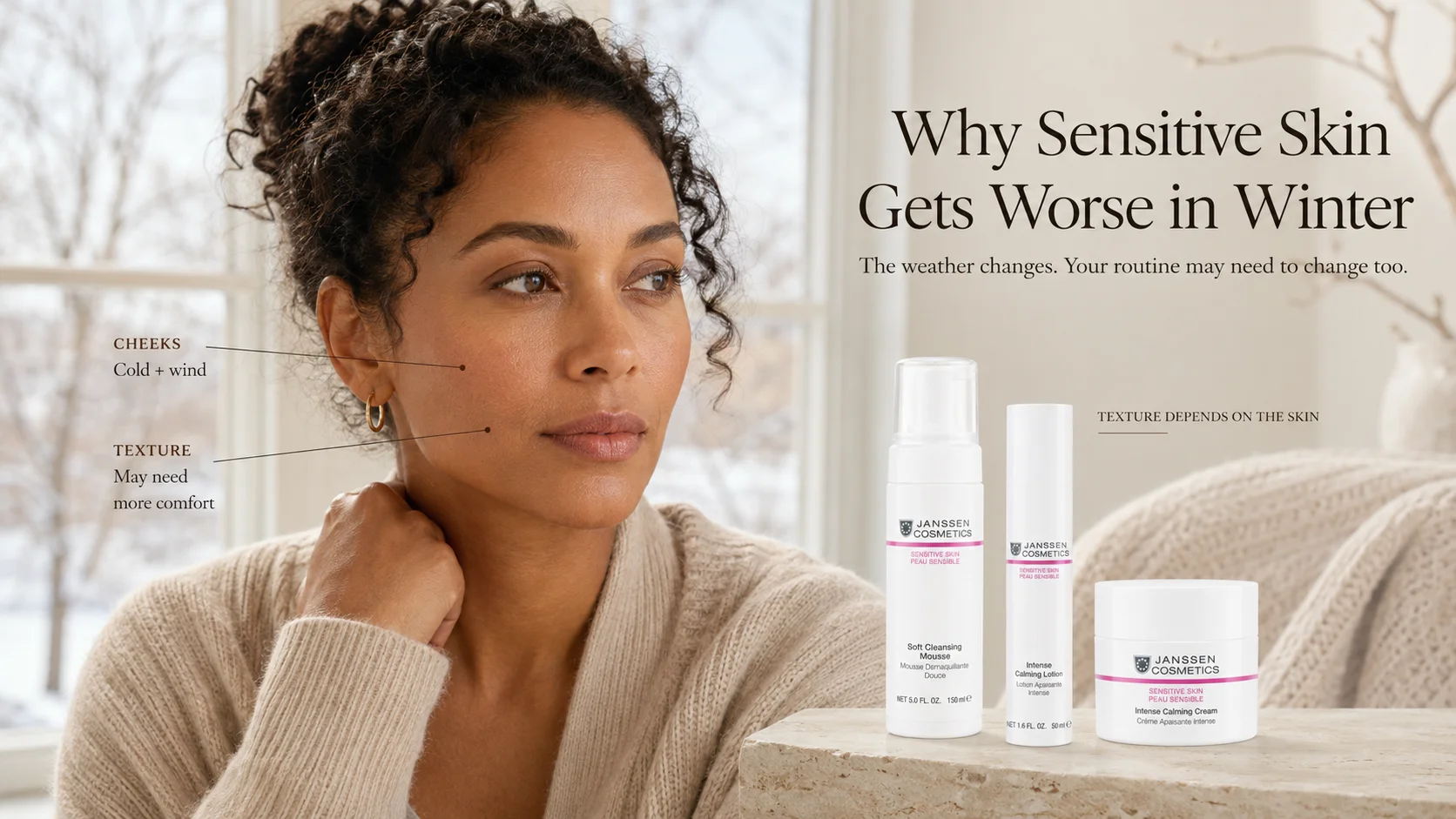
Sensitive skin may feel completely different when the weather becomes colder.
A cleanser that felt comfortable in summer may suddenly leave the face tight.
A lightweight moisturizer may no longer feel like enough.
Retinol may begin to sting.
An acid toner may create more flaking.
Cold wind may make the cheeks feel raw.
Indoor heating may leave the skin dry even when the face still looks oily.
This does not always mean the skin type has completely changed.
The environment around the skin has changed.
Winter often brings a combination of:
Sensitive skin may become less tolerant when these factors are combined with retinol, exfoliating acids, strong cleansers, fragrance, or frequent washing.
At Zendevie, our licensed esthetician looks at the full seasonal pattern before recommending a stronger cream or another serum.
The goal is to understand what changed, which steps are now uncomfortable, and whether the routine needs to become simpler, richer, less active, or more consistent.
Sensitive skin may get worse in winter because cold air, low humidity, indoor heating, wind, and hot water can leave the skin feeling drier and less comfortable.
Common winter signs include:
A simple winter starting routine may be:
Morning: Gentle cleanser or lukewarm-water rinse if appropriate → moisturizer → SPF
Evening: Gentle cleanser → moisturizer
During periods of increased sensitivity, consider pausing:
If the skin becomes persistently painful, significantly swollen, blistering, crusting, bleeding, infection-looking, severely itchy, close to the eyes, or continues to worsen after products are stopped, seek dermatologist guidance.

Skin does not exist separately from the environment.
Cold air outdoors and heated air indoors can both influence how the skin feels.
During winter, sensitive skin may experience:
A routine that worked in humid weather may not provide the same comfort during winter.
Seasonal adjustment does not always mean adding many new products.
It may mean changing one or two steps carefully.

Cold outdoor air often contains less moisture than warm, humid air.
Sensitive skin may feel:
The cheeks and mouth area may notice the change first.
Cold air does not automatically mean the skin needs aggressive exfoliation.
Roughness during winter may be connected to dryness and environmental exposure rather than excessive surface buildup.
Humidity refers to the amount of moisture in the air.
When humidity is low, the skin may feel as though moisture leaves more quickly.
This may contribute to:
A lightweight summer lotion may no longer feel sufficient.
However, the correct adjustment depends on skin type.
Dry-sensitive skin may need a richer moisturizer.
Oily-sensitive skin may still prefer a lighter lotion but require more consistent application.
Indoor heating keeps the environment comfortable, but it may also reduce indoor humidity.
Sensitive skin may feel worse after spending long periods near:
The face may feel dry, tight, or warm even when it is protected from the outdoor cold.
If indoor heating is strong, review:
Avoid placing the face close to a heater.
Winter often involves repeated temperature changes.
For example:
Sensitive or redness-prone skin may respond with:
This does not mean skincare alone can diagnose the cause.
But reducing aggressive products during periods of frequent temperature change may help keep the routine more comfortable.
Wind creates physical exposure and may make sensitive skin feel:
The face may also be rubbed by scarves or coat collars during windy weather.
Before going outdoors, use the moisturizer and SPF routine the skin already tolerates.
Do not apply a new exfoliating acid immediately before long outdoor exposure.
Hot showers may feel especially comfortable during cold weather.
But very hot water can leave sensitive facial and body skin feeling:
Even when the face is not directly under the water, steam and heat can affect it.
Use warm or lukewarm water rather than very hot water.
After showering, apply skincare gently.
Do not scrub the face because steam made it feel soft.
Long exposure to hot water may contribute to a dry or uncomfortable feeling.
Sensitive skin may become more reactive when a long shower is followed by:
Winter routines should avoid combining several drying or active steps after heat exposure.
Steam is sometimes used because the skin feels dry or congested.
However, facial steaming may make sensitive or redness-prone skin feel:
Steam does not replace moisturizer.
It also does not prepare sensitive skin for stronger exfoliation.
If facial heat is already a concern, steaming may not be appropriate.
A cleanser that felt comfortable during summer may feel too strong in winter.
Possible reasons include:
Review whether the skin needs the same cleansing intensity every season.
Some sensitive skin may prefer:
Morning: Lukewarm-water rinse or gentle cleanser
Evening: Gentle cleanser to remove SPF and makeup
The correct approach depends on oiliness, makeup, SPF, exercise, and product buildup.
Signs the cleanser may be too strong include:
Do not wash more often because the face looks shiny.
Winter shine may exist alongside dehydration and irritation.
A foaming cleanser is not automatically inappropriate for sensitive skin.
But some formulas may feel more drying when the environment changes.
Ask:
The complete cleansing method matters.
Double cleansing can be useful for heavy makeup or water-resistant sunscreen.
It may feel excessive when:
Use double cleansing only when it serves a clear purpose.
Do not turn every winter evening into two full cleansing routines when one appropriate cleanser may be enough.
When the skin flakes, many people add:
But winter flaking may be connected to:
Scrubbing away flakes may leave the skin feeling more raw.
Pause and assess before exfoliating.
AHA and BHA may feel stronger during winter because the skin is already drier or less comfortable.
Sensitive skin may need:
Do not maintain the same exfoliation schedule automatically throughout the year.
The skin’s response should guide frequency.
An acid toner may be used daily because it is labeled as toner.
But it remains an exfoliating product.
In winter, daily acid-toner use may contribute to:
Count the acid toner as the exfoliating step.
Do not add another acid serum or scrub on top of it.
Retinol tolerance may change as the weather becomes colder.
A routine that felt comfortable in summer may become too active when the skin is exposed to:
Sensitive skin may need:
Retinol is optional.
It should not be continued through persistent burning, swelling, rash-like irritation, or painful flaking.
Some vitamin C formulas may sting more when the skin is dry or weather-stressed.
If vitamin C begins feeling uncomfortable, review:
Do not assume the product must be used every morning regardless of tolerance.
A fragranced product that felt pleasant during warmer weather may sting when the skin is:
This does not always mean fragrance is the only cause.
The skin may simply be less tolerant overall.
Review the complete formula and routine.
Peppermint, eucalyptus, citrus, tea tree, lavender, and other essential oils may feel more noticeable on dry or cracked-looking skin.
Do not apply undiluted essential oils directly to the face.
Avoid homemade essential-oil treatments.
A warming or cooling sensation may feel stronger when the skin is weather-stressed.
Summer and winter moisturizer needs may be different.
A lightweight lotion that felt ideal in humid weather may no longer provide enough comfort in winter.
Possible signs include:
Dry-sensitive or mature-sensitive skin may need a richer texture.
Oily-sensitive skin may still prefer a lighter lotion but may need more consistent use or a slightly more supportive formula.
Sensitive skin should not automatically choose the richest product.
Texture should match skin type, season, and routine comfort.
A heavy cream may help some dry-sensitive skin.
It may feel too occlusive for:
Signs the cream may feel too heavy include:
A winter adjustment should be personalized.
Some people apply moisturizer only when the skin feels visibly dry.
Sensitive skin may benefit from more consistent use rather than waiting for tightness.
A simple structure may be:
Morning: Cleanser or rinse → moisturizer → SPF
Evening: Gentle cleanser → moisturizer
Apply gently.
Do not rub aggressively to make the product absorb faster.
A moisturizer may be applied after cleansing once the skin is gently patted dry or left slightly comfortable according to the product directions.
Do not apply retinol or acids to very wet skin unless the product specifically directs that method.
Active products may feel more intense on wet skin.
Facial oils may help some dry-sensitive skin feel more comfortable.
But they are not required.
A facial oil may:
Do not assume every winter routine needs cleanser, serum, cream, balm, and oil.
Use only the steps that serve a purpose.
Some very dry areas may benefit from an occlusive layer.
However, thick products should not be applied automatically across oily or clogged-looking areas.
Be cautious around:
Targeted use may be more appropriate than full-face use.
Cold weather does not remove the need for daytime protection.
Sun exposure can still occur during:
SPF is especially important when the routine includes:
A winter routine should not stop SPF while continuing active ingredients.
SPF may begin stinging because the skin is:
The sunscreen formula may also be contributing.
Review the complete routine rather than simply avoiding SPF.
A different texture or application method may be needed.
Foundation and concealer may begin:
Do not scrub the skin to make makeup smoother.
Review:
Makeup usually sits better when the skin feels comfortable.
Winter routines may become heavy because the skin feels dry.
A person may layer:
Sensitive skin may not need every layer.
Too many products may contribute to:
Choose purposeful steps.
Winter clothing may touch:
Repeated rubbing from scarves, collars, and face coverings may contribute to:
Wash scarves regularly according to their fabric instructions.
Be cautious with fragranced fabric sprays or detergents if the face reacts where fabric touches.
Some textured fabrics may create physical discomfort on sensitive skin.
This does not mean the person has a fabric allergy.
The friction itself may be enough to make already dry skin feel itchy or rough.
Use softer barriers between the face and rough fabric when possible.
A humidifier may make the indoor environment feel more comfortable for some people.
However:
Do not rely on a humidifier as the only solution.
Review the skincare routine as well.
Car heaters may blow warm, dry air directly toward the face.
This may increase:
Redirect vents away from the face when possible.
Winter travel may combine:
Bring the basic products the skin already tolerates.
Do not start new acids, retinol, fragrance-heavy products, or essential-oil treatments during travel.
Airplane cabins may leave the skin feeling dry or tight.
A simple travel approach may include:
Applying more and more product during the flight may not be necessary.
Cold-weather exercise may expose the skin to:
After exercise:
Do not apply acids or retinol to skin that is still hot, sweaty, wind-stressed, or irritated.
Snowy conditions may increase the importance of thoughtful daytime protection.
Sensitive skin should not assume winter means no sun exposure.
Use the SPF product the skin tolerates.
Also consider physical protection such as appropriate hats and clothing without creating excessive friction.
Dry-sensitive skin may experience:
A winter routine may need:
Do not use exfoliation as the main response to dryness.
Oily-sensitive skin may still feel tight in winter.
Possible signs include:
Do not wash more often simply because the skin looks oily.
The skin may be both oily and dehydrated.
A lighter moisturizer may still be necessary.
Combination-sensitive skin may need different care in different zones.
For example:
Do not apply every product at the same frequency across the whole face.
Keep sensitive areas simple.
Use targeted active products only when appropriate.
Cold air, wind, hot indoor environments, hot showers, and sudden temperature changes may make redness-looking areas more visible.
A comfort-focused routine may include:
Persistent, painful, swollen, or worsening redness should be evaluated by a dermatologist.
Mature sensitive skin may feel drier or less tolerant during winter.
Concerns may include:
Do not respond by combining stronger retinol, acids, and rich fragrance-heavy creams.
A well-aging winter routine should focus on:
Blemish-prone skin may become more complicated in winter.
The skin may still develop clogged-looking pores while also feeling dry or flaky.
Avoid combining:
A targeted approach may be more appropriate than treating the whole face aggressively.
Painful, deep, swollen, infection-looking, crusting, bleeding, persistent, or scarring blemishes should be evaluated by a dermatologist.
The eye area may become:
Avoid applying facial acids or retinol too close to the eyes.
Use products designed for the eye area when appropriate.
Seek medical guidance for persistent swelling, pain, crusting, significant redness, discharge, or vision changes.
The mouth corners may be affected by:
Avoid applying active products over cracked-looking, burning, or rash-like areas.
Persistent mouth-area irritation should be evaluated by a dermatologist.
The skin around the nose may become irritated because of:
Use gentle cleansing.
Avoid acids, retinol, or fragrance on visibly irritated nostril creases.
Sensitive facial skin may coexist with sensitive body skin.
Winter may affect:
Fragranced body lotions, hot showers, and strong soaps may contribute to discomfort.
Use body products according to the needs of the body area.
Do not automatically use body creams on the face.
Review:
Use the gentlest tolerated approach.
Apply moisturizer consistently.
If tightness continues despite a simplified routine, professional evaluation may be helpful.
The skin may already be irritated from:
The moisturizer formula may also not suit the skin.
Pause active products.
Use only products that remain comfortable.
If moisturizer continues burning, or the skin becomes swollen, rash-like, painful, or worsening, seek dermatologist guidance.
Review:
Do not continue strong actives while skipping SPF because the skin is uncomfortable.
The morning routine may need fewer layers or a different sunscreen formula.
This may happen when the skin is:
Do not respond by washing more often.
Review moisturizer texture and active-product frequency.
Possible contributors include:
Do not scrub the flakes.
Keep active products away from irritated nostril creases.
Pause:
Use the simplest tolerated cleanser, moisturizer, and SPF routine.
Avoid rubbing the cheeks with scarves or towels.
Do not exfoliate more aggressively before makeup.
Review:
Makeup usually applies more evenly when the skin feels comfortable.
A rapid temperature change may make sensitive or redness-prone skin feel warm.
Avoid immediately applying:
Allow the skin to settle.
Use a simple routine later if needed.
Itching may be related to dryness, friction, a product reaction, or another concern.
Do not scratch.
Review:
Persistent, severe, spreading, swollen, rash-like, or sleep-disrupting itching should be evaluated by a dermatologist.
Pause retinol.
The skin’s winter tolerance may be lower.
Review:
Do not restart retinol until cleanser, moisturizer, and SPF feel consistently comfortable.
Reduce or pause acid use.
Do not scrub the flakes.
Review whether the routine includes:
The total exfoliation may be too high for winter.
This may happen because of:
Do not assume the product became bad.
The skin’s current tolerance may have changed.
Pause and reassess.
That is useful information.
It may suggest that the winter routine contained:
Do not restart every active at once.
Reintroduce one product at a time only when it serves a clear purpose.
Stop introducing new products.
Return to the simplest routine that remains comfortable.
Avoid:
If cleanser, moisturizer, SPF, or water continues to cause significant discomfort, seek dermatologist guidance.
Gentle cleanser or lukewarm-water rinse if appropriate → moisturizer → SPF
Gentle cleanser → moisturizer
Optional products should be added only when they serve a clear purpose and the skin remains comfortable.
Gentle cleanser or rinse → supportive moisturizer → SPF
Gentle cleanser → comfort-focused serum if appropriate → richer moisturizer
Avoid introducing several active products at once.
Retinol and exfoliation may need less frequent use.
Gentle cleanser or rinse → lighter moisturizer → SPF
Gentle cleanser → lighter moisturizer
If BHA is needed for clogged-looking pores, targeted and less frequent use may be more appropriate than full-face daily use.
Gentle cleanser → lighter moisturizer on oilier zones and appropriate support on drier areas → SPF
Gentle cleanser → moisturizer according to area needs
Do not apply the same active product everywhere automatically.
Lukewarm-water rinse or gentle cleanser if needed → tolerated moisturizer → tolerated SPF
Gentle cleanser → tolerated moisturizer
Temporarily avoid:
The routine should feel simple and predictable.
Once the skin feels stable:
Winter may require a slower schedule than summer.
A skincare routine does not need to remain identical throughout the year.
Seasonal adjustments may include:
The goal is consistency in skin comfort, not consistency in the exact number of products.
When skin feels dry, people may add:
Sensitive skin may not need every layer.
Too many products may increase:
Start with cleanser, moisturizer, and SPF.
Add only what is clearly needed.
A dermatologist should evaluate the skin if winter discomfort includes:
Seek urgent medical care for breathing difficulty, throat tightness, faintness, or rapid swelling of the face, lips, tongue, or eyes.
Cosmetic skincare can help organize a winter routine.
It cannot diagnose a medical skin condition.
After consultation, our licensed esthetician may consider Janssen Cosmetics options based on whether the skin is dry-sensitive, oily-sensitive, combination-sensitive, mature-sensitive, redness-prone, or currently uncomfortable.
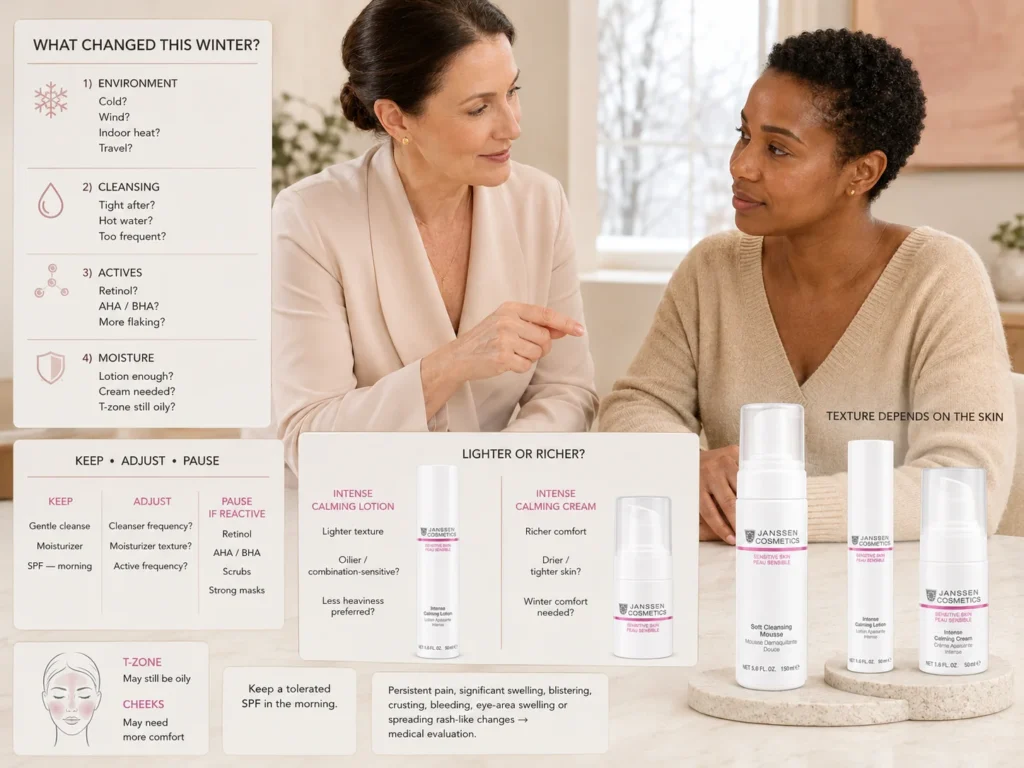
Possible sensitive-skin options may include:
These products are possible options, not one automatic winter routine.
A dry-sensitive complexion may prefer Intense Calming Cream because it needs a richer texture.
An oily-sensitive or combination-sensitive complexion may prefer Intense Calming Lotion because it wants comfort without a heavier feel.
The moisturizer should be selected according to skin type, climate, current dryness, layering habits, and product tolerance.
A tonic, serum, eye product, or mask should not be added simply because the season changed.
Each step should have a clear purpose.
If winter sensitivity includes burning from moisturizer, SPF stinging, flaking, heat, or active irritation, retinol, AHA, BHA, enzyme exfoliation, and other strong active options should wait.
Professional exfoliation systems belong in professional treatment settings and should not be copied as home winter routines.
Do not use very hot water because the weather is cold.
Do not take long hot showers and immediately apply strong active products.
Do not cleanse repeatedly because the face looks shiny.
Do not treat a squeaky-clean feeling as the goal.
Do not use a facial brush or rough washcloth on flaky skin.
Do not assume every winter routine needs double cleansing.
Do not scrub away winter flakes.
Do not increase AHA or BHA because the skin looks rough.
Do not use acid toner, BHA serum, retinol, and facial scrub in the same routine.
Do not continue retinol through persistent burning.
Do not assume a rich cream is best for every sensitive complexion.
Do not skip moisturizer because the T-zone looks oily.
Do not apply several heavy layers automatically.
Do not apply undiluted essential oils to dry or cracked-looking winter skin.
Do not use fragrance-heavy products on skin that is already burning.
Do not stop SPF while continuing acids or retinol.
Do not apply strong products immediately after wind exposure, outdoor exercise, shaving, waxing, or professional exfoliation.
Do not introduce several new products during winter travel.
Do not rub the face with scarves, collars, or rough towels.
Do not apply facial acids or retinol close to irritated eyes, nostrils, or mouth corners.
Do not use professional peeling systems at home.
Do not ignore persistent pain, significant swelling, blistering, crusting, bleeding, eye-area symptoms, infection-looking changes, or worsening reactions.
Cold air, low humidity, indoor heating, wind, hot water, and seasonal routine habits may leave sensitive skin feeling drier, tighter, flakier, or more reactive.
Yes. Weather-stressed or dry skin may become less tolerant of products that felt comfortable during warmer months.
The skin may already be irritated from cold air, wind, strong cleansing, acids, retinol, or hot water. The moisturizer formula may also not suit the skin.
Yes. Weather-stressed or dry skin may become less tolerant of products that felt comfortable during warmer months.
The skin may already be irritated from cold air, wind, strong cleansing, acids, retinol, or hot water. The moisturizer formula may also not suit the skin.
The skin may already be irritated from cold air, wind, strong cleansing, acids, retinol, or hot water. The moisturizer formula may also not suit the skin.
Yes, oily-sensitive skin may still need moisturizer. A lightweight texture may support comfort without feeling too heavy.
Some sensitive skin may tolerate occasional exfoliation, but frequency may need to decrease. Exfoliation should pause when the skin is burning, flaky from irritation, swollen, or reacting to basic products.
Some sensitive skin may continue retinol with reduced frequency and appropriate moisturizer support. Retinol should pause if the skin burns, flakes painfully, feels hot, or reacts to basic products.
The skin may be oily and dehydrated, over-cleansed, over-exfoliated, or using a moisturizer that is too light.
Dryness, over-exfoliation, retinol use, cleanser strength, moisturizer texture, and makeup formula may all contribute.
Some people may do well with twice-daily gentle cleansing. Others may prefer a morning rinse and an evening cleanse. The decision depends on skin type, makeup, SPF, oiliness, an
Very hot water may increase tightness, dryness, warmth, and visible flushing. Lukewarm water is usually a more comfortable choice.
Yes. Daytime exposure can still occur during winter, including cloudy days, driving, travel, and time near windows.
The skin may be drier, over-exfoliated, using retinol too often, exposed to wind, or lacking enough moisturizer support. The sunscreen formula may also be involved.
Yes. Heated indoor air may reduce environmental humidity and make the skin feel tighter or drier.
A properly maintained humidifier may make the indoor environment more comfortable for some people. It does not replace a suitable skincare routine.
Wind may make the cheeks, nose, mouth area, and eye area feel dry, tight, or raw.
Facial oil is optional. It may feel useful for some dry-sensitive skin but heavy for oily-sensitive or combination-sensitive skin.
The skin may have lower tolerance because of cold air, low humidity, indoor heating, wind, hot water, or increased dryness.
Stop introducing new products, pause active ingredients, and return to the simplest tolerated cleanser, moisturizer, and SPF routine. Seek dermatologist guidance if basic products continue to cause significant discomfort.
See a dermatologist if winter irritation is persistent, painful, significantly swollen, blistering, crusting, bleeding, infection-looking, near the eyes, repeatedly returning, or not improving after products are stopped.
If your skin becomes tight, flaky, hot, or more reactive every winter, a free virtual consultation can help you adjust your routine without adding unnecessary products.
At Zendevie, we review your cleanser, moisturizer texture, SPF, exfoliation schedule, retinol use, indoor environment, wind exposure, fragrance, makeup, and seasonal reaction history before discussing winter product options.
The goal is not to build the heaviest routine.
The goal is to help your skin tolerate a simple seasonal foundation and add only the support it actually needs.

Zendevie is guided by Haby Diallo, a licensed esthetician with more than 20 years of professional skincare experience. Her approach is rooted in education, professional judgment, and personal care.
years of experience