


Why Over-Exfoliation Can Make Uneven Tone Look Worse
Exfoliation can be helpful when used carefully.
But over-exfoliation can make uneven-looking tone look worse.
When the skin is exfoliated too often, too strongly, or with too many active products at once, it may become tight, stingy, flaky, shiny but dull, sensitive, or patchy. Dark spot appearance may look more noticeable. Post-blemish marks may stand out more. Makeup may cling. SPF may sting. The face may look less even, even though the goal was to make it look smoother.
This is one of the most common brightening-support mistakes.
At Zendevie, we do not treat uneven-looking tone by automatically increasing exfoliation. In consultation, our licensed esthetician first looks at skin type, sensitivity, hydration, cleanser choice, SPF habits, product layering, active product use, post-blemish marks, dark spot appearance, and whether the skin is already over-exfoliated.
A more even-looking complexion needs consistency and protection.
Not irritation.
Quick Answer
Over-exfoliation can make uneven tone look worse because it can irritate the skin, create dryness, increase flaking, make the skin feel tight, and cause the complexion to look more patchy or sensitive.
Signs of over-exfoliation may include:
- Burning
- Stinging
- Tightness
- Flaking
- Skin feeling hot
- Moisturizer burning
- SPF stinging
- Makeup clinging
- Skin looking shiny but dull
- Uneven tone looking more noticeable
- Post-blemish marks standing out more
- Skin feeling raw or sensitive
If this happens, pause exfoliation and simplify the routine:
Morning: Mild cleanser → moisturizer → SPF
Evening: Mild cleanser → moisturizer
Exfoliation should only be reintroduced when the skin feels calm, stable, and comfortable.
What Over-Exfoliation Means
Over-exfoliation means the skin is receiving more exfoliating action than it can comfortably tolerate. Once the skin feels calm, review how to exfoliate uneven-looking skin safely before restarting.
This may happen from:
- Scrubs used too often
- Scrubs used too aggressively
- AHA used too often
- BHA used too often
- Exfoliating toners used daily without tolerance
- Exfoliating cleansers used with other active products
- Peeling products used too often
- Enzyme products used too frequently
- Retinol-style products combined with acids
- Brightening-support products layered with exfoliation
- Professional-strength products used at home
- Too many new active products at once
Over-exfoliation is not always obvious at first.
Sometimes the skin looks smooth briefly, then becomes more sensitive and patchy later.
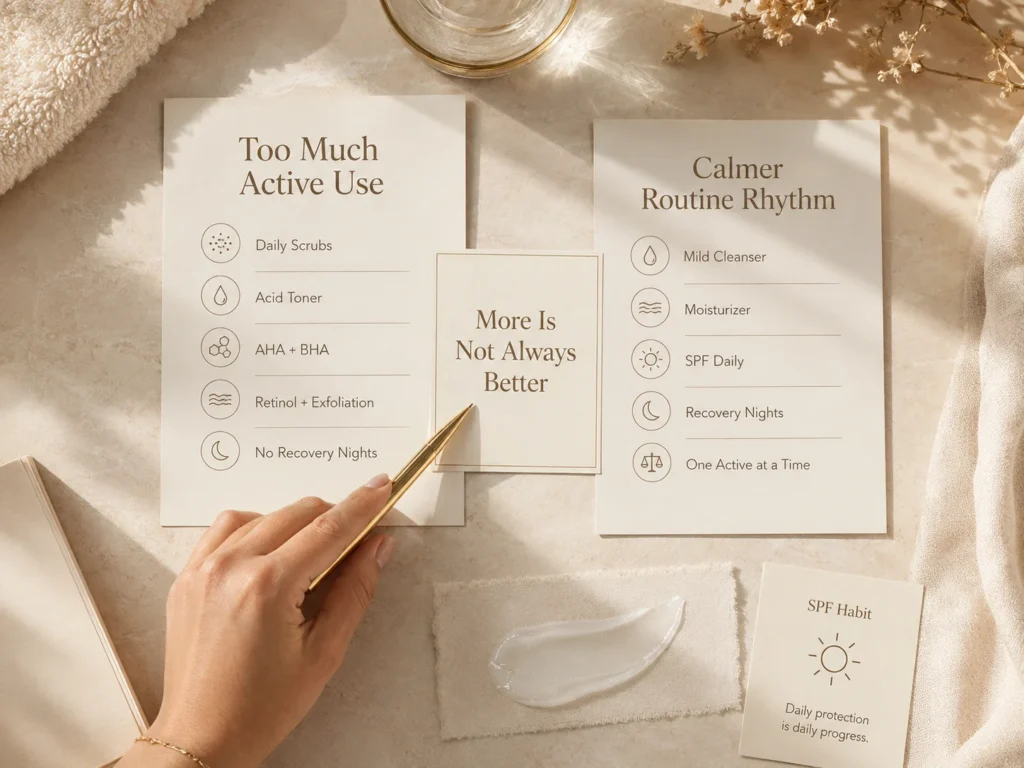
Why People Over-Exfoliate Uneven Tone
People often over-exfoliate because uneven-looking tone can feel frustrating.
When dark spot appearance, post-blemish marks, patchiness, or dull uneven skin does not improve quickly, it is tempting to do more.
More scrubbing.
More acids.
More brightening products.
More peeling.
More active nights.
But uneven tone is not something to force away.
If the skin becomes irritated, the complexion can look worse.
A brightening-support routine should be steady, protective, and tolerated well.
Dark Spots Are Not Dirt
Dark spot appearance is not dirt sitting on top of the skin.
It cannot be scrubbed away safely.
When people scrub dark spots aggressively, the surrounding skin may become irritated, dry, flaky, or sensitive. This can make the spot look even more noticeable by contrast.
A better approach includes:
- Daily SPF
- Gentle cleansing
- Moisturizer
- Hydration if needed
- Brightening-support products only when appropriate
- Gentle exfoliation only if needed and tolerated
- Patience
- Dermatologist guidance for changing or concerning marks
Dark spot appearance needs care.
Not pressure.
Post-Blemish Marks Should Not Be Scrubbed
Post-blemish marks can make people feel impatient.
But scrubbing them can irritate the skin and make the area look more noticeable.
Post-blemish marks may appear worse when:
- The area is picked
- The skin becomes dry
- Flakes form around the mark
- Makeup clings
- SPF stings or looks patchy
- The area is over-exfoliated
- Active products are used on freshly irritated skin
Post-blemish marks need SPF, low irritation, and time.
Do not apply exfoliation to broken, crusted, bleeding, or painful skin.
Why Over-Exfoliation Makes Skin Look Patchy
Over-exfoliation can make the complexion look patchy because irritated skin does not reflect light evenly.
The skin may look:
- Redness-looking
- Brownish-looking
- Purple-looking
- Shiny but dull
- Dry in some areas
- Oily in others
- Flaky
- Tight
- Rough under makeup
- More uneven than before
This can make someone think they need even more exfoliation.
But the skin may actually need a break.
Why Over-Exfoliation Makes Dark Spots Stand Out
When the surrounding skin becomes irritated or flaky, dark spot appearance may stand out more.
This can happen because over-exfoliated skin may create:
- More surface dryness
- More contrast around marks
- Makeup clinging around spots
- SPF patchiness
- Redness-looking areas
- Uneven texture
- A less smooth finish
The spot itself may not be the only issue.
The surrounding skin may be stressed.
Why Over-Exfoliation Makes Post-Blemish Marks Stand Out
Post-blemish marks may look more noticeable when exfoliation is too aggressive.
This is especially true if the mark is recent or the skin was picked.
Over-exfoliation may make the area:
- Dry
- Flaky
- Sensitive
- More patchy
- More visible under makeup
- More reactive to SPF
- More irritated-looking
A post-blemish mark routine should never feel harsh.
It should protect and support the skin while the appearance changes slowly.
Why Over-Exfoliation Can Make Skin Look Dull
Over-exfoliated skin can look shiny but dull.
This happens when the surface looks tight or reflective, but the skin does not look healthy, fresh, or comfortable.
The skin may look:
- Shiny
- Tight
- Flat
- Patchy
- Tired
- Less smooth
- More reactive
- Less radiant
- Flaky around marks
True radiance should not come from rawness.
Fresh-looking skin should feel comfortable.
Why Over-Exfoliation Can Make Skin Feel Sensitive
Over-exfoliation can make skin more reactive.
Products that used to feel fine may suddenly sting.
This can include:
- Moisturizer
- SPF
- Cleanser
- Serum
- Makeup
- Toner
- Eye-area products
When basic products sting, the routine is likely too strong.
Pause exfoliation and active products before adding more.
Why SPF May Sting After Over-Exfoliation
SPF is essential for uneven tone, but over-exfoliated skin may sting when SPF is applied.
This does not mean SPF should be removed from the routine.
It may mean the skin underneath needs calming and simplification.
Review whether the routine includes:
- AHA
- BHA
- Scrubs
- Retinol-style products
- Strong vitamin C
- Exfoliating toner
- Harsh cleanser
- Peeling products
- Too many active products
The routine should support SPF comfort.
Why Makeup Looks Worse After Over-Exfoliation
Over-exfoliation can make makeup look patchy.
Foundation may:
- Cling to flakes
- Settle around marks
- Separate on irritated skin
- Look heavy
- Emphasize texture
- Make dark spot appearance stand out
- Make post-blemish marks look more visible
- Look dry by midday
If makeup looks worse after exfoliating, the skin may need recovery.
Not more exfoliation.
How Over-Exfoliation Happens Without Realizing It
Many people do not realize how many exfoliating steps they are using.
For example, one routine may include:
- Exfoliating cleanser
- Acid toner
- Vitamin C serum
- AHA serum
- BHA serum
- Retinol-style product
- Scrub
- Clay mask
- Brightening cream
- Peeling mask
Even if each product seems reasonable alone, the total routine may be too much.
The skin responds to the full routine.
Not just one product.
Exfoliating Cleansers Can Add Up
An exfoliating cleanser can contribute to over-exfoliation, especially when used with other active products.
Be careful if your routine includes:
- Exfoliating cleanser
- AHA toner
- BHA serum
- Scrub
- Retinol-style product
- Brightening-support serum
- Peeling product
If the skin is uneven-looking and sensitive, a non-exfoliating cleanser may be more appropriate until the skin feels stable.
Exfoliating Toners Can Add Up
Exfoliating toners can be easy to overuse because they feel light.
But they can still affect the skin.
A toner may be too much if the skin is already using:
- AHA
- BHA
- Retinol-style products
- Scrubs
- Peeling products
- Strong vitamin C
- Exfoliating cleanser
A toner should not leave the skin burning, tight, or raw.
Scrubs Can Be Too Aggressive
Scrubs can irritate uneven-looking skin if they are rough, used too often, or applied with too much pressure.
Scrubs should be avoided if the skin is:
- Sensitive
- Burning
- Stinging
- Tight
- Flaky
- Rash-like
- Freshly picked
- Broken
- Crusted
- Bleeding
- Painful
Scrubbing dark spots or post-blemish marks can make the area look worse.
AHA Can Be Overused
AHA may support the look of smoother skin when used correctly.
But AHA can be too much if used too often or combined with other exfoliating products.
AHA may be too much if the skin becomes:
- Tight
- Stingy
- Flaky
- Shiny but uncomfortable
- Patchy
- Sensitive to SPF
- Sensitive to moisturizer
- Less smooth under makeup
AHA should not be used as a daily solution for every uneven tone concern.
BHA Can Be Overused
BHA may be helpful for oily skin with clogged-looking pores, blackheads, whiteheads, or T-zone buildup.
But BHA is not needed for every uneven-tone routine.
BHA can be too much if the skin is:
- Dry
- Tight
- Flaky
- Sensitive
- Burning
- Over-exfoliated
- Reacting to SPF or moisturizer
Oily skin still needs moisturizer.
BHA should not be used to punish oil.
Retinol-Style Products Can Add to Exfoliation Stress
Retinol-style products are not the same as exfoliating acids, but they can still make the skin more sensitive when used too often or combined with acids and scrubs.
Be careful combining retinol-style products with:
- AHA
- BHA
- Exfoliating toners
- Scrubs
- Peeling products
- Strong vitamin C
- Multiple brightening-support products
If the skin becomes flaky, tight, or patchy, the routine may be too active.
Brightening Products Can Become Too Much
Brightening-support products are often used for uneven-looking tone.
But they can become too much when layered with exfoliation, vitamin C, acids, and retinol-style products.
The skin may become:
- Irritated
- Dry
- Stinging
- More patchy
- More sensitive
- Less even-looking
- More reactive under SPF
Brightening support should be purposeful.
Not stacked without a plan.
Professional-Only Products Should Not Be Used at Home
Professional exfoliation systems and professional-strength products belong in professional treatment settings.
They should not be treated as home-use routine steps.
Using professional-level exfoliation without guidance can increase irritation risk and make uneven-looking tone appear worse.
Home routines should be built around consistency, SPF, and skin comfort.
Professional treatments require professional judgment.
Signs You Are Over-Exfoliating Uneven Tone
You may be over-exfoliating if your skin shows:
- Burning
- Stinging
- Tightness
- Flaking
- Shiny but dull appearance
- Redness-looking areas
- Increased sensitivity
- Makeup clinging
- SPF stinging
- Moisturizer burning
- Skin feeling hot
- Skin feeling raw
- Uneven tone looking more noticeable
- Dark spot appearance standing out more
- Post-blemish marks looking stronger
These signs mean the routine should slow down.
Signs Your Skin Needs a Break
Your skin may need a break from exfoliation if:
- It feels uncomfortable after cleansing
- Moisturizer stings
- SPF burns
- Makeup looks worse
- Flakes appear
- Skin feels tight but shiny
- Marks look more obvious
- You are using several active products
- You recently introduced a new product
- You are exfoliating several times per week without tolerance
- You are using acids and retinol-style products together
A break does not mean failure.
It means the skin needs support.
What to Pause First
If you suspect over-exfoliation, pause:
- Scrubs
- AHA
- BHA
- Exfoliating toners
- Exfoliating cleansers
- Peeling products
- Strong vitamin C if stinging
- Retinol-style products
- Clay masks if skin feels tight
- Brightening-support products if they sting
- Professional-strength products
Return to basics while the skin calms.
Simple Reset Routine for Over-Exfoliated Uneven Skin
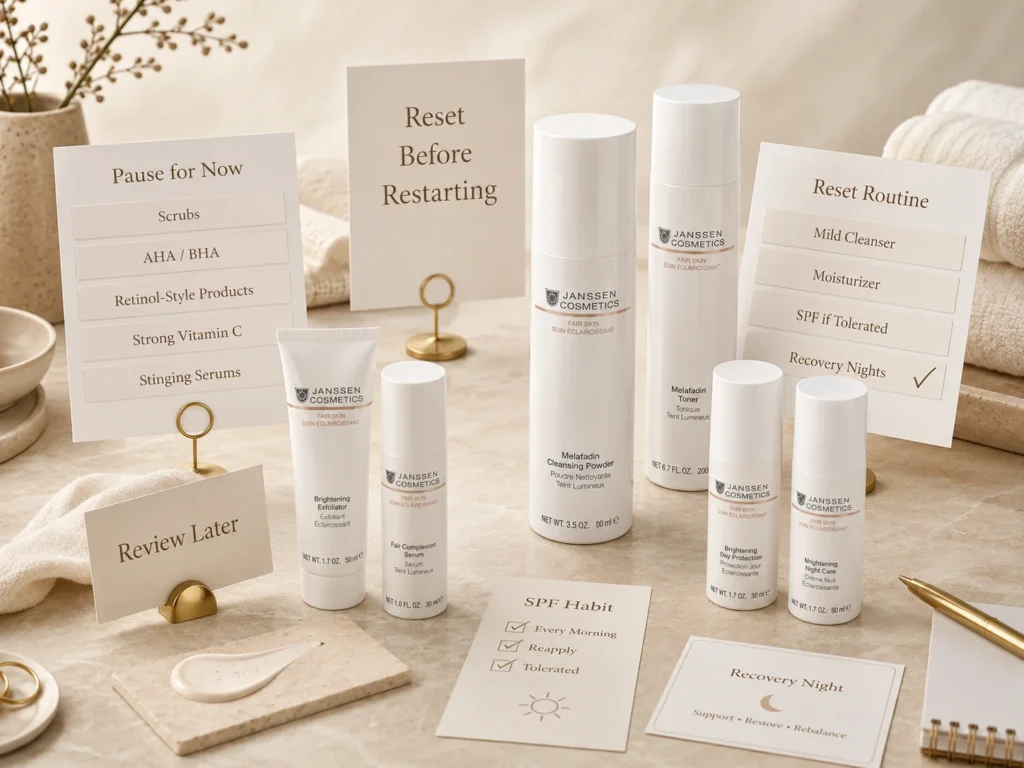
A simple reset routine may look like:
Morning: Mild cleanser → moisturizer → SPF if tolerated
Evening: Mild cleanser → moisturizer
If the skin feels dehydrated and can tolerate it:
Add gentle hydration support.
Avoid testing new products during the reset.
The goal is to make the skin feel comfortable again before tone support continues.
What Not to Do During a Reset
During a reset, avoid:
- Scrubbing flakes
- Using acids
- Using retinol-style products
- Trying a new brightening serum
- Applying active products to irritated skin
- Using hot water
- Using rough towels
- Picking marks
- Applying makeup over broken skin
- Using professional-only products
- Expecting the skin to recover overnight
Give the skin time.
Comfort comes first.
How Long Should You Pause Exfoliation?
There is no universal timeline.
The skin may need a few days or longer depending on how irritated it feels.
Do not reintroduce exfoliation until:
- Moisturizer feels comfortable
- SPF feels comfortable
- Skin is not burning
- Skin is not stinging
- Flaking is reduced
- Skin is not rash-like
- Makeup sits better
- The skin feels calmer
If symptoms persist, worsen, or look medical, seek dermatologist guidance.
How to Reintroduce Exfoliation Safely
When the skin feels stable, exfoliation may be reintroduced carefully.
Start with:
- One exfoliating product only
- Low frequency
- No scrubbing pressure
- No active stacking
- Moisturizer afterward
- SPF every morning
- Recovery nights
- Careful observation
If the skin becomes tight, flaky, or stingy again, pause.
The goal is support, not intensity.
How Often Should Uneven Skin Tone Exfoliate?
There is no one correct schedule.
Some skin may tolerate occasional exfoliation.
Sensitive skin may need very little.
Dry skin may need comfort first.
Oily skin may need targeted BHA only when appropriate.
Mature skin may need gentle support only when tolerated.
A safe starting point is to exfoliate less often than you think, then adjust based on tolerance.
Exfoliation Is Not the First Step for Everyone
Exfoliation is not always the first step in an uneven-tone routine.
Some skin needs:
- SPF first
- Hydration first
- Moisturizer first
- Cleanser change first
- Calming support first
- Less product layering first
- Dermatologist evaluation first
If the skin is already irritated, exfoliation should wait.
SPF Is More Important Than More Exfoliation
For uneven-looking tone, SPF is essential.
If dark spot appearance or post-blemish marks are present, daily SPF matters more than adding another exfoliation step.
A simple routine may look like:
Morning: Gentle cleanser → moisturizer → SPF
or:
Morning: Gentle cleanser → brightening-support serum if appropriate → moisturizer → SPF
Exfoliation without SPF is not a complete tone-support routine.
Hydration Can Make Skin Look Smoother Without Exfoliation
Sometimes uneven-looking tone appears worse because the skin is dehydrated.
Hydration support may help skin look:
- Less flat
- Less tight
- Smoother
- Fresher
- More comfortable under SPF
- Better under makeup
- Less patchy by evening
Hydration is not a replacement for tone support, but it can improve the look of the overall complexion.
Moisturizer Can Reduce the Look of Patchiness
Moisturizer helps the skin feel supported and less tight.
When skin is moisturized properly, it may look:
- Smoother
- Softer
- Less flaky
- Less patchy
- More balanced
- Better under makeup
- Better under SPF
If the skin is over-exfoliated, moisturizer is essential.
Do not skip it because you want a brighter-looking result.
Gentle Cleansing Matters During Recovery
A harsh cleanser can keep over-exfoliated skin irritated.
During recovery, choose a mild cleanser that does not leave the skin tight.
Avoid:
- Squeaky-clean feeling
- Harsh foaming if it strips the skin
- Hot water
- Rough towels
- Double cleansing too aggressively
- Exfoliating cleanser
Cleansing should leave the skin calm and comfortable.
Over-Exfoliation and Dry Skin
Dry skin is more likely to look worse with over-exfoliation.
Dry over-exfoliated skin may show:
- Flakes
- Tightness
- Burning
- Makeup clinging
- SPF patchiness
- Dark spots looking stronger
- Rough cheeks
- Around-mouth dryness
- Fine dryness lines
Dry skin needs comfort before exfoliation.
Over-Exfoliation and Sensitive Skin
Sensitive skin can become very patchy with over-exfoliation.
Sensitive over-exfoliated skin may show:
- Stinging
- Burning
- Redness-looking areas
- Hot feeling
- Rash-like patches
- Moisturizer burning
- SPF discomfort
- Makeup irritation
- More visible marks
Sensitive skin may need a longer reset and professional guidance.
Over-Exfoliation and Oily Skin
Oily skin can also be over-exfoliated.
This may look like:
- Skin feels oily but tight
- Shine returns quickly
- Skin feels stripped after cleansing
- T-zone looks shiny but dull
- Makeup separates
- Post-blemish marks look more visible
- BHA stings
- Moisturizer feels uncomfortable
Oily skin should not be treated harshly.
Balance matters.
Over-Exfoliation and Combination Skin
Combination skin may become uneven when the entire face is exfoliated the same way.
The T-zone may tolerate more than the cheeks.
The cheeks may become dry or irritated.
The mouth area may become flaky.
The forehead may feel oily but tight.
Combination skin needs zone awareness.
Do not treat every area the same.
Over-Exfoliation and Mature Skin
Mature skin can look less fresh when over-exfoliated.
It may show:
- Dryness
- Tightness
- Makeup settling
- Fine lines looking more visible
- Dark spot appearance standing out more
- Neck and décolleté sensitivity
- Less smooth finish
- Eye-area irritation
Mature skin needs gentle support, hydration, comfort, and SPF.
Aggressive exfoliation can make the skin look more tired.
Over-Exfoliation Around the Mouth
The area around the mouth can become easily irritated.
Over-exfoliation around the mouth may cause:
- Dryness
- Flaking
- Tightness
- Patchiness
- Burning
- Makeup clinging
- Uneven tone looking more visible
- Discomfort with lip products
Avoid strong acids, scrubs, and retinol-style products too close to the mouth if the area reacts.
Over-Exfoliation on the Forehead
The forehead may become over-exfoliated from active cleansers, acid toners, BHA, scrubs, and retinol-style products.
Signs include:
- Tight shine
- Flakes near the hairline
- Stinging
- SPF discomfort
- Makeup patchiness
- Post-blemish marks looking stronger
- Skin feeling oily but tight
The forehead may need a gentler routine and careful SPF placement.
Over-Exfoliation on the Neck and Décolleté
The neck and décolleté can be more delicate than the face.
Using strong facial exfoliants on these areas can cause irritation.
Signs of over-exfoliation may include:
- Redness-looking patches
- Tightness
- Itching
- Burning
- Dryness
- Patchiness
- SPF discomfort
- Fragrance sensitivity
These areas need gentle care and SPF when exposed.
Over-Exfoliation and Brightening Routines
Brightening routines can become too aggressive when they include too many active products.
A routine may be too much if it includes:
- Vitamin C in the morning
- AHA toner
- BHA serum
- Retinol-style product at night
- Scrub twice weekly
- Brightening cream
- Peeling mask
- No recovery nights
A more even-looking complexion needs routine rhythm.
Not constant active use.
Better Routine Rhythm for Uneven Tone
A balanced routine may include:
Most mornings: Gentle cleanser → moisturizer → SPF
Some mornings: Brightening-support serum if appropriate → moisturizer → SPF
Most evenings: Gentle cleanser → moisturizer
Occasional evenings: Gentle exfoliation only if needed and tolerated
Recovery nights: Gentle cleanser → moisturizer only
This rhythm helps reduce irritation.
It also makes it easier to see what the skin can tolerate.
Morning Routine After Over-Exfoliation
A simple morning routine may include:
Mild cleanser → moisturizer → SPF if tolerated
If skin feels very sensitive, avoid unnecessary layers.
If SPF stings, review the routine and seek guidance.
Do not add vitamin C or acids while the skin is burning, stinging, or raw.
Evening Routine After Over-Exfoliation
A simple evening routine may include:
Mild cleanser → moisturizer
If wearing makeup or SPF:
Remove gently without scrubbing.
Avoid:
- Exfoliating cleanser
- Scrub
- Acid toner
- Retinol-style product
- Brightening serum if it stings
- Peeling mask
The evening routine should help the skin feel settled.
Routine for Dry Over-Exfoliated Uneven Skin
Morning:
Mild cleanser → hydrating support if tolerated → moisturizer → SPF
Evening:
Mild cleanser → hydrating support if tolerated → moisturizer or cream
Avoid:
- Scrubs
- AHA
- BHA
- Strong vitamin C
- Retinol-style products
- Hot water
- Rough towels
- Active stacking
Dry over-exfoliated skin needs comfort first.
Routine for Sensitive Over-Exfoliated Uneven Skin
Morning:
Mild cleanser → moisturizer → SPF if tolerated
Evening:
Mild cleanser → moisturizer
Avoid all strong active products until the skin feels calm.
If the skin is rash-like, swollen, painful, crusted, bleeding, or worsening, seek dermatologist guidance.
Sensitive skin should not be pushed.
Routine for Oily Over-Exfoliated Uneven Skin
Morning:
Gentle cleanser → lightweight moisturizer → SPF
Evening:
Gentle cleanser → lightweight moisturizer
Avoid:
- Drying toner
- Daily BHA
- Scrubs
- Harsh cleanser
- Skipping moisturizer
- Picking blemishes
- Using multiple clarifying products
Oily over-exfoliated skin needs balance, not more stripping.
Routine for Post-Blemish Marks After Over-Exfoliation
Morning:
Mild cleanser → moisturizer → SPF
Evening:
Mild cleanser → moisturizer
Once the skin is stable:
Brightening-support products may be reviewed carefully.
Avoid:
- Picking
- Scrubbing marks
- Applying acids to freshly irritated areas
- Using brightening products on broken skin
- Expecting fast results
Post-blemish marks need low irritation.
Routine for Dark Spot Appearance After Over-Exfoliation
Morning:
Mild cleanser → moisturizer → SPF
Evening:
Mild cleanser → moisturizer
Once the skin feels comfortable:
A brightening-support product may be reviewed if appropriate.
Avoid:
- Scrubbing dark spots
- Applying actives to irritated skin
- Using several brightening products at once
- Skipping SPF
- Ignoring changing or unusual spots
Tone support should resume slowly.
When to Add Brightening-Support Products Again
Brightening-support products may be reintroduced when:
- Skin feels calm
- Skin is not burning
- Skin is not stinging
- Skin is not flaky from irritation
- Moisturizer feels comfortable
- SPF feels comfortable
- Skin is not rash-like
- The routine is stable
- SPF is used daily
Add only one product at a time.
Do not restart the entire brightening routine at once.
When to Add Exfoliation Again
Exfoliation may be reintroduced when:
- Skin is comfortable
- Moisturizer does not sting
- SPF does not sting
- Skin is not tight or raw
- Flaking has improved
- Skin is not rash-like
- The routine is simple and stable
- You know why exfoliation is needed
Start slowly.
If irritation returns, stop.
When to Avoid Exfoliation Completely
Avoid exfoliation if the skin has:
- Persistent burning
- Stinging
- Pain
- Swelling
- Rash-like irritation
- Crusting
- Bleeding
- Oozing
- Blistering
- Eye-area irritation
- Infection-looking areas
- Deep cracking
- Skin reacting to basic products
- A changing or concerning spot
These signs need caution and possibly medical evaluation.
When Professional Guidance Helps
Professional guidance may help if:
- You are unsure if you over-exfoliated
- Uneven tone looks worse after exfoliation
- Brightening products sting
- SPF burns
- Moisturizer stings
- Makeup clings after exfoliation
- Your skin is oily but tight
- Your skin is sensitive and patchy
- Post-blemish marks look stronger
- You use many active products
- You need help rebuilding a safe routine
A consultation can help decide what to pause, what to keep, and what to reintroduce later.
When to See a Dermatologist
A dermatologist should evaluate over-exfoliated-looking skin if there are warning signs such as:
- Persistent rash-like irritation
- Swelling
- Pain
- Severe itching
- Burning that does not settle
- Crusting
- Bleeding
- Oozing
- Infection-looking areas
- Blistering
- Eye-area irritation
- Sudden discoloration
- A spot changing in size, shape, or color
- A spot that looks very different from others
- Skin reacting strongly to basic products
- Rapid worsening
Cosmetic skincare can support appearance, but medical-looking changes need medical evaluation.
Where Janssen Cosmetics Fits
After consultation, our licensed esthetician may consider Janssen Cosmetics options depending on whether the skin is over-exfoliated, dry, sensitive, dehydrated, oily, uneven-looking, or in need of calming support before brightening support.
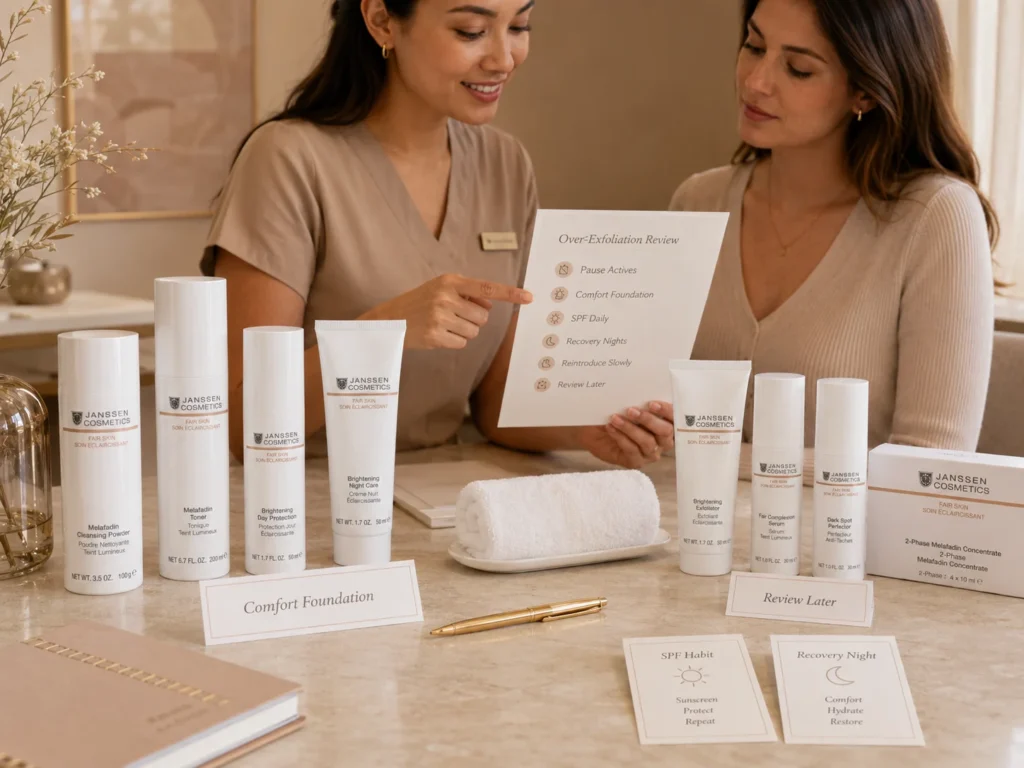
If the skin feels sensitive or overworked, comfort-focused options may come first, such as:
- Soft Cleansing Mousse when a gentle cleansing step is appropriate
- Soft Soothing Tonic when a calming tonic step fits
- Intense Calming Serum when calming support may be appropriate
- Intense Calming Cream or Intense Calming Lotion depending on texture needs
- Instant Soothing Mask when a comfort-focused mask may fit
For dry or dehydrated uneven-looking skin, possible options may include:
- Mild Creamy Cleanser
- Radiant Firming Tonic
- Deep Xpress Moist Serum
- Hydro Active Gel
- Super Hydrating Cream
- Hyaluron³ Replenish Cream
- Deep Xpress Hydro Mask
For uneven-looking tone and radiance support, options may be reviewed only when the skin is calm and stable, such as:
- Brightening Face Cleanser
- Brightening Face Freshener
- Magic Glow Serum
- Vitaforce C Skin Complex only if vitamin C support is appropriate and tolerated
- Vitaforce C Cream
- Sensational Glow Cream
For oily skin with clogged-looking pores or T-zone buildup, possible options may include:
- Purifying Cleansing Gel
- Purifying Tonic only if tolerated
- Light Mattifying Cream
- Purifying BHA Serum only when clogged-looking pores, blackheads, whiteheads, or T-zone buildup are present and the skin is stable enough
For exfoliation support, products such as Mild Face Rub, Enzyme Peeling Powder, Skin Refining Enzyme Peel, AHA + BHA Exfoliator, or Brightening Exfoliator should only be reviewed after skin type, sensitivity, SPF habits, current active use, and tolerance are understood.
Professional exfoliation systems should remain in professional treatment settings and should not be treated as home-use steps.
For morning routines, Face Guard Advanced SPF 30 may be considered as the final daytime protection step when appropriate and tolerated.
These are not automatic recommendations. If the skin is over-exfoliated, calming, hydration, moisturizer, and SPF comfort usually come before brightening-support products or exfoliation.
What Not to Do
Do not scrub dark spot appearance.
Do not exfoliate post-blemish marks aggressively.
Do not use acids on irritated skin.
Do not apply brightening-support products to broken, crusted, bleeding, or painful skin.
Do not combine AHA, BHA, scrubs, retinol-style products, and strong vitamin C blindly.
Do not use professional-only exfoliation products at home.
Do not skip moisturizer.
Do not skip SPF.
Do not keep using products that burn, sting, swell, itch severely, or make the skin look more patchy.
Do not ignore changing, sudden, bleeding, crusting, painful, or unusual marks.
Frequently Asked Questions
Can over-exfoliation make uneven tone worse?
Yes. Over-exfoliation can irritate the skin, create dryness, cause flaking, and make uneven-looking tone, dark spot appearance, and post-blemish marks look more noticeable.
What does over-exfoliated skin look like?
Over-exfoliated skin may look shiny but dull, tight, flaky, patchy, redness-looking, sensitive, or irritated. Moisturizer and SPF may sting.
Should I exfoliate dark spots?
Dark spot appearance should not be scrubbed aggressively. Exfoliation may support texture when appropriate, but dark spots need SPF, low irritation, and patience.
Can exfoliation help uneven tone?
Gentle exfoliation may help if rough surface buildup is part of the concern and the skin is stable. It should not be used on irritated, broken, or over-exfoliated skin.
How do I fix over-exfoliated-looking skin?
Pause exfoliation and strong active products. Use a simple routine with mild cleanser, moisturizer, and SPF if tolerated. Seek guidance if symptoms persist or worsen.
Why does SPF sting after exfoliation?
SPF may sting if the skin is irritated or over-exfoliated. Review exfoliation frequency and active products instead of skipping SPF entirely.
Can vitamin C make over-exfoliated skin worse?
Strong vitamin C may sting or irritate over-exfoliated skin. It may need to wait until the skin feels calm and stable.
How often should uneven skin tone exfoliate?
There is no universal schedule. Frequency depends on skin type, sensitivity, active product use, SPF habits, and tolerance.
Can oily skin be over-exfoliated?
Yes. Oily skin can feel oily but tight, stripped, sensitive, and patchy when over-exfoliated.
When should I see a dermatologist?
See a dermatologist if the skin has persistent rash-like irritation, swelling, pain, severe itching, burning that does not settle, crusting, bleeding, oozing, infection-looking areas, blistering, eye-area irritation, changing spots, or rapid worsening.
If uneven tone looks worse after exfoliation, your skin may not need a stronger product.
It may need a pause.
At Zendevie, a free virtual consultation helps us review your exfoliation habits, cleanser, moisturizer, SPF, vitamin C use, brightening-support products, sensitivity, hydration level, dark spot appearance, and post-blemish marks before recommending anything.
The goal is to support a more even-looking complexion without overwhelming the skin.

About the Esthetician Behind Zendevie
Zendevie is guided by Haby Diallo, a licensed esthetician with more than 20 years of professional skincare experience. Her approach is rooted in education, professional judgment, and personal care.
20+
years of experience