


Common Uneven Skin Tone Mistakes That Slow Progress
Uneven-looking tone can be frustrating because progress often feels slow.
You may be using a cleanser, serum, moisturizer, exfoliant, or brightening-support product and still feel like dark spot appearance, post-blemish marks, dull uneven skin, or patchy-looking tone are not improving the way you hoped.
Sometimes the issue is not that your skin needs more products.
Sometimes the issue is that small routine mistakes are making the skin look more irritated, dry, sensitive, patchy, or inconsistent.
At Zendevie, we do not look at uneven-looking tone as a reason to push the strongest products right away. In consultation, our licensed esthetician reviews SPF habits, cleanser choice, moisturizer, hydration, sensitivity, exfoliation, product layering, active product use, post-blemish marks, dark spot appearance, and whether the skin needs calming before brightening support.
A more even-looking complexion needs patience.
It also needs the right habits.
Quick Answer
Common uneven skin tone mistakes include skipping SPF, using brightening products without protection, over-exfoliating, scrubbing dark spots, picking blemishes, using too many active products, skipping moisturizer, changing products too quickly, ignoring sensitivity, and expecting overnight results.
The biggest mistakes include:
- Skipping daily SPF
- Using SPF only on sunny days
- Scrubbing dark spot appearance
- Picking blemishes
- Over-exfoliating
- Using too many active products together
- Using vitamin C on irritated skin
- Combining acids and retinol-style products blindly
- Skipping moisturizer
- Treating oily skin too harshly
- Ignoring dry or dehydrated skin
- Changing routines too often
- Expecting fast results
- Ignoring changing or concerning marks
A simple, safer routine often begins with:
Morning: Gentle cleanser → serum if appropriate → moisturizer → SPF
Evening: Gentle cleanser → moisturizer or targeted support if appropriate
Consistency matters more than intensity.
Mistake 1: Skipping SPF
Skipping SPF is one of the biggest mistakes in an uneven-tone routine.
Dark spot appearance, post-blemish marks, and sun-related unevenness appearance can look more noticeable when skin is exposed to daylight without consistent protection.
A brightening-support routine without SPF is incomplete.
Morning routine:
Cleanser → serum if appropriate → moisturizer → SPF
SPF should be the final morning skincare step before makeup.
Mistake 2: Using SPF Only on Sunny Days
Uneven-looking tone routines need daily consistency.
Many people use SPF only when it is hot, sunny, or beach weather.
But uneven-looking tone may still be affected by regular daylight exposure during errands, driving, travel, sitting near windows, or cloudy days.
SPF should become a daily habit, not an occasional step.
If SPF feels heavy, pills, or looks patchy, review the routine underneath.
Do not remove SPF from the routine.
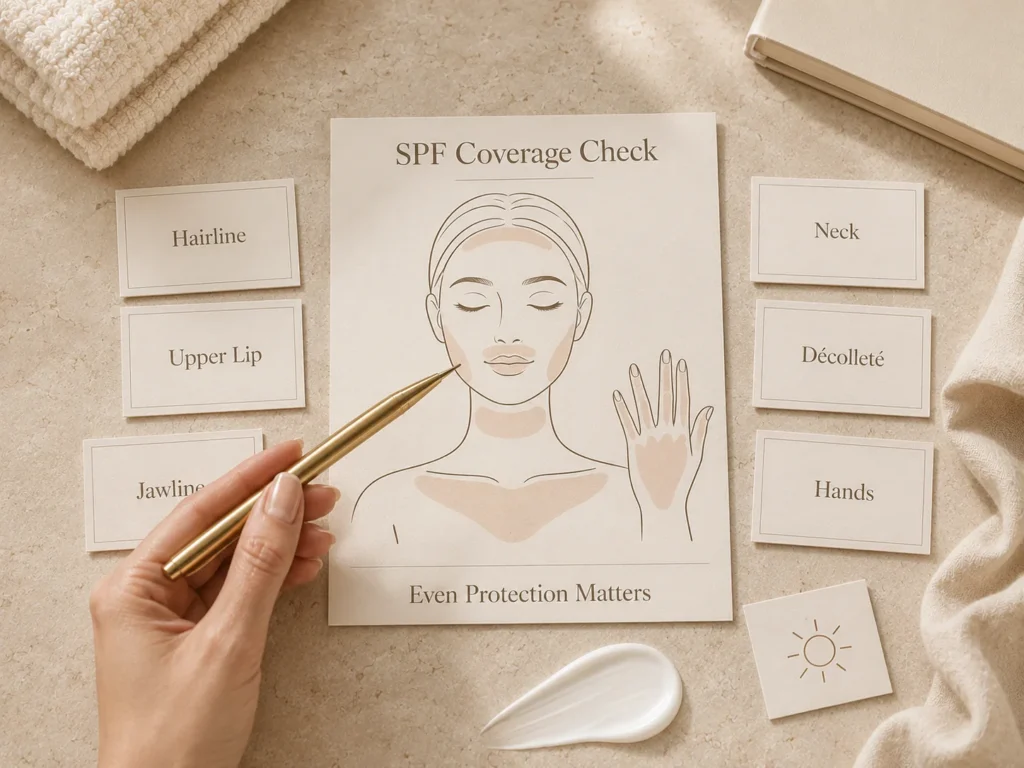
Mistake 3: Not Applying SPF Evenly
SPF gaps can make some areas look more uneven than others.
Common missed areas include:
- Hairline
- Around the mouth
- Upper lip
- Jawline
- Neck
- Décolleté
- Ears
- Hands when exposed
If SPF is applied unevenly, tone differences may become more noticeable over time.
A more even-looking complexion needs even protection.
Mistake 4: Using Brightening Products Without SPF
Brightening-support products should not be used without daytime protection.
If you use vitamin C, brightening-support serum, exfoliation, AHA, BHA, or retinol-style products, SPF is especially important.
Without SPF, the skin may keep receiving daylight exposure while you are trying to support a more even-looking complexion.
This can make progress feel slow.
Brightening support and SPF belong together.
Mistake 5: Scrubbing Dark Spots
Dark spot appearance is not dirt.
It cannot be safely scrubbed away.
Scrubbing can irritate the skin and make dark spot appearance look more noticeable because the surrounding skin becomes dry, flaky, or sensitive.
Instead of scrubbing, focus on:
- SPF
- Gentle cleansing
- Moisturizer
- Hydration if needed
- Brightening-support products if appropriate
- Low irritation
- Patience
- Dermatologist guidance for changing or concerning spots
The goal is support, not force.
Mistake 6: Picking Blemishes
Picking blemishes can make post-blemish mark appearance more noticeable.
When the skin is picked, squeezed, scratched, or irritated, the area may look more marked afterward.
Post-blemish marks often look worse when the skin is:
- Picked
- Scrubbed
- Dried out
- Over-exfoliated
- Exposed to sun without SPF
- Treated with strong actives too soon
Avoid picking as much as possible.
Post-blemish marks need low irritation and protection.
Mistake 7: Over-Exfoliating
Exfoliation can support smoother-looking skin when used carefully.
But over-exfoliation can make uneven-looking tone worse.
Signs of over-exfoliation include:
- Burning
- Stinging
- Tightness
- Flaking
- Skin feeling hot
- Moisturizer burning
- SPF stinging
- Makeup clinging
- Skin looking shiny but dull
- Tone looking more patchy
- Dark spot appearance standing out more
If this happens, pause exfoliation and simplify.

Mistake 8: Using Too Many Active Products Together
Many uneven-tone routines become too active.
A routine may include:
- Vitamin C
- Brightening-support serum
- AHA
- BHA
- Exfoliating toner
- Scrub
- Retinol-style product
- Peeling product
- Clay mask
- Strong cleanser
Used together, these products can overwhelm the skin.
More active products do not always mean faster visible improvement.
Sometimes they create irritation that makes the skin look more uneven.
Mistake 9: Using Strong Vitamin C on Irritated Skin
Vitamin C support may help some routines focused on radiance and a more even-looking complexion.
But vitamin C should not be forced onto irritated skin.
Vitamin C may need to wait if the skin is:
- Burning
- Stinging
- Flaky
- Rash-like
- Over-exfoliated
- Freshly picked
- Very dry
- Reacting to moisturizer
- Reacting to SPF
Radiance support should not hurt.
If vitamin C stings, the skin may need calming, hydration, or moisturizer first.
Mistake 10: Combining Acids and Retinol-Style Products Blindly
AHA, BHA, exfoliating toners, scrubs, and retinol-style products can be too much when combined without a plan.
This may lead to:
- Flaking
- Tightness
- Burning
- Patchiness
- More sensitivity
- Makeup clinging
- SPF discomfort
- Dark spot appearance looking stronger
If active products are used, they need structure and recovery nights.
Do not use every active product every night.
Mistake 11: Skipping Moisturizer
Some people skip moisturizer because they think uneven tone only needs brightening products.
But skipping moisturizer can make skin look dry, flaky, tight, and patchy.
Moisturizer helps skin feel:
- Softer
- More comfortable
- Less tight
- Less dry
- Better under SPF
- Better under makeup
- Less patchy-looking from dryness
Serum does not always replace moisturizer.
Even oily skin often needs a lightweight moisturizer.
Mistake 12: Treating Oily Skin Too Harshly
Oily uneven-looking skin should not be stripped.
Harsh cleansing, drying toner, too much BHA, and skipping moisturizer can make oily skin feel oily but tight.
Oily skin may become:
- Dehydrated
- Reactive
- Shiny but dull
- Patchy under makeup
- More marked after blemishes
- Uncomfortable under SPF
The goal is balance.
Not dryness.
Mistake 13: Ignoring Dryness
Dryness can make uneven-looking tone appear worse.
Dry skin may make dark spot appearance and post-blemish marks look more noticeable because the skin surface becomes rough or flaky.
Dryness can also make makeup and SPF look patchy.
If dryness is present, the routine may need:
- Gentle cleanser
- Hydration support
- Moisturizer
- SPF
- Less exfoliation
- Less hot water
- Fewer strong actives
Comfort should come before intensity.
Mistake 14: Ignoring Dehydration
Dehydrated skin can look dull, tight, flat, and patchy.
Some people mistake dehydration for uneven tone and start using stronger brightening products.
But dehydrated skin may need hydration first.
Signs of dehydration include:
- Tight feeling
- Oily but uncomfortable skin
- Fine dehydration lines
- Makeup creasing
- SPF looking uneven
- Dullness by evening
- Skin feeling less flexible
Hydration support can help the skin look fresher and more comfortable.
Mistake 15: Ignoring Sensitivity
Sensitive uneven-looking skin needs a gentle routine.
If the skin is already stinging, burning, hot, or rash-like, brightening-support products may need to wait.
Sensitive skin may look more uneven when irritated.
A sensitive routine may begin with:
Morning: Mild cleanser → moisturizer → SPF
Evening: Mild cleanser → moisturizer
Calming and hydration support may come before brightening support.
Mistake 16: Using Exfoliating Toner Every Day Too Soon
Exfoliating toner can be useful for some skin, but it can also be overused.
Using exfoliating toner every day before the skin is ready may cause:
- Tightness
- Flaking
- Burning
- Stinging
- Shiny but dull skin
- More patchiness
- SPF discomfort
- Makeup clinging
Exfoliating toner should be used carefully, especially if the routine already includes vitamin C, AHA, BHA, scrubs, or retinol-style products.
Mistake 17: Using a Harsh Cleanser
A harsh cleanser can make uneven-looking tone look worse.
If the cleanser strips the skin, moisturizer and SPF may not sit well.
Signs the cleanser may be too harsh include:
- Skin feels tight after cleansing
- Skin feels squeaky clean
- Moisturizer stings
- SPF stings
- Skin feels hot
- Cheeks look patchy
- Makeup clings
- Skin flakes by midday
A cleanser should leave skin clean and comfortable.
Mistake 18: Not Cleansing Properly at Night
Evening cleansing matters, especially if you wear SPF or makeup.
If SPF, makeup, oil, sweat, or residue stays on the skin, the complexion may look dull, coated, textured, or patchy.
Evening cleansing should remove the day without stripping the skin.
A simple evening routine:
Gentle cleanser → moisturizer
If wearing heavy makeup or SPF:
Makeup/SPF removal step if needed → gentle cleanser → moisturizer
Mistake 19: Changing Products Too Quickly
Uneven-looking tone routines need time.
Changing products too often can make it hard to know what is helping and what is irritating the skin.
Frequent product changes may cause:
- Sensitivity
- Breakouts
- Dryness
- Confusion
- Overlapping active ingredients
- More irritation
- Inconsistent SPF use
- Slower visible progress
Introduce one product at a time.
Give the routine enough time to be evaluated.
Mistake 20: Expecting Overnight Results
A more even-looking complexion usually needs patience.
Dark spot appearance, post-blemish marks, dull uneven skin, and patchiness do not always change quickly.
Visible progress depends on:
- SPF consistency
- Skin type
- Sensitivity
- Sun exposure
- Hydration
- Moisturizer use
- Product tolerance
- Picking habits
- Exfoliation habits
- Whether the concern needs dermatologist evaluation
A routine should avoid overnight promises.
Consistency matters.
Mistake 21: Using Products Because They Are Popular
A popular product is not automatically right for your skin.
A product may work well for someone else but irritate your skin.
Uneven-looking tone routines should consider:
- Skin type
- Sensitivity
- Dryness
- Oiliness
- Dehydration
- SPF habits
- Current products
- Post-blemish marks
- Dark spot appearance
- Product tolerance
Skincare should be personalized.
Not copied blindly.
Mistake 22: Not Knowing the Difference Between Dullness and Uneven Tone
Dullness and uneven tone can appear together, but they are not always the same.
Dullness may look like:
- Flat skin
- Tired-looking skin
- Less radiance
- Rough surface
- Product buildup
- Dehydration
Uneven tone may look like:
- Dark spot appearance
- Post-blemish marks
- Patchy-looking tone
- Around-mouth unevenness
- Forehead unevenness
- Neck and décolleté tone differences
If dullness is the main concern, hydration, cleansing, or gentle exfoliation may be reviewed before strong brightening support.
Mistake 23: Treating Every Patch as Hyperpigmentation
Not every uneven-looking area is hyperpigmentation.
Patchiness may come from:
- Dryness
- Dehydration
- Irritation
- Product buildup
- Makeup texture
- SPF pilling
- Sensitivity
- Over-exfoliation
- Oily and dry zones
- Dullness
Hyperpigmentation is a more clinical term and should not be self-diagnosed casually.
If a spot is changing, sudden, bleeding, crusting, painful, unusual, or worsening, dermatologist guidance should come first.
Mistake 24: Ignoring the Neck and Décolleté
Many people focus only on the face.
But the neck and décolleté can show uneven-looking tone from sun exposure, dryness, fragrance irritation, or skipped SPF.
Do not forget:
- Neck
- Décolleté
- Jawline
- Upper chest
- Hands when exposed
Use gentle care and SPF when exposed.
Avoid strong facial actives on the neck and décolleté without guidance.
Mistake 25: Applying Actives Too Close to Sensitive Areas
Some areas are more sensitive, especially:
- Around the mouth
- Corners of the nose
- Under the eyes
- Neck
- Décolleté
- Areas with dryness
- Areas with fresh post-blemish marks
Applying strong acids, vitamin C, retinol-style products, or brightening products too close to sensitive areas can cause irritation.
Irritation can make uneven tone look worse.
Mistake 26: Using Products on Broken or Picked Skin
Active products should not be applied to broken, crusted, bleeding, painful, or freshly picked skin.
This includes:
- Vitamin C
- AHA
- BHA
- Scrubs
- Exfoliating toners
- Retinol-style products
- Brightening-support serums
- Peeling products
Broken or irritated skin needs care, not active pressure.
If the area looks infected, painful, swollen, or worsening, seek medical guidance.
Mistake 27: Skipping Recovery Nights
Recovery nights help the skin stay balanced.
A recovery night may be:
Gentle cleanser → moisturizer
No acids.
No scrubs.
No retinol-style products.
No brightening-support serum.
No active stacking.
Recovery nights are important if your routine includes exfoliation, vitamin C, brightening support, BHA, AHA, or retinol-style products.
Mistake 28: Using Professional-Only Products at Home
Professional-only products should not be used as home routine steps.
Professional exfoliation systems, peels, and treatment products require professional judgment.
Using professional-strength products at home can increase irritation risk and make uneven-looking tone appear worse.
Home routines should focus on consistency, SPF, and appropriate support.
Professional treatment belongs in a professional setting.
Mistake 29: Not Reviewing Product Layering
Layering mistakes can slow progress and make the routine feel uncomfortable.
Common layering mistakes include:
- Applying SPF before moisturizer
- Mixing SPF into moisturizer or foundation
- Applying too much serum
- Not allowing layers to settle
- Using heavy cream under SPF that pills
- Applying active products in the wrong order
- Layering too many serums
- Using toner and serum combinations that irritate the skin
A good routine should feel smooth and wearable.
Mistake 30: Using Brightening Language the Wrong Way
This matters for safe skincare education.
Brightening should not mean whitening.
The goal is not to change natural skin color.
The goal is to support:
- A more even-looking complexion
- Radiance
- Freshness
- Less dull-looking skin
- A smoother-looking surface
- A more balanced-looking finish
Natural skin tone is not the problem.
Uneven-looking tone is the concern.
Mistake 31: Ignoring Makeup and SPF Texture
Sometimes uneven tone looks worse because makeup or SPF is not sitting well.
This can happen when:
- Skin is dry
- Skin is dehydrated
- Products pill
- SPF leaves a cast
- Makeup clings to patches
- Powder emphasizes texture
- Heavy layers collect around marks
- Skin is over-exfoliated
Before adding another active product, review the texture of the routine.
Mistake 32: Not Adjusting for Seasons
Skin can change with seasons.
Winter may bring dryness and flaking.
Summer may bring sweat, SPF buildup, oiliness, and more sun exposure.
Travel may bring dehydration and dullness.
A routine that works in one season may need adjustment later.
Uneven-looking tone routines should respond to the skin’s current condition.
Not only the original concern.
Mistake 33: Not Asking What the Skin Needs First
Before adding more products, ask:
- Is my skin protected with SPF?
- Is my cleanser too harsh?
- Is my skin dry?
- Is my skin dehydrated?
- Is my skin sensitive?
- Am I over-exfoliating?
- Am I picking blemishes?
- Am I using too many active products?
- Is makeup or SPF making the skin look patchy?
- Does this concern need dermatologist guidance?
The right answer depends on the skin.
Not the product trend.
Mistake 34: Not Seeking Dermatologist Guidance When Needed
Some marks should not be handled only with skincare.
A dermatologist should evaluate spots or patches that are:
- Changing in size, shape, or color
- Bleeding
- Crusting
- Painful
- Severely itchy
- Sudden
- Unusual
- Irregular-looking
- Rapidly worsening
- Different from other spots
- Paired with persistent rash-like irritation
- Swollen
- Infection-looking
- Blistering
- Near the eye area with irritation
Cosmetic skincare can support appearance.
It should not replace medical evaluation when warning signs are present.
How to Correct These Mistakes
Start by simplifying.
A simple routine may look like:
Morning:
Gentle cleanser → moisturizer → SPF
Evening:
Gentle cleanser → moisturizer
Once the skin feels stable, you can review one support step at a time:
- Hydration serum if dehydrated
- Calming serum if sensitive
- Brightening-support serum if uneven tone is the main concern
- Vitamin C support if radiance support is appropriate and tolerated
- BHA only if oily clogged-looking areas are present
- Gentle exfoliation only if rough buildup is present and skin is stable
Do not add everything at once.
Simple Routine for Uneven-Looking Tone
Morning:
Gentle cleanser → serum if appropriate → moisturizer → SPF
Evening:
Gentle cleanser → moisturizer or targeted support if appropriate
If the skin is sensitive or irritated:
Morning:
Mild cleanser → moisturizer → SPF
Evening:
Mild cleanser → moisturizer
If the skin is over-exfoliated, pause active products.
Routine for Dark Spot Appearance
Morning:
Gentle cleanser → brightening-support serum if appropriate → moisturizer → SPF
Evening:
Gentle cleanser → moisturizer or targeted support if appropriate
Avoid:
- Scrubbing dark spots
- Skipping SPF
- Using several brightening products together
- Applying actives to irritated skin
- Ignoring changing or unusual spots
Dark spot appearance needs protection and patience.
Routine for Post-Blemish Marks
Morning:
Gentle cleanser → serum if appropriate → moisturizer → SPF
Evening:
Gentle cleanser → moisturizer
Avoid:
- Picking
- Scrubbing marks
- Applying active products to broken skin
- Over-exfoliating
- Skipping SPF
Post-blemish marks often look worse when the skin is irritated.
Routine for Dry Uneven Skin
Morning:
Gentle cleanser → hydrating serum if needed → moisturizer → SPF
Evening:
Gentle cleanser → hydrating serum if needed → cream
Avoid:
- Harsh cleanser
- Hot water
- Strong exfoliation
- Brightening products on irritated skin
- Skipping moisturizer
Dry skin needs comfort before active support.
Routine for Oily Uneven Skin
Morning:
Gentle gel cleanser → lightweight moisturizer → SPF
Evening:
Gentle cleanser → lightweight moisturizer
Optional:
BHA only when clogged-looking pores, blackheads, whiteheads, or T-zone buildup are present and skin is stable
Avoid stripping and skipping moisturizer.
Oily skin still needs support.
Routine for Sensitive Uneven Skin
Morning:
Mild cleanser → moisturizer → SPF
Evening:
Mild cleanser → moisturizer
Optional later:
Calming or hydration support if tolerated
Brightening support should wait until the skin is calm.
Avoid active stacking.
Routine for Mature Uneven Skin
Morning:
Gentle cleanser → hydration or radiance-support serum if tolerated → moisturizer or cream → SPF
Evening:
Gentle cleanser → serum if appropriate → cream
Do not forget:
- Neck
- Décolleté
- Hands if exposed
Mature skin needs comfort, hydration, SPF, and patience.
When Professional Guidance Helps
Professional guidance may help if:
- You are using many products but seeing little progress
- Your skin looks more uneven after brightening products
- SPF stings or pills
- Moisturizer burns
- Vitamin C stings
- Exfoliation makes skin worse
- You have post-blemish marks and keep picking
- Your skin is oily but tight
- Your skin is dry and marked
- Your skin is sensitive and patchy
- You are unsure whether to simplify or add support
A consultation can help identify which mistake is slowing the routine down.
When to See a Dermatologist
A dermatologist should evaluate uneven-looking tone, marks, or irritation if there are warning signs such as:
- A spot changing in size, shape, or color
- Bleeding
- Crusting
- Pain
- Severe itching
- Sudden appearance
- Irregular-looking borders
- A spot that looks very different from others
- Rapid worsening
- Persistent rash-like irritation
- Swelling
- Infection-looking areas
- Eye-area irritation
- Skin reacting strongly to basic products
- Blistering
- Severe sunburn-looking changes
Cosmetic skincare can support appearance, but changing or concerning marks need medical evaluation.
Where Janssen Cosmetics Fits
After consultation, our licensed esthetician may consider Janssen Cosmetics options depending on which routine mistake is slowing progress.
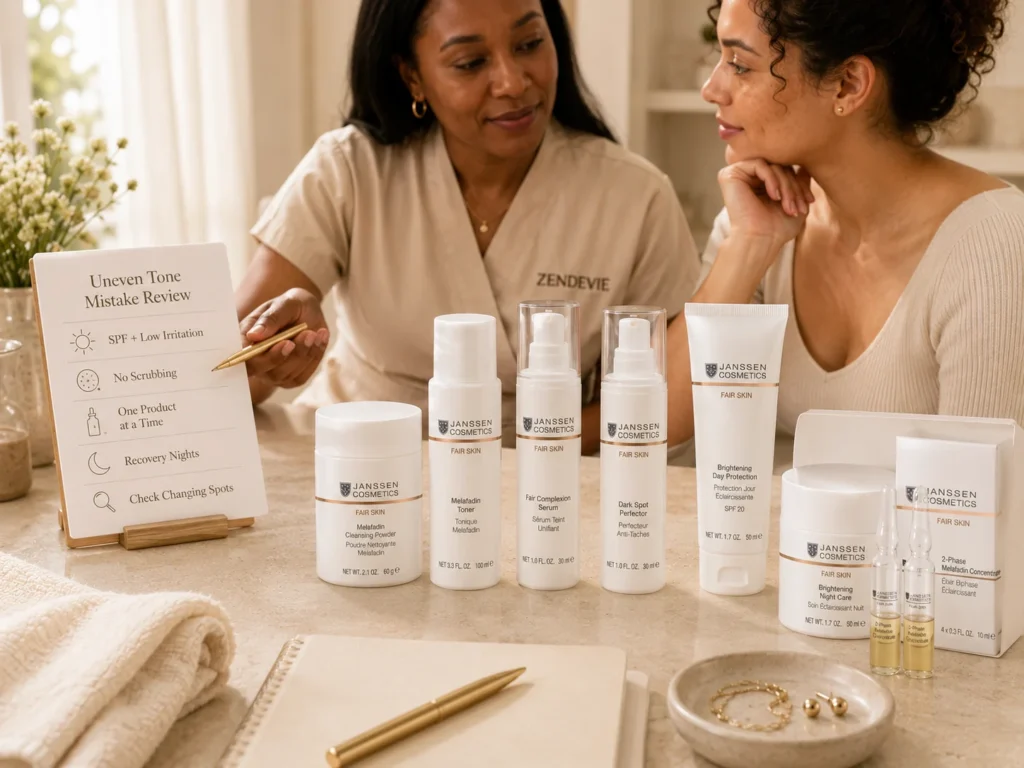
If the skin needs a more organized brightening-support routine, possible options may include:
- Brightening Face Cleanser when a fresh cleansing step fits tired-looking or uneven-looking skin
- Brightening Face Freshener when a freshening tonic step is appropriate
- Magic Glow Serum when glow and radiance support may fit
- Vitaforce C Skin Complex when vitamin C support is appropriate and tolerated
- Vitaforce C Cream when a radiance-focused cream may fit
- Sensational Glow Cream when a soft-focus fresh-looking finish is appropriate
If the skin is dry or dehydrated and uneven tone looks worse because of roughness or tightness, possible options may include:
- Mild Creamy Cleanser
- Radiant Firming Tonic
- Deep Xpress Moist Serum
- Hydro Active Gel
- Super Hydrating Cream
- Hyaluron³ Replenish Cream
- Deep Xpress Hydro Mask
If the skin is sensitive, irritated, or overworked, comfort-focused options may come first, such as:
- Soft Cleansing Mousse
- Soft Soothing Tonic
- Intense Calming Serum
- Intense Calming Cream or Intense Calming Lotion
- Instant Soothing Mask
If the skin is oily or has clogged-looking areas, possible options may include:
- Purifying Cleansing Gel
- Purifying Tonic only if tolerated
- Purifying BHA Serum only when clogged-looking pores, blackheads, whiteheads, or T-zone buildup are present and skin is stable enough
- Light Mattifying Cream
- Intense Clearing Mask when appropriate for oily areas
For exfoliation support, options should only be reviewed after tolerance and routine stability are understood, such as:
- Mild Face Rub
- Enzyme Peeling Powder
- Skin Refining Enzyme Peel
- AHA + BHA Exfoliator
- Brightening Exfoliator
For morning routines, Face Guard Advanced SPF 30 may be considered as the final daytime protection step when appropriate and tolerated.
These are not automatic recommendations. The correct routine depends on the mistake being made, the skin type, sensitivity, SPF habits, and whether the skin needs calming, hydration, brightening support, oil balance, or simplification first.
What Not to Do
Do not skip SPF.
Do not use brightening products without SPF.
Do not scrub dark spot appearance.
Do not pick post-blemish marks.
Do not over-exfoliate.
Do not layer every active product at once.
Do not use vitamin C on irritated skin.
Do not combine acids and retinol-style products blindly.
Do not skip moisturizer.
Do not strip oily skin.
Do not ignore dry, dehydrated, or sensitive skin.
Do not change products every few days.
Do not use professional-only products at home.
Do not apply active products to broken, crusted, bleeding, painful, or irritated skin.
Do not ignore changing, sudden, bleeding, crusting, painful, or unusual marks.
Frequently Asked Questions
What is the biggest mistake with uneven skin tone?
One of the biggest mistakes is skipping SPF. Brightening-support products are not enough if the skin is not protected during the day.
Can over-exfoliation make uneven tone worse?
Yes. Over-exfoliation can irritate the skin and make uneven-looking tone, dark spot appearance, and post-blemish marks look more noticeable.
Why are my dark spots not improving?
Dark spot appearance may look slow to improve if SPF is inconsistent, skin is irritated, products are too harsh, or the concern needs dermatologist evaluation.
Can picking blemishes cause post-blemish marks?
Picking can make post-blemish mark appearance more noticeable and may slow the look of recovery.
Should I use more brightening products for faster results?
Not necessarily. Using too many brightening products can irritate the skin and make uneven tone look worse.
Can dry skin make uneven tone look worse?
Yes. Dryness can make uneven-looking tone, dark spot appearance, and post-blemish marks look more noticeable because rough skin reflects light unevenly.
Can oily skin have uneven tone?
Yes. Oily skin can have dark spot appearance, post-blemish marks, dullness, clogged-looking areas, and patchiness. It still needs moisturizer and SPF.
How long does uneven tone take to improve in appearance?
There is no guaranteed timeline. The appearance of uneven tone depends on SPF consistency, skin type, sensitivity, product tolerance, sun exposure, and the type of concern.
Should I stop everything if my skin is irritated?
Pause active products and simplify to mild cleanser, moisturizer, and SPF if tolerated. Seek guidance if irritation persists or worsens.
When should I see a dermatologist?
See a dermatologist if a spot changes in size, shape, or color; bleeds; crusts; hurts; itches severely; appears suddenly; looks unusual; has irregular-looking borders; or worsens quickly.
If your uneven-tone routine feels slow, the answer may not be stronger products.
It may be better habits, better order, or fewer irritating steps.
At Zendevie, a free virtual consultation helps us review your cleanser, toner, serum, moisturizer, SPF, exfoliation habits, sensitivity, hydration level, dark spot appearance, post-blemish marks, and current routine before recommending anything.
The goal is to find what is slowing your progress.
Then support your skin with care, consistency, and the right routine.

About the Esthetician Behind Zendevie
Zendevie is guided by Haby Diallo, a licensed esthetician with more than 20 years of professional skincare experience. Her approach is rooted in education, professional judgment, and personal care.
20+
years of experience