

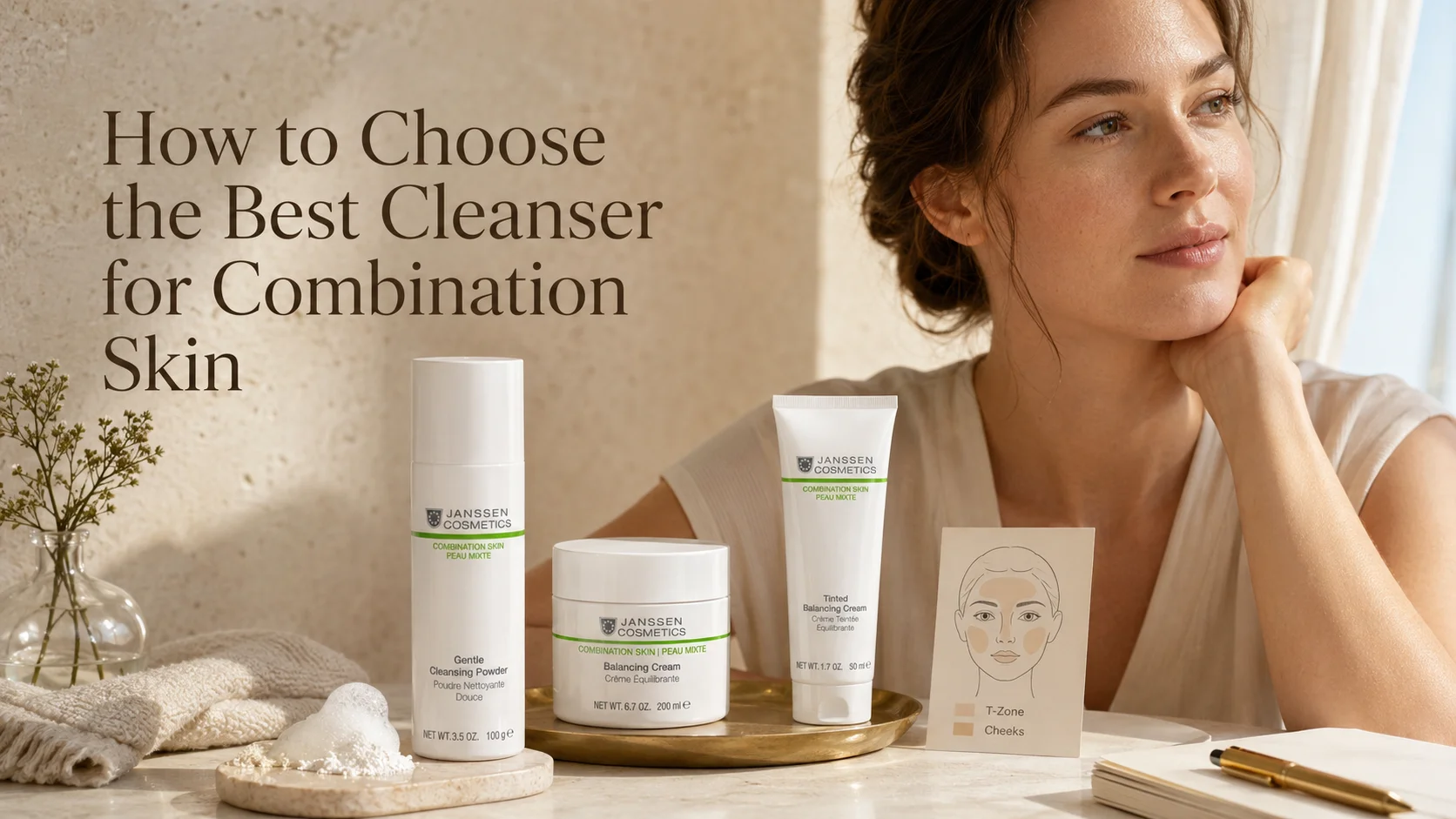
Choosing a cleanser for combination skin can be tricky.
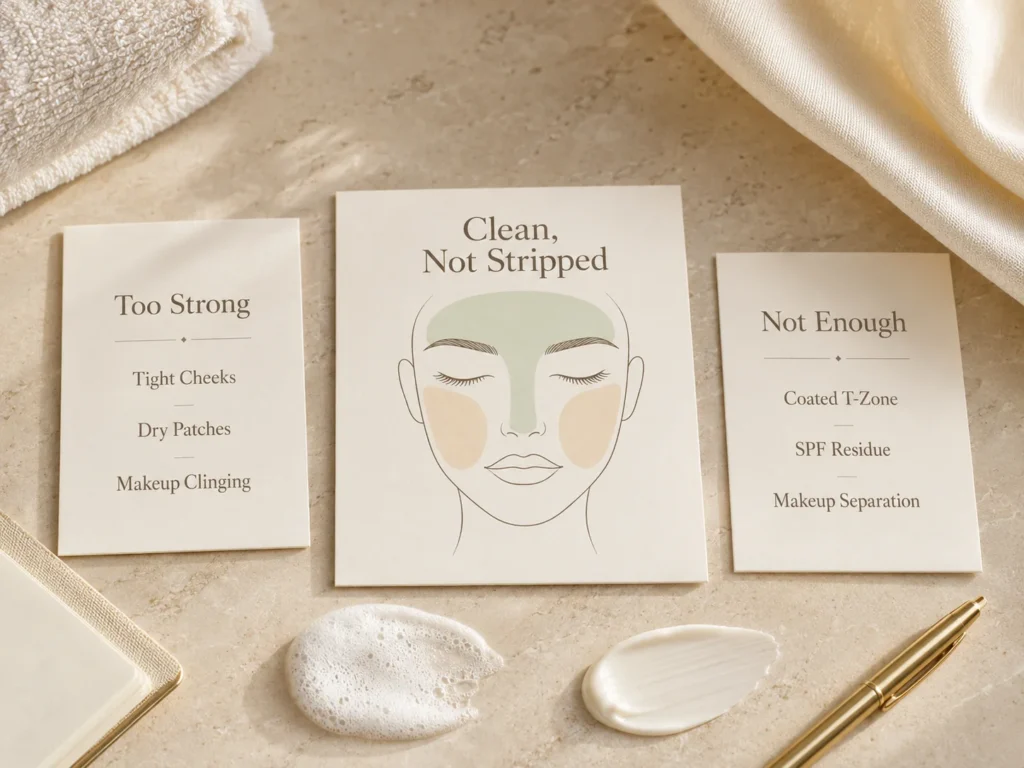
Your T-zone may feel oily, shiny, or heavy by midday. Your cheeks may feel dry, tight, normal, or sensitive. If the cleanser is too strong, the cheeks may feel stripped. If the cleanser is too rich or too gentle for your oilier areas, the T-zone may feel coated or not fully clean.
This is why combination skin should not choose a cleanser based on only one part of the face.
The cleanser needs to respect both zones.
At Zendevie, we do not recommend cleansers blindly. In consultation, our licensed esthetician reviews how your skin feels after washing, where oil appears, where dryness appears, whether the cheeks feel tight, whether the T-zone looks clogged, whether you wear makeup or SPF, and whether your current cleanser is helping or making balance harder.
The right cleanser should leave your skin clean.
Not tight.
Not greasy.
Not confused.
The best cleanser for combination skin is gentle enough for dry or normal cheeks but effective enough to remove oil, SPF, makeup, sweat, and residue from the T-zone.
Look for a cleanser that leaves skin feeling:
Avoid cleansers that make cheeks feel dry, moisturizer sting, or the T-zone feel oily but tight.
A simple routine may look like:
Morning: Gentle cleanser → lightweight moisturizer by zone → SPF
Evening: Gentle cleanser → moisturizer by zone
If wearing makeup or heavier SPF:
Makeup/SPF removal step if needed → gentle cleanser → moisturizer by zone
Cleanser is the first step.
If the cleanser is wrong, the rest of the routine becomes harder.
A harsh cleanser can make the cheeks feel tight and dry.
A cleanser that does not remove enough residue can leave the T-zone feeling heavy or clogged-looking.
A cleanser that leaves a film may make SPF or makeup pill.
A cleanser that strips too much may make the skin feel oily and dry at the same time.
For combination skin, cleanser should create balance.
It should not create a new problem.
Combination skin needs a cleanser that can remove the day without disturbing the skin too much.
A good cleanser should help remove:
But it should not make the cheeks feel uncomfortable.
The goal is clean and calm.
Not squeaky and tight.
The T-zone includes the forehead, nose, and chin.
This area may collect more oil, sweat, SPF, makeup, and residue.
If the T-zone is not cleansed well, it may look:
The cleanser should be effective enough for this area.
But it should still be gentle enough for the cheeks.
The cheeks may be dry, normal, or sensitive in combination skin.
If the cleanser is too strong, the cheeks may feel:
This is why strong oily-skin cleansers may not be the right choice for the whole face.
The cheeks should not feel punished because the nose is oily.
Many people think squeaky-clean skin means the cleanser is working.
For combination skin, that feeling may be a warning sign.
Squeaky-clean skin may mean the cleanser is removing too much.
Signs of over-cleansing include:
Combination skin should feel fresh after cleansing, not stripped.
Gentle does not mean ineffective.
A gentle cleanser can still remove oil, sweat, dirt, SPF, and residue when it is the right match.
The key is choosing a cleanser that cleans without harshness.
Combination skin often does well with cleansers that feel:
The cleanser should prepare the skin for moisturizer and SPF. The cleanser is only one part of learning how to balance combination skin without over-drying
It should not leave the skin desperate for comfort.
A gel cleanser may be helpful when the T-zone is oily or clogged-looking.
Gel textures can feel fresh and light.
They may be useful if the skin has:
But a gel cleanser should not make the cheeks tight.
If the gel cleanser strips the cheeks, it may need to be used differently, alternated, or replaced with a gentler option.
A creamy cleanser may be helpful when the cheeks are dry, tight, or uncomfortable.
Creamier textures may support comfort in dry areas.
They may be useful if the skin has:
But if a creamy cleanser leaves the T-zone feeling coated, it may not be the best whole-face option.
In some cases, cleanser choice or technique may need adjustment.
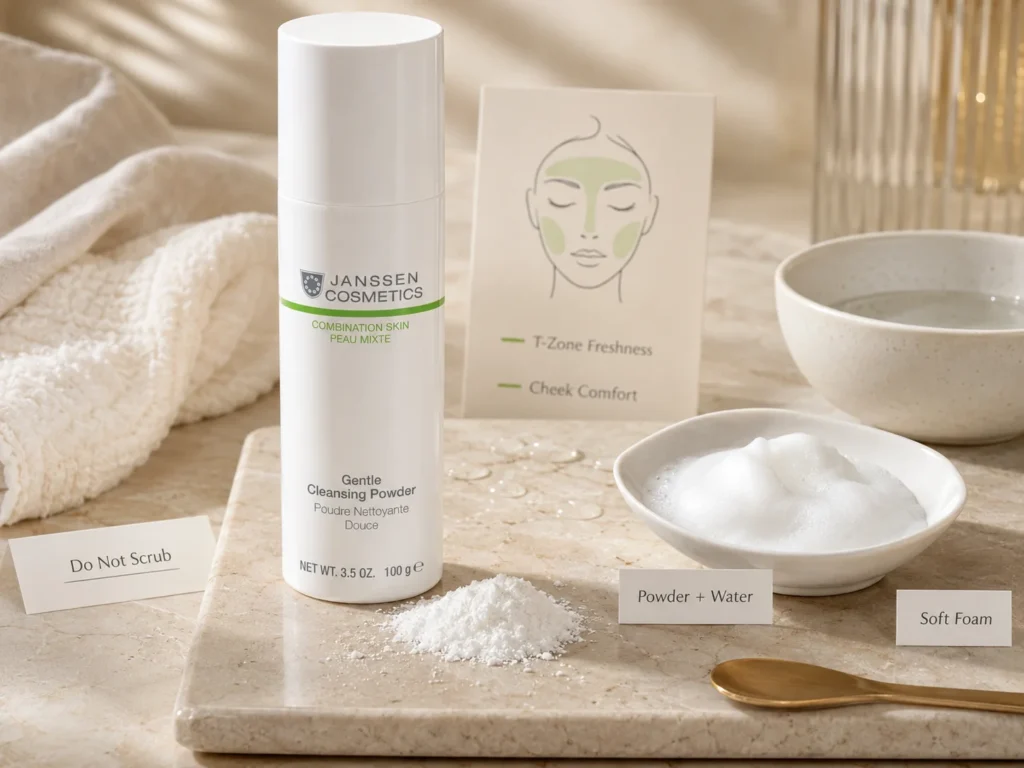
A powder cleanser may be helpful for combination skin when it is mild and balanced.
Powder cleansers can be mixed with water to create a light cleansing texture.
They may work well when the goal is:
The key is not to scrub aggressively.
A powder cleanser should be used gently.
Active cleansers may include ingredients such as acids or exfoliating support.
They may be useful in some oily or clogged-looking skin routines.
But combination skin should be careful.
An active cleanser may be too much if the cheeks are:
Active cleansers should not be chosen just because the T-zone is oily.
The full face response matters.
Double cleansing may help if you wear makeup, water-resistant SPF, heavy sunscreen, primer, or long-wear products.
A double cleanse may look like:
First cleanse: Remove makeup or SPF
Second cleanse: Gentle facial cleanser
But double cleansing should still be gentle.
If the cheeks feel tight afterward, the products may be too strong or the method may be too aggressive.
Double cleansing should remove residue without making dry zones uncomfortable.
Morning cleansing depends on how the skin feels.
Some people with combination skin prefer a gentle morning cleanse because the T-zone feels oily.
Others may need a softer cleanse or lighter approach because the cheeks feel dry.
A simple morning routine may be:
Gentle cleanser → lightweight moisturizer by zone → SPF
The morning cleanser should not leave the cheeks tight before the day even begins.
If morning cleansing makes the skin uncomfortable, the cleanser or frequency may need review.
Evening cleansing is very important.
During the day, the skin collects:
If this is not removed, the T-zone may look clogged or dull, and the cheeks may feel uneven under moisturizer.
A simple evening routine may be:
Gentle cleanser → moisturizer by zone
If wearing makeup or heavier SPF:
Makeup/SPF removal step if needed → gentle cleanser → moisturizer by zone
Your cleanser may be too harsh if:
A cleanser should not make the skin feel stressed.
Your cleanser may not be cleansing enough if:
This does not always mean you need a stronger cleanser.
You may need better evening cleansing, a makeup/SPF removal step, or a different texture.
To cleanse combination skin without drying the cheeks:
The cheeks should feel calm after cleansing.
Not tight.
To cleanse the T-zone properly:
The T-zone can be cleansed effectively without being stripped.
The nose may be oilier or more pore-visible.
Cleanse the nose gently but thoroughly.
Avoid:
If blackheads or clogged-looking pores are present, targeted support may be reviewed later.
Cleanser alone may not solve every clogged-looking concern.
The chin may be oily, blemish-prone, dry, or sensitive.
It can also develop post-blemish marks.
Cleanse the chin gently.
Avoid applying harsh cleanser repeatedly to the chin to dry it out.
If the chin has clogged-looking pores or blemish-prone areas, targeted support may be reviewed only when the skin is stable.
Do not apply active products to broken, crusted, bleeding, or freshly picked skin.
The cheeks need gentle care.
Avoid:
If the cheeks feel tight after washing, the cleanser may not be right for the full face.
Oily but tight skin may be dehydrated or over-cleansed.
If your T-zone is oily but your face feels tight, do not assume you need a stronger cleanser.
You may need:
Oil and dehydration can happen at the same time.
This is a classic combination skin pattern.
A good approach may include:
Morning: Gentle cleanser → lightweight moisturizer by zone → SPF
Evening: Gentle cleanser → moisturizer by zone
Use less moisturizer on the T-zone if it feels greasy.
Use more comfort on the cheeks if they feel tight.
Avoid strong cleanser everywhere.
If combination skin is sensitive, cleanser should be extra gentle.
Sensitive combination skin may react to:
A simple routine may be:
Morning: Mild cleanser → moisturizer → SPF
Evening: Mild cleanser → moisturizer
Active support should wait until the skin feels stable.
Makeup can behave differently on combination skin.
It may separate on the T-zone and cling to cheeks.
Evening cleansing should remove makeup without stripping.
A makeup-wearing routine may include:
Makeup removal step if needed → gentle cleanser → moisturizer by zone
Do not scrub makeup off the cheeks.
Do not leave makeup residue near the hairline, nose, or chin.
SPF is essential, but it should be removed at night.
If SPF remains on the skin, the T-zone may feel coated and the cheeks may look dull.
Evening cleansing should remove SPF residue gently.
If the SPF is heavy or water-resistant, a first removal step may be needed before cleanser.
Do not skip SPF because it is difficult to remove.
Adjust the cleansing method.
If the T-zone has clogged-looking pores, blackheads, whiteheads, or buildup, cleanser is important but may not be the only step.
A routine may include:
Gentle cleanser → lightweight moisturizer → SPF
Optional targeted support may be reviewed if the skin is stable.
This may include BHA for the T-zone only when appropriate.
Do not use a harsh cleanser to force pores to look smaller.
If cheeks are flaky, do not scrub them hard.
Flaking may be from dryness, over-exfoliation, sensitivity, or a cleanser that is too strong.
Support flaky cheeks with:
If flaking is rash-like, painful, swollen, crusting, or worsening, seek dermatologist guidance.
If combination skin feels coated, review what is building up.
Possible causes include:
The answer may be better cleansing, not harsher cleansing.
Evening removal matters.
Cleanser and toner are not the same step.
Cleanser removes oil, makeup, SPF, sweat, and residue.
Toner may help refresh and prepare the skin after cleansing, if tolerated.
Combination skin may use toner when it helps balance the skin, but it is not required for everyone.
If toner makes cheeks tight, skip it or review the formula.
The cleanser should still do the main cleansing work. The next question is whether combination skin should use toner, since that step is helpful only when it improves balance.
A cleanser should not leave the skin so dry that moisturizer has to rescue it.
Moisturizer supports comfort after cleansing.
For combination skin:
The routine works as a system.
SPF belongs in the morning.
Cleanser belongs in the evening to remove SPF residue.
A balanced SPF routine needs both:
Morning: Gentle cleanser → moisturizer → SPF
Evening: Gentle cleanser → moisturizer
If SPF feels heavy, review moisturizer and product layering.
If SPF leaves residue, review evening cleansing.
A cleanser cleans the skin.
Exfoliation removes surface buildup.
Some cleansers have active or exfoliating ingredients, but that does not mean every combination skin routine needs them.
If the skin is dry, sensitive, or over-exfoliated, keep cleanser simple.
Exfoliation should be added only when needed and tolerated.
A cleanser may help remove oil and residue.
BHA may support clogged-looking pores when appropriate.
Combination skin should not use BHA automatically.
BHA may be reviewed for:
But BHA should wait if the skin is irritated, dry, stinging, peeling, or over-exfoliated.
A cleanser is daily care.
A clay mask is an occasional support step when appropriate.
Combination skin may use a clay mask only on oily zones.
Do not use a clay mask to replace cleansing.
Do not use clay mask on dry cheeks if it makes them tight.
Cleanser should be the steady foundation.
There is no single best texture for everyone.
The best cleanser texture depends on the skin pattern.
Possible options include:
The best cleanser is the one that keeps both zones comfortable.
Be careful with cleansers that leave the skin feeling:
Also be careful with:
Comfort matters.
After cleansing, wait a moment and ask:
Your skin’s response tells you more than the label.
You may need to change your cleanser if:
Do not keep forcing a cleanser that your skin dislikes.
Do not change cleanser just because of one oily day.
Combination skin can change with:
Look for patterns.
If the cleanser usually works and the skin feels comfortable, you may only need a seasonal or zone adjustment.
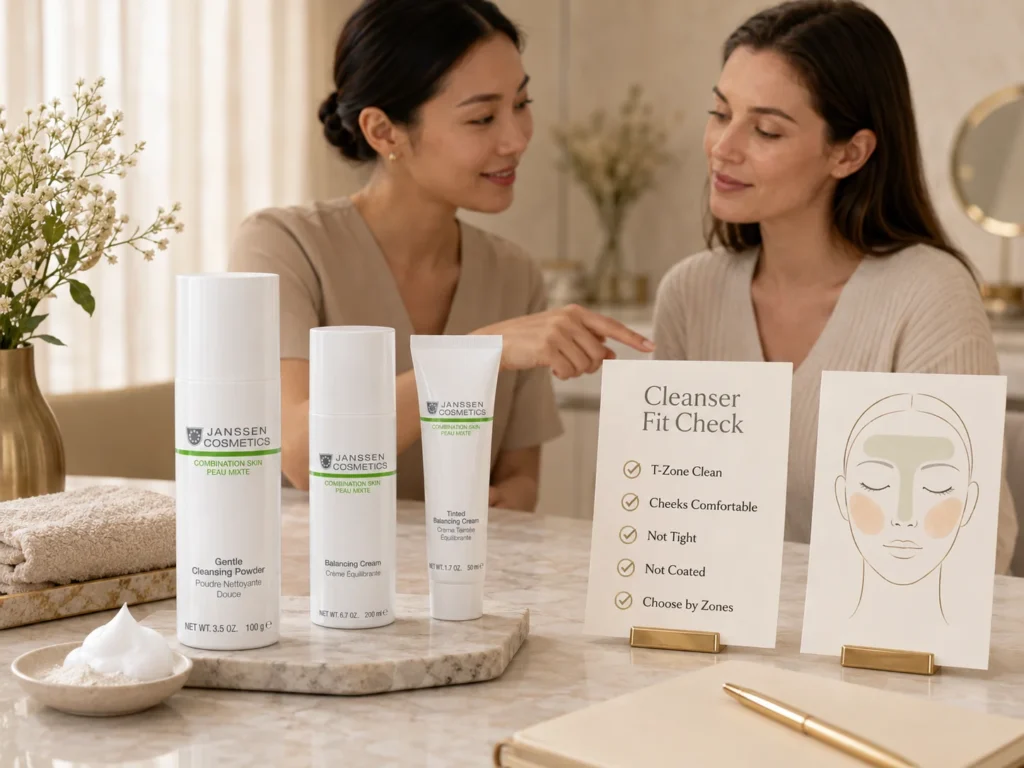
After consultation, our licensed esthetician may consider Janssen Cosmetics cleanser options depending on the skin’s zones, comfort level, sensitivity, and residue concerns.
For combination skin balance, possible options may include:
For oily T-zone support, possible options may include:
For dry or tight cheeks, possible options may include:
For sensitive or irritated-feeling cheeks, possible options may include:
For dull, tired-looking combination skin when the skin is stable, possible options may include:
For morning routines, Face Guard Advanced SPF 30 may be considered as the final daytime protection step when appropriate and tolerated.
These are not automatic recommendations. The cleanser should be chosen based on how the T-zone, cheeks, sensitivity, hydration, makeup use, and SPF use behave together.
Do not choose cleanser only for the oily T-zone.
Do not ignore tight cheeks.
Do not use harsh cleanser to make the skin feel squeaky.
Do not scrub the nose aggressively.
Do not use active cleanser too often if the cheeks are dry or sensitive.
Do not double cleanse harshly.
Do not skip moisturizer after cleansing.
Do not use hot water.
Do not apply toner that burns after cleansing.
Do not keep using a cleanser that makes moisturizer or SPF sting.
Do not apply active products to broken, crusted, bleeding, painful, or freshly picked skin.
Do not ignore persistent rash-like irritation, swelling, pain, severe itching, oozing, or worsening skin changes.
The best cleanser for combination skin removes oil, SPF, makeup, sweat, and residue without making dry or normal cheeks feel tight.
A gel cleanser may help oily T-zone areas, but it should not strip the cheeks.
A creamy cleanser may help dry or tight cheeks, but it should not leave the T-zone feeling coated.
A mild powder cleanser may work well for combination skin when it cleans the T-zone while keeping cheeks comfortable.
Double cleansing may help if you wear makeup, primer, or heavier SPF, but it should be gentle and should not leave cheeks tight.
Your cleanser may be too strong, too drying, or not the right match for your dry or sensitive zones.
The cleanser may not be removing residue well, or the skin may need better evening cleansing, lighter moisturizer, or targeted T-zone support.
Cleanser supports a clean routine, but clogged-looking pores may need targeted support when the skin is stable.
Only when appropriate and tolerated. Active cleansers can be too strong for dry or sensitive cheeks.
Combination skin should feel clean, fresh, and comfortable — not tight, squeaky, greasy, or coated.
If you are not sure which cleanser is right for your combination skin, start by listening to how your skin feels after washing.
Your cleanser should not make one zone better while making another zone worse.
At Zendevie, a free virtual consultation helps us review your T-zone, cheeks, cleanser texture, SPF use, makeup habits, sensitivity, dryness, hydration level, and current routine before recommending anything.
Combination skin needs a cleanser that respects the whole face.
Not just the oily part.

Zendevie is guided by Haby Diallo, a licensed esthetician with more than 20 years of professional skincare experience. Her approach is rooted in education, professional judgment, and personal care.
years of experience