


Combination skin often needs a different morning and evening approach.
In the morning, the goal is to prepare and protect the skin for the day.
At night, the goal is to remove oil, SPF, makeup, sweat, and buildup while helping the skin feel comfortable again.
This difference matters because combination skin can behave in two directions at once. The T-zone may get oily by midday. The cheeks may feel dry, tight, or sensitive. Makeup may separate on the nose but cling to the cheeks. SPF may feel heavy in one area and dry in another.
At Zendevie, we do not build routines by adding every possible step. In consultation, our licensed esthetician reviews how your skin behaves in the morning, how it changes during the day, what happens after cleansing at night, and which zones need more support before recommending anything.
Morning and evening skincare should have different jobs. Because these needs can shift by season, review why combination skin changes with the weather before changing both routines at once.
But both should support balance.
The morning routine for combination skin should focus on lightweight comfort, zone-based moisturizer, and SPF.
The evening routine should focus on removing the day gently and supporting the skin after cleansing.
A simple morning routine may be:
Gentle cleanser → lightweight moisturizer by zone → SPF
A simple evening routine may be:
Gentle cleanser → moisturizer by zone
If wearing makeup or heavier SPF:
Makeup/SPF removal step if needed → gentle cleanser → moisturizer by zone
Optional steps such as toner, serum, BHA, exfoliation, clay masks, and brightening-support products should be added only when they fit the skin’s needs and tolerance.
The routine should be simple enough to repeat.
Not so strong that it makes the cheeks tight or the T-zone overworked.

Morning skincare prepares the skin for the day.
Evening skincare removes what built up during the day.
Morning routine may need to support:
Evening routine may need to support:
The morning routine should not be too heavy.
The evening routine should not be too harsh.
In the morning, combination skin needs a routine that helps the skin feel comfortable and ready for the day.
The T-zone should not feel overloaded.
The cheeks should not feel tight.
SPF should sit smoothly.
Makeup, if used, should have a balanced surface.
A morning routine may focus on:
Morning skincare should feel wearable.
In the evening, combination skin needs a routine that removes the day without stripping the skin.
The T-zone may have oil, sweat, SPF, makeup, or buildup.
The cheeks may be dry or sensitive.
Evening skincare may focus on:
Evening skincare should leave the skin clean and comfortable.
Not tight.
A beginner morning routine can stay very simple.
Step 1: Gentle cleanser
Step 2: Lightweight moisturizer by zone
Step 3: SPF
This is enough to begin.
The T-zone may need a lighter moisturizer layer.
The cheeks may need slightly more comfort.
SPF should be applied evenly over exposed skin.
Do not start with too many steps if the skin is already confused.

A beginner evening routine can also stay simple.
Step 1: Gentle cleanser
Step 2: Moisturizer by zone
If wearing makeup or heavier SPF:
Step 1: Makeup/SPF removal step if needed
Step 2: Gentle cleanser
Step 3: Moisturizer by zone
Evening routine should remove the day, but it should not leave the cheeks tight or the T-zone squeaky.
Simple is often better at the beginning.
Some combination skin benefits from morning cleansing, especially if the T-zone feels oily after sleep.
Morning cleansing may help remove:
But morning cleansing should be gentle.
If the cheeks feel tight every morning after washing, the cleanser may be too strong or the morning cleanse may need adjustment.
The skin should feel fresh, not stripped.
Yes, evening cleansing is very important for combination skin.
During the day, the skin may collect:
If this is not removed, the T-zone may feel coated or clogged-looking, and the cheeks may feel dull or uneven under moisturizer.
Evening cleansing should be thorough but gentle.
A morning cleanser should feel light and comfortable.
It should not make the cheeks tight before the day begins.
A good morning cleanser should leave the skin feeling:
If the T-zone is oily, cleanse gently.
If the cheeks are dry, avoid harsh cleanser.
Combination skin should not start the day feeling stripped.
An evening cleanser may need to remove more than the morning cleanser.
It should remove oil, SPF, makeup, sweat, and residue without irritating dry zones.
If wearing makeup or heavier SPF, a removal step may be needed before the cleanser.
Evening routine may look like:
Makeup/SPF removal step if needed → gentle cleanser → moisturizer by zone
Do not scrub.
Do not over-cleanse.
Clean skin should still feel comfortable.
Toner is optional in the morning.
A toner may help if the skin feels coated, oily, or in need of a light prep step.
But toner should not burn, sting, or dry the cheeks.
Morning toner may be used:
If toner makes SPF sting or pill, review whether it belongs in the morning routine.
Evening toner may help after cleansing if the skin tolerates it.
It may support a fresh feeling before serum or moisturizer.
But it should not be used to “clean harder” after cleansing.
If toner dries the cheeks, skip it or apply only where appropriate.
If toner burns or makes moisturizer sting, pause it.
A routine without toner can still be complete.
Morning serum is optional.
A serum may support hydration, calming comfort, radiance, or uneven-looking tone when appropriate.
Morning serum should layer well under moisturizer and SPF.
A simple morning routine with serum may look like:
Gentle cleanser → serum if appropriate → moisturizer by zone → SPF
Use caution with strong serums if the skin is sensitive, flaky, over-exfoliated, or reactive.
Evening may be a better time for some targeted products because the skin is not being layered under makeup and SPF.
Evening serum may support:
But targeted products should not be added all at once.
Evening is not a reason to overload the skin.
Morning moisturizer should help the skin feel comfortable without making the T-zone greasy.
Use moisturizer by zone:
Morning moisturizer should help SPF apply smoothly.
It should not create heaviness under SPF.
Evening moisturizer can give dry areas more comfort.
The cheeks may need more support at night, especially after cleansing.
The T-zone may still need a lighter layer.
A simple evening approach:
Evening moisturizer should help the skin feel calm before sleep.
SPF belongs in the morning.
It should be the final skincare step before makeup.
A morning routine should end with SPF:
Gentle cleanser → moisturizer by zone → SPF
Combination skin should not skip SPF because the T-zone is oily.
If SPF feels greasy, review moisturizer amount, serum amount, texture, and layering.
SPF stays.
The routine underneath may need adjustment.
SPF is not needed at night.
Evening routine should focus on removing the SPF from the day and supporting the skin afterward.
Evening routine:
Gentle cleanser → moisturizer by zone
If wearing makeup or heavier SPF:
Makeup/SPF removal step if needed → gentle cleanser → moisturizer by zone
Removing SPF at night helps prevent the skin from feeling coated by morning.
A practical morning routine:
Gentle cleanser → light moisturizer on T-zone → more comfort on cheeks → SPF
Helpful tips:
The goal is comfort without heaviness.
A practical evening routine:
Gentle cleanser → moisturizer by zone
If SPF or makeup is present:
Makeup/SPF removal step if needed → gentle cleanser → moisturizer by zone
If clogged-looking pores are present and the skin is stable:
Gentle cleanser → targeted support only where appropriate → moisturizer by zone
Do not apply T-zone products to dry cheeks unless they are appropriate and tolerated.
Dehydrated combination skin may feel oily and tight.
Morning routine may look like:
Gentle cleanser → lightweight hydration if appropriate → moisturizer by zone → SPF
Use hydration lightly.
Do not overload the T-zone.
Do not skip moisturizer on the cheeks.
SPF should remain final.
Evening routine may look like:
Gentle cleanser → lightweight hydration if appropriate → moisturizer by zone
If the skin is sensitive or irritated, keep it even simpler:
Mild cleanser → moisturizer by zone
Pause harsh toner, exfoliation, and strong active products until the skin feels stable.
Sensitive combination skin needs a calm morning routine.
Mild cleanser → gentle moisturizer by zone → SPF
Avoid strong active products in the morning if they make the skin sting or make SPF uncomfortable.
If SPF stings, review whether the skin is irritated from cleanser, toner, exfoliation, BHA, or other active products.
Do not start the day with a routine that leaves the skin burning.
Sensitive combination skin may need a very simple night routine.
Mild cleanser → gentle moisturizer by zone
If wearing makeup or SPF:
Gentle makeup/SPF removal if needed → mild cleanser → gentle moisturizer by zone
Pause:
Sensitive skin needs calm before active support.
A makeup-friendly morning routine:
Gentle cleanser → moisturizer by zone → SPF → makeup
If hydration is needed:
Gentle cleanser → lightweight hydration if appropriate → moisturizer by zone → SPF → makeup
Helpful habits:
Makeup sits better when skincare is balanced.
Evening makeup removal matters.
Routine:
Makeup removal step if needed → gentle cleanser → moisturizer by zone
Avoid:
The skin should feel clean and supported after makeup removal.
If SPF pills, simplify the morning routine.
Try:
Gentle cleanser → lightweight moisturizer by zone → SPF
Then review:
SPF should remain the final step.
If skin feels coated by evening, review cleansing.
The T-zone may collect SPF, makeup, oil, sweat, and residue.
Evening routine may need:
Makeup/SPF removal step if needed → gentle cleanser → moisturizer by zone
Do not respond with harsh scrubbing.
Better removal does not mean more aggression.
Morning routine should stay simple:
Gentle cleanser → lightweight moisturizer by zone → SPF
Do not start the morning by applying many strong products to the T-zone.
If clogged-looking pores, blackheads, whiteheads, or buildup are present, targeted support may be reviewed, often better placed in the evening.
Morning should still protect the skin.
Evening may be a better time for targeted T-zone support.
Routine may look like:
Gentle cleanser → BHA only on clogged-looking T-zone areas if appropriate → moisturizer by zone
Avoid BHA on:
Targeted support should stay targeted.
Vitamin C support may fit some morning routines when the skin is stable and tolerant.
Routine:
Gentle cleanser → vitamin C support if appropriate → moisturizer by zone → SPF
Use caution if the skin is sensitive, dehydrated, over-exfoliated, flaky, or reacting to basic products.
Do not combine strong vitamin C with multiple active products without guidance.
SPF is essential.
Brightening-support products may be reviewed for dullness, uneven-looking tone, or post-blemish mark appearance when the skin is calm.
Evening routine may look like:
Gentle cleanser → brightening-support product if appropriate → moisturizer by zone
Avoid applying brightening-support products to irritated, broken, crusted, bleeding, painful, or freshly picked skin.
Support a more even-looking complexion gently.
Do not rush active layering.
If toner is helpful and tolerated:
Gentle cleanser → toner if appropriate → moisturizer by zone → SPF
Use toner lightly.
Apply only to the T-zone if the cheeks are dry or sensitive.
Skip toner if it makes SPF sting, burn, pill, or feel uncomfortable.
Toner should not make the morning routine harder.
If toner is helpful and tolerated:
Gentle cleanser → toner if appropriate → serum if appropriate → moisturizer by zone
Toner should not burn.
It should not make moisturizer sting.
It should not dry the cheeks.
If the toner is active or exfoliating, avoid combining it blindly with BHA, AHA, retinol-style products, strong vitamin C, or strong brightening support.
If combination skin is dehydrated:
Gentle cleanser → lightweight hydration if appropriate → moisturizer by zone → SPF
Use hydration support lightly on the T-zone.
Use more comfort on the cheeks if needed.
Hydrating serum does not replace moisturizer.
SPF stays final.
Evening hydration routine:
Gentle cleanser → lightweight hydration if appropriate → moisturizer by zone
This may help skin feel less tight by morning.
Use more comfort on dry cheeks.
Use lighter layers on oily areas.
If the skin is irritated, simplify further.
Mattifying support may help the T-zone in the morning if shine is a major concern.
Routine:
Gentle cleanser → light moisturizer on cheeks → mattifying support on T-zone if appropriate → SPF
Use carefully.
Do not apply mattifying product to dry cheeks if it makes them tight.
Do not skip SPF.
Clay masks are usually better as occasional evening support.
Routine:
Gentle cleanser → clay mask on T-zone only if appropriate → rinse → moisturizer by zone
Avoid clay mask on:
Do not leave clay mask on until the skin feels uncomfortable.
If the skin feels over-exfoliated, keep morning simple:
Mild cleanser → moisturizer by zone → SPF
Do not use active toner, BHA, AHA, vitamin C, or exfoliation on irritated skin.
The goal is comfort and protection.
SPF may sting if the skin is overworked, so review the routine and seek guidance if discomfort continues.
Evening routine after over-exfoliation:
Mild cleanser → moisturizer by zone
Pause:
Let the skin feel calm before rebuilding.
Summer combination skin may feel oilier in the T-zone.
Morning routine:
Gentle cleanser → lightweight moisturizer by zone → SPF
Summer tips:
Summer routine should feel breathable.
Summer evening routine:
Gentle cleanser → moisturizer by zone
If wearing SPF or makeup:
Makeup/SPF removal step if needed → gentle cleanser → moisturizer by zone
Summer evening focus:
The skin should not go to bed coated.
Winter combination skin may need more cheek comfort.
Morning routine:
Gentle cleanser → more moisturizer on cheeks → light moisturizer on T-zone → SPF when exposed
Winter tips:
Winter routine should protect dry areas without making oily zones greasy.
Winter evening routine:
Gentle cleanser → moisturizer by zone
If cheeks are very dry:
Gentle cleanser → hydration support if appropriate → more comfort on cheeks → lighter layer on T-zone
Avoid heavy cream everywhere if the T-zone becomes greasy.
Support where needed.
Travel morning routine:
Gentle cleanser → moisturizer by zone → SPF
Keep it simple.
Travel can make the skin unpredictable.
Avoid testing strong new products during travel.
Use lightweight layers and support dry zones.
Travel evening routine:
Gentle cleanser → moisturizer by zone
If wearing SPF or makeup:
Makeup/SPF removal step if needed → gentle cleanser → moisturizer by zone
Travel can dry cheeks and make the T-zone oily.
Do not overcorrect with harsh products.
Keep the routine calm.
Morning-only or morning-focused steps may include:
The morning routine should support the day.
Do not overload it.
Night-focused steps may include:
Night routine should remove and support.
Not attack the skin.
Some steps may be used morning and night if tolerated:
But frequency depends on the skin.
Sensitive, dehydrated, or overworked combination skin may need fewer steps.
Use caution with:
These may have a place in some routines, but not all at once and not everywhere.
Combination skin needs restraint.
Your morning routine may be working if:
Morning skincare should make the day easier.
Your evening routine may be working if:
Evening skincare should help the skin reset.
If your morning routine needs help, start with:
If your evening routine needs help, start with:
Add one change at a time.
If the skin feels irritated, pause:
Return to:
Morning: Mild cleanser → moisturizer by zone → SPF
Evening: Mild cleanser → moisturizer by zone
Let the skin settle before adding more.
Professional guidance may help if:
A consultation can help simplify the routine and separate morning needs from evening needs.
A dermatologist should evaluate the skin if there are warning signs such as:
Cosmetic skincare can support comfort and appearance, but medical-looking changes need medical evaluation.
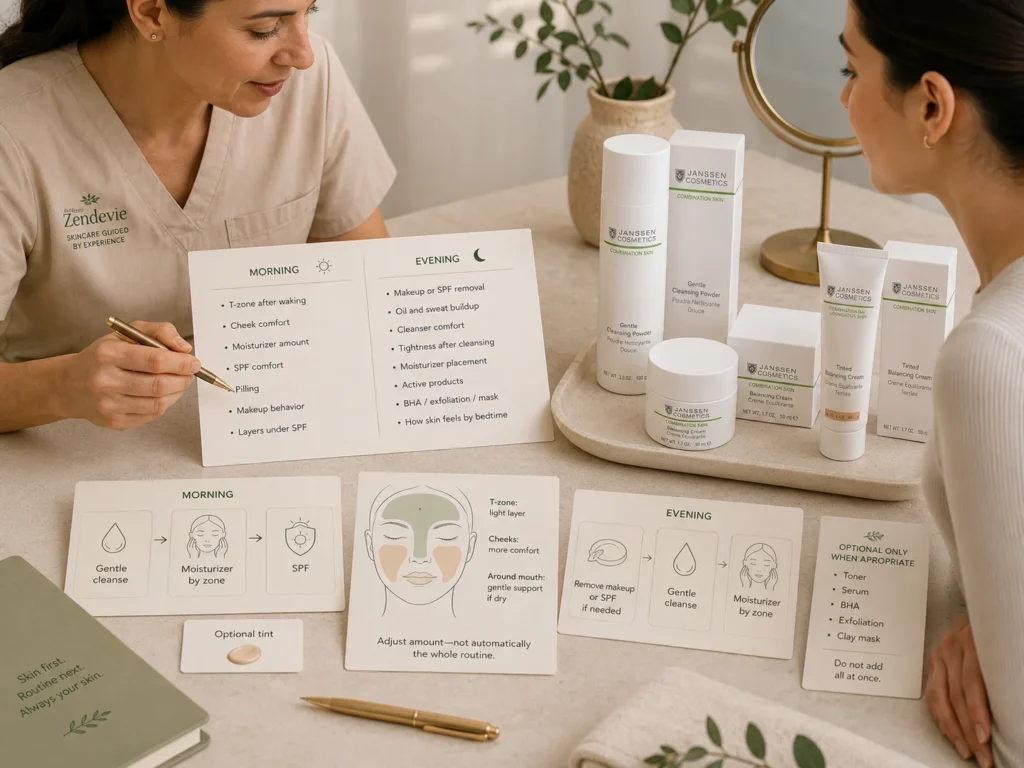
After consultation, our licensed esthetician may consider Janssen Cosmetics options based on whether the morning routine needs lightweight balance and SPF support, or whether the evening routine needs cleansing, hydration, calming, or targeted T-zone support.
For combination skin balance, possible options may include:
For oily T-zone support, possible options may include:
For dry or dehydrated cheeks, possible options may include:
For sensitive or overworked cheeks, possible comfort-focused options may include:
For dullness, post-blemish mark appearance, or uneven-looking tone when the skin is calm and stable, possible radiance-support options may include:
For morning routines, Face Guard Advanced SPF 30 may be considered as the final daytime protection step when appropriate and tolerated.
These are not automatic recommendations. Morning and evening routines should be chosen based on skin zones, comfort, tolerance, SPF use, makeup use, and whether the skin needs simple support or targeted care.
Do not use every product morning and night.
Do not skip SPF in the morning because the T-zone is oily.
Do not sleep in SPF or makeup.
Do not scrub the T-zone at night until it feels squeaky.
Do not dry out the cheeks to manage oil.
Do not apply BHA to dry or sensitive areas unnecessarily.
Do not use clay mask on cheeks if it makes them tight.
Do not combine exfoliating toner, AHA, BHA, scrubs, retinol-style products, strong vitamin C, and brightening products blindly.
Do not apply active products to broken, crusted, bleeding, painful, or freshly picked skin.
Do not keep adding steps when the skin is already irritated.
A simple morning routine is gentle cleanser, lightweight moisturizer by zone, and SPF.
A simple evening routine is gentle cleanser and moisturizer by zone. If wearing makeup or SPF, use a removal step if needed before cleansing.
Many people with combination skin cleanse morning and night, but the cleanser should be gentle. If morning cleansing makes cheeks tight, the routine may need adjustment.
Yes. SPF should be the final morning skincare step.
BHA is often easier to place in the evening, only on clogged-looking oily areas if appropriate and the skin is stable.
Exfoliation is often better placed in the evening when appropriate, but it should not be used on irritated, broken, flaky, or over-exfoliated skin.
Yes, but use a lighter layer on oily areas and more comfort on dry cheeks.
Pilling may happen from too many layers, too much product, heavy moisturizer, sticky serum, dry flakes, or applying products too quickly.
It can include targeted support if appropriate, but stronger does not always mean better. Sensitive or dehydrated skin may need a gentle evening routine.
Use gentle cleanser, moisturizer by zone, and SPF in the morning. At night, cleanse gently and moisturize by zone.
If your morning routine feels greasy but your evening routine leaves your skin tight, your combination skin may need better timing and placement.
At Zendevie, a free virtual consultation helps us review your T-zone, cheeks, cleanser, toner, moisturizer, SPF, makeup habits, evening cleansing, hydration level, sensitivity, and active products before recommending anything.
Morning skincare should protect.
Evening skincare should reset.
And both should help your skin feel balanced.

Zendevie is guided by Haby Diallo, a licensed esthetician with more than 20 years of professional skincare experience. Her approach is rooted in education, professional judgment, and personal care.
years of experience