
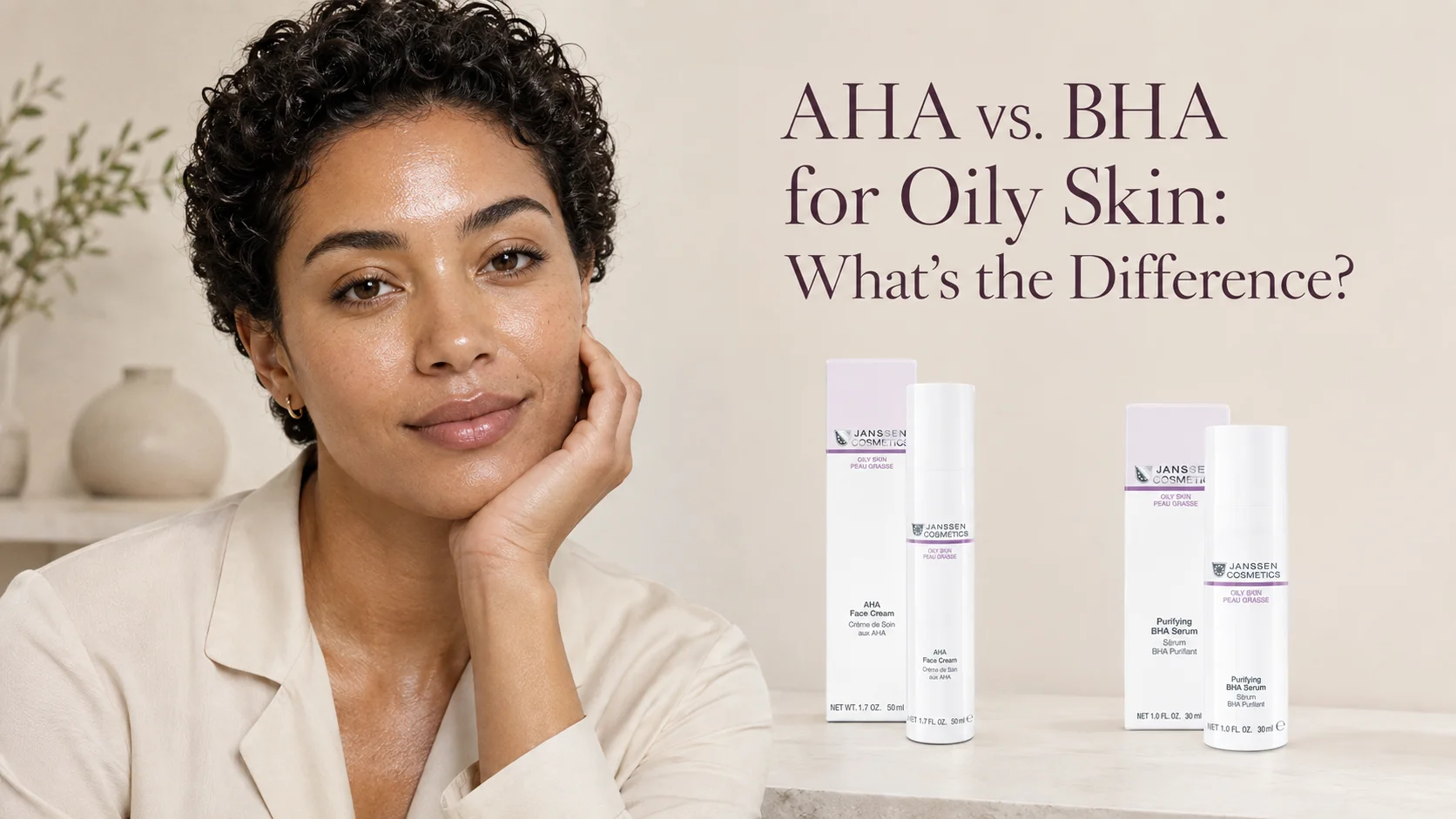
When oily skin looks shiny, textured, or clogged, exfoliating ingredients often come up quickly.
AHA and BHA are two of the most common ingredient families people hear about. They are both exfoliating ingredients, but they do not behave the same way on the skin. Choosing between them should not be based on which one sounds stronger. It should be based on what the skin is showing.
Is the main concern blackheads around the nose? Whiteheads on the forehead or chin? Rough surface texture? Dull buildup? Makeup separating in the T-zone? Tightness after cleansing?
Those clues matter.
In consultation, our licensed esthetician looks at shine, texture, clogged-looking pores, sensitivity, dehydration, and current product use before deciding whether AHA, BHA, both, or neither makes sense.
AHA is usually considered when oily skin has surface dullness, rough texture, or uneven-looking smoothness.
BHA, often known as salicylic acid, is usually considered when oily skin has clogged-looking pores, blackheads, whiteheads, or congestion in the T-zone.
Oily skin does not automatically need both. If the skin feels tight, stingy, flaky, or irritated, adding more acids may make the skin harder to manage.
AHA stands for alpha hydroxy acid.
In skincare, AHAs are often used when the surface of the skin looks dull, rough, or uneven. Common AHAs include glycolic acid, lactic acid, mandelic acid, and other related exfoliating acids.
For oily skin, AHA may be considered when the concern is more about surface texture than clogged-looking pores.
That may include:
AHA is not automatically the best choice for every oily face. It depends on whether surface buildup is the main issue.
BHA stands for beta hydroxy acid.
The most common BHA in skincare is salicylic acid. It is often used in formulas for oily, blemish-prone, or clogged-looking skin.
For oily skin, BHA may be considered when the concern is more connected to oil and visible congestion.
That may include:
BHA is often the ingredient people think of first for oily skin, but it still needs to be used with care.
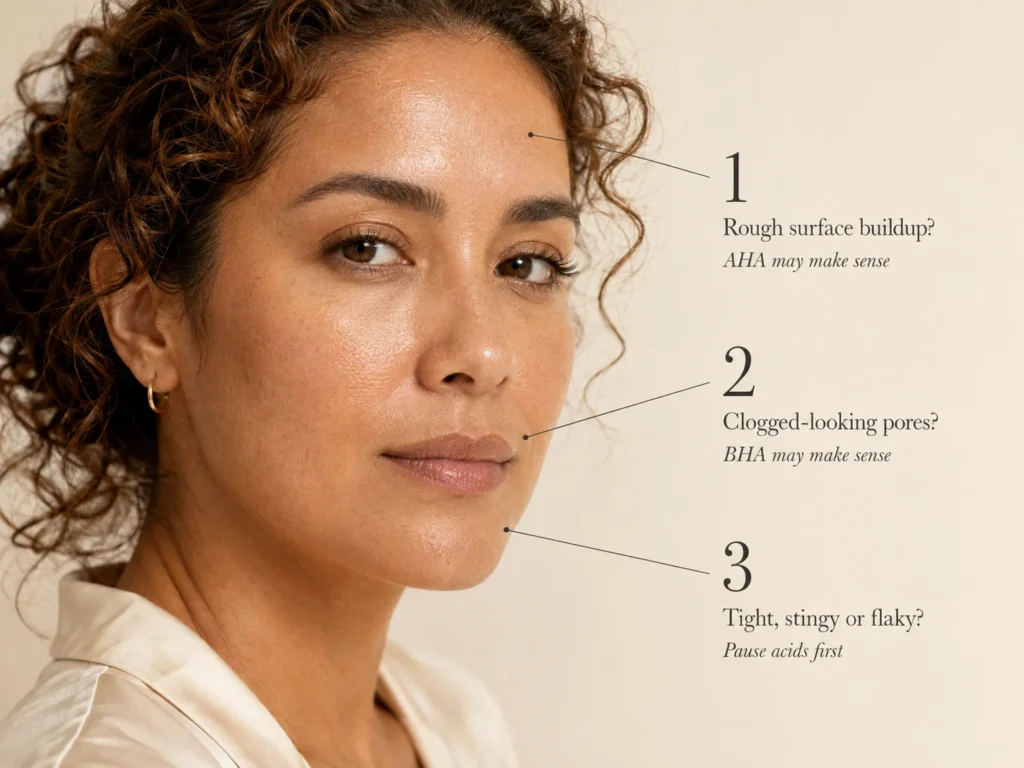
A simple way to understand the difference:
AHA is often chosen for surface texture and dull buildup.
BHA is often chosen for oily, clogged-looking areas.
That does not mean AHA is only for dry skin or BHA is only for oily skin. It means their roles are different.
If your skin is oily but mostly rough and dull, AHA may be part of the conversation.
If your skin is oily with blackheads, whiteheads, and clogged-looking pores, BHA may make more sense.
If your skin is oily and tight, neither acid may be the first step until the skin feels less overworked.
AHA may be considered when oily skin has a dull or uneven surface.
You may notice:
AHA can be useful when exfoliation is needed on the surface, but it should not be used aggressively just because the skin is oily.
BHA may be considered when oily skin has visible congestion.
You may notice:
This is where BHA often fits better than AHA.
The goal is not to dry out the entire face. The goal is to address the look of buildup in oil-prone areas.
Some oily skin can use both, but not blindly.
AHA and BHA may both make sense when the skin has surface dullness and clogged-looking pores. But using them together too often can make the skin feel tight, stingy, flaky, or irritated.
This is especially true if you are also using:
More exfoliation does not always mean clearer-looking skin. Sometimes it makes oily skin look shiny, rough, and dehydrated at the same time.
Oily skin is often treated like it can tolerate anything. That is not true.
When oily skin is over-exfoliated, it may show:
If this happens, the answer is not another acid. The skin needs a simpler plan for a while.
For blackhead-prone oily skin, BHA is often the ingredient to consider first.
Blackheads are commonly seen around oily areas such as the nose, chin, and forehead. Because BHA is often used in formulas for oily buildup and clogged-looking pores, it may fit this concern better than AHA.
That said, blackheads are not only about one ingredient. Cleansing, makeup removal, moisturizer texture, SPF texture, and product buildup all matter.
Whiteheads and closed comedones can be frustrating because the skin may look bumpy even when it is not visibly inflamed.
BHA may be considered when whiteheads appear with oily, clogged-looking skin.
AHA may be considered if the surface also looks rough or dull.
The key is not to layer both too quickly. If you add too much at once, you will not know what helped or what irritated the skin.
Skincare cannot permanently erase pores, but it can help the skin surface look cleaner and more refined.
If pores look more noticeable because of oil and buildup, BHA may make sense.
If the skin surface looks rough or dull, AHA may be considered.
If the skin is shiny but tight, pause before adding either one. Tightness may mean the skin is dehydrated or over-cleansed.
If your skin feels oily but tight, be careful with acids.
That tight feeling is a clue that the skin may be lacking water, reacting to harsh cleansing, or already getting too much exfoliation.
In that case, start by reviewing:
Once the skin feels easier to read, AHA or BHA can be considered more clearly.
Sensitive oily skin needs fewer variables.
If the skin stings easily, turns red-prone, or reacts to products quickly, do not add AHA and BHA at the same time.
A better approach is to choose one clear purpose.
If clogged-looking pores are the issue, BHA may be considered.
If dull surface texture is the issue, AHA may be considered.
If the skin is irritated, neither may be the right first move.
Mature oily skin can still have shine, blemish-prone areas, or clogged-looking pores. It may also show dullness, texture changes, makeup settling, or dehydration.
This is where the decision becomes more detailed.
BHA may be considered for clogged-looking pores or blackheads.
AHA may be considered for dull surface texture.
But mature skin may not tolerate aggressive exfoliation as easily as it once did. Daily SPF, a non-stripping cleanser, and the right moisturizer texture become especially important.
An AHA cleanser is rinsed off. It may be considered when someone wants a milder exfoliating step built into cleansing.
An AHA serum or leave-on product is usually more direct and should be introduced more slowly.
If oily skin is already using an active cleanser, it may not need another active leave-on step immediately.
The question is not only which product contains AHA. The question is how much exfoliation the skin is receiving across the entire plan.
A BHA cleanser may be considered when oily skin needs active cleansing but the person wants a rinse-off step.
A BHA serum may be considered when clogged-looking pores need more focused attention.
A serum should be introduced carefully, especially if the skin already feels tight or uses other active products.
If the cleanser, toner, serum, and mask all contain exfoliating ingredients, the plan may be too much.
There is no single schedule that works for everyone.
Some oily skin tolerates exfoliating ingredients more often. Other skin becomes tight quickly.
A good sign is how the skin feels after use and the next morning.
If the skin looks clearer and feels normal, the plan may be reasonable.
If the skin feels dry, stingy, shiny but tight, or rough under makeup, the frequency may need to be reduced.
Not unless the skin can tolerate it and there is a clear reason.
For many people, using AHA and BHA on separate nights is easier to manage. Some people may only need one of them.
Using both on the same night can be too much if the skin is dehydrated, sensitive, mature, or already using retinol, scrubs, or clay masks.
One well-chosen exfoliating step is often better than several strong steps fighting each other.
After exfoliating ingredients, oily skin still needs moisture.
That does not mean a heavy cream. It means a texture that keeps the skin from feeling bare.
Depending on the skin, that may be:
In the morning, SPF is important, especially when exfoliating products are part of the plan.
Be careful when combining AHA or BHA with:
These ingredients may each have a place, but the skin does not need all of them at once.
Use what the skin is showing.
Choose BHA to discuss first if your main concern is:
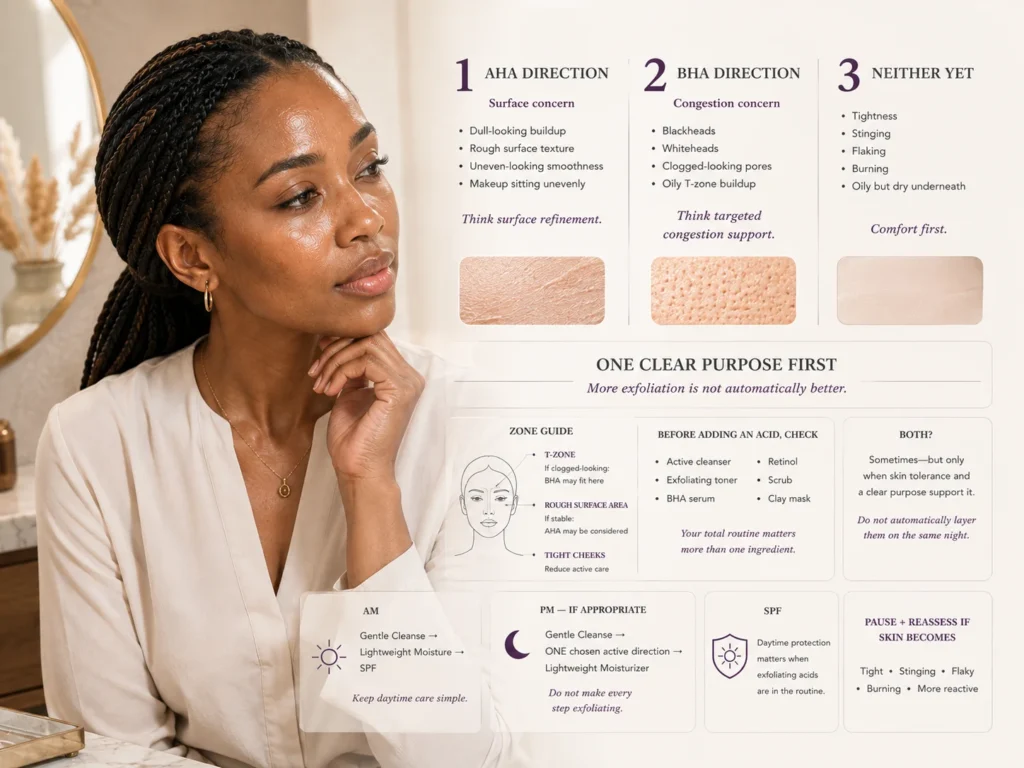
Choose AHA to discuss first if your main concern is:
Pause acids and simplify first if your main concern is:
Morning care should not be overloaded.
A simple order may be:
Cleanser → Toner if appropriate → Lightweight Moisturizer → SPF
If the skin feels dehydrated, add light hydration before moisturizer.
Do not use acids in every step just because the skin is oily.
Evening is often where AHA or BHA may fit.
A simple order may be:
Cleanser → Toner if appropriate → AHA or BHA if appropriate → Lightweight Moisturizer
If you are using an active cleanser, you may not need an active serum the same night.
If you are using a BHA serum, a strong exfoliating toner may not be necessary.
Keep the plan readable.
After consultation, our licensed esthetician may consider Janssen Cosmetics options depending on whether the skin is oily, clogged-looking, dull, textured, dehydrated, or sensitive from product overload.
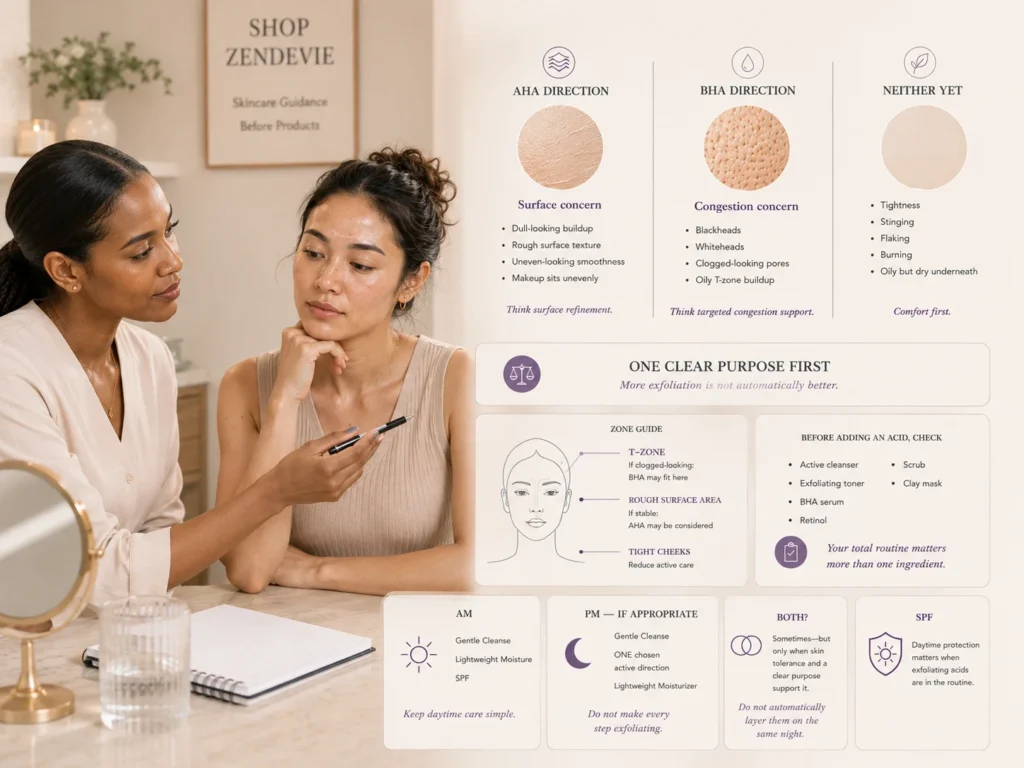
Possible options may include:
These options are not automatic recommendations. The right match depends on whether the skin needs BHA, AHA, a milder cleanse, less exfoliation, or a simpler plan first.
Do not choose AHA or BHA only because it sounds stronger.
Do not layer acid cleanser, acid toner, acid serum, retinol, scrub, and mask all at once.
Do not use BHA all over the face if only the nose is congested and the cheeks are tight.
Do not use AHA on irritated skin just because it looks dull.
Do not skip moisturizer after exfoliating products.
Do not ignore stinging, burning, flaking, or tightness.
Do not keep experimenting if blemishes are painful, deep, swollen, infected-looking, scarring, or worsening.
BHA is often considered when oily skin has clogged-looking pores, blackheads, whiteheads, or congestion. AHA may be considered when oily skin has surface dullness or rough texture. The better choice depends on what your skin is showing.
Yes, some oily skin can use AHA, especially when rough texture or dull buildup is the main concern. It should be used carefully if the skin feels tight or sensitive.
Yes, BHA may make sense for oily skin with clogged-looking pores, blackheads, whiteheads, or a congested T-zone.
Some skin can tolerate both, but they should not be layered blindly. Many people do better using one at a time or alternating them.
Salicylic acid is a BHA.
BHA is usually the ingredient to consider first for blackhead-prone oily areas because it is commonly used for clogged-looking pores and oily buildup.
Yes. Oily skin still needs a light moisturizer after exfoliating products so the skin does not feel tight or bare.
If you are not sure whether your oily skin needs AHA, BHA, both, or neither, a free virtual consultation can help.
At Zendevie, we look at your shine pattern, clogged-looking pores, texture, sensitivity, makeup behavior, and current products before choosing exfoliating steps. The goal is to help your skin look clearer without making it feel stripped.

Zendevie is guided by Haby Diallo, a licensed esthetician with more than 20 years of professional skincare experience. Her approach is rooted in education, professional judgment, and personal care.
years of experience