


Best Ingredients for Combination Skin: What Helps Balance Oily and Dry Areas
Combination skin needs ingredients that understand both sides of the face.
The T-zone may need help with shine and clogged-looking pores. The cheeks may need comfort and hydration. If you choose ingredients only for oil control, your cheeks may feel stripped. If you choose ingredients only for dryness, your T-zone may feel greasy.
The best ingredients for combination skin are usually not extreme. They are balancing, lightweight, hydrating, and gentle enough to work with mixed skin needs.
At Zendevie, we focus on matching ingredient categories to the skin’s pattern before choosing products.
Quick Answer
The best ingredients for combination skin often include lightweight hydrators, balancing moisturizers, gentle clarifying ingredients for the T-zone, soothing ingredients for dry or sensitive areas, and SPF during the day.
Combination skin usually does best with textures that support comfort without heaviness.
The goal is balance, not drying out the oily areas or overloading the dry areas.
If you are still defining your skin type, start with what combination skin means before choosing ingredients.
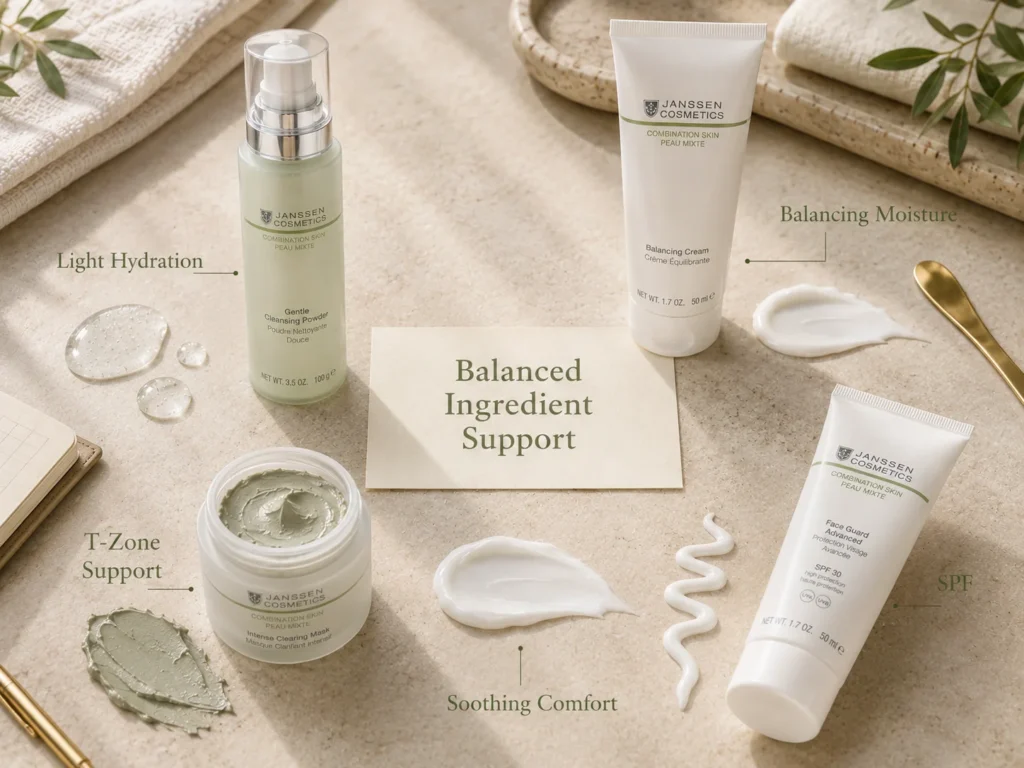
What Combination Skin Needs From Ingredients
Combination skin usually needs ingredients that can support:
- Lightweight hydration
- Comfort on dry areas
- Oil-balance support for the T-zone
- Gentle cleansing
- Pore-appearance support where needed
- Skin barrier comfort
- Daytime protection
If you are not sure which zones need support, review how to know if you have combination skin before adding active products.
The best routine is not about using every ingredient at once. It is about using the right categories in the right places.
Lightweight Hydrators
Hydration is important for combination skin because both oily and dry areas can become dehydrated.
Lightweight hydrators help the skin feel fresh without adding a heavy finish.
Helpful hydration-support ingredients may include:
- Hyaluronic acid
- Glycerin
- Moisture-binding ingredients
- Lightweight gel-serum textures
These ingredients can support comfort on the cheeks while still feeling acceptable on the T-zone.
Balancing Moisture Ingredients
Combination skin needs moisturizer, but the texture matters.
The best moisturizers for combination skin usually feel:
- Lightweight
- Smooth
- Non-heavy
- Comfortable
- Not greasy
- Not too drying
A balancing moisturizer helps the face feel more even without making oily areas shine too much.
Gentle Clarifying Ingredients
If the T-zone has shine, clogged-looking pores, or blackhead-prone areas, gentle clarifying ingredients may help.
These may include ingredient categories used in oily skin routines, such as:
- BHA-style support when appropriate
- Gentle exfoliating support
- Oil-balancing ingredients
- Clarifying mask ingredients
The key is placement. Clarifying products may not need to go all over the face.
Soothing Ingredients
Some combination skin has cheeks that feel dry, tight, or sensitive. In that case, soothing support matters.
Ingredients that support comfort may help the cheeks feel calmer and more hydrated.
This is especially important if the person has been using strong oily-skin products all over the face.
SPF
SPF is important for every skin type, including combination skin.
For combination skin, texture is important. A heavy SPF may feel greasy on the T-zone, while a very drying SPF may make the cheeks uncomfortable.
The best SPF is one that feels comfortable enough to use consistently.
Ingredients to Use Carefully
Combination skin can become irritated if too many active products are used at once.
Be careful with:
- Strong acids
- Retinol
- Scrubs
- Drying toners
- Strong clay masks
- Multiple exfoliants
- Heavy oils over oily areas
These ingredients may have a place in some routines, but they should be used carefully.
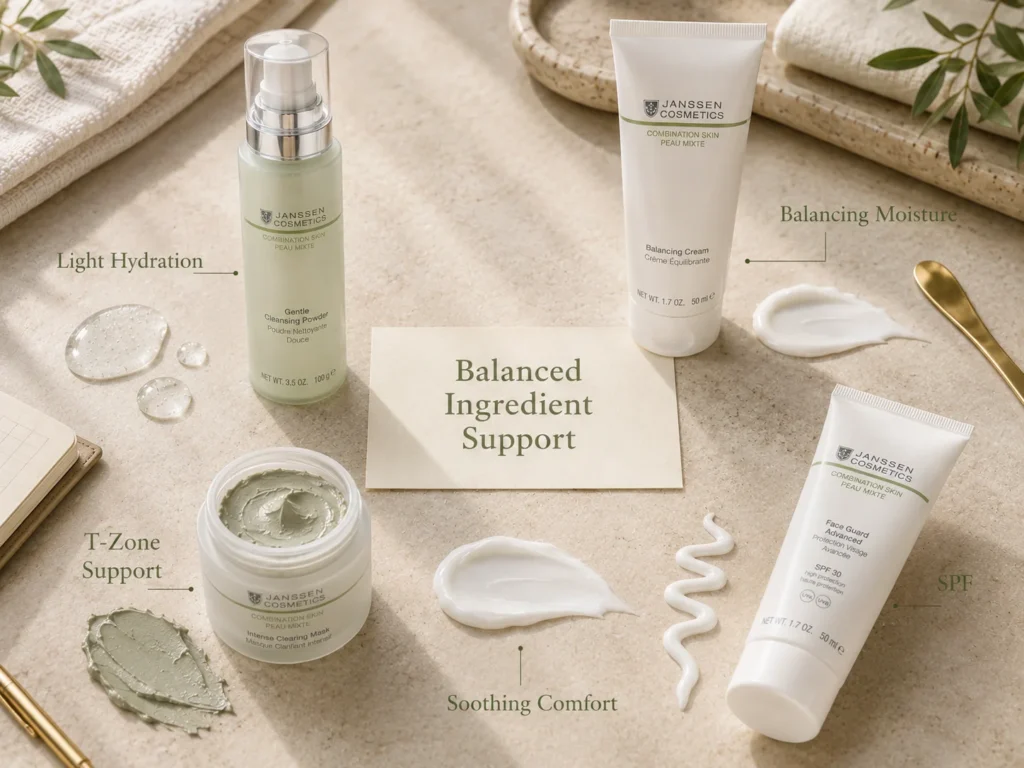
How to Choose Ingredients by Zone
For the T-zone, you may need:
- Lightweight moisturizer
- Clarifying mask when appropriate
- Oil-balance support
- Pore-appearance support
For the cheeks, you may need:
- Hydration
- Comfort
- Soothing support
- A little more moisturizer if dry
For the whole face, you usually need:
- Gentle cleanser
- Balanced moisturizer
- SPF
For order and placement, use a simple combination skin routine so clarifying products, moisturizer, and SPF are applied in the right areas.
This is how combination skin becomes easier to manage.
Where Janssen Cosmetics Fits
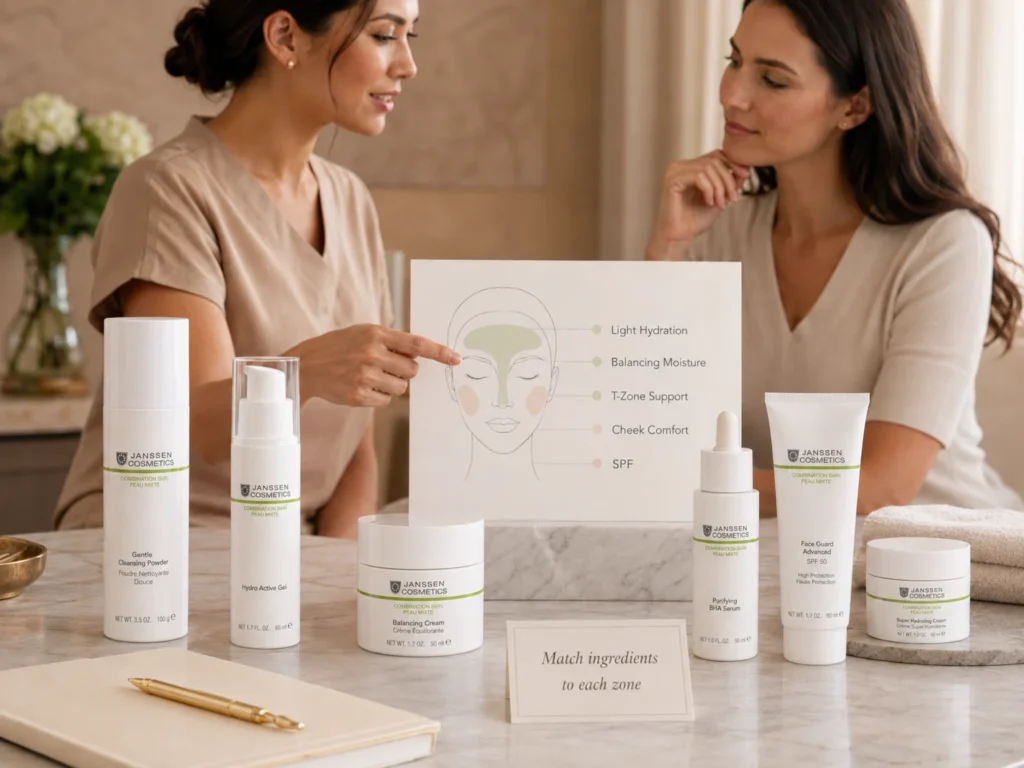
Products that may be discussed during a combination skin consultation include:
- Gentle Cleansing Powder for mild cleansing support
- Balancing Cream for lightweight moisture and balance
- Tinted Balancing Cream for a low-lipid tinted moisturizer option when appropriate
- Intense Clearing Mask for oily or congested-looking T-zone areas
- Face Guard Advanced for daytime protection when appropriate
These examples are selected based on skin pattern, tolerance, and routine comfort. They are not automatic recommendations.
What Not to Do
Do not choose ingredients only for oily skin if your cheeks are dry.
Do not choose only rich dry-skin ingredients if your T-zone gets shiny.
Do not layer multiple exfoliating ingredients at once.
Do not use a drying mask over the whole face.
Do not skip moisturizer.
Do not forget SPF.
Frequently Asked Questions
What ingredients are best for combination skin?
Combination skin often does well with lightweight hydrators, balancing moisturizers, gentle clarifying support for oily areas, soothing ingredients for dry areas, and SPF.
Is hyaluronic acid good for combination skin?
Yes. Hyaluronic acid can support hydration without feeling too heavy when used in the right formula.
Can combination skin use salicylic acid?
Some combination skin may benefit from salicylic acid-style support on oily or clogged-looking areas, but it should be used carefully and not necessarily all over the face.
Should combination skin use oils?
It depends. Heavy oils may feel too much on the T-zone. Some dry cheek areas may need more comfort, but texture matters.
Can combination skin use exfoliation?
Yes, but gently and not too often. Over-exfoliation can make dry or sensitive areas worse.
What moisturizer ingredients are best?
Look for lightweight hydration and balancing comfort. The best texture should not feel greasy or drying.
About the Esthetician Behind Zendevie
Zendevie is guided by Haby Diallo, a licensed esthetician with more than 20 years of professional skincare experience. Her approach is rooted in education, professional judgment, and personal care.
20+
years of experience