


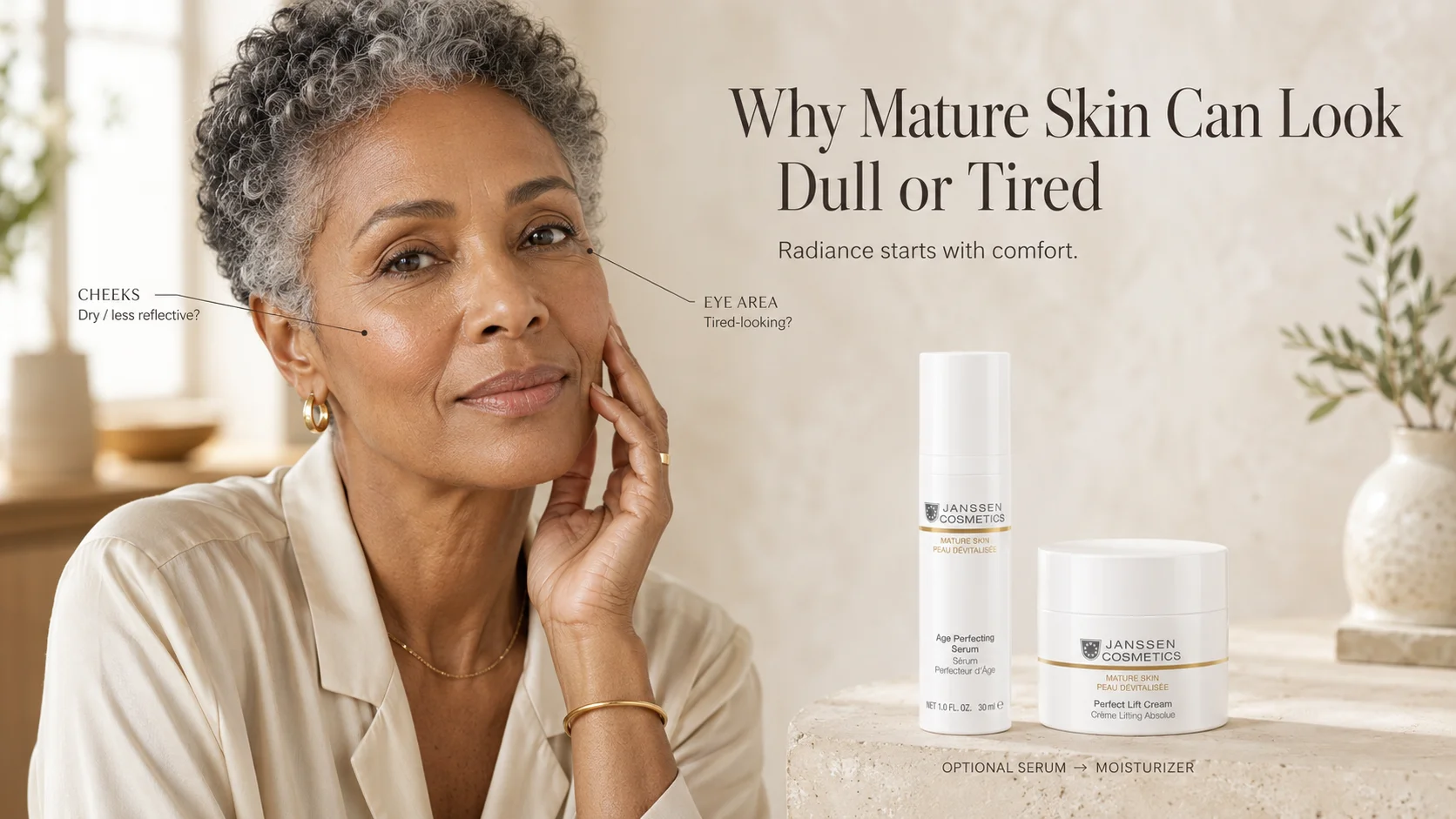
Mature skin may sometimes look less refreshed even when the routine has not changed.
The complexion may appear:
This does not mean the skin has suddenly become unhealthy.
It also does not mean the skin needs a stronger peel.
A dull or tired-looking complexion may reflect several smaller changes happening at the same time.
The skin may be:
The eye area may also look drier or more shadowed, which can make the entire face appear less rested.
At Zendevie, our licensed esthetician does not begin by assuming that dull-looking skin needs more exfoliation.
The first step is understanding whether the skin needs:
Radiance should be supported through comfort and consistency—not forced through irritation.
Mature skin may look dull or tired because of:
A simple radiance-supporting routine may be:
Gentle cleanser or lukewarm-water rinse → one hydrating or antioxidant serum if needed → moisturizer → SPF
Gentle cleanser → one hydrating or comfort-focused serum if needed → moisturizer
Optional exfoliation, masks, ampoules, retinol, vitamin C, and facial oils should be added only when:
Do not use several acids or scrubs simply because the complexion looks flat.
Persistent yellowing, significant swelling, painful skin, rapid color changes, unexplained bruising, bleeding, crusting, blistering, eye symptoms, or sudden changes accompanied by feeling unwell should be evaluated by an appropriate healthcare provider.
“Dull” is a cosmetic description.
It may refer to skin that appears:
It is not a medical diagnosis.
The way skin reflects light can change when its surface becomes:
A smoother, more comfortably moisturized surface often reflects light more evenly.
This is why hydration and moisturizer may sometimes improve the appearance of radiance more effectively than another exfoliating product.
A tired-looking complexion may involve:
It does not always mean the person is tired.
Natural facial structure, eye-area shadowing, dryness, travel, environmental exposure, and makeup may all influence the appearance.
Skincare may support a fresher-looking complexion.
It cannot diagnose or correct every possible cause of a tired appearance.

Many mature complexions look radiant and comfortable.
Skin maturity alone does not create dullness.
A mature complexion may look less luminous when the routine no longer matches its needs.
For example:
The goal is to identify what changed.
It is not to treat maturity itself as the problem.
When the skin surface feels hydrated and comfortable, it may appear:
Dry or rough areas scatter light unevenly.
This can create a flatter-looking finish.
Hydration may help improve the appearance of fine dryness lines and surface smoothness.
It does not permanently remove natural lines or reverse skin maturation.
Dehydrated skin lacks water.
It may be:
Possible signs include:
Dehydration may be influenced by:
A hydrating serum may help some mature skin.
However, the cleanser and moisturizer should also be reviewed.
Dry mature skin may have less oil or lipid comfort.
It may look:
Dry mature skin may need:
A watery serum alone may not provide enough lasting comfort.
The skin may need both hydration and richer moisture support.
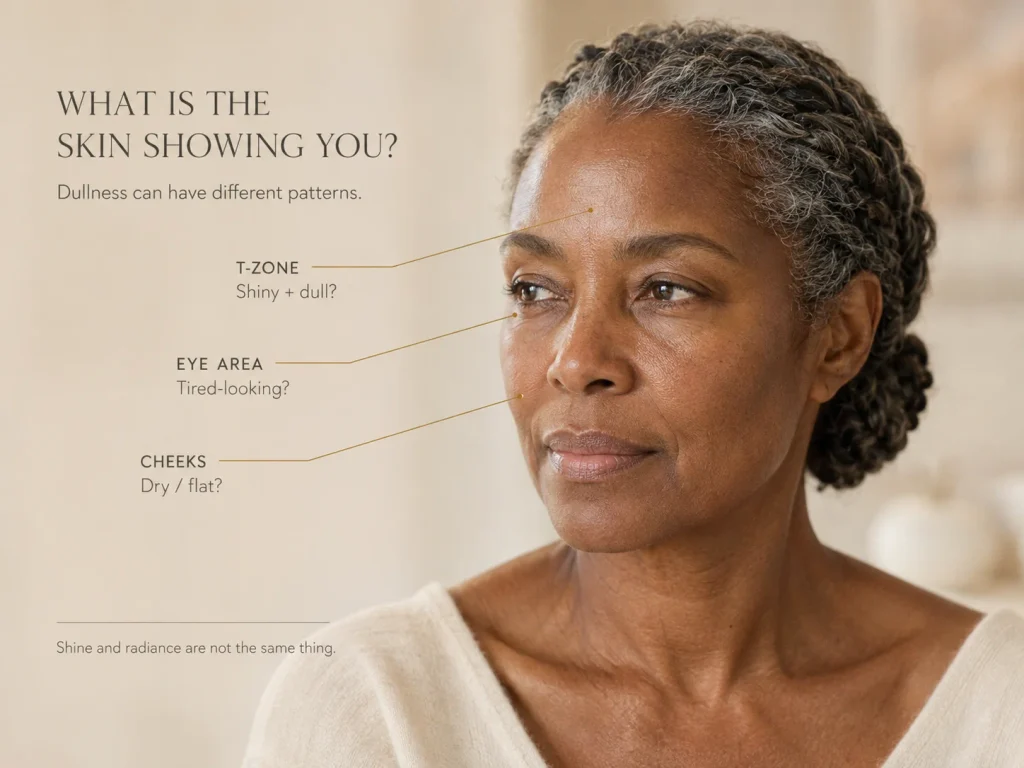
Oily mature skin may show:
Oiliness and radiance are not the same.
A shiny surface may still be:
Do not attempt to create glow by applying facial oil over already oily skin automatically.
The first step may be gentler cleansing and lightweight hydration.
Combination mature skin may have:
The cheeks may look dull while the nose looks oily.
One full-face solution may not work.
Possible adjustments include:
The face does not need identical product amounts everywhere.
Sensitive or over-stressed skin may look:
When the skin is irritated, adding a brightening serum may make it feel worse.
Pause:
Return to a simple cleanser, moisturizer, and SPF routine.
Comfort should come before radiance-focused products.
A cleanser that removes too much surface comfort may leave mature skin:
This may make the face look less luminous.
Review:
A richer serum will not fully correct a stripping cleansing step.
Very hot water may make mature skin feel:
Use lukewarm water.
The face does not need extreme temperatures to become clean.
A comfortable cleansing routine helps prepare the surface for hydration and moisturizer.
The complexion may appear dull when several layers accumulate.
These may include:
Product buildup may create:
This does not always mean the skin needs exfoliation.
It may mean the routine needs fewer layers or more effective evening cleansing.
Makeup and sunscreen residue may remain around:
The next morning, the skin may look:
Use an appropriate cleanser for the amount and type of makeup worn.
Avoid aggressive rubbing.
A cleansing balm or oil may reduce friction when removing long-wear products.
Exfoliation may create a temporary smoother feeling.
But excessive exfoliation may lead to:
This can make the complexion look less radiant over time.
Do not use:
in the same routine without professional direction.
Rough mature skin may need:
Before exfoliating, ask:
If the answer suggests irritation, exfoliation should wait.
Retinol may support:
It may also create:
If the skin looks less refreshed after introducing retinol, review:
Do not continue increasing retinol while moisturizer and sunscreen are stinging.
A complexion may appear less luminous when some areas look darker or more uneven than others.
Possible contributors may include:
A routine for uneven-looking tone should include:
Do not use whitening language.
The goal is to support a more even-looking complexion while respecting the person’s natural skin color.
A radiance-focused routine should not depend only on:
Daytime protection matters too.
A practical morning routine may be:
Gentle cleanser or rinse → serum if needed → moisturizer → SPF
Some specialty SPF concentrates have product-specific layering instructions.
Follow the directions for the selected formula.
Do not mix separate sunscreen into serum or moisturizer unless designed for that use.
Antioxidant ingredients may help support the skin against environmental stress.
They may include:
Antioxidants may be included in:
A separate antioxidant serum is optional.
The moisturizer may already contain antioxidant support.
More antioxidant products do not automatically create more radiance.
Vitamin C may support:
A possible morning routine may be:
Gentle cleanser → vitamin C serum → moisturizer → SPF
However, vitamin C may feel too active when the skin is:
Choose the formula according to tolerance.
A stronger concentration is not automatically better.
Peptide products may support:
Peptides may appear in:
A peptide serum should not automatically be layered with every other active ingredient.
One purposeful product may be enough.
When mature skin feels dry, rough, or less comfortable, ceramide-focused products may help support:
Ceramides may appear in:
A ceramide product may help the skin look more comfortable and less dry.
It does not need to be combined with several oils and rich creams automatically.
Hyaluronic acid may help support hydration and a smoother-looking surface.
It may be found in:
A separate hyaluronic-acid serum may be unnecessary when the moisturizer already provides enough hydration.
Several hyaluronic-acid layers may create stickiness or pilling.
A moisturizer that is too light may leave the skin:
A moisturizer that is too rich may leave the skin:
Radiance is not simply about adding more shine.
The goal is a comfortable, balanced-looking finish.
A comfortable, luminous complexion may reflect light evenly.
Greasy skin may appear shiny because of:
A shiny finish does not automatically mean the skin is hydrated.
Likewise, a matte finish does not automatically mean the skin is unhealthy.
The correct finish is the one that feels comfortable and suits the person’s preference.
Facial oil may help some dry mature skin feel:
It may also:
Do not use facial oil solely to create an immediate glow.
Review whether the skin needs water-binding hydration, moisturizer, or lipid support.
A hydrating or comfort-focused mask may help mature skin temporarily appear:
A mask should not replace:
Avoid new masks immediately before an event.
A heavily fragranced, warming, or exfoliating mask may cause discomfort.
Ampoules are concentrated cosmetic products.
They may be used:
Do not assume an ampoule should be combined with:
all in one routine.
A concentrated product still requires careful introduction.
The eye area may look:
This may influence how rested the entire face appears.
A simple eye-area routine may include:
Eye cream cannot correct every cause of dark-circle or tired-eye appearance.
Persistent swelling, pain, discharge, crusting, or vision changes require medical guidance.
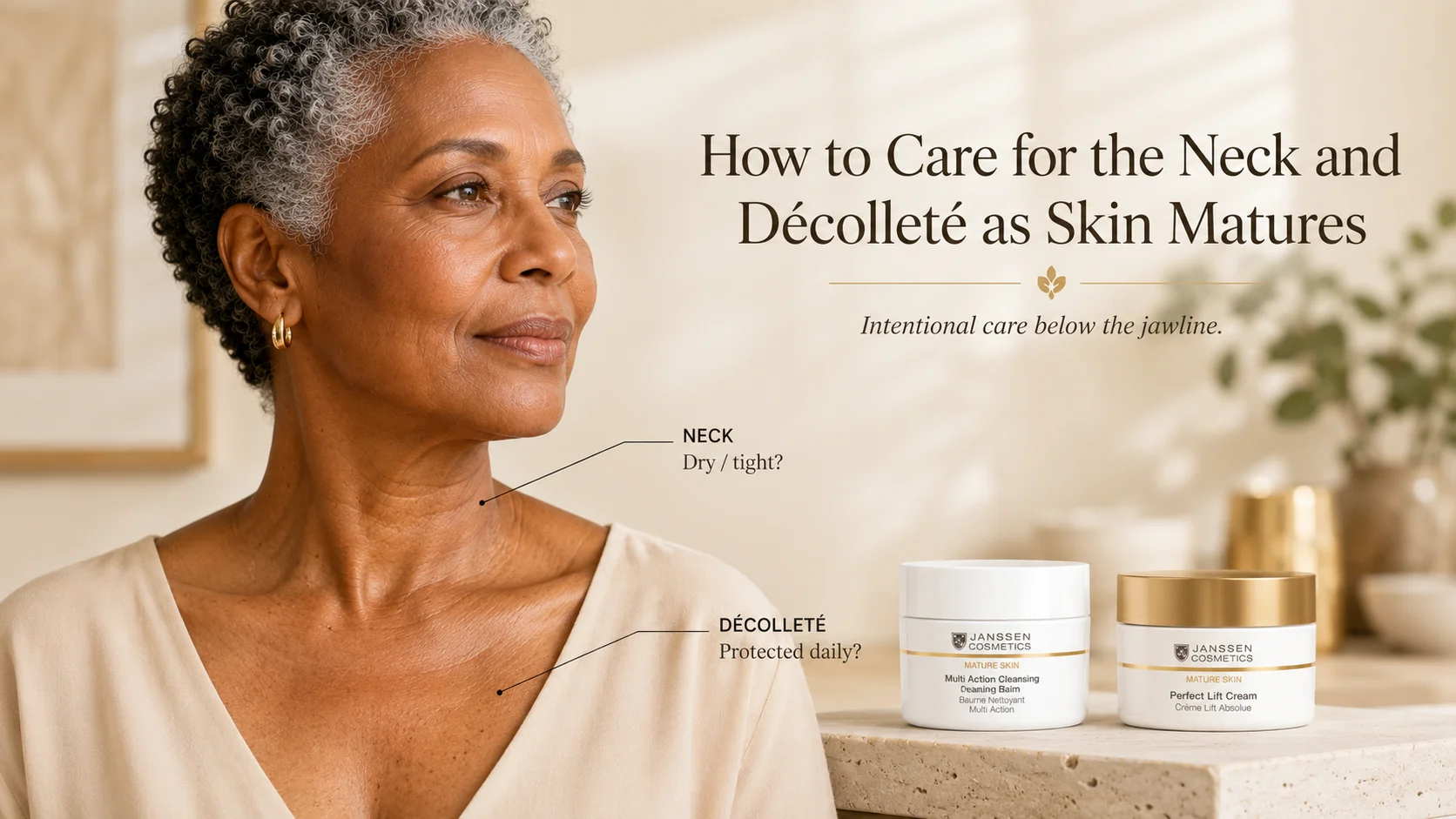
Mature skin care may extend to the neck and décolleté.
These areas may appear:
Use:
Introduce strong actives carefully.
The neck may be less tolerant than the face.
A short period of poor rest may make the face appear:
Skincare may support comfort and moisture.
It cannot replace adequate rest or address an underlying sleep concern.
Persistent fatigue, sudden skin changes, or changes accompanied by other health symptoms should be discussed with an appropriate healthcare provider.
During busy or stressful periods, people may:
A simple routine may be easier to maintain:
Rinse or gentle cleanse → moisturizer → SPF
Gentle cleanser → moisturizer
Consistency often supports the complexion better than occasional intensive treatments.
Travel may involve:
A practical travel routine may remain:
Gentle cleanser or rinse → moisturizer → SPF
Gentle cleanser → moisturizer
Bring familiar products.
Do not introduce a new peel, retinol, vitamin C, mask, and ampoule during the same trip.
Air-conditioned environments may leave mature skin:
Possible adjustments include:
Do not repeatedly mist the face with fragranced spray as the only solution.
Indoor heating may contribute to:
A winter routine may need:
A serum alone may not be enough when the skin also needs lipid support.
In humidity, mature skin may appear:
Adjust by using:
Do not over-cleanse to remove every trace of shine.
Makeup may reduce radiance when:
A more natural-looking finish may begin with:
Do not scrub the skin to make makeup look smoother.
Powder may help control shine and set makeup.
Too much may make mature skin look:
Use powder strategically on:
Dry cheeks and the outer eye area may need little or no powder.
A luminous foundation or highlighter may create immediate shine.
It does not replace:
Likewise, natural texture beneath radiant makeup is normal.
The goal should not be to make the face appear reflective everywhere.
Highlighter may draw attention to:
Use a small amount on smoother areas when desired.
Avoid applying a strong reflective product directly over visibly flaky or heavily textured areas.
Makeup choices should respect personal preference.
A minimal routine may be:
Gentle cleanser or rinse → moisturizer → SPF
A routine with one serum may be:
Gentle cleanser → hydrating or antioxidant serum → moisturizer → SPF
Optional:
Do not automatically add:
The morning routine should remain comfortable and stable under SPF.
A minimal evening routine may be:
Gentle cleanser → moisturizer
A routine with serum may be:
Gentle cleanser → hydrating or nighttime serum → moisturizer
An active-treatment night may be:
Gentle cleanser → one active product → moisturizer
Do not use exfoliation and retinol together automatically.
Gentle creamy, balm, milk, or oil cleanser—or rinse if appropriate → hydrating serum if needed → supportive moisturizer → SPF
Gentle cleanser → comfort-focused serum if needed → richer moisturizer
Optional:
Avoid:
Gentle cleanser → lightweight hydrating or antioxidant serum if needed → lightweight moisturizer → SPF
Gentle cleanser → one targeted serum if appropriate → lightweight moisturizer
Avoid:
Oil control should not create tightness.
Gentle cleanser → lightweight serum if needed → moisturizer according to area needs → SPF
Gentle cleanser → targeted treatment only where appropriate → moisturizer by zone
Possible adjustments:
Lukewarm-water rinse or gentle cleanser → tolerated moisturizer → tolerated SPF
Gentle cleanser → tolerated moisturizer
Once the skin is stable, one comfort-focused or hydrating serum may be introduced.
Avoid:
Radiance-focused actives should wait until the skin feels comfortable.
Gentle cleanser → one tone-support or antioxidant serum when tolerated → moisturizer → SPF
Gentle cleanser → one appropriate serum or simple moisturizer
Daytime protection is essential to the routine.
Do not combine several brightening ingredients without reviewing tolerance.
Visible tone support requires patience.
Gentle cleanser → retinol according to directions → moisturizer
Gentle cleanser → hydrating or comfort-focused serum → moisturizer
Do not add exfoliation to the retinol night automatically.
If the complexion becomes flaky or less luminous, reduce the active schedule.
Several days before the event:
The night before:
Gentle cleanser → familiar hydrating serum if needed → moisturizer
The morning of:
Gentle cleanse or rinse → familiar moisturizer → SPF → makeup
Do not chase overnight radiance through irritation.
Some mature skin may benefit from carefully scheduled exfoliation.
Exfoliation may support:
However, exfoliation is not appropriate when the skin is:
Begin with the gentlest suitable method.
Use one exfoliating product.
There is no universal schedule.
Frequency depends on:
Some mature skin may tolerate occasional exfoliation.
Other mature skin may need very little or none during sensitive periods.
Do not increase frequency simply because the skin looks dull on one day.
Enzyme products may help loosen surface buildup without scrub particles.
They are still exfoliating products.
They may not suit:
Follow the directions.
Do not combine an enzyme product with acids and retinol automatically.
AHA may support the appearance of:
It may also cause:
Use a suitable formula at an appropriate frequency.
Maintain daytime protection.
Do not use professional-strength peels at home.
BHA may be more relevant when dullness occurs alongside:
It does not need to be applied across dry mature cheeks automatically.
Targeted use may be more appropriate.
Avoid layering it with retinol, acid toner, scrub, and clay mask without a clear plan.
Scrubs may create immediate smoothness.
They may also create friction.
Avoid scrubbing mature skin that is:
Do not scrub harder because the complexion looks tired.
Gentle facial massage may create a temporarily refreshed appearance for some people.
However, it should not be used as a medical circulation treatment or a guaranteed lifting method.
Avoid strong massage when the skin is:
Use clean hands, light pressure, and an appropriate product when massage is part of a professionally guided routine.
Cold tools may temporarily reduce the look of puffiness.
Do not apply ice directly to the skin.
Extreme cold may create:
Use tools according to their instructions.
Do not treat a temporary cooling effect as a long-term skincare solution.
A facial mist may feel refreshing.
It may also contain:
Repeated misting without moisturizer may not provide lasting comfort.
A mist is optional.
Review the cleanser and moisturizer before adding another layer.
The cleanser may be too strong.
Review:
The skin should not look tight and flat after washing.
A gentler cleanser may support a softer-looking finish.
Possible reasons include:
Review the complete routine rather than adding another cream automatically.
The oil may temporarily improve surface shine and softness.
Observe whether the skin later becomes:
The skin may still need hydration or a better moisturizer.
Immediate shine is not the same as lasting comfort.
This may happen when the skin is:
Do not add more facial oil.
Use gentle cleansing and lightweight hydration.
Possible contributors include:
Adjust:
Seasonal changes are normal.
Possible contributors include:
Use fewer layers.
Choose a lighter moisturizer.
Cleanse effectively but gently.
Do not over-strip the skin.
Return to familiar products.
Focus on:
Pause:
Allow the skin to settle before adding targeted treatments.
The skin may be dry or flaking.
Pause or reduce retinol.
Also review:
Do not exfoliate the flakes aggressively.
Restart only after the basic routine feels comfortable.
Stop the vitamin C.
Possible contributors include:
A product should not create persistent burning to support radiance.
Choose a gentler formula only after the skin is stable.
The treatment may be removing more surface support than the skin tolerates.
Reduce frequency or stop.
A smooth feeling should not come with:
Comfort and appearance should be evaluated together.
The concern may involve:
One antioxidant or radiance-support serum may be considered.
Do not change the entire routine at once.
Review:
Use a small amount of appropriate eye care.
Do not apply facial acids or retinol close to the lash line.
Try:
Do not use more highlighter to correct a dry, over-powdered base.
Possible cosmetic contributors include:
Review the skincare and makeup separately.
A sudden, persistent, or unexplained color change should be discussed with a healthcare provider rather than treated only with brightening products.
Makeup, self-tanning products, lighting, and natural undertone can affect appearance.
However, a new or unexplained yellow appearance involving the skin or eyes requires medical evaluation.
Do not attempt to correct it with exfoliation or brightening products.
Lighting, makeup, dryness, and temporary tiredness may influence appearance.
A sudden or persistent change—especially with weakness, dizziness, shortness of breath, or feeling unwell—should be discussed with a healthcare provider.
Skincare cannot determine the cause.
Keep the routine simple and comfortable.
Avoid:
Follow medical guidance when appropriate.
Allow the skin and overall well-being time to recover.
The routine may be overloaded.
Possible issues include:
Return to:
Gentle cleanser or rinse → moisturizer → SPF
Gentle cleanser → moisturizer
Add one product only after the foundation feels stable.
Keep the routine simple.
That may mean the previous routine contained:
A short routine can still support mature skin effectively.
Try:
Do not exfoliate to correct pilling.
The issue may be product compatibility.
Stop using it.
Review whether it contains:
Return to the simplest routine.
Seek dermatologist guidance if basic products also sting.
Remove it according to directions.
Stop using the product if discomfort persists.
Review:
Significant swelling, blistering, severe itching, or spreading rash-like changes require medical guidance.
Stop it.
An ampoule may be concentrated even when it is marketed for tired-looking skin.
Use one ampoule product at a time.
Do not combine it blindly with:
Appearance should not be valued above comfort.
A glossy or smooth finish may come from:
If the skin burns, feels tight, or is becoming increasingly reactive, simplify the routine.
Hydration and moisturizer may soften the appearance of fine dryness lines.
They cannot permanently remove natural expression lines.
Makeup, lighting, eye-area shadowing, and facial structure also influence the appearance.
A well-aging routine should support comfort and a refreshed look without promising a line-free face.
Do not begin vitamin C, exfoliation, retinol, ampoules, and a new mask at the same time.
Ask:
A radiance product should address a specific need.
Seek medical guidance when a change in appearance is:
Seek urgent medical care for:
Cosmetic skincare can support hydration and radiance.
It cannot diagnose an underlying medical concern.
After consultation, our licensed esthetician may consider Janssen Cosmetics options based on whether the mature complexion looks dull because of dryness, dehydration, uneven-looking tone, product buildup, a tired-looking eye area, or an overcomplicated routine.
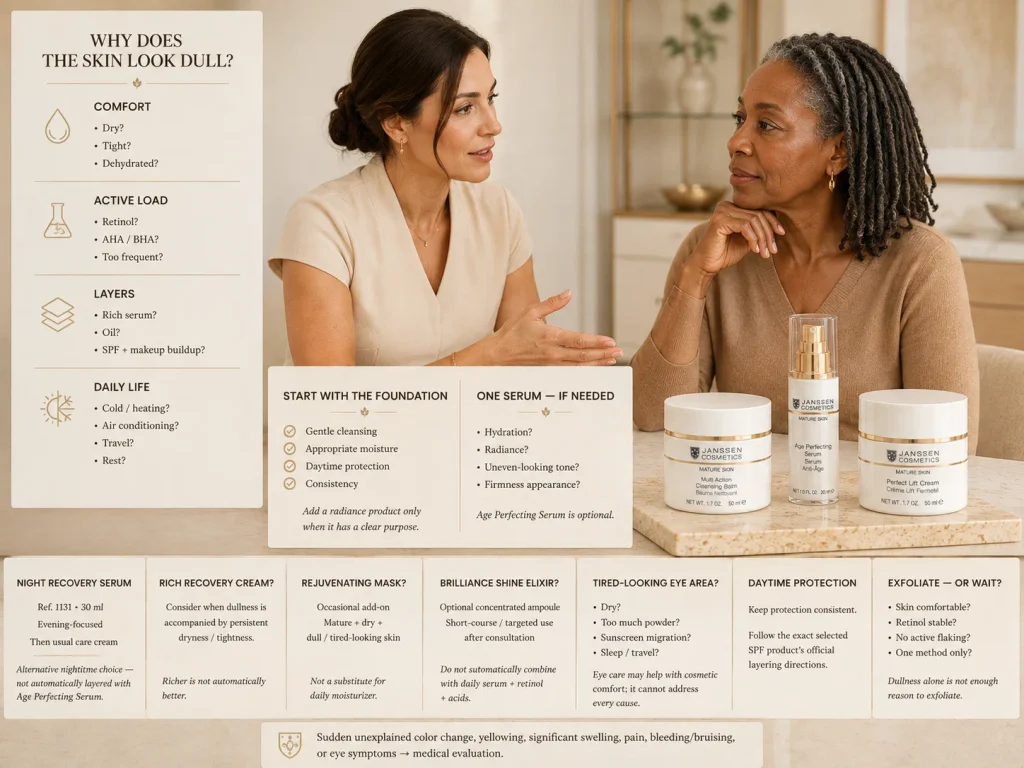
Possible options may include:
These products should not all be used together automatically.
A dull-looking complexion may first need effective but gentle cleansing.
Multi Action Cleansing Balm may be considered when mature skin wears:
Its transforming balm-to-oil-to-milky texture may help remove buildup without aggressive rubbing when used according to directions.
Luxury Oil Cleanser may be considered when dry mature skin prefers a lighter emulsifying oil cleanser.
A second cleanser should be added only when genuinely necessary and comfortable.
Micellar Skin Tonic may be used after cleansing when the skin tolerates an additional step.
Its verified formula includes:
It may support:
It is alcohol-free.
It should be applied gently.
Repeated cotton-pad friction should be avoided.
The tonic is optional.
Age Perfecting Serum may be considered when the mature complexion needs one lightweight daytime or evening serum.
Its verified formula includes:
It may help support:
A possible routine may be:
Appropriate cleanser → optional Micellar Skin Tonic → Age Perfecting Serum → Face Guard Advanced in its officially directed position → selected moisturizer
Appropriate cleanser → optional Micellar Skin Tonic → Age Perfecting Serum → selected moisturizer
The serum is optional.
It should not automatically be layered with Night Recovery Serum, another vitamin C serum, and several ampoules.
Night Recovery Serum may be considered when the complexion looks less rested and the routine needs an evening-focused serum.
Its verified formula includes:
It may support:
A possible evening routine may be:
Appropriate cleanser → optional Micellar Skin Tonic → Night Recovery Serum → Perfect Lift Cream or Rich Recovery Cream
Age Perfecting Serum and Night Recovery Serum do not need to be layered together.
A simpler plan may use:
or:
or:
Perfect Lift Cream may be considered when mature skin needs a supportive daily cream.
Its verified formula includes:
It may support:
A possible routine may be:
Age Perfecting Serum → Perfect Lift Cream
or:
Night Recovery Serum → Perfect Lift Cream
The product amount should remain appropriate.
Too much cream may create heaviness or makeup movement.
Rich Recovery Cream is the richer Mature Skin cream.
Its water-in-oil texture includes lipid-supportive ingredients such as:
It may be considered when dull-looking mature skin is also:
A possible evening routine may be:
Night Recovery Serum → Rich Recovery Cream
This combination may feel too rich for:
The cream may fit nighttime or seasonal use better than every morning.
Rejuvenating Mask is an optional cream mask for mature, dry skin that appears dull or tired.
Its verified formula includes:
It may support:
It should remain an occasional add-on used according to directions.
It does not replace daily moisturizer.
It should not be combined automatically with exfoliating acids, retinol, facial oil, and several serums.
Brilliance Shine Elixir is an ampoule concentrate positioned for tired-looking skin.
Its verified formula includes:
It may support:
An ampoule is a concentrated optional step.
A possible short-course routine may be:
Cleanser → Brilliance Shine Elixir → selected moisturizer
It should not automatically be combined in the same routine with:
A consultation should determine whether the skin needs a daily serum, an occasional ampoule, or only a simpler moisturizer routine.
Tri-Care Eye Cream may be considered when eye-area dryness contributes to a less rested-looking complexion.
Use a small amount according to directions.
A possible order may be:
Facial serum → Tri-Care Eye Cream → facial moisturizer
Do not apply a heavy layer.
Excess eye product may contribute to:
Face Guard Advanced is a lightweight SPF 30 protection concentrate.
Its official Janssen directions place it beneath the selected day cream.
A possible Janssen daytime order may be:
Cleanser → optional tonic → selected serum → Face Guard Advanced → selected day cream
Do not mix Face Guard Advanced into serum or cream.
Follow its product-specific directions.
Appropriate cleanser → Face Guard Advanced in its officially directed position → selected moisturizer
Appropriate cleanser → selected moisturizer
This simple routine may be enough when the skin primarily needs comfort and consistency.
Appropriate cleanser → optional tonic → Age Perfecting Serum → Face Guard Advanced → Perfect Lift Cream
Appropriate cleanser → optional tonic → Night Recovery Serum → Perfect Lift Cream or Rich Recovery Cream
This is an example of possible routine logic.
It is not a universal recommendation.
If the skin is burning, painfully flaky, swollen, rash-like, or reacting to basic moisturizer, radiance-focused serums, ampoules, exfoliation, and masks should wait.
Professional peel products belong in professional treatment settings.
Do not treat mature skin as naturally dull or unhealthy.
Do not promise to restore a permanently youthful glow.
Do not use a strong peel every time the skin looks tired.
Do not combine acid cleanser, acid toner, AHA, BHA, scrub, enzyme peel, and retinol.
Do not scrub visible flakes.
Do not continue retinol through persistent burning or painful dryness.
Do not use facial oil as the only solution for dullness.
Do not confuse immediate shine with hydration.
Do not layer several radiance serums without a clear purpose.
Do not use multiple vitamin C products automatically.
Do not skip moisturizer because the skin is oily.
Do not use a rich cream automatically because the skin is mature.
Do not over-cleanse product buildup.
Do not use hot water.
Do not rub the face until it becomes red-looking.
Do not use undiluted essential oils.
Do not apply lemon juice, baking soda, toothpaste, or harsh home remedies.
Do not introduce a new peel, serum, ampoule, mask, and retinol before an event.
Do not use professional peel products at home.
Do not skip SPF while using exfoliation, retinol, or tone-support products.
Do not mix sunscreen into serum or moisturizer unless specifically directed.
Do not hide sudden, painful, swollen, yellow-looking, or medically concerning changes with makeup.
Do not ignore persistent eye symptoms, significant swelling, bleeding, blistering, crusting, infection-looking changes, or sudden unexplained color changes.
Possible contributors include dehydration, dryness, rough texture, strong cleansing, product buildup, over-exfoliation, retinol-related flaking, uneven-looking tone, environmental exposure, makeup, and inconsistent SPF.
No. Mature skin may look radiant, comfortable, and healthy-looking. Dullness is not an automatic feature of maturity.
Eye-area shadowing, puffiness, dryness, natural facial structure, uneven-looking tone, makeup, and environmental exposure may influence the appearance.
Yes. Dehydrated skin may appear flat, tight, rough, or less flexible.
Yes. Oiliness does not guarantee hydration or even texture. Oily skin may still be dehydrated or over-cleansed.
Dry surface texture and flaking may reduce even light reflection and make the complexion appear less luminous.
A cleanser that is too strong may create tightness, dryness, and roughness that affect radiance.
Heavy skincare, sunscreen, makeup, and incomplete removal may create a coated or uneven-looking finish.
Some mature skin may benefit from gentle, appropriately scheduled exfoliation. It should not be used on irritated, retinol-stressed, or painfully dry skin.
There is no universal schedule. Frequency depends on the product, skin type, sensitivity, retinol use, and other active ingredients.
It may be appropriate for some mature skin. It remains an exfoliating product and should not be combined blindly with acids and retinol.
Some mature skin may use AHA carefully. Dry or sensitive skin may need a gentler approach and less frequent use.
BHA may be more relevant when dullness occurs with clogged-looking or oily areas. It may not be needed across dry cheeks.
Retinol may support texture and tone appearance over time. Overuse may cause flaking and make the skin look less refreshed.
Dryness, flaking, irritation, and an overly frequent schedule may contribute.
Vitamin C may support radiance, antioxidant care, and more even-looking tone when tolerated.
Yes. Formula strength, other actives, dryness, fragrance, and over-exfoliation may affect tolerance.
Peptides may support smoother-looking texture and firmness appearance. They are optional and do not need to be combined with every active ingredient.
Hyaluronic acid may support hydration and a smoother-looking surface. It may already be present in a moisturizer or serum.
Hyaluronic acid may support hydration and a smoother-looking surface. It may already be present in a moisturizer or serum.
Ceramide-focused care may support moisture-barrier comfort and reduce the appearance of dryness and roughness.
Not always. A glow or radiance serum may be useful when it serves a clear purpose and the basic routine is already comfortable.
An appropriate moisturizer may support softness, hydration, comfort, and more even light reflection.
Facial oil is optional. It may support dry-skin comfort but may feel heavy or greasy for oily and combination skin.
A familiar hydrating or comfort-focused mask may temporarily support a fresher-looking complexion. It does not replace daily care.
No. Ampoules are optional concentrated products. A simple routine may be enough.
Matte foundation, too much powder, dryness, product pilling, heavy skincare, and shade mismatch may contribute.
Use comfortable moisturizer, compatible SPF, thin foundation, targeted concealer, and minimal powder.
Poor rest may influence puffiness, eye-area shadowing, dryness, and overall appearance. Skincare cannot replace adequate rest.
Airplane dryness, climate changes, less sleep, more sunscreen, makeup, and unfamiliar products may contribute.
A simple routine may be gentle cleanser, one serum if needed, moisturizer, and daytime SPF.
Toner is optional. A gentle hydrating tonic may fit some routines, while an acid toner should be counted as an exfoliating product.
The skin may be oily but dehydrated, covered with product buildup, rough beneath surface oil, or wearing heavy products.
A sudden, persistent, or unexplained color change—especially yellowing, marked paleness, bruising, or a change accompanied by feeling unwell—should be medically evaluated.
Seek guidance for sudden or persistent changes, significant swelling, pain, bleeding, blistering, crusting, spreading rash-like changes, eye symptoms, or reactions to basic products.
If your mature skin looks dull, flat, or tired even though you are using several products, a free virtual consultation can help you identify what the routine may be missing—or what it may be doing too much of.
At Zendevie, we review your cleanser, hydration, moisturizer texture, serum use, retinol, exfoliation, SPF, eye-area care, makeup, climate, travel, and product-layering habits before discussing recommendations.
The goal is not to force glow through stronger exfoliation.
The goal is to support a comfortable, smoother-looking, and more refreshed complexion through consistent care selected for your skin’s current needs.

Zendevie is guided by Haby Diallo, a licensed esthetician with more than 20 years of professional skincare experience. Her approach is rooted in education, professional judgment, and personal care.
years of experience
