



Mature skin may begin to feel different even when the routine has not changed.
A moisturizer that once felt comfortable may no longer last through the day.
A hydrating serum may make the skin feel refreshed at first, but tightness may return several hours later.
Retinol may create more dryness than it did before.
Winter air, indoor heating, air conditioning, travel, and hot water may make the skin feel increasingly rough.
These changes do not mean the skin is failing.
They may mean the routine needs a better balance of:
Ceramides are one category of lipid used in skincare products designed to support moisture retention and surface comfort.
They may be especially useful when mature skin feels:
However, ceramides are not automatically the answer to every mature-skin concern.
A person may need:
At Zendevie, our licensed esthetician first asks what the skin is actually experiencing.
The goal is not to cover every mature complexion with the richest product available.
The goal is to understand whether the skin needs more hydration, more lipid comfort, or a simpler routine.
Ceramides are skin-related lipids used in cosmetic products to help support the skin’s moisture barrier and reduce the feeling of dryness and tightness.
A ceramide product may help mature skin feel:
A simple ceramide routine may be:
Gentle cleanser or rinse → hydrating serum if needed → ceramide moisturizer → SPF
Gentle cleanser → ceramide serum, capsule, or moisturizer when appropriate → cream if still needed
One ceramide-focused product may be enough.
Do not automatically combine:
in the same routine.
If the skin is burning, swollen, severely itchy, painfully cracked, bleeding, blistering, crusting, oozing, or reacting to water and basic moisturizer, cosmetic ceramide care should wait while professional medical guidance is considered.
Ceramides are a type of lipid naturally associated with the outer layers of the skin.
In skincare, ceramide ingredients are used in formulas designed to support:
Ceramides are often included in:
The presence of ceramides does not tell the whole story.
The product may also contain:
The complete formula determines how the product feels and where it fits into the routine.
The outer surface of the skin helps limit unnecessary moisture loss and provides protection from everyday environmental exposure.
A simplified way to understand it is:
When the surface becomes less comfortable, the skin may feel:
A cosmetic barrier-support routine may help improve comfort.
It cannot diagnose or treat a skin disorder.
“Damaged barrier” is often used online to describe almost every form of discomfort.
But burning, itching, flaking, swelling, bumps, and redness-looking areas may have several causes.
Possible contributors include:
Cosmetic skincare cannot confirm the cause.
It is often safer to describe the skin as:
Persistent or severe symptoms need appropriate professional evaluation.
Mature skin may become more likely to experience:
This does not occur in exactly the same way for everyone.
Some mature complexions remain oily.
Some are combination.
Some become dry only during winter.
Some feel dry because the routine includes too many active products.
Some are dehydrated but still produce noticeable oil.
Ceramides may be useful when lipid comfort is part of the concern.
They should not be recommended only because of age.

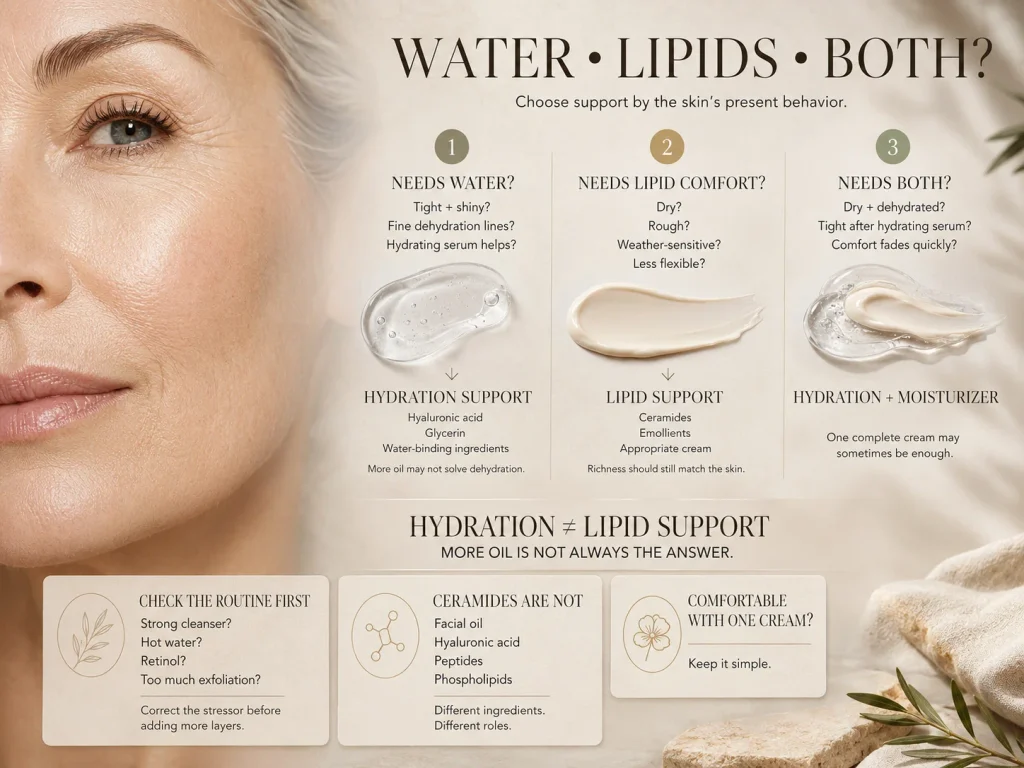
Dry skin generally needs more lipid or oil-related comfort.
Dehydrated skin lacks water.
A complexion can be:
Ceramides may support dry skin.
A hydrating serum may support dehydration.
Some mature skin needs both.
A ceramide cream may provide lipid support, but the skin may still need water-binding ingredients such as:
A balanced routine may be:
Hydrating serum → ceramide moisturizer
However, a well-formulated ceramide cream may already contain enough hydrating ingredients to make a separate serum unnecessary.
More layers are not always better.
Ceramides and hyaluronic acid have different roles.
They may be used together in one product or routine.
Neither ingredient is universally better.
The correct choice depends on whether the skin mainly needs:
Facial oils may contain plant-derived oils such as:
These ingredients may help the skin feel softer and reduce dryness.
However, facial oil and ceramides are not identical.
A facial oil may:
A ceramide product may be formulated to more specifically support the lipid organization of the skin surface.
The overall formula still matters.
Squalane is a lightweight emollient often used to help:
Ceramides are a different lipid category.
A product may contain both.
The combination may be useful for dry mature skin.
It may feel too rich for some oily or humid-weather complexions.
Ceramides are often discussed alongside:
These components may be used together in barrier-support formulations.
A formula does not need to contain every possible lipid to be useful.
The product’s:
matter more than collecting the longest lipid list.
Phospholipids are another lipid category used in some skincare formulas.
They may support:
A product containing a phospholipid complex should not automatically be called a ceramide cream.
Both categories may support barrier comfort, but they are not the same ingredient.
Ceramides and peptides have different cosmetic roles.
A product may include both.
Mature skin does not automatically need separate ceramide and peptide serums.
Occlusive balms may contain ingredients that form a protective surface film.
They may help reduce moisture loss from very dry areas.
However, a heavy balm may:
Ceramides may be included in lighter creams or serums.
A balm is not automatically stronger or better.
A well-formulated ceramide product may help support:
These are cosmetic benefits.
Ceramides should not be described as:
Fine surface lines may appear more visible when the skin is:
Ceramide-focused moisturizer may help the surface look:
This does not permanently remove expression lines or natural mature-skin folds.
Rough mature skin may need:
A ceramide product may help when dryness contributes to roughness.
It may not solve texture caused by:
Understanding the type of texture comes first.
Dry, rough skin may reflect light unevenly and appear less radiant.
A ceramide moisturizer may support:
It does not exfoliate.
If dullness is caused by product buildup or uneven-looking tone, another carefully selected step may be needed.
Ceramides are primarily included for lipid and moisture support.
Improved hydration and surface comfort may make the skin look:
This may improve the overall appearance of firmness.
Ceramides should not be presented as ingredients that permanently lift loose skin.
Some sensitive mature skin may benefit from a simple ceramide moisturizer.
However, a ceramide product may still contain:
Do not assume that the presence of ceramides makes the entire formula appropriate for sensitive skin.
The complete ingredient list and current skin condition matter.
A supportive moisturizer may help redness-prone skin feel more comfortable when dryness is contributing to the appearance.
However, persistent or medically concerning redness may require dermatologist guidance.
Do not say ceramides:
Use safe language such as:
Oily mature skin may still need lipid support, especially when it is:
A lightweight ceramide lotion or serum may be more appropriate than a rich balm.
A possible routine may be:
Gentle cleanser → lightweight ceramide moisturizer
Do not use facial oil, rich ceramide cream, sleeping mask, and balm together automatically.
Combination skin may need:
A zone-based approach may feel better than applying one thick layer everywhere.
Blemish-prone mature skin may be dry or oily.
Ceramides may support comfort when blemish-focused products create dryness.
However, the formula should be evaluated for:
A lightweight ceramide product may suit the skin better than an oil-rich capsule.
Do not assume every bump means the skin needs more exfoliation.
Retinol may make mature skin feel:
A ceramide-focused moisturizer may support comfort during a retinol routine.
A simple schedule may be:
Gentle cleanser → retinol → ceramide moisturizer
Gentle cleanser → ceramide moisturizer
or:
Gentle cleanser → hydrating serum → ceramide moisturizer
Ceramides do not make excessive retinol use safe.
If the skin is burning or painfully peeling, pause retinol.
A ceramide moisturizer may be used in a buffered retinol routine:
Gentle cleanser → light ceramide moisturizer → retinol → moisturizer
This may help selected dry or sensitive mature skin.
However, the method may feel too heavy when:
It does not guarantee that irritation will not occur.
Exfoliation may create more dryness when used:
A ceramide moisturizer may support comfort after an appropriate exfoliation step.
A simple routine may be:
Gentle cleanser → one exfoliant according to directions → ceramide moisturizer
Do not use the moisturizer as permission to combine several acids.
Ceramide products may be used in a routine with vitamin C when the formulas are appropriate.
A possible morning routine may be:
Gentle cleanser → vitamin C serum → ceramide moisturizer → SPF
Some ceramide products already include a vitamin C derivative.
A separate vitamin C serum may be unnecessary.
Review the full routine to avoid overlap.
Niacinamide may support the skin’s own lipid and barrier-related processes.
It is often included in formulas designed for:
Ceramides and niacinamide may appear together.
A separate niacinamide serum may not be needed.
Sensitive skin may still react to the complete formula.
A peptide serum may be followed by a ceramide moisturizer:
Gentle cleanser → peptide serum → ceramide moisturizer
This may suit mature skin focused on:
The routine does not automatically need a second peptide cream, facial oil, and capsule.
Ceramide products may include antioxidants such as:
These ingredients may help support:
Antioxidants do not replace SPF.
Ceramides do not protect the skin from UV exposure unless the finished product is officially labeled with SPF.
A morning routine may be:
Gentle cleanser or rinse → ceramide moisturizer → SPF
When using a product with a specific layering order, follow its official directions.
Do not mix separate sunscreen into ceramide cream.
May be:
May be:
The skin may not need both.
Ceramide capsules provide a measured amount of product.
They may contain:
A capsule may feel:
It is not the same texture as a water-based serum.
Capsules may suit dry mature skin better than oily or congestion-prone skin.
Not necessarily.
A capsule may provide lipid-rich support but may not provide the same balance of:
A common product-specific order may be:
Ceramide capsule → moisturizer
However, exact directions matter.
Some people may find the capsule plus cream too heavy.
A ceramide cream may provide a more balanced blend of:
A facial oil contains little or no water.
Someone with dry and dehydrated mature skin may find a cream more complete than oil alone.
Oil may be an optional final step on selected dry areas.
Ceramide-focused care may be useful when:
The product should still match the skin’s oil level and texture preference.
Ceramides may not be the first answer when:
Correct the routine issue before adding more layers.
There is no required number.
One ceramide product may be enough.
A routine containing:
may feel unnecessarily heavy.
Ask:
The skin does not count how many products contain ceramides.
A simple morning routine may be:
Gentle cleanser or rinse → ceramide moisturizer → SPF
A routine with serum may be:
Gentle cleanser → hydrating or peptide serum → ceramide moisturizer → SPF
Optional:
Avoid too many rich layers beneath sunscreen.
A simple evening routine may be:
Gentle cleanser → ceramide moisturizer
A richer routine may be:
Gentle cleanser → hydrating serum → ceramide cream
A capsule routine may be:
Gentle cleanser → ceramide capsule according to directions → moisturizer
Use only what the skin needs.
Dry mature skin may prefer:
A possible routine may be:
Gentle creamy cleanser or rinse → hydrating serum if needed → ceramide moisturizer → SPF
Gentle cleanser → ceramide-focused product → richer moisturizer if still needed
Do not use hot water or frequent exfoliation while trying to improve comfort.
Dehydrated skin may first need:
A ceramide cream may then help reduce moisture loss.
A possible routine may be:
Hydrating serum → ceramide moisturizer
If the skin is oily, choose lighter textures.
Oily mature skin may prefer:
Avoid:
all in the same routine.
A zone-based routine may include:
Observe how each zone responds.
Sensitive mature skin may benefit from a simple, fragrance-conscious ceramide product.
Before introducing it:
Ceramides do not make an actively irritating formula suitable.
A possible routine may be:
Gentle cleanser or rinse → ceramide moisturizer → SPF
Gentle cleanser → retinol → ceramide moisturizer
Gentle cleanser → hydrating serum if needed → ceramide moisturizer
If moisturizer and SPF sting, pause retinol.
Gentle cleanser → one exfoliant according to directions → ceramide moisturizer
Gentle cleanser → ceramide moisturizer
Do not exfoliate again because the skin still feels rough immediately afterward.
The eye contour may benefit from a lipid-supportive eye product when it feels:
Do not apply facial ceramide capsules directly to:
unless the product is specifically directed for that area.
A rich product may contribute to puffiness or concealer movement when too much is used.
The neck and décolleté may benefit from lipid support when they feel:
Introduce rich products carefully.
The upper chest may become:
A lighter barrier-support cream may be preferable during the day.
Winter may increase:
A ceramide cream may fit well during:
The retinol or exfoliation schedule may still need to be reduced.
Hot and humid weather may make a rich ceramide product feel:
Possible adjustments include:
The skin does not need the same texture year-round.
Travel may increase dryness because of:
Bring a familiar ceramide product.
Do not test a rich new capsule or balm for the first time during travel.
A balanced ceramide moisturizer may help:
Too much may cause:
Use a controlled amount and allow it to settle.
Possible reasons include:
Review the entire routine.
Do not automatically add several oils.
The skin may need more emollient or lipid support.
Try:
Hydrating serum → appropriate moisturizer
A ceramide cream may be useful.
Observe whether comfort lasts longer.
Try:
A heavy texture is not required for barrier comfort.
A serum may not provide enough lasting moisture support.
Apply an appropriate moisturizer over it.
Dry mature skin may prefer a cream instead of serum plus several layers.
Use the directed amount.
A capsule already provides a measured oil-rich dose.
Do not add facial oil.
Consider:
Possible contributors include:
Do not immediately apply acids.
Simplify the routine and observe.
Persistent, itchy, swollen, painful, or spreading bumps need professional evaluation.
Pilling may result from:
Test a simpler morning:
Gentle cleanser → ceramide moisturizer → SPF
If pilling continues, adjust the formula or use the ceramide product only at night.
Assess whether the skin feels:
A luminous finish may be acceptable.
Excessive heaviness may indicate that a lighter product is needed.
Stop using it.
Ceramides themselves may not be the only possible cause.
The formula may also contain:
Also review whether the skin was already irritated.
Persistent stinging requires professional guidance.
Pause retinol.
Do not simply apply more ceramide cream over ongoing burning.
Use:
If basic products continue to sting, seek dermatologist guidance.
Retinol use may be too frequent or the formula may not suit the skin.
Pause or reduce retinol.
Do not use ceramides as permission to continue through painful irritation.
Visible smoothness does not always mean adequate comfort.
The formula may create a surface film without enough water-based hydration.
Consider:
Appearance and comfort should be assessed together.
The product may simply have a richer finish.
Decide whether the finish suits:
A lighter daytime product and richer nighttime product may work better.
Seasonal adjustment is appropriate.
Use:
The routine does not need to remain identical all year.
The skin may need:
A ceramide ingredient does not require a rich texture.
Stop introducing new products.
Use only previously tolerated care.
Pause:
Seek dermatologist guidance if basic moisturizer or water continues to cause significant discomfort.
The skin may need different care by area.
For example:
Do not use full-face strong exfoliation.
This may suggest dehydration or over-cleansing.
A lightweight routine may include:
Gentle cleanser → hydrating serum → lightweight ceramide moisturizer
Avoid strong degreasing cleansers.
Continue the simpler routine.
A separate serum is not mandatory.
A complete routine may be:
Cleanser → ceramide moisturizer → SPF
A separate ceramide serum or capsule may be unnecessary.
Ask whether the skin:
Do not duplicate ingredients without a clear reason.
Do not begin a ceramide serum, capsule, cream, oil, and mask simultaneously.
Ask:
The correct recommendation may be a different cleanser rather than another moisturizer.
Seek dermatologist guidance when the skin develops:
Seek prompt eye-care guidance for:
Seek urgent medical care for:
Cosmetic ceramide care cannot diagnose dermatitis, allergy, infection, eczema, or another medical condition.
After consultation, our licensed esthetician may consider Janssen Cosmetics options according to whether the mature complexion needs direct ceramide support, broader lipid comfort, water-based hydration, sensitivity care, or a lighter moisturizer texture.

Possible options may include:
These products should not all be layered together automatically.
Ceramide Protection is the Mature Skin family’s direct ceramide-focused home-care product.
It comes in premeasured capsules containing a silky, fast-absorbing oil.
Its verified active profile includes:
The formula may help support:
The stronger manufacturer language should be translated into safe cosmetic expectations.
Ceramide Protection should not be described as permanently rebuilding collagen, reversing aging, or removing pigmentation.
Ceramide III is included to support the skin’s natural moisture barrier by adding lipid support.
It may help:
This does not mean the capsule cures a barrier disorder.
Ceramide Protection contains an oil-soluble vitamin C derivative.
Within the cosmetic formula, it may support:
Because the capsule already contains a vitamin C derivative, a separate strong vitamin C serum may be unnecessary.
Sensitive mature skin should not layer several vitamin C products automatically.
The verified home-care directions recommend applying Ceramide Protection in the morning and/or evening before the selected skincare cream.
The capsule is opened, and its contents are applied with the fingertips.
A possible evening routine may be:
Gentle cleanser → Ceramide Protection → Perfect Lift Cream or Rich Recovery Cream
A possible morning routine may be:
Gentle cleanser or rinse → Face Guard Advanced → Ceramide Protection → selected day cream
This daytime sequence is product-specific.
The verified Janssen directions place Face Guard Advanced before the Ceramide Protection capsule and then the care cream.
Do not replace that sequence with a generic sunscreen-last rule.
It may suit mature skin that is:
It may feel too rich for:
The verified product guidance recommends the 30 capsules as a month-long course, while also allowing targeted use when needed.
This does not mean every mature complexion needs continual capsule use.
A consultation should determine whether the product fits:
Do not invent frequency beyond the official directions and personalized routine.
Ceramide Protection is an oil-like capsule.
It should not be confused with:
A person with dry and dehydrated skin may still need water-binding hydration.
A possible routine may be:
Hydrating serum → Ceramide Protection → cream
However, this may become too layered.
A simpler routine may use the capsule plus one suitable cream.
Rich Recovery Cream is the richer Mature Skin moisturizer.
Its water-in-oil texture includes:
A possible dry-skin evening routine may be:
Gentle cleanser → Ceramide Protection → Rich Recovery Cream
This may suit:
It may feel excessive for:
Do not use the richest combination automatically.
Perfect Lift Cream provides a lighter alternative within the Mature Skin family.
Its formula includes:
A possible routine may be:
Ceramide Protection → Perfect Lift Cream
This may offer ceramide capsule support followed by a less rich cream than Rich Recovery Cream.
The correct pairing depends on dryness and climate.
A ceramide capsule may fit a recovery evening after retinol use.
For example:
Gentle cleanser → one retinol product → moisturizer
Gentle cleanser → Ceramide Protection → selected cream
Do not automatically layer Ceramide Protection over:
This may become heavy and difficult to assess.
Ceramide Protection may be considered on a recovery evening after an exfoliation schedule.
Do not automatically combine it with:
in the same evening.
A simple moisturizer may be enough immediately after exfoliation.
The capsule contains more than ceramides.
It also contains:
Very sensitive mature skin should introduce it carefully.
If the skin is actively burning or reacting to basic care, a simpler Sensitive Skin moisturizer may be more appropriate.
Vitalizing Skin Refiner does not need to be called a ceramide cream.
However, it contains SLM Regenerator, a phospholipid-based ingredient system with lamellar structures designed to resemble the lipid organization of the outer skin.
It also includes:
It may support:
Its lightweight, fast-absorbing texture may suit mature skin that wants barrier support without an oil capsule or rich cream.
A possible morning routine may be:
Gentle cleanser → Face Guard Advanced → Vitalizing Skin Refiner
Pro-Lift Cream also contains SLM Regenerator and an amino-acid complex.
Its richer evening texture may suit:
A possible evening routine may be:
Gentle cleanser → Pro-Lift Cream
A separate ceramide capsule may be unnecessary.
May suit:
May suit:
They should not automatically be layered together.
A person wanting fewer steps may prefer one complete cream.
When mature skin is highly reactive, consultation may prioritize:
These products are selected according to sensitivity and texture needs.
They should not be described as ceramide products unless the verified formula contains ceramides.
Their purpose may be to support:
A mature-skin family product is not always the best choice.
Face Guard Advanced is Janssen’s SPF 30 protection concentrate.
It does not replace ceramide moisturizer.
It supports daytime protection within a well-aging routine.
When used with Ceramide Protection, the verified product-specific order is:
Face Guard Advanced → Ceramide Protection → selected day cream
Do not mix the products together.
Ceramide RE-BARRIER Mask is a professional sheet-mask product from the Essentials range.
Its verified formula includes:
It is designed to support:
This is a professional-format product.
It should not be presented as an ordinary home-care mask or sold as a beginner home routine step without verifying its intended professional use.
Biocellulose Mask Pro-Youth is also a professional Essentials mask.
Its formula includes a ceramide-related ingredient system alongside:
It is positioned for:
It remains a professional treatment product.
Do not present it as routine home care.
Gentle cleanser or rinse → Face Guard Advanced → selected moisturizer
Gentle cleanser → Ceramide Protection when appropriate → Perfect Lift Cream or Rich Recovery Cream
The capsule is optional.
Gentle cleanser → Face Guard Advanced → Vitalizing Skin Refiner
Gentle cleanser → Vitalizing Skin Refiner or another lightweight moisturizer
This may suit skin that dislikes oil capsules.
Gentle cleanser or rinse → Face Guard Advanced → Perfect Lift Cream
Gentle cleanser → Ceramide Protection → Rich Recovery Cream when the skin genuinely needs the richer combination
Gentle cleanser → one retinol product → selected moisturizer
Gentle cleanser → Ceramide Protection or a barrier-support cream—not every product together → moisturizer when needed
Gentle cleanser or rinse → tolerated calming moisturizer → tolerated daytime protection
Gentle cleanser → tolerated calming moisturizer
Ceramide Protection should wait until the skin is stable enough to assess a more complex formula.
Product recommendation should wait when the skin has:
Medical evaluation comes before cosmetic barrier-support products.
Do not assume every mature complexion needs ceramides.
Do not describe all dryness as barrier damage.
Do not assume dry and dehydrated skin are the same.
Do not expect ceramides to replace water-based hydration.
Do not expect hyaluronic acid to replace lipid support.
Do not treat facial oil and ceramides as identical.
Do not call every phospholipid product a ceramide product.
Do not layer ceramide serum, capsule, cream, oil, balm, and mask automatically.
Do not use the richest formula simply because the skin is mature.
Do not apply excessive product to force comfort.
Do not continue retinol through painful peeling because a ceramide cream is available.
Do not continue exfoliation while moisturizer and SPF sting.
Do not cover significant burning with several rich layers.
Do not apply oil-rich capsules directly to the eyelids.
Do not combine several vitamin C products blindly.
Do not mix sunscreen into a ceramide moisturizer.
Do not expect ceramides to cure eczema, dermatitis, allergy, or rosacea.
Do not promise permanent barrier repair.
Do not promise permanent wrinkle removal.
Do not promise that ceramides will prevent every reaction.
Do not exfoliate because a ceramide cream causes pilling.
Do not label every bump as purging.
Do not use sales information as evidence that a product works.
Do not present professional masks as ordinary home-care products.
Do not ignore persistent swelling, itching, cracking, bleeding, blistering, crusting, eye symptoms, or infection-looking changes.
Ceramides are lipids used in skincare formulas designed to support moisture retention, surface comfort, and the skin’s natural barrier function.
They may be helpful for mature skin that feels dry, tight, rough, or affected by weather and active products.
No. Some mature skin is oily, combination, comfortable, or more dehydrated than dry.
They may help support softness, moisture retention, reduced feelings of tightness, and a smoother-looking surface.
Ceramide products may support natural barrier function and comfort. They should not be presented as permanently repairing every skin concern.
No. “Damaged barrier” is not one universal cosmetic diagnosis. Persistent symptoms may need dermatologist evaluation.
Ceramides provide lipid-related support. The finished product may also contain humectants, oils, and emollients that provide broader moisturization.
No. Ceramides support lipid comfort, while hyaluronic acid primarily supports water-binding hydration.
Yes. Many mature-skin routines benefit from both water-based hydration and lipid support.
No. Facial oils and ceramides are different lipid categories and may perform different roles within a formula.
No. Squalane is an emollient. It may be combined with ceramides in a moisturizer.
No. Peptides are amino-acid chains generally used for different cosmetic appearance goals.
It may benefit from ceramide care, especially when tightness, roughness, or weather-related dryness is present.
Yes. A lightweight ceramide lotion or serum may suit oily mature skin better than a rich balm.
Yes. Apply lighter support across the face and richer products only on dry zones when needed.
Some sensitive skin may benefit, but the complete formula—including fragrance and active ingredients—must be reviewed.
Possibly. Ceramide products may support comfort but do not treat rosacea or another medical condition.
Possibly. Ceramide products may support comfort but do not treat rosacea or another medical condition.
Yes, but a lightweight, non-heavy texture may be more appropriate than an oil-rich product.
Yes. A ceramide moisturizer may support comfort within a carefully managed retinol routine.
No. They may support comfort, but they do not make excessive retinol use safe.
Yes, when the exfoliation is appropriate and the product directions allow. A simple ceramide moisturizer may be enough afterward.
Yes. Some ceramide products already contain vitamin C derivatives, making a separate vitamin C serum optional.
Yes. A peptide serum may be followed by a ceramide moisturizer.
Yes, and some formulas use niacinamide to support barrier comfort and the skin’s own ceramide-related processes.
A lightweight ceramide serum generally goes before moisturizer unless the product directions state otherwise.
A ceramide cream may serve as the moisturizer step when it provides enough hydration and comfort.
Ceramide Protection is officially applied before the selected skincare cream
Not always. An oil-like capsule may still need a cream over it according to the product directions and skin needs.
There is no required number. One well-selected product is often enough.
They may be used morning, evening, or both depending on the product directions and texture.
A balanced ceramide moisturizer may improve comfort and reduce visible flaking. Excessively rich products may make makeup move.
The formula may be too rich, too much may be used, or several oily layers may already be present.
A serum may not provide enough emollient or occlusive support. Apply an appropriate moisturizer or choose a cream.
A rich texture, excessive product, facial oil, makeup, sunscreen, or formula sensitivity may contribute.
Too many serums, facial oil, heavy moisturizer, incompatible sunscreen, or repeated rubbing may cause pilling.
The finished formula may contain other active or fragranced ingredients, or the skin may already be irritated.
They may soften the appearance of fine dryness lines through moisture support. They cannot permanently remove wrinkles.
Improved hydration and comfort may help the skin look smoother and better supported. Ceramides do not permanently lift the face.
By supporting softness and smoother-looking texture, they may help the complexion reflect light more evenly.
A product specifically designed for the eye contour may support dryness and comfort. Facial capsules should not be applied directly to the eyelids.
Yes, when the product directions and skin tolerance support it. Rich textures may feel heavy beneath clothing.
They may be especially helpful when cold weather and indoor heating increase dryness.
Not necessarily. A lighter ceramide serum or lotion may feel more comfortable in hot, humid weather.
Review dehydration, cleanser strength, active-product use, climate, moisturizer texture, and possible medical causes.
Stop testing new products, pause active ingredients, and seek dermatologist guidance when basic products or water continue causing significant discomfort.
Seek guidance for persistent burning, severe itching, swelling, painful cracks, bleeding, blistering, crusting, oozing, infection-looking changes, or reactions that do not improve.
If your mature skin still feels tight after using a hydrating serum, or if every rich moisturizer feels too heavy, a free virtual consultation can help you understand whether the skin needs more water-based hydration, more lipid support, or a simpler routine.
At Zendevie, we review your cleanser, moisturizer, retinol, exfoliation, SPF, facial oils, climate, sensitivity, makeup, and current product textures before discussing ceramides.
The goal is not to cover the skin with as many barrier products as possible.
The goal is to choose one comfortable source of hydration and lipid support that fits your skin’s present needs and helps the routine remain consistent.

Zendevie is guided by Haby Diallo, a licensed esthetician with more than 20 years of professional skincare experience. Her approach is rooted in education, professional judgment, and personal care.
years of experience
