


Combination skin needs balance.
It does not need to be dried out.
When your forehead, nose, or chin feel oily, it is tempting to use stronger cleansers, drying toners, more exfoliation, or mattifying products everywhere. But if your cheeks are dry, tight, normal, or sensitive, that approach can make the whole face feel more uncomfortable.
The T-zone may feel less shiny for a moment.
But the cheeks may become tight.
The skin may feel oily and dry at the same time.
Makeup may separate in one area and cling in another.
At Zendevie, combination skin is never handled with a one-size-fits-all routine. In consultation, our licensed esthetician looks at the T-zone, cheeks, mouth area, sensitivity, hydration, cleanser choice, moisturizer texture, SPF habits, makeup behavior, and whether active products are helping or making balance harder.
Combination skin should feel clean, comfortable, and supported.
Not stripped.
To balance combination skin without over-drying, use a gentle cleanser, lightweight moisturizer, SPF, and zone-by-zone product placement. Treat the oily T-zone without irritating dry or sensitive cheeks.
A simple routine may look like:
Morning: Gentle cleanser → lightweight moisturizer by zone → SPF
Evening: Gentle cleanser → moisturizer by zone
If needed, targeted support may be added carefully:
The goal is not to make the face matte everywhere.
The goal is to help each zone feel balanced.
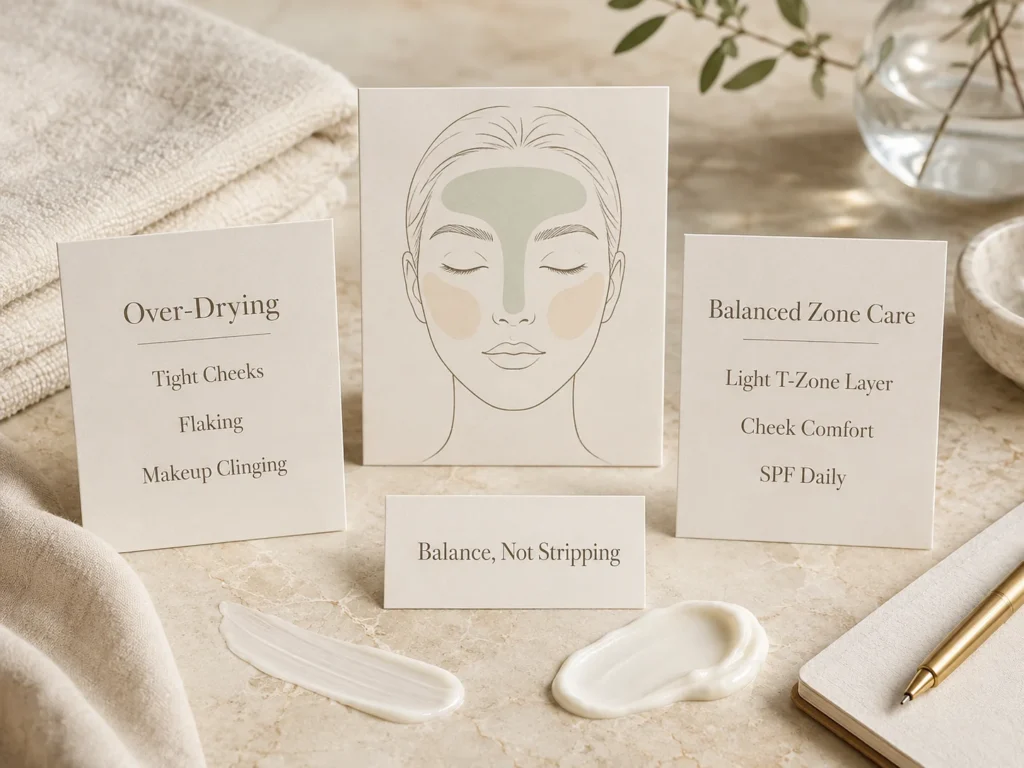
Over-drying combination skin can make balance harder.
When the whole face is treated like oily skin, the dry or normal areas may become uncomfortable.
This can lead to:
Drying the skin is not the same as balancing the skin. Reviewing the common combination skin mistakes can also help you spot habits that keep the face feeling unbalanced.
Combination skin needs control in oily areas and comfort in dry areas.
The T-zone includes the forehead, nose, and chin.
This area often produces more oil.
It may need help with:
But the T-zone should not be stripped until it feels tight.
If the T-zone feels oily but uncomfortable, the routine may be too drying or dehydrating.
The goal is a cleaner, fresher-looking T-zone without making the skin feel raw.
The cheeks may be dry, normal, or sensitive in combination skin.
They may not tolerate the same products used on the T-zone.
Cheeks may become irritated by:
Balancing combination skin means respecting the cheeks.
The oily areas should not decide the entire routine.
A balanced routine begins with cleanser.
The cleanser should remove oil, SPF, makeup, sweat, and residue without making the cheeks tight.
A good cleanser for combination skin should leave the skin feeling:
If the cheeks feel tight after cleansing, the cleanser may be too strong.
If the T-zone feels heavy after cleansing, the cleanser may not be enough.
The right cleanser should support both zones.
A squeaky-clean feeling is not always a good sign.
For combination skin, that feeling may mean too much oil and moisture have been removed.
This can make the cheeks feel dry and the T-zone feel oily again later.
Signs of over-cleansing include:
Combination skin should feel clean, not stripped.
Toner can support combination skin when it helps the skin feel fresh and balanced.
But toner should not dry out the cheeks.
A toner may be helpful if:
A toner may not be helpful if:
Combination skin toner should support balance, not force dryness.
Combination skin still needs moisturizer.
Skipping moisturizer can make the cheeks drier and the T-zone feel oily but tight.
Moisturizer helps support:
The key is texture and placement.
Combination skin usually does better with a lightweight moisturizer adjusted by zone.
Zone moisturizing means adjusting how much product you apply to each area.
For example:
This helps the routine feel balanced instead of heavy or drying.
A rich cream may comfort dry cheeks, but it may feel too heavy on the T-zone.
If heavy cream is applied everywhere, the T-zone may become:
This does not mean rich cream is wrong.
It means it may belong only where the skin needs that level of comfort.
Mattifying products may help oily areas, but they can be too drying for cheeks.
If a mattifying product makes dry zones tight or rough, use it more carefully.
A better approach may be:
Combination skin often needs placement control.
Not one product everywhere.
SPF should not be skipped because the T-zone is oily.
A balanced morning routine still needs daytime protection.
Morning routine:
Gentle cleanser → lightweight moisturizer by zone → SPF
If SPF feels greasy or pills, review the routine underneath before removing SPF.
Possible causes of SPF problems include:
SPF should remain the final morning skincare step.
Exfoliation may help combination skin when there is rough texture, dullness, or clogged-looking buildup.
But it should not be used aggressively.
The T-zone may need more exfoliation support than the cheeks.
The cheeks may need less.
Avoid exfoliating the whole face if only the nose or chin feels congested.
Exfoliation should support smoothness without creating tightness, flaking, or sensitivity.
BHA may be helpful when the T-zone has clogged-looking pores, blackheads, whiteheads, or oily buildup.
But BHA should not automatically be applied all over the face.
BHA should wait if the skin is:
For combination skin, BHA is often a targeted support step, not a whole-face rule.
Clay masks can help oily areas feel cleaner and less shiny-looking.
But clay masks can dry out cheeks if used everywhere.
A better approach:
Do not dry out the cheeks to manage the nose.
Combination skin can be dehydrated.
This means the skin may lack water, even if the T-zone is oily.
Hydration support may help if the skin feels:
A light hydrating serum may help some combination skin routines.
It should be followed with moisturizer.
Combination skin can also be sensitive.
The cheeks or mouth area may react more easily than the T-zone.
If the skin is sensitive, balance should begin with calm.
A simple routine may be:
Morning: Mild cleanser → lightweight moisturizer → SPF
Evening: Mild cleanser → moisturizer
Active products should wait until the skin feels stable.
Do not try to balance sensitive combination skin with strong products.
Morning combination skin care should focus on comfort, balance, and SPF.
A simple morning routine:
Gentle cleanser → lightweight moisturizer by zone → SPF
If serum is needed:
Gentle cleanser → serum if appropriate → lightweight moisturizer by zone → SPF
The morning routine should not feel heavy on the T-zone or tight on the cheeks.
It should be easy to wear during the day.
Evening care should remove the day without stripping the skin.
A simple evening routine:
Gentle cleanser → moisturizer by zone
If wearing makeup or SPF:
Makeup/SPF removal step if needed → gentle cleanser → moisturizer by zone
If targeted support is needed:
Cleanser → targeted support only where appropriate → moisturizer
Evening should help the skin reset, not become irritated.
Balanced combination skin does not have to be completely matte.
Natural oil is normal.
The goal is not to erase shine from every area.
A balanced routine should help the skin feel:
A little natural glow is not a problem.
Balanced skin also does not mean heavy cream everywhere.
Combination skin may need:
Balance is about matching the zone.
Not applying the same amount everywhere.
You may be over-drying combination skin if:
If this happens, simplify the routine.
You may be over-moisturizing certain zones if:
This may mean the moisturizer is too rich for the oily areas.
You may still need moisturizer, but less or lighter texture in the T-zone.
To balance the T-zone:
The T-zone needs structure.
Not harshness.
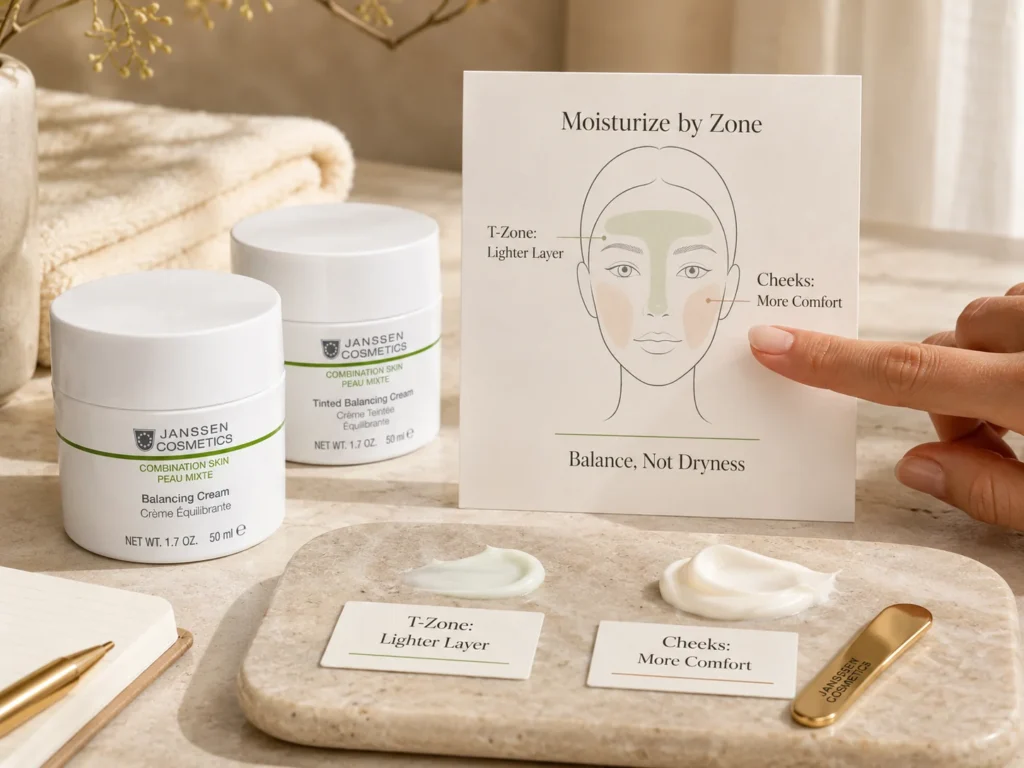
To comfort the cheeks:
The cheeks should not suffer because the T-zone is oily.
The nose often has more oil and visible pores.
Support the nose with:
Do not try to scrub pores away.
Pores are normal.
The chin may be oily, dry, sensitive, or blemish-prone.
It may also develop post-blemish marks.
Support the chin with:
The chin may need a different approach than the cheeks.
Dry cheeks need comfort.
Support dry cheeks with:
Dry cheeks can make combination skin feel more sensitive and patchy.
Protect them.
Sensitive cheeks may need calming before balancing products.
Support sensitive cheeks with:
If cheeks are burning, stinging, rash-like, swollen, painful, or worsening, seek dermatologist guidance.
Combination skin often causes makeup problems.
Makeup may separate on the T-zone but cling to cheeks.
To support better makeup texture:
Makeup problems often reveal routine imbalance.
If SPF feels greasy on the T-zone:
If SPF clings to cheeks:
Do not skip SPF.
Adjust the routine underneath.
A balanced combination skin routine may look like this:
Morning:
Gentle cleanser → lightweight moisturizer by zone → SPF
Evening:
Gentle cleanser → moisturizer by zone
Optional support:
The foundation should stay simple.
If the routine feels unbalanced, do not add five products at once.
Start with one adjustment.
Possible first adjustments:
Small changes can make combination skin easier to understand.
If combination skin feels irritated or over-dried, pause:
Return to:
Morning: Mild cleanser → moisturizer → SPF
Evening: Mild cleanser → moisturizer
Then rebuild carefully.
You may need different products by zone if:
Zone care does not have to be complicated.
It can be as simple as changing the amount and placement.
Sometimes one product can work for the whole face if it is balanced enough.
A good whole-face product for combination skin should feel:
If one product works, keep the routine simple.
Do not make the routine complicated just because the skin is combination.
Weather can change combination skin.
In summer, the T-zone may feel oilier because of heat, sweat, and SPF buildup.
In winter, cheeks may become drier because of cold air, indoor heat, and hot water.
A balanced routine may need seasonal adjustment.
Summer may need:
Winter may need:
The skin’s needs can change.
Stress and travel can make combination skin feel less predictable.
You may notice:
During travel or stress, keep the routine simple.
Do not test strong new products when the skin is already unbalanced.
Professional guidance may help if:
A consultation can help identify what each zone needs.
A dermatologist should evaluate the skin if there are warning signs such as:
Cosmetic skincare can support comfort and appearance, but medical-looking changes need medical evaluation.

After consultation, our licensed esthetician may consider Janssen Cosmetics options depending on which zones need balance, comfort, hydration, oil control, or sensitivity support.
For combination skin balance, possible options may include:
For oily T-zone support, possible options may include:
For dry or dehydrated cheeks, possible options may include:
For sensitive or overworked cheeks, comfort-focused options may come first, such as:
For morning routines, Face Guard Advanced SPF 30 may be considered as the final daytime protection step when appropriate and tolerated.
These are not automatic recommendations. Combination skin should be supported zone by zone, so the oily areas feel balanced without drying out the cheeks.
Do not strip the whole face to control the T-zone.
Do not skip moisturizer.
Do not apply clay mask to dry cheeks if it makes them tight.
Do not use drying toner everywhere.
Do not scrub the nose or chin aggressively.
Do not apply BHA to dry or sensitive cheeks unnecessarily.
Do not use heavy cream everywhere if it makes the T-zone greasy.
Do not skip SPF because the T-zone is oily.
Do not over-exfoliate.
Do not introduce too many new products at once.
Do not apply active products to broken, crusted, bleeding, painful, or freshly picked skin.
Do not ignore persistent rash-like irritation, swelling, pain, severe itching, oozing, or worsening skin changes.
Start with a gentle cleanser, lightweight moisturizer by zone, and SPF. Add targeted support only where needed.
Combination skin gets over-dried when products meant for oily areas are applied too aggressively to the whole face, especially the cheeks.
Sometimes on the T-zone, but not always on the whole face. Dry or sensitive cheeks may need gentler care.
Yes. Combination skin still needs moisturizer. The texture and amount may need to be adjusted by zone.
A lightweight moisturizer often works well, with more product on dry areas and less on oily zones.
Yes, if tolerated. Toner should not sting, burn, or make cheeks feel tight.
BHA may be reviewed for clogged-looking T-zone areas, blackheads, whiteheads, or oily buildup, but it should not be applied blindly to dry or sensitive cheeks.
A clay mask may be used on the oily T-zone if appropriate, but it should not dry out the cheeks.
The T-zone often produces more oil, while the cheeks may produce less oil or need more moisture and comfort.
Use a gentle cleanser, moisturize by zone, and apply SPF every morning. Then adjust targeted products slowly.
If your skin feels oily in one area and dry in another, you do not need to force one product to solve everything.
Combination skin needs a thoughtful routine that respects each zone.
At Zendevie, a free virtual consultation helps us review your T-zone, cheeks, cleanser, moisturizer texture, SPF habits, toner use, makeup behavior, sensitivity, hydration level, and current products before recommending anything.
The goal is balance.
Not dryness.

Zendevie is guided by Haby Diallo, a licensed esthetician with more than 20 years of professional skincare experience. Her approach is rooted in education, professional judgment, and personal care.
years of experience