


Combination skin can feel frustrating when the routine is not balanced.
The T-zone may stay shiny.
The cheeks may feel dry or tight.
Makeup may separate on the nose but cling to the cheeks.
SPF may feel greasy in one area and dry in another.
When this happens, many people think they need stronger products. But often, combination skin does not need a stronger routine.
It needs a smarter one. A practical first step is to balance combination skin without over-drying either zone.
At Zendevie, we look at combination skin zone by zone before recommending products. In consultation, our licensed esthetician reviews the T-zone, cheeks, cleanser, toner, moisturizer, SPF, makeup habits, sensitivity, hydration level, exfoliation habits, and current products to understand what may be making balance harder.
Combination skin usually does not become easier through force.
It becomes easier through better placement, better texture, and better patience.
The most common combination skin mistakes include:
A better routine usually begins with:
Morning: Gentle cleanser → moisturizer by zone → SPF
Evening: Gentle cleanser → moisturizer by zone
Then targeted support can be added only where needed and only when the skin is stable.
This is one of the biggest mistakes.
Because the T-zone gets oily, many people choose products made for oily skin and apply them everywhere.
That may feel good on the forehead, nose, or chin for a short time.
But the cheeks may become:
Combination skin is not oily skin everywhere.
The cheeks may need comfort while the T-zone needs light balance.
The whole face should not be punished because one area gets shiny.
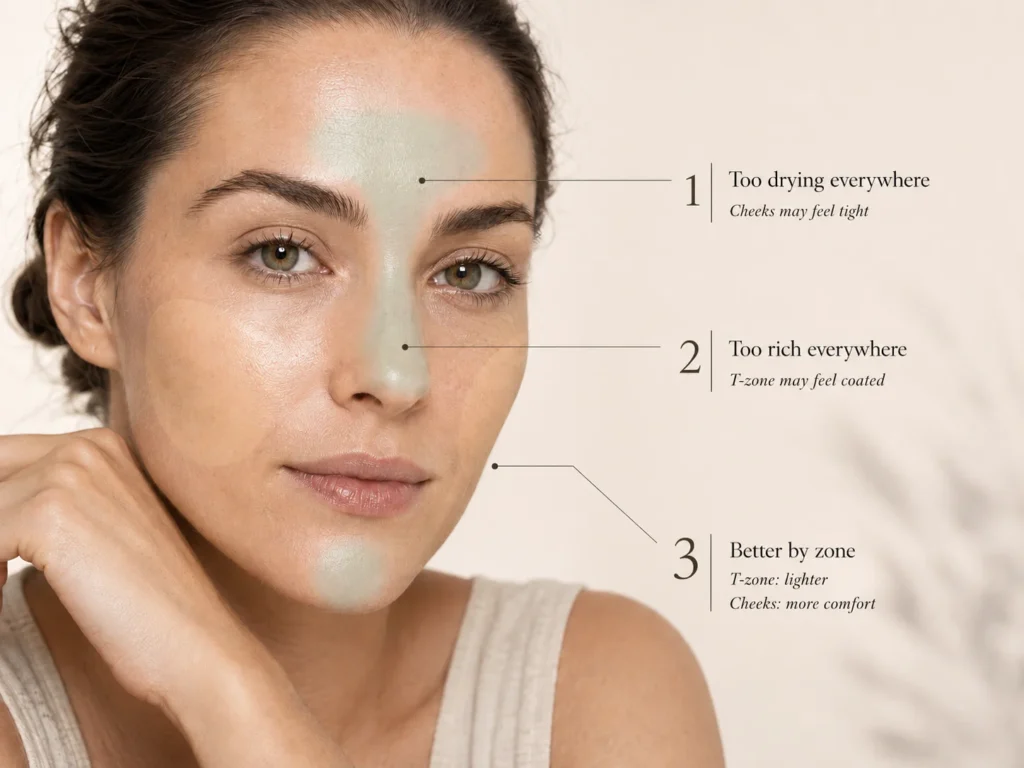
The opposite mistake can happen too.
If the cheeks are dry, some people use rich cream everywhere.
This may help the cheeks but make the T-zone feel greasy or coated.
Signs a routine may be too rich for the T-zone include:
Dry cheeks deserve comfort.
But the T-zone may need a lighter texture.
Combination skin often needs different amounts by zone.
A harsh cleanser may make the T-zone feel clean, but it can strip the cheeks.
Signs the cleanser may be too strong include:
A cleanser for combination skin should remove oil, SPF, makeup, sweat, and residue without making the skin feel raw.
Clean does not mean stripped.
When the T-zone gets shiny, it can be tempting to wash more often.
But over-cleansing can make the skin feel more unbalanced.
Over-cleansing may lead to:
Combination skin needs consistent cleansing, not aggressive cleansing.
The evening cleanse should remove the day well.
The morning cleanse should feel gentle and comfortable.
Hot water can make dry or sensitive zones feel worse.
It may leave the cheeks tight and the skin uncomfortable after cleansing.
Use lukewarm water instead.
Avoid:
Technique matters as much as product choice.
Many people with combination skin skip moisturizer because the T-zone is oily.
But oily areas can still need hydration and comfort support.
Skipping moisturizer may make:
Combination skin usually still needs moisturizer.
The key is texture and placement.
Use less on oily areas and more where the skin feels dry.
Combination skin usually does not need the same amount of moisturizer in every zone.
A better approach may be:
The T-zone may need less.
The cheeks may need more.
This simple adjustment can make the routine feel much more balanced.
Heavy cream is not always wrong.
But heavy cream everywhere may be too much for combination skin.
It may cause:
If the cheeks need a richer texture, apply it there.
The T-zone can stay lighter.
Zone placement matters.
Mattifying products may help oily areas, but they can dry the cheeks.
Using mattifying products across the full face may lead to:
Mattifying support should usually be used only where needed.
Do not apply it to dry or sensitive zones just because the T-zone gets shiny.
Toner can be useful for some combination skin routines.
But drying toner on dry cheeks can make balance harder.
Signs toner may be too drying include:
Toner is optional.
If it helps the T-zone but bothers the cheeks, use it only where appropriate or skip it.
A routine can be complete without toner.
Some combination skin routines do very well with:
Morning: Gentle cleanser → moisturizer by zone → SPF
Evening: Gentle cleanser → moisturizer by zone
Toner should have a purpose.
It may help refresh, prepare, or balance the skin when appropriate.
But it should not be used just because a routine feels incomplete.
Over-exfoliation is a common reason combination skin becomes sensitive, tight, and patchy.
People may exfoliate often because the T-zone looks oily, the nose looks clogged, or makeup looks textured.
But too much exfoliation can create:
Exfoliation should support smoothness.
It should not make the skin feel raw.
BHA may be helpful for clogged-looking T-zone areas when appropriate.
But it does not need to go everywhere.
Avoid applying BHA to:
Targeted support should stay targeted.
If only the nose or chin needs support, the cheeks do not need the same product.
Clay masks may help oily areas feel cleaner when appropriate.
But clay on dry cheeks can make them tight and uncomfortable.
A better approach may be:
Gentle cleanser → clay mask on T-zone only if appropriate → rinse → moisturizer by zone
Do not use clay mask on:
A mask should support the routine.
Not create dryness.
The nose may look shiny, pore-visible, or clogged-looking.
But scrubbing the nose can irritate the skin.
Avoid:
The nose needs consistent care.
Not force.
Picking can make the skin look more uneven and irritated.
It may contribute to post-blemish mark appearance, rough texture, and sensitivity.
Avoid applying strong active products to freshly picked skin.
If the area is broken, crusted, bleeding, painful, swollen, oozing, or worsening, seek dermatologist guidance.
Gentle routine support is better than picking.
Combination skin can be dehydrated.
That means the skin may lack water even when the T-zone produces oil.
Signs of dehydrated combination skin include:
If the skin feels oily and tight, more drying products may make things worse.
Lightweight hydration and moisturizer by zone may be more helpful.
Oil is not the same as moisture.
The skin can have oil and still feel tight, dehydrated, or uncomfortable.
This is why the T-zone may still need a light moisturizer.
The cheeks may need more comfort.
Do not let shine decide the whole routine.
Combination skin needs balance, not avoidance of moisturizer.
Combination skin can also be sensitive.
The cheeks, around-mouth area, jawline, or sides of the nose may react faster than the T-zone.
Sensitive zones may react to:
If one area is sensitive, protect it.
Do not apply strong products everywhere.
Active product stacking can make combination skin harder to balance.
Be careful combining:
The T-zone may seem to tolerate more, but the cheeks may not.
Active products should be selected carefully and introduced slowly.
When the skin is frustrating, it is tempting to change everything.
But adding many new products at once makes it hard to know what helped or what irritated the skin.
A better approach:
Combination skin needs observation.
Not rushing.
Active products should not be applied to skin that is broken, crusted, bleeding, painful, freshly picked, or rash-like.
Avoid applying strong products to irritated areas, including:
If the skin looks medical, worsening, swollen, oozing, crusted, or painful, seek dermatologist guidance.
SPF is important for combination skin.
Skipping SPF can make uneven-looking tone, dullness, and post-blemish mark appearance more noticeable over time.
Some people skip SPF because it feels greasy on the T-zone.
Instead of skipping SPF, review:
SPF should be the final morning skincare step.
Combination skin can feel coated if SPF and makeup are not removed properly.
The T-zone may collect oil, sweat, SPF, makeup, and residue.
The cheeks may look dull or feel uneven under moisturizer.
Evening routine may need:
Makeup/SPF removal step if needed → gentle cleanser → moisturizer by zone
Do not sleep in makeup or SPF residue.
But do not scrub the skin harshly either.
Makeup can separate or cling because the skin underneath is unbalanced.
If makeup separates on the T-zone and clings to the cheeks, review:
Sometimes better skincare prep improves makeup more than changing foundation.
Too many layers under SPF can cause pilling, heaviness, or makeup separation.
Possible causes include:
Simplify the morning routine:
Gentle cleanser → moisturizer by zone → SPF
Then adjust slowly.
Some people avoid moisturizer because they are afraid of shine.
But dry zones may need more comfort.
If the cheeks are still tight, you may need:
Do not under-support the cheeks to protect the T-zone from shine.
Combination skin changes with the weather.
In summer, the T-zone may become oilier.
In winter, the cheeks may become drier.
A routine that works in July may not work the same way in January.
Seasonal adjustments may include:
Combination skin is not static.
Travel can change the skin quickly.
Airplane air, heat, sweat, sun exposure, hotel air conditioning, and routine changes may make combination skin feel unpredictable.
Travel is not the best time to test strong new products.
Keep the routine simple:
Morning: Gentle cleanser → moisturizer by zone → SPF
Evening: Gentle cleanser → moisturizer by zone
If wearing makeup or heavier SPF:
Removal step if needed → gentle cleanser → moisturizer by zone
Support the skin gently until it feels stable again.
Combination skin usually does not need one miracle product.
It needs a routine that makes sense.
A good routine may include:
One product may help, but balance usually comes from the full routine.
The jawline and neck may behave differently from the T-zone and cheeks.
They may be dry, sensitive, or affected by friction, scarves, hair products, or makeup.
Do not stop observing at the center of the face.
If these areas feel dry or irritated, keep products gentle.
Avoid strong active products on sensitive neck or jawline areas unless appropriate and tolerated.
Some skincare products are designed for professional treatment settings.
Combination skin should not use professional-only products as a home routine.
Professional products may be stronger or intended for trained use.
At-home routines should stay appropriate, safe, and manageable.
When stronger support is needed, it should be discussed in consultation or handled in a professional treatment setting.
Combination skin needs consistency.
Changing products too quickly can make it harder to see what is working.
Look for signs of improvement such as:
Do not rush the skin with too many changes.
Cosmetic skincare can support comfort and appearance, but some signs need medical evaluation.
Do not ignore:
If these appear, seek dermatologist guidance.
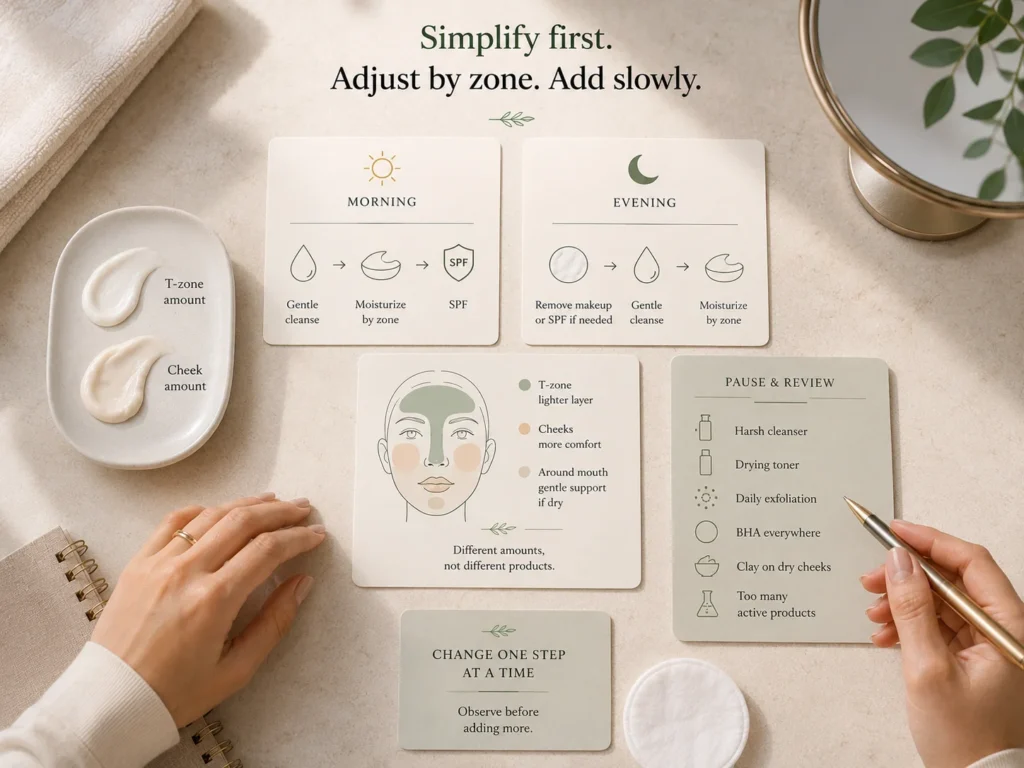
A simple foundation routine may look like this:
Morning:
Gentle cleanser → moisturizer by zone → SPF
Evening:
Gentle cleanser → moisturizer by zone
If wearing makeup or heavier SPF:
Makeup/SPF removal step if needed → gentle cleanser → moisturizer by zone
Once the foundation feels stable, optional support can be reviewed.
The routine should not feel like a battle.
Morning:
Gentle cleanser → light moisturizer on T-zone → more comfort on cheeks → SPF
Evening:
Gentle cleanser → moisturizer by zone
Optional targeted support:
Keep the cheeks protected.
Morning:
Mild cleanser → gentle moisturizer by zone → SPF
Evening:
Mild cleanser → gentle moisturizer by zone
Pause strong products until the skin feels calm.
Sensitive combination skin should not be pushed with active products too quickly.
Calm comes before correction.
Morning:
Gentle cleanser → lightweight hydration if appropriate → moisturizer by zone → SPF
Evening:
Gentle cleanser → lightweight hydration if appropriate → moisturizer by zone
Avoid drying toner, harsh cleanser, over-exfoliation, and skipping moisturizer.
Dehydrated combination skin needs water-support and comfort.
If makeup separates on the T-zone and clings to the cheeks:
Morning:
Gentle cleanser → light moisturizer on T-zone → more comfort on cheeks → SPF → makeup
Evening:
Makeup/SPF removal step if needed → gentle cleanser → moisturizer by zone
Helpful habits:
Makeup often improves when the routine underneath is balanced.
If your routine is not working, do not add everything at once.
Start with one change:
Small changes are easier to evaluate.
If your skin feels irritated, pause:
Return to:
Morning: Mild cleanser → moisturizer by zone → SPF
Evening: Mild cleanser → moisturizer by zone
Then rebuild slowly.
Your routine may be improving if:
Balance should feel easier over time.
Professional guidance may help if:
A consultation can help simplify the routine and identify the biggest mistake affecting your skin.
A dermatologist should evaluate the skin if there are warning signs such as:
Cosmetic skincare can support comfort and appearance, but medical-looking changes need medical evaluation.
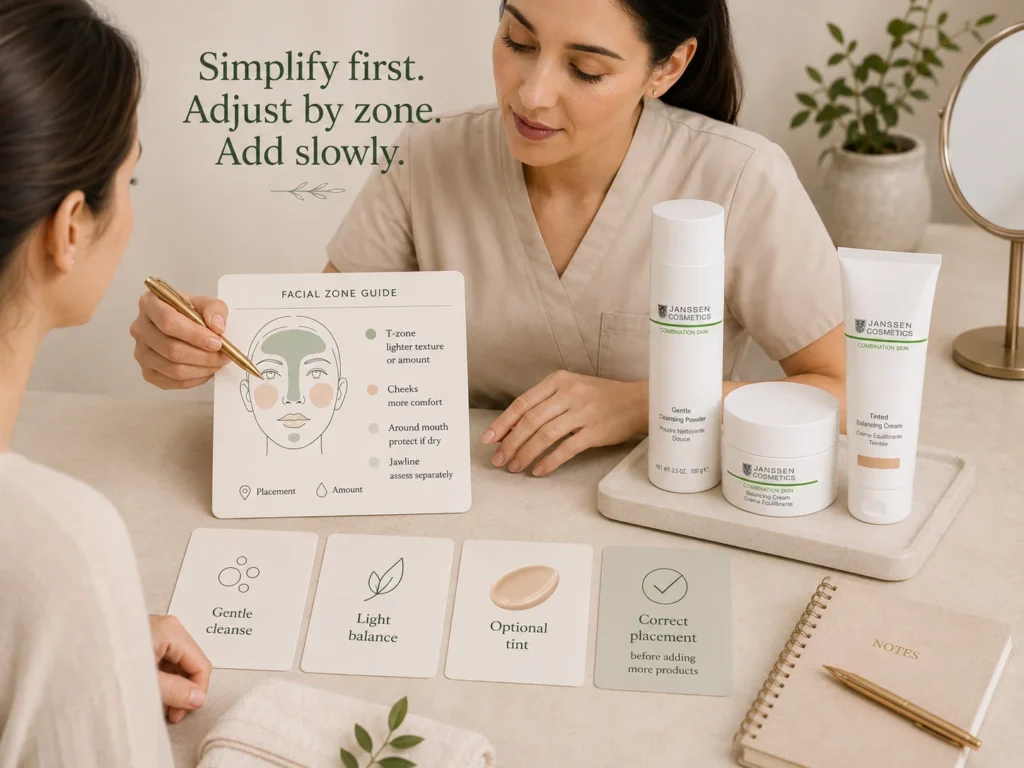
After consultation, our licensed esthetician may consider Janssen Cosmetics options depending on which mistake is making the routine harder — stripping, under-moisturizing, over-moisturizing, dehydration, sensitivity, T-zone buildup, or poor SPF layering.
For combination skin balance, possible options may include:
For oily T-zone support, possible options may include:
For dry or dehydrated cheeks, possible options may include:
For sensitive or overworked cheeks, comfort-focused options may include:
For dullness, post-blemish mark appearance, or uneven-looking tone when the skin is calm and stable, possible radiance-support options may include:
For morning routines, Face Guard Advanced SPF 30 may be considered as the final daytime protection step when appropriate and tolerated.
These are not automatic recommendations. Combination skin should be reviewed zone by zone so the routine supports balance instead of creating more dryness, oiliness, sensitivity, or confusion.
Do not treat the whole face like oily skin.
Do not treat the whole face like dry skin.
Do not use harsh cleanser to control shine.
Do not skip moisturizer.
Do not apply heavy cream everywhere.
Do not use drying toner on dry cheeks.
Do not exfoliate every day without guidance.
Do not apply BHA all over the face unnecessarily.
Do not use clay mask on dry or sensitive cheeks.
Do not layer strong active products blindly.
Do not skip SPF.
Do not sleep in makeup or SPF residue.
Do not apply active products to broken, crusted, bleeding, painful, or freshly picked skin.
Do not ignore persistent irritation, swelling, pain, oozing, or worsening skin changes.
One of the biggest mistakes is treating the whole face the same way. Combination skin usually needs lighter care on the T-zone and more comfort on dry areas.
Sometimes, but not everywhere. Oily-skin products may be useful for the T-zone but too drying for cheeks.
No. Combination skin usually still needs moisturizer, but the texture and amount should be adjusted by zone.
Yes. Over-cleansing can make cheeks tight and the T-zone feel oily but uncomfortable.
Yes, if it is too drying or used on dry or sensitive cheeks.
Yes. Over-exfoliation can cause tightness, stinging, flaking, sensitivity, and makeup clinging.
Not automatically. BHA may be used only on clogged-looking oily areas if appropriate and the skin is stable.
Usually not for combination skin. Clay masks are often better used only on oily zones if appropriate.
It may be dehydrated, over-cleansed, under-moisturized, over-exfoliated, or using products that are too drying in some zones.
Use gentle cleanser, moisturizer by zone, and SPF in the morning. At night, cleanse gently and moisturize by zone.
If your combination skin feels impossible to balance, your routine may not need to be stronger.
It may need to be more thoughtful.
At Zendevie, a free virtual consultation helps us review your T-zone, cheeks, cleanser, toner, moisturizer, SPF, makeup behavior, hydration level, sensitivity, exfoliation habits, and active products before recommending anything.
Combination skin becomes easier when the routine stops fighting the skin and starts respecting each zone.

Zendevie is guided by Haby Diallo, a licensed esthetician with more than 20 years of professional skincare experience. Her approach is rooted in education, professional judgment, and personal care.
years of experience