



Makeup may begin sitting differently as skin matures.
Foundation may settle into fine lines.
Concealer may crease more quickly.
Powder may emphasize dryness.
A routine that looked smooth several years ago may now appear:
This does not mean mature skin cannot wear makeup beautifully.
It may mean that the skin and makeup routine need to be adjusted.
Mature skin may need:
At Zendevie, our licensed esthetician first looks at why the makeup is sitting unevenly.
The concern may not be a lack of primer.
It may be:
The correct preparation depends on the cause.
A simple mature-skin makeup-preparation routine may be:
Do not automatically add:
The best preparation is the shortest routine that leaves the skin comfortable and allows protection and makeup to apply evenly.

Healthy mature skin may show:
Makeup may soften the appearance of these features.
It cannot permanently erase them.
The goal should not be a completely poreless or motionless surface.
A successful makeup routine allows the skin to look:
Makeup moves during the day because the face:
Some settling is normal.
The goal is to reduce unnecessary buildup and dryness—not prevent all natural movement.
Possible contributors include:
Each contributor requires a different adjustment.
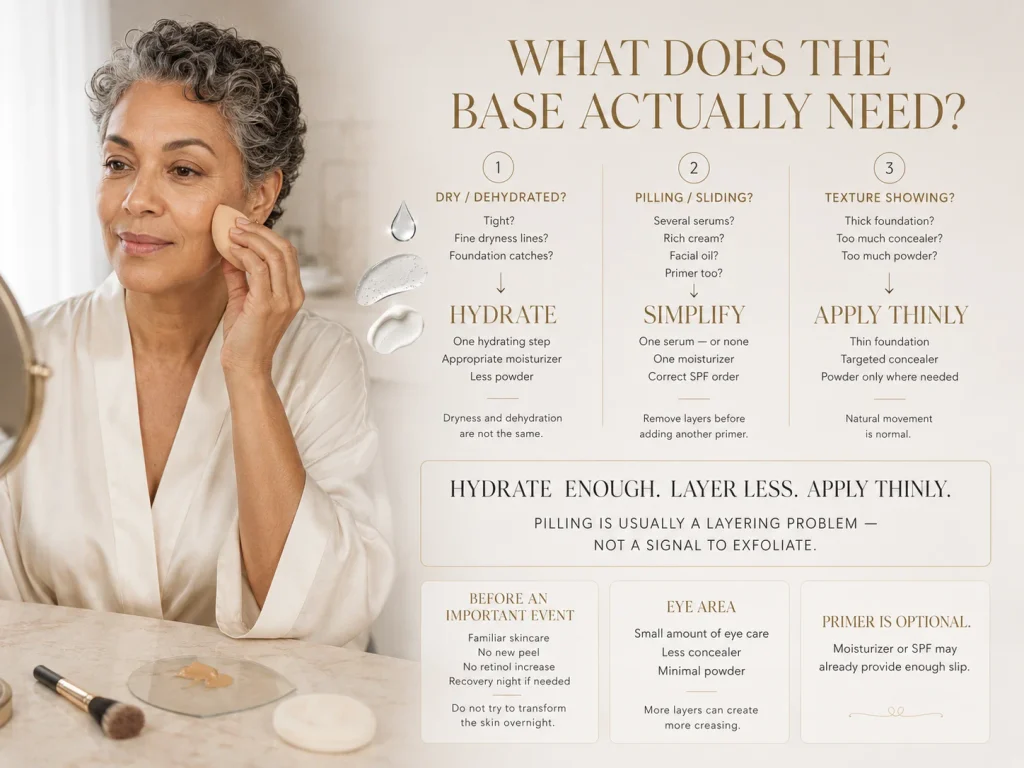
Dry mature skin lacks enough lipid comfort.
It may appear:
Dehydrated skin lacks water.
It may appear:
A person may have both.
The same preparation does not fit every skin type.
Makeup may emphasize skin that is:
During active irritation, the priority should be comfort—not perfect coverage.
A simple routine may be:
Gentle rinse or cleanser → tolerated moisturizer → tolerated SPF
Makeup may be reduced or paused when it causes additional discomfort.
Persistent or severe reactions need appropriate medical evaluation.
Makeup preparation begins before serum or primer.
The skin should be clean without feeling stripped.
A morning cleanse may use:
The correct choice depends on:
Not always.
A lukewarm-water rinse may be enough when the skin is:
A cleanser may be useful when the skin is:
The first step should leave the skin comfortable.
A squeaky or very tight feeling may indicate that the cleanser is removing too much surface oil.
This can make foundation:
A stronger cleanse is not better makeup preparation.
Use lukewarm water.
Hot water may contribute to:
Very cold water may feel refreshing, but it does not permanently close pores or tighten skin.
A washcloth may add friction.
Before makeup, repeated rubbing may create:
Use clean hands or a very soft cloth with light pressure.
Do not scrub until the skin feels polished.
A tonic or toner is optional.
A hydrating tonic may help:
An acid toner may contain:
An acid toner is an active treatment.
It should not be treated as a harmless makeup-preparation step.
Only when:
A toner is not required for foundation to apply well.
Repeatedly wiping the skin may contribute to:
Use light pressure.
Clean hands may be more comfortable for some hydrating tonics.
Daily acid use may make the skin temporarily smooth but later cause:
Exfoliation should be scheduled separately and used only when appropriate.
A serum may support one clear concern.
Possible morning serum goals include:
One serum is usually enough beneath makeup.
A hydrating serum may be useful when the skin:
Useful ingredients may include:
A hydrating serum does not always replace moisturizer.
A serum may be unnecessary when:
A complete makeup-preparation routine may be:
Rinse → moisturizer → SPF
Possibly, but they may increase:
A person using:
may be able to replace several layers with one multifunctional formula.
If the skin is flaky from retinol or acids, adding several hydrating serums may not solve the problem.
The routine may need:
Do not keep adding hydration while continuing the irritation source.
Too much serum may cause:
Follow the product directions.
More serum does not automatically create smoother makeup.
The eye area may be the first place where makeup shows:
Preparation should be light and controlled.
Too much eye cream may contribute to:
A thin layer is usually enough.
A separate eye cream may help when:
A gentle facial moisturizer may be enough when it remains comfortable and does not migrate.
Using both may be useful for selected dry eye areas.
However, several eye layers may increase:
One well-selected eye product is often enough before makeup.
Avoid applying eye cream directly into:
Product migration may cause:
There is no universal waiting time.
Allow the product to stop feeling very wet before concealer is applied.
If concealer still moves, use less eye cream rather than waiting for a long period.
Moisturizer is often the most important preparation step.
It may help support:
The correct texture matters more than the word “anti-aging” on the label.
A rich cream may suit:
It may be too heavy for:
A lightweight moisturizer may be more appropriate.
Signs may include:
A more supportive cream may be needed.
Signs may include:
Try:
Combination mature skin may need:
The whole face does not require the same amount.
Use:
Aggressive massage may create temporary redness and make foundation apply unevenly.
SPF is part of makeup preparation.
It should not be skipped because foundation looks better without it.
The correct goal is to find a routine where daytime protection and makeup work together.
Different protection products may feel:
A protection formula may affect:
The complete morning routine should be assessed together.
Many traditional sunscreen products are applied after moisturizer.
Some specialty protection concentrates are officially applied before the day cream.
Follow the exact directions for the selected product.
Do not assume one universal order applies to every formula.
Mixing may:
Apply sunscreen as its own even layer unless the product is specifically designed for mixing.
If the routine pills:
Do not solve pilling by applying less protection than directed.
Allow enough time for:
Long waiting periods are not always necessary.
If sunscreen requires a very long wait to stop rolling, the routine may contain too many layers.
Primer is optional.
It may help with:
However, moisturizer or sunscreen may already perform a similar function.
Primer may be unnecessary when:
A shorter routine may perform better.
A smoothing primer may temporarily soften the appearance of:
Use a small amount.
Applying too much may cause foundation to:
A hydrating primer may help when:
However, it may duplicate:
Too many hydrating layers may become sticky.
A mattifying primer may suit:
Avoid applying it heavily across dry cheeks.
Mature combination skin may benefit from zone-based primer use.
An illuminating primer may create:
Too much may emphasize:
Use strategically rather than across every area.
A thin layer generally moves more naturally with mature skin than a thick coat.
Begin with less foundation.
Add only where needed.
Possible finishes include:
No finish is universally best.
A full-coverage foundation may:
Targeted concealer may provide better coverage with less product.
Foundation may be applied with:
Each method creates a different finish.
May help warm and spread thin layers.
May provide a softer, more diffused application.
May provide controlled coverage but can emphasize flakes when used aggressively.
Use gentle pressing or light smoothing.
Do not repeatedly buff dry areas.
Repeated dragging may disturb:
Gentle pressing may help preserve the skincare layers beneath.
Use less foundation around:
More product in a moving area usually creates more visible settling.
Concealer may be useful for:
It does not need to cover the entire under-eye area heavily.
Use:
Avoid:
Natural eye movement will still create some creasing.
A concealer that is too light may make:
look more noticeable.
A shade closer to the skin or slightly corrective may look more natural.
A color corrector may help reduce the amount of concealer needed.
Use a thin layer.
Too much corrector plus concealer may create:
Apply concealer only to the visible area.
Use:
Avoid repeatedly rubbing the spot.
Changing, bleeding, crusting, painful, or non-healing areas should not simply be covered with makeup without medical evaluation.
Powder may help:
Too much powder may make mature skin look:
Apply powder only where needed, such as:
Dry cheeks and under-eye areas may need little or no powder.
Use a very small amount.
Heavy powder may emphasize:
If concealer moves, first review:
Do not keep adding powder.
A soft puff or small brush may gently press powder into selected areas.
Aggressive sweeping may move the foundation beneath.
Heavy baking may make mature under-eye areas appear:
A small amount of finely applied powder may be enough.
Setting spray is optional.
It may help:
Some sprays contain:
Sensitive mature skin should introduce them carefully.
A mist may temporarily reduce a powdery appearance.
It does not correct:
Correct the underlying preparation first.
A simple routine may be:
Lukewarm-water rinse or gentle creamy cleanser → hydrating serum if needed → supportive moisturizer → SPF → thin makeup
Helpful adjustments:
A simple routine may be:
Gentle cleanser → lightweight serum if needed → lightweight moisturizer if needed → SPF → thin foundation → strategic powder
Helpful adjustments:
A simple routine may be:
Gentle cleanser → lightweight serum → moisturizer by zone → SPF → makeup adjusted by zone
Possible adjustments:
A simple routine may be:
Gentle rinse or cleanser → tolerated moisturizer → tolerated SPF → minimal makeup when comfortable
Avoid during active sensitivity:
Persistent burning, swelling, itching, or eye symptoms need appropriate evaluation.
A possible routine may be:
Gentle cleanser or rinse → lightweight hydrating serum → moisturizer → SPF → flexible makeup
Avoid:
A possible routine may be:
Gentle cleanser → lightweight hydration → light moisturizer → SPF → non-heavy makeup
Use:
Avoid:
Retinol may create:
A retinol routine should be adjusted when makeup begins sitting poorly.
Gentle cleanser → retinol → moisturizer
Gentle cleanser → moisturizer
Gentle rinse or cleanser → moisturizer → SPF → lighter makeup
Do not scrub retinol flakes before foundation.
Gentle exfoliation may support smoother-looking texture.
However, exfoliating immediately before every makeup application may cause:
Schedule exfoliation separately.
Do not begin a new peel immediately before an important event.
A vitamin C serum may support:
It may also cause pilling when layered with:
If pilling occurs:
A peptide serum may support:
A peptide moisturizer may be easier beneath makeup than serum plus cream.
One peptide product may be enough.
A ceramide moisturizer may help dry mature skin feel:
An oil-based ceramide capsule may feel too heavy beneath makeup.
It may be more practical in the evening or on selected dry zones.
Facial oil may make foundation:
It is usually more practical at night.
Selected dry skin may use a very small amount, but the SPF must still apply evenly.
Winter may increase:
Adjust with:
Summer may increase:
Adjust with:
Humidity may make humectant-rich routines feel sticky.
Use:
Air conditioning and heating may make makeup look dry later in the day.
Consider:
Travel may involve:
Use familiar products.
Do not test a new:
immediately before or during important travel days.
Before an event:
Do not attempt to transform the skin overnight.
Makeup may be extended to the:
These areas may be:
A simple routine may be:
Gentle cleansing → lightweight moisturizer and daytime protection in the product-directed order → minimal makeup when needed
Avoid:
Blend makeup lightly rather than covering the entire neck heavily.
The backs of the hands may appear:
A simple routine may be:
Hand moisturizer → daytime protection
For photography, allow the moisturizer to absorb before touching clothing or makeup tools.
Do not use a strong peel immediately before an event.
Use less foundation.
Review:
Apply thin layers and allow natural movement.
Fine lines cannot be permanently filled by makeup.
Possible contributors include:
Try:
Pores are normal and cannot be permanently erased.
Possible causes include:
Simplify the routine.
Do not scrub immediately.
Review:
Use less skincare around the nose and apply foundation in a thin layer.
A small amount of powder may help.
Possible contributors include:
Use:
Persistent rash-like mouth-area changes need medical evaluation.
Some creasing is normal.
Try:
Do not heavily layer eye serum, eye cream, corrector, concealer, and powder automatically.
Review:
Use a small amount of eye care and less powder.
Possible contributors include:
Use smaller amounts.
A rich evening eye product may be replaced with a lighter morning texture.
Reduce:
Use powder only where needed.
A powdery finish may emphasize dryness and natural lines.
Possible contributors include:
Adjust skincare and makeup together.
Do not repeatedly mist the skin without reviewing the routine foundation.
Possible contributors include:
Try:
Pilling may come from:
Simplify to:
Cleanser or rinse → moisturizer → SPF → makeup
Then add one optional product only when needed.
Test it with fewer layers.
Possible simplified routine:
Gentle cleanser → SPF and moisturizer in the product-directed order
Remove:
Do not apply less SPF than directed.
The primer may be incompatible with:
Try skipping primer.
Moisturizer or SPF may already create a sufficient base.
Do not scrub immediately.
Flakes may result from:
Pause active products.
Use moisturizer and lighter makeup.
The skin may be dehydrated.
Oil and water balance are different.
Use:
Do not use stronger oil-control products automatically.
Review:
A shade or formula adjustment may help more than another corrective serum.
Remove it gently.
Review:
Do not continue using a product that repeatedly causes burning, itching, or swelling.
Possible contributors include:
Use smaller amounts and keep products away from the wet lash line.
Seek prompt eye-care guidance for:
Possible contributors include:
Do not immediately add acids.
Simplify and observe.
Skip the serum.
Serum is optional.
A moisturizer and SPF may create a better makeup base.
Skip primer.
Primer is optional.
A suitable moisturizer may already provide enough smoothing.
Use no powder or apply it only to selected areas.
Mature skin does not need to be fully powdered.
Continue using less.
Sheer or targeted coverage may allow:
Higher coverage is not always more flattering.
That is also a valid choice.
Makeup is optional.
Skincare should support comfort whether makeup is worn or not.
The night-before routine should not be aggressive.
A simple routine may be:
Gentle cleanser → hydrating serum if needed → moisturizer
Optional:
Avoid introducing:
immediately before an important makeup day.
Only when:
For many people, hydration and moisturizer are safer before an event.
A hydrating mask may support:
Use it according to directions.
Do not combine it automatically with:
One supportive step is enough.
A recovery evening may be:
Gentle cleanser → moisturizer
This simple routine may create a better makeup base than an intensive treatment.
Do not introduce a new serum, primer, foundation, and powder on the same day.
Ask:
The correct adjustment may be removing one layer rather than adding another.
Seek dermatologist guidance when makeup or skincare is followed by:
Seek prompt eye-care guidance for:
Seek urgent medical care for:
Cosmetic makeup-preparation guidance cannot diagnose allergy, dermatitis, infection, or another medical concern.
After consultation, our licensed esthetician may consider Janssen Cosmetics products according to whether the makeup concern relates to:
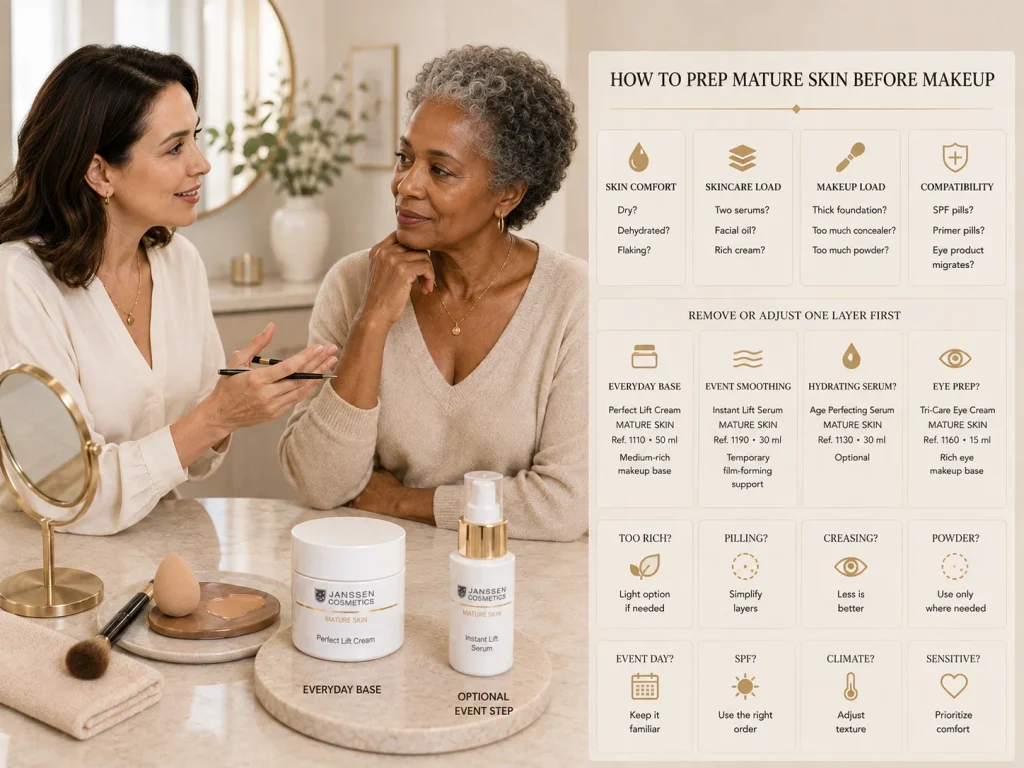
Possible options may include:
These products should not all be layered together automatically.
Several Janssen products are officially described as makeup bases.
The choice should depend on:
Using several makeup-base products together may create too many layers.
Multi Action Cleansing Balm belongs to the Mature Skin family.
Its texture changes during use:
Its verified formula includes:
It is designed to remove:
while supporting a soft skin feel.
A possible evening sequence may be:
Multi Action Cleansing Balm → rinse thoroughly → Micellar Skin Tonic if desired → evening serum or moisturizer
Use gentle massage.
Do not rub for an excessive amount of time.
A second cleanser should be added only when needed and tolerated.
It may be unnecessary every morning.
A dry mature complexion may prefer a lukewarm-water rinse.
Use the balm in the morning only when overnight product buildup genuinely needs removal.
Luxury Oil Cleanser is designed for mature skin and may be used to remove waterproof eye makeup.
Its verified directions include:
A possible evening sequence may be:
Luxury Oil Cleanser → Micellar Skin Tonic → selected evening care
Use gentle movements.
Allow the oil to loosen makeup rather than repeatedly rubbing the lashes.
Keep the product out of the eyes.
Persistent eye discomfort needs appropriate evaluation.
If oil cleanser residue remains, the following morning makeup may appear:
Emulsify and rinse thoroughly.
Do not compensate with harsh morning cleansing.
Micellar Skin Tonic is an alcohol-free Mature Skin tonic.
Its verified formula includes:
It may help support:
The official directions allow morning and evening use after cleansing across the:
A possible morning order may be:
Gentle cleanser or rinse → Micellar Skin Tonic → serum or moisturizer
Use a small amount.
Do not repeatedly wipe the skin.
The tonic is optional when:
Age Perfecting Serum is a lightweight Mature Skin serum containing:
It may help support:
The official directions place the selected care cream over the serum.
A possible morning routine may be:
Gentle cleanser → Age Perfecting Serum → eye care when needed → Face Guard Advanced → selected day cream → makeup
The serum may be useful when:
It may be unnecessary when:
Do not layer it automatically with Instant Lift Serum.
Choose one primary serum.
Instant Lift Serum is a Mature Skin serum designed for temporary surface smoothing.
Its verified formula includes:
Marine collagen primarily supports the surface through:
This should be explained honestly.
It does not permanently replace collagen or lift facial tissue.
The official directions allow use:
It may also be applied close to the eye contour before the selected eye care according to its directions.
A possible special-event routine may be:
Gentle cleanser → Instant Lift Serum → selected eye care → Face Guard Advanced → lightweight day cream → makeup
Use a controlled amount.
Too much may create:
May suit:
May suit:
They should not automatically be layered together before makeup.
One serum is usually enough.
Tri-Care Eye Cream belongs to the Mature Skin family.
Its verified formula includes:
It may help support:
The official directions recommend gently dabbing it around the cleansed eye area in the morning and/or evening.
It is officially described as an eye-makeup foundation.
A possible order may be:
Gentle cleanse or rinse → Tri-Care Eye Cream in a small amount → daytime protection applied carefully → concealer
Use less than may be used at night.
Its rich texture may be too much when combined with:
It may suit:
It may feel too rich for:
Smooth + Lift Eye Cream belongs to the Demanding Skin family.
Its verified formula includes:
It may help support:
The official directions recommend patting it around the cleansed eye area in the morning and evening.
It is officially described as an eye-makeup base.
A possible order may be:
Gentle cleanse or rinse → Smooth + Lift Eye Cream in a controlled amount → daytime protection applied carefully → makeup
The soft-focus pigments may create an immediate optical effect.
This should not be confused with permanent line removal.
May suit:
May suit:
They should not be layered together.
Choose one eye product.
Perfect Lift Cream is a medium-rich Mature Skin moisturizer.
Its verified formula includes:
It may help support:
The official directions allow morning and/or evening use on cleansed skin of the:
It is officially described as an ideal makeup foundation.
A possible morning order may be:
Gentle cleanser → selected serum when needed → eye care → Face Guard Advanced → Perfect Lift Cream → makeup
Use enough to provide comfort without leaving a heavy film.
It may suit:
It may feel too rich for:
A lighter moisturizer may work better.
Vitalizing Skin Refiner is a lightweight, fast-absorbing moisturizer from the Demanding Skin family.
Its verified formula includes:
It may help support:
Its silky texture is officially described as an ideal makeup base.
The official directions recommend morning application to cleansed skin of the:
Allow it to absorb.
During the day, Face Guard Advanced is applied beneath Vitalizing Skin Refiner.
A possible order may be:
Gentle cleanser → selected serum when needed → eye care → Face Guard Advanced → Vitalizing Skin Refiner → makeup
It may suit:
It may be too light for very dry mature skin.
Light Tightening Cream is a lightweight moisturizer from the Demanding Skin family.
Its verified formula includes:
It may help support:
Its texture may suit:
A possible morning order may be:
Gentle cleanser → lightweight serum when needed → Face Guard Advanced → Light Tightening Cream → makeup
Use less product through oily areas.
A richer moisturizer may be applied only to dry cheeks when needed.
Face Guard Advanced is Janssen’s SPF 30 protection concentrate.
Its verified formula includes:
It has an extra-light texture and may be combined with any Janssen day-care cream.
The official home-care directions are:
Apply every morning after cleansing → follow with the usual day-care cream
This is a product-specific sequence.
A Janssen morning order may be:
Gentle cleanser → optional tonic → selected serum → eye care → Face Guard Advanced → selected day cream → makeup
Do not mix Face Guard Advanced into:
Apply it as a separate even layer.
If pilling occurs, review:
Do not reduce the directed protection amount simply to prevent pilling.
Gentle cleanser or rinse → Face Guard Advanced → selected day cream → makeup
Possible day creams:
This may be enough.
Gentle cleanser or rinse → Age Perfecting Serum if needed → Tri-Care Eye Cream in a small amount → Face Guard Advanced → Perfect Lift Cream → thin makeup
Use Rich Recovery Cream during the day only when the skin genuinely needs the richer texture and makeup remains stable.
Gentle cleanser → Face Guard Advanced → Vitalizing Skin Refiner → makeup
Optional:
This may suit warm weather or skin that dislikes rich layers.
Gentle cleanser → lightweight serum when needed → Smooth + Lift Eye Cream in a small amount → Face Guard Advanced → Light Tightening Cream → thin makeup → powder only through oily zones
Avoid facial oil in the morning.
Gentle cleanser → Instant Lift Serum → one eye cream → Face Guard Advanced → selected lightweight day cream → makeup
Do not add:
to the same morning automatically.
Gentle cleanser or rinse → tolerated eye care when needed → Face Guard Advanced when tolerated → Intense Calming Lotion or Cream → minimal makeup
A calming moisturizer may be more appropriate than a firming makeup base during sensitivity.
Multi Action Cleansing Balm or Luxury Oil Cleanser → rinse thoroughly → Micellar Skin Tonic if desired → selected evening moisturizer
Use only one primary oil-based cleanser.
A second cleanse is optional and should depend on residue and skin comfort.
Gentle makeup removal → cleanser → Night Recovery Serum when needed → selected moisturizer
or:
Gentle cleanser → Rejuvenating Mask according to directions → moisturizer only when needed
Do not use retinol, enzyme peel, and mask together before an important makeup day.
New skincare or makeup experimentation should wait when the skin has:
Medical evaluation comes before another primer, serum, peel, or coverage product.
Professional-only Janssen products should remain within professional treatment settings.
Do not try to erase every mature-skin line before makeup.
Do not assume more skincare creates smoother foundation.
Do not use several serums beneath makeup automatically.
Do not apply facial oil beneath SPF automatically.
Do not use the richest cream solely because the skin is mature.
Do not skip moisturizer when the skin feels tight.
Do not skip SPF because makeup looks smoother without it.
Do not mix separate sunscreen into foundation or moisturizer.
Do not reduce sunscreen below its directed amount to stop pilling.
Do not exfoliate every morning before makeup.
Do not scrub retinol flakes.
Do not begin a new peel before an event.
Do not apply strong acids to irritated skin.
Do not use excessive eye cream under concealer.
Do not layer two eye creams.
Do not apply products along the wet lash line.
Do not apply thick foundation over every area.
Do not use heavy concealer across the entire under-eye region automatically.
Do not bake dry mature under-eyes.
Do not powder the whole face when only the T-zone needs setting.
Do not repeatedly buff foundation over visible flakes.
Do not continue a primer that causes pilling.
Do not use setting spray to cover an irritating skincare routine.
Do not label every bump as purging.
Do not use dirty brushes or sponges.
Do not cover changing, bleeding, crusting, painful, or non-healing lesions without medical evaluation.
Do not use sales data as proof that a makeup-preparation product works.
Do not present professional peels as routine event preparation.
Do not ignore persistent burning, swelling, blistering, eye symptoms, or breathing difficulty.
Use gentle cleansing, one hydrating product when needed, suitable moisturizer, daytime protection, and thin makeup layers.
Not always. Moisturizer or SPF may already create a comfortable base.
Gentle cleanse or rinse → moisturizer → SPF → makeup
Not automatically. Frequent or last-minute exfoliation may increase dryness and sensitivity.
Only when the product is familiar, tolerated, and already part of the routine. Hydration may be safer before an event.
Natural movement, product amount, dryness, dehydration, powder, and foundation texture may contribute.
No. Some movement is normal. Thin layers and better hydration may reduce visible settling.
Dry flakes, pilling, heavy skincare, incompatible sunscreen, or foundation formula may contribute.
Oil, heavy moisturizer, facial oil, glasses, touching, and product buildup may contribute.
Dryness, movement, heavy application, retinol irritation, and lip-product migration may contribute.
Powder, matte foundation, excessive coverage, dryness, active-product irritation, or poor layering may emphasize texture.
Only when the skin is dehydrated or the moisturizer is not enough. Serum is optional.
Possibly, but one serum is usually easier to layer beneath moisturizer and SPF.
A lightweight serum generally goes before moisturizer.
A general order is serum, eye care, and then facial moisturizer.
Use a small, even amount. Too much may cause creasing, puffiness, or migration.
The eye cream may be too rich, too much may be applied, or concealer and powder may be excessive.
Allow it to settle briefly. If concealer still moves, use less eye cream.
Not necessarily. A lighter amount or texture may be preferred in the morning.
Natural eye movement, excess concealer, rich eye cream, and powder may contribute.
Use less eye cream, less concealer, targeted placement, flexible formula, and minimal powder.
Only when needed, using a very small amount.
Heavy baking often emphasizes dryness and fine lines.
No. Powder may be useful when applied strategically and lightly.
Usually through oily areas, around the nose, or where makeup transfers. Dry cheeks may need little or none.
Natural, satin, radiant, or flexible finishes often work well, but the best option depends on skin type and makeup preference.
Yes, when the formula is flexible and the skin is prepared appropriately. Very drying formulas may emphasize texture.
Yes, but thin application and targeted concealer may look more natural than a heavy full-face layer.
Neither is universally better. A damp sponge may create a diffused finish, while a brush may offer controlled coverage.
Yes. Clean fingers may help warm and spread thin layers.
Too many skincare layers, excessive product, facial oil, incompatible formulas, primer, or repeated rubbing may contribute.
No. Pilling is usually a product-layering issue.
Use fewer layers, smaller amounts, no morning facial oil, one serum, and a compatible moisturizer and SPF.
Serum, moisturizer, facial oil, primer, or foundation may be incompatible with the SPF texture.
No. Simplify the layers beneath it instead.
Do not mix a separate sunscreen into foundation unless specifically directed.
Possibly for selected very dry skin, but it may interfere with sunscreen and foundation. Evening use is often more practical.
Rich moisturizer, facial oil, humidity, excess foundation, and natural oil production may contribute.
Dehydration, strong cleanser, insufficient moisturizer, mattifying foundation, powder, and air conditioning may contribute.
Use gentle cleansing, hydrating serum when needed, supportive moisturizer, SPF, flexible foundation, and minimal powder.
Use gentle cleansing, lightweight hydration, light moisturizer when needed, SPF, thin foundation, and strategic powder.
Adjust moisturizer, primer, and powder by zone.
Use tolerated cleanser, moisturizer, SPF, and minimal makeup. Avoid new actives during sensitivity.
Yes, but apply it lightly because excess shine may emphasize texture.
Yes, especially on oily zones. Avoid applying it heavily across dry cheeks.
Yes.
Yes
Yes, or use it only where needed.
It is optional. Sensitive skin should review alcohol and fragrance.
It may temporarily reduce powderiness but cannot correct an overly drying routine.
Retinol may be causing dryness or irritation. Pause or reduce it and do not scrub the flakes.
Only when it is already tolerated. Do not increase or introduce retinol before an event.
Yes, when the formula layers comfortably. Move it to evening if it causes pilling.
Yes. A peptide cream may be simpler when serum plus moisturizer feels heavy.
Yes, when the texture suits the skin. An oil-based capsule may feel too heavy.
Yes, when the mask is familiar and used according to directions. Do not combine it with strong exfoliation.
Eye-cream migration, sunscreen, mascara, setting spray, fragrance, and facial oil may contribute.
Seek prompt guidance for eye pain, vision changes, light sensitivity, discharge, significant redness, or persistent watering.
Use familiar skincare, avoid new peels and retinol increases, hydrate appropriately, test makeup in advance, and use thin layers.
It may provide temporary surface smoothing before cream, but it should be used in a controlled amount and should not be combined with several other serums.
Yes. Its verified directions describe it as an ideal makeup foundation
Yes. Its fast-absorbing silky texture is officially positioned as a makeup base.
It may suit oily or warm-weather mature-looking skin that prefers a light, silky-matte finish.
Yes. Its verified directions describe it as an eye-makeup foundation.
Yes. Its verified directions describe it as an eye-makeup base with soft-focus support.
Face Guard Advanced → selected Janssen day cream, after any compatible serum and eye care.
No. Apply it as a separate layer.
Not automatically. Choose one primary serum according to the makeup goal.
Seek guidance for persistent burning, swelling, severe itching, blistering, bleeding, crusting, oozing, eye symptoms, infection-looking changes, or reactions that do not improve after products are stopped.
If your foundation settles into fine lines, your concealer creases, or your sunscreen and skincare pill beneath makeup, a free virtual consultation can help identify which layer may need to change.
At Zendevie, we review your cleanser, serum, eye care, moisturizer, SPF, primer, foundation, powder, retinol, exfoliation, climate, and skin type before discussing products.
The goal is not to cover mature skin with more layers.
The goal is to create a comfortable, protected base that allows makeup to sit lightly, move naturally, and support the beauty of your skin rather than hide it.

Zendevie is guided by Haby Diallo, a licensed esthetician with more than 20 years of professional skincare experience. Her approach is rooted in education, professional judgment, and personal care.
years of experience
