


Some mature skin can use retinol.
But mature skin does not automatically need it.
Retinol is one optional active ingredient within a well-aging routine.
It may help support the appearance of:
It may also create:
This is why retinol should not be selected only because the product is labeled for mature skin.
A person may have mature skin that is:
Each of these patterns may respond differently.
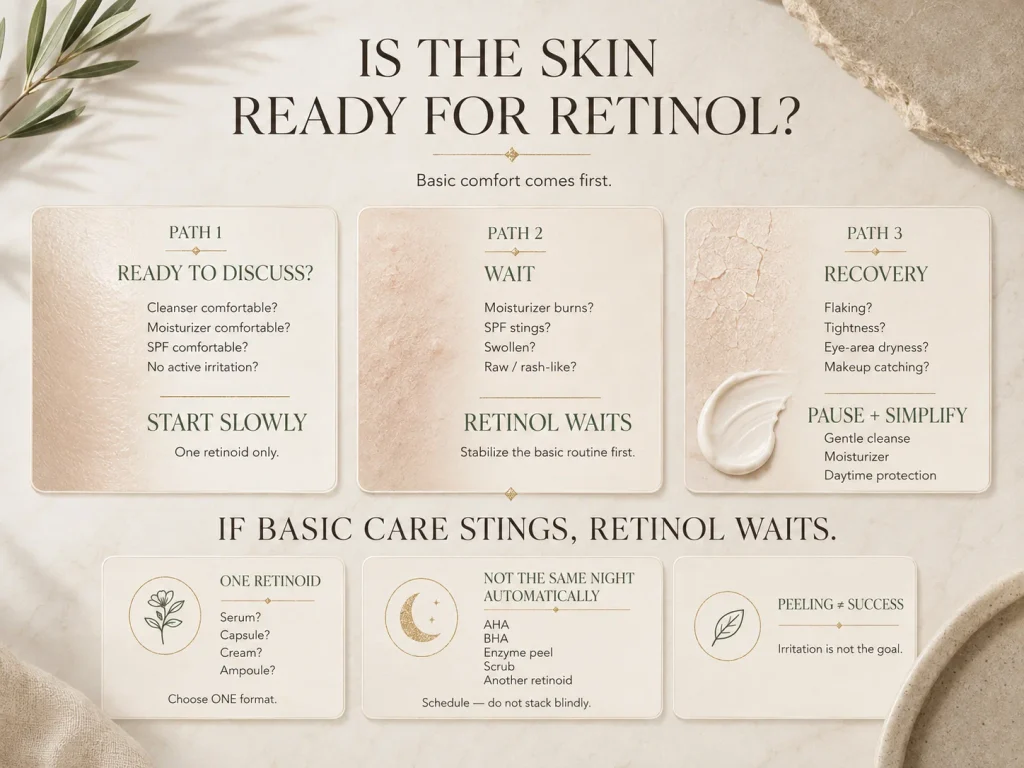
At Zendevie, our licensed esthetician first asks whether the skin already tolerates:
If basic moisturizer or SPF already burns, retinol should wait.
If the skin is actively swollen, painfully flaky, rash-like, or reacting to water, retinol should wait.
If the routine already contains several acids, scrubs, exfoliating toners, or another retinoid, retinol should not be added blindly.
The first question is not:
Which retinol should I buy?
It is:
Is my skin ready for retinol, and what role would it serve?
Yes, some mature skin can use retinol carefully.
A beginner retinol routine may be:
Gentle cleanser or rinse → moisturizer → SPF
Gentle cleanser → retinol according to directions → moisturizer
A more sensitive routine may be:
Gentle cleanser → light layer of moisturizer → retinol according to directions → moisturizer
This is sometimes called a moisturizer sandwich.
It may reduce direct contact and improve comfort for some people, but it does not guarantee that irritation will not occur.
Begin slowly.
Use only one retinoid product.
Avoid combining it blindly with:
Use daytime protection consistently.
Stop and reassess if retinol causes:
Retinol is not required for a complete mature-skin routine.

Retinol is a form of vitamin A used in cosmetic skincare.
It belongs to the broader retinoid family.
Retinoid products may include different forms and strengths, such as:
These forms do not behave identically.
The product’s:
all influence how it may feel on the skin.
Do not compare products only by the word “retinol” on the front label.
Mature skin can still have a thoughtful routine without retinol.
A complete routine may remain:
Gentle cleanser or rinse → moisturizer → SPF
Gentle cleanser → moisturizer
Optional support may come from:
Retinol is one option.
It is not the definition of an effective well-aging routine.
Depending on the formula and skin tolerance, retinol may help support the appearance of:
Results are gradual.
Retinol should not be described as a product that:
Safe skincare language focuses on cosmetic appearance and consistent support.
Natural lines may be influenced by:
Retinol may support a smoother-looking surface.
It cannot stop facial movement or permanently remove expression lines.
A well-aging routine should respect natural skin rather than aim for a filtered appearance.
Some mature skin already experiences:
Adding retinol may make these concerns more noticeable.
This does not mean all mature skin must avoid retinol.
It means the routine surrounding retinol matters.
The cleanser, moisturizer, SPF, application frequency, and other active products must be considered together.
Retinol may be considered when the skin is:
This does not guarantee tolerance.
It creates a more controlled starting point.
Before starting retinol, ask:
Retinol should be selected because it has a clear role.
It should not be added because mature-skin marketing says everyone needs it.
There is no universal schedule.
Frequency depends on:
A cautious introduction may begin less frequently than every night.
For example, the routine may start with one retinol evening followed by several recovery evenings.
Frequency may be increased only when the skin remains comfortable.
Do not increase use because no immediate change is visible.
Retinol is not an overnight transformation product.
During the first several uses, the main task is assessing tolerance.
Look for:
Do not judge success by tingling, peeling, or redness.
Discomfort is not a required sign of effectiveness.
Some formulas may create a brief mild sensation for some users.
However, the following are not goals:
Do not continue simply because a product is expected to be active.
The skin should be observed carefully.
Peeling is not required for retinol to support the skin’s appearance.
Visible peeling may indicate:
Do not scrub peeling skin.
Reduce or pause the active routine.
Follow the exact product directions.
Using more does not create faster or better results.
Excessive application may increase:
Use a controlled, even layer.
Avoid repeatedly adding more because the product absorbs quickly.
Facial retinol is generally kept away from:
The exact product directions should guide placement.
Do not extend retinol automatically to:
These areas may require separate introduction or a different formula.
Many retinol products are applied to clean, dry skin.
Applying a strong active to damp skin may increase how intensely it feels.
However, product directions differ.
Follow the exact formula instructions.
Do not use damp-skin application as a universal rule.
There is no universal waiting time.
The goal is simply to avoid applying a product that requires dry skin while the face is still wet.
Pat the skin gently and allow it to feel dry.
Long waiting periods are not required unless the product directions specify them.
A basic retinol order may be:
Cleanser → retinol → moisturizer
For dry or sensitive mature skin, a more buffered approach may be:
Cleanser → light moisturizer → retinol → moisturizer
Some retinol products are already creams and may serve as the treatment and moisturizing step.
Product-specific directions take priority.
Do not force every formula into one generic order.
The moisturizer sandwich method generally means:
This may reduce direct contact for some sensitive or dry skin.
However, it may also:
It does not make an unsuitable retinol safe.
If irritation persists, stop and reassess.
A rich moisturizer may help dry mature skin maintain comfort.
But excessive occlusion may also:
Use an appropriate amount.
Do not cover significant burning with several layers of rich cream.
A hydrating serum may be used on some recovery nights.
It does not need to be layered with retinol automatically.
A simple schedule may be:
Gentle cleanser → retinol → moisturizer
Gentle cleanser → hydrating serum → moisturizer
This makes it easier to assess the retinol.
Peptides may support:
They do not need to be layered with retinol in the same routine.
A simple schedule may use:
Peptide serum → moisturizer
Retinol → moisturizer
Separating products may reduce complexity.
Ceramide-focused moisturizer may support mature skin that becomes dry or uncomfortable with retinol.
Ceramides may be included in:
A simple retinol routine may use one ceramide-supportive moisturizer.
It does not need:
all at the same time.
Hyaluronic acid may support hydration and improve the appearance of fine dryness lines.
It may be present in:
A separate hyaluronic-acid product may be unnecessary when the retinol formula and moisturizer already include it.
More layers do not automatically mean more comfort.
Niacinamide may be included in retinol formulas to support:
Some people may also use a separate niacinamide product.
However, it should have a clear purpose.
Do not add several overlapping serums simply because the ingredients are generally compatible.
The complete formula still affects tolerance.
Some routines use:
This may be appropriate for skin that tolerates both products.
However, mature skin should not introduce both at the same time.
A cautious approach is:
Sensitive or dry mature skin may prefer using one active rather than both.
AHA exfoliates the skin surface.
Combining it with retinol may increase:
Do not use AHA and retinol on the same night automatically.
A possible schedule may separate them with recovery nights.
Some mature skin may not need both.
BHA may be used for:
Combining BHA and retinol may feel too active, especially for dry or sensitive mature skin.
Use targeted care when appropriate.
Do not apply BHA across dry cheeks simply because the nose is congested-looking.
An enzyme product is still an exfoliating step.
Do not use an enzyme peel on the same evening as retinol unless the exact professional plan supports that combination.
A simpler schedule may alternate:
The skin does not need active renewal every evening.
Scrubs may increase friction over retinol-stressed skin.
Avoid scrubbing:
Do not use a rough cloth, brush, or exfoliating pad to remove retinol peeling.
Support the skin with gentle cleansing and moisturizer.
Professional peels may involve higher-strength acids and controlled protocols.
Retinol may need to be paused before or after treatment according to the provider’s instructions.
Do not decide the timing independently.
Always tell the treating professional about:
Professional peel products do not belong in home routines.
Retinol may make the skin more vulnerable to irritation from waxing.
Discuss product timing with the waxing professional.
Do not apply retinol to:
Allow the area to recover before restarting.
Shaving may create temporary sensitivity.
Avoid applying retinol directly after shaving when the skin feels:
Use gentle moisturizer.
Resume only when the area is comfortable.
Hair-removal methods may include:
Each may affect the skin differently.
Retinol timing should be reviewed before and after hair removal.
Do not apply retinol to visibly irritated skin.
Retinol routines require consistent daytime protection.
A simple morning routine may be:
Gentle cleanser or rinse → moisturizer → SPF
Do not depend only on:
unless the product is labeled and applied according to its sunscreen directions.
Use hats, sunglasses, clothing, and shade as additional protection when appropriate.
Travel is not the best time to begin retinol.
Travel may involve:
Bring a routine already known to be comfortable.
A simple travel routine may be:
Gentle cleanser or rinse → moisturizer → SPF
Gentle cleanser → moisturizer
Retinol may be paused when the routine becomes unpredictable.
Winter may increase:
A winter retinol routine may require:
Do not continue a summer retinol schedule automatically.
Heat and humidity may create:
A summer routine may use:
Do not apply retinol before daytime outdoor exposure unless the exact product is specifically directed that way.
Air conditioning may make mature skin feel:
Use recovery nights and appropriate moisturizer.
A hydrating serum may be helpful on non-retinol evenings.
Do not increase facial oil automatically if product migration is affecting the eyes.
Indoor heating may increase:
Review the retinol schedule during winter.
The skin may need more moisturizer-only evenings.
Dry mature skin may use retinol only when the foundational routine is comfortable.
A cautious routine may be:
Gentle creamy cleanser or rinse → moisturizer → SPF
Gentle cleanser → light moisturizer if needed → retinol → richer moisturizer
Gentle cleanser → hydrating serum if needed → richer moisturizer
Avoid:
Dry skin may need slower introduction.
Oily mature skin may use retinol to support:
A possible routine may be:
Gentle cleanser → lightweight moisturizer if needed → SPF
Gentle cleanser → retinol product → lightweight moisturizer when needed
Avoid:
Oiliness does not prevent retinol irritation.
Combination mature skin may need retinol applied differently by area.
For example:
Do not apply the same amount to every zone automatically.
Some sensitive mature skin may eventually tolerate a carefully selected retinol.
It should begin only when the skin:
A cautious routine may be:
Gentle cleanser → moisturizer → retinol according to directions → moisturizer
Use it infrequently at first.
Avoid introducing other active products.
Sensitive skin does not have to use retinol.
Redness-prone mature skin may react to:
Retinol should be introduced only after the redness-prone routine is stable.
Use:
Persistent painful, hot, swollen, or medically concerning redness needs dermatologist evaluation.
Blemish-prone mature skin may be:
Retinol may support:
However, do not combine automatically:
A consultation should determine whether the main issue is:
Deep, painful, swollen, persistent, infection-looking, or scarring blemishes should be evaluated by a dermatologist.
Retinol may help support a more even-looking complexion over time.
A simple routine may be:
Gentle cleanser → moisturizer → SPF
Gentle cleanser → retinol → moisturizer
Do not add:
all at once.
Daytime protection, patience, and reduced irritation remain important.
Facial retinol should not be applied directly to:
unless the product is specifically formulated and directed for that area.
Retinol may migrate through:
Possible signs of migration include:
Keep facial retinol at an appropriate distance.
A small amount of eye cream may help protect the eye contour from dryness.
Apply it according to its directions.
Do not layer:
all together.
The eye area needs controlled care.
The mouth corners and nose folds may be sensitive.
Avoid applying retinol directly onto:
A small amount of basic moisturizer may be applied to vulnerable areas before retinol.
Persistent rash-like, painful, cracking, or crusting mouth-area changes need professional evaluation.
The neck may be more reactive than the face.
Introduce retinol separately.
Use:
Do not assume the neck can follow the facial schedule.
The upper chest may be affected by:
Introduce retinol separately.
Do not apply it to:
Daytime protection of exposed skin remains important.
Some products may be directed for the hands.
Do not assume every facial retinol is suitable there.
Consider:
Follow the exact product directions.
Do not begin or increase retinol immediately before:
Unexpected dryness or flaking may interfere with makeup.
Use familiar products.
Do not chase an overnight transformation.
After a long pause, do not assume the skin will tolerate the previous schedule immediately.
Restart gradually.
A break may occur because of:
Treat the restart as a new introduction.
People who are pregnant, trying to conceive, or breastfeeding should follow the product label and seek guidance from their physician or other qualified healthcare provider before using retinoid products.
Shop Zendevie does not provide medical clearance for retinoid use.
A non-retinol routine may focus on:
Tell the dermatologist or prescribing provider about all cosmetic retinol products.
Do not combine cosmetic retinol blindly with:
Follow medical instructions.
Cosmetic guidance should not override a prescribed treatment plan.
Gentle cleanser or rinse → moisturizer → SPF
Gentle cleanser → retinol according to directions → moisturizer
Gentle cleanser → moisturizer
Observe the skin before the next application.
Do not introduce another active product during the same period.
Gentle cleanser or rinse → moisturizer → SPF
Gentle cleanser → light moisturizer → retinol according to directions → moisturizer
This may suit selected dry or sensitive mature skin.
If irritation still develops, stop and reassess.
Gentle cleanser → retinol → moisturizer
Gentle cleanser → hydrating serum if needed → moisturizer
Gentle cleanser → moisturizer
An active-free evening is still a useful part of the routine.
A carefully planned week may include:
Gentle cleanser → retinol → moisturizer
Gentle cleanser → moisturizer
Gentle cleanser → one suitable exfoliating product → moisturizer
Gentle cleanser → hydrating serum if needed → moisturizer
This is only an example.
Some mature skin should not use both retinol and exfoliation.
“Retinization” is a term sometimes used for the adjustment period after starting a retinoid.
Possible temporary changes may include:
However, the term should not be used to normalize:
Severe or worsening symptoms are not a routine adjustment goal.
Some people describe temporary blemish changes after introducing a renewal-focused product.
However, every breakout should not be labeled purging.
New bumps may reflect:
If blemishes are deep, painful, swollen, persistent, infection-looking, or scarring, seek dermatologist guidance.
Stop using it.
Remove it gently if needed.
Do not scrub.
Use a simple routine:
Gentle rinse or cleanser → tolerated moisturizer → tolerated SPF
Gentle cleanser → tolerated moisturizer
Persistent burning requires professional guidance.
Delayed irritation may happen even when the product felt comfortable during application.
Pause:
Use gentle cleanser, moisturizer, and SPF.
Restart only when basic products feel comfortable.
This may indicate that the skin has become reactive.
Stop retinol.
Do not assume the moisturizer is the only problem.
Return to products previously known to be comfortable.
If basic moisturizer continues to sting, seek dermatologist guidance.
Pause retinol.
The skin may not be ready for another application.
Use:
Do not add exfoliation to remove roughness.
Daytime protection remains important, but the formula may need reassessment if it repeatedly burns.
Pause or reduce retinol.
Do not:
Use a gentle cleanser and moisturizer.
Allow the skin to recover.
Retinol-related dryness may cause:
Reduce or pause retinol.
Use:
Do not exfoliate immediately before makeup to remove the flakes.
The product may be applied too close or migrating.
Try:
Persistent eye pain, discharge, light sensitivity, or vision changes require eye-care guidance.
Stop using it on the neck.
Continue only on the face if the face remains comfortable and the product directions support that use.
The neck may need:
Do not force the neck to follow the face.
Mild temporary color change may occur for some users.
However, stop and reassess when redness is:
Do not cover significant irritation with makeup.
Stop the product.
Do not scratch.
Review:
Persistent, severe, swollen, or sleep-disrupting itching needs dermatologist evaluation.
Possible contributors include:
Do not automatically add BHA or a scrub.
Simplify the routine and observe.
Deep, painful, swollen, or scarring blemishes should not be managed by adding several cosmetic active products.
Stop and seek dermatologist guidance.
Cosmetic consultation can support routine structure but cannot diagnose the cause.
The product may contain supportive oils or emollients.
Try:
Do not reduce the retinol amount below its directions without reviewing the product plan.
Review:
Possible adjustments include:
Retinol is optional.
Pilling may relate to:
Test a simpler evening:
Cleanser → retinol → moisturizer
Do not exfoliate to correct pilling.
The shine may come from:
Assess whether the skin feels:
Shiny skin is not always hydrated or healthy-looking.
Do not increase frequency immediately.
Continue the starting schedule long enough to observe delayed tolerance.
More frequent use is not automatically more effective.
Consistency at a tolerable schedule is more useful than repeated irritation.
Review:
Do not increase amount or combine several active products to accelerate change.
That is useful information.
A non-retinol routine may be better for the person’s:
Continue with cleanser, moisturizer, SPF, and other suitable supportive ingredients.
Possible contributors include:
Pause the retinol.
Return to the last comfortable routine.
Retinol may not suit the skin.
Do not continue testing stronger or more expensive options.
Focus on:
Seek dermatologist evaluation if basic products also cause discomfort.
Do not begin several retinol products at the same time.
Ask:
The correct recommendation may be to delay retinol.
Seek dermatologist guidance when retinol use is followed by:
Seek prompt eye-care guidance for:
Seek urgent medical care for:
Cosmetic retinol guidance cannot diagnose an allergy, dermatitis, infection, acne as a medical condition, or another skin concern.
After consultation, our licensed esthetician may consider a Janssen Cosmetics retinol option according to the skin’s dryness, oiliness, blemish pattern, sensitivity, preferred texture, current active products, and previous retinol experience.
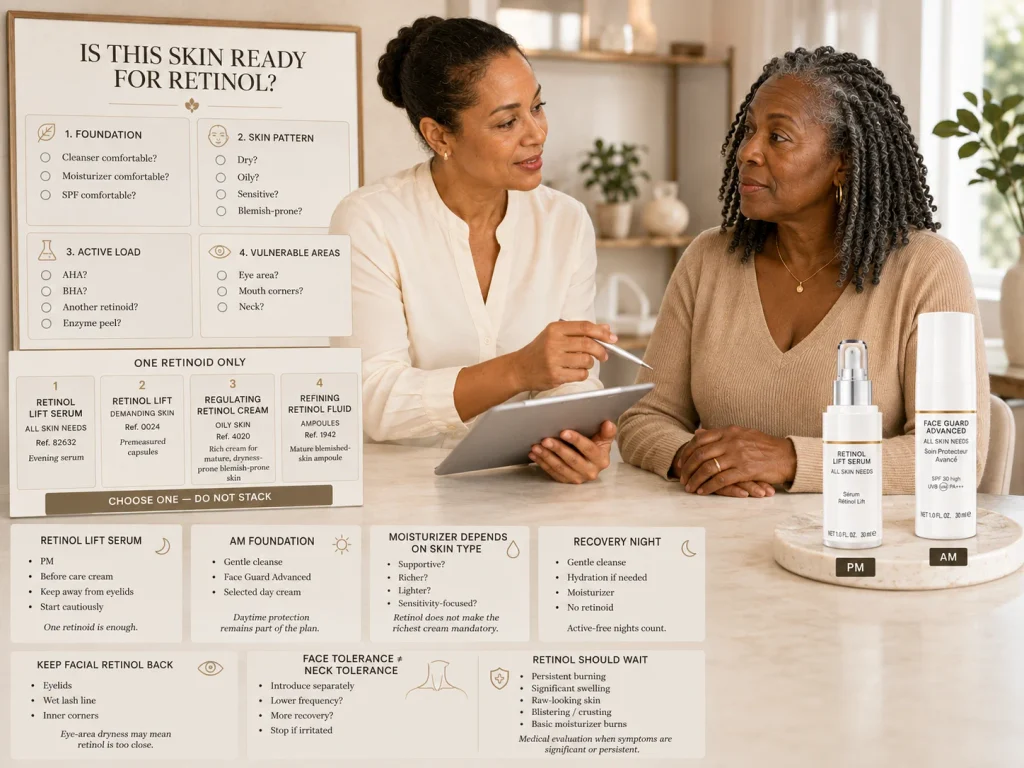
Possible options may include:
These products contain retinol and should not be combined with one another automatically.
Janssen’s practical pairing guidance specifically cautions against combining retinol with multiple acid products in the same routine and emphasizes daytime protection with active products.
Retinol Lift Serum is an evening-focused serum from the All Skin Needs range.
Its verified formula includes:
The formula is positioned to support:
The official home-care directions recommend applying it in the evening before the selected care cream.
It should not be applied directly beneath the eyes or on the eyelids.
The catalog also recommends daytime use of Face Guard Advanced when Retinol Lift Serum is part of the routine.
A possible routine may be:
Gentle cleanser or rinse → Face Guard Advanced in its officially directed position → selected moisturizer
Gentle cleanser → Retinol Lift Serum → selected moisturizer
Gentle cleanser → hydrating or comfort-focused serum if needed → selected moisturizer
Do not layer Retinol Lift Serum with:
The moisturizer should reflect the skin type.
Possible options may include:
The retinol serum does not make the richest cream mandatory.
Retinol Lift is a capsule product from the Demanding Skin family.
Each capsule contains retinol with vitamin E acetate in an oil-based care texture.
The verified directions recommend using it preferably in the evening before the selected care cream.
The capsule should be opened, and its contents spread gently over the skin.
The official directions state:
The formula is described as free of fragrance, silicones, and preservatives.
A possible evening routine may be:
Gentle cleanser → Retinol Lift capsule → selected moisturizer
Do not layer the capsule with:
A capsule provides a premeasured format.
That does not mean every mature complexion should use one capsule every evening.
Frequency should still follow the official directions, consultation plan, and skin tolerance.
A simplified consultation-led comparison may be:
May suit:
May suit:
They should not be layered together.
The correct choice depends on:
Regulating Retinol Cream belongs to the Oily Skin family but is specifically positioned for mature, rather dry, blemish-prone skin.
Its verified formula includes:
It is positioned to support:
The catalog describes it as a rich cream rather than a lightweight retinol serum.
A possible routine may be:
Purifying Cleansing Gel or another appropriate cleanser → lightweight moisturizer if needed → daytime SPF
Gentle cleanser → Regulating Retinol Cream
Because it is already a retinol-containing cream, do not automatically apply:
Some skin may still need a separate moisturizer on selected dry zones, but the routine should be assessed carefully.
It may be discussed when mature skin is:
It may not suit:
Product-family labels do not replace consultation.
Refining Retinol Fluid is a retinol ampoule designed for mature, blemished skin.
Its verified formula includes:
It is positioned to support:
The Janssen catalog identifies it as an ampoule-format intensive retinol product for mature, blemish-prone skin.
The Shop Zendevie Product Use Index also places Refining Retinol Fluid in the evening retinol category and cautions against overuse.
A possible short-course routine may be:
Gentle cleanser → Refining Retinol Fluid according to its official ampoule directions → selected moisturizer
Do not combine it automatically with:
An ampoule is not an extra step to add over an existing retinol routine.
It may temporarily replace another serum within a structured plan.
A simplified comparison may be:
May suit:
May suit:
They should not be layered together automatically.
The core Mature Skin family does not require a retinol product to form a complete routine.
A non-retinol Mature Skin routine may include:
Multi Action Cleansing Balm or another appropriate cleanser → Micellar Skin Tonic if needed → Age Perfecting Serum if needed → Face Guard Advanced in its officially directed position → Perfect Lift Cream
Luxury Oil Cleanser or another appropriate cleanser → Micellar Skin Tonic if needed → Night Recovery Serum if needed → Perfect Lift Cream or Rich Recovery Cream
Retinol may be introduced from another Janssen family only after the skin pattern is assessed.
Face Guard Advanced is Janssen’s SPF 30 UV protection concentrate.
Daytime protection is an important part of every retinol routine.
A simplified morning may be:
Gentle cleanser → Face Guard Advanced → selected day cream
Some Janssen products have more specific sequencing instructions.
Follow the official directions for all selected products.
Do not mix Face Guard Advanced into:
Apply it as its own even layer.
When mature skin is dry, reactive, or recovering from retinol discomfort, consultation may prioritize Sensitive Skin products such as:
These products are not intended to force the skin through retinol irritation.
Retinol should be paused when the skin is actively uncomfortable.
A calming routine may be:
Gentle cleanser or rinse → tolerated moisturizer → tolerated SPF
Gentle cleanser → tolerated moisturizer
Only after the skin is stable should retinol be reconsidered.
Skin Refining Enzyme Peel is an exfoliating Mature Skin product.
It should not be used on the same evening as a Janssen retinol product automatically.
A possible alternating plan may be:
Some skin should choose only one renewal method.
Ceramide Protection is an oil-like capsule designed for lipid support within the Mature Skin routine.
It should not automatically be layered with a retinol capsule or oil-rich retinol product.
The combination may become:
A simpler schedule may use:
Rejuvenating Mask may be used as an occasional mature-skin comfort step.
It should not automatically be layered over a new retinol product.
Use it on a separate recovery evening when appropriate.
Do not use a mask to cover severe burning or significant irritation.
Gentle cleanser or rinse → Face Guard Advanced → selected day cream
Gentle cleanser → one selected Janssen retinol product → moisturizer when the product structure requires it
Gentle cleanser → selected non-retinol serum if needed → moisturizer
One retinol product is enough.
Retinol recommendation should wait when the skin has:
Medical evaluation or prescriber guidance comes before cosmetic retinol selection.
Do not use retinol only because mature skin is expected to use it.
Do not begin retinol when moisturizer or SPF already stings.
Do not apply retinol to burning, swollen, raw-looking, or rash-like skin.
Do not begin several retinoid products together.
Do not combine retinol serum, retinol cream, retinol capsules, and retinol ampoules.
Do not use cosmetic retinol blindly with a prescription retinoid.
Do not apply more product to get faster results.
Do not start with nightly use automatically.
Do not treat peeling as proof that the product is working.
Do not scrub retinol flakes.
Do not use cleansing brushes over irritated skin.
Do not combine retinol with AHA, BHA, acid toner, scrub, and enzyme peel in one routine.
Do not apply a professional peel at home.
Do not increase peel contact time while using retinol.
Do not apply facial retinol directly to eyelids or the wet lash line.
Do not apply it to cracked mouth corners.
Do not apply it immediately after waxing or shaving irritated skin.
Do not assume the neck tolerates the same frequency as the face.
Do not spray perfume over retinol-treated neck or décolleté skin.
Do not use retinol immediately before an important event.
Do not begin retinol during unpredictable travel.
Do not use facial oil automatically over retinol if product migration affects the eyes.
Do not cover significant burning with several layers of rich cream.
Do not continue retinol when basic moisturizer and SPF burn.
Do not skip daytime protection.
Do not mix sunscreen into retinol or moisturizer.
Do not use retinol to change the person’s natural skin color.
Do not promise permanent wrinkle, pore, scar, or dark-spot removal.
Do not ignore deep painful blemishes, swelling, bleeding, blistering, crusting, eye symptoms, or infection-looking changes.
Yes, some mature skin may use retinol carefully when the skin already tolerates cleanser, moisturizer, and SPF.
No. Retinol is optional. A complete routine may use gentle cleansing, moisturizer, SPF, hydration, peptides, antioxidants, or ceramides without retinol.
Retinol may support fine-line appearance, smoother-looking texture, visible pores, firmness appearance, uneven-looking tone, and selected blemish-prone patterns
No. It may support cosmetic appearance but cannot reverse natural skin maturation.
No. Retinol may improve the appearance of fine lines over time but cannot permanently remove every line.
No. Pores are natural structures. Retinol may support a more refined-looking surface.
Frequency depends on the exact formula, skin type, sensitivity, previous experience, and product directions. Begin cautiously.
Usually not without prior tolerance. A slower introduction makes it easier to observe the skin’s response.
Follow the product directions. More product may increase irritation without improving results.
Many cosmetic retinol products are directed for evening use. Follow the exact product instructions.
It depends on the product and skin tolerance. A general order is retinol before moisturizer, while sensitive skin may use a buffered moisturizer-sandwich method.
It places a light moisturizer before retinol and another moisturizer layer afterward. It may improve comfort for some skin but does not make an unsuitable product safe.
Possibly, but it may need slower introduction, a gentle cleanser, supportive moisturizer, recovery nights, and consistent SPF.
Yes, some oily mature skin may use retinol for visible pores, texture, fine-line appearance, and blemish-prone concerns.
Possibly. Dry and oily zones may need different amounts and moisturizer textures.
Some sensitive skin may tolerate a carefully selected formula, but only after the basic routine is stable. Retinol is not required.
Possibly, but it should be introduced cautiously and stopped if redness becomes persistent, painful, hot, swollen, or rash-like.
Some blemish-prone mature skin may benefit from a retinol formula designed for its specific dryness and oil pattern.
Retinol may support a more even-looking complexion over time. Daytime protection remains important.
Only when the product is specifically formulated and directed for the eye contour. Standard facial retinol should be kept away from eyelids and the wet lash line.
It may be applied too close, migrate through facial oil or moisturizer, or be used too frequently.
Some skin may tolerate it, but the neck should be introduced separately and usually more cautiously.
Possibly, when product directions allow and the area is introduced separately with careful moisturizer and daytime protection.
Some routines use vitamin C in the morning and retinol at night. Introduce one active first and assess tolerance.
Some retinol formulas already include niacinamide. A separate product may be unnecessary.
Yes, hyaluronic acid may support hydration. It may already be included in the retinol formula or moisturizer.
Possibly. Peptides may be used at a different time or on recovery nights to keep the routine simple.
A ceramide-focused moisturizer may support comfort. Avoid layering too many capsules, oils, creams, and balms.
This combination may increase irritation. Using them on separate evenings with recovery nights may be more appropriate.
It may be too active for some skin. Targeted and alternating use should be considered only after assessment.
Do not combine them on the same evening automatically. Some mature skin should choose one renewal method.
Physical scrubs may increase irritation and should not be used over retinol-related flakes.
Yes. Consistent daytime protection is an important part of a retinol routine.
Retinol may have made the skin dry or reactive. Pause retinol and simplify the routine.
Some mild flaking may occur, but peeling is not required. Significant or persistent peeling indicates the routine should be reassessed.
No. Use gentle cleansing and moisturizer and allow the skin to recover.
No. Tingling, burning, redness, or peeling should not be used as proof that retinol is effective.
Stop using it, simplify the routine, and seek guidance if burning persists or is accompanied by swelling, pain, blistering, or a rash-like reaction.
Simplify the routine. Do not automatically add acids. Persistent, painful, itchy, swollen, or scarring bumps need professional evaluation.
Some people report temporary blemish changes, but every breakout should not be labeled purging. Irritation or formula incompatibility may also contribute.
Do not combine retinoid products unless specifically directed by a qualified professional who has reviewed the formulas.
No. Choose one retinol format according to the consultation plan.
Do not combine them automatically. This may expose the skin to overlapping retinoids.
Follow the treatment provider’s aftercare instructions. Some treatments require retinol to be paused.
Retinol may increase sensitivity. Follow professional timing guidance and wait until the skin is comfortable.
It may be practical to pause when climate, sun exposure, sleep, or routine becomes unpredictable.
Continue without it. Retinol is optional, and a non-retinol routine may suit the skin better.
Follow product labeling and seek guidance from a physician or qualified healthcare provider before using retinoid products.
Seek guidance for persistent burning, swelling, severe itching, pain, raw skin, bleeding, blistering, crusting, eye symptoms, infection-looking changes, or reactions that do not improve after stopping.
If you are considering retinol but are unsure whether your mature skin is dry, sensitive, blemish-prone, or ready for an active ingredient, a free virtual consultation can help you begin more carefully.
At Zendevie, we review your cleanser, moisturizer, SPF, exfoliation, vitamin C, existing retinoids, eye-area sensitivity, neck tolerance, blemish pattern, climate, and previous reactions before discussing products.
The goal is not to place every mature complexion on the strongest retinol routine.
The goal is to determine whether retinol has a useful role, choose one appropriate format, and build enough recovery and moisture support around it for the routine to remain comfortable and consistent.

Zendevie is guided by Haby Diallo, a licensed esthetician with more than 20 years of professional skincare experience. Her approach is rooted in education, professional judgment, and personal care.
years of experience