


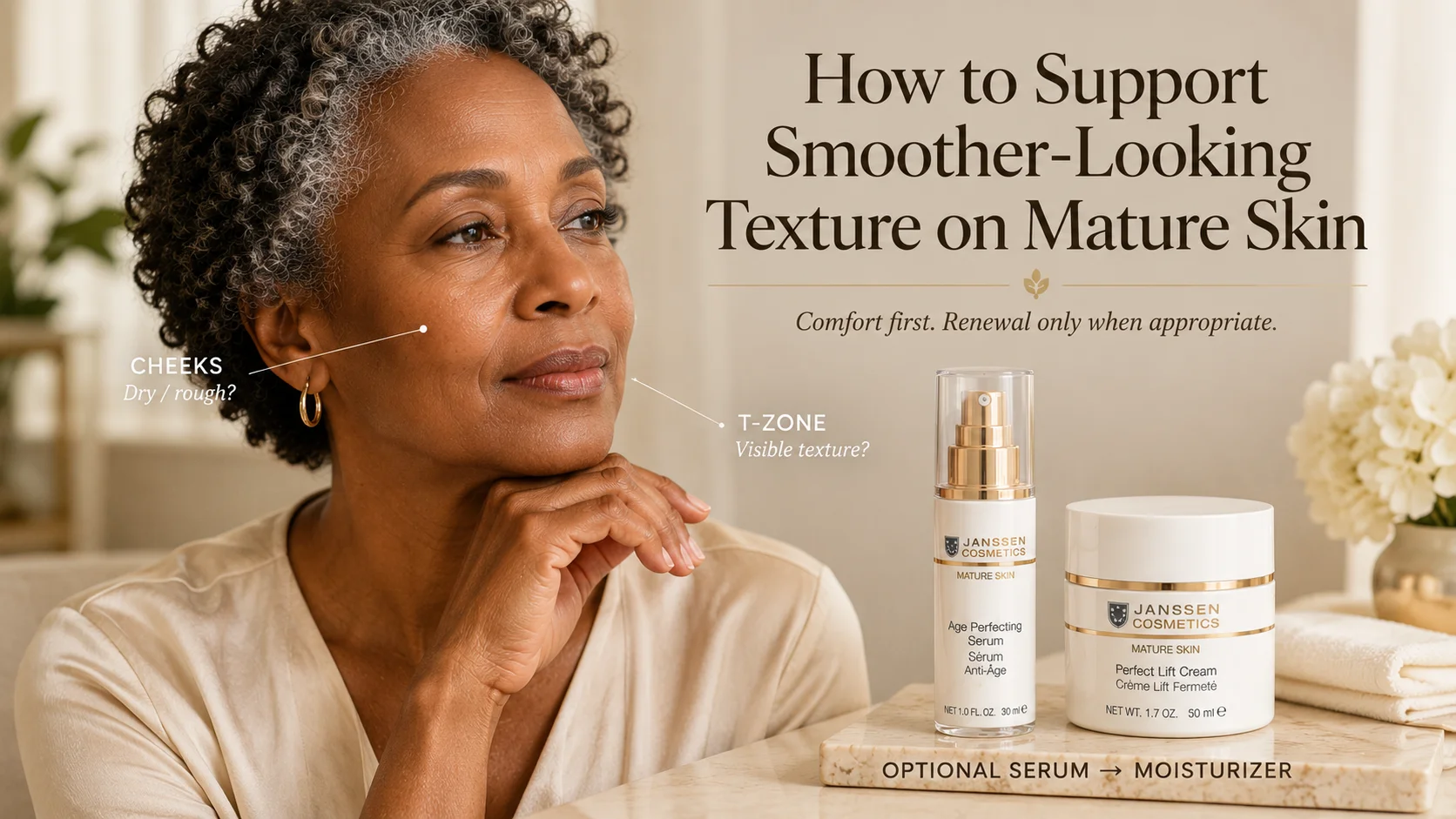
Mature skin does not need to look perfectly poreless or completely free of lines to look cared for.
Natural texture is part of skin.
The face contains:
These features do not represent skincare failure.
However, mature skin may begin to feel or look rougher when:
The answer is not always another peel.
Sometimes the smoother-looking result comes from:
At Zendevie, our licensed esthetician first looks at what kind of texture the client is describing.
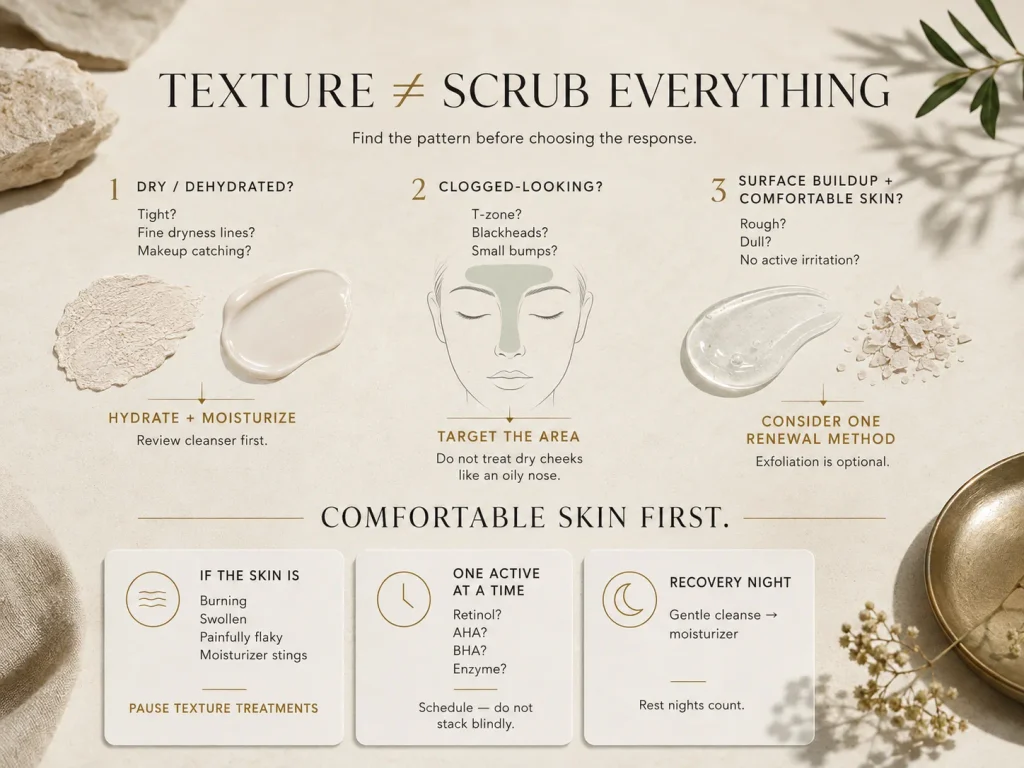
“Texture” may mean:
These concerns should not all be treated in the same way.
Understanding the texture comes before choosing the product.
Smoother-looking mature-skin texture may be supported through:
A simple texture-supporting routine may be:
Gentle cleanser or lukewarm-water rinse → one hydrating, antioxidant, or peptide serum if needed → moisturizer → SPF
Gentle cleanser → one treatment or comfort-focused serum when appropriate → moisturizer
An exfoliation night may be:
Gentle cleanser → one suitable exfoliating product according to directions → moisturizer
A retinol night may be:
Gentle cleanser → retinol according to directions → moisturizer
Do not combine several exfoliating steps and retinol automatically.
If the skin is burning, swollen, painful, bleeding, blistering, crusting, oozing, infection-looking, or reacting to water and basic moisturizer, texture-focused products should wait while medical guidance is considered.
Healthy-looking skin still has texture.
It may show:
The goal of skincare is not to create a filtered surface.
Safe skincare may help support:
It cannot permanently erase pores, facial movement, or every line.
Skincare should improve comfort and appearance without teaching the person to dislike normal skin.
Uneven texture may describe several different concerns.
May appear as:
May appear as:
May include:
May include:
May include:
Each category needs different care.
Applying the same acid or scrub to every form of texture may make the skin less comfortable.
The goal of exfoliation is not to keep removing more and more from the skin.
Over-exfoliated mature skin may look:
A temporarily polished appearance may hide an uncomfortable routine.
The skin should feel:
A smooth appearance without comfort is not a successful result.

Dry mature skin may appear:
This may be influenced by:
When dryness is the main issue, the first solution may be:
Exfoliating dry skin more aggressively may increase roughness later.
Dehydrated mature skin may show fine surface lines even when it produces oil.
It may feel:
Possible contributors include:
A hydrating serum or more suitable moisturizer may help support a smoother-looking surface.
A rich oil alone may not correct water-related dehydration.
Oily mature skin may experience:
Common mistakes include:
Oily mature skin may need:
The goal is not to remove all oil.
It is to support a balanced-looking, comfortable surface.
Combination mature skin may show:
One product may not belong everywhere.
A zone-based routine may include:
Do not treat the entire face as oily because the nose has visible pores.
Sensitive skin may develop:
This is not the time to increase exfoliation.
Pause:
Return to:
Gentle rinse or cleanser → tolerated moisturizer → tolerated SPF
Gentle cleanser → tolerated moisturizer
Once the skin feels consistently comfortable, texture-focused products may be reconsidered.
A cleanser may affect texture before the rest of the routine begins.
If cleansing leaves the skin:
the formula or method may be too strong.
Review:
A richer moisturizer may not completely correct an overly stripping cleanser.
Very hot water may increase:
Use lukewarm water.
The skin does not need steam or extreme heat to become clean.
Avoid long hot showers directly over the face.
The skin may appear shiny after excessive cleansing because the surface is tight and light reflects strongly.
It may still feel:
This shine should not be confused with healthy-looking radiance.
Reduce cleansing strength and frequency when appropriate.
A well-matched moisturizer may help mature skin look:
A moisturizer that is too light may leave:
A moisturizer that is too rich may create:
The correct texture depends on skin type, climate, serum use, and daytime products.
A hydrating serum may support smoother-looking texture when the skin is:
A simple routine may be:
Cleanser → hydrating serum → moisturizer
The serum remains optional.
If serum and cream pill or feel sticky, the routine may need fewer layers.
Ceramide-focused products may help support mature skin that feels:
Ceramides may be included in:
They may support moisture-barrier comfort and a softer-looking surface.
They do not need to be combined automatically with several oils and rich creams.
Peptide products may support:
They may appear in:
Peptides do not exfoliate the skin.
They are generally used as supportive cosmetic ingredients rather than surface-removal treatments.
A peptide product may be a better fit than another acid when the skin is already dry or sensitive.
Antioxidant ingredients may support the skin against environmental stress and help promote a fresher-looking complexion.
They may include:
Antioxidants may support:
They do not replace moisturizer or SPF.
Dark spots, previous blemish marks, and natural tone variation may create the appearance of uneven texture even when the surface is relatively smooth.
A tone-supporting routine may include:
Do not scrub or peel the skin aggressively because darker areas appear textured.
The goal is a more even-looking complexion, not changing the person’s natural skin color.
A texture routine may include:
Daytime protection remains important.
A general morning order may be:
Gentle cleanser → serum if needed → moisturizer → SPF
Some specialty SPF concentrates have product-specific instructions.
Follow the selected product’s directions.
Do not mix a separate sunscreen into serum, facial oil, or moisturizer unless specifically designed for that use.
Mature skin does not need exfoliation every day.
Some people may benefit from carefully scheduled exfoliation when the skin has:
Other mature skin may need little or no exfoliation during:
The right frequency depends on the individual product and skin tolerance.
May use ingredients such as:
Uses enzyme-based ingredients to help loosen surface-cell connections.
Uses particles, cloths, brushes, or manual friction.
Each method may support smoother-looking texture.
Each method can also become too much.
Mature skin does not need to use all three.
AHA may help support the appearance of:
It may also cause:
Use one suitable formula at an appropriate frequency.
Do not combine several AHA products automatically.
Maintain daytime protection.
BHA may be more useful when mature skin has:
It may not be necessary across:
Targeted use may be more appropriate than full-face use.
An enzyme exfoliant may help loosen surface buildup without scrub particles.
This can make it appealing for mature skin.
However, enzyme exfoliation is still an active renewal step.
It may cause discomfort when the skin is:
Use according to exact directions.
Do not assume “enzyme” means unlimited gentleness.
Scrubs may provide immediate smoothness through friction.
They may also create:
Avoid physical scrubs on skin that is:
The skin should not need force to look smoother.
Cleansing brushes may add daily physical exfoliation even when the user does not think of them as exfoliating tools.
Repeated use may create:
Clean hands may be enough for daily cleansing.
A brush should not be used over irritated or reactive mature skin.
A textured cloth may remove loose flakes.
It may also create friction.
Use:
Do not scrub until the surface feels polished.
The cloth should not be combined automatically with acid cleanser, scrub, enzyme peel, and retinol.
Retinol may support:
However, retinol may also cause:
A texture routine using retinol should begin only after the skin tolerates:
Retinol does not need to be used every night.
Retinol supports skin-renewal processes, but it should not be treated as permission to add multiple exfoliants.
Avoid combining retinol automatically with:
A simpler schedule may alternate treatment nights.
Some people may experience temporary dryness or mild flaking during careful retinol introduction.
However, stop and reassess when the skin develops:
Do not label severe or persistent irritation as proof that retinol is working.
A carefully organized week may include:
For example:
Gentle cleanser → moisturizer
Gentle cleanser → retinol → moisturizer
Gentle cleanser → moisturizer
Gentle cleanser → one exfoliating product → moisturizer
Gentle cleanser → hydrating serum if needed → moisturizer
This is only an example.
The exact schedule depends on product strength and skin tolerance.
A recovery night uses no strong active ingredient.
A simple sequence may be:
Gentle cleanser → hydrating or comfort-focused serum if needed → moisturizer
Recovery nights may help mature skin maintain comfort between:
A rest night is still an active part of a thoughtful routine.
Professional peel systems may use stronger concentrations and require:
They should not be used as ordinary home products.
Home exfoliation should stay within the exact directions of retail products.
Do not attempt to copy a professional treatment by increasing product amount, contact time, or frequency.
Before adding exfoliation, confirm that the skin can tolerate:
If moisturizer burns or sunscreen stings, the skin may not be ready for another exfoliating step.
A texture-focused routine should not begin from an irritated foundation.
After an appropriate exfoliating product, mature skin may need a comfortable moisturizer.
Use a formula that:
Do not apply several active serums after exfoliation.
A simple moisturizer may be enough.
Facial oil is optional.
It may feel comfortable for selected dry skin.
It may also:
Do not automatically use oil after every exfoliation treatment.
Choose moisturizer based on the skin’s response.
A hydrating or comfort-focused mask may help mature skin look:
A mask does not replace daily moisturizer.
Avoid combining a mask automatically with:
The skin does not need an entire facial treatment every evening.
Clay masks may help absorb surface oil.
They may feel useful for:
Full-face clay use may feel too drying for:
Targeted application may be more appropriate.
Do not allow the mask to become painfully tight.
Ampoules may provide concentrated cosmetic support for:
They remain optional.
An ampoule should not automatically be layered with:
Choose one concentrated step according to the routine goal.
Blemish-prone mature skin may have:
Do not treat every bump with:
all at once.
A consultation should distinguish between:
Deep, painful, swollen, infection-looking, persistent, or scarring blemishes should be evaluated by a dermatologist.
Pores cannot be permanently opened, closed, or erased.
Their appearance may be influenced by:
Gentle cleansing, appropriate BHA use when suitable, moisturizer, and SPF may help support a more refined-looking surface.
Do not squeeze or scrape pores repeatedly.
Small bumps may be caused by several cosmetic or medical concerns.
Possible routine contributors include:
Do not diagnose every bump as a clogged pore.
If bumps are itchy, spreading, swollen, painful, or persistent, seek professional guidance.
Previous blemish marks may create:
Skincare may support:
Deep or permanent scar changes may require dermatologist-led procedures.
Cosmetic products should not promise to erase scars completely.
Foundation may catch on:
The answer may be:
Do not exfoliate immediately before every makeup application.
A smoothing primer may temporarily blur the appearance of pores or fine lines.
It does not permanently change texture.
Too much primer may:
Use a thin layer only where needed.
Primer is optional.
Powder may emphasize:
Use it strategically.
Oily areas may need more setting than dry cheeks.
Heavy full-face powder may make texture more noticeable.
A simple routine may be:
Gentle cleanser or rinse → moisturizer → SPF → makeup
A routine with serum may be:
Gentle cleanser → one hydrating serum → moisturizer → SPF → makeup
Allow each layer to settle.
Use:
The eye area may look:
Use:
Do not use facial scrubs, acids, or strong peels near the eyelids.
Persistent swelling, pain, discharge, crusting, or vision changes require medical guidance.
The mouth area may become rough because of:
Avoid exfoliating cracked-looking corners.
Use a gentle routine.
Persistent, painful, rash-like, spreading, or crusting mouth-area changes should be evaluated.
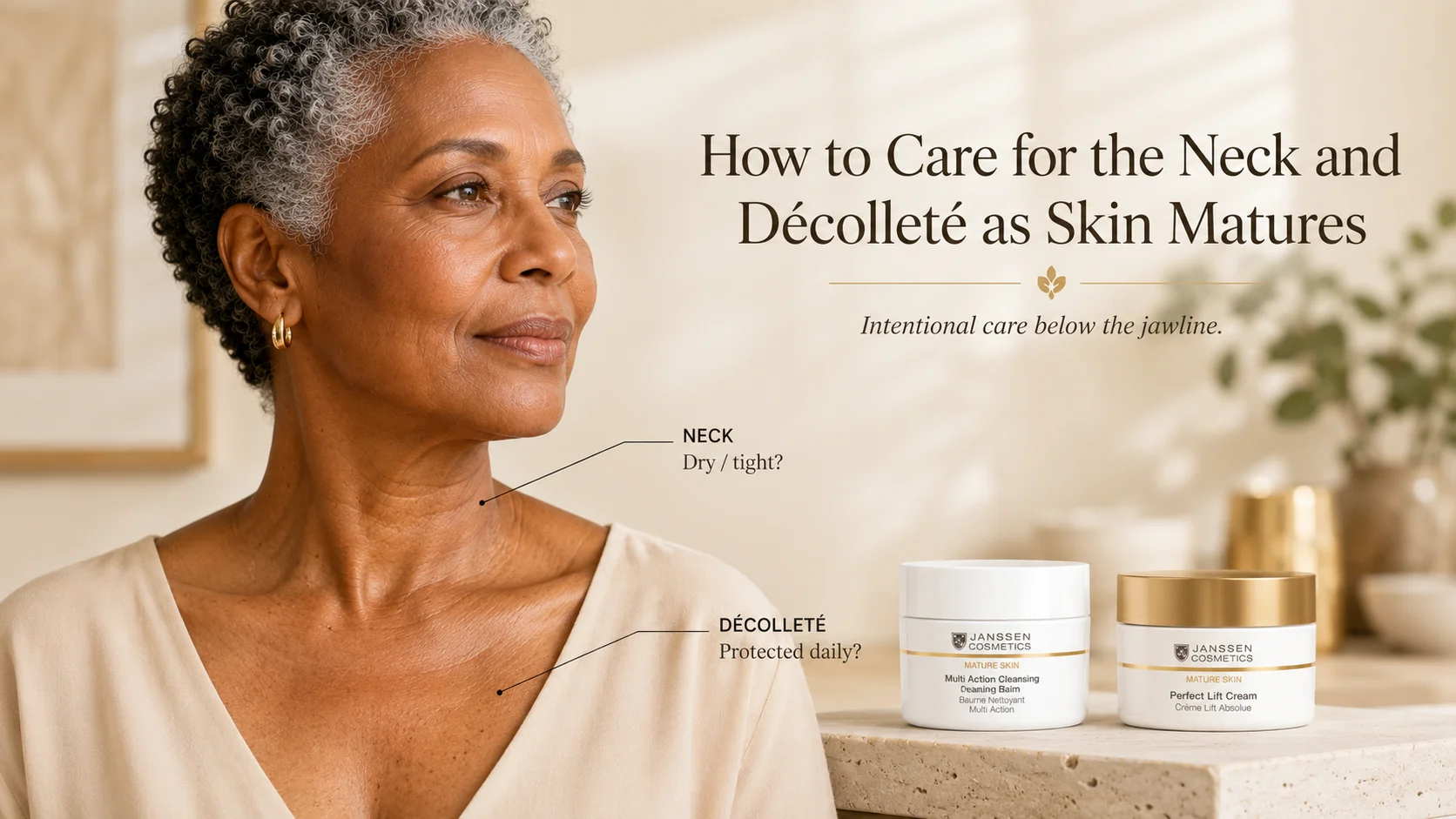
The neck and décolleté may show:
Use:
The neck may be more sensitive than the face.
Do not begin facial retinol, acid, and scrub on the neck at the same time.
Winter may make mature skin appear:
A winter routine may need:
Do not continue a summer active schedule automatically.
Heat and humidity may contribute to:
A summer routine may need:
Do not over-cleanse because the skin looks shiny.
Air conditioning may make the skin:
Possible adjustments include:
Do not repeatedly spray fragranced mist as the only solution.
Travel may involve:
Bring a familiar routine:
Gentle cleanser or rinse → moisturizer → SPF
Gentle cleanser → moisturizer
One familiar serum may be added when useful.
Do not introduce a new peel or retinol during travel.
Gentle cream, balm, oil, or milk cleanser—or rinse when appropriate → hydrating serum if needed → supportive moisturizer → SPF
Gentle cleanser → comfort-focused serum if needed → richer moisturizer
Optional:
Avoid:
Gentle cleanser → lightweight hydrating serum if needed → lightweight moisturizer → SPF
Gentle cleanser → targeted BHA or another appropriate treatment on scheduled nights → lightweight moisturizer
Avoid:
Gentle cleanser → lightweight serum if needed → moisturizer by zone → SPF
Gentle cleanser → targeted treatment only where needed → moisturizer by zone
Possible adjustments include:
Lukewarm-water rinse or gentle cleanser → tolerated moisturizer → tolerated SPF
Gentle cleanser → tolerated moisturizer
Once stable, consider only one optional step:
Do not add several products simultaneously.
Gentle cleanser → retinol according to directions → moisturizer
Gentle cleanser → hydrating serum if needed → moisturizer
Gentle cleanser → one exfoliating product according to directions → moisturizer
Retinol and exfoliation should not be placed together automatically.
The skin may need several recovery nights between them.
Gentle cleanser → one antioxidant or tone-support serum → moisturizer → SPF
Gentle cleanser → one selected active product or hydrating serum → moisturizer
Alternate active products rather than stacking them.
Daytime protection, patience, and consistency matter.
This may suggest:
Do not add more scrub.
Use gentle cleansing and lightweight hydration.
A targeted pore-supporting product may be considered only after the skin is comfortable.
The routine may be creating a polished surface through over-cleansing or exfoliation.
Reduce:
A smooth-looking result should not require discomfort.
The texture may be related mainly to dryness or dehydration.
Continue assessing:
You may not need a stronger active product.
The texture may be too rich, or too much product may be used.
Review:
A lighter cream or zone-based application may be more appropriate.
Use less product.
Review whether:
A cream containing hyaluronic acid may make a separate serum unnecessary.
The exfoliation may be too strong or too frequent.
Reduce or pause it.
Review whether the skin develops:
Temporary polish should not create longer-term discomfort.
Remove or stop the product according to its directions.
Review:
Enzyme exfoliation should not create persistent burning.
Pause AHA.
Also pause:
Return to a gentle cleanser, moisturizer, and SPF routine.
Do not scrub off the flakes.
Apply it only to the areas that need it when the product and consultation plan allow.
Dry cheeks may not need BHA.
Use moisturizer according to zone.
Do not treat the whole face based on the T-zone.
The skin may be:
Pause or reduce retinol.
Do not increase exfoliation to remove retinol flakes.
Fine lines are part of natural facial movement and skin maturation.
Hydration and moisturizer may support a smoother-looking surface.
They cannot permanently erase every line.
Makeup, lighting, expression, and dryness also affect visibility.
Pores are normal anatomical structures.
Their appearance may be influenced by:
Skincare may support a more refined-looking appearance.
It cannot permanently remove pores.
Review:
Use thinner makeup layers.
Do not exfoliate immediately before every application.
Use less powder.
Apply it only to areas that become oily or where makeup moves.
Dry cheeks and fine-lined areas may need little or none.
Review:
Do not use facial acids or scrubs around the eyes.
Use a small amount of appropriate eye care.
Review:
Avoid active products on irritated mouth corners.
Persistent rash-like changes should be medically evaluated.
Stop the new product.
Return to the last stable routine.
Document:
Do not add an exfoliant immediately.
Follow the provider’s aftercare instructions.
Contact the provider when symptoms are:
Do not apply retinol, acids, scrubs, or essential oils over unexpected symptoms.
Keep the routine simple.
The previous routine may have contained:
A shorter routine may support more consistent comfort.
Stop testing new products.
Focus on:
Seek dermatologist guidance if:
The concern may require medical evaluation rather than stronger cosmetic products.
Do not begin retinol, AHA, BHA, enzyme peel, and scrub at the same time.
Ask:
The correct answer may be hydration rather than exfoliation.
Seek dermatologist guidance when texture changes include:
Seek urgent medical care for:
Cosmetic skincare can support the appearance of texture.
It cannot diagnose dermatitis, infection, acne as a medical condition, allergy, or another skin concern.
After consultation, our licensed esthetician may consider Janssen Cosmetics options according to whether mature-skin texture is connected to dryness, dehydration, surface buildup, natural fine lines, uneven-looking tone, clogged-looking pores, or an overactive routine.
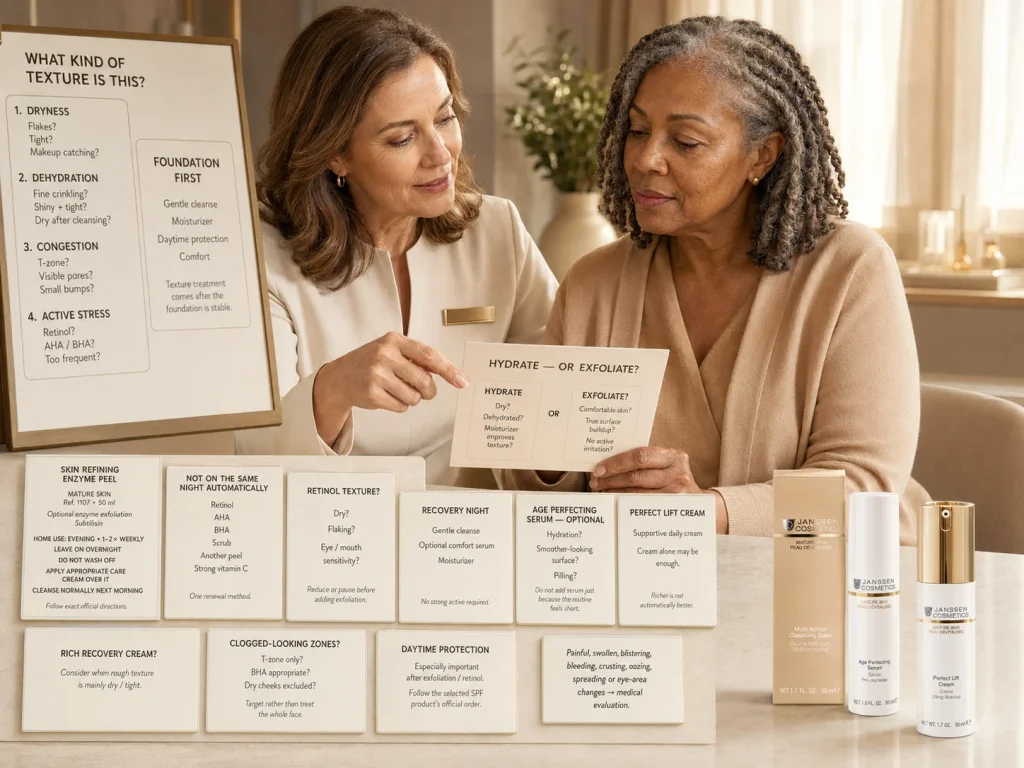
Possible options may include:
These products should not all be used in the same routine.
Mature skin with rough-looking texture may first need more effective but comfortable cleansing.
Multi Action Cleansing Balm may be considered when makeup, sunscreen, and product buildup are contributing to an uneven-looking surface.
Its texture changes from a cream-gel to an oil and then to a milky emulsion when water is added.
It should be used according to its official directions and removed gently.
Luxury Oil Cleanser may be considered when dry mature skin prefers a lighter oil-cleanser texture.
A second cleanser should be added only when necessary and tolerated.
Neither cleanser should be massaged aggressively to “polish” the skin.
Micellar Skin Tonic may be used after cleansing when the skin tolerates and benefits from an additional step.
Its verified moisture-supporting ingredients include:
It may support:
The tonic is optional.
It should not be confused with an exfoliating acid toner.
Skin Refining Enzyme Peel is the Mature Skin family’s enzyme exfoliation product.
Its verified active enzyme is subtilisin, a biotechnologically produced enzyme used to help loosen connections between upper surface cells.
The product is:
This does not mean the product is appropriate for every mature complexion.
It should wait when the skin is:
The verified Janssen home-care directions are product-specific.
They direct application to cleansed skin in the evening once or twice weekly, leaving the formula on overnight and applying an appropriate care cream over it.
The following morning, the skin is cleansed and cared for as usual.
Because this differs from the way many rinse-off enzyme products are used, the exact official directions should be followed rather than replaced with a generic exfoliation method.
A possible product-specific evening sequence may be:
Appropriate cleanser → Skin Refining Enzyme Peel according to official directions → selected moisturizer
Do not add:
to the same evening automatically.
The official directions also emphasize daytime protection after peel use.
Age Perfecting Serum may be considered when mature skin needs one lightweight serum after cleansing.
Its verified formula includes:
It may support:
A possible routine may be:
Cleanser → optional Micellar Skin Tonic → Age Perfecting Serum → selected moisturizer
During the day, add Face Guard Advanced in its officially directed position.
Age Perfecting Serum should not automatically be layered with:
Night Recovery Serum may be considered as an evening serum when mature skin appears:
A possible evening sequence may be:
Cleanser → optional tonic → Night Recovery Serum → Perfect Lift Cream or Rich Recovery Cream
It should not automatically be used on the same night as Skin Refining Enzyme Peel.
A simpler schedule may alternate:
Perfect Lift Cream contains moisture-supportive and emollient ingredients such as:
It may support:
A possible routine may be:
Age Perfecting Serum → Perfect Lift Cream
or:
Night Recovery Serum → Perfect Lift Cream
It may also be used without serum when the cream alone provides enough support.
Rich Recovery Cream is a richer water-in-oil moisturizer.
Its verified lipid-supporting ingredients include:
It may suit dry mature skin when rough-looking texture is connected to:
A possible routine may be:
Night Recovery Serum → Rich Recovery Cream
or:
Skin Refining Enzyme Peel according to directions → Rich Recovery Cream when appropriate
This combination may feel too rich for oily, humid-weather, or congestion-prone mature skin.
Ceramide Protection may be considered when mature skin needs additional lipid and barrier-comfort support.
It is an oil-like capsule product applied before cream according to its verified directions.
A possible evening routine may be:
Cleanser → Ceramide Protection → selected moisturizer
It should not be combined automatically with:
The routine may become unnecessarily heavy or difficult to assess.
For daytime use, Janssen provides a specific order involving Face Guard Advanced before Ceramide Protection, followed by the selected care cream.
That product-specific sequence should be followed.
Rejuvenating Mask may be considered as an occasional add-on when mature skin looks:
Its verified formula includes moisture- and comfort-supporting ingredients such as:
It may support a softer and more rested-looking surface.
It should not be used automatically on the same night as:
A mask does not replace daily moisturizer.
Face Guard Advanced is a lightweight SPF 30 protection concentrate.
Its official Janssen directions place it beneath the selected day cream.
A possible daytime sequence may be:
Cleanser → optional tonic → selected serum → Face Guard Advanced → selected moisturizer
The official Skin Refining Enzyme Peel directions emphasize daytime protection after exfoliation.
Do not mix Face Guard Advanced into serum or cream.
Appropriate cleanser → Face Guard Advanced in its officially directed position → selected moisturizer
Appropriate cleanser → selected moisturizer
This may be enough when the primary texture concern is dryness or dehydration.
Appropriate cleanser → optional Micellar Skin Tonic → Age Perfecting Serum → Face Guard Advanced → Perfect Lift Cream
Appropriate cleanser → optional tonic → Night Recovery Serum → Perfect Lift Cream or Rich Recovery Cream
On a separately scheduled evening:
Appropriate cleanser → Skin Refining Enzyme Peel according to official directions → selected moisturizer
Do not add retinol or another exfoliant to this routine automatically.
Multi Action Cleansing Balm or Luxury Oil Cleanser → optional tonic → Age Perfecting Serum or Night Recovery Serum according to time of day → Rich Recovery Cream
An occasional Rejuvenating Mask may be added on a separate night when appropriate.
When sensitivity is the primary concern, a product from the Sensitive Skin family may be more appropriate than an enzyme peel or active Mature Skin serum.
The correct first recommendation may be:
Gentle cleanser → calming moisturizer → daytime protection
Texture-focused exfoliation should wait until the skin is comfortable.
If the skin is burning, swollen, painful, blistering, rash-like, or reacting to basic products, no new texture treatment should be introduced until the concern has been appropriately assessed.
Professional peel systems remain within professional treatment settings.
Do not expect mature skin to look filtered or poreless.
Do not treat every line as damage.
Do not scrub dry flakes.
Do not exfoliate every day automatically.
Do not use acid cleanser, acid toner, AHA serum, BHA serum, scrub, enzyme peel, and retinol in the same routine.
Do not increase exfoliation because makeup looks textured.
Do not use strong cleanser to create a polished feeling.
Do not use very hot water.
Do not use cleansing brushes over irritated skin.
Do not squeeze visible pores repeatedly.
Do not pick whiteheads, blackheads, or deep blemishes.
Do not apply BHA across dry cheeks automatically.
Do not apply facial acids or scrubs close to the eyes.
Do not use retinol on irritated mouth corners or eyelids.
Do not continue retinol through persistent burning or painful peeling.
Do not use a rich cream to force the skin through excessive active-product irritation.
Do not apply several serums, oils, capsules, masks, and creams in one routine without a clear purpose.
Do not use facial oil as the only solution for dehydrated texture.
Do not confuse shiny, tight skin with healthy-looking smoothness.
Do not exfoliate to correct product pilling.
Do not use professional peel systems at home.
Do not extend product contact time beyond official directions.
Do not increase exfoliant amount to get faster results.
Do not skip daytime protection after exfoliation or retinol.
Do not mix sunscreen into serum, oil, or moisturizer unless specifically directed.
Do not cover painful, blistering, bleeding, crusting, or infection-looking texture with makeup.
Do not ignore persistent itching, swelling, eye symptoms, deep painful blemishes, or sudden unexplained texture changes.
Possible contributors include dryness, dehydration, product buildup, over-cleansing, retinol-related flaking, excessive exfoliation, uneven-looking tone, blemishes, climate, and makeup.
Yes. Pores, fine lines, expression lines, and natural surface variation are normal.
Skincare may support a softer and smoother-looking surface. It cannot permanently remove pores, facial movement, or every natural line.
Hydration may support flexibility, softness, and a smoother-looking surface, particularly when fine lines are related to dehydration.
An appropriate moisturizer may support softness, comfort, reduced visible flaking, and more even light reflection.
The skin may be oily but dehydrated, over-cleansed, congested-looking, or covered with product buildup.
Some mature skin may benefit from carefully scheduled exfoliation. It is optional and should match skin tolerance.
There is no universal schedule. Frequency depends on product strength, skin type, sensitivity, retinol use, and other active ingredients.
AHA may support roughness, dullness, fine-line appearance, and uneven-looking tone. It may also create dryness or irritation.
BHA may be useful when mature skin has oily zones, blackheads, whiteheads, or clogged-looking pores.
An enzyme peel may support gentle surface renewal for selected mature skin. It remains an active product and must be used according to its exact directions.
Enzyme products avoid scrub particles, but they can still irritate sensitive or over-exfoliated skin.
Some skin may tolerate occasional gentle physical exfoliation, but scrubs may be too much for dry, sensitive, redness-prone, or retinol-stressed mature skin.
They are not required and may add unnecessary friction, especially when used frequently.
Some mature skin may use retinol carefully to support texture and fine-line appearance. It requires gradual use, moisturizer, and daytime SPF.
They should not be combined blindly. Using them on separate nights may be more appropriate.
Retinol may create dryness, flaking, or irritation when introduced too quickly or combined with other active products.
Yes. Moisturizer-focused nights may help maintain comfort between retinol and exfoliation
No. Peptides are supportive cosmetic ingredients and do not remove surface cells like exfoliating acids.
Ceramide-focused care may support lipid comfort, moisture retention, and a softer-looking surface.
Facial oil may help dry skin feel softer. It may not fully address dehydration and can feel heavy for oily or congestion-prone skin.
Daytime protection supports routines using retinol, exfoliation, antioxidants, and uneven-tone products. It also supports overall well-aging care.
Dryness, retinol flakes, excessive foundation, heavy powder, product pilling, and unsuitable moisturizer may contribute.
Not every time. Exfoliating immediately before makeup may make sensitive or dry skin more reactive.
Use gentle cleansing, appropriate moisturizer, compatible SPF, thin foundation, targeted concealer, and minimal powder.
Primer may temporarily blur texture. It cannot permanently change pores or lines.
Pore appearance may be influenced by oil, congestion, dehydration, makeup, light reflection, and natural skin structure.
No. Skincare may support a more refined-looking appearance but cannot permanently open or close pores.
Use moisturizer and active products by zone. Dry cheeks may need comfort, while the nose may need targeted pore care.
The product may be too strong, used too frequently, or combined with other active ingredients.
Stop or remove it according to directions, simplify the routine, and seek guidance if burning persists.
Possibly, but sensitive skin may need them at different times. Establish tolerance to one active before adding another.
Peptides may be used on non-exfoliation days or according to product compatibility. Several layers are not always necessary.
Stop active products and return to tolerated cleanser, moisturizer, and SPF. Seek dermatologist guidance if basic products also cause discomfort.
Seek guidance for persistent burning, significant swelling, severe itching, painful or deep blemishes, scarring, blistering, bleeding, crusting, oozing, eye symptoms, or a spreading rash-like change.
If your mature skin feels rough, looks uneven under makeup, or becomes irritated every time you try to smooth it, a free virtual consultation can help you understand what type of texture you are seeing.
At Zendevie, we review your cleanser, hydration, moisturizer, SPF, retinol, exfoliation, blemish pattern, sensitivity, makeup, climate, and current product combinations before discussing recommendations.
The goal is not to scrub or peel mature skin into temporary smoothness.
The goal is to support a softer, more comfortable, and smoother-looking complexion through care selected for your skin’s present needs.

Zendevie is guided by Haby Diallo, a licensed esthetician with more than 20 years of professional skincare experience. Her approach is rooted in education, professional judgment, and personal care.
years of experience
